
Roughly half of marketing decision-makers now measure only what's easy, expected, or visible, which leaves the channels that work early in the journey underfunded and the channels closest to the sale over-credited. Cross-channel attribution exists to correct that imbalance. It measures the contribution of every touch across the customer journey, so the credit follows influence rather than proximity to the final click.
TL;DR:
- Cross-channel attribution measures how every touch across the customer journey contributes to a conversion, rather than handing all the credit to the last click.
- Last-touch flatters the wrong channels—it over-credits branded search and retargeting while erasing the display, social, and content that built the demand.
- The main payoff is cleaner budgets—attribution deduplicates conversions counted across platforms and moves spend toward the channels that create demand.
- No single model is correct—match it to your sales cycle and data volume, run more than one, and compare where they disagree.
- Attribution is strongest alongside MMM and incrementality testing, which cover the blind spots it can't see on its own.
- First-party data is now the foundation—with third-party cookies unreliable across browsers, accurate attribution rests on owned, consented data and strong identity resolution.
What is cross-channel attribution?
Cross-channel attribution is the practice of measuring how each marketing channel contributes to a conversion across the complete customer journey, rather than assigning all the credit to the last interaction before the sale. It treats a purchase as the outcome of a sequence—a display impression, a search click, an email open, a store visit—and distributes credit across those touches using a consistent model applied to data the business controls.
That consistency separates true cross-channel marketing attribution from stitching platform reports together. When every channel is measured against the same definitions and the same journey, marketers can compare them honestly. The average marketer now runs campaigns across about 10 customer engagement channels, and each one reports success in its own language. Attribution translates them into one.
What counts as shared definitions, governance, and reporting standardsa marketing channel?
A channel is any touchpoint where a customer encounters the brand, and useful attribution counts all of them, not only the ones that are convenient to track. That includes paid search, social, display, connected TV, audio, email, organic search, and referral traffic, plus offline touches like retail visits, call centers, events, and direct mail.
Leaving the awkward ones out distorts everything downstream. A journey measured in halves produces halved conclusions: if in-store or phone conversions sit outside the model, every channel that drives them looks weaker than it is, and budget drains away from work that's actually producing revenue. Unified measurement depends on pulling signals from all touchpoints into a single view before any credit is assigned.
Attribution vs. marketing analytics
Marketing analytics and attribution answer different questions, and treating them as one is a common source of confusion.
- Analytics describes what happened—traffic, engagement, conversion rates, channel-level performance.
- Attribution decides who gets the credit for a conversion when several channels touched the customer along the way.
Analytics tells you email drove 4,000 sessions and 200 conversions. Attribution tells you how much of the revenue behind those conversions email actually earned, given that most of those buyers also saw a display ad and searched the brand first.
Attribution sits inside the broader analytics function as the layer that connects activity to outcomes across channels, which is why it depends on clean, unified data to work at all.
Benefits of cross-channel attribution
Attribution earns its place when it changes decisions. Done well, it reveals where budget is wasted, gives credit to the channels that build demand, and creates a single version of performance that marketing, analytics, and finance can agree on. The four benefits below build on each other.
Eliminate wasted media spend
Cross-channel attribution exposes the waste that comes from counting the same conversion more than once. When each platform claims credit inside its own walls, a single sale can appear in three dashboards, and budget migrates toward whichever channel shouts loudest, rather than the one that earned it. Deduplicating conversions against one journey stops that double-counting and shows where spend overlaps.
The waste is not marginal. Some 78% of marketing decision-makers believe at least 10% of their spend is wasted because of insufficient measurement, and 7% put the figure at 30% or more. A model that sees the whole journey turns that guesswork into a list of specific channels to trim, pause, or reallocate.
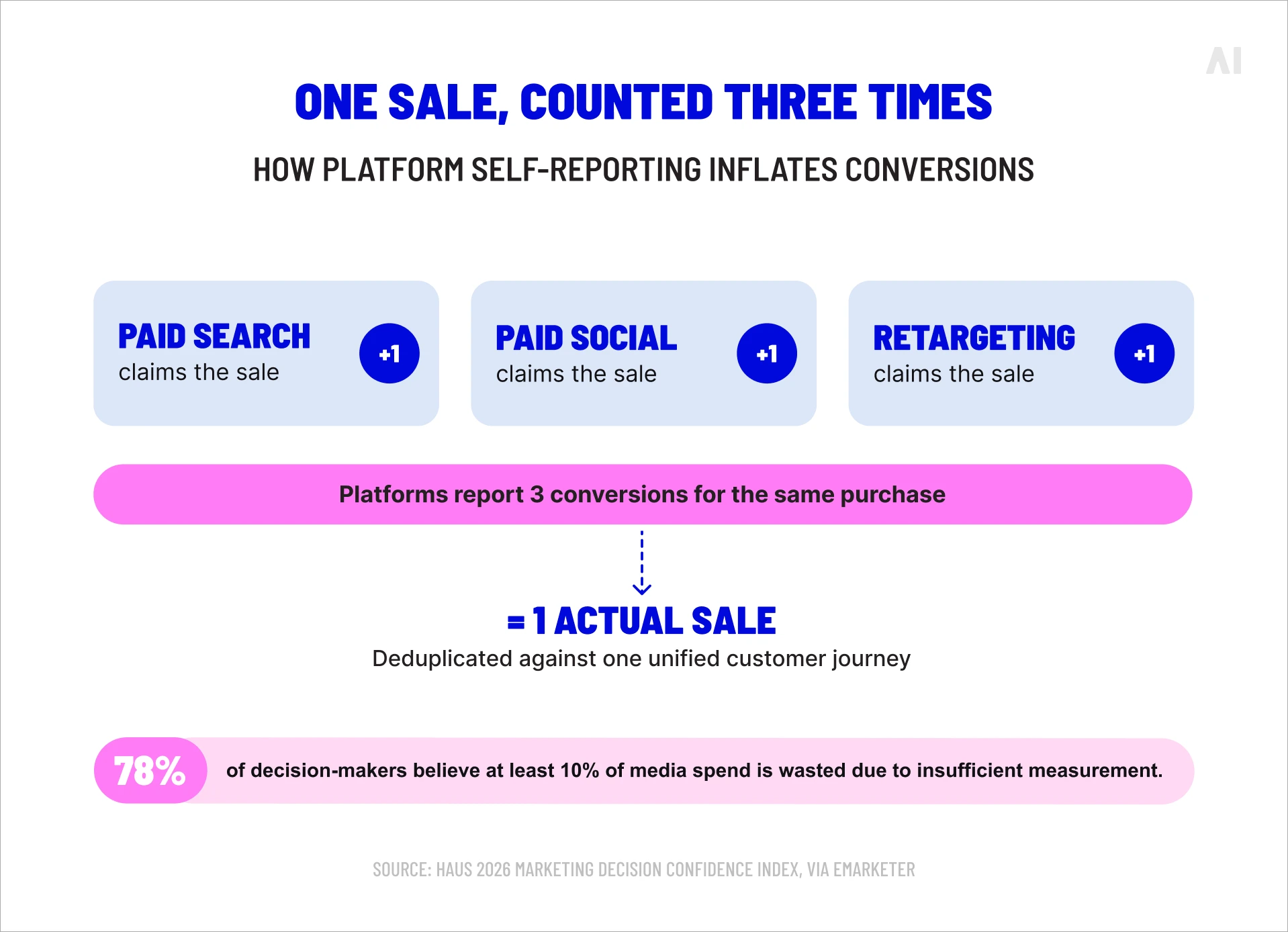
⚡ The last click takes the applause. The sale was built by everything the customer saw before it.
Measure assisted conversions
An assisted conversion is a touch that moved the customer forward without being the final click, and last-touch models erase it entirely. Upper-funnel channels—display, social video, connected TV, sponsored content—rarely close the sale, so a last-click view rates them as failures even when they started the journeys that later converted.
Cross-channel attribution credits those assists in proportion to their role, which changes how awareness and consideration budgets are judged. A channel that never appears in a last-click report but shows up early in thousands of converting journeys is doing measurable work, and attribution puts that work on the record.
Create one source of truth across teams
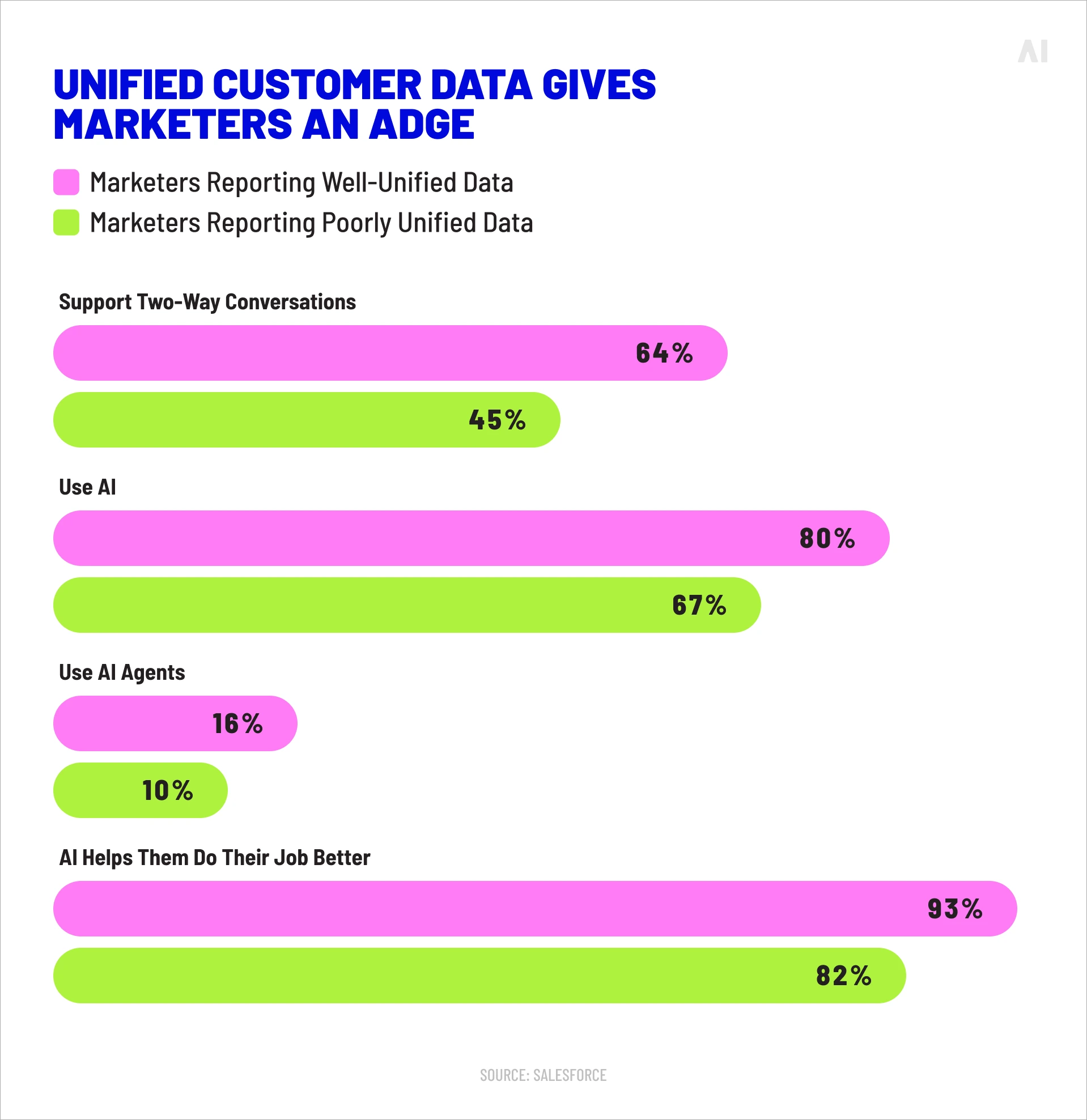
Attribution only aligns an organization when everyone reads from the same numbers. Today that's rare: only 31% of marketers are fully satisfied with their ability to unify data, and siloed systems and poor data quality remain the top barriers to acting on it. When marketing, finance, and analytics each hold a different performance story, decisions stall.
A shared attribution layer replaces those competing stories with one. The reward is measurable. High-performing marketers are 2.4 times more likely to have unified their data sources than their peers. Consistent definitions, applied once across channels, let a CMO defend budget to a CFO using figures the analytics team already trusts.
Optimize the entire marketing mix
Attribution improves two kinds of decision at once: the tactical and the strategic.
- At the campaign level, it shows which creatives, placements, and audiences pull conversions forward.
- At the portfolio level, it shows how channels combine, where they overlap, and where an extra dollar produces the most incremental return.
That dual view lifts attribution above single-campaign reporting. A team can tune a paid search account and, in the same system, see whether that account is cannibalizing brand demand that display and CTV created. Cross-channel marketing attribution connects those decisions rather than leaving them in separate tools.
How cross-channel attribution works
Behind the reporting sits a four-step pipeline: collect signals, resolve identities, apply a model, and turn the output into decisions. Each step introduces its own choices, and the quality of the final insight depends on getting the early ones right.
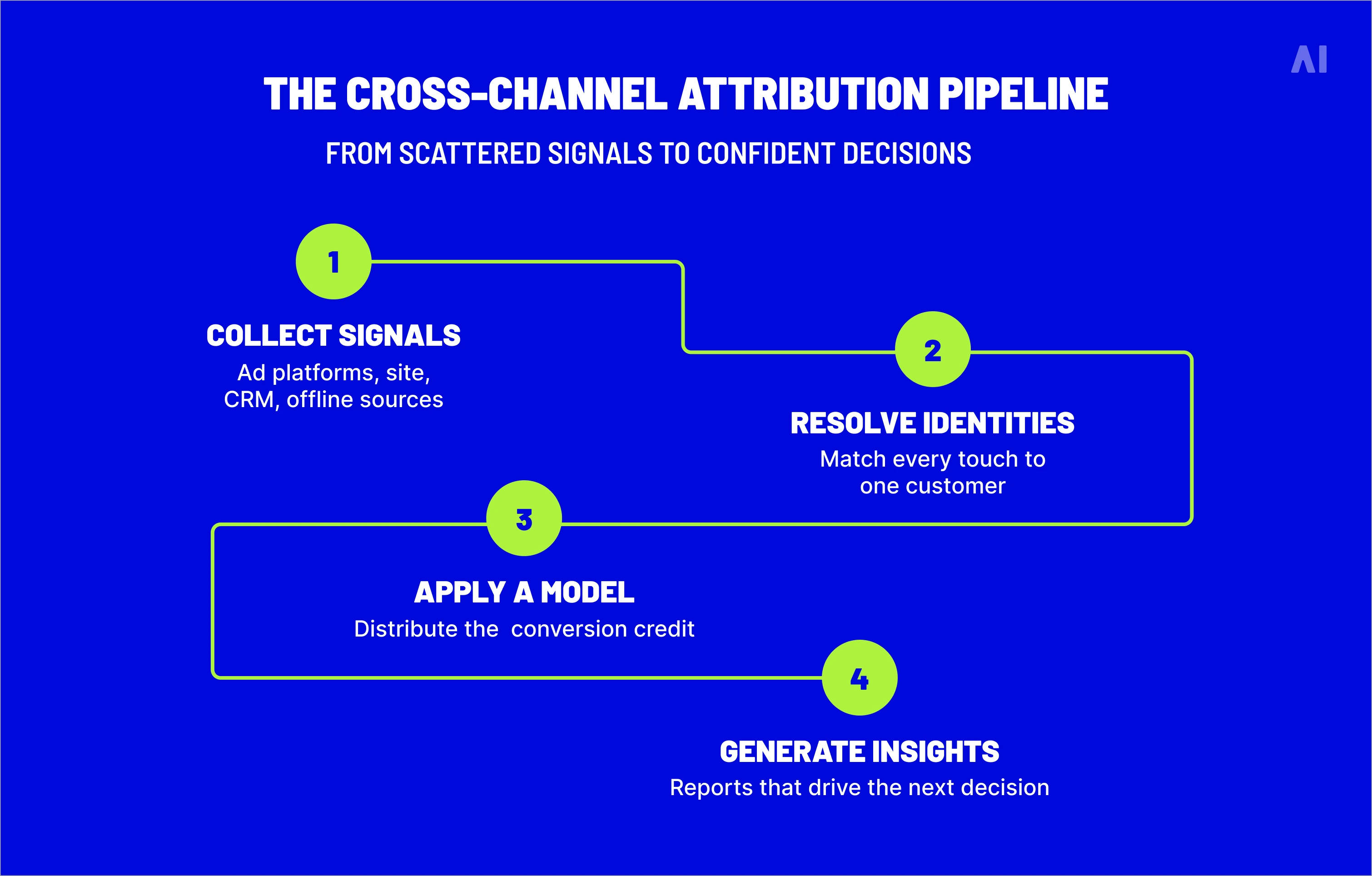
Step 1. Collect customer signals
The pipeline starts by gathering interactions from every system that records them: ad platforms, the website and app, the CRM, email and marketing automation tools, call tracking, and offline sources like point-of-sale and events. Each contributes a different slice of the journey, and none is complete on its own.
The collection method increasingly favors first-party and server-side capture over browser-side tags, because signal reliability now varies by browser and consent state. Server-side collection of the events a business owns—purchases, logins, form fills—produces a more durable record than pixels that fire only when tracking is permitted. That durable record is the raw material for everything downstream. The idea of a persistent identity spine, which ties these signals to a stable customer record, is becoming central to how modern teams approach this.
Step 2. Resolve customer identities
Raw signals arrive fragmented—the same person appears as a mobile visitor, a desktop session, an email address, and a loyalty ID. Identity resolution stitches those fragments into one customer, using deterministic matching where a shared identifier exists (a hashed email, a login) and probabilistic matching where it doesn't (device and behavioral signals inferred within privacy limits).
Resolution quality decides attribution accuracy. A customer who researches on a phone, compares on a laptop, and buys on a tablet looks like three separate users until the identities are joined, and three separate users produce three broken journeys. Deterministic matches are the more reliable foundation; probabilistic methods extend coverage where consented identifiers run out. Cross-device identity improves the picture, though it doesn't replace the need to measure every channel—the two solve different parts of the problem.
Step 3. Apply an attribution model
With a unified journey in place, an attribution model distributes conversion credit across the touches in it. The model is a rule—or, in the data-driven case, a learned pattern—for deciding how much each interaction earned. Model choice is a business decision as much as a technical one, because different models reward different channels and therefore steer budget differently.
The sections below compare the main models. Before that, one caution: a model never reads the data neutrally. It imposes an assumption about behavior, and that assumption drives the numbers it produces.
Step 4. Generate reporting and insights
The final step converts credited journeys into channel contribution reports, journey analysis, assisted-conversion metrics, and reallocation recommendations. Good reporting doesn't stop at describing performance—it points to the next decision, showing which channel to fund, which to test, and which to cut.
The industry is investing hardest at this stage. The IAB's 2026 Project Eidos initiative—a coordinated effort by advertisers, agencies, and platforms to build shared cross-channel attribution and incrementality standards—exists precisely because reporting has been trapped inside incompatible channel silos, and about half of buy-side teams are now scaling AI to pull those silos into one view.
Best cross-channel attribution models
No single model is correct for every business, and choosing one means accepting a particular view of how customers behave. A short-cycle ecommerce brand and a six-month B2B pipeline need different logic. The six models below cover the practical range, from single-touch rules to machine-learned credit.
💡 For the mechanics of each model in depth, see our full guide to marketing attribution models; here the focus is how each one behaves across channels.
- Last-touch attribution assigns all credit to the final interaction before conversion. It's fast, legible, and still the default in most ad platforms, which makes it useful for short sales cycles, ecommerce promotions, and direct-response work. Its flaw across channels runs deep—it flatters bottom-funnel channels like branded search and retargeting while erasing everything that fed them.
- First-touch attribution gives all credit to the first interaction, measuring which channels acquire new customers. It suits brand awareness, demand generation, and acquisition analysis. The trade-off mirrors last-touch in reverse—it over-rewards the opening channel and ignores the nurture and closing work that turned interest into revenue.
- Linear attribution splits credit equally across every touch. Its even hand makes it a reasonable baseline for teams beginning their attribution work or running relatively simple journeys. Equal weighting is also its weakness: real touches don't contribute equally, and linear pretends they do.
- Position-based attribution (also called U-shaped) weights the first and last interactions most heavily while sharing the remainder across the middle. It fits lead generation, B2B, and longer consideration cycles where both the initial contact and the conversion moment carry real weight. The middle-touch discount is a judgment call baked into the model.
- Time-decay attribution gives more credit to interactions closer to the conversion. It suits subscription and SaaS businesses and campaigns where recent engagement is the strongest signal of intent. It systematically undervalues early awareness touches, so it's a poor fit for long journeys with important upper-funnel work.
- Data-driven attribution uses machine learning trained on historical journeys to distribute credit dynamically, comparing paths that converted against paths that didn't. It's the most accurate approach for enterprise organizations, omnichannel retailers, and high-volume businesses—provided there's enough clean data to train it. Where data is thin or fragmented, its accuracy and transparency both fall away.
Cross-channel attribution vs. other measurement approaches
Cross-channel attribution is often confused with approaches that sit next to it. Each measures something distinct, and the strongest programs use several together rather than forcing one to do every job.
Cross-channel vs. multichannel attribution
Multichannel and cross-channel attribution differ in one respect—connection.
- Multichannel attribution measures conversions across several channels but treats each as a separate track, reporting how each performed on its own.
- Cross-channel attribution joins those tracks into one journey and measures how the channels influenced each other along the way.
That distinction produces different conclusions. Multichannel might show social and search both converting well; cross-channel reveals that social consistently precedes the search click, which reframes social from an underperformer into a demand driver. The unified journey surfaces those relationships.
Cross-channel vs. omnichannel measurement
Omnichannel and cross-channel attribution operate on different objects.
- Omnichannel is about delivery—giving the customer a consistent, connected experience as they move between channels.
- Cross-channel attribution is about effectiveness—measuring whether those channels actually contribute to conversions and revenue.
The two are complementary. A strong omnichannel experience creates the connected journeys that make cross-channel attribution worth running, and attribution is how a team learns whether the omnichannel investment paid for itself.
💡 Related read: Understanding the omnichannel customer journey in modern advertising.
Cross-channel vs. cross-device attribution
Cross-device attribution solves identity rather than credit. Its job is to recognize that the phone researcher and the desktop buyer are one person, joining sessions that would otherwise fragment. Cross-channel attribution then evaluates the contribution of each channel across that joined journey.
They depend on each other without substituting for each other. Better cross-device identity feeds cleaner journeys into the attribution model, which raises its accuracy—but resolving devices tells you nothing about which channels earned the sale. Cross-device resolution feeds the cross-channel model as one input rather than standing in for it.
Attribution vs. unified measurement & MMM
Attribution, marketing mix modeling, and unified measurement work at different altitudes.
- Attribution optimizes at the user level, tracking observed journeys to tune campaigns in flight.
- Marketing mix modeling works at the aggregate level, using historical spend and outcomes to guide long-term budget allocation and to measure offline and upper-funnel effects attribution can't see.
- Unified measurement combines attribution, MMM, and incrementality testing into one decision framework.
Combining them works because each covers the others' blind spots—the interoperability the IAB's Project Eidos is trying to standardize. Attribution is precise but near-sighted. MMM sees the whole picture but moves slowly. Incrementality proves the causation that neither can establish on its own. A program that runs them together, and reconciles where they disagree, produces answers no single method can defend alone.
Top cross-channel attribution challenges
Accurate cross channel attribution runs into real technical and organizational limits. The four barriers below—signal loss, fragmentation, offline blind spots, and model bias—are the ones that most often keep marketers from seeing the whole journey, along with practical ways to reduce their effect.
💡 For the wider data problem underneath them, see our guide to data fragmentation in advertising.
Privacy and signal loss
The signal environment has changed in a way that punishes user-level tracking, and the change is less orderly than the "cookies are going away" story suggests. Google reversed its plan to deprecate third-party cookies in Chrome and, in April 2025, dropped the user-choice prompt it had proposed. Then, in October 2025, Google retired most of its Privacy Sandbox APIs, keeping only a small set of privacy and anti-fraud features. The planned replacement for cookies was wound down along with the deadline to remove them.
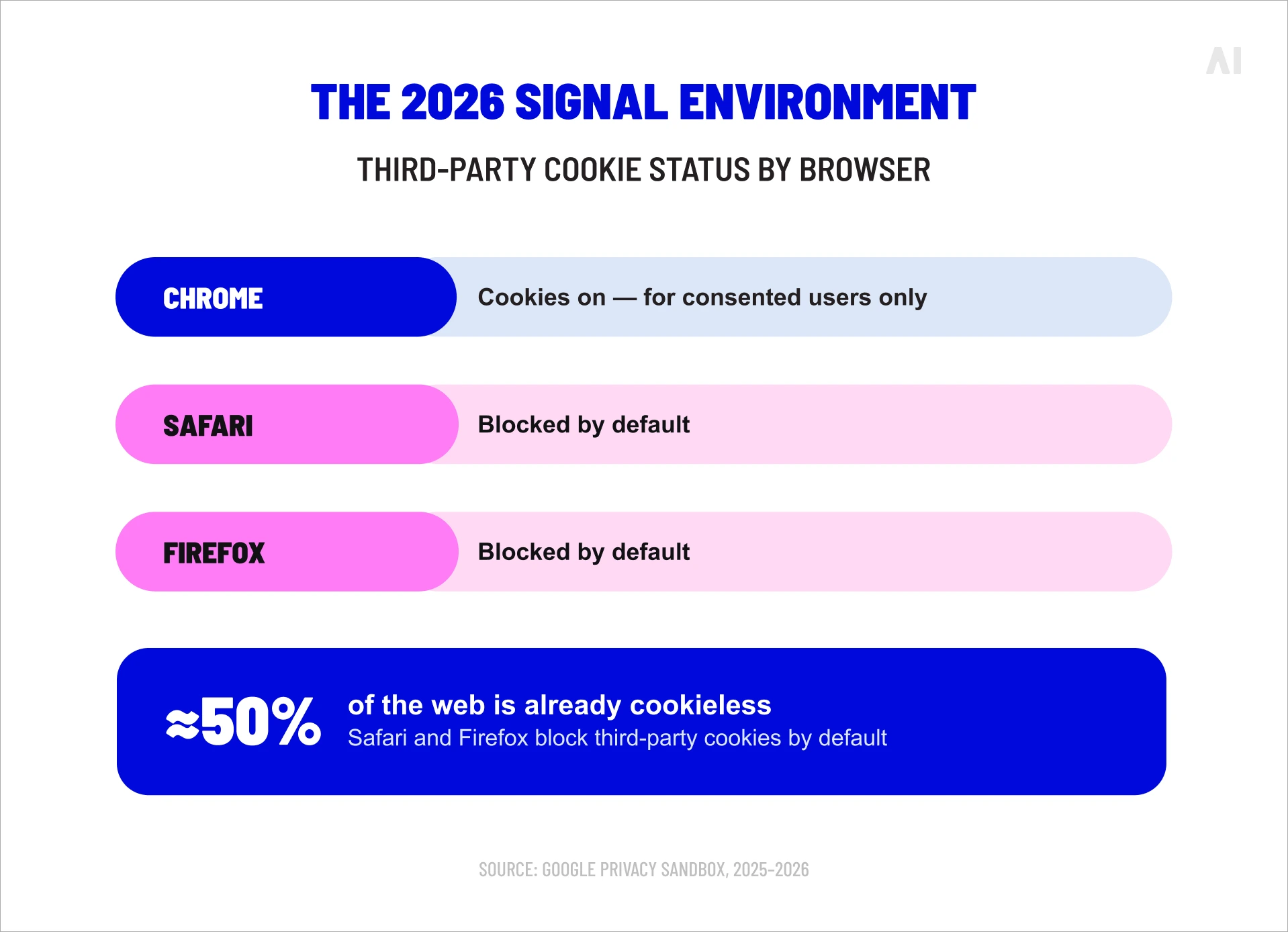
For 2026, that leaves a consent-gated, browser-dependent environment. Third-party cookies still function in Chrome, but only for consented users, while Safari and Firefox block them by default—leaving roughly half the web already cookieless. Marketers adapt by leaning on first-party data, server-side measurement, and privacy-safe methods like contextual targeting and data clean rooms rather than waiting for a single standard to restore what cookies provided. Addressability now comes from consented relationships rather than ambient tracking.
First-party data foundations
First-party data has become the reliable core of attribution because it's the data least affected by signal loss. Some 84% of marketers now use first-party data, drawing on CRM records, consented interactions, and server-side events that the business owns outright rather than borrows from a platform.
That ownership buys durability. A hashed email captured at login resolves identities across devices and sessions long after a third-party cookie would have expired, which makes consented first-party identifiers the backbone of cross-device and cross-channel measurement. Building that foundation—collecting, consenting, and connecting owned data—is now the prerequisite for accurate attribution rather than a nice-to-have.
Data fragmentation across platforms
Customer data stays scattered across ad platforms, analytics tools, CRMs, and offline systems, and each defines conversions its own way. That fragmentation makes a unified journey hard to build. The same event is counted differently in different systems, identities don't resolve across them, and no shared definition lets the numbers reconcile. Centralizing data into one tool doesn't fix it on its own—the definitions and identity logic have to align too, a problem worsened by walled gardens that limit what leaves their environment. Cross-platform measurement is the discipline of forcing that alignment.
Measuring offline customer journeys
Offline touches remain the hardest to connect to digital activity. Retail purchases, phone orders, in-store visits, and events happen outside the click stream, so the digital marketing that drove them often goes uncredited, and the channels responsible look weaker than they are.
The practical fixes are partial but real: importing point-of-sale and CRM conversions into the attribution model, using call tracking to tie phone orders to campaigns, and applying store-visit measurement where consented location data allows.
Where user-level joining fails entirely, aggregate methods like MMM step in to estimate offline contribution that attribution can't observe directly. The aim is broader coverage rather than perfect precision.
Attribution model bias
Every model encodes assumptions about how customers behave, so every model is biased in a predictable direction—and trusting one as the single truth bakes that bias into budget decisions. The discipline is to compare several models, watch where they disagree, and validate the disputed cases with incrementality testing, which asks whether a conversion would have happened without the marketing at all.
Acting on that comparison is where most organizations stall. Only 22% of organizations are effective at both extracting insight from their models and turning it into timely decisions, while 42% are not—the weak point is rarely the model and usually the process around it.
⚡ When no single tool sees the whole journey, confidence comes from methods that agree with each other rather than from trust in any one of them.
How to implement cross-channel attribution
A workable rollout moves an organization from scattered reporting to mature measurement in deliberate stages. The IAB's cross-channel measurement playbook frames this as a multi-step process, and the five steps below follow that logic. Treat them as sequential—each depends on the one before.
💡 For the obstacles that tend to derail implementation, see our guide to marketing effectiveness measurement challenges.
- Audit your data sources. Map every marketing, analytics, CRM, and offline source you have, and note where coverage is missing or inconsistent. The audit defines what your attribution can and can't see before you commit to a model.
- Define conversions and KPIs. Establish the outcomes attribution should measure and the decisions those insights will drive. Clear conversion and KPI definitions stop teams from optimizing toward metrics that don't connect to revenue.
- Select the right attribution technology. Compare attribution platforms, customer data platforms, data warehouses, and managed measurement services against your data reality and in-house skills. Fit to requirements beats feature count, and the field of cross channel attribution vendors ranges from point tools to full managed programs.
- Align marketing, analytics, and finance. Agree shared definitions, governance, and reporting standards so one set of numbers holds across teams. Attribution that finance doesn't trust changes no budgets.
- Optimize and refine continuously. Revalidate the model as customer behavior and channel mix change, and re-compare models on a schedule. Attribution is a standing practice rather than a one-time build.
Key metrics to monitor
The right metrics tell you whether attribution is improving decisions or just producing reports. Track a compact set rather than everything the platform offers, since a wall of numbers erodes trust in measurement in the first place—and with finance scrutinizing marketing budgets more closely every year, the metrics that connect spend to revenue are the ones worth defending.
Monitor these five as a core set:
- Attributed revenue by channel—the revenue each channel earned under your model, and the clearest link between activity and business outcome.
- Assisted conversions—how often a channel supported journeys it didn't close, which reveals hidden upper-funnel value.
- Cost per attributed conversion—spend measured against credited conversions, a truer efficiency read than platform-reported cost per action.
- Time to conversion—how long journeys take, which informs attribution windows and reveals cycle length by segment.
- Model comparison—how channel rankings change across models, the fastest way to catch bias before it misdirects budget.
Read together, these turn attribution from a scorecard into an optimization tool.
💡 For the broader measurement context they sit within, see our overview of marketing measurement.
How AI Digital helps unify cross-channel measurement
Fragmented reporting is a data and intelligence problem before it's a tooling problem, and it's solved by combining marketing intelligence, independent measurement, and transparent execution. AI Digital brings those together through three complementary offerings—Elevate, the Open Garden framework, and Smart Supply—built to give organizations one consistent view of performance across a fragmented ecosystem.
💡 For the wider category these sit in, see our guide to the marketing intelligence platform.
A unified approach to marketing measurement
Elevate is a vendor- and DSP-agnostic marketing intelligence platform spanning research, planning, optimization, and reporting. It sits across channels rather than inside any one platform, and it deliberately doesn't bid, serve ads, or build creative. Its role is intelligence and measurement rather than execution, which is why it can read performance without holding a stake in the outcome.
The Open Garden framework is the structural alternative to walled gardens that makes unified, cross-platform data possible in the first place, operating across 15+ DSPs.
Smart Supply handles supply selection and optimization, filtering toward inventory that performs. Where most platforms gate their clients out, Elevate puts them inside the intelligence.
From attribution insights to better decisions
Insight only counts when it changes what a team does next.
AI Digital's approach connects attribution output to the decisions around it—reallocating budget toward channels with proven incremental impact, tuning campaigns against unified measurement rather than platform self-reporting, and holding a consistent performance view as signals degrade.
In a consent-first environment, that connection between measurement and action separates confident decisions from educated guesses. Independent measurement layered over transparent programmatic execution and open alternatives to walled gardens keeps cross-channel attribution actionable rather than academic.
Ready to build a smarter measurement strategy?
Cross-channel attribution is the first step toward measurement that reflects how customers actually buy—across channels, across devices, and across the online-offline line. The teams that build it stop rewarding proximity to the click and start funding the channels that create demand, which is where durable growth comes from.
If your current measurement can't connect the journey end to end, find out where it breaks down before another quarter of budget lands in the wrong channels. AI Digital combines marketing intelligence, independent measurement, and transparent execution to connect what's currently siloed. Get in touch to talk through your measurement setup and where cross-channel attribution would make the biggest difference.