What Is an Ad Tech Stack — Components, Structure & Strategic Role

Modern digital advertising does not run on a single platform. It depends on a layered infrastructure of specialized technologies, each responsible for a distinct part of campaign execution—from media buying and audience targeting to creative delivery and performance measurement. That infrastructure spans search, social platforms, retail media networks, streaming services, and the open web, and the technologies that connect these environments are what the industry calls an ad tech stack.
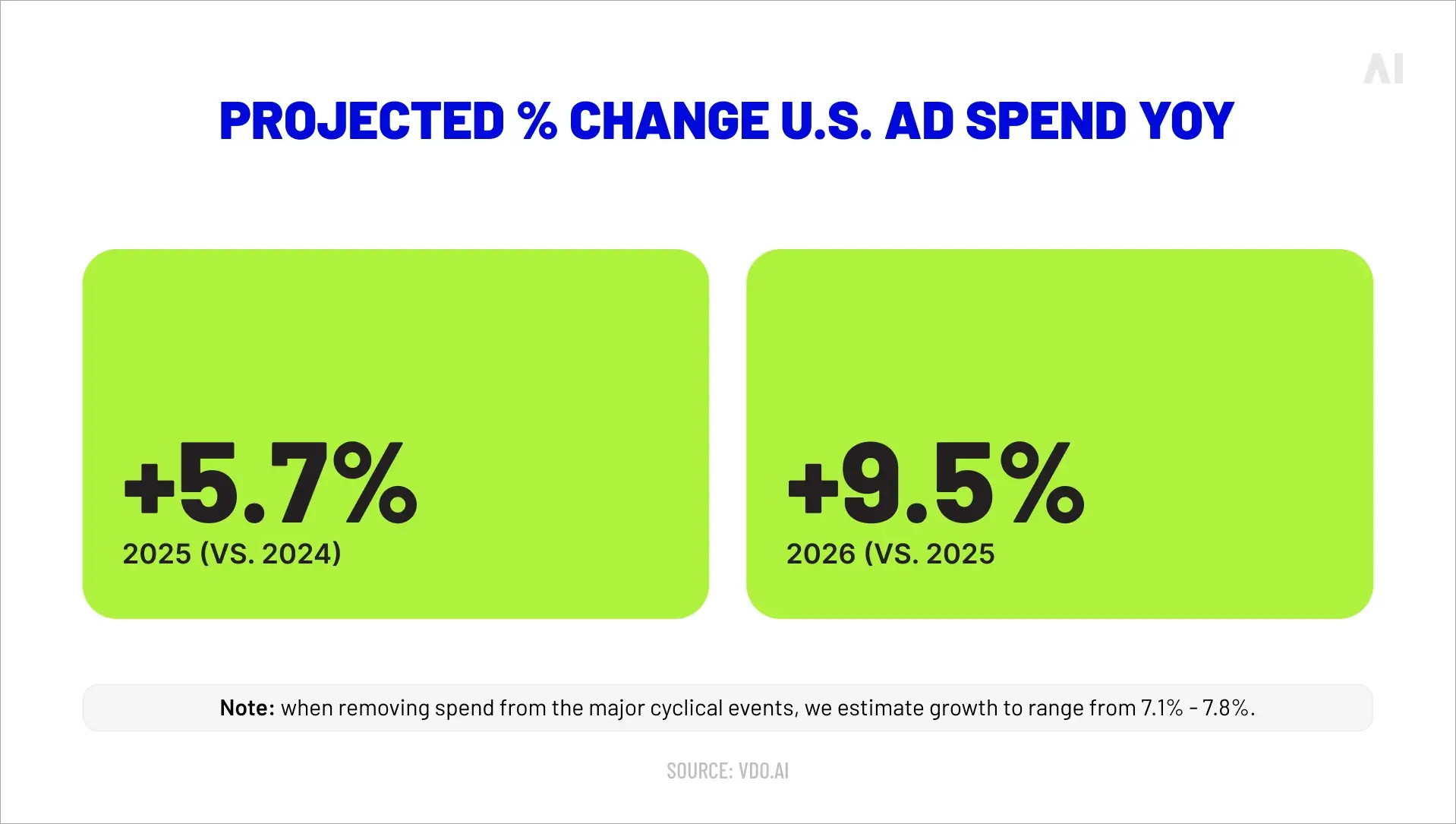
For many advertisers, these tools sit behind agency dashboards or platform interfaces, which can obscure how campaigns are actually assembled and delivered. Yet the structure of that technology layer matters more than most marketers realize. According to the IAB's 2026 Outlook Study, U.S. ad spend is projected to grow 9.5% this year, with digital channels driving nearly all of that growth. As more budget flows through automated systems, the composition, coordination, and governance of an organization's advertising tech stack increasingly determine its transparency, cost efficiency, and campaign outcomes.
This article explains what an ad tech stack is, how its core components work together, and why its design has a direct influence on advertising performance. It also examines how fragmentation, economic pressures, and evolving data regulations are reshaping the way organizations manage their advertising technology, and why structured governance is becoming essential in an increasingly complex ecosystem.
💡 Related read: Open Garden framework: A New Operating Model for Programmatic Advertising
What is an ad tech stack in digital advertising?
An ad tech stack is the collection of technologies an organization uses to plan, buy, deliver, measure, and optimise digital advertising campaigns. Rather than being a single product, it is an interconnected set of platforms, each handling a specific function within the advertising workflow.
A typical adtech stack includes platforms responsible for:
- Buying advertising inventory through programmatic auctions or direct deals
- Managing audience data for targeting and segmentation
- Delivering ad creatives to the right environments at the right time
- Measuring campaign performance across channels and devices
- Automating optimization processes based on real-time signals
These technologies form a layered infrastructure. At the foundation sit data systems that collect and organize audience information. Above them, buying platforms connect advertisers to available inventory. Delivery and measurement tools then close the loop, tracking what was served and how it performed. The way these layers connect (or fail to connect) determines how effectively the stack operates as a whole.
Understanding what is ad tech at the infrastructure level, rather than at the level of individual tools, is what separates strategic media operations from reactive campaign management.
Ad tech stack vs marketing technology stack
The terms are sometimes used interchangeably, but an ad tech stack and a marketing technology (martech) stack serve different functions.
- An adtech stack focuses specifically on paid media activation: the platforms that buy, deliver, and measure advertising.
- A martech stack is broader, encompassing tools for customer relationship management (CRM), marketing automation, email, content management, analytics, and customer experience.
{{26-Ad-Tech-Stack-Components-Structure-1="/tables"}}
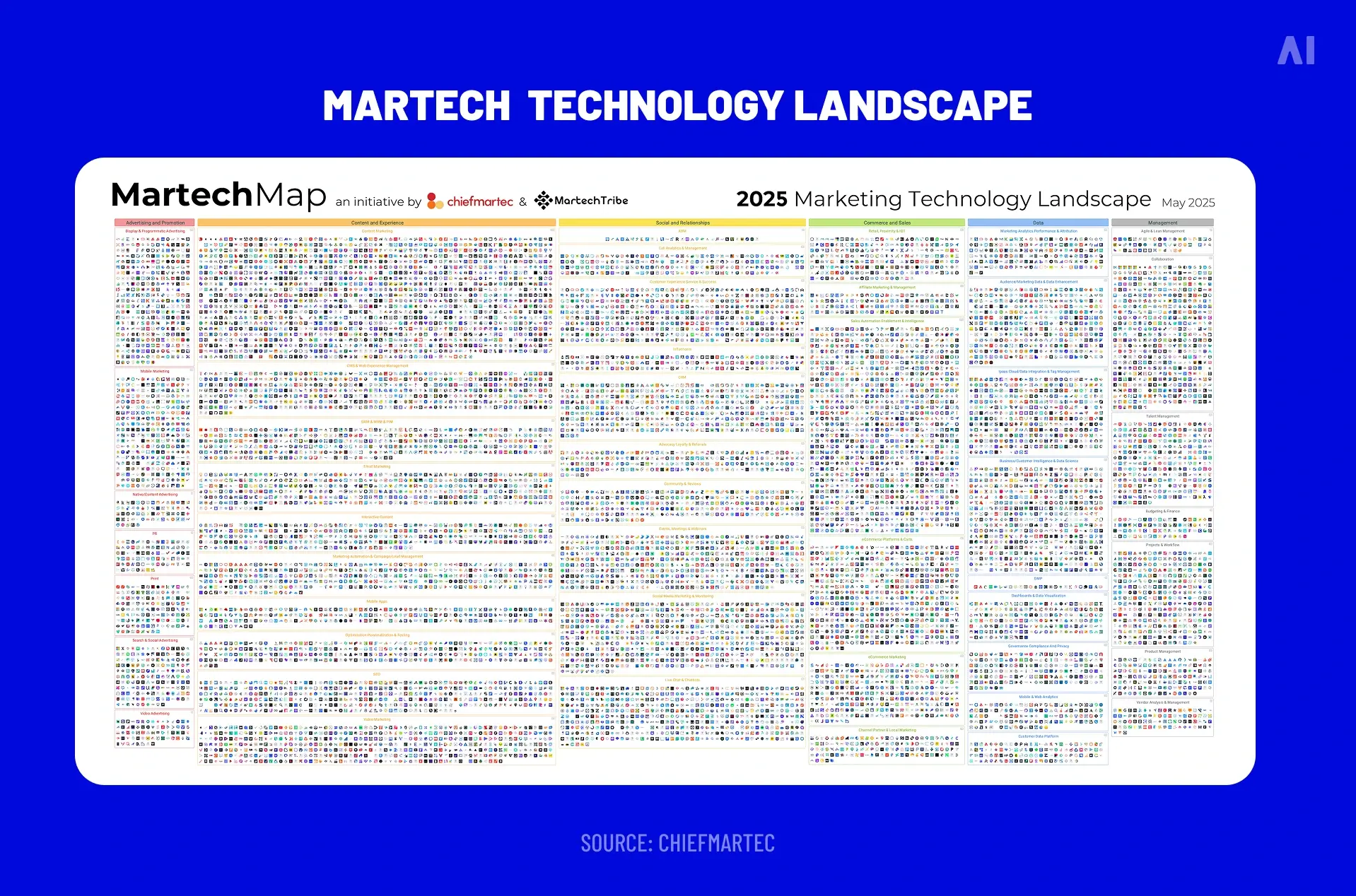
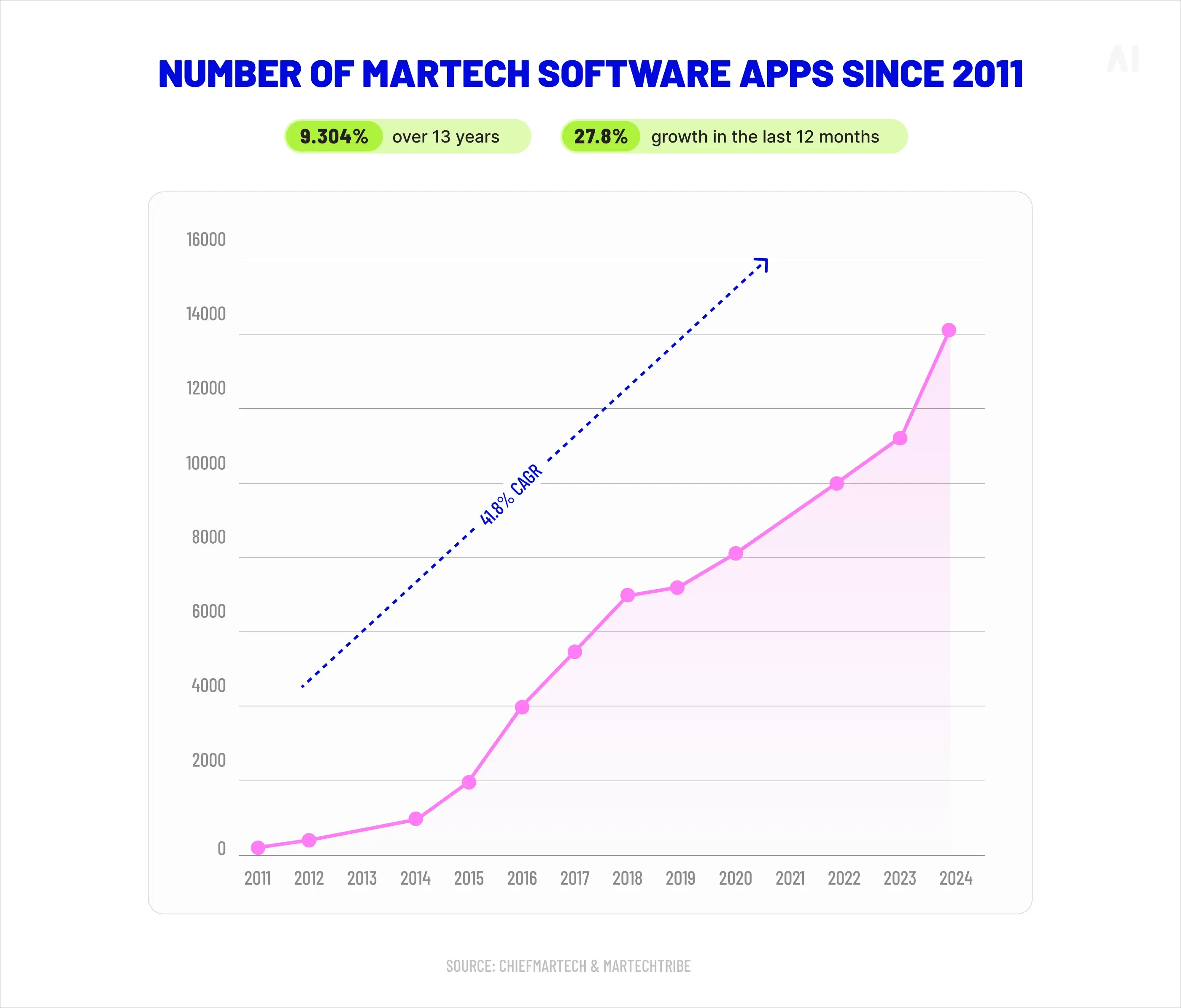
Shared data infrastructure is pulling the two stacks into closer overlap, which makes the distinction worth drawing clearly. Customer data platforms (CDPs) and analytics tools now sit at the intersection, feeding audience insights into ad targeting while also supporting lifecycle marketing. In 2025, researchers catalogued over 15,384 commercial martech solutions, according to ChiefMartec and MartechTribe. That figure illustrates the sheer scale of the broader technology landscape, and why a focused understanding of the advertising-specific layer is necessary for media buyers and campaign strategists.
Where adtech primarily enables the buying and delivery of paid advertising, martech supports the wider marketing operation: nurturing leads, managing loyalty programmes, and orchestrating owned-channel communications. In practice, the strongest advertising operations integrate both stacks through shared data systems and unified measurement.
💡 Related read: Adtech vs martech
Core components of an ad tech stack
An advertising tech stack is composed of several core technology layers. Each plays a distinct role in campaign execution and connects to others through data flows, APIs, and auction protocols.
{{26-Ad-Tech-Stack-Components-Structure-2="/tables"}}
Demand-side platforms (DSPs)
DSPs are the buying engines of programmatic advertising. They allow advertisers to purchase digital inventory across exchanges and publisher networks through automated auctions, often in real time. The advertiser sets parameters—audience segments, bid limits, channel preferences—and the DSP executes purchases across available supply.
DSP capabilities vary widely. Fee structures differ significantly: Amazon DSP, for instance, charges as little as 1% on open-web buys, while The Trade Desk's take rate is estimated at roughly 20%, according to EMARKETER. These differences make DSP selection a consequential decision for the overall economics of a media plan.
Most large advertisers operate across multiple DSPs simultaneously, a model that increases flexibility but also introduces coordination challenges.
💡 Related read: DSP vs SSP vs ad exchange
Supply-side platforms (SSPs)
On the other side of the transaction, SSPs help publishers manage and sell their advertising inventory through programmatic marketplaces. SSPs connect publishers to multiple demand sources, enabling them to maximise yield on each impression. They handle auction mechanics, set floor prices, and manage which buyers can access specific inventory.
The relationship between DSPs and SSPs forms the backbone of programmatic trading. When an ad request is generated—a user loads a web page or opens a streaming app—the SSP offers that impression to connected DSPs, which then bid on behalf of their advertiser clients. This transaction typically completes in under 100 milliseconds.
💡 Related read: What is a supply-side platform (SSP)?
Ad servers
Ad servers sit between the creative assets and the end user. They manage the delivery of advertising creatives, control campaign pacing and frequency caps, and track impressions, clicks, and other engagement signals. Both advertisers and publishers may operate their own ad servers, each with a slightly different function.
On the advertiser side, the ad server decides which creative to deliver and to which audience. On the publisher side, it manages which ads fill available placements. The ad server also produces the raw delivery data that feeds into attribution and measurement, making its accuracy foundational to the entire stack.
Data management platforms (DMPs)
DMPs collect, organize, and activate audience data for targeting and segmentation. They aggregate information from multiple sources—website behavior, CRM records, third-party data providers—and create audience segments that can be pushed to DSPs for campaign activation.
However, the role of DMPs has shifted. As third-party data signals become less reliable and privacy regulations tighten, DMPs that depended heavily on cookie-based data are losing relevance. Many organizations are moving toward CDPs and first-party data strategies that offer more durable foundations.
💡 Related read: Data management platform | DSP vs DMP
Customer data platforms (CDPs)
CDPs unify first-party customer data from multiple touchpoints into a single, persistent profile. Unlike DMPs, which were designed for segment-based targeting using largely anonymous data, CDPs resolve identity at the individual level and support both advertising and broader marketing use cases.
As the advertising industry pivots toward first-party data strategies, CDPs have become a critical link between marketing operations and media activation. They enable advertisers to build audiences grounded in their own customer relationships, rather than relying on rented data that may degrade or disappear as privacy frameworks evolve.
Measurement and analytics tools
Measurement platforms track campaign performance, attribute conversions to specific touchpoints, and provide cross-channel analytics. These tools range from basic reporting dashboards to sophisticated multi-touch attribution models and marketing mix analyses.
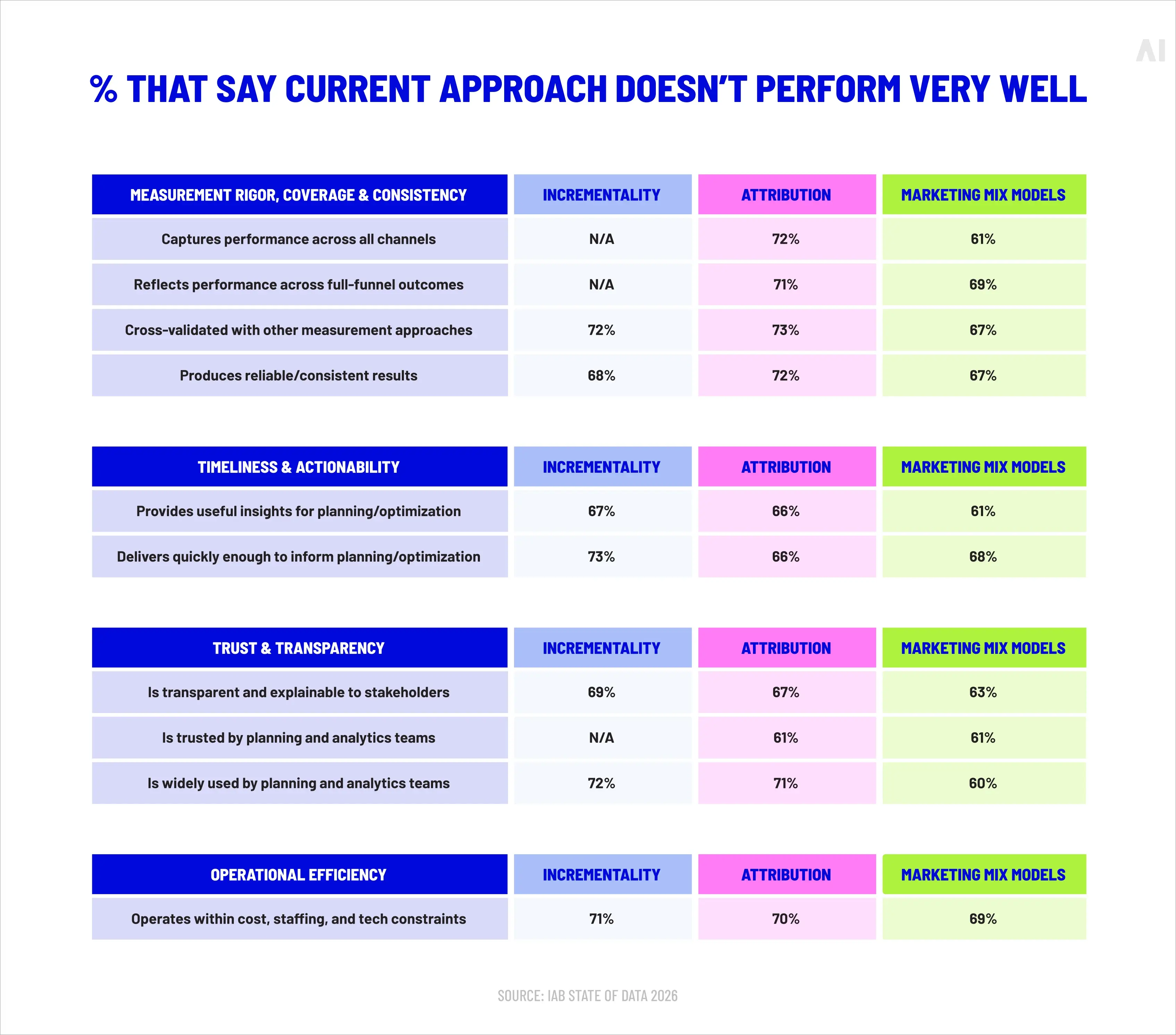
The measurement layer is also where transparency challenges tend to surface. According to the IAB's "State of Data 2026" report, between 60% and 75% of senior brand and agency decision-makers believe current measurement approaches fall short on rigor, timeliness, and trust. None of the respondents said all paid channels are adequately represented in their marketing mix models. That gap between what measurement tools promise and what they deliver remains one of the most consequential weaknesses in many ad tech stacks.
💡 Related read: Elevate — AI Digital's cross-platform intelligence platform for predictive campaign planning, real-time optimization, and unified performance reporting across DSPs.
How the ad tech stack powers media buying and optimization
The components described above do not operate in isolation. They form a workflow—a sequence of interdependent steps that move a campaign from strategy to execution to evaluation.
The process typically follows this path:
- Advertisers define campaign goals and audiences, setting KPIs and budget parameters.
- Data platforms provide audience insights and segmentation, drawing on first-party, contextual, or modelled data.
- DSPs execute programmatic media buying, bidding on impressions that match the defined audience criteria.
- Ad servers deliver creatives across channels—display, video, CTV, native, audio.
- Measurement tools analyse campaign performance, feeding results back into optimization models.
Each hand-off between layers introduces both opportunity and risk. When the stack is well-integrated, data flows cleanly from one platform to the next, enabling fast optimization and consistent reporting. When it is not, signals get lost, budgets are misallocated, and performance becomes difficult to diagnose.
"Programmatic has entered an accountability era. Transparency and efficiency are now table stakes. What separates winners is disciplined execution." — Bob Liodice, CEO, ANA
Machine learning models are now embedded throughout this workflow. In the U.S., programmatic transactions account for approximately 92% of all digital display ad spending, according to EMARKETER. At that scale, manual intervention cannot keep pace. Automated bidding, budget reallocation, and creative selection have become standard, raising the stakes for how well the underlying technology infrastructure holds together.
💡 Related read: AI in DSPs
Why ad tech stacks often become fragmented
As advertising ecosystems expand, organizations accumulate more platforms. What begins as a focused set of tools can gradually become an unwieldy collection of overlapping systems, each added to address a new channel, data source, or measurement requirement. This is the fragmentation problem, and it affects nearly every large-scale advertising operation.
Platform specialization
Different tools focus on different tasks. One platform might excel at display targeting, another at CTV buying, and a third at attribution modelling. Organizations adopt multiple specialists, each strong in its niche, but the resulting stack lacks a unified data layer or consistent reporting framework.
Rapid growth of advertising channels
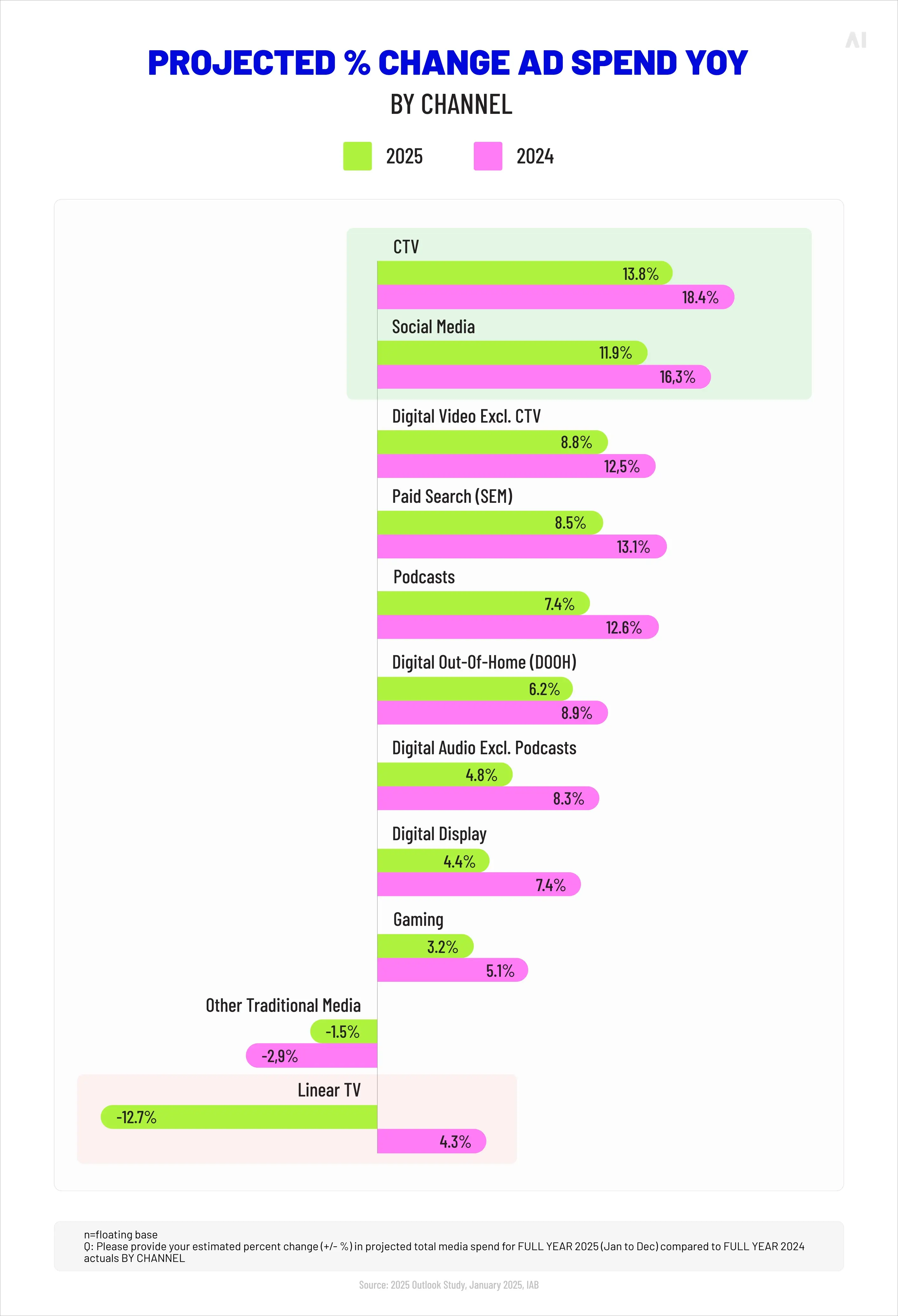
New environments create new technology requirements. Retail media networks, for example, saw programmatic spending grow by 29.3% in 2025, according to Basis Technologies data cited by EMARKETER. Connected TV is projected to grow 13.8% in 2026, per the IAB. Each new channel typically brings its own buying platform, measurement methodology, and data format—adding layers to an already complex infrastructure.
Vendor overlap and duplication
Over time, organizations may find themselves paying for multiple platforms that perform overlapping functions. A Gartner survey found that marketers use just 33% of their martech stack's capabilities—a figure that has declined steadily from 58% in 2020. That underutilization reflects not just poor adoption, but architectural bloat: too many platforms, too few integrations, and too little governance over what stays and what goes.
Fragmentation makes integration and operational coordination more difficult with every tool added. It also compounds measurement inconsistencies, since each platform may define conversions, viewability, or engagement differently.
💡 Related read: Digital Advertising Ecosystem: How It Actually Works in a Fragmented, Platform-Driven World
In-house vs outsourced ad tech stack models
How an adtech stack is managed matters as much as which platforms it contains. Organizations approach this differently depending on their scale, expertise, and strategic priorities.
In-house stack management
Some organizations operate their advertising technology infrastructure internally, maintaining direct relationships with DSPs, SSPs, data providers, and measurement vendors. This model offers maximum control and transparency but requires significant investment in talent, technology licensing, and ongoing platform management.
Agency-managed stacks
Many advertisers rely on agencies or technology partners to operate their advertising infrastructure. The agency selects platforms, manages integrations, and executes campaigns on the advertiser's behalf. This reduces the operational burden but can limit the advertiser's visibility into technology costs, supply paths, and data access.
Hybrid stack models
The most common approach combines internal technology control with external service providers. An advertiser might manage its own CDP and measurement tools while outsourcing programmatic execution to an agency or managed service partner.
{{26-Ad-Tech-Stack-Components-Structure-3="/tables"}}
“If you can't measure it, you're not going to be able to grow the business." — David Cohen, CEO, IAB, PPC Land
The chosen model influences transparency, operational flexibility, and strategic control. Organizations that outsource entirely often have limited leverage over supply path decisions, while those that go fully in-house may struggle to maintain the specialist expertise each platform demands.
Data flow and interoperability across the ad tech stack
Data is what connects the layers of an ad tech stack—but it is also where the most persistent friction occurs. How audience data moves between platforms, how identity is resolved across environments, and how privacy requirements are enforced all determine whether a stack functions as a coherent system or a collection of disconnected tools.
Several concepts are central to this challenge:
- Identity signals—the mechanisms (cookies, device IDs, authenticated logins, contextual signals) used to recognise and reach audiences across platforms
- Audience data activation—the process of moving segments from data platforms into buying systems for campaign targeting
- Cross-platform data sharing—enabling consistent measurement and targeting when campaigns span multiple channels and vendors
- Privacy-safe collaboration—frameworks that allow multiple parties to share insights without exposing raw user-level data
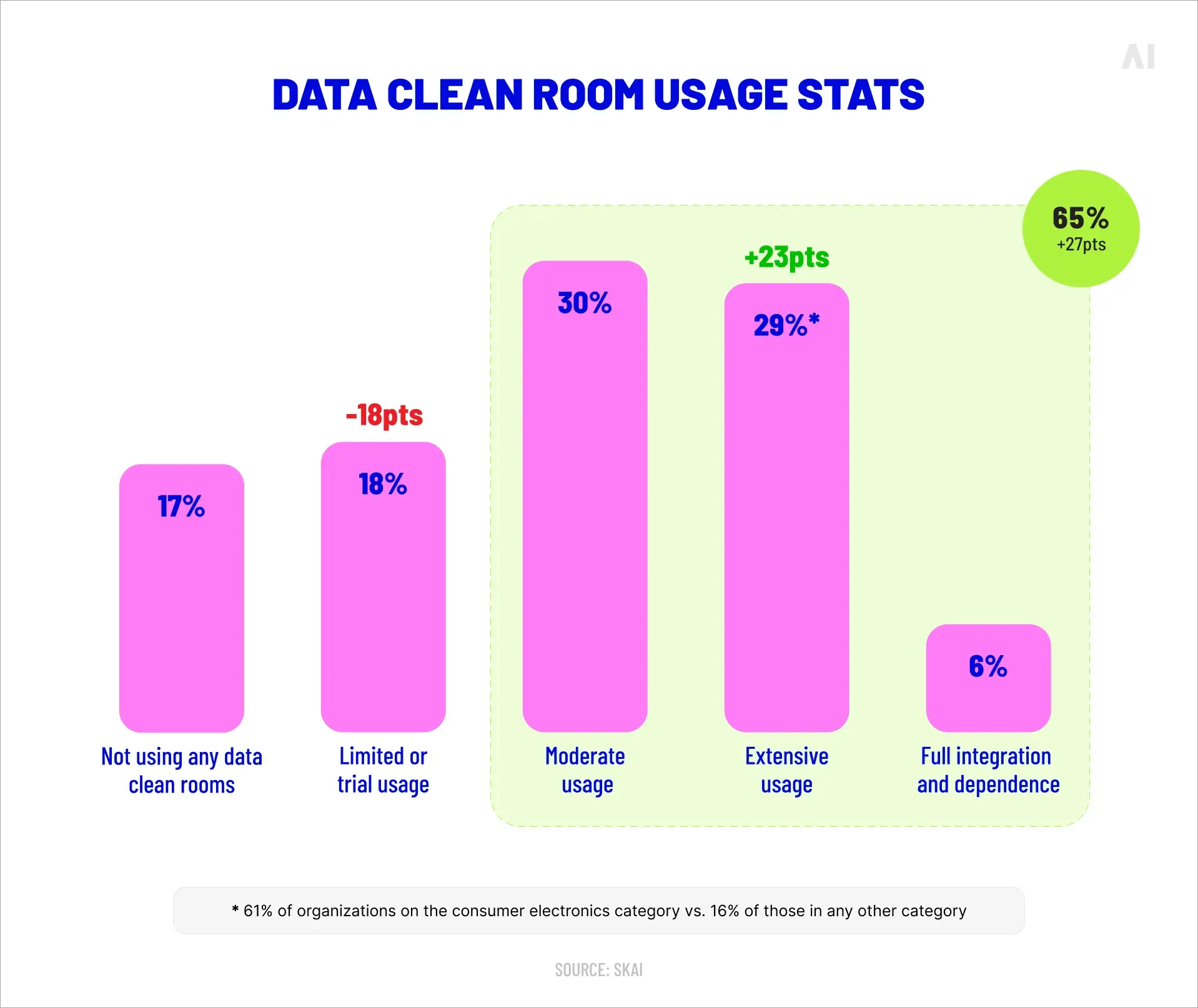
Data clean rooms have emerged as a key mechanism for that last point. These are secure environments where advertisers, publishers, and retailers can match datasets, measure attribution, and analyse overlapping audiences without either party accessing the other's raw records. Close to 66% of organizations now use clean rooms in some capacity, according to the 2025 State of Retail Media report. IAB Tech Lab has been formalizing interoperability standards in this space, finalizing ADMaP 1.0 in February 2025 and PAIR 1.1 in July 2025 to support privacy-compliant data matching at scale.
There's no single methodology that can answer every measurement question. Project Eidos addresses this at the foundation, creating shared constructs that allow measurement approaches to work together. — Maggie Zak, EVP Analytics & Engineering, Havas Media Network
Interoperability between platforms is not a technical nicety—it is a structural requirement. Without it, data becomes siloed, audience insights become fragmented, and measurement becomes inconsistent.
💡 Related read: What is a data clean room? | What is cross-platform advertising? Strategy, challenges, and measurement
The economic and transparency impact of ad tech stack design
The structure of an adtech stack directly influences how much of an advertiser's budget reaches working media, and how much is absorbed by intermediaries along the way.
The ANA's Q2 2025 Programmatic Transparency Benchmark found that $26.8 billion in global media value is lost each year to supply chain inefficiencies. By Q3 2025, the share of ad spend reaching publishers had climbed to 47.1%—an 11-point improvement since 2023—but that still means more than half of programmatic investment goes to transaction costs, low-quality placements, and other non-working spend.
Several factors contribute to this:
- Intermediary fees—each platform in the supply chain takes a margin, and those margins compound as the number of intermediaries grows
- Supply chain complexity—a single campaign can pass through dozens of technology partners before an impression is served
- Measurement inconsistencies—different platforms define and report metrics differently, making it difficult to compare performance or identify waste
- Limited visibility into media transactions—when advertisers cannot see where their budgets are going at the impression level, inefficiencies persist unchallenged
Poorly coordinated stacks amplify these problems. When buying, measurement, and data systems operate independently, there is no unified view of where money goes or what it achieves.
"Advertisers that actively govern quality are converting more of their budgets into benchmark-qualified impressions, seeing measurably stronger results." — Bob Liodice, CEO, ANA
The Q4 2025 ANA Benchmark confirmed this pattern: advertisers enforcing disciplined quality governance converted 56.7% of programmatic spend into benchmark-qualified impressions, and those prioritising quality-adjusted metrics over raw CPM achieved nearly 40% reductions in cost per conversion.
💡 Related read: Digital advertising supply chain explained | Digital advertising transparency
Why ad tech stack governance determines performance and control
As advertising ecosystems become more complex, the technology infrastructure alone cannot guarantee results. Organizations increasingly need governance frameworks—structured processes for coordinating, evaluating, and evolving their ad tech stack—to maintain control over campaign performance, data quality, and supply chain integrity.
Governance addresses the operational questions that technology alone cannot answer:
- Aligning measurement frameworks across platforms so that performance can be compared consistently
- Coordinating data across buying, measurement, and audience platforms to prevent fragmentation
- Improving transparency across supply chains by enforcing standards for log-level data access and reporting
- Supporting cross-platform performance analysis so that optimization decisions reflect the full picture, not just one platform's metrics
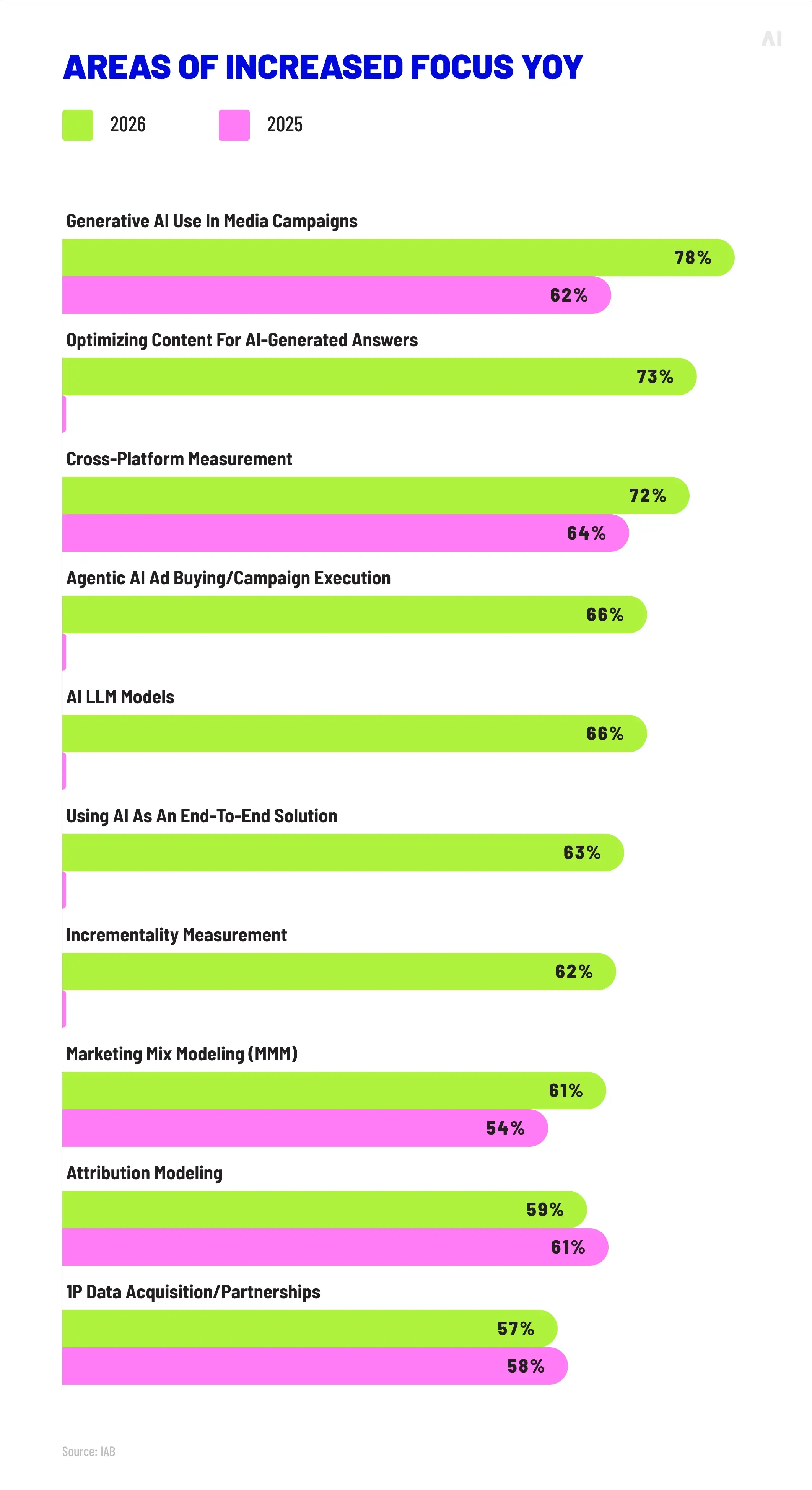
The demand for this kind of structured coordination is growing. In the IAB's 2026 Outlook Study, cross-platform measurement rose to a 72% priority among advertisers, up from 64% the previous year. That shift reflects a recognition that as automated systems handle more of the buying and optimization process, the frameworks governing those systems need to be equally rigorous.
Governance is, in practical terms, the layer that connects technology infrastructure with strategic decision-making. Without it, organizations risk optimising within individual platforms while missing the broader patterns that determine whether their total media investment is working.
💡 Related read: Cross-platform measurement governance in digital advertising
Conclusion: Build an effective ad stack
An ad tech stack forms the technological backbone of digital advertising operations. Its components—DSPs, SSPs, ad servers, data platforms, and measurement tools—enable the automation, audience targeting, and large-scale media buying that define modern advertising. But that same infrastructure also introduces complexity that must be actively managed.
For marketers evaluating or building their own stack, several principles apply:
- An adtech stack consists of multiple interconnected technologies, each supporting a distinct function within the advertising workflow
- Core components include demand-side and supply-side platforms, ad servers, data management platforms, customer data platforms, and measurement tools
- Stack structure and integration quality influence both transparency and campaign efficiency—poorly coordinated systems amplify waste
- Fragmentation is a natural consequence of ecosystem growth, but it can be mitigated through deliberate vendor evaluation and integration planning
- Governance frameworks help organizations coordinate their technology infrastructure, align measurement, and maintain control as complexity increases
The organizations that perform best are not necessarily those with the most platforms. They are the ones that understand how their technology connects, where their data flows, and what governance is required to keep the system accountable.
For organizations looking to bring more structure, transparency, and cross-platform coordination to their advertising technology, AI Digital's Open Garden framework offers a practical starting point. Rather than locking advertisers into a single platform's ecosystem, Open Garden operates on a DSP-agnostic model—connecting campaigns across 15+ demand-side platforms with full visibility into supply paths, pricing, and performance. Combined with managed service execution and AI-powered optimization through Elevate, the approach is designed to give advertisers the control and transparency that fragmented, ungoverned stacks often lack. Get in touch to discuss how your ad tech stack could work harder.