Top TV Advertisers in 2026 — Who’s Leading the Shift to CTV and Streaming Ads

The TV advertising environment in 2026 is defined by a completed shift: the transition from linear television to Connected TV (CTV) and ad-supported streaming platforms is no longer a prediction, but the operational standard. While television remains a high-impact channel for mass awareness, the fastest-growing advertisers have reallocated the majority of their video budgets to streaming environments where targeting, measurement, and creative optimization are far more advanced.
This article explores the industries and brands leading this transformation and analyzes what their strategies reveal about the future of TV advertising. We look at how top advertisers are using CTV not just for reach, but as a performance channel capable of driving measurable lower-funnel outcomes.
Why TV advertising is changing in 2026
TV is still one of the fastest ways to change how people feel and what they buy, but the mechanics behind it are being rebuilt. Audiences are shifting to streaming, ad-supported tiers are multiplying, and measurement looks a lot more like digital than traditional broadcast. Before looking at individual brands and platforms, it’s worth spelling out the core shifts that are reshaping how TV advertising works in 2026.

{{Top -TV-Advertisers-in-2026-SEO-1="/tables"}}
⚡ Streaming is no longer the side dish to “real TV”. For a growing share of households, it is the only way they watch long-form video on the big screen.
Cord-cutting and streaming-first viewing
The starting point is obvious but worth quantifying. The U.S. TV audience has shifted decisively to streaming:
- Streaming hit a record 38.8% share of TV usage in May 2024, up around eight percent year-on-year.
- By May 2025, streaming climbed to 44.8% of total TV usage, finally outpacing broadcast and cable combined.
- Pay-TV penetration has fallen from over 80% in 2011 to roughly a third of U.S. households by the end of 2024.
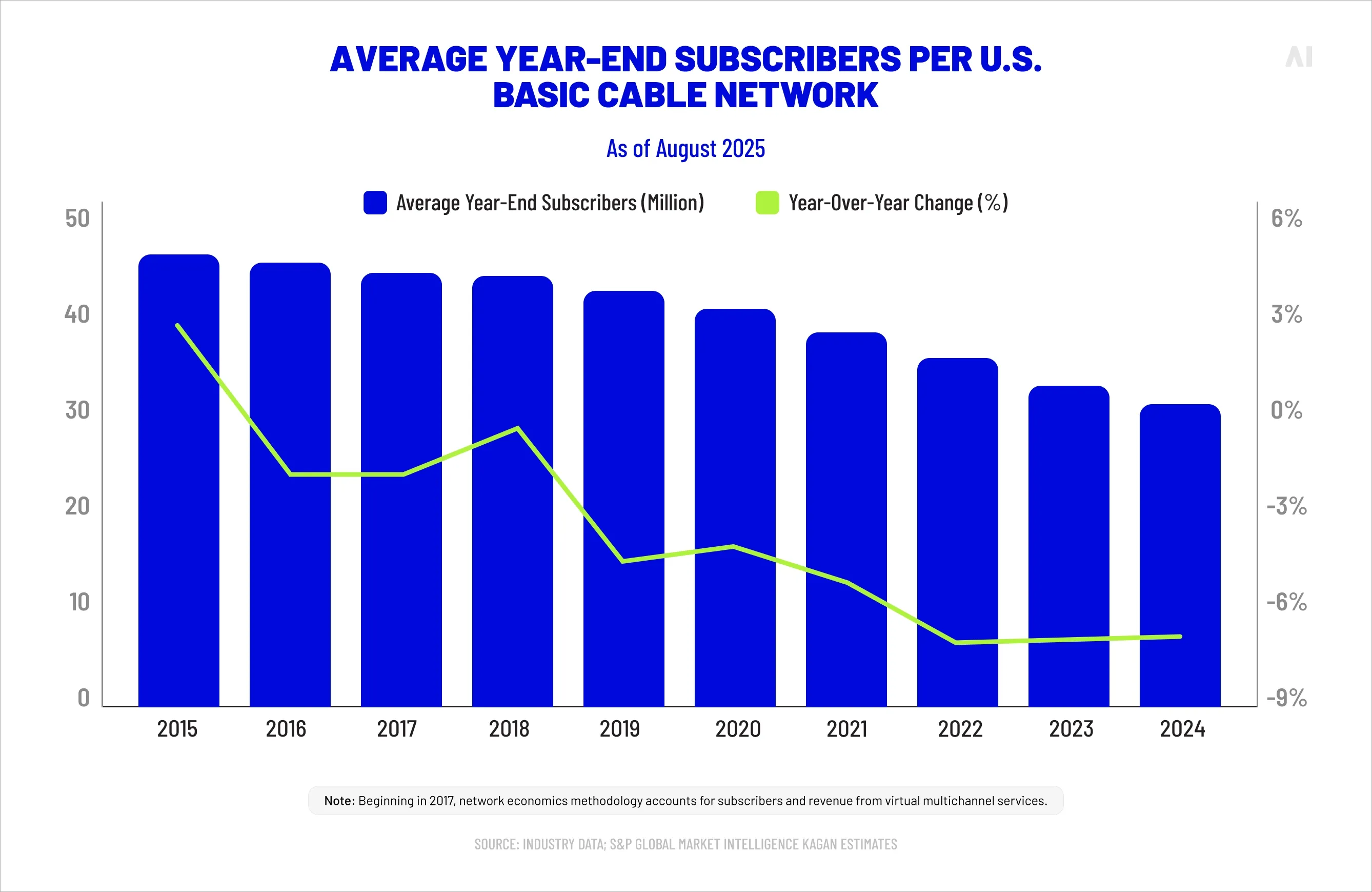
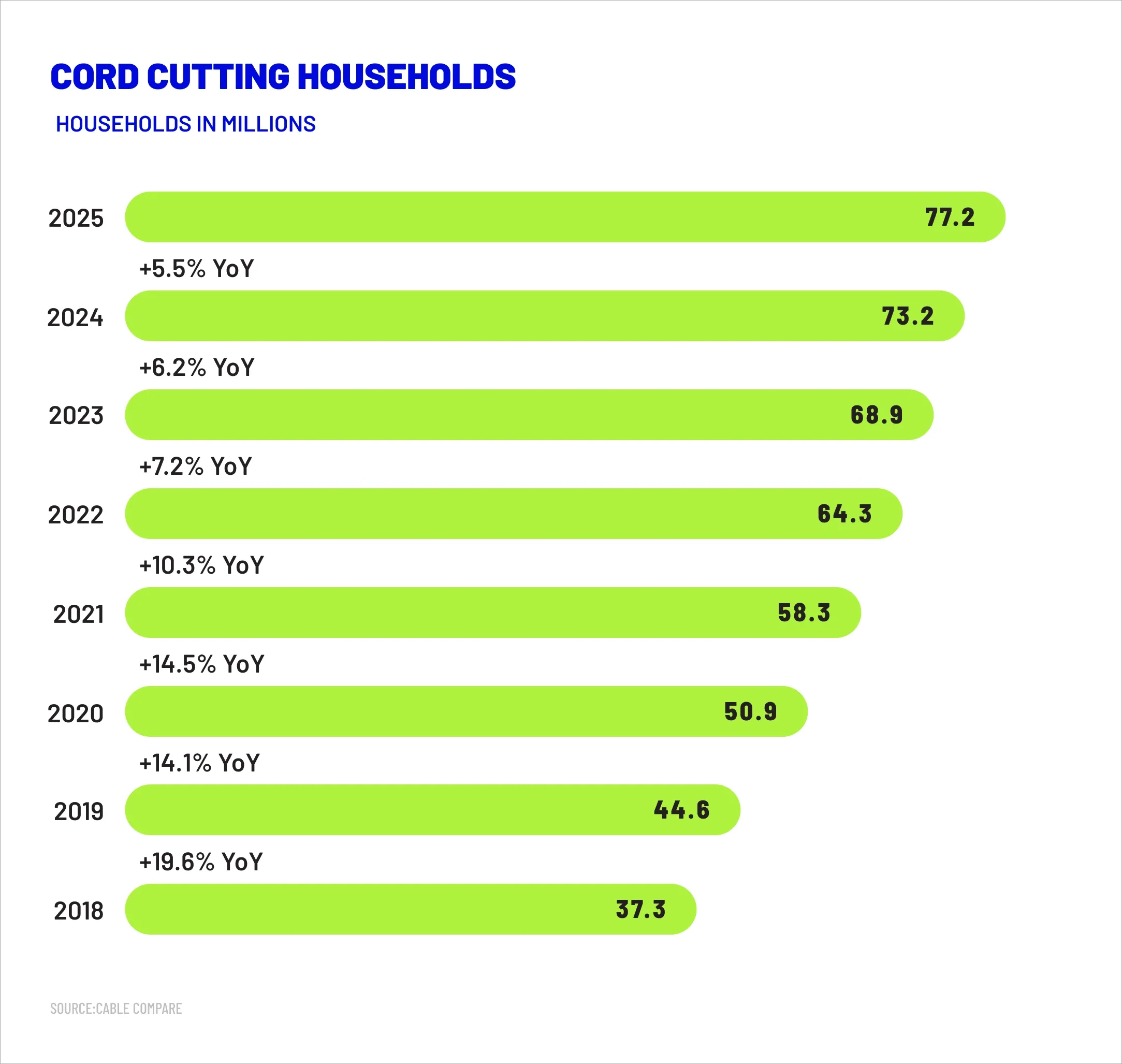
Cord-cutting isn’t just about people cancelling cable. Cord-nevers—households that have never had a pay-TV subscription—now represent about 12% of U.S. internet households. Since 2018, the number of cord-cutting households has more than doubled, from roughly 37 million to over 77 million projected by 2025.
For advertisers, this breaks the old assumption that a standard national linear buy “naturally” reaches most adults. There is still reach in linear, especially for older skewing audiences and tentpole sports, but reach is now fragmented across multiple streaming platforms, devices, and operating systems.
⚡Even with all the fragmentation, TV screens still command the longest, most focused viewing sessions in the home. The challenge isn’t whether TV works; it’s whether your plan reflects how people actually watch it now.
Ad-supported tiers become the default
When streaming launched, many marketers worried that ad-free subscription models would permanently shrink TV inventory. The opposite has happened.
- Netflix’s ad-supported plan grew from 5 million to 40 million monthly active users in a year, and then to 70 million by late 2024, with the ad tier accounting for more than half of new sign-ups in markets where it’s available.
- By early 2025, more than half of new Netflix subscribers in ad markets were choosing the ad-supported plan.
- Disney CEO Bob Iger revealed that around 37% of U.S. Disney+ subscribers and 30% of global subscribers are on the ad-supported tier, equating to tens of millions of ad-viewing customers.
- Across major U.S. streaming services, ad-supported plans now represent about 46% of subscriptions, and more than 70% of subscriber growth over the last two years has come from these ad tiers.
%2520viewers.webp)
Disney says its ad-supported streaming products now reach around 157 million monthly active users globally, including 112 million in the U.S. That’s a TV-sized audience, and it behaves like TV: big screens, high completion rates, and shared viewing.

Nielsen’s new “Ad-Supported Gauge” shows that services with ads account for about 72.9% of total TV viewing, while ad-free services account for only 27.1%. In other words, most TV time—even in a streaming world—is spent in environments where advertising can run.
⚡Ad-free TV isn’t disappearing, but the growth story is on the ad-supported side. That means more premium inventory where big brands can reach streaming-first audiences at scale.
CTV ad spend approaches traditional TV
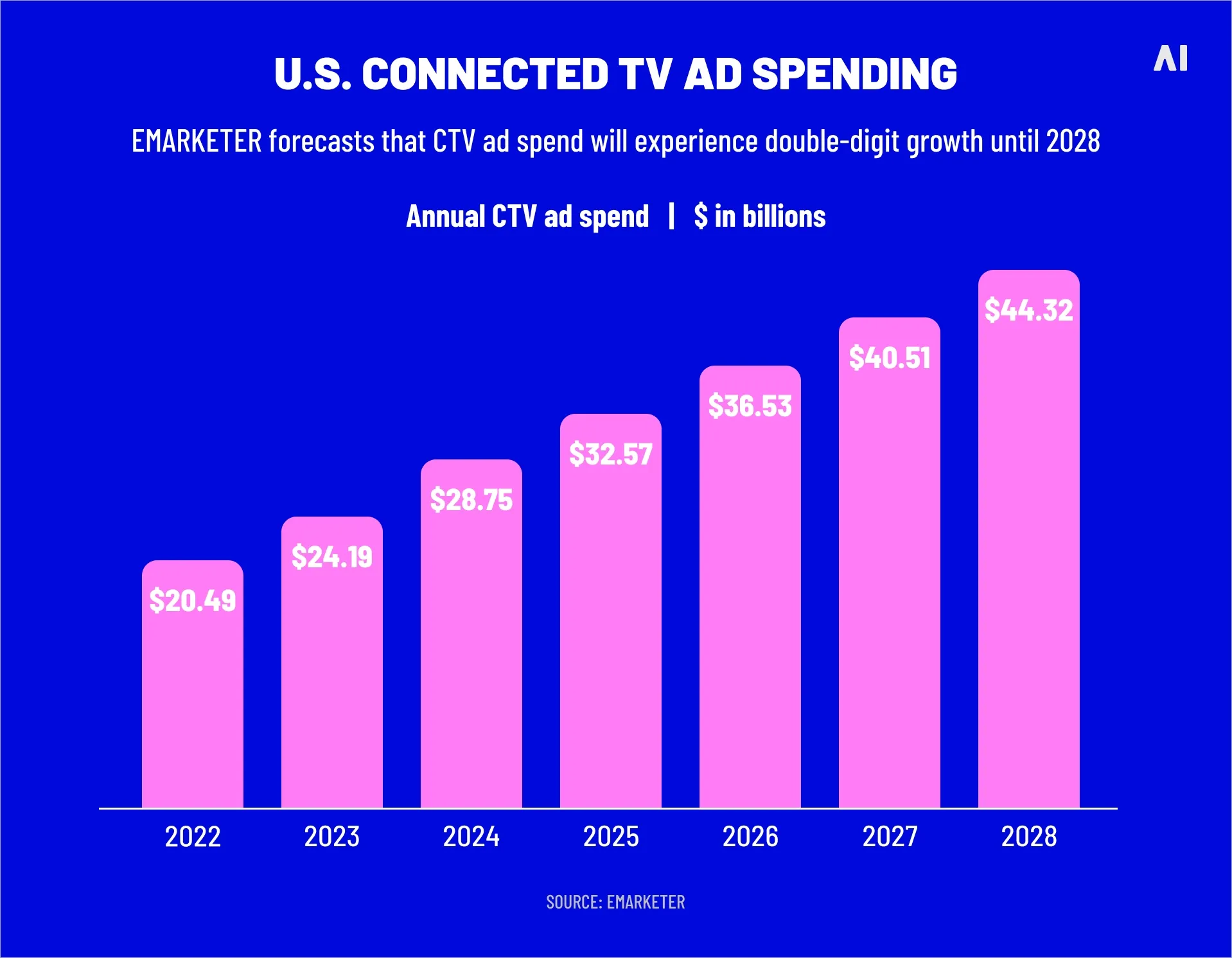
Insider Intelligence (eMarketer) projects that U.S. CTV ad spend will hit around $33.35 billion in 2025 and climb to $46.89 billion in 2028, overtaking traditional TV ad spending that same year. CTV already accounts for the majority of “TV-like” digital video budgets in many large advertisers, particularly in consumer categories.

Two dynamics matter here:
- CTV is still under-weighted versus attention. In 2024, U.S. adults spent almost 18% of their media time watching CTV, but brands invested only around 7% of total media budgets there. That gap creates an arbitrage opportunity for marketers willing to lean into streaming video while CPMs are still relatively efficient.
- Premium CTV is consolidating. By 2026, Insider Intelligence expects only three companies—YouTube, Amazon, and Disney—to each capture more than 10% of U.S. CTV ad sales. YouTube alone is forecast to net about 11.9% of CTV ad revenues in 2026, or around $9.21 billion in net CTV ad sales.
So while CTV inventory is fragmented at the surface level (hundreds of apps), most of the ad money is flowing into a handful of large ecosystems that can offer real scale, logged-in identity, and advanced measurement.

From GRPs to outcomes: the rise of performance TV
CTV isn’t just about reach and storytelling anymore. It is becoming a performance channel that can be optimized and measured alongside search, social, and retail media.
A few proof points:
- Innovid’s 2025 CTV Insights report found that CTV accounted for just 38% of cross-platform impressions, but drove over 63% of attributable conversions in its dataset, implying far more efficient response relative to impression volume.
- Walmart Connect case studies show CTV combined with retail data can double sales for some brands when paired with display and search using closed-loop sales attribution.
- Verve Group data cited by YouAppi shows that CTV retargeting delivers 12x higher engagement and 13x higher ROAS than other digital ad channels for mobile app re-engagement.
Retail media and CTV are converging as well. Global retail media revenue is projected to reach about $176.9 billion in 2025, surpassing total TV revenue (including streaming) for the first time, with U.S. retail media alone expected to exceed $62 billion. A growing share of that spend is video and CTV inventory bought through retailer DSPs or partnerships with CTV platforms.
This is the backdrop for the “performance TV” movement: outcome-based buying (CPV plus sales lift, incremental reach, or new-to-brand customers) and the expectation that TV should be as accountable as digital.
⚡ For the first time, big-screen video can be judged on the same terms as search and social. That changes how much budget TV deserves—and who inside a brand is responsible for it.
AI and automation reshape planning, buying, and creative
Artificial intelligence is moving from experimentation to standard practice in TV and video planning:
- The IAB’s 2025 Digital Video Ad Spend & Strategy report, as summarized by multiple industry analyses, notes that almost 90% of video advertisers plan to use AI tools to create or optimize video ads by 2026.
- Samsung Ads highlights AI-driven audience modelling and cross-device identity as core to its 2025 CTV innovation roadmap, framing CTV as a channel that combines “the storytelling power of TV with the precision and measurability of digital.
- YouTube is introducing AI-powered “Peak Points” ad formats that place messages at contextually relevant, high-engagement moments during specific cultural events, giving brands more control over when their ads appear in high-attention windows.
On the measurement side, AI is increasingly embedded in MMM, incrementality testing, cross-device attribution, and anomaly detection. For large TV advertisers, this means less manual spreadsheet work and more algorithmic budget shifts based on live performance signals.
💡For a deep primer on TV advertising, consider reading: What Is television advertising? — Key benefits and disadvantages
Industries leading TV and CTV ad spend in 2026
Although TV and CTV budgets have become more fragmented, a familiar group of industries still dominates big-screen spend—just with more dollars flowing into streaming screens.
💡 For a deeper primer on CTV, please see: Connected TV advertising in 2025
{{Top -TV-Advertisers-in-2026-SEO-2="/tables"}}
Retail & eCommerce
Retail and ecommerce are the powerhouses behind CTV’s shift toward performance and closed-loop measurement.
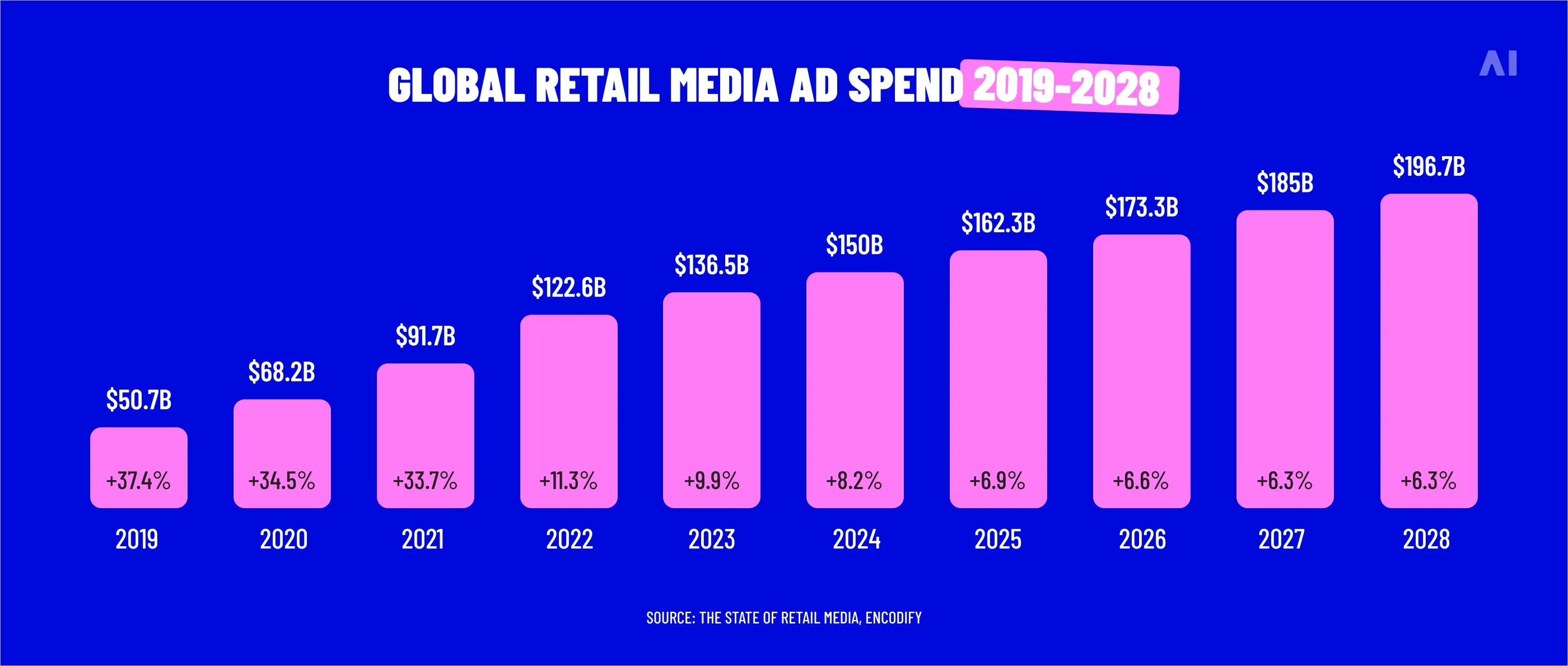
As mentioned previously, retail media has grown so quickly that it’s now on track to rival—and in some markets overtake—total TV revenue. That growth isn’t just happening in search and on-site display. Retail media networks such as Walmart Connect, Amazon Ads, Target’s Roundel, and Kroger Precision Marketing are packaging CTV and streaming video into their offerings, so brands can reach shoppers on the big screen and tie that exposure directly to store and ecommerce sales.

Case studies from Walmart Connect and The Trade Desk (also noted earlier) show that when CTV is combined with sponsored search and retail audience data, brands see higher click-through rates, more new-to-brand customers, and, in some cases, more than double year-over-year holiday sales.
From a category perspective, retail has several advantages in CTV:
- Massive SKU portfolios that justify broad reach
- Plenty of first-party data from loyalty programmes and ecommerce behaviour
- Frequent purchase cycles, which make TV-driven sales lift easier to detect quickly
That’s why retailers and large ecommerce brands are not just TV advertisers, they are also TV sellers—operating their own ad platforms and CTV supply.
Streaming platforms & entertainment
Entertainment and streaming platforms themselves are among the heaviest TV advertisers as they compete in the “streaming wars”.
Samba TV data shows that in the first half of 2025, the entertainment category alone delivered roughly 273 billion U.S. ad impressions across TV, making it the largest category by impression volume. Within that, major players like Netflix, Disney (Disney+, Hulu, ESPN+), Amazon Prime Video, Max, and Paramount+ are all spending heavily on both linear and CTV to promote tentpole series, films, and sports rights.
Netflix, for instance, is investing aggressively in live sports (including a multi-billion-dollar deal around WWE and NFL Christmas games) and promoting those events with TV-like campaigns to drive tune-in and ad tier adoption. Disney is blending traditional TV and streaming promotion for Disney+, Hulu, and the forthcoming ESPN direct-to-consumer app, alongside blockbuster sports rights for the NFL and WWE.
Entertainment advertisers also have strong creative assets and fan bases, which makes them natural heavy users of premium CTV placements, sponsorships, and branded content on YouTube, Roku, Samsung TV+, and others.
💡 For a complete overview of the streaming landscape, please refer to: Streaming TV advertising: The most complete guide to trends, tactics & formats
Automotive
Auto remains one of the most important TV categories, even as budgets shift to digital.
In the above-mentioned Samba TV’s 2025 analysis of U.S. TV ad impressions, automotive accounted for roughly 60 billion impressions—behind entertainment and pharma but ahead of several other major verticals. Automotive brands lean on TV for national launches, dealer support, and upper-funnel consideration, but increasingly they are using CTV for in-market targeting and sales attribution.
Roku has built out partnerships with auto-focused providers such as Cox Automotive to link CTV exposure with dealership visits and purchase signals. Vizio’s Inscape data has been used in campaigns that reportedly linked CTV exposure to more than 2,600 vehicle purchases and ROAS above 30:1 for specific auto brands, illustrating why carmakers are pushing harder into measurable CTV formats.
Brands like Toyota and Ford now routinely run cross-screen campaigns that combine national linear TV, addressable buys via MVPDs, and targeted CTV campaigns on Roku, Samsung TV+, and YouTube to reach “auto intenders” using third-party and first-party data.

Finance & insurance
Financial services—banks, credit cards, fintechs—and insurance carriers are heavy TV users for brand trust and product education, and they are leaning into CTV for more precise segmentation.
Samba TV’s 2025 impressions data shows the financial services category (including banks and credit cards) delivered around 116 billion TV ad impressions, and insurance added another 85 billion. These are categories where brand trust, perceived stability, and broad awareness still matter, but where behavioural data can dramatically improve efficiency.
CTV lets financial brands build segments around credit card prospects, small business owners, or home buyers, using both third-party and their own CRM data, then measure downstream outcomes such as online applications and funded accounts. That is particularly important in 2026 as customer acquisition costs rise and privacy rules tighten in other channels.
Telecom & broadband
Telecom and broadband providers have always been major TV advertisers, but the competitive set has expanded: cable operators, fibre providers, wireless networks, and mobile virtual network operators all compete for the same households.
TV remains central because it matches the product’s household-level decision making. At the same time, telecoms are some of the earliest adopters of CTV as a performance channel:
- LG Ad Solutions’ research on “connected gamers” and streaming households shows high overlap between heavy streamers and advanced broadband users, giving telecoms a clear incentive to buy into CTV to reach those segments.
- Fizz Mobile’s CTV campaign with Amazon Ads targeted Canadian gamers on Prime Video’s CTV inventory to drive mobile plan sign-ups, illustrating how telcos can target niche segments on big screens.
As fibre roll-outs and 5G fixed wireless compete directly with cable, we should expect telecom TV budgets to increasingly favour CTV over traditional linear slots, simply because the audiences they need are streaming-first.
Travel & hospitality
Travel brands have historically depended on TV to trigger inspiration and brand preference. That’s now migrating toward streaming, where long-form travel content and trip planning behaviours live.
While travel doesn’t appear at the absolute top of the impression tables, it still registered tens of billions of U.S. TV impressions in 2024–25. In CTV, travel advertisers are taking advantage of:
- Contextual signals (viewing travel documentaries, booking content, or airline programming on FAST channels)
- Household-level geo-targeting for regional airports, cruises, and resorts
- Integration with travel search and metasearch partners for closed-loop attribution
As travel brands push more spend into retail media (for travel ancillaries) and search, CTV becomes the big-screen layer that keeps brands front of mind while still giving clear performance signals.

Gaming & mobile apps
Gaming and mobile app marketers historically poured money into in-app video and social. As user-acquisition costs rise and signal loss increases on mobile, CTV has become a serious growth channel.
Samsung’s Gamers in the Age of Streaming study, for example, finds that 84% of gamers fall into a “mostly streamer” bucket and spend only about 20% of their TV time with linear, making streaming environments the primary way to reach them at scale.
On the supply side, products like Samsung’s Mobile Conversion—built initially for gaming brands and shown in beta to beat client Day-7 ROAS benchmarks by up to a 150% index—and Roku’s SRN integration with AppsFlyer, which the companies describe as “among the most requested by mobile apps and games,” underline how aggressively app marketers are adopting CTV as a performance channel, not just a branding play.
For advertisers in any of these industries, the lesson is simple: the brands that master TV and CTV in 2026 are those that treat big-screen video as a full-funnel, data-driven channel rather than a one-way broadcast.
Top TV and CTV advertisers in 2026
There is no single definitive public list of 2026’s top TV advertisers yet, so we’ll triangulate from Ad Age’s “World’s Largest Advertisers”, Samba TV impression reports, and platform-level disclosures to identify the brands that are consistently at the top of the TV and CTV charts.
{{Top -TV-Advertisers-in-2026-SEO-3="/tables"}}
Amazon
Amazon was named the world’s largest advertiser for the third consecutive year in Ad Age’s “World’s Largest Advertisers 2024” report, with an estimated $20.3 billion in 2023 global advertising and promotion spend, up 10% from the previous year. That spend covers everything from ecommerce and devices to Prime Video, Fire TV, and Twitch.
On TV and CTV specifically:
- Amazon uses TV as a showcase for Prime Day, Black Friday, and major brand campaigns (e.g., Alexa, Ring, and device launches).
- It is rapidly expanding Prime Video’s ad business. S&P Global projects Amazon Prime Video ad revenue to reach around $806 million in 2025 after ads launched in early 2024.
- Amazon Ads’ DSP is becoming a central buying route into CTV, with inventory on Prime Video, Fire TV, and third-party services like Netflix, Disney, Roku, and others, creating a powerful full-funnel environment that links TV exposure to Amazon shopping behaviour.
Amazon is unusual in that it is both a top advertiser and a top media owner. In 2026, that dual role lets it shift budgets fluidly between on-site search, retail media display, and Prime Video CTV to maximise sales and subscriber growth.
Apple
Apple rarely publishes detailed breakdowns of its ad spend, but it routinely appears near the top of global and U.S. advertiser rankings. In Ad Age’s 2024 analysis, Apple is cited among the world’s largest advertisers, with multi-billion-dollar budgets across device launches, services, and Apple TV+.
On TV and CTV, Apple focuses on:
- Iconic launch campaigns for iPhone, Apple Watch, and Mac that still rely heavily on premium TV placements
- Apple TV+ originals promoted across both linear and CTV environments, often around awards season or tentpole series
- High-impact sports and live events, particularly around its MLB and MLS rights, where Apple TV+ uses TV-like promotion to build appointment viewing
While Apple doesn’t operate a third-party ad network on TV screens at the same scale as Amazon or Roku, its own brand advertising remains a fixture in high-profile TV and CTV inventory.
Disney (Hulu + Disney+)
Disney plays three roles in the new TV system: content powerhouse, streaming platform owner, and major advertiser for its own services and franchises.
Financial filings and analyst reports show that Disney+ and Hulu together now have close to 196 million streaming subscribers globally as of late 2025. Also, as mentioned, around 30–37% of Disney+ subscribers are on ad-supported plans, and Disney reports about 157 million ad-supported monthly active users across Disney+, Hulu, and ESPN+ worldwide.
Disney is also a huge buyer of TV inventory:
- It markets Disney+, Hulu, ESPN, and its theatrical releases aggressively on both traditional TV and CTV.
- ESPN’s acquisition of high-profile sports rights, including a major deal with WWE and a proposed broader NFL partnership, is backed by extensive promotion to ensure audiences follow sports into streaming environments.
From a CTV revenue standpoint, eMarketer estimates that Hulu and Disney+ together will capture around 10.8% of U.S. CTV ad sales in 2026, putting Disney alongside YouTube and Amazon as one of the three biggest CTV ad sellers.
Walmart / Walmart Connect
Walmart is both a top-tier TV advertiser and a rapidly expanding media owner through Walmart Connect. In Ad Age’s global rankings, Walmart appears among the world’s largest advertisers, with heavy investment in TV, digital, and in-store media to support its retail business.
On the media side, Walmart Connect:
- Extends Walmart audience data into CTV via partnerships with The Trade Desk and other DSPs, enabling brands to target Walmart shoppers on big screens and measure in-store and online sales.
- Promotes its own retail media offering via trade marketing that often includes CTV placements on industry events and business networks.
- Publishes case studies demonstrating that CTV plus sponsored search delivers lift in new-to-brand buyers and ROAS, which in turn encourages brands to shift more TV budget into Walmart’s CTV ecosystem.
Because Walmart is a mass-market retailer with frequent purchases and large average marketing budgets from CPG partners, it sits at the centre of the performance-TV story: TV budgets are increasingly tied to retail outcomes that Walmart can measure directly.
Procter & Gamble (P&G)
P&G is historically one of the world’s largest TV advertisers and remains near the top of Ad Age’s global advertiser rankings. While Amazon has recently overtaken P&G in total ad spend, P&G still invests billions annually across TV and digital to support brands like Tide, Pampers, Gillette, and Pantene.
P&G has publicly pushed for more accountable TV, with long-standing experiments in addressable TV, CTV, and outcome-based measurement. It uses:
- Mass-reach national buys to support brand equity
- Addressable linear and CTV for household-level targeting based on life stage, family size, and purchase behaviour
- Cross-platform frequency management to avoid the classic problem of heavy TV viewers being over-served
Because P&G’s brands are sold everywhere—especially through Amazon, Walmart, and other major retailers—it is deeply invested in connecting TV exposure to retail data and pushing both networks and platforms to provide better attribution.
Netflix
Netflix has moved from being “just” a programmer to a hybrid media company with a rapidly growing ad business.
As mentioned, in mid-2024, Netflix announced that its ad-supported plan had reached 40 million monthly active users, up from 5 million a year before. By November 2024, that number had reached 70 million MAUs globally, with more than half of new sign-ups in ad markets choosing the ad tier. The company has said it doubled ad revenue year-over-year and expects to double it again, signalling a sharp ramp-up in ad monetization through 2025–26.
Although Netflix historically spent heavily on out-of-home, digital, and some linear TV to promote its originals, its role as a top “TV advertiser” is now intertwined with its role as a TV ad seller. It invests in:
- Brand campaigns to support major franchises, live events, and its growing sports portfolio
- Trade marketing aimed at agencies and brands to position Netflix as a must-buy CTV platform
- Partnerships (for example, with Amazon’s DSP) that expand how advertisers can access its inventory.
Given the scale of Netflix’s ad-tier user base and the velocity of its ad revenue growth, it is fast becoming one of the most important CTV properties for performance-minded TV advertisers.
💡 For a deeper primer on Netflix advertising, see: Netflix advertising: The future of streaming TV ads.
Samsung / Samsung Ads
Samsung is both a top global consumer electronics advertiser and the largest smart TV footprint in the U.S. Samsung Ads is the unit that monetizes that footprint.
Samsung’s 2025 “State of Viewership” work and StreamTV Insider coverage note that Samsung has about 67.8 million smart TVs installed in U.S. homes, representing roughly 32% of all smart TVs and 45% of U.S. smart TV households. This gives Samsung Ads an enormous panel of first-party viewing data and a large CTV inventory pool through Samsung TV+ and third-party apps.
Samsung’s own marketing uses TV aggressively to push premium phones, TVs, and appliances. At the same time, Samsung Ads is courting top advertisers with:
- Cross-device targeting that links smart TV viewing to mobile and desktop activity
- Category-specific CTV inventory (e.g., automotive, retail, gaming)
- AI-driven insights into reach and frequency across linear and streaming
The combination of Samsung as a brand advertiser and Samsung Ads as a CTV platform puts it squarely in the “top TV advertiser plus top CTV seller” group for 2026.
PepsiCo / Coca-Cola
PepsiCo and Coca-Cola are evergreen top TV advertisers thanks to soft drinks, snacks, and major sports sponsorships. Their budgets are increasingly extending into CTV, especially around marquee sports and live events.
Streaming Media’s 2025 coverage of CTV sports trends quotes PepsiCo’s head of media strategy highlighting shoppable ads and increased investment in live events on streaming platforms as core to their CTV playbook. Both companies are experimenting with:
- Shoppable CTV formats that allow viewers to scan QR codes or click remote buttons to save offers
- Data-driven sports targeting (fans of specific teams, leagues, or tentpole events) on YouTube, Prime Video, and ESPN’s streaming propositions
- Retail media integrations that connect TV exposure with incremental sales at supermarkets and convenience stores
If you think about who “owns” Super Bowl moments in a streaming-forward year, PepsiCo and Coca-Cola are still at the top of the list.
Toyota / Ford
Global auto manufacturers like Toyota and Ford are still among the most visible brands on U.S. TV, and they are aggressively reallocating spend into CTV as addressability improves.
Recent campaigns have used:
- CTV to reach in-market auto intenders using data from partners like Polk, Experian, and auto marketplace providers
- Home screen takeovers on smart TVs (such as Vizio and Samsung) to promote new models
- Outcome-based measurement that links CTV exposure to dealership visits and vehicle purchases, often via third-party data partnerships
Data-driven CTV campaigns in the auto category are proving that advanced targeting and attribution can meaningfully improve how TV spend performs. As marketers see clearer links between big-screen exposure, dealer interest, and vehicle sales, more automotive budgets are shifting toward performance-TV approaches and away from undifferentiated GRP buys.
💡For a deeper primer on programmatic video, see our dedicated explainer: Programmatic video advertising: Smarter campaigns for the streaming era
Why these brands dominate: Strategy breakdown
The brands listed above are not simply “spending more on TV.” They are restructuring how TV and streaming fit into their entire media system.
Cross-channel budget allocation and fluidity
Top advertisers treat TV and CTV as one part of an integrated video and commerce system, not an isolated silo.
- Retail players (Amazon, Walmart, P&G) use CTV budgets dynamically alongside retail media and search. For instance, Kroger Precision Marketing has shown in a Red Bull case study that a programmatic CTV campaign using Kroger’s first-party data delivered a 4.7x attributable ROAS for a highly efficient TV spend, with precision targeting of loyal, lapsed, and prospective buyers. That kind of performance is nudging planners to fund more cross-channel combinations, rather than treating CTV and retail media as separate budget lines.
- Streaming giants (Disney, Netflix, Amazon) shift budgets between brand and performance goals. They may use traditional TV for mass awareness of a new series while using highly targeted CTV placements and YouTube on TV screens to drive sign-ups and engagement among specific cohorts.
- Automotive and finance brands align CTV with direct-response channels, using CTV to drive visits to online configurators, application forms, or dealer locators, with budgets dynamically reallocated based on cost-per-lead or cost-per-incremental-visit data.
This fluid approach is enabled by AI-driven optimization on platforms like The Trade Desk, Amazon DSP, Google’s DV360, and performance-TV platforms such as MNTN and others, which can shift spend in near real time based on performance signals.
Frequency control and incremental reach
Top TV advertisers know that wasted frequency is the enemy of effectiveness, especially when you’re paying premium CTV CPMs.
Advanced measurement providers and platforms (Nielsen, Samba TV, Innovid, Roku, Samsung Ads) now provide cross-publisher reach and frequency views across linear and streaming. For instance, Innovid’s research across 95 million CTV households found that the average campaign reaches only about 19.6% of available households, leaving 80% untapped—suggesting significant room to optimize reach and cap frequency.
Leading brands use that insight to:
- Cap frequency across publishers rather than per publisher
- Use CTV to reach light-linear viewers and younger demographics instead of over-serving heavy TV households
- Employ incremental reach planning, where CTV is specifically tasked with extending beyond linear coverage rather than duplicating it
Platforms like YouTube on TV screens are particularly strong here, because YouTube accounts for a leading share of TV-set streaming usage and reaches younger audiences who are hard to find on traditional TV.
Creative investment and AI-assisted optimization
The largest TV advertisers invest heavily in creative variation and testing:
- They produce multiple lengths and versions for different placements (shorter pre-rolls, mid-rolls, bumpers, and longer spots for sponsorships).
- They localize messaging for regions or retail partners, often dynamically.
- They run structured creative tests to identify messaging and formats that drive the best combination of brand lift and performance.
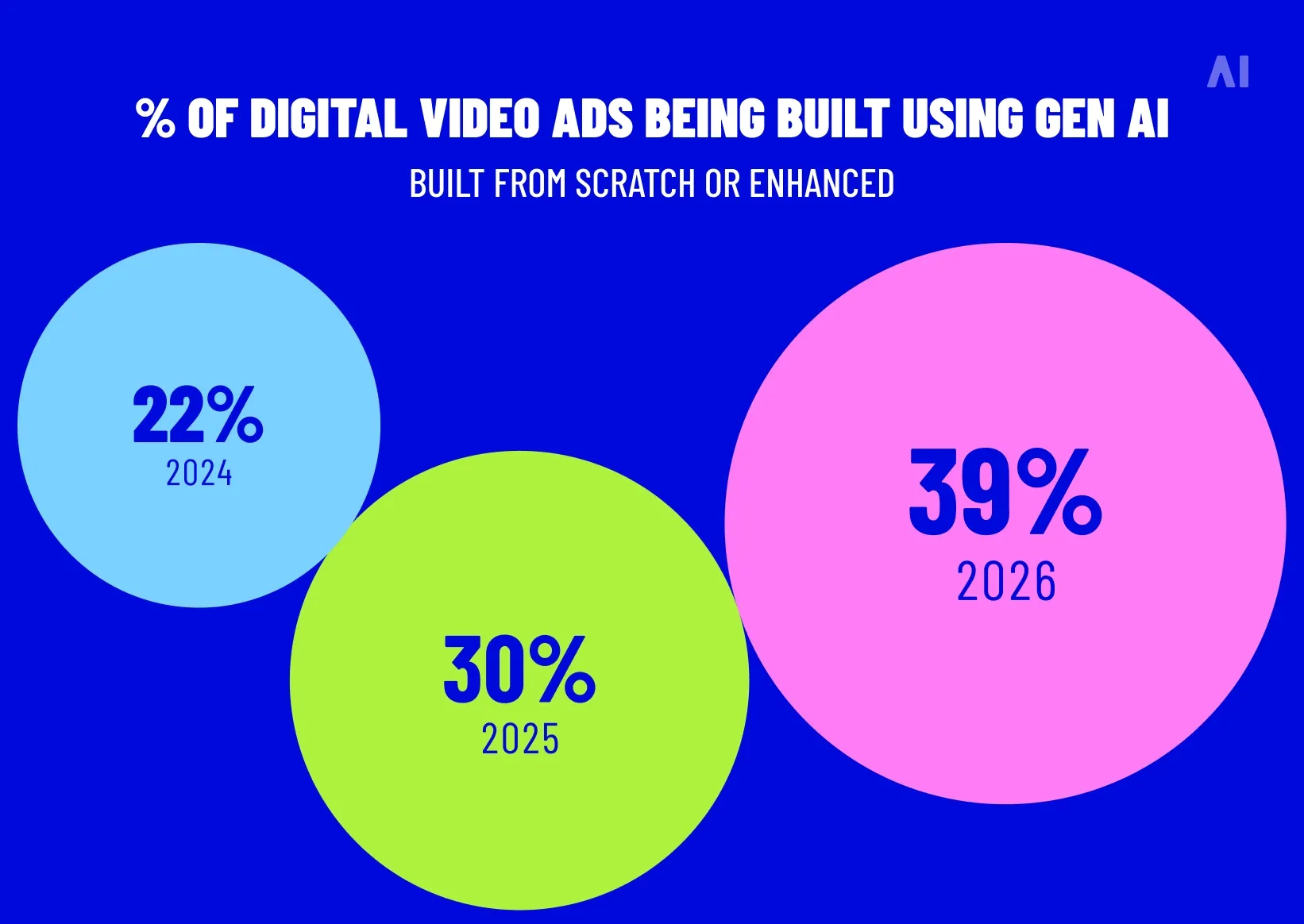
AI is increasingly embedded in this creative process. The IAB’s research indicates that a large majority of video advertisers plan to use AI tools for creative generation, optimization, and video editing by 2026.
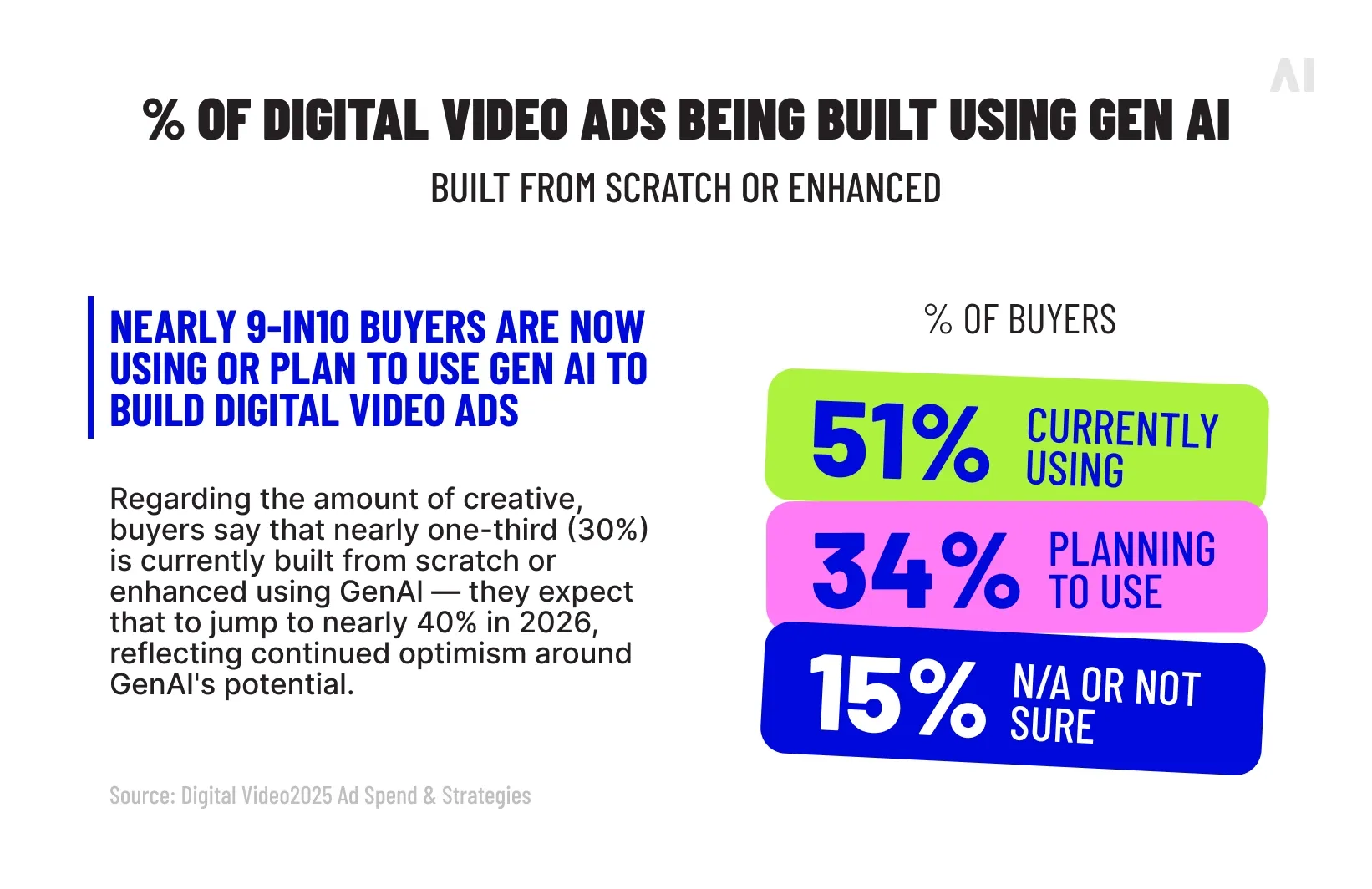
YouTube, for example, offers AI-powered creative suggestions and auto-generated ad variants, while Netflix and Disney are introducing more automated tools for versioning assets across markets and surfaces.
Advertisers that dominate TV in 2026 will be those that treat creative as an iterative, data-driven process instead of a one-off production exercise.
⚡ The old model was “launch the TV spot and hope for the best”. The new model is closer to product development: continuous testing, versioning, and learning while the campaign runs.
Data-driven targeting and CTV attribution
The biggest brands are moving away from blunt demographic targeting and toward:
- First-party data activation: Using CRM and loyalty data (e.g., Amazon shoppers, Walmart loyalty, bank customers, auto intenders) to build precise audience segments on CTV via clean rooms, hashed identifiers, and publisher APIs.
- Retail media integrations: Connecting CTV exposures to SKU-level sales using retailer data from Walmart, Amazon, Kroger, and others, often through DSP integrations like The Trade Desk.
- Cross-device attribution: Using identity graphs to link household-level TV exposure to mobile app installs, website visits, and purchases.
This is not just “better targeting.” It’s a structural shift in how TV is planned and measured: impressions are no longer anonymous; they are part of a trackable path to conversion.
⚡ Top TV advertisers aren’t chasing ever-narrower micro segments for fun. They’re using data to be more generous with reach—just with a much higher bar for waste.
Dynamic creative and personalization
Dynamic creative optimization (DCO) has been common in display and social for years; now it is arriving in CTV, especially through programmatic pipes and platforms that support server-side ad insertion.
Top advertisers use DCO to:
- Tailor offers by geography (e.g., nearest store, local price, regional promotions)
- Update messaging based on real-time signals such as weather, sports outcomes, or inventory levels
- Swap creatives mid-flight in response to performance data, without rebuilding the entire campaign
Retail and auto categories are leading here, using dynamic templates to show local dealers, stock availability, or personalized offers, while entertainment brands use dynamic slates to promote different shows based on what viewers just watched.
💡 For a deeper primer on DCP, please see Dynamic content personalization: how brands create smarter customer experiences in 2026
Full-funnel measurement across devices
Leading TV advertisers don’t ask, “Is TV brand or performance?” They expect both.
They combine:
- Brand lift: Using survey-based tools from Nielsen, Kantar, or platform-specific solutions to measure awareness, recall, and favourability.
- Incrementality tests: Using holdouts or geo-based test/control groups to estimate the incremental impact of CTV and linear on web visits, app installs, sales, or subscription sign-ups.
- Marketing mix modelling (MMM): Incorporating CTV as its own line item in econometric models, which often reveal that streaming TV punches above its weight when modelled correctly.
- Multi-touch attribution (MTA): Where data and privacy rules allow, linking CTV exposures to digital actions using cross-device graphs and publisher log-in data.
Innovid’s finding that CTV drove a disproportionately high share of conversions relative to impressions, as mentioned earlier, is one example of how full-funnel measurement is changing budget debates.
💡 For a primer on OTT and CTV, please see: OTT vs CTV: Key differences, similarities, and what they mean for your marketing strategy in 2025
Owning premium cultural moments
Finally, the biggest TV advertisers are obsessed with owning moments:
- Live sports: NFL, NBA, MLB, WWE, Formula 1, and more are increasingly available via streaming on YouTube TV, Prime Video, Disney’s ESPN apps, and others.
- Awards shows, tentpole dramas, and reality formats that still attract co-viewing on big screens.
- Cultural moments on YouTube: Google highlights “Cultural Moments Sponsorships” that allow brands to own categories like the Oscars, major golf tournaments, or Black Friday across YouTube inventory on TV screens.
Owning these moments increasingly means planning across broadcast, cable, and CTV platforms simultaneously, with unified frequency and creative orchestration.
⚡ Live sports, finales, award shows and cultural spikes are still where people lean in together. The difference now is that those moments increasingly happen inside apps, not just on channels.
CTV platforms capturing the most ad spend in 2026
Although there are dozens of CTV apps and FAST services, most U.S. CTV ad budget in 2026 will go to a relatively small set of platforms.
{{Top -TV-Advertisers-in-2026-SEO-4="/tables"}}
⚡ It’s tempting to fixate on platform rankings. The real question is more practical: which combination of platforms gets you the right people, at the right frequency, with measurement you trust?
YouTube on TV screens
YouTube is arguably the single most important CTV platform for advertisers in 2026:
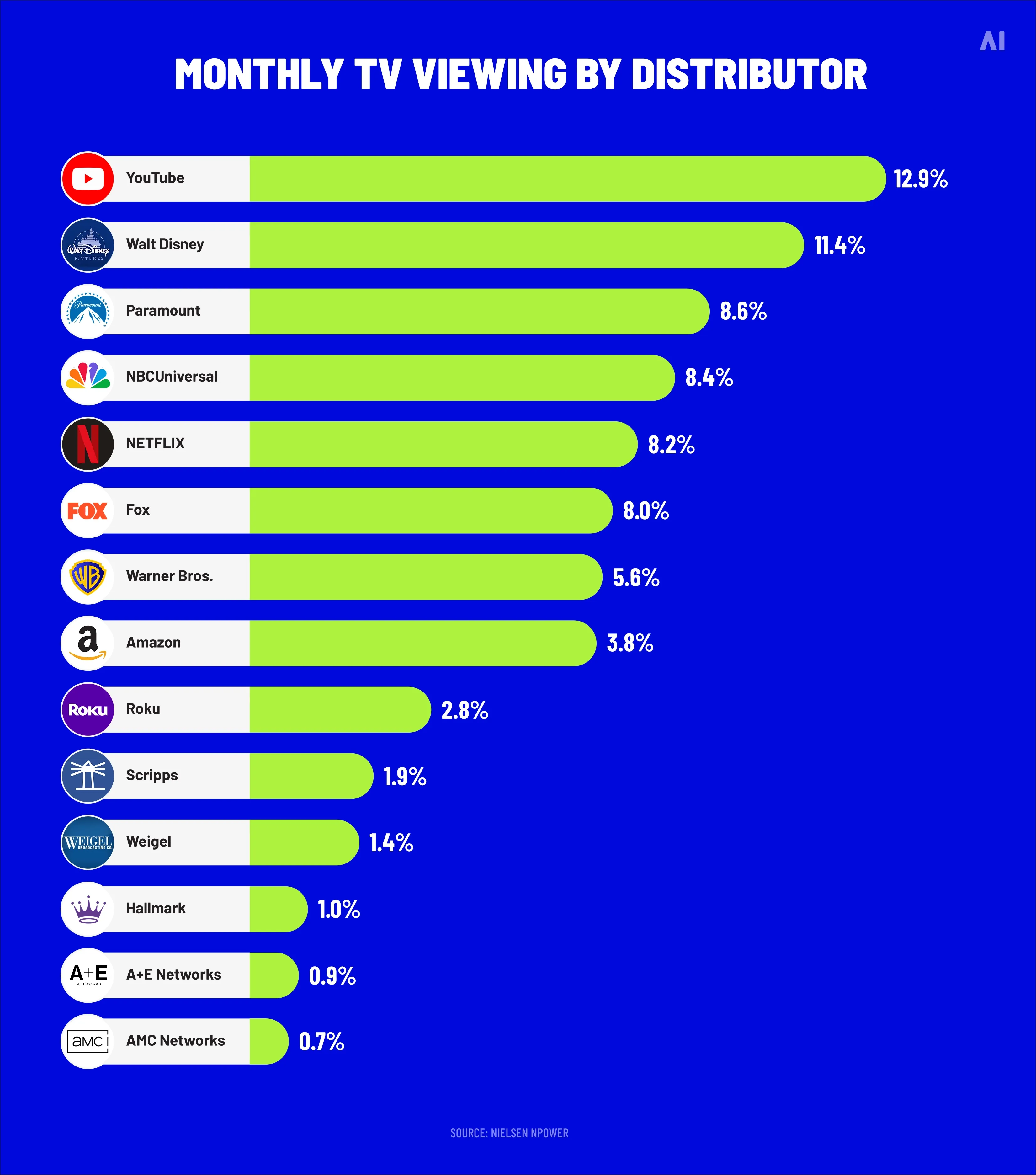
- In some 2025 reports, YouTube accounts for roughly 12.5% of U.S. TV usage across all streaming platforms, ahead of Netflix and Prime Video.
- eMarketer/Insider Intelligence projects that YouTube will capture about 11.9% of U.S. CTV ad revenue in 2026, corresponding to roughly $9.2 billion in net CTV ad sales.
YouTube combines:
- Immense reach across all ages, especially under-35s
- High watch-time on TV devices
- Sophisticated AI-driven targeting and optimization
- Strong performance attribution via Google’s wider stack
For TV advertisers in 2026, YouTube on TV screens is not an afterthought; it is often the anchor of the CTV buy.
💡 For a deeper dive into YouTube and the advantages of advertising on the platform, please refer to our dedicated guide: The advantages of YouTube TV advertising & how to start.
Disney: Hulu, Disney+, and ESPN
When you combine Hulu, Disney+, and ESPN’s streaming inventory, Disney becomes one of the top three CTV ad sellers:
- eMarketer estimates that Hulu and Disney+ together will command roughly 10.8% of U.S. CTV ad sales in 2026.
- Disney reports about 157 million ad-supported monthly active users globally across its streaming properties.
Disney’s CTV inventory is especially valuable because of:
- Premium scripted content and family franchises
- ESPN’s sports rights, increasingly available via streaming
- Robust first-party data across parks, consumer products, and streaming
For top TV advertisers, Disney’s bundle of CTV properties is still a must-buy environment for both reach and brand safety.
Amazon Prime Video (plus integrated Freevee content)
Amazon is consolidating its ad-supported video inventory into Prime Video, phasing out the Freevee brand while carrying Freevee content into a “watch for free” section inside Prime.
Key points for 2026:
- Prime Video’s ad business is projected to generate about $806 million in ad revenue by 2025, up from $433 million the year before, driven by ads introduced in early 2024.
- Prime Video reaches more than 315 million users monthly globally, many of them logged-in Prime members tied to rich shopping data.
- Amazon’s DSP allows advertisers to combine Prime Video and Fire TV placements with retail audiences and measurement, and now provides access to third-party premium inventory like Netflix, Disney, Roku, and more.
For performance-oriented TV advertisers, Amazon’s CTV footprint is especially attractive because it bridges TV exposure and retail outcomes inside one data system.
Netflix
Netflix is still smaller than YouTube in ad revenue terms but is growing quickly as an ad platform:
- Its ad-supported plan reached 70 million MAUs by late 2024, up from 40 million in mid-2024.
- More than half of new Netflix sign-ups in ad markets now choose the ad tier.
- Netflix has publicly said it doubled advertising revenue year-over-year and expects to double it again, signalling rapid growth.
With high-profile live sports rights, blockbuster series, and the ability to target by content and geography, Netflix will be one of the most coveted CTV buys for big brands in 2026, especially in entertainment, retail, and CPG.
Roku and The Roku Channel
Roku is both a leading CTV operating system and a large ad business in its own right:
- Roku reported over 90 million streaming households in early 2025, with The Roku Channel alone reaching households with nearly 145 million people and accounting for about 2.5% of all U.S. TV usage in May 2025.
- The Roku Channel is the top FAST service by share of viewing, and Roku has a long track record of dominating open programmatic CTV ad impressions.
Roku sells both:
- Inventory on The Roku Channel
- Home screen and OS-level placements across its platform
- Advanced measurement products that tie CTV exposure to outcomes like app installs and retail sales
Roku’s partnership with Amazon DSP, announced in 2025, further integrates it into the cross-platform CTV buying workflow advertisers are building.
Samsung TV+ and smart TV operating systems
Smart TV operating systems—especially Samsung TV+—are a critical piece of the CTV story:
- Samsung has around 67.8 million smart TVs in U.S. homes, equating to 32% of all smart TVs and presence in roughly 45% of smart TV households.
- Globally, smart TV ownership is projected to surpass 1.1 billion households by 2026, making smart TV OS platforms a central marketing channel rather than a niche environment.
Samsung TV+ inventory, combined with data from the broader Samsung device ecosystem, offers:
- Household-level targeting across categories like auto, retail, finance, and gaming
- Rich measurement capabilities using automatic content recognition (ACR) data
- Premium CTV replacement for some parts of traditional linear buys
LG, Vizio, and other smart TV OS players offer similar propositions, making the OS layer an essential part of many 2026 TV plans.
Paramount+ and Pluto TV
Paramount’s streaming footprint includes Paramount+ and the Pluto TV FAST service:
- Pluto TV sits among the top FAST services by share of TV usage in Nielsen’s Gauge reports, often close behind Tubi and The Roku Channel.
- Paramount+ has seen strong growth in ad-tier adoption after introducing lower-priced tiers, with some markets doubling ad-tier penetration over a year.
Paramount’s CTV inventory is especially attractive around sports (e.g., Champions League, some NFL, and other rights), kids and family programming via Nickelodeon, and franchise content such as Yellowstone and Star Trek.
For many advertisers, Paramount is part of a “second tier” of CTV buys after YouTube, Disney, Amazon, and Netflix—but still important for reach, genre coverage, and incremental audiences.
Examples of standout CTV campaigns in 2026
To make this more concrete, let’s look at a handful of real CTV campaigns that illustrate how top advertisers are using streaming in 2025–26:
- A good reference point comes from food-delivery brand Wolt, which used YouTube on connected TVs to reach “shared screen” moments at home, then nudged people onto their phones to order. The campaign focused on big-screen storytelling but was measured on app engagement and order intent, delivering notable lifts in both brand metrics and on-site actions.
💡 You can read more about the campaign here: Shared screens, shared meals: How Wolt delivered brand lift via connected TV & Delivering Brand Impact for Wolt: Magnite and Adform CTV Partnership
- Skincare brand Cetaphil worked with The Trade Desk on an AI-assisted “Social CTV” approach, repurposing social-style video into CTV creative aimed at Gen Z audiences. The campaign ran across premium CTV inventory, then used brand lift studies to show a strong jump in consideration among younger viewers, proving that social-native assets can work on the biggest screen in the house when they’re framed correctly.
💡 You can read more about this campaign here: How Cetaphil’s AI-powered “Social CTV” creative drove a 33% lift in consideration for Gen Z audiences.
- LG Display used a data-driven CTV strategy to reach TV and OLED intenders during key research moments, focusing on audiences watching comparison reviews and deal content. The campaign reached more than 1.7 million households with a very high completion rate, and follow-up brand lift research showed gains in both awareness and ad recall versus competitors.
💡 You can read more about this case study here: LG Display reaches 1.76m households with data-driven CTV strategy.
- A live-sports ecommerce campaign on The Trade Desk used CTV placements in football livestreams as the primary awareness driver, then tracked what happened when the first ad exposure occurred on the TV screen rather than elsewhere. The brand saw a significantly higher return on ad spend compared with non-CTV setups, alongside lifts in both brand awareness and online transactions, which led the agency to bake CTV into its standard sports playbook.
💡 You can read more here: 366% ROAS with connected TV live sports streaming.
- In Germany, lottery brand NKL partnered with Rakuten Advertising and Datazulu to shift budget from traditional TV into connected TV on Rakuten TV’s AVOD service. A short 15-second CTV spot delivered strong ad recall and brand attribution, and a brand lift study showed a clear uptick in consideration among lottery users, giving the advertiser evidence that CTV could refresh a mature category.
💡 You can read more about this campaign here: Leveraging connected TV to enhance lottery advertising in Germany – NKL case study.
- Finally, LG Ad Solutions’ Social Sync product offers a useful template for brands trying to stretch social assets onto CTV. In a recent blind test, turning social content into CTV creative delivered clear lifts across awareness, recall, consideration, and purchase intent, reinforcing the idea that CTV can work as an amplifier for the best-performing creative from other channels.
💡 You can read more here: LG Ad Solutions brings Social Sync to UK.
Key trends shaping TV & streaming advertising in 2026
Looking ahead, several trends will define how TV and CTV evolve through 2026 and beyond.
AI-powered creative optimization and decisioning
AI is already embedded in almost every part of TV buying, and its influence is growing:
- Creative: Generating and optimising video variants, personalising messaging, and automatically editing creative to fit multiple placements and length requirements.
- Bidding: Adjusting bids in real time based on predicted performance for specific audiences, placements, or content types.
- Planning: Forecasting reach and frequency across linear and streaming and identifying the mix that maximizes incremental reach for a given budget.
Platforms like YouTube, Amazon Ads, and Samsung Ads are building increasingly sophisticated AI-driven products around contextual targeting, attention prediction, and “peak moment” insertion.
For advertisers, the takeaway is that manual optimization alone is no longer enough; the brands that win will be those that feed high-quality first-party data and clear business goals into AI-powered TV systems.
True cross-device attribution
As streaming usage moves across TV sets, phones, tablets, and laptops, attribution is becoming more cross-device by default.
Several developments are driving this:
- Identity graphs and clean rooms from Google, Amazon, Disney, Roku, Samsung, and independent providers make it possible to link CTV exposures to digital actions without relying entirely on cookies.
- Retail media integrations allow advertisers to connect big-screen exposures directly to SKU-level sales at retailers like Walmart, Amazon, Target, and Kroger.
- Cross-platform measurement from firms like Innovid, Samba TV, and Nielsen provides unified reporting for linear plus streaming reach and outcomes.
By 2026, “TV attribution” increasingly means understanding the full contribution of big-screen exposure across all devices in the household, not treating TV as a separate channel with its own isolated metrics.
First-party data activation at scale
Privacy regulations and platform changes are making third-party identifiers less reliable. In response, CTV is becoming a key channel for activating first-party data:
- Retailers like Amazon and Walmart, with deep purchase histories, are using their data to segment and target CTV campaigns with precision.
- Banks, auto brands, and subscription services are using clean rooms and hashed identifiers to match their CRM data with publisher or platform audiences on CTV without exposing raw PII.
- Streaming platforms with log-ins (Netflix, Disney+, Hulu, Prime Video, YouTube, Roku, Samsung) use first-party identity to deliver more relevant ads and better frequency control.
In this environment, smaller advertisers without strong first-party datasets will increasingly rely on retail media networks and platform-owned segments to access high-value audiences on TV screens.
⚡ Once TV, CTV, and retail media operate on the same identity spine, they stop feeling like separate channels. You’re simply using different surfaces to move the same customer closer to a decision.
💡 For a deep primer on AI-driven personalization, please refer to our article: What is AI-driven Personalization?
Premium live sports moving to streaming
Live sports are one of the last bastions of appointment viewing and are crucial to TV advertising:
- Nielsen’s 2025 data shows that sports accounted for a large share of broadcast viewing spikes, with NFL and college football driving a 20% month-over-month increase in broadcast viewing in September 2025, even as streaming remained the largest category.
- Amazon Prime Video continues to invest in NFL Thursday Night Football, with record-breaking viewing minutes and advertiser interest.
- ESPN and Disney are deepening their streaming sports bets, including rights deals with WWE and ongoing negotiations around the NFL and other leagues.
- Netflix is moving into sports-style live events, including WWE and NFL-adjacent programming, and has sold out in-game ad inventory for some of its first NFL events.
As more sports migrate toward streaming, TV advertisers in categories like auto, beer, QSR, finance, and tech will shift a growing share of their “sports” budgets into CTV buys on YouTube, Prime Video, Disney, and others.
💡 If you want to dig deeper into how live sports are shifting from linear to streaming and what that means for media planning, you can download AI Digital’s live sports streaming report. It breaks down which rights are moving where, how CTV platforms package live inventory, and what leading advertisers are doing to measure incremental reach and sales from sports buys. You’ll also find practical frameworks for reallocating budgets between linear, CTV, and retail media around big sporting moments. Grab the full report here: The State of Live Streaming 2025.
Performance TV and outcome-based buying
The biggest shift in TV buying philosophy is the move toward performance-oriented TV:
- Ad tech providers and CTV platforms promote cost-per-outcome models (cost per site visit, per incremental reach, per store visit, or per sale) as complements to TRPs and CPMs.
- Retail media-CTV combinations (like Walmart Connect + CTV, Amazon DSP + Prime Video + retail audiences) allow advertisers to buy TV the way they buy search: set an outcome goal and optimize.
This doesn’t mean traditional brand metrics disappear. Instead, TV plans are increasingly built to hit both brand KPIs (lift, reach, recall) and business KPIs (sales, sign-ups, installs) within a single framework.
CTV as an extension of retail media and commerce
Retail media’s explosive growth means that CTV is becoming a natural extension of retail media, not a separate world.
In practice:
- Retailers extend retail audiences to CTV inventory via DSPs.
- Brands run CTV campaigns targeted to loyalty segments, then retarget exposed households with sponsored search and display.
- All of this is measured in terms of incremental sales and new-to-brand buyers.
For top TV advertisers in 2026, the real advantage comes when TV, CTV, search, and retail media are planned, bought, and measured as one system — exactly what AI Digital’s Open Garden framework, Smart Supply selection, and Elevate intelligence platform are designed to deliver, supported by our DSP-agnostic managed service team.
Conclusion: How marketers can win in the new TV landscape
If you’re planning for 2026 and want to act more like the top TV advertisers above, here’s how to approach it.
- Treat TV and CTV as one video system. Plan reach and frequency across linear, YouTube on TV, major streamers, and smart TV OS platforms together. Use incremental reach and frequency data to guide allocation rather than relying on habit or legacy splits.
- Invest in first-party data and identity. Build or improve your own CRM and event tracking so you can use clean rooms and platform integrations to activate your audiences on CTV, especially via retail media partners and major platforms like Amazon, Google, and Disney.
- Adopt performance-TV thinking. Move beyond “TV is awareness.” Set outcome KPIs for CTV campaigns (incremental sales, sign-ups, or qualified visits), and work with partners who can measure them using retail data, cross-device attribution, and incrementality tests.
- Upgrade creative operations. Plan for multiple variants, formats, and lengths from the start. Use AI tools to accelerate versioning and testing, but keep human creative judgement at the centre. Measure creative performance by audience and placement, and iterate mid-flight.
- Lean into premium live moments. Identify the sports, cultural tentpoles, and platform-level “cultural moments” that matter to your audience, and design integrated campaigns that span broadcast, CTV, and short-form digital video around them.
- Choose the right mix of CTV platforms. Prioritize YouTube on TV, Disney (Hulu/Disney+/ESPN), Amazon/Prime Video, Netflix, Roku, and major smart TV OS platforms like Samsung TV+, then layer in FAST and niche services where they add unique reach or context.
- Use AI-driven optimization carefully. Let algorithms do the heavy lifting on bids, pacing, and dynamic allocation, but set clear constraints and guardrails to ensure brand safety, sensible frequency, and alignment with your business priorities.
In short: TV advertising in 2026 is still about big cultural moments and emotional storytelling—but the brands that dominate are those treating big-screen video like a data-driven performance channel, with AI, first-party data, and retail media at its core.
If you’re serious about making TV and CTV work like the rest of your performance stack, it’s worth talking to the AI Digital team. Our Smart Supply solution selects the best-performing TV, CTV, and video inventory across an open, DSP-agnostic supply graph, then optimizes it to the outcomes that matter to you with full transparency on fees and media. If you’d like to see what that could look like for your brand, reach out to AI Digital or ask for a Smart Supply walkthrough from our team.