Local TV Advertising: How Brands Reach, Engage, and Convert


Local TV advertising is having a quiet reset. The reason is simple: the “TV screen” is now split across linear viewing (broadcast/cable) and streaming viewing (connected TV), but local demand still looks familiar: people want nearby services, nearby stores, nearby appointments, and nearby events.
In May 2025, Nielsen reported that streaming’s share of total TV usage (44.8%) edged past broadcast plus cable combined (44.2%) for the first time. That one data point explains why local TV planning now starts with a practical question: what do you need TV to do—reach the market, or drive measurable actions, or both?
💡 If you want a broader primer on how TV advertising works across formats, see AI Digital’s overview.
⚡ Local TV works best when it collapses the distance between “I’ve heard of you” and “I know exactly where to go.”
What is local TV advertising?
Local TV advertising is paid video placement designed to reach people in a defined geography, usually a DMA (Designated Market Area) or a tighter region (county/ZIP radius), and often with local creative (location, offer, hours, local voice, local proof).
It can include:
- Linear local TV: broadcast station inventory and cable zones.
- Local streaming/CTV: ads served into streaming environments and addressable TV placements that still keep the targeting local.
- Sponsorships: owning a local segment (weather, traffic, high school sports, community programming) that delivers repeated association.
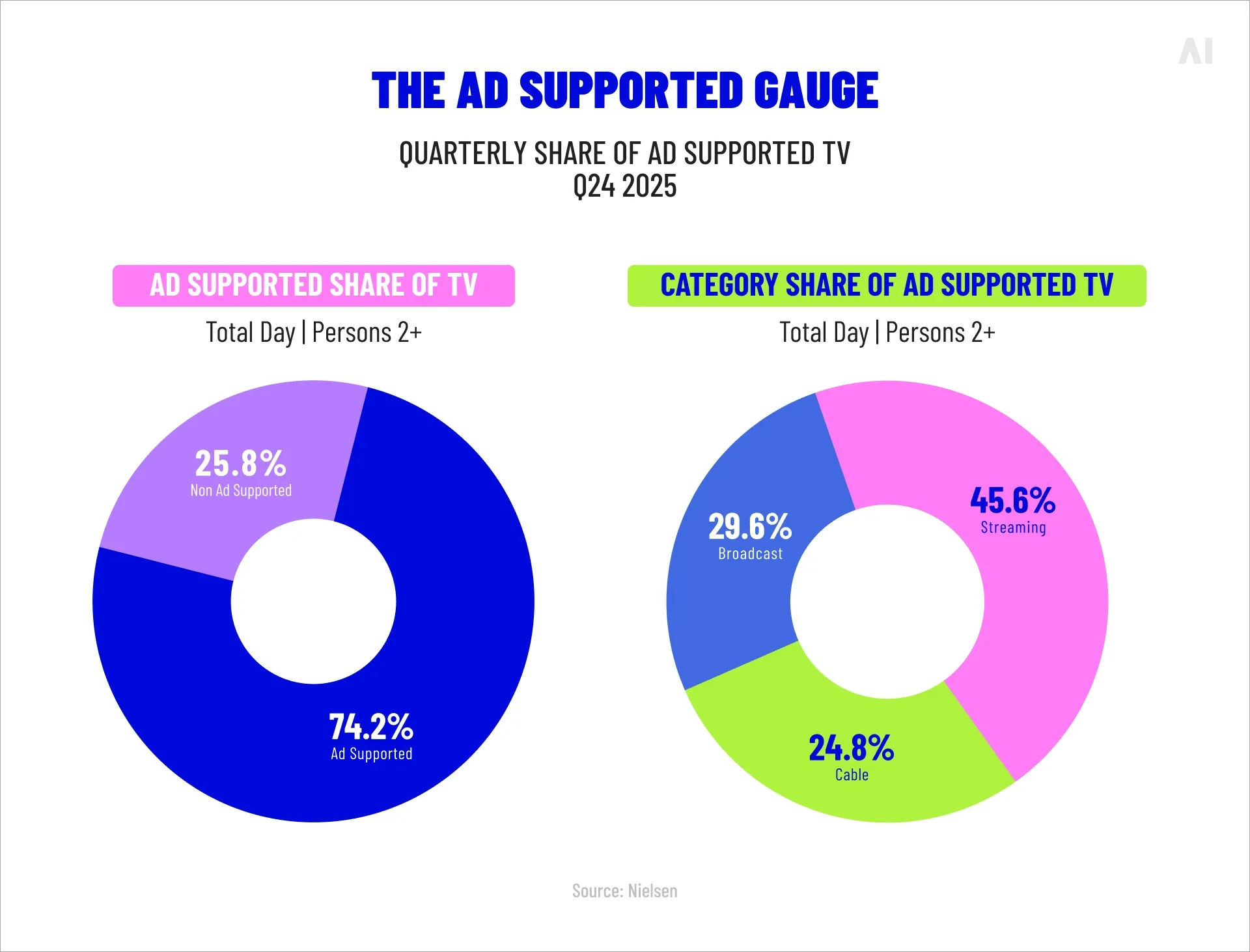
⚡ In Q2 2025, Nielsen reported that 73.6% of overall TV viewing was ad-supported. That matters for local campaigns because it means inventory depth is still there—you just have to plan across where ad-supported viewing actually happens.
Two clarifications matter for marketers who want measurable outcomes:
- “Local” describes the targeting and distribution model, not the screen. A streaming ad targeted to a 10-mile radius around a store is still local TV, even if it runs inside a streaming app.
- Local TV can be bought in two currencies. Linear buying often uses ratings-based units (like CPP), while streaming buying uses digital units (like CPM) and can attach performance metrics (site visits, QR scans, store-visit lift, etc.).
Types of local TV advertising
Local TV isn’t one thing. It’s a menu of inventory types, each with different strengths for reach, targeting, and measurement.
{{26-What-is-Local-TV-Advertising-SEO-1="/tables"}}
Broadcast TV advertising
Broadcast (local stations and their network programming) is still the local “mass reach” engine. It’s the quickest way to:
- Put a message in front of a large share of the market in a short window.
- Pair your offer with high-trust programming like local news.
- Support seasonal surges (back-to-school, tax season, holidays) where local demand spikes.
Broadcast inventory is typically bought by:
- Daypart (morning, daytime, early news, primetime, late news)
- Program (specific shows, sports, special events)
- Audience demo (age/gender household targets, depending on availability)
Local program sponsorships
Sponsorships are the “repeat association” play. Instead of buying scattered spots, you own a recurring moment: weather, traffic, a community segment, a local sports roundup, a morning show feature.
This format matters because local TV effectiveness often comes from frequency and memory, not just a single exposure. In a 2025 study from Television Bureau of Advertising, 95% of respondents said local news helps them stay informed and connected to their community, which is exactly the mindset sponsorships can borrow.
Local cable TV advertising
Cable is more fragmented than broadcast, but it offers a useful lever for local advertisers: geographic specificity.
Cable inventory may allow:
- Zone-based placement (e.g., specific parts of a metro)
- Audience-based buying in some systems (depending on provider)
Cable can be effective for:
- Retailers with multiple locations
- Home services covering specific neighborhoods
- Healthcare systems targeting defined catchment areas
💡 Related reading: Cable TV advertising.
CTV & local streaming advertising
Connected TV (CTV) and streaming ads run inside streaming environments on smart TVs and streaming devices. This is where “local TV” begins to look and behave like digital media:
- You can target tighter geographies (DMA, ZIP clusters, or radius targeting, depending on platform and data).
- You can control frequency more directly.
- You can use performance-style measurement, including site visits, QR scans, call tracking, and (with the right partners) store-visit lift.
IIf you’re wondering where local streaming inventory lives, think in buckets rather than brand lists:
- Ad-supported subscription video (streaming services with ad tiers)
- Live TV streaming bundles (vMVPDs)
- Free ad-supported streaming TV (FAST)
- Local broadcaster streaming apps and websites (OTT extensions of local stations)
⚡ In May 2025, three FAST services—Pluto TV, The Roku Channel, and Tubi—combined for 5.7% of total TV viewing. For local advertisers, that’s a reminder that “premium streaming” and “free streaming” both contribute meaningful reach, but they don’t always behave the same for performance.
💡 Related reading: Streaming TV advertising & Connected TV advertising.
Linear TV vs. Connected TV: what matters for local campaigns
Most marketers don’t need a philosophical debate about linear versus CTV. They need to know what changes in planning, buying, and measurement.
{{{26-What-is-Local-TV-Advertising-SEO-2="/tables"}}
Here are the practical differences that matter.
1. Reach versus addressability —
- Linear is still the fastest way to reach a large share of a local market, especially during news and live programming.
- CTV is the better lever when you need tighter targeting and more control over who sees the ad, how often, and in what environment.
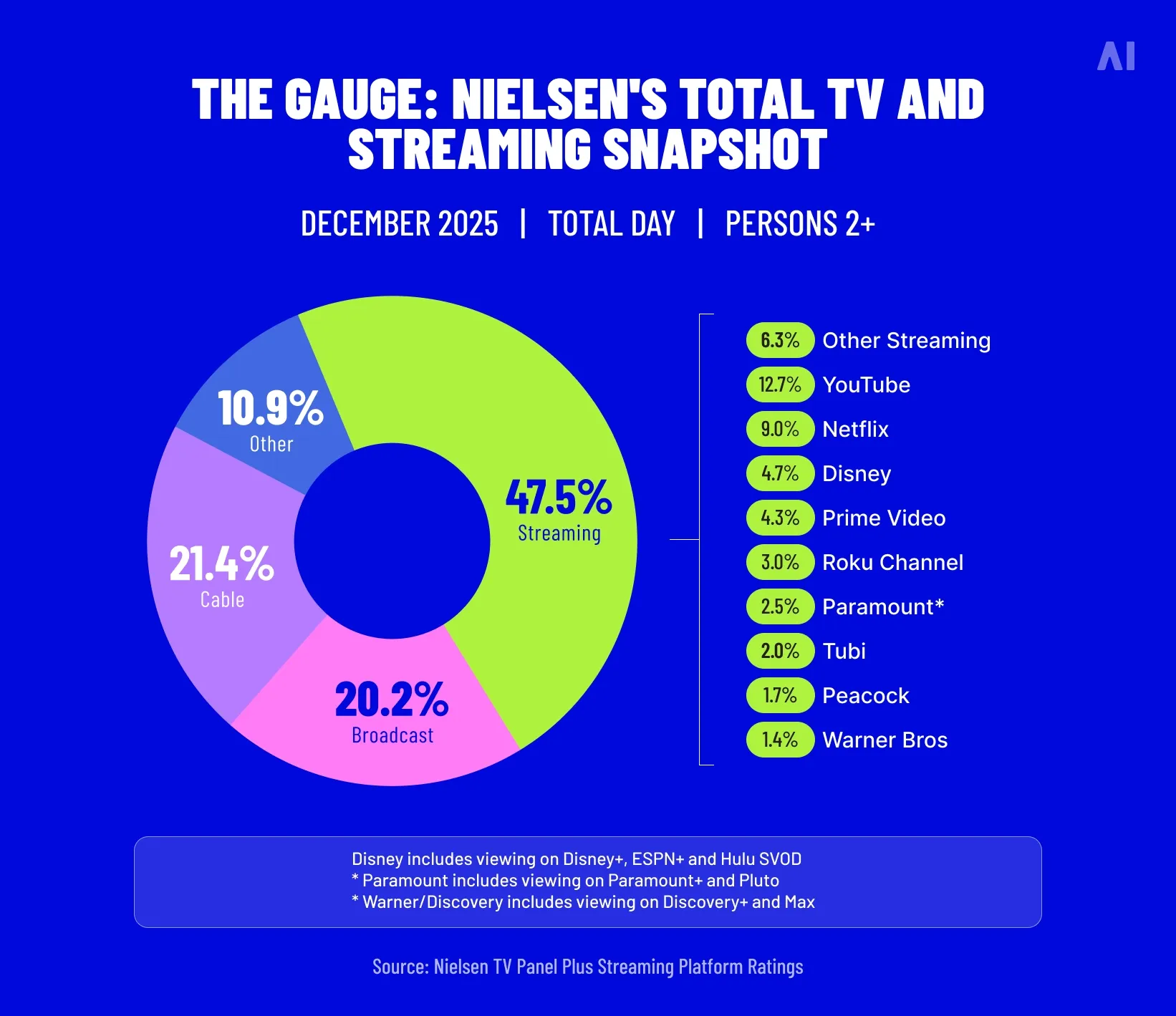
By December 2025, Nielsen reported streaming represented 47.5% of total TV usage. That’s a reminder that “TV reach” is no longer a single pool.
.webp)
2. Buying mechanics and KPIs —
Linear local campaigns often optimize around:
- Reach and frequency
- CPP / cost efficiency by demo
- GRPs and delivery
- Post-buy verification (what actually ran)
CTV campaigns often optimize around:
- CPM and audience delivery
- Completion rate / view-through behavior
- Incremental reach (how many “new” households you reached beyond linear)
- Down-funnel signals (site visits, calls, store visits where available)
💡 Related read: CTV vs linear TV: Key differences.
3. Measurement expectations —
CTV raises the expectation that TV should be more measurable. That can be good, but it also creates a trap: counting clicks is not the same as proving incremental lift.
A practical way to keep measurement honest:
- Use CTV metrics (delivery, frequency, completion) to manage execution.
- Use incrementality (geo-lift tests, matched market tests, holdouts) to validate outcome.
- Use blended signals (search lift, direct traffic, calls, appointment volume, store visits) to cross-check.
Nielsen has also expanded cross-platform transparency by adding measurement across 20 platforms totaling 95% coverage of the U.S. CTV ad market within Nielsen Ad Intel, reinforcing the push toward clearer “where did the spend go?” visibility.
4. Creative implications —
Linear rewards clarity and repetition:
- The viewer may not be actively “shopping.”
- You’re often building memory for later action.
CTV can support more tailored creative:
- Different messages for different audience segments.
- Dynamic overlays (where supported) and more precise calls to action.
Simple rule: Use linear to make the market know you. Use CTV to make the right households act.
Benefits of local TV ads
Local TV works when you match the benefit to the business outcome you actually need. Below are the benefits most relevant to performance-driven local plans, especially when you’re using a hybrid of linear and CTV.
Highly targeted geographic reach
Local TV can be broad (entire DMA) or precise (zones, ZIP clusters, radius targeting on streaming). That flexibility matters when your market isn’t “the whole city,” but a set of trade areas with very different customer density and intent.
The modern advantage is not just local reach. It’s local reach with controls that reduce waste and improve consistency:
- Frequency caps (more feasible in streaming) so you don’t overserve the same households.
- Exclusions so you don’t pay to reach outside your service area (or in areas you can’t fulfill quickly).
- Day/time alignment so the ad shows up when people are most likely to act (for example, evenings for home services, weekends for retail).
⚡ Geo precision is wasted if your operational reality can’t support it. Make sure your targeting map matches where you can actually deliver great service, quickly, without exceptions.
A practical way to think about this: local TV lets you decide whether you want “coverage” (market-wide familiarity) or “coverage with precision” (trade-area focus), then buy accordingly.
💡 Related read: Geotargeting vs. geofencing.
Brand credibility & trust
Local stations and local news still borrow trust in a way many digital environments can’t. In October 2025, Pew Research Center reported that 70% of U.S. adults say they have at least some trust in the information they get from local news organizations.
.webp)
This doesn’t mean your ad inherits full credibility automatically. It means local TV can be a stronger environment for “high-friction” decisions where people want reassurance before they act. It tends to support categories like:
- Healthcare and regulated services (providers, clinics, insurance, compliance-heavy offers)
- Financial services (local branches, advisors, credit unions)
- Local retailers that need to look established, not temporary
What makes this work is consistency: the same promise, repeated in familiar local programming, with proof that feels grounded (reviews, tenure, real locations).
⚡ Local news and local stations can create a more credible context, but your spot still has to earn belief. Proof beats polish, especially in categories where people feel risk.
High-impact visibility
TV remains one of the few formats where the viewer is often in a lean-back setting and the creative fills the screen:
- The screen is large.
- Sound is often on.
- The ad is hard to ignore when it’s well-made.
High impact is not just aesthetic. It’s practical: it makes your offer easier to remember when people later search, compare, ask a friend, or drive past your location. For performance plans, this matters because memorability is often what turns “I’ve heard of them” into “I should try them.”
A small creative note that improves impact fast: state the category and local promise early, then use the rest of the spot to justify it with proof.
Foot traffic & conversion lift
Local TV is often strongest when it is paired with a measurable next step:
- “Book online”
- “Call now”
- “Visit today”
- “Get directions”
- “Use this local code”
The measurement approach matters more than the claim. If you want to connect TV to outcomes, you typically need:
- A clean, trackable CTA (vanity URL, QR, call tracking)
- An attribution plan (geo-lift, matched markets, incrementality)
- A cross-channel assist (search and social capture demand once it’s created)
The simplest way to keep this honest is to treat local TV as a demand creator and your digital channels as demand capture. When you line up the timing, you can see a clearer pattern in the data: lift in branded search, direct visits, calls, store-locator actions, and then downstream conversions.
💡 Related read: Foot traffic attribution.
⚡ TV doesn’t “convert” the same way a click does. It creates demand, then your other channels collect it.
Seasonal & Event-based relevance
Local TV is built for moments when consumer intent rises:
- Weather shifts (HVAC, roofing, tires)
- Calendar peaks (back-to-school, holidays)
- Local events (sports seasons, festivals)
- Category surges (tax season, enrollment windows)
These windows reward campaigns that can move quickly and feel truly local, not generic. If you’re planning around seasonal spikes, TV’s advantage is speed-to-awareness: you can put the message in front of a large share of your market fast, then use streaming and digital to focus on the highest-value areas and audiences.
💡 Related read: The ultimate guide to sports OTT streaming in 2026.
Cost of local TV advertising
Cost is where most teams either overestimate the barrier or underestimate the complexity. The truth is: local TV can be accessible, but pricing is highly dependent on market, timing, inventory, and how you buy.
Start with the big picture: BIA Advisory Services forecasts U.S. local media/advertising revenues at $171B in 2025, rising to $199B by 2029, with digital holding a slight majority share in 2025. That’s a reminder that local budgets are not disappearing. They’re shifting into more trackable formats.

What actually drives the price
Here are the variables that move cost up or down:
- Market size (DMA rank): Bigger markets cost more.
- Daypart/program quality: Primetime and live sports are premium.
- Seasonality: Political cycles, holidays, and category peaks affect demand.
- Spot length and unit type: 15s vs 30s vs 60s; sponsorships vs standard spots.
- Audience specificity: Tighter targeting usually costs more (but reduces waste).
- Volume and commitment: Larger commitments can improve pricing.
- Creative and production: Production is separate from media but affects performance.
{{26-What-is-Local-TV-Advertising-SEO-3="/tables"}}
What does a local TV spot cost?
Because pricing varies so widely, the most useful “cost” discussion is range by market size.
In a June 2025 guide, Simulmedia listed typical 30-second local TV ad ranges by market size:
- Small markets (DMAs 151–210): $200–$1,500
- Mid-sized markets (DMAs 51–150): $500–$3,000
- Large markets (DMAs 1–50): $2,000–$10,000
- Top 10 markets: $5,000–$50,000+
Use these as planning inputs, not as promises. Your actual rate depends on what you buy and when.
What does local streaming (CTV) cost?
Streaming is usually priced on CPM, and rates vary based on:
- Inventory quality (premium vs long-tail)
- Targeting depth
- Supply path (direct vs resold)
- Fraud/quality protections
If you are trying to estimate streaming locally, it helps to think in outcomes:
- How many households do you need to reach?
- How often do you need them to see it (frequency)?
- What action are you trying to cause (and how will you measure it)?
A simple way to budget without guessing
If you want a sane budgeting workflow:
- Define the trade area and target reach.
- Choose a primary role for TV:
- Market reach (linear-heavy)
- Addressable performance (CTV-heavy)
- Hybrid (most common)
- Set an initial frequency goal.
- Back into spend using the buying currency:
- Linear: ratings delivery and CPP logic
- CTV: CPM and household reach
- Reserve 10–20% for optimization and creative refresh, because fatigue is real.
💡 Related read: CTV media buying
How to buy local TV ads
Buying local TV has three main paths. The “best” option is the one that matches your team’s capabilities and your measurement requirements. In practice, many brands use a hybrid: lock in premium linear placements for reach, then use CTV to tighten targeting, manage frequency, and attach clearer outcome measurement.
{{26-What-is-Local-TV-Advertising-SEO-4="/tables"}}
A helpful way to choose is to ask two questions up front:
- What role is TV playing in this campaign? Broad market reach, measurable response, or both.
- What proof do you need at the end? Delivery proof is different from incrementality proof, and the buying path changes what’s realistic.
Option 1: Buying directly through local stations
This is the classic approach: you work with station reps, negotiate inventory, and receive post-buy reporting. It’s especially relevant when you care about premium local programming (news, major local sports, high-attention shows) and want access to sponsorships.
What this process usually looks like
- You brief the station on your geography, target audience, timing (flight dates), budget range, and category (some categories have restrictions).
- The station proposes a schedule (dayparts/programs) and estimated delivery.
- You negotiate: rates, placement protections (if any), and sponsorship elements.
- After the campaign, you receive delivery documentation and a recap (and, if needed, makegoods).
Best for:
- Brands that want premium local programming, especially news.
- Teams that value relationships and access to high-impact placements.
- Campaigns where broad reach is the priority.
Watch-outs:
- It can be slower, especially if you’re buying multiple markets.
- Measurement may rely more on delivery and correlation unless you add incrementality testing.
How to make this path more measurable (without pretending it’s click-based):
- Build a simple response layer: unique vanity URL, QR, call tracking, store-locator tracking.
- Use matched-market or geo-lift testing if you need stronger causal proof.
- Align TV flighting with search coverage so you can see lift in branded/category demand capture, not just “impressions delivered.”
What to ask stations for:
- Clear inventory description (program/daypart mix) and any placement protections.
- Post-buy delivery reporting, plus how makegoods are handled if something under-delivers.
- If you’re running sponsorships: what exactly is included (mentions, billboards, integrations, digital extensions).
Option 2: Agencies and managed services
Agencies (and managed-service partners) bundle expertise across linear, streaming, and measurement. This route is often the most efficient when your campaign spans multiple markets, multiple formats, or you want a clean operating model: one plan, one set of reporting expectations.
Agencies can bundle expertise across:
- Negotiation and market-level buying
- Market selection and flighting strategy
- Creative coordination and versioning
- Measurement planning (including incrementality approaches)
Best for:
- Teams without in-house TV buying expertise.
- Multi-market campaigns where coordination is complex.
- Brands that want a blended plan across linear, streaming, and digital.
Watch-outs:
- You need clear reporting expectations up front.
- You should ask where fees sit (transparent vs bundled) and what’s included.
The questions that prevent headaches later:
- What does “managed” mean here? Weekly optimizations, creative rotation, frequency management, supply path controls, and troubleshooting should be explicit.
- What is your measurement plan before launch? If the answer is vague, you’ll get vague results.
- Who owns the learnings and the data? You want portability, not a one-off report you can’t build on.
When agencies shine:
- When you need a hybrid approach that balances linear reach with CTV precision.
- When your creative needs versioning by market or offer but you don’t want chaos in production and trafficking.
- When stakeholders demand outcome proof and someone has to design the test plan, not just run media.
Option 3: Programmatic and CTV platforms
This route covers streaming buys and, in some cases, addressable linear inventory. It’s attractive because it:
- Speeds up activation
- Improves targeting and frequency control
- Enables more digital-style measurement
The tradeoff is that quality control becomes your job. You’re buying through a marketplace. That can be powerful, but only if you manage supply, verification, and measurement intentionally.
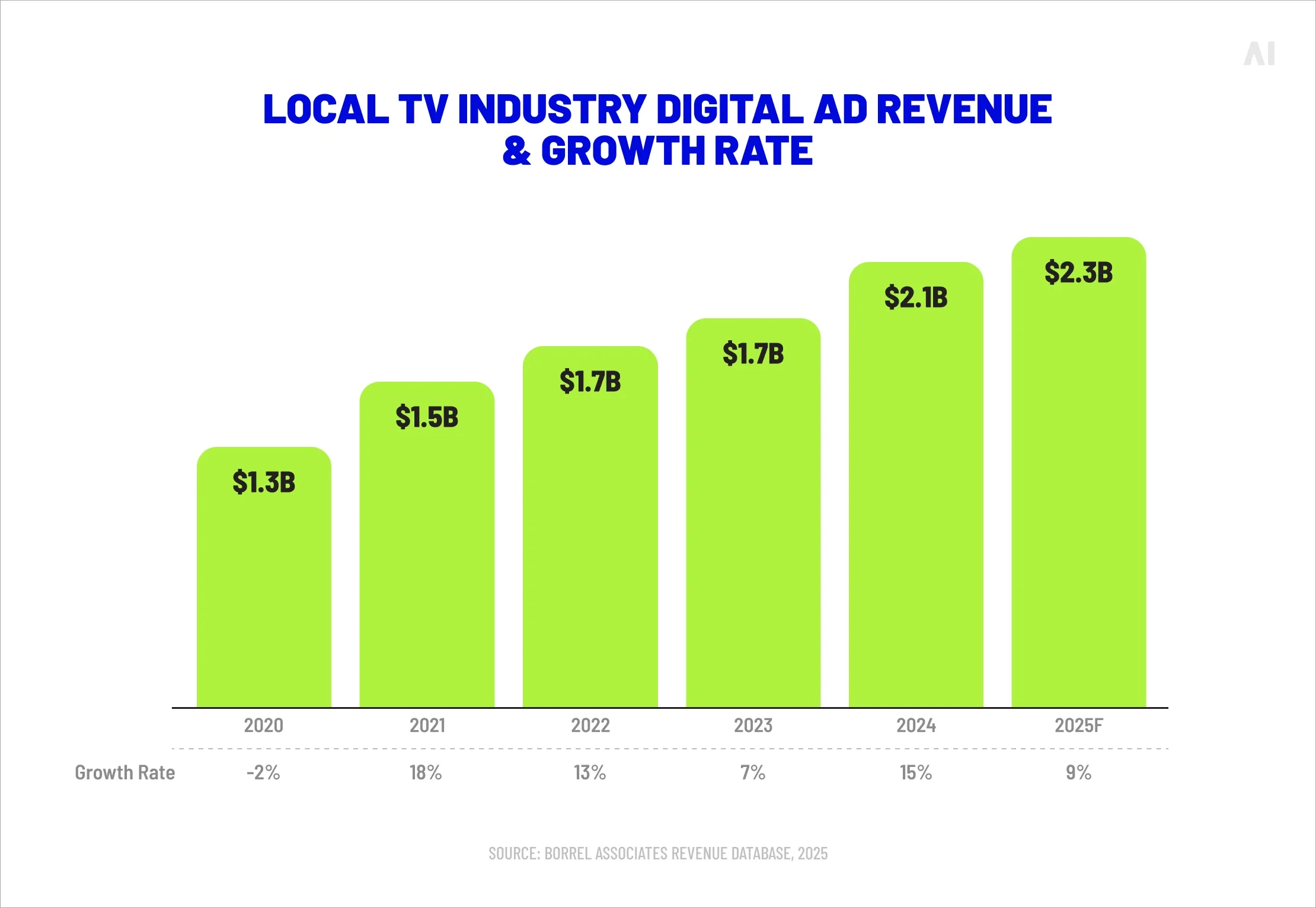
What this process usually looks like:
- You choose a buying surface: DSP, platform direct, curated marketplace, or a managed-service programmatic partner.
- You define geography and audience (trade area, ZIP clusters, household segments).
- You set frequency rules, creative rotation, and measurement tags.
- You monitor delivery, reach, and response signals, then optimize mid-flight.
Why standards matter more here: Programmatic CTV has historically suffered from fragmentation: different ad formats, inconsistent implementation, and operational friction. A key improvement in 2025 is continued standardization of CTV ad formats. In December 2025, IAB Tech Lab published its CTV Ad Portfolio (six core formats) alongside updates to programmatic CTV guidance, including OpenRTB support for prioritized formats like Pause and Menu.
This kind of standardization matters because it reduces the “custom one-off” nature of CTV creative and makes buying and reporting more consistent.
How to keep programmatic CTV performance-focused
- Treat targeting as a hypothesis, not a guarantee. Start broad enough to learn, then tighten.
- Use frequency caps and creative rotation to avoid waste.
- Use verification and transparency requirements so you know where ads ran.
- Align measurement to outcomes. If your goal is performance, don’t stop at completion rate.
On the measurement side, there’s also a clear industry push to close the “outcome gap” in CTV. In October 2025, IAB published guidance on Conversion APIs (CAPI) for CTV measurement to support more privacy-safe, outcome-oriented reporting and optimization.
And on the transparency side (and as previously mentioned), Nielsen notes it added measurement across 20 platforms totaling 95% coverage of the U.S. CTV ad market in Nielsen Ad Intel, which helps marketers better understand where budgets are going across major platforms.
💡 Where supply quality discipline matters: If your goal is performance and waste reduction, this is also where supply quality discipline matters most: inventory transparency, fraud controls, and a clear view of the supply path. AI Digital’s Smart Supply approach and its guide to programmatic advertising platforms are relevant reads if your plan includes programmatic CTV:
- Smart Supply | Programmatic Media Buying & Planning Software by AI Digital
- The Best Programmatic Advertising Platforms — AI Digital
A quick “which option should I pick?” shortcut:
- If you need premium local context and broad reach, start with stations.
- If you need operational simplicity across markets and formats, use an agency/managed service.
- If you need tight targeting, frequency control, and faster optimization, lean into programmatic/CTV, but only with strong transparency and measurement guardrails.
Steps to winning local TV campaigns
This is the part most teams rush. The fastest way to waste a local TV budget is to treat it like a single creative drop with no measurement logic.
A “winning” local TV campaign is built like a system:
- Role clarity: what TV is responsible for (reach, response, or both).
- Local relevance: creative that feels specific to the market.
- Capture and proof: a clear path from exposure to action, plus a way to validate lift.
Define clear business goals
Start by choosing one primary goal and one secondary goal. This keeps planning clean and prevents reporting from becoming a pile of unrelated metrics.
Examples:
- Primary: drive booked appointments
- Secondary: lift branded search volume in-market
If you set five goals, you usually measure none well.
Make the goal measurable before you buy anything:
- If your primary goal is appointments, decide what “counts”: booked consults, completed forms, calls over 60 seconds, etc.
- If your goal is store visits, decide what proof you’ll accept: store-locator clicks and direction requests, POS-linked redemptions, footfall lift studies (where available), or a geo-lift test.
- If your goal is awareness, define the proxy you’ll use: incremental reach, frequency, or brand search lift.
Pick your measurement approach early: You’ll usually fall into one of these:
- Response measurement: track direct actions (calls, QR scans, site sessions, offer redemptions).
- Lift measurement: validate incrementality (geo-lift, matched markets, holdouts).
- Blended measurement: use response signals for optimization, then validate with lift.
If you’re running CTV and care about outcome measurement, it’s also worth aligning data flows early (server-to-server where possible).
Identify the right audience
Local TV audiences can be defined in three ways:
- Geography first (trade area, DMA, radius)
- Demo first (age/gender household targets)
- Behavior first (households likely to be in-market, where data allows)
A good local audience definition also includes exclusions:
- Don’t pay for impressions outside service coverage.
- Don’t over-frequency people who can’t buy.
Start with the trade area, not the DMA: DMAs are useful for buying, but your business likely operates in smaller shapes:
- Retail: radius around each store, plus “high-intent corridors.”
- Services: serviceable ZIPs, not just “the metro.”
- Healthcare: catchment areas, not city borders.
Translate the audience into buying logic:
- Linear (broadcast/cable): you’re often approximating your audience through programming (news, sports, lifestyle) and dayparts. The “targeting” is less surgical, so creative and repetition do more of the heavy lifting.
- CTV: you can combine geography with household-level or segment-based targeting, and you can manage frequency more directly. This is where you can reduce waste if the campaign is set up properly.
Practical guardrails:
- Set a frequency goal at the audience level (not just “spend the budget”).
- Cap frequency in CTV where possible, and watch for “accidental over-frequency” caused by overlapping audiences and multiple supply paths.
Build compelling, localized creatives
Localization is not just adding a city name. Local creative usually performs better when it includes:
- A specific local promise (“same-day service in [area]”)
- Local proof (reviews, tenure, recognizable locations)
- A single clear offer (avoid stacked incentives)
- A clean CTA (and one measurable path to action)
Use a simple creative structure: A reliable local TV structure looks like this:
- 0–3 seconds: the problem or promise (what you do, for whom, locally).
- 3–10 seconds: proof (why you, not the nearest alternative).
- 10–20 seconds: the offer or reason to act now (keep it simple).
- Last 5 seconds: CTA and brand (make it legible, repeat it).
Make the CTA “trackable by design”:
- Use one primary CTA per spot (don’t split attention).
- Keep QR codes large, stable on screen long enough, and paired with a short URL for people who ignore the code.
- If calls matter, use a dedicated tracked number for the campaign or market.
Practical creative note: Make a “local master” spot, then version it lightly for neighborhoods, offers, or seasons. That’s how you stay fresh without rebuilding from scratch every time.
Set budget, flighting & KPIs
Flighting is strategy, not scheduling. Your flight pattern should mirror how demand behaves in your category.
Common flighting patterns:
- Always-on light + bursts (best for most service categories)
- Seasonal heavy-ups (best for peak-driven categories)
- Event windows (best when local intent spikes)
Budget with roles, not channels: A clean way to avoid messy plans is to assign roles:
- Linear: broad local coverage and credibility.
- CTV: precision, frequency control, measurable response.
- Search/social: capture and reinforce the demand TV creates.
Set KPIs in three layers:
- Delivery KPIs: reach, frequency, completion
- Response KPIs: site sessions, calls, directions, QR scans
- Outcome KPIs: booked appointments, store visits, revenue (where measurable)
💡 If you need a KPI structure that plays nicely across channels, AI Digital’s KPI framework is a useful reference: 15 Essential Digital Marketing KPIs to Track (and Improve) in 2026
Decide what “success” looks like before launch
Examples:
- “We need X% of target households reached at Y frequency.”
- “We need cost per booked appointment under $Z.”
- “We need measurable lift vs a matched holdout area.”
{{26-What-is-Local-TV-Advertising-SEO-5="/tables"}}
Launch, optimize, and scale
Optimization is not “swap creative because you feel like it.” It’s structured.
Pre-launch checklist (the part that saves you later):
- Tracking links tested (landing pages, UTMs, QR destinations).
- Call tracking tested (if calls matter).
- Store-locator tracking validated (if retail).
- Frequency caps and pacing rules set (especially in CTV).
- Placement transparency expectations aligned with partners (what you will and won’t accept).
A practical optimization cadence:
- Week 1–2: confirm delivery and frequency are on target. Fix obvious issues: under-delivery, overserving, wrong geo.
- Week 2–4: test creative variants and tighten targeting. Look for early winners by message, offer, and audience segment.
- Month 2+: scale what works and reduce waste. Expand to adjacent trade areas only when core areas are stable.
If you run both linear and CTV, optimization often looks like:
- Keep linear stable for market reach.
- Tune CTV for incremental reach and performance.
Best practices for local TV advertising
These are the habits that show up in local campaigns that consistently perform.
Keep messaging local and authentic
Local audiences can tell when a brand is “parachuting in.”
Make it local by being specific:
- Real service areas
- Real hours
- Real proof
- Real reasons to choose you over the nearest alternative
If your creative could run unchanged in ten cities, it probably won’t feel local in any of them.
Make CTAs measurable
If you can’t measure response, you’re left with vibes.
Use:
- Vanity URLs that redirect to tagged landing pages
- QR codes with unique parameters
- Call tracking numbers
- Store locator clicks and direction requests
- Offer codes (but don’t make the offer the whole brand)
Refresh creative to avoid fatigue
Creative wear-out is real on TV too. Streaming in particular can over-frequency if you don’t cap it.
A simple refresh plan:
- Keep the core promise stable.
- Rotate the offer, proof point, or scenario.
- Swap end cards more frequently than full spots.
Signals that it’s time to refresh:
- Completion stays high, but response drops.
- Frequency creeps up on the same households.
- Calls or site sessions flatten despite steady delivery.
Combine linear TV with CTV
This is where most modern local plans land: hybrid.
A useful default split (to be adapted by category and market):
- Linear for broad local coverage and credibility
- CTV for precision, frequency control, and measurable response
Budget shifts also reflect this direction. As mentioned previously, IAB reported that in 2025, most dollars flowing into CTV were coming from reallocations, primarily from linear TV (36%) and social media (36%).
Align TV with search, social, and location-based marketing
TV creates demand. Your other channels should be built to capture it.
Practical alignment examples:
- Run paid search coverage for brand + category terms during flights.
- Use social for retargeting (where appropriate and compliant).
- Coordinate location-based messaging around store visits and directions.
This also improves interpretation. When TV is paired with search coverage, you can separate “TV created interest” from “we failed to capture it.”
Use a quality-first approach for programmatic CTV
Not all “CTV impressions” are equal.
If you buy programmatically, ask:
- Where did the impression run (app/site transparency)?
- Was it direct, or resold multiple times?
- What brand safety and fraud controls are applied?
- How is frequency managed across supply paths?
💡 Related reads: Dynamic content personalization & The future of location-based marketing
Local TV advertising vs. other channels
Local TV isn’t “better” than other channels. It’s different. The point is to understand what you’re buying.
At a high level, local TV (linear + CTV) is usually strongest at two things:
- Creating demand in a defined geography by putting a brand and a reason-to-act into people’s heads.
- Shaping choice by making you feel familiar and credible before someone compares options.
Most other channels are stronger at capturing demand once it already exists. That’s why the best local plans don’t ask “TV or digital?” They assign jobs.

Versus paid search
Search captures existing demand. Someone is already asking a question, and you’re competing to be the answer.
Local TV helps create demand, especially when the category is competitive or the brand is not top-of-mind.
What search does better
- Converts high-intent users fast (especially “near me” and service queries).
- Lets you optimize directly to actions (calls, forms, bookings).
- Gives you clear, day-to-day performance signals.
What local TV does better
- Makes your brand feel familiar before a search happens.
- Increases the number of people who search in the first place, or pushes them from generic queries to branded queries.
- Reduces “race to the bottom” behavior when everyone is bidding on the same keywords.
How to combine them
- Keep search coverage tight during TV flights, especially brand + category terms.
- Align landing pages and offers so the TV message matches what people find when they search.
- Watch for lift patterns: branded search volume, direct traffic, calls, and booking starts during flight windows.
Common mistake: Running TV, then underfunding search. You end up paying to create demand and letting competitors collect it.
Versus paid social
Social can be efficient for targeting and retargeting. It’s also great for rapid creative testing and frequency.
Local TV tends to be stronger for broad local credibility and shared cultural attention, especially around news and events.
What social does better
- Fast iteration: you can test hooks, offers, and creative angles quickly.
- Cheap frequency (with the usual caveats around diminishing returns).
- Retargeting sequences that move people from interest to action.
What local TV does better
- High-impact storytelling in a lean-back environment.
- “I’ve seen them” familiarity that supports trust-heavy categories (healthcare, home services, finance).
- Reaching households that are harder to hit efficiently on social at scale.
How to combine them
- Use TV to establish the message and brand feel.
- Use social to reinforce it with shorter, more direct variations and retargeting (where appropriate and compliant).
- Sync creative cues (same offer, same visual identity) so it feels like one campaign, not three unrelated ads.
Common mistake: Measuring TV by social-style click metrics. TV often shifts behavior without producing neat last-click attribution.
Versus display and programmatic banners
Display can scale impressions cheaply, but attention quality varies. It’s effective for reach extension and reminders, less reliable as a primary persuasion channel.
Local TV inventory generally sits in higher-attention contexts and can help brands look established, especially in local categories where trust matters.
What display does better
- Efficient reach extension across the web.
- Frequency and reminder-style messaging.
- Simple retargeting overlays (again, where appropriate).
What local TV does better
- Attention and memorability, especially when creative is strong.
- Better environment control (particularly on premium linear and curated CTV).
- Stronger ability to introduce a brand, not just follow people around after they already know you.
How to combine them
- Use TV as the primary “introduce and persuade” layer.
- Use display as a controlled reminder layer in the same geography, timed to the flight.
- Keep frequency discipline. Cheap impressions are still waste if you saturate the same people.
Common mistake: Chasing low CPMs in display and assuming it equals reach that matters. Low-cost impressions can be low-impact impressions.
Versus out-of-home (OOH and DOOH)
OOH is excellent for geographic presence and repeated exposure in the physical world. It’s a strong “we’re here” channel.
Local TV is better when you need:
- Storytelling
- Audio + motion
- A clearer bridge to response (especially with streaming CTAs)
What OOH does better:
- Reinforces a local footprint in high-traffic areas.
- Builds mental availability through repeated exposure.
- Works well for store networks and “drive-by” awareness.
What local TV does better:
- Communicates a reason-to-act, not just recognition.
- Shows proof (before/after, demo, testimonials, staff).
- Supports measurable CTAs more easily, particularly in CTV.
How to combine them:
- Use OOH to create constant local presence.
- Use TV to add the message that explains why someone should choose you.
- Coordinate creative: OOH anchors the brand and offer, TV explains it.
Common mistake: Treating OOH as a conversion channel without giving people a frictionless next step (store locator, offer code, or a clear “where to go”).
Versus audio (radio, podcasts, streaming audio)
Audio can be strong for frequency and commute behavior. It’s also a useful channel for local reach at relatively efficient costs.
TV is stronger when you need visual proof, demonstration, or brand-building creative.
What audio does better:
- High frequency in routine contexts (commute, workday, gym).
- Simpler production and faster creative turnover.
- Strong local presence when the station/show alignment is right.
What local TV does better:
- Visual proof and demonstration (especially for services, products, and retail).
- Higher impact for launching a new offer, store, or positioning.
- Stronger ability to establish credibility quickly.
How to combine them:
- Use TV for the “story and proof” layer.
- Use audio to keep frequency up with the same core message.
- Keep the CTA consistent so you’re building one mental pathway to action.
Common mistake: Changing the offer and CTA by channel. You dilute memory instead of reinforcing it.
A simple role-based planning model
The best local media mixes usually assign roles:
- TV (linear + streaming): establish + persuade
- Search: capture intent
- Social: retarget and reinforce
- Location-based: validate and optimize store-driven outcomes
If you want one quick decision rule: use local TV when you need more people in your market to think of you before they decide. Use other channels to make sure that interest turns into measurable action.
Conclusion: Drive measurable growth with local TV advertising
Local TV advertising in 2026 is no longer a single decision. It’s a system choice: how you combine linear reach, streaming precision, localized creative, and measurable outcomes.
If you build the campaign the right way, local TV can do what few channels can do at once: make the market recognize you, then make the right households act.
If you want to go deeper on planning and buying mechanics, AI Digital’s TV media buying guide is a strong next read. And if anything here resonates and you want to pressure-test a local TV plan, measurement approach, or hybrid linear + CTV mix, AI Digital is up for a direct, practical conversation.