What Is a Multi-CDN? Strategy, Architecture, and Implementation for Real-Time Streaming

Streaming now dominates how audiences consume content. In December 2025, streaming captured 47.5% of all US television viewing—a record high according to Nielsen's The Gauge—with Christmas Day alone generating over 55 billion minutes of streaming activity. The global video streaming market, valued at approximately $160 billion in 2025, is projected to approach $196 billion by the end of 2026. Competition for viewer attention has never been fiercer, and the infrastructure supporting that competition has never been under more pressure.
Yet for all the investment in content libraries and subscriber acquisition, a single buffering event can undo millions in marketing spend. A delayed live sports feed can send bettors to a rival platform. A CDN outage during a peak traffic window can wipe out hours of advertising revenue in minutes. These are not hypothetical risks. On November 18, 2025, a Cloudflare outage disrupted roughly 20% of global websites for several hours, affecting platforms from Shopify to Spotify and causing estimated losses in the hundreds of millions of dollars.
This is the environment in which a multi CDN strategy becomes not merely a technical preference but a business-critical priority. A multi CDN solution distributes content delivery across multiple providers, dynamically routing traffic to protect uptime, reduce latency, and safeguard monetization during the moments that matter most.
This guide explores how multi CDN architecture works, why it matters for real-time streaming, how to implement it effectively, and why infrastructure resilience is now a direct line item in revenue protection for digital platforms operating in 2026.

What is a multi CDN for real-time streaming?
A multi CDN is an infrastructure strategy that distributes content delivery across two or more CDN providers simultaneously, routing traffic dynamically based on performance, availability, cost, and geographic conditions. Rather than relying on a single provider's network to serve every request, a multi CDN solution spreads that responsibility across multiple networks—each with different strengths, coverage footprints, and performance characteristics.
In real-time streaming environments, the stakes of delivery failure are immediate and measurable.
- OTT platforms risk subscriber churn when playback quality drops.
- Live sports broadcasters lose viewers (and advertising revenue) when feeds lag behind social media spoilers.
- Fintech applications processing time-sensitive transactions cannot afford the milliseconds lost to suboptimal routing.
For OTT platforms and betting operators alike, delivery quality directly correlates with user retention and revenue per session.
Performance delays already carry measurable abandonment risk. For instance, UMass Amherst and Akamai found that once video startup delay passes two seconds, each additional second increases abandonment by about 5.8%.
A multi CDN solution addresses these risks by ensuring that if one provider experiences degradation—whether from congestion, localized outages, or capacity constraints—traffic is automatically redirected to a better-performing alternative. It transforms content delivery from a static dependency into an adaptive, resilient system designed to protect revenue at the edge.
💡 Related reading: Adtech explained: definition, ecosystem, benefits, and trends in 2026.

CDN vs. Multi CDN
A single CDN and a multi CDN serve the same fundamental purpose: delivering content from origin servers to end users as quickly and reliably as possible. The difference lies in how they handle failure, scale, and commercial flexibility.
With a single CDN, an organization depends entirely on one provider's network infrastructure, routing logic, and operational reliability. When that provider performs well, everything works. When it doesn't—due to regional congestion, configuration errors, or full-scale outages—there is no fallback. The November 2025 Cloudflare incident demonstrated this risk at global scale, but smaller, localized disruptions happen far more frequently and often go unnoticed until revenue dashboards tell the story.
A multi CDN approach introduces redundancy at the provider level. The key differences include:
- Single-vendor dependency vs. redundant provider architecture. A single CDN creates a single point of failure. A multi CDN distributes that risk across providers with independent infrastructure, reducing the probability that any one event affects the entire delivery chain.
- Limited failover vs. intelligent routing. Most single-CDN configurations offer basic health checks but lack real-time performance-based traffic steering. Multi CDN environments use continuous monitoring to route requests to the best-performing provider at any given moment.
- Regional variance vs. geo-optimized delivery. No single CDN performs equally well in every region. A multi CDN strategy allows organizations to route traffic to whichever provider delivers the lowest latency and highest throughput in each geography.
- Vendor lock-in vs. commercial leverage. Committing entirely to one provider limits negotiating power on pricing and SLAs. Diversified delivery portfolios give organizations stronger contractual positions and faster procurement flexibility.
💡 Understanding the differences across the digital advertising supply chain helps illustrate why redundancy in infrastructure is just as important as redundancy in demand-side or supply-side partnerships.
{{26-What-Is-a-Multi-CDN-1="/tables"}}
⚡ Relying on a single CDN provider creates a single point of failure where technical malfunctions, outages, or cyberattacks can lead to complete service disruption.
How multi CDN works
The core mechanism behind a multi CDN system is intelligent traffic routing—the ability to direct each user request to the best-performing CDN provider based on real-time conditions rather than static configuration.
This typically operates through several interconnected layers:
- DNS-based routing is the most common entry point. When a user requests content, the DNS resolver directs that request to a specific CDN based on predefined rules—geographic proximity, provider health, or weighted traffic distribution. DNS-level decisions are relatively simple to implement but offer limited granularity, as they rely on resolver location rather than actual end-user conditions.
- Performance-based traffic steering adds a more dynamic layer. Orchestration platforms continuously collect latency, throughput, error rate, and availability data from each CDN provider across regions. When one provider's performance degrades—even marginally—traffic is automatically shifted to a higher-performing alternative. This happens in real time, often within seconds.
- Predictive analytics and telemetry represent the most advanced tier of multi CDN operations. Rather than reacting to degradation after it occurs, modern orchestration systems use historical performance patterns and traffic forecasting to anticipate congestion before it affects users. If a major live event is expected to spike traffic in a particular region, routing logic can pre-position delivery capacity across providers before demand surges.
These layers work together to create a delivery system with no single point of failure. Traffic decisions are not fixed—they adapt continuously, balancing performance, cost, and availability across every request.
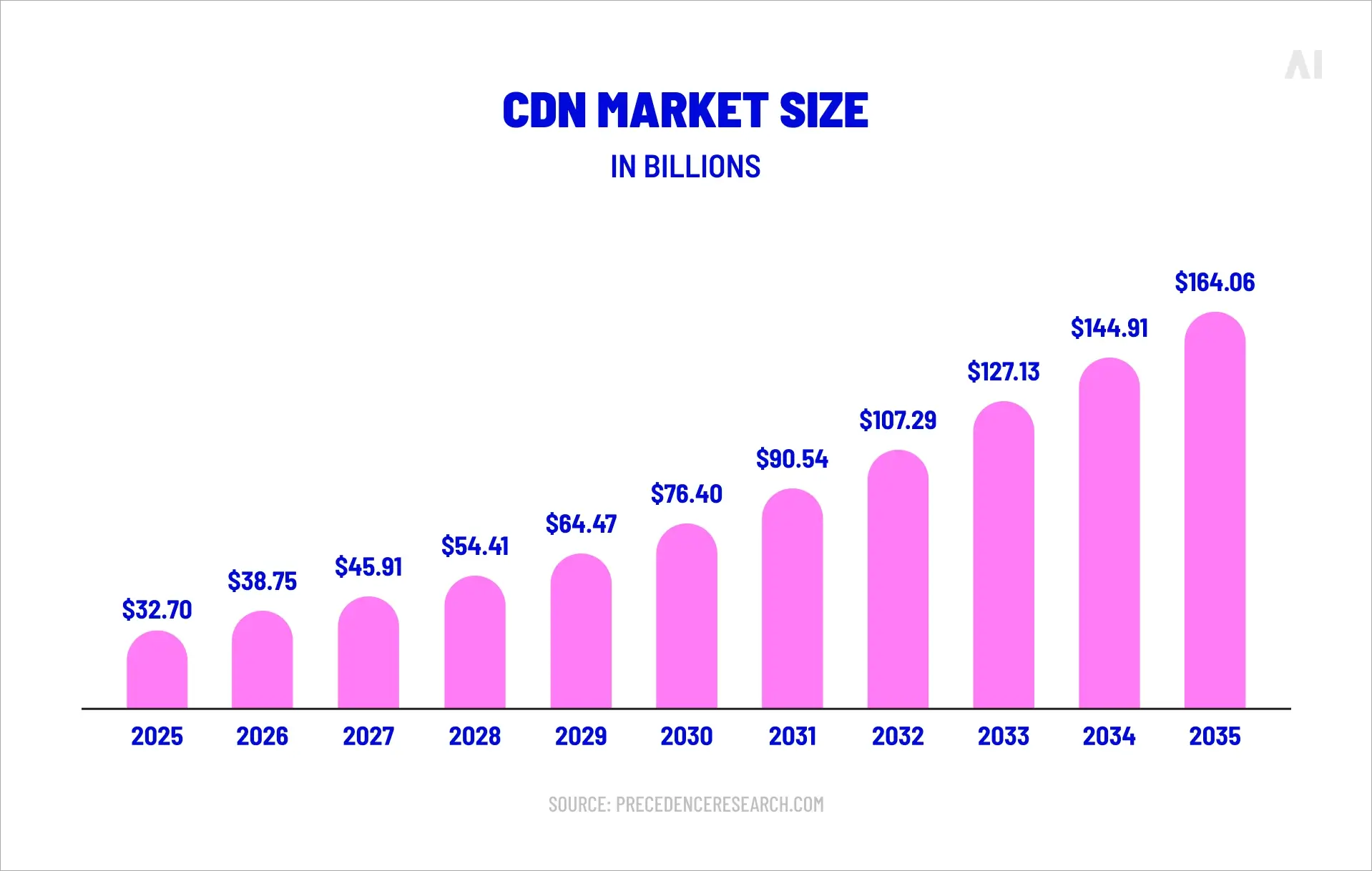
The global CDN market, valued at approximately $32.7 billion in 2025, is growing at a compound annual rate of 17.5%. Much of that growth is driven by enterprises moving beyond single-provider configurations toward more sophisticated, multi-provider delivery architectures.
Core benefits of multi CDN
The strategic value of a multi CDN solution extends across four interconnected areas: infrastructure resilience, delivery performance, cost efficiency, and commercial flexibility. Each addresses a different dimension of risk that single-provider architectures leave exposed—and each contributes directly to measurable business outcomes rather than abstract operational improvements.
Resilience and uptime reliability
The most immediate benefit of a multi CDN strategy is eliminating the single point of failure that comes with relying on one provider. When traffic is distributed across multiple CDN networks, an outage or degradation at one provider does not take down the entire delivery chain.
Automated failover mechanisms monitor each provider continuously and redirect traffic when performance drops below acceptable thresholds. This is not theoretical. In October 2025, an AWS disruption locked users out of platforms including Fortnite, Roblox, and Duolingo. Organizations with multi CDN architectures in place were able to reroute traffic and maintain service continuity. Those relying on a single provider had no recourse until the outage was resolved.
For platforms where uptime directly correlates with revenue—streaming services, betting operators, e-commerce during peak sales—the financial case for redundancy is straightforward. Industry research suggests that large enterprises lose an average of $5,600 to $9,000 per minute of downtime, with 93% of enterprises reporting hourly costs exceeding $300,000.
Intelligent routing reduces latency
Latency in real-time streaming is not just a technical metric—it is a direct determinant of engagement and monetization. A viewer who experiences persistent buffering during a live broadcast is far more likely to abandon the stream, and with it, the advertising impressions and subscription value attached to that session.
Multi CDN environments reduce latency through several mechanisms.
- DNS-based routing directs users to geographically optimal providers.
- Performance-based routing evaluates real-time conditions—not just proximity—to identify the fastest delivery path for each request.
- Geo-performance optimization accounts for regional network conditions, peering arrangements, and last-mile connectivity to ensure the best possible experience in each market.
According to Mordor Intelligence, AI-driven routing engines can cut egress charges by up to 30% while simultaneously improving performance during demand spikes. This dual benefit—lower cost and better performance—makes intelligent routing one of the highest-value capabilities within a multi CDN architecture.
Cost-performance optimization
Not all CDN providers charge the same rates across every region or traffic tier. A multi CDN environment enables organizations to allocate traffic dynamically across providers with different pricing models and geographic strengths, optimizing the balance between delivery quality and infrastructure cost.
During off-peak periods, traffic can be shifted toward more cost-efficient providers without degrading user experience. During high-demand events, premium providers can absorb the spike while cost-optimized networks handle baseline traffic. This approach mirrors the logic of supply-path optimization in digital advertising, where media buyers route spend through the most efficient and transparent intermediaries to maximise return.
The key is that cost decisions are not made in isolation from performance data. Orchestration platforms evaluate both dimensions simultaneously, ensuring that cost savings never come at the expense of delivery quality. For platforms operating at scale, even modest per-gigabyte savings compound into significant annual cost reductions.
💡 Related reading: What is supply path optimization (SPO) in programmatic advertising?
Vendor lock-in avoidance
Dependence on a single CDN provider creates more than a technical risk—it creates a commercial constraint. Pricing negotiations are weakened when there is no credible alternative. Contractual flexibility diminishes when migration costs are perceived as prohibitive. Innovation stalls when platform capabilities are limited to what one vendor offers.
A multi CDN strategy diversifies that dependency. Organizations can negotiate more aggressively because switching traffic between providers is an operational reality rather than a theoretical exercise. Procurement cycles shorten because onboarding additional providers becomes routine rather than exceptional.
⚡ The cost of implementing redundancy is less expensive than the financial damage of massive-scale outages and significant hits to service-level agreements.
Multi CDN solution architectures
The right architecture for a multi CDN deployment depends on platform scale, operational maturity, and the specific performance requirements of the business. There is no single correct model—the choice involves trade-offs between complexity, control, and cost.
- DNS-based routing is the simplest starting point. Traffic is distributed across providers at the DNS resolution layer, using weighted rules or geographic policies. It is straightforward to implement and requires minimal operational overhead, but it offers limited real-time responsiveness because DNS changes propagate with inherent latency.
- Active-active distribution routes traffic simultaneously across multiple providers, with each handling a share of live requests at all times. This model ensures that every provider is continuously tested under production conditions, which improves failover readiness. The trade-off is increased monitoring complexity and the need for consistent configuration across all providers.
- Primary-plus-failover designates one CDN as the default delivery network, with secondary providers activated only when the primary degrades or fails. This reduces operational complexity but introduces the risk that failover providers are not fully warmed up when called upon, potentially causing brief performance dips during transitions.
- Orchestration platforms automate routing decisions using real-time telemetry, removing the need for manual intervention. These platforms evaluate performance across providers continuously and adjust traffic allocation based on latency, error rates, cost, and availability. For organizations at scale, orchestration provides the strongest combination of performance optimization and operational efficiency—though it adds a new layer of dependency that must itself be resilient.
.webp)
Signs your business needs a multi CDN strategy
Not every organization requires a multi CDN solution from day one. But there are clear signals that indicate when the risks of single-provider delivery outweigh its simplicity.

- Global audiences with diverse geographic reach. When users span multiple continents, no single CDN performs optimally everywhere. Regional strengths and weaknesses become pronounced, and delivery quality becomes inconsistent without provider diversification.
- Live streaming or real-time content delivery. Live events—whether sports, concerts, product launches, or financial data feeds—create concentrated traffic spikes that stress single-provider capacity. The consequences of failure during these moments are disproportionately high.
- Growing SLA requirements from partners or regulators. As platforms mature, uptime commitments become contractually binding. Advertisers, broadcasters, and regulatory bodies expect delivery guarantees that a single-provider architecture cannot reliably meet.
- Revenue directly tied to delivery quality. If monetization depends on ad impressions, in-play betting, subscription retention, or transaction completion, delivery failure is revenue failure. The investment in multi CDN infrastructure pays for itself through avoided losses.
- Transition from regional to global operations. The inflection point for many organizations is the shift from serving a single market to operating across regions with different network conditions, content regulations, and user expectations.
Multi CDN use cases by industry
Delivery reliability is not a universal concern—it varies in urgency and financial impact depending on the industry. What remains consistent is that latency and downtime carry direct business consequences wherever real-time content drives revenue.
💡 Related reading: Streaming TV advertising.
{{26-What-Is-a-Multi-CDN-2="/tables"}}
OTT and Connected TV
OTT platforms operate in an environment where buffering is the leading driver of subscriber churn. Viewers paying monthly subscriptions have zero tolerance for playback interruptions, and the competitive landscape makes switching effortless.
Older Visible Measures research, widely cited in industry sources, found that nearly 20% of viewers abandon a web video within the first 10 seconds and almost 60% by the two-minute mark. For poor-quality viewing specifically, industry sources citing Conviva report that 33% of users abandon immediately and 84% stop watching within one minute after the experience deteriorates.
A multi CDN strategy ensures that peak traffic events—season premieres, exclusive live broadcasts, holiday viewing surges—are absorbed across multiple providers rather than overwhelming a single network. For ad-supported tiers, consistent delivery quality protects ad viewability rates and the CPMs they command.
The growth of connected TV advertising and the strategic importance of OTT advertising make infrastructure resilience a direct contributor to monetization performance.
Live sports and eSports
No use case tests real-time content delivery more rigorously than live sports. Ultra-low latency is the minimum expectation—any delay that puts viewers behind social media commentary undermines the experience at a fundamental level.
InterDigital and Parks Associates found that 57% of sports viewers face challenges when streaming sports, with 18% citing poor-quality video and younger viewers especially likely to report freezing, buffering, and lag. At the same time, major live events now draw enormous concentrated audiences—Tubi’s Super Bowl LIX stream hit a 15.5 million peak audience, while Netflix’s 2024 Christmas NFL games reached 65 million U.S. viewers—raising the cost of any delivery failure during high-value moments.
Concurrent traffic spikes during major events are enormous and highly concentrated. A single CDN provider can struggle to absorb millions of simultaneous connections in a narrow geographic window. Multi CDN architectures distribute that load, ensuring that the highest-value moments in sports broadcasting—injury-time goals, final-lap overtakes, championship points—reach every viewer without delay.
For sports streaming platforms, the relationship between delivery quality and revenue extends beyond subscriptions into betting markets, sponsorship activation, and second-screen engagement.
💡 Related reading: OTT sports streaming in 2026: Platforms, monetization & growth strategies
iGaming and Betting
In iGaming and live betting, latency is measured in terms of financial accuracy rather than viewer comfort. Real-time odds updates, in-play bet placement, and transaction confirmation all depend on millisecond-level delivery performance. A delayed odds feed creates arbitrage risk. A slow bet confirmation frustrates players and erodes trust.
The operational stakes are high because the market is large and increasingly digital. The American Gaming Association says U.S. sports betting handle reached $166.94 billion in 2025, while Optimove found that 76% of bettors place wagers via mobile or online platforms, 80% use two or more betting platforms each week, and 16% have already churned because of a frustrating app experience.
Downtime during a marquee sporting event does not just cost a betting platform its revenue for that period—it drives players to competitors who maintained service. Multi CDN solutions reduce these risks by ensuring that transactional and data delivery infrastructure remains available even when individual providers falter.
Fintech and Trading platforms
Financial technology platforms share the same latency sensitivity as iGaming but with regulatory and compliance dimensions that raise the stakes further. Trading platforms where execution speed determines profit or loss cannot tolerate routing delays. Payment processing systems where transaction timeouts result in failed purchases lose revenue and customer confidence simultaneously.
Financial infrastructure now operates at a scale where speed and continuity are core requirements. NYSE Research said options volume exceeded 53 million contracts per day in the first three quarters of 2025, while The Clearing House’s RTP network processed 125 million transactions worth $405 billion in Q4 2025 alone. At the same time, digital financial customers are willing to move: Accenture found that 73% engage with multiple banks beyond their primary provider, and Capgemini found that 47% of prospective customers abandon onboarding due to a poor experience.
Multi-CDN strategy in fintech serves performance and operational continuity simultaneously—critical in an environment where downtime carries both regulatory and financial liability.
How to build and execute a multi CDN strategy
Moving from recognizing the need for a multi CDN strategy to executing one effectively requires a structured approach. The following steps outline a practical framework—from defining what success looks like, through provider monitoring and traffic management, to the ongoing operational discipline that keeps a multi CDN environment performing at its best.
Define performance SLAs beyond vendor promises
CDN vendor SLAs typically guarantee high uptime percentages—99.9% or 99.99%. But those guarantees often exclude the specific conditions under which failures are most damaging: regional outages, performance degradation that does not constitute full downtime, or latency spikes during peak traffic events.
Organizations should define internal performance targets aligned with their own user experience and revenue metrics rather than relying on vendor-defined thresholds.
💡 Platforms such as AI Digital's Elevate help organizations assess infrastructure performance against business outcomes and define measurable transformation strategies tied to real delivery conditions rather than contractual abstractions.
Implement unified monitoring
Operating multiple CDN providers without centralized visibility is a recipe for operational fragmentation. Unified monitoring systems consolidate latency, availability, error rate, and throughput metrics from all providers into a single operational view, enabling faster troubleshooting and more informed routing decisions.
Without unified observability, teams risk discovering performance issues through user complaints rather than proactive detection—by which point revenue has already been lost.
Use data-driven traffic allocation
Static routing rules—fixed geographic assignments or predetermined traffic splits—do not adapt to real-world conditions. Traffic allocation should respond continuously to real-time performance telemetry and cost data, shifting load between providers as conditions change.
This requires investment in orchestration tooling and analytics capabilities, but the return is measurable: better delivery performance, lower infrastructure costs, and reduced manual intervention from engineering teams.
Continuously test failover
Failover readiness that is never tested is failover readiness that cannot be trusted. Organizations should conduct regular failover drills—simulating provider outages and verifying that traffic reroutes correctly, that secondary providers absorb load without degradation, and that recovery times meet internal SLA targets.
The worst time to discover a failover gap is during a real outage at peak traffic.
Manage operational complexity
Multi CDN environments introduce governance challenges that should not be underestimated. Monitoring fragmentation, configuration inconsistencies across providers, certificate management, cache invalidation logic, and DevOps overhead all increase with each additional provider.
Structured operational processes and orchestration frameworks help contain this complexity. Without them, the resilience benefits of multi CDN can be undermined by the operational burden of managing it.
⚡ Outages at major cloud and CDN providers are now expected. The only real uncertainty is when it will happen next, and whether your business will be prepared.
Choosing the right multi CDN providers
Selecting CDN partners is not purely a technical procurement exercise—it is a strategic decision that shapes delivery performance, operational complexity, and commercial flexibility for years. The right provider mix depends on how well each candidate aligns with your platform's geographic footprint, traffic profile, and risk tolerance.
Key evaluation criteria
Selecting CDN partners requires evaluation across multiple dimensions:
- Global point-of-presence coverage—does the provider have sufficient edge infrastructure in the regions where your users are concentrated?
- Real-user performance metrics—vendor-reported benchmarks are useful but insufficient. Third-party performance data and real-user monitoring provide more accurate assessments.
- API capabilities and integration flexibility—providers with robust APIs accelerate orchestration integration and reduce operational friction.
- Security protections—DDoS mitigation, WAF capabilities, and TLS management are increasingly table-stakes requirements rather than premium add-ons.
- SLA transparency and financial accountability—the gap between guaranteed uptime and actual business loss during downtime should be clearly understood before signing contracts.
{{26-What-Is-a-Multi-CDN-3="/tables"}}
Single vendor vs diversified portfolio
A two-provider configuration offers meaningful redundancy with manageable complexity. Three or more providers increase resilience further but introduce additional operational overhead in monitoring, configuration management, and vendor coordination.
The right number depends on the organization's risk tolerance, traffic patterns, and internal engineering capacity. Most enterprises find that two to three providers strike an effective balance between resilience and manageability.
Managed orchestration vs direct integration
Third-party orchestration platforms provide automated traffic routing, unified monitoring, and simplified provider management—significantly reducing the engineering effort required to operate a multi CDN environment. The trade-off is introducing another external dependency and potentially reducing granular control over routing logic.
Fully in-house integration gives organizations complete control over their delivery stack but demands dedicated engineering resources for ongoing maintenance and optimization. For most organizations, a hybrid approach—using orchestration platforms with customisable routing policies—delivers the strongest balance of operational simplicity and infrastructure control.
💡 Related read: Understanding the digital advertising ecosystem in a fragmented, platform-driven world
Why multi CDN is a revenue imperative in 2026
The case for multi CDN adoption is no longer confined to infrastructure teams making availability arguments to CIOs. It has become a revenue conversation.
The CDN market, projected to reach approximately $38.75 billion in 2026, reflects an industry where delivery infrastructure is scaling alongside the content it supports. 43% of enterprises already use multi-CDN models for content delivery, and that adoption rate is climbing as streaming ecosystems expand, regulatory complexity increases, and the financial consequences of delivery failure become harder to ignore.
Infrastructure resilience now influences monetization stability, user experience, and long-term competitive positioning. Platforms that treat delivery as a solved problem—rather than an ongoing strategic priority—will increasingly find themselves exposed during the moments when performance matters most.
For organizations evaluating how delivery and performance decisions connect to measurable business outcomes, AI Digital brings strategic oversight, cross-platform intelligence, and AI-enhanced decision support to help shape a more informed transformation path. Get in touch!
.webp)