Performance TV Advertising: The Playbook for Measurable CTV Growth


Performance TV advertising promises what traditional TV could not: measurable growth, tighter targeting, and clearer accountability. But for many advertisers, the reality is still messy. Fragmented supply, inconsistent attribution, weak signal quality, and limited visibility into execution often create a gap between what performance TV should deliver and what campaigns actually prove.
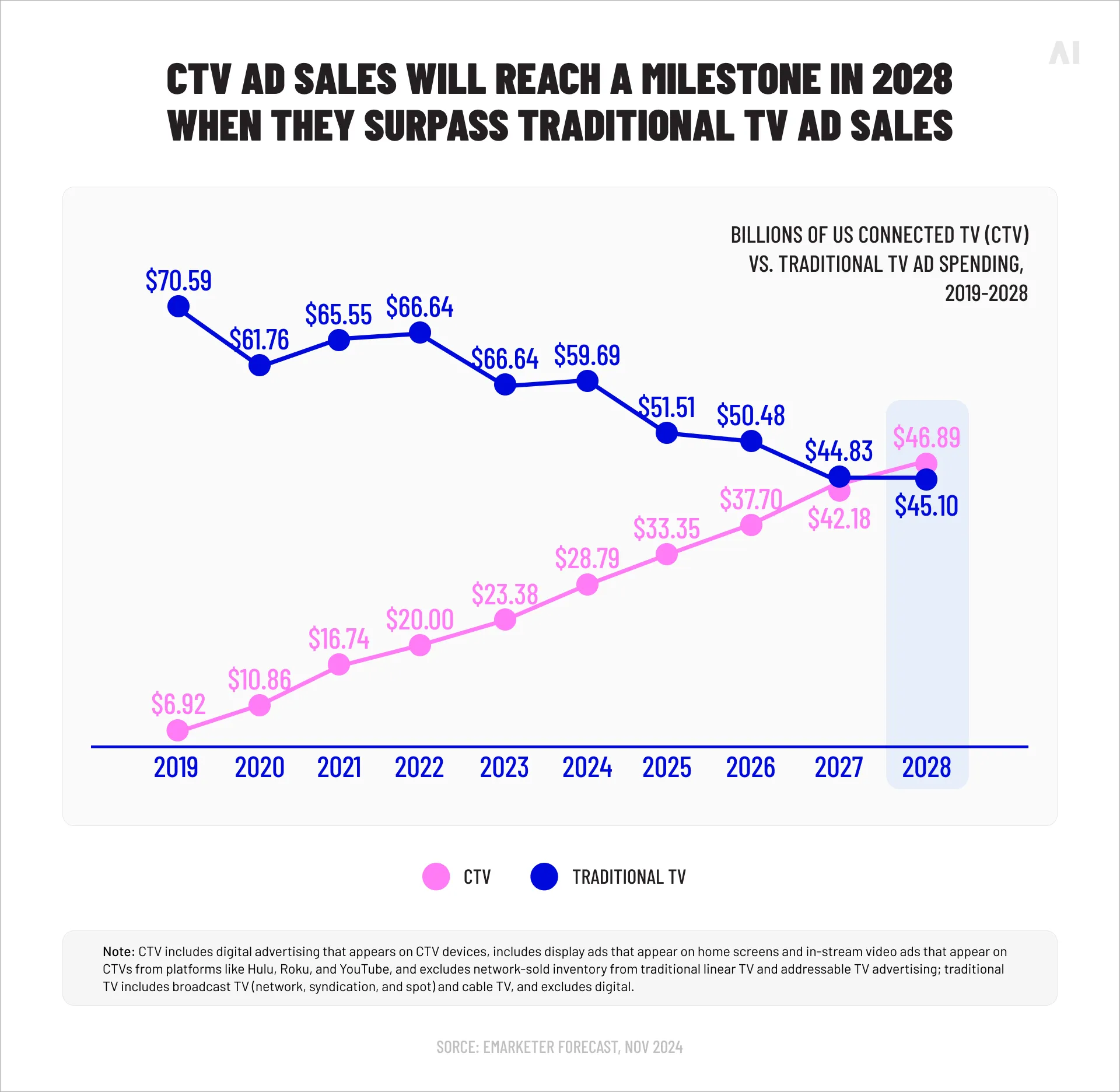
As streaming becomes a larger share of viewing, that gap matters more. Nielsen reported that streaming reached 44.8% of total U.S. TV usage in May 2025, surpassing broadcast and cable combined for the first time. At the same time, IAB projects digital video to capture nearly 60% of U.S. TV/video ad spend in 2025, up from 29% in 2020.
💡For growth leaders, this means performance CTV is no longer just an awareness channel with better reporting. It is becoming part of the acquisition mix, alongside search, paid social, programmatic display, and retail media. But measurable CTV growth does not happen automatically. It depends on how campaigns are bought, how audiences are built, how conversions are tracked, and how media is optimized after launch.
This guide explains how to turn performance TV advertising into a scalable revenue driver: from buying models and supply paths to targeting, creative, attribution, ROI measurement, and full-funnel execution.
⚡️ For a broader foundation on how TV buying is changing, see AI Digital’s guide to TV media buying.
What is performance TV and why it matters now
Performance TV refers to TV advertising optimized for measurable business outcomes — such as conversions, cost per acquisition (CPA), and return on ad spend (ROAS)—rather than traditional metrics like reach or impressions. In this model, performance TV advertising operates less like a branding channel and more like a performance engine, where every impression is evaluated based on its ability to drive downstream revenue.
This marks a fundamental shift from how TV has historically been used. Linear TV buying relied on aggregated audiences, panel-based measurement, and delayed reporting, making it difficult to connect exposure to actual outcomes. In contrast, performance CTV leverages programmatic infrastructure, household-level data, and cross-device tracking to enable deterministic targeting and measurable attribution. As a result, TV is no longer limited to awareness — it becomes part of the acquisition system.
The timing of this shift is not incidental. As audiences move to streaming environments, advertisers gain access to more addressable inventory, but they also face increasing complexity in data and measurement. According to IAB, over 60% of buyers say cross-platform measurement remains one of the biggest barriers to CTV effectiveness, reinforcing that access to inventory alone does not guarantee performance. This is why understanding how to operationalize performance TV advertising is critical, not optional.
💡When executed correctly, performance TV delivers the most value in scenarios where scale and influence matter: generating new demand, accelerating mid-funnel consideration, and supporting conversion across channels like search and paid social. It is particularly effective when paired with strong attribution systems and integrated media strategies, allowing advertisers to connect TV exposure to real outcomes rather than assumed impact.
⚡️For a deeper look at how connected TV fits into modern media strategies, see AI Digital’s guide to connected TV advertising, and for a breakdown of the measurement challenges shaping this space, explore Why Fragmented Data Is Breaking Cross-Platform Performance.
Performance TV advertising vs Other channels
Performance TV advertising sits between traditional brand media and lower-funnel acquisition channels. Search and social are still essential for capturing existing intent, but performance CTV helps create demand earlier, with stronger storytelling, premium video environments, and household-level reach. That distinction matters as budgets shift toward streaming: IAB reported that U.S. digital video ad spend grew 18% year over year in 2024 to $64 billion and was projected to reach $72 billion in 2025, driven by CTV, social video, and online video growth.
%2520.webp)
⚡️For AI Digital, this is where cross-channel strategy becomes critical. Performance TV works best when it is not planned in isolation, but connected to paid social, search, programmatic, and measurement systems. For more context on the broader channel environment, see AI Digital’s guide to streaming TV advertising and the article, What Is Cross-Platform Advertising? Strategy, Challenges, and Measurement.
Performance TV vs. search and social
Search captures users who already know what they want. Paid social creates and converts demand inside feed-based environments. Performance TV advertising does something different: it reaches high-value audiences in premium streaming environments before they actively search, compare, or click.
That makes CTV especially useful when search and social costs rise or audience saturation limits growth. It can introduce the brand, build consideration, and then allow search, social, and retargeting campaigns to capture the response. The goal is not to replace lower-funnel channels, but to improve their efficiency by generating qualified demand before the click.
Performance TV vs. linear TV
Linear TV is effective for broad awareness, but it is limited by aggregated buying, delayed reporting, and weaker optimization control. Performance CTV gives advertisers more precise targeting, clearer delivery visibility, and the ability to adjust campaigns based on results.
This shift reflects audience behavior. Nielsen reported that streaming represented 44.8% of total U.S. TV usage in May 2025, surpassing broadcast and cable combined for the first time. For advertisers, that means performance-focused TV investment increasingly needs to follow streaming audiences, not only traditional reach plans.
CTV vs. OTT vs. linear TV: what matters for performance
CTV, OTT, and linear TV are often used interchangeably, but they are not the same. CTV refers to TV content watched through internet-connected television devices. OTT refers to video content delivered over the internet, across devices. Linear TV refers to scheduled broadcast or cable programming.
💡For performance, the difference is practical: CTV environments generally offer stronger household-level targeting, attribution, and optimization than linear TV, while OTT can include mobile, desktop, and tablet viewing.
⚡️ The most effective performance TV products are built around inventory quality, measurable exposure, and conversion visibility—not simply whether the ad appears in a streaming environment. For deeper definitions, see AI Digital’s guides to CTV vs. linear TV and OTT advertising.
How performance TV actually works (from impression to conversion)
At a high level, performance TV advertising follows the same logic as other performance channels: identify the right audience, deliver the right message, and measure the outcome. What makes performance CTV different is the infrastructure behind it. Campaigns are executed through programmatic systems that connect demand (advertisers) with supply (publishers), using data to control delivery and optimization in near real time.
💡From the moment an impression is available to the point a user converts, multiple layers are involved: supply paths determine where the ad is shown, audience data defines who sees it, and measurement systems connect exposure to downstream actions.
⚡️This is why performance TV is not just about running video ads—it is about managing an ecosystem of data, inventory, and decisioning. For a deeper foundation, see AI Digital’s overview of programmatic advertising.
Buying models and supply paths
Performance TV campaigns are typically executed through a mix of programmatic buying and direct deals. Programmatic enables scalable access to inventory across multiple publishers, while direct or curated deals provide more control over premium placements. The challenge is that not all supply paths are equal.
💡Each impression can pass through multiple intermediaries before reaching the advertiser, increasing costs and reducing transparency. Studies from the Association of National Advertisers (ANA) have shown that a significant portion of programmatic spend can be lost across the supply chain, limiting efficiency and performance visibility. This is where supply path strategy becomes critical.
⚡️Solutions like AI Digital’s Smart Supply are designed to address this problem by optimizing how inventory is accessed. By reducing unnecessary intermediaries and prioritizing high-quality, direct supply routes, advertisers can improve delivery consistency, reduce hidden fees, and gain clearer insight into where their ads appear. This directly impacts performance outcomes, as cleaner supply paths lead to more reliable data and better optimization decisions.
⚡️To explore this further, see What Is Supply Path Optimization (SPO) in Programmatic Advertising? and From Fragmented to Sustainable: Rethinking the Programmatic Supply Path.
Audience and targeting logic
Audience strategy is central to how performance TV advertising drives results. Unlike traditional TV, where targeting is based on broad demographics, performance CTV uses multiple data layers to build more precise and scalable audiences.
- First-party data (CRM data, site visitors, converters) provides the strongest signal for performance, enabling advertisers to reach users who already have a relationship with the brand.
- Third-party data adds scale by identifying users with similar characteristics or behaviors, though its reliability is increasingly limited by privacy changes.
- Household-level data and identity graphs allow advertisers to target across devices within the same home, a key advantage of CTV environments.
💡The effectiveness of these layers depends on how they are combined. High-performing campaigns typically use first-party data as a foundation, expand reach with modeled audiences, and refine targeting using behavioral and contextual signals. According to BCG, campaigns leveraging first-party data can deliver up to 2x higher ROI, reinforcing its role in performance-driven strategies.
⚡️For a deeper look at how data shapes targeting decisions, see AI Digital’s guide to AI-targeted advertising and the article How to Convert High-Intent Audiences on the Open Web.
Where performance TV advertising drives revenue
Performance TV advertising delivers the strongest ROI when it is aligned with measurable outcomes, sufficient scale, and a clear path to conversion. Not every business model benefits equally. The difference typically comes down to conversion latency, data quality, and channel integration.
Industry data reinforces this pattern. Nielsen studies show that CTV campaigns can drive 10–25% lifts in conversion rates when integrated with other channels, while BCG finds that data-driven campaigns outperform by up to 2x in ROI when first-party signals are effectively used. The implication is clear: performance CTV works best as part of a connected system, not a standalone channel.
High-impact use cases
Performance TV scales efficiently in scenarios where there is a clear conversion signal and the ability to connect exposure to action:
{{26-Performance-TV-Advertising-1="/tables"}}
Across these use cases, performance TV is most effective when conversion tracking is reliable and audiences can be continuously refined.
Common failure scenarios
Performance TV underperforms when execution gaps prevent accurate optimization or measurement:
- Weak attribution frameworks:
Without cross-device tracking or incrementality testing, conversions cannot be reliably linked to exposure.
- Misaligned KPIs:
Optimizing for reach or completion rate instead of CPA or ROAS leads to misleading performance signals. For KPI alignment frameworks, see AI Digital’s guide to digital marketing KPIs.
- Creative built for branding, not action:
Cinematic ads without clear value propositions or CTAs fail to drive measurable outcomes.
- Insufficient scale or budget:
Campaigns that cannot generate enough data fail to exit the learning phase, limiting optimization.
- Fragmented channel execution:
Running CTV without integration into search, social, or retargeting reduces its impact on actual conversions.
In most cases, underperformance is not caused by the channel itself, but by disconnects between data, measurement, and execution strategy.
3 Performance TV strategies that drive conversions
High-performing performance TV advertising campaigns are built on structured audience strategies, not isolated targeting decisions. The goal is to combine data sources and signals to create scalable, conversion-oriented audiences.
⚡️For a broader strategic foundation, see AI Digital’s guide to performance marketing strategy.
%25E2%2580%258D%2520.webp)
Strategy 1: Audience strategy framework
Effective audience strategy in performance CTV is layered, combining precision with scale:
{{26-Performance-TV-Advertising-2="/tables"}}
💡 First-party data anchors the strategy, while lookalikes and intent signals expand reach without diluting performance. According to BCG, brands that integrate first-party data into media activation can achieve up to 2x higher marketing ROI, making it the most critical layer.
⚡️ For a deeper framework, see Creating a Data-Driven Marketing Strategy.
Strategy 2: Retargeting and sequential messaging
Performance TV advertising rarely converts in isolation. Instead, it initiates user journeys that are completed through other channels.
Sequential messaging connects CTV exposure to downstream actions:
- CTV introduces the product or value proposition
- Paid social and display retarget engaged users
- Search captures high-intent queries
This cross-channel flow improves efficiency. Industry benchmarks show that retargeted users are significantly more likely to convert compared to cold audiences, especially when messaging is consistent across touchpoints.
💡For execution strategies, see AI Digital’s guide to CTV retargeting.
Strategy 3: Precision at scale
A common mistake in performance TV is over-targeting. While CTV allows granular audience definition, excessive narrowing reduces delivery, increases costs, and limits optimization.
High-performing campaigns balance precision with scale by:
- Using household-level targeting to reach relevant users across devices
- Applying geo-targeting to align campaigns with market-level demand
- Maintaining sufficient audience size to enable algorithmic learning
The objective is controlled reach, not minimal reach. Campaigns that maintain scale generate more data, enabling better optimization and more stable CPAs over time.
⚡️For more on location-driven strategies, see AI Digital’s guide to location-based marketing and the upcoming articles Geotargeting in 2026: How Location Intelligence Drives Measurable Business Growth and Location-Based Advertising: How to Drive Real Results Across Channels.
How to measure performance TV advertising ROI
Measuring performance TV advertising requires connecting ad exposure on CTV to real business outcomes across devices and channels. Unlike click-based environments, CTV operates without direct interaction, which makes attribution and measurement design critical to proving ROI.
The challenge is structural. According to IAB, over 60% of advertisers cite cross-platform measurement as a major barrier in CTV, while Nielsen research shows that campaigns integrated with digital channels can drive 10–25% higher conversion impact. The implication is clear: ROI is not visible by default — it must be engineered through the right measurement framework.
Metrics that drive decisions
In performance CTV, success is defined by business outcomes, not media delivery. While impressions, reach, and completion rates provide directional insight, they are not sufficient for decision-making.
The metrics that matter are:
- Return on Ad Spend (ROAS):
Measures revenue generated relative to media spend. This is the primary indicator of efficiency at scale.
- Cost per Acquisition (CPA):
Defines how much it costs to generate a conversion. Critical for budget allocation and optimization.
- Conversion rate and conversion volume:
Track how effectively exposure translates into action, across devices and channels.
- Incremental conversions:
Distinguish between conversions that would have happened anyway and those driven by media.
The shift is from media metrics to business metrics. High-performing campaigns optimize toward CPA and ROAS, not reach or impressions.
Attribution that reflects real impact
Attribution is the mechanism that connects exposure to outcomes. In performance TV advertising, relying on a single model is rarely sufficient due to cross-device behavior and delayed conversions.
A robust measurement framework typically combines:
- Multi-touch attribution (MTA):
Assigns value across multiple touchpoints in the user journey, helping identify how CTV contributes alongside search, social, and display. For a deeper explanation, see AI Digital’s guide to multi-touch attribution.
- Incrementality testing:
Measures the true impact of CTV by comparing exposed vs. unexposed groups. Industry benchmarks show that 20–40% of conversions in digital campaigns can be incremental, making this approach essential for validating performance.
Provides a top-down view of how channels contribute to overall revenue, particularly useful when user-level tracking is limited.
These methods address different parts of the measurement problem. Together, they create a more accurate picture of how performance CTV drives outcomes.
Fixing the CTV attribution gap
The biggest limitation in performance TV advertising is not lack of data, but lack of unified data. Signals are often fragmented across platforms, devices, and vendors, making it difficult to consistently connect exposure to conversion.
⚡️AI Digital addresses this challenge through Elevate, a measurement framework designed to unify cross-channel data and improve attribution accuracy. Elevate connects CTV exposure with downstream actions across search, social, and web environments, enabling advertisers to:
- Track conversions beyond last-click models
- Measure cross-device user journeys
- Identify incremental impact across channels
- Optimize campaigns based on real performance signals
This approach shifts measurement from reporting to decision infrastructure, allowing performance TV to be evaluated and optimized with the same rigor as other performance channels.
⚡️For a deeper exploration of this topic, see Cross-Platform Measurement Governance in Digital Advertising.
How to launch and scale a performance CTV campaign
Launching performance TV advertising requires a structured approach that prioritizes measurable outcomes from day one. Campaigns that skip setup discipline often struggle to reach stable performance or scale efficiently.
A practical framework includes four phases:
- Define outcome-driven KPIs
Start with business metrics, not media metrics. Set clear targets for CPA, ROAS, and conversion volume, aligned with broader acquisition goals. Avoid optimizing toward reach or completion rates, which do not reflect revenue impact.
- Structure controlled tests
Launch with segmented audiences, creatives, and supply paths to generate comparable performance signals. Each variable—audience, inventory, creative—should be testable. Campaigns typically require 4–6 weeks of data accumulation before reliable optimization decisions can be made.
- Optimize based on real signals
Shift budget toward:
- high-performing audience segments
- efficient supply paths
- creatives driving conversions
At this stage, weak signals (low-quality inventory, underperforming creatives) should be removed to stabilize CPA.
- Scale with controlled expansion
Scale gradually by increasing budget, expanding audiences, and testing additional inventory sources. Rapid scaling without validated performance often leads to rising CPAs and unstable results.
💡The key principle is consistency: performance CTV improves over time as data quality and optimization depth increase.
What makes a high-performing CTV ad creative
In performance TV advertising, creative is not just a branding asset—it is a conversion driver. High-performing CTV ads are designed to generate action, not just attention.
Effective creatives share several characteristics:
- Immediate clarity (first 3–5 seconds):
Users decide quickly whether to engage. The value proposition must be visible early.
- Strong, direct messaging:
Focus on what the product solves, not abstract brand storytelling.
- Clear call to action (CTA):
Even without a clickable format, users must know what to do next (search, visit, download).
- Consistency across channels:
Messaging should align with landing pages, paid social, and search campaigns to support conversion.
- Optimized length and pacing:
Shorter formats (15–30 seconds) often outperform longer formats in performance scenarios.
Common issues that reduce performance include:
- overly cinematic ads with delayed messaging
- unclear product positioning
- lack of a defined CTA
- creative built for awareness rather than conversion
⚡️For deeper execution guidance, see AI Digital’s overview of programmatic video advertising.
How much does performance TV advertising cost?
The cost of performance TV advertising is typically structured around CPM (cost per thousand impressions), but evaluating performance based on CPM alone is misleading. The real benchmark is cost per acquisition (CPA) and overall return on spend.
Typical CTV CPM ranges:
- $15–$40+ depending on inventory quality, targeting, and geography
However, lower CPMs do not necessarily mean better performance. Cheaper inventory often results in:
- lower-quality impressions
- weaker engagement
- higher effective CPA
Budget planning should account for:
- learning phase investment: campaigns need sufficient spend to generate optimization data
- audience scale: narrow targeting increases costs and limits delivery
- creative testing: multiple variations are required to identify high performers
💡As a guideline, campaigns need enough budget to produce consistent conversion signals. Without this, performance CTV cannot exit the testing phase or stabilize results.
How performance TV fits into a full-funnel marketing strategy
Performance TV advertising is most effective when integrated into a broader acquisition system. It does not replace other channels—it amplifies their performance by generating demand and improving conversion efficiency downstream.
CTV and paid social
CTV builds initial awareness and consideration in high-impact environments. Paid social then captures and retargets these users with more direct, conversion-oriented messaging.
This combination improves efficiency by:
- warming audiences before social exposure
- increasing engagement rates
- lowering acquisition costs over time
CTV and search
CTV exposure often leads to increased branded search activity. Users who see ads on streaming platforms are more likely to:
- search for the brand
- compare products
- convert through search campaigns
💡Studies show that TV exposure can drive 20–50% increases in branded search volume, making search a critical capture channel for demand generated by CTV.
Unified execution with open ecosystem
One of the main barriers to scaling performance TV is fragmentation across platforms and data silos. Walled gardens limit visibility, making it difficult to measure and optimize cross-channel performance.
⚡️AI Digital addresses this through the Open Garden Framework, which enables:
- interoperability across channels and platforms
- unified data and measurement
- transparent execution across the open internet
⚡️This approach allows advertisers to move beyond isolated channel strategies and operate within a connected ecosystem. For additional context, see AI Digital’s perspectives on the open internet and the limitations of walled gardens, as well as our article on The Open Garden Framework: A New Operating Model for Programmatic Advertising.
💡The result is a more cohesive performance system, where CTV, search, social, and programmatic channels work together to drive measurable growth.
Tech stack for performance TV advertising
Running performance TV advertising effectively does not require an overly complex stack—but it does require the right integration of core components. Many advertisers struggle not because they lack tools, but because their tools operate in silos, creating fragmented data, inconsistent reporting, and limited optimization capability.
⚡️A streamlined performance CTV tech stack focuses on three essential layers: execution, data, and measurement. These layers must work together to ensure that campaigns are not only delivered efficiently, but also optimized based on real business outcomes. For a broader overview of how these systems fit together, see AI Digital’s guide to adtech.
Core components
At the foundation of performance TV advertising are three interconnected systems:
- Demand-Side Platform (DSP):
The DSP is where campaigns are executed. It provides access to CTV inventory, manages bidding, and controls delivery across supply sources. DSPs enable audience targeting, budget allocation, and real-time optimization. For a deeper explanation, see AI Digital’s guide to demand-side platforms.
- Data layer (DMP/CDP):
Data management platforms (DMPs) and customer data platforms (CDPs) organize and activate audience data. They integrate first-party data, enrich it with external signals, and make it usable for targeting and segmentation. This layer is critical for building scalable, high-quality audiences. Learn more in AI Digital’s overview of data management platforms.
- Measurement and attribution systems:
These systems connect ad exposure to outcomes. They track conversions, evaluate performance across channels, and provide the signals needed for optimization. Without a strong measurement layer, even well-executed campaigns cannot be accurately evaluated.
The effectiveness of the stack depends on how well these components are connected. Disconnected systems lead to inconsistent data and unreliable performance insights.
Integrated execution approach
The main limitation of traditional setups is fragmentation. Separate tools for supply, data, and measurement often create delays, inconsistencies, and blind spots in optimization. This is where an integrated approach becomes critical.
AI Digital addresses this through a unified execution model that combines:
- optimized supply access
- structured audience strategy
- cross-channel measurement
- continuous performance optimization
Instead of treating each component as a separate function, this approach connects them into a single performance system. The result is greater transparency, faster optimization cycles, and more reliable ROI measurement.
⚡️For a closer look at how these elements come together in practice, see AI Digital’s overview of what we do.
Performance TV advertising checklist before launch
Before launching a performance TV advertising campaign, the goal is to eliminate execution gaps that prevent accurate measurement and optimization. Most underperformance can be traced back to incomplete setup rather than channel limitations.
Use this checklist to validate readiness:
{{26-Performance-TV-Advertising-3="/tables"}}
⚡️Campaigns that meet these conditions are significantly more likely to produce stable performance signals and avoid wasted spend. For additional context on how the space is evolving, see AI Digital’s insights on CTV advertising trends.
Is performance TV advertising worth the investment?
Performance TV advertising can deliver strong ROI, but only when the underlying execution model supports measurable outcomes. It is not inherently efficient by default—its value depends on budget scale, data quality, attribution capability, and cross-channel integration.
From an investment perspective, performance TV becomes viable when campaigns generate enough data to enable optimization. This typically requires moving beyond minimal test budgets and allowing the system to stabilize CPA and ROAS over time. Campaigns that remain underfunded often fail to exit the learning phase, leading to inconsistent or misleading results.
Equally important is how performance TV is integrated into the broader marketing system. Performance CTV is most effective as a demand-generation layer, influencing users before they convert through search, paid social, or direct traffic. Advertisers who treat it as an isolated channel often underestimate its impact, while those who connect it to downstream channels see stronger overall efficiency.
⚡️This is where execution model matters. Fragmented environments—where data, supply, and measurement are disconnected—limit visibility and optimization. AI Digital addresses this through the Open Garden Framework, which enables:
- Interoperability across platforms and channels
- Unified data and measurement across the open ecosystem
- Transparent access to inventory beyond walled gardens
- Continuous optimization based on real performance signals
By removing silos, the Open Garden approach allows advertisers to evaluate performance TV advertising in the context of total business impact, not isolated platform metrics. This is critical for accurately measuring ROI and scaling efficiently.
💡Key takeaways:
- Works best with a sufficient budget to generate data and enable optimization
- Drives demand that search and social convert
- Requires strong attribution to prove real impact
- Performs best within an open, connected ecosystem, not fragmented platforms
- Improves over time after an initial learning phase
⚡️For advertisers looking to implement performance TV within a unified, measurable framework, AI Digital provides integrated solutions across supply, data, and strategy. Learn more here: Get in touch.