Marketing Planning Software: How to Connect Planning, Optimization, and Reporting in One System


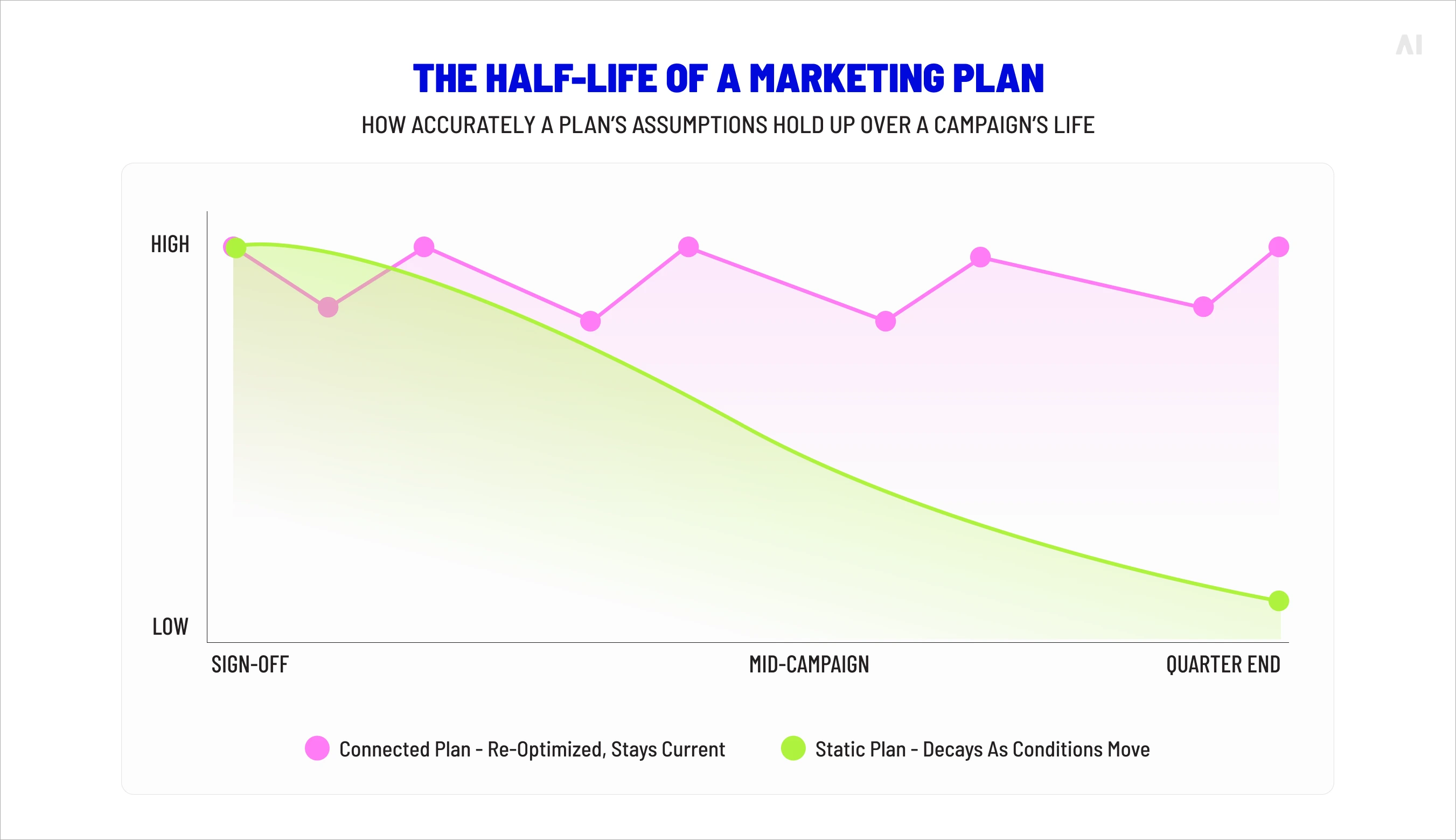
A marketing plan has something close to a half-life. The assumptions inside it — what an audience will cost, which channel will convert, how a quarter will unfold — begin losing accuracy the moment it is signed off, because the conditions it describes keep moving while the document sits still. The problem is rarely bad planning but planning that happens once and then stops.
Marketing now runs across more channels, agencies, and platforms than any single annual document can keep up with, and budgets are tight enough to make a stale plan an expensive thing to carry. Gartner's 2025 CMO Spend Survey found that 59% of marketing leaders say they don't have the budget to deliver their strategy, even as paid media absorbs 30.6% of the average budget and technology another 22.4%. Spending that deliberate leaves little tolerance for plans that stop being true in February.
This is the issue marketing planning software is meant to address, though rarely the way it is used. As a place to park the annual plan, it is an expensive filing cabinet. As one part of a wider set of marketing operations — carrying the plan into execution, adjusting it through optimization, and measuring it honestly in reporting — it becomes something more useful: a way to keep planning all year rather than once a year, with the collaboration, visibility, and accountability that implies. Building that connected system, and understanding why it pays, is what the rest of this article is about.
What is marketing planning software?
Marketing planning software is the system a team uses to plan campaigns, allocate budgets and resources, build timelines, manage workflows, and track performance against the goals it set at the start. Done properly, it gives everyone — strategists, media planners, analysts, agency partners — a shared view of what is being run, why, with what money, and to what end.
The category has broadened considerably. Early marketing planning tools were essentially organizers: a place to log campaigns, mark deadlines, and assign owners. The newer generation of marketing planning platform sets out to do more, linking the act of planning to the work that follows it. Rather than ending the moment a campaign goes live, a connected platform keeps the plan present throughout — measuring it, adjusting it, and feeding what it learns back into the next round.
Traditional planning tools versus modern planning platforms
Marketing teams used to plan in spreadsheets and slide decks, and many still do. A spreadsheet is a fine way to record a plan and a poor way to run one, because it captures a single moment and immediately starts going stale. The plan exists, but it doesn't talk to anything. Campaign data lands somewhere else; results arrive weeks later in a format that bears no resemblance to the original file.
Modern campaign planning software treats the plan as a live object rather than a snapshot. It connects to the platforms where campaigns run, updates as performance comes in, and keeps the planning assumptions visible alongside the actual outcomes. The practical difference is whether a team finds out something is off in week one or week six.
{{mps-1}}
Why planning alone is no longer enough
A plan disconnected from everything downstream creates predictable failures: execution gaps where the running campaign drifts from the brief, duplicated work as teams rebuild the same numbers in different tools, reporting delays while someone stitches results back to objectives, and a slow loss of alignment between what was promised and what was delivered.
Buying more software has not solved this. Gartner's 2025 Marketing Technology Survey found that organizations actively use just 49% of their marketing technology, and only 15% qualify as "high performers" — teams that both hit their strategic goals and show a positive return on the stack they pay for. Owning capable tools and connecting them into something coherent are two very different achievements, and most organizations have done the first without the second.

Why marketing workflows break between planning and reporting
The breakdowns are not mysterious once you look for them. They cluster at the handover points — the moments when work passes from one tool, team, or stage to the next and something gets dropped in the transfer.
💡 Related reads: Fragmented Martech Stacks Are Killing Marketing Performance — Here’s Why
Siloed planning documents
When a plan lives in a spreadsheet on one person's drive and a deck in someone else's inbox, it cannot be a shared reference. Information sits in pockets. The media team plans against one version, the analytics team reports against another, and the agency works from a third they were emailed in March. Marketing workflow management falls apart not because anyone is careless but because the plan was never in a place everyone could see.
Campaign execution happens in separate platforms
Once a campaign is approved, the actual running of it moves into ad platforms, CRM systems, and marketing automation tools, each with its own interface, its own metrics, and its own idea of what success looks like. None of them knows what the original plan said. They optimize toward their native goals — impressions, opens, clicks — which may or may not have anything to do with the business outcome the plan was built around.
Reporting becomes disconnected from original objectives
By the time results arrive, the reporting has changed the subject. It reports on what the channels measure rather than what the plan intended. A campaign set up to drive incremental revenue gets a report full of cost-per-click and view rates, and the genuinely useful question — did this do what we said it would? — goes unanswered because nobody kept the goals and the data in the same system. Marketing planning and reporting end up as two unrelated activities that happen to share a campaign name.
⚡ A plan that can't be measured against its own goals is just a wish with a budget attached.
Things to do before selecting any software: Define your business goals and use cases
Useful planning starts before any tool is chosen, with a clear statement of what the business is actually trying to achieve. Growth targets, customer acquisition priorities, retention programs, and revenue objectives should drive the planning decisions and, by extension, the choice of platform. A tool selected before the goals are settled tends to organize the wrong things very efficiently.
💡 Related reads: Marketing measurement framework: how to build a scalable system | Unified marketing measurement: what it is and why it matters.
Align marketing goals with business outcomes
Planning improves the moment its KPIs are pinned directly to revenue, growth, retention, and profitability rather than to marketing activity for its own sake. A campaign goal of "increase qualified pipeline by 15% in the target segment" gives a plan something to be judged against. A goal of "run a strong always-on program" gives it nothing. The first can be measured, optimized, and defended in front of a finance team; the second can only be asserted.
Identify operational and reporting requirements
Before comparing platforms, it helps to write down how the team actually needs to work. A short, honest list spares a great deal of regret later:
- Workflow and collaboration — who plans, who approves, who runs, and how work passes between them.
- Measurement — which outcomes will be tracked and against which definitions.
- Reporting — who needs to see what, how often, and in what form.
- Forecasting — whether the team needs to model scenarios before committing budget.
- Optimization — how plans will be adjusted once campaigns are live, and by whom.
Requirements first, software second. The reverse order is how organizations end up among the 85% that are not high performers.
The four layers of a connected marketing system
A connected system is easier to picture as four layers, each feeding the next.
- Planning sets direction.
- Execution puts it into market.
- Optimization improves it while it runs.
- Reporting turns the results into intelligence — which then improves the next plan.
The output of each layer is the input to the one after it, and a break at any join is where performance leaks out.
{{mps-2}}
💡 Related read: Integrated marketing systems: how to connect data, channels, and performance.
Planning layer
This is where campaigns are scoped: objectives agreed, budgets allocated, resources assigned, forecasts built, and priorities set so the most important work gets the most attention. Strong planning is specific about what success will look like, because everything downstream depends on that definition being clear and shared.
Execution layer
Execution is where the plan becomes real activity — across paid media, CRM systems, marketing automation, content workflows, and sales channels. The defining quality of a connected execution layer is that it stays tied back to the plan, so the work running in the wild can be compared, in something close to real time, against what was intended.
Optimization layer
Optimization is the ongoing business of improving a campaign while it is still live: reallocating budget toward what is performing, refining audiences, adjusting creative, and revising forecasts as evidence accumulates. This is the layer that benefits most from being connected to planning, because an optimization decision is only as good as its understanding of the goal it is optimizing toward.
Reporting and intelligence layer
The final layer turns performance data into something a person can act on. A reporting and intelligence layer worth the name does more than display metrics — it relates them back to the original objectives and surfaces the decisions they imply. This is where a marketing intelligence platform earns its place, by holding planning assumptions and live outcomes together so the comparison everyone wants is finally possible. We'll come back to how that works in practice.
How modern marketing planning software supports optimization
Planning should not stop when execution starts. The most common error in marketing operations is treating the plan as a thing you finish, rather than a thing you keep using. Connected marketing planning software keeps the plan in play right through the campaign, which is precisely what allows optimization to be deliberate rather than reactive.
💡 Related read: The AI marketing platform explained.
Real-time performance visibility
When a team can watch campaign progress against its objectives as it happens, problems get caught while they are still cheap to fix. Visibility against the plan — not just against channel benchmarks — lets a planner see that a campaign is delivering plenty of clicks but none of the conversions it was built for, and intervene in week one rather than discovering it in the post-mortem.
Budget monitoring and allocation
Performance visibility leads naturally to better budget decisions. With paid media taking up nearly a third of marketing spend, the ability to move money toward what is working, and away from what isn't, is among the highest-leverage things a planning platform can do. Marketing performance management depends on this loop: monitor, compare to plan, reallocate, repeat. A budget set in stone at the start of a quarter is a budget that ignores everything the quarter teaches it.
Forecasting and scenario planning
The strongest planning platforms let teams model outcomes before committing, testing different investment levels and channel mixes against forecasted performance. AI-driven forecasting makes this faster and, with enough historical data behind it, more reliable — though forecasts are guides, not guarantees.
⚡ A forecast is only useful while it's still being recalculated. The plans that survive contact with a campaign are the ones that update as the results come in, so the forecast and what's actually happening stay within hours of each other.
💡 Related read: Retail forecasting and how it works.
Why reporting should start before campaigns launch
Reporting is usually treated as the last step, which is exactly why so much of it is useless. A measurement frame built after a campaign has run can only describe what happened to get captured; a frame built during planning decides what to capture in the first place. Defining how you'll measure success while you're still defining success is the difference between a report that answers your question and one that answers a different, easier question instead
- Align KPIs with business objectives: Meaningful measurement begins with choosing metrics that reflect business outcomes rather than marketing motion. A high open rate is pleasant; revenue influenced is decisive. The KPIs set during planning should be the ones the business cares about, so that the report at the end speaks the language of the people who approved the budget.
- Define measurement frameworks early: Attribution, incrementality, and cross-channel measurement all involve choices — about windows, models, and what counts as influence — that are far easier to make calmly during planning than under pressure once results are in. Settling these questions early also keeps everyone honest, because the rules are agreed before anyone has a stake in how the numbers come out.
- Create decision-focused reporting: A report should help someone decide something. Too many are built to display performance rather than to drive action, which produces dashboards nobody reads and meetings nobody leaves with a decision. Decision-focused marketing reporting software organizes data around the choices a team faces: where to spend more, what to stop, which audience to lean into next.
Key capabilities to look for in marketing planning software
When comparing platforms, a handful of capabilities separate genuine planning systems from glorified to-do lists. The relevant ones cluster as follows.
- Collaboration and workflow management: Planning is a team activity, so the platform should make shared work straightforward: clear ownership, visible approvals, and a single version of the plan everyone references. Good marketing workflow management removes the email-attachment archaeology that plagues siloed teams.
- Resource and budget planning: The system should handle the money and the people — what is being spent where, who is doing what, and whether either is over-committed. Budget planning that connects to performance data, rather than living in a separate file, is the foundation of later optimization.
- Campaign calendars and timeline management: A shared calendar keeps overlapping campaigns, dependencies, and deadlines legible across a busy team. This is the most project-management-like capability, and the one buyers most often mistake for the whole job.
- Integrations with marketing and analytics platforms: A planning platform that cannot connect to the tools where campaigns actually run will always leave the plan stranded from the results. Integration breadth — ad platforms, CRM, automation, analytics — determines whether the four layers can be joined at all.
- Reporting and measurement capabilities: Native reporting that ties back to the plan's original goals is what turns a planning tool into a marketing operations platform. Without it, teams export data and rebuild the connection by hand, which is where both the time and the accuracy quietly drain away.
- AI-powered planning and forecasting: AI capabilities — predictive forecasting, budget recommendations, scenario testing — increasingly distinguish leading platforms, provided they are built on real data and kept under human review.
Marketing planning software vs project management software
A persistent confusion is worth clearing up, because it leads organizations to buy the wrong tool and then wonder why it doesn't connect strategy to results. Project management software and marketing planning software look similar from across the room and do quite different jobs up close.
{{mps-3}}
Project management tools organize tasks
General project management platforms — the Asanas and Trellos of the working day — are built to coordinate work: tasks, owners, deadlines, dependencies. They are excellent at making sure things get done and broadly indifferent to whether those things achieve a marketing outcome. That isn't a flaw; it simply isn't their job.
Marketing planning platforms connect strategy and performance
Marketing planning platforms exist to do the part project management leaves untouched: connecting planning, budgeting, measurement, and optimization to business outcomes. A team can run its tasks in a project tool and its strategy-to-performance loop in a planning platform, and the two solve different problems. Confusing one for the other is how a team ends up beautifully organized and none the wiser about whether its marketing worked.
The role of AI in modern marketing planning
AI has become a genuine ingredient in marketing planning rather than a slogan attached to it, improving forecasting accuracy, prioritization, and the speed at which performance insight reaches a human. The returns are real and measurable: Gartner's CMO research found that generative AI is delivering value chiefly through improved time efficiency (49%) and cost efficiency (40%), much of it in automating the analysis and reporting work that used to swallow analysts' afternoons.
The enthusiasm comes with a clear-eyed caveat, though. A separate Gartner Marketing Technology Survey of 413 martech leaders found that while 89% expect AI agents to deliver significant business benefits, 45% say the vendor-offered AI agents they have tried fall short of those expectations. The reason is not complicated: AI inherits whatever workflow it lands in. Bolted onto a broken process, it produces faster confusion; built into a connected one, it compounds.
⚡ AI is only as useful as the system it plugs into — fast answers built on disconnected data are still disconnected.
💡 Related read: AI in programmatic advertising: how it improves targeting, bidding, and optimization.
Predictive forecasting
AI models trained on historical campaign data can forecast reach, engagement, and conversion with more nuance than a planner working from memory, giving plans a more defensible starting point.
Resource planning
AI can flag where people and budget are over- or under-committed across a portfolio of campaigns, helping teams allocate before a crunch rather than after one.
Budget recommendations
By analyzing performance across channels, AI can suggest where additional spend will earn its keep and where it is being wasted, turning budget allocation into an evidence-led decision rather than a negotiation.
Campaign prioritization
When everything cannot be done at once, AI can rank initiatives by likely impact against the stated goals, so attention follows opportunity.
Automated performance insights
Rather than waiting for an analyst to assemble a report, teams can have the system surface what changed, what it implies, and what to consider next — which is where the time savings above mostly come from.
Common mistakes that prevent planning systems from working
Even good planning software fails in the wrong hands, usually for organizational rather than technical reasons. A few errors recur often enough to be worth naming.
- Treating planning as a one-time activity. A plan written once and never revisited is a historical document by week two. Planning has to continue through the campaign or it stops being planning and turns into record-keeping.
- Using disconnected tools. A best-in-class tool for each stage, with nothing joining them, recreates the exact problem the software was meant to solve. The connections between tools carry more value than the tools themselves.
- Measuring performance separately from planning. When measurement happens in a system that never saw the plan, reporting can describe activity but cannot judge success. Keeping goals and results together is the whole game.
- Focusing on reporting instead of decisions. A dashboard that nobody acts on is a cost, not an asset. Reporting that doesn't lead to a decision is decoration.
- Lack of governance and accountability. Without clear ownership of plans, budgets, and outcomes, even a connected system drifts. Someone has to be answerable for whether the plan delivered, or the answer will always be "it's complicated."
💡 Related read: Why AI alone can't fix marketing performance.
Building a connected marketing operating system
The organizations that get the most from planning software tend to treat planning, execution, optimization, and reporting as one continuous practice rather than four separate tasks handed between four separate teams.
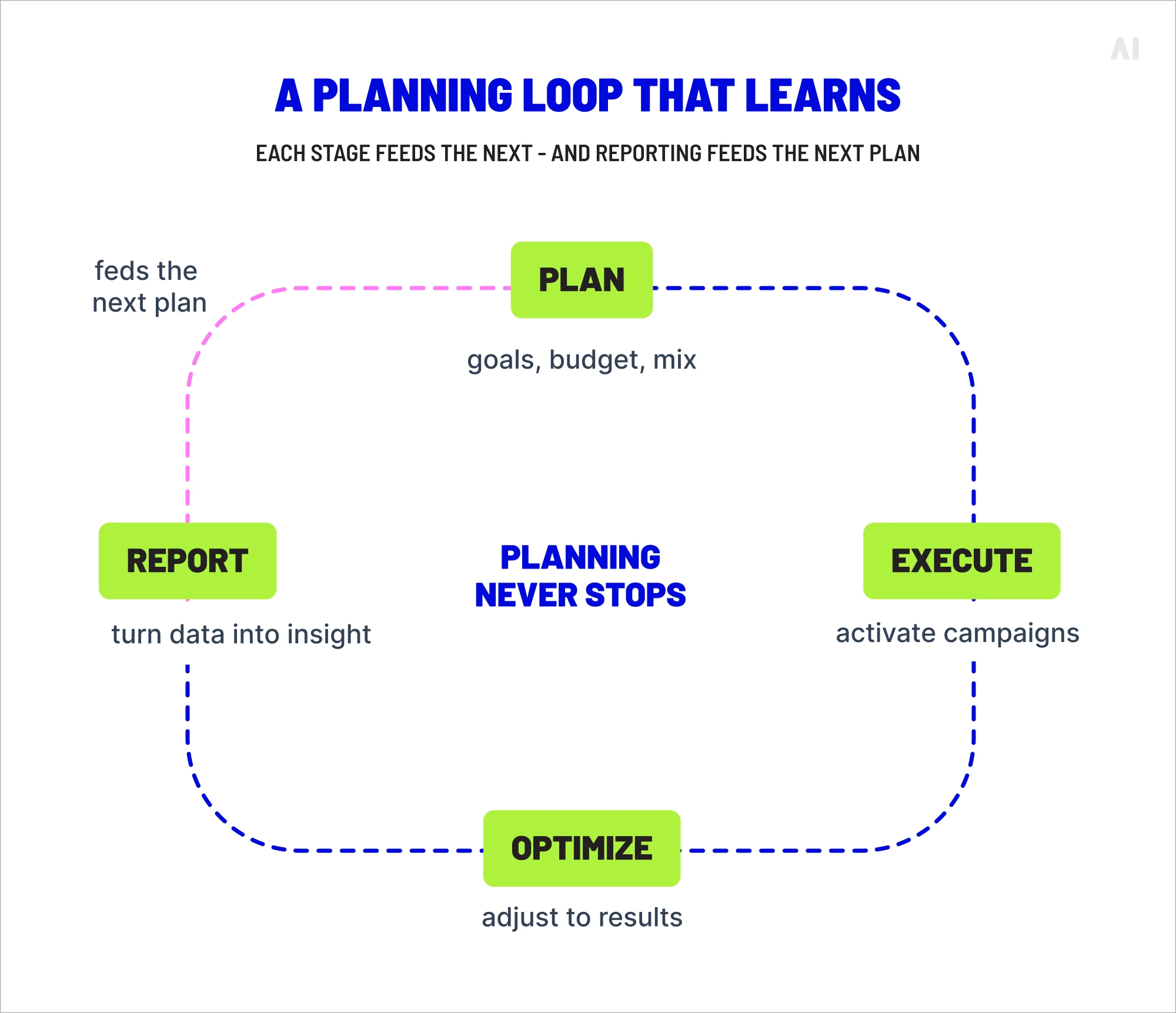
⚡ A connected marketing operating system is less a single product than a way of working, supported by technology that keeps the four layers in conversation.
Unified planning and measurement
The foundation is joining planning assumptions, KPIs, and campaign objectives to the actual performance outcomes — so that every plan can be honestly assessed against itself, and every assessment improves the next plan. This single connection, planning to measurement and back again, does more for performance than any individual feature.
💡 Related reads: Unified marketing measurement: what it is and why it matters.
Open and interoperable ecosystems
Modern marketing teams increasingly favor flexible, interoperable architectures over closed systems that lock data away. The reasoning is practical: a plan can only be connected to execution and reporting if the underlying tools are willing to talk to one another. AI Digital's Open Garden framework is built on this principle, giving advertisers neutral, cross-platform access rather than the restricted view of any single walled platform — which is what lets a connected planning workflow span the whole of a campaign instead of one corner of it.
💡 Related reads: What the Open Garden framework is
Intelligence-driven optimization
This is where a marketing intelligence platform brings the layers together. AI Digital's Elevate is built as a vendor-agnostic intelligence layer that unifies research, planning, optimization, and reporting in one place — connecting pre-campaign intelligence with live optimization and post-campaign analysis, so the plan and the proof finally live under the same roof. Drawing on intelligence from 150 billion data points a month and more than 10,000 audience attributes, Elevate lets teams define audiences, generate personas, build and refine media plans, study competitors, and produce client-ready reporting without leaving the platform. Its AI-Assisted Media Planner turns campaign inputs into a structured plan in seconds, while modules such as Marketing Mix Modeling and Path to Conversion connect spending to genuine business outcomes rather than last-click metrics. Built in collaboration with the agencies and brands that use it, the platform improves planning decisions and forecasting accuracy by keeping intelligence and execution in one continuous loop.
Transparent media and performance management
Optimization is only as trustworthy as the visibility behind it. AI Digital's Smart Supply brings transparency to where media is actually running, applying AI-driven supply selection and filtering to remove low-quality and fraudulent inventory before it ever reaches a campaign, and using supply path optimization to cut the wasted hops that inflate costs without improving results. Cleaner media buys produce cleaner performance data, which in turn makes every downstream optimization and planning decision more reliable. Transparency at the supply level and intelligence at the planning level reinforce one another.
From planning to performance: creating one connected system
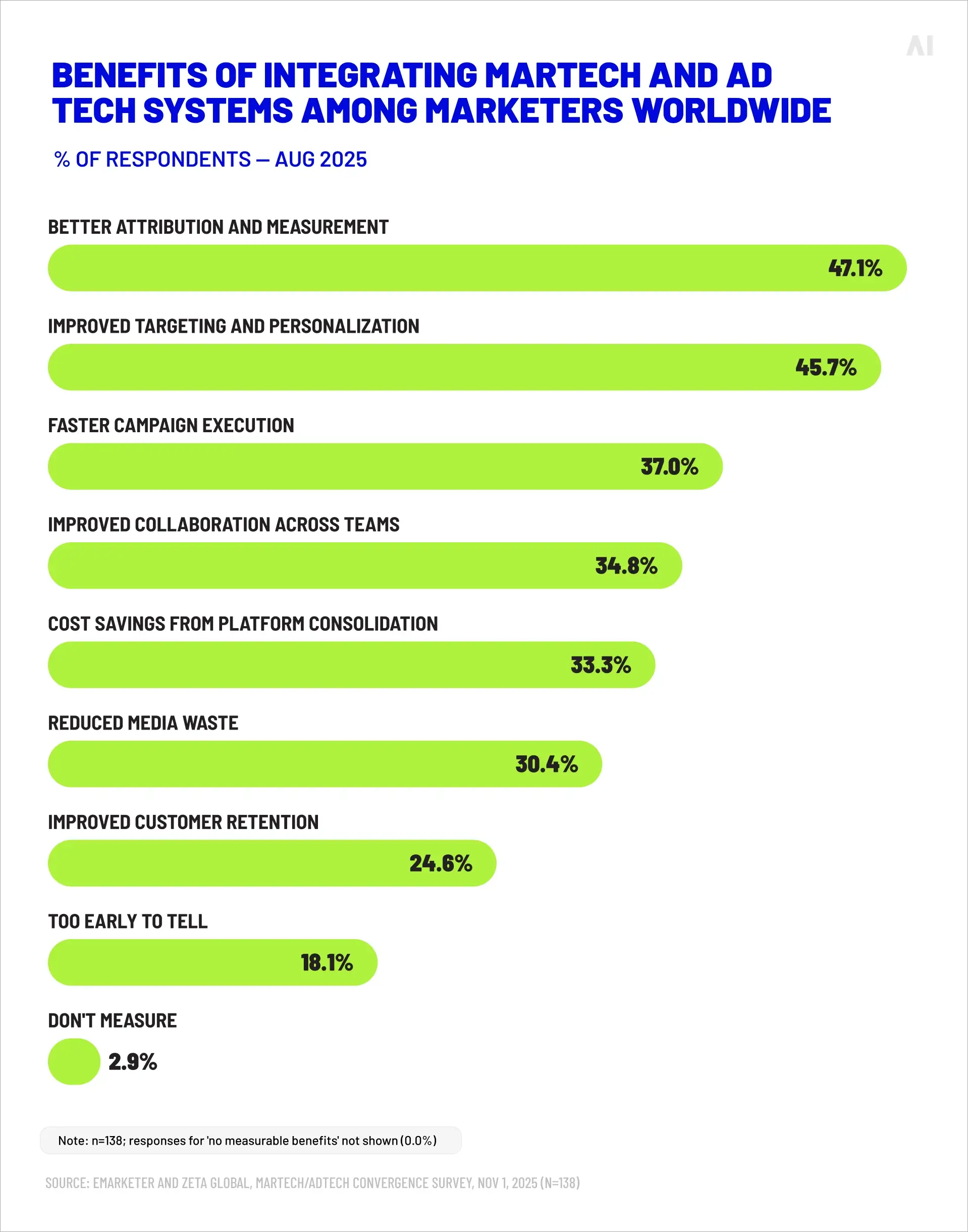
Connected marketing systems win because connection compounds. A plan that flows into execution, an execution that streams results back into optimization, and reporting that sharpens the next plan together produce something no individual tool can: an organization that gets better at marketing on a schedule rather than by luck. Forrester's Marketing Survey 2025, based on more than a thousand marketing decision-makers, found that the "leading" marketers — those that consistently apply joined-up practices such as cross-functional alignment — report materially stronger revenue and profit than their lagging peers. The advantage lives in the connections rather than the inventory of tools.
Sustainable growth tends to follow from connected systems, shared intelligence, transparent measurement, and better decisions, rather than from adding another platform to a stack that already runs at half utilization. The work is to join what you have into a loop that learns.
This is the problem AI Digital was built to help solve. Through the Open Garden framework, the Elevate intelligence platform, and Smart Supply's transparent media optimization, AI Digital connects planning, execution, optimization, and reporting into one working system — neutral, AI-powered, and overseen by people. If your plans and your performance still live in different rooms, get in touch; we're happy to talk through what connecting them could look like for your team.