Marketing Analytics vs Marketing Intelligence: Why the Difference Matters for Growth


Marketing teams have never had more instrumentation. Web analytics platforms, attribution stacks, CRM dashboards, customer data platforms, brand trackers—most performance teams in 2026 sit on top of a data infrastructure that, on paper, ought to answer almost any question a CFO can ask. It usually cannot. According to the 2025 CMO Survey, focusing data and analytics on the most important marketing problems climbed 24.5% in two years to become the fastest-growing challenge marketing leaders face—now cited by 51.8% of respondents, second only to demonstrating the impact of marketing actions on financial outcomes at 64%.
Some of that gap is a tooling problem. Most of it is a category problem. What is marketing analytics and what is marketing intelligence get treated as the same question when they are answers to different ones. Analytics measures and optimizes the campaigns a brand already runs; intelligence works the layer above—what the market is doing, where competitors are pulling ahead, where customer demand is moving before the dashboards register the shift. Confuse the two and analytics gets asked to drive strategic decisions it was never built for, while marketing intelligence is reduced to a quarterly slide deck nobody acts on.
This article walks through what each discipline does, where they diverge, where they reinforce one another, and how to build a marketing intelligence system—alongside the analytics for marketing that feeds it—capable of turning measurement into growth rather than reporting.
⚡ Analytics measures the campaigns marketing already runs. Intelligence questions whether those were the right campaigns to run.

What is marketing analytics?
Marketing analytics is the practice of measuring, modeling, and optimizing marketing performance using internal data—the data a brand collects from its own campaigns, web properties, CRM, and ad platforms. Where it earns its keep is in the practical work of converting raw activity into decisions: which creatives are paying back, which audiences are converting at acceptable cost, which channels are getting more credit than they deserve.
- Done well, analytics gives marketing a defensible answer to the question every CFO eventually asks—what did this spend produce?
- Done poorly, it produces dashboards everyone watches and nobody trusts.
💡 Related read: Unified marketing measurement: what it is and why it matters
What marketing analytics tracks
At the operational level, marketing analytics tracks the metrics that determine whether a campaign is working. The core set is well-established:
- impressions and reach for visibility,
- click-through rate and engagement for relevance,
- conversion rate and cost per acquisition for efficiency,
- return on ad spend and lifetime value for profitability, and
- customer acquisition cost set against retention figures for sustainability over time.
Cross-channel attribution — fraught as it is — sits across all of them, attempting to assign credit fairly across the touchpoints a customer actually saw.
The point is not to collect every metric available, which most platforms make trivial, but to identify the small handful that genuinely predict business outcomes for a given brand. Analytics in marketing is most useful where it filters signal from telemetry, rather than amplifying both.
Value of marketing analytics
The business case for analytics rests on a straightforward premise: campaigns that are measured improve, and campaigns that are not, do not. Run with discipline, marketing analytics surfaces the underperforming line items most marketing plans contain by default—the channels paying for impressions that never convert, the audience segments costing more to acquire than they ever return, the creative that tested well in research but flatlined in market.
McKinsey's marketing-analytics work has consistently put the recoverable inefficiency at 10 to 20 percent of total marketing spend—capital available either for reinvestment or for bottom-line savings. The figure tends to hold across brand sizes; what varies is the discipline required to act on it once analytics has surfaced it.
What is marketing intelligence?
Marketing intelligence is a continuous system that pairs internal performance data with external signals—competitor activity, market trends, customer behavior in adjacent categories, regulatory shifts, macroeconomic indicators—and uses the combination to inform decisions analytics on its own cannot reach. Where analytics asks how a campaign performed, marketing intelligence asks why the market that campaign ran into looked the way it did, and what is likely to change.
What is market intelligence at the broader business level becomes what is marketing intelligence when those external signals are filtered through what the marketing function specifically needs to decide: where to compete, where to retreat, where to invest before competitors do.
💡 Related read: How to gain full visibility across your marketing ecosystem.
What marketing intelligence covers
The aperture is wider than analytics by design.
- Market trends—category growth, channel migration, format adoption rates—give marketing a sense of the direction of travel.
- Competitor activity—spend levels, creative posture, channel mix, message testing, partnership announcements—reveals where rivals are placing their bets and how aggressively.
- Customer signals—search behavior, social sentiment, review patterns, demand in adjacent categories—surface intent the brand's own analytics will not see until that intent has already converted somewhere else.
- Regulatory and macroeconomic data add the boundary conditions: privacy regimes that change targeting economics, interest-rate moves that compress discretionary spending, supply-chain disruptions that swing category demand.
Together, these layers produce the context analytics alone cannot supply, and the foundation strategy needs.
Value of marketing intelligence
The value of marketing intelligence is anticipatory rather than corrective. By the time analytics shows a campaign has begun to underperform, the conditions causing it have already played out—a competitor has launched, a category has shifted, a customer segment has migrated to a new platform.
Marketing intelligence is the discipline of seeing those moves while there is still time to respond: the channel a competitor is over-investing in, the audience whose behavior is breaking from the segment average, the macro signal that a category is about to compress.
McKinsey's most recent work on AI-enabled marketing workflows puts the revenue uplift from this kind of anticipatory operating model at 10 to 30 percent. What matters is less the precise figure than the gap it implies between brands that see market changes coming and brands that find out about them in next quarter's report.
💡 Related read: Marketing Planning Software: How to Connect Planning, Optimization, and Reporting in One System.
How marketing analytics and intelligence work
In a working marketing operation, analytics and intelligence are not separate functions running in parallel—they are two passes over the same body of data, asking different questions.
Analytics begins with internal performance data: clicks, conversions, costs, attributed revenue, customer behaviors captured in first-party systems. It cleans, reconciles, and models that data to surface what is happening across the campaigns the brand is currently running.
Intelligence layers external signals on top of that internal foundation—competitor moves, search trends, sentiment changes, regulatory developments—and reframes the same performance picture against the conditions that produced it.
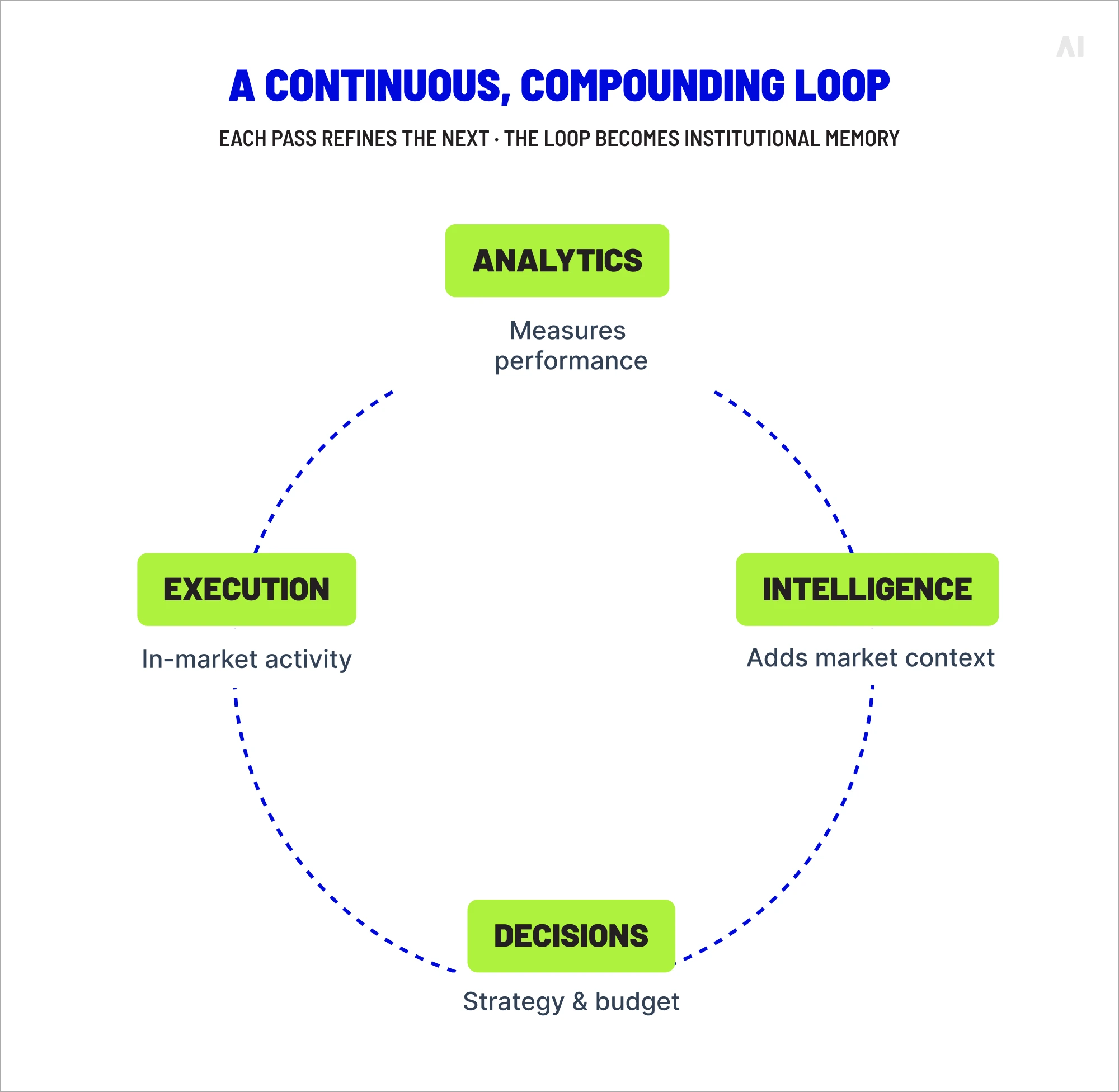
The output is a continuous feedback loop: analytics tells the team what to optimize this week; intelligence tells leadership what to plan for next quarter.

Where marketing data comes from
Useful marketing data sits across more places than any single dashboard can reach. Campaign-level performance comes from each ad platform, customer records from the CRM, transactional data from commerce systems, behavioral data from web and app analytics, and external signals from third-party research, syndicated panels, and competitive monitoring tools. Each source captures a partial truth and reports it in its own taxonomy, on its own cadence.
The work of unifying these inputs into a single, reconcilable view is what separates a marketing operation that can answer business questions from one that can only answer platform questions.
What marketing intelligence is not
Marketing intelligence is often confused with the artifacts that surround it: a quarterly competitor scan, a market sizing deck, a dashboard pulling third-party feeds. None of those qualify on their own. Intelligence is a continuous practice of interpretation, not a deliverable. A dashboard that surfaces competitor spend without a view on what to do about it is a data point. The category turns on whether the output drives a decision the organization actually makes—or merely informs one it never gets around to.
Marketing intelligence vs Marketing analytics: Key differences
Once the categories are properly distinguished, the practical differences are straightforward. Analytics and intelligence diverge across data scope, time orientation, and the kind of decision each is built to support. Treating them as interchangeable produces predictable failures—strategy made on optimization data, or optimization driven by frameworks built for strategy. The table below summarizes the core distinctions; the three sections that follow develop them in turn.
{{mavmi-1}}
Optimization vs decision-making
Analytics is built to optimize within a given strategy. It tells a team that paid social is outperforming display, that the morning bid is over-priced, that this creative should have its budget reweighted. Intelligence is built to challenge the strategy itself: whether paid social is the right channel for this category in the first place, whether the audience the campaign targets is still the right audience to reach. The two answer different orders of question.
Internal data vs market context
The data scope differs by definition. Analytics works with what the brand has captured itself—its campaigns, its sites, its customer records, its measurement tools. Intelligence works with that internal data and the signal around it: what the broader market is doing, how competitors are positioning, where customers are spending attention outside the brand's measurable footprint. Without external context, analytics describes a closed system. The closed system is rarely the one the business actually competes in.
Tactical execution vs strategic direction
Analytics owns the operational rhythm—the daily and weekly decisions that keep campaigns running well. Intelligence owns the longer arc: the quarterly and annual choices about which markets to enter, which segments to invest in, how to position against incumbents. A brand that runs only on analytics gets very good at executing the wrong strategy. A brand that runs only on intelligence has a strategy but no evidence it works.
The evolution of marketing data: From reports to intelligence
Marketing data has not always been the multi-source operation it is now, and the messiness traces a recognizable arc.
- The earliest era was descriptive reporting: monthly printouts, channel-specific exports, separate views of search and display and email that nobody attempted to reconcile. Decisions were monthly because the data was monthly.
- The 2010s brought integrated analytics — unified dashboards, multi-touch attribution, the first serious attempts to read campaigns across channels. Decisions tightened to weekly.
- The late 2010s and early 2020s introduced predictive modeling: forecasting, machine-learning bid optimization, propensity scoring. Decisions tightened again, to daily and in some cases hourly.
- The current era pushes the frontier outward rather than tighter, fusing internal performance data with external signals into systems that interpret both at once.
Each stage has reduced latency, but the more consequential change is in what marketing teams can act on. Reporting told marketing what had happened. Integrated analytics began to show why, in tactical terms. Predictive modeling forecast what would happen next inside the brand's own data. Intelligence does something different—it interprets what is happening outside the brand's own data, where the strategy actually plays out.
{{mavmi-2}}
💡 Related read: From data to decisions: how marketing intelligence transforms performance strategy
Real business use cases
Marketing analytics is enough to solve some problems. Marketing intelligence is essential for others. The harder operational call is recognizing which type of problem the brand is actually facing—and where both are needed to produce a usable answer.
When analytics is enough
For problems contained inside the brand's own performance data, analytics does the work. A campaign whose CPA has drifted upward over the past month does not require external context to fix; it requires interrogating the funnel, identifying which audience or creative is dragging the average, and reweighting accordingly. A landing page converting at 1.4% when the category benchmark is 2.3% can be diagnosed and remediated through A/B testing on copy, layout, and form length. Funnel drop-off between cart and checkout is an analytics problem, not an intelligence one.
When intelligence is critical
Other problems sit outside what analytics can see. A brand entering a new geography needs to know category demand, dominant competitors, and the channel mix consumers actually use—none of which appears in the brand's own data. A category leader watching its conversion rates erode despite no operational change in its own campaigns is almost always looking at competitor activity it has not measured. Emerging demand in an adjacent segment—a younger demographic, a new use case, a regulatory change opening a category—registers in market signal long before it shows up in attributed revenue. Intelligence is the only place to find any of these.
How teams use marketing intelligence
Intelligence is rarely useful only to marketing. Pipeline forecasts depend on the same competitor signal sales leadership briefs reps with; strategy teams pull from the same market-trend data marketing uses to inform briefs; product organizations rely on adjacent-segment intent data to inform roadmap decisions. A well-built marketing intelligence practice doubles as the central source of external context across functions—which is when the investment usually starts paying for itself.
{{mavmi-3}}
Benefits of combining marketing intelligence and analytics
The benefits of combining analytics and intelligence are not theoretical. Brands that operate them as a connected system, rather than two parallel functions, see measurable outcomes: tighter alignment between media investment and revenue contribution, faster reallocation when market conditions change, and a meaningful reduction in the share of marketing spend consumed by activity that cannot be defended at quarterly review. The cumulative effect is a marketing operation that scales without losing its grip on what is working.
What makes this combination work in practice is structural. Analytics and intelligence cannot be combined effectively when the underlying media environment is opaque, when measurement is gated by walled platforms, or when the data infrastructure is split across vendors who report incompatibly.
AI Digital's Open Garden framework approaches the problem from that angle—building cross-channel transparency and DSP-agnostic execution as the operating model rather than a configuration option, which is the substrate a unified analytics-and-intelligence practice actually needs.
Why companies misuse marketing analytics and intelligence
Companies that have invested heavily in marketing analytics often find, after several planning cycles, that the quality of their decisions has not improved. The reason is rarely the analytics itself; it is what the analytics is being asked to do.
💡 Related read: The problem with platform-reported data: why you can't trust the numbers.
Treating analytics as strategy
Analytics describes the campaigns a brand has chosen to run; it does not validate that they were the right campaigns. Used as a substitute for strategy, analytics produces a familiar failure—reactive optimization of an outdated playbook. The 2025 CMO Survey found marketing leads revenue growth in just 32% of companies and innovation in 26%—symptoms, in part, of leadership unable to make the strategic case its analytics infrastructure was never built to support.
Ignoring external signals
A brand that monitors its own performance closely while ignoring competitor activity, customer sentiment outside its owned channels, and broader category dynamics is making decisions inside a closed system.
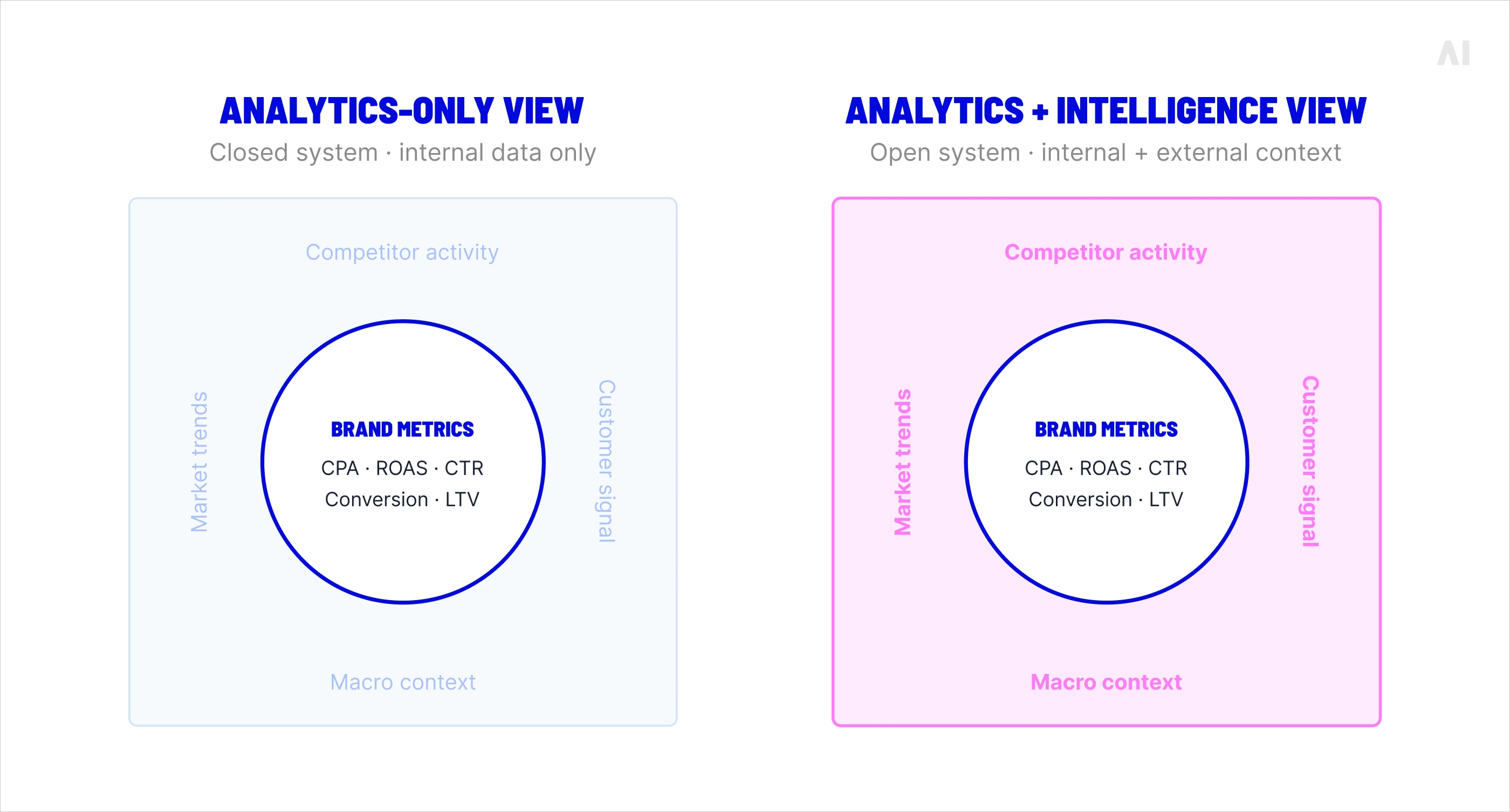
The blind spots show up at predictable moments—a competitor changes positioning and conversion rates begin to slip; a category undergoes a generational change in audience and the brand's targeting parameters are still calibrated to the old one. Ignoring external signal is a strategic choice with predictable costs.
Data overload without insights
Volume of data is not the same as quality of decision. Performance teams routinely sit on more telemetry than they can read, let alone act on, and the usual response is to add more—another dashboard, another attribution model, another cohort report. The problem compounds. Mature marketing operations are characterized less by how much they measure than by the discipline of measuring fewer things with more intent. A small set of well-instrumented metrics tied to business outcomes outperforms a large set tied to nothing in particular.
Fragmented tools and silos
The mechanical version of the same problem is tooling fragmentation. A marketing organization running separate platforms for ad-buying, analytics, attribution, customer data, brand measurement, and competitive monitoring spends more time reconciling reports than acting on them. Each platform tells the truth as it sees it, and no two see it the same way. The cost is operational and cognitive—decisions stall because the underlying data does not agree, and the work of forcing it to agree falls to the team meant to be using it.
💡 Related reads: Why fragmented martech stacks kill marketing performance
How AI connects analytics and intelligence
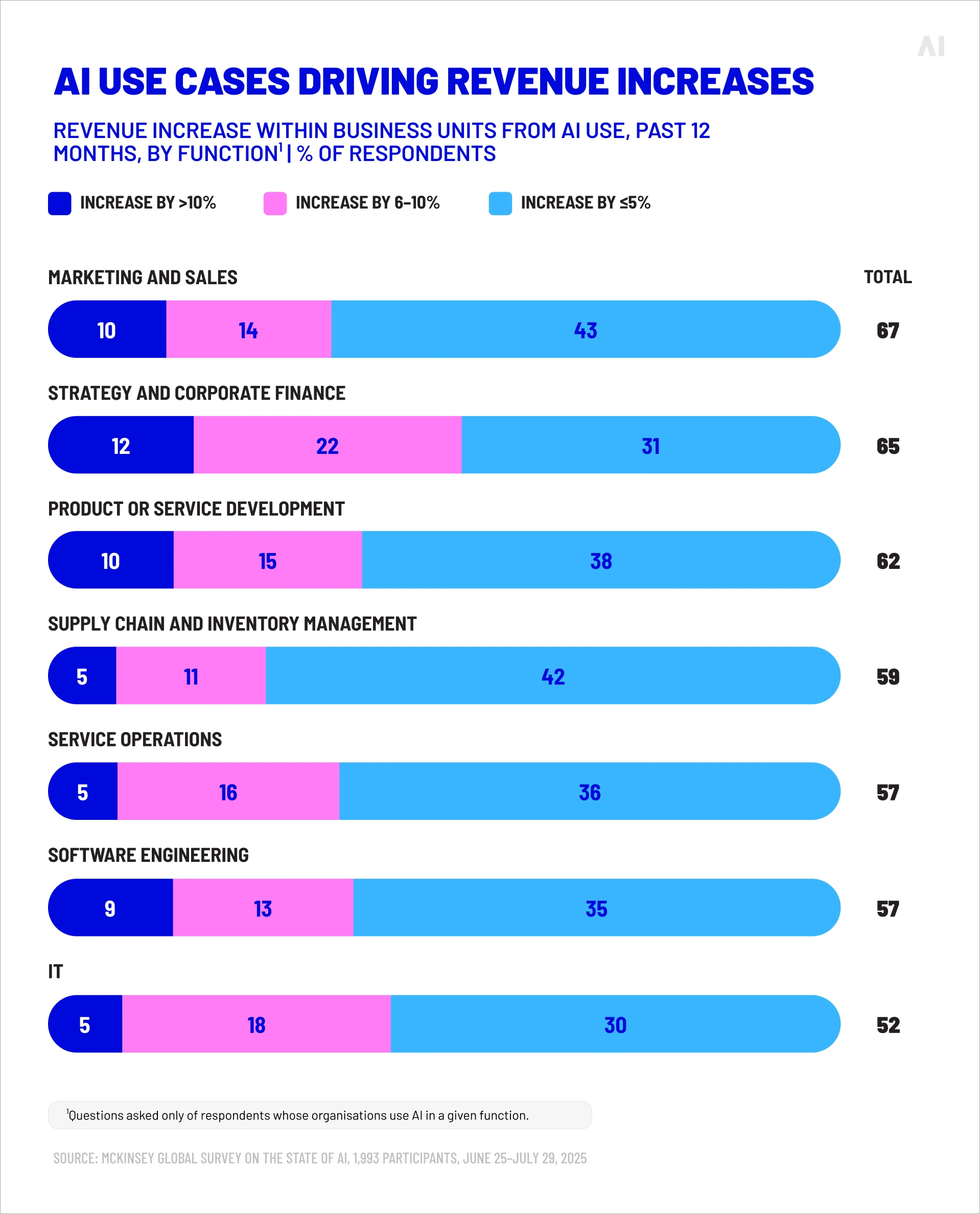
AI is the technology that finally makes the integration of analytics and intelligence operationally feasible rather than aspirational. Until recently, the work of joining internal performance data with external signal, running both through interpretable models, and surfacing usable decisions in time to act on them was beyond what most marketing teams could do at scale.
Marketing leaders surveyed by Duke University in 2025 projected a 157% increase in their use of AI to optimize and automate marketing over the next three years, reaching 44.2% of total marketing activity.
Platforms like Elevate, AI Digital's vendor-agnostic marketing intelligence platform, are built for this combined role—unifying research, planning, optimization, and reporting in a single intelligence layer where analytics and intelligence run as one continuous system.
💡 Related reads: AI in digital marketing
AI in marketing analytics
On the analytics side, AI does what static dashboards never could.
- Predictive models forecast campaign performance against historical patterns and adjust bidding, audience weighting, and creative rotation in flight.
- Automated alerts surface budget reallocation opportunities the moment they appear, rather than the next morning.
- Anomaly detection flags performance breaks worth investigating, separating noise from genuine signal in data volumes that would defeat manual review.
The change in operating tempo is the practical effect: a team using AI-augmented analytics can reweight a misallocated campaign in hours rather than days, and the cumulative compound of those small reallocations across a quarter is where most of the measurable efficiency gain comes from.
AI in marketing intelligence
On the intelligence side, AI does work that until recently was barely possible.
- Pattern detection across thousands of competitor signals—creative refreshes, spend changes, channel migrations—surfaces moves no human analyst would catch in time to act on.
- Demand forecasting against external indicators identifies category turns before they show up in revenue.
- Sentiment models running across review platforms, social conversation, and search query data spot audience changes weeks before they would surface in attributed conversion data.
The net effect is that intelligence stops being a quarterly artifact and becomes a continuous operating signal—one the strategy function can act on in the same cadence performance teams act on analytics.
💡 Related read: AI in marketing automation
How to build a marketing intelligence & analytics system
Building a marketing intelligence and analytics practice that genuinely supports decisions rather than generating reports takes six steps. None is exotic; what matters is doing them as a connected sequence rather than as discrete projects.
1. Connect data across analytics and intelligence tools
The first task is connecting the data sources the brand already has. Web analytics, CRM, ad-platform reporting, marketing automation, and external feeds for market and competitor data all need to flow into a unified environment where they can be reconciled and queried together. Without this foundation, every downstream step is constrained by whichever silo happens to get the last word in any given decision.
💡 Related reads: How AI platforms improve cross-channel marketing performance
2. Turn metrics into business KPIs
Channel metrics are operational instruments; they are not what the business is being run against. The second task is mapping what each platform reports to what the company actually values—revenue contribution, customer lifetime value, growth efficiency, retention. The exercise sounds bureaucratic but is consequential. A marketing operation reporting in CTRs and impressions is invisible to the rest of the business. One reporting in revenue and growth efficiency is in the conversation about how the business itself is performing.
3. Add an intelligence layer to guide decisions
With data connected and KPIs aligned, the next task is adding the layer that interprets external context against that internal foundation. This is what dedicated marketing intelligence platforms exist to do—combining cross-channel performance data with competitor signal, audience behavior, and market trends, and returning insights tied to specific planning and resource decisions.
Elevate plays this role for AI Digital clients, applying AI across research, planning, optimization, and reporting in a single platform that draws on more than one million analyzed audiences and 8,000-plus campaigns across 12 or more DSPs.
💡 Related reads: AI marketing platform vs traditional martech stack
4. Improve efficiency
Decisions only matter to the extent they are executed efficiently, and execution efficiency is largely a question of supply discipline. A meaningful share of programmatic spend leaks into intermediary fees, low-quality inventory, and bid-stream redundancy that working analytics can identify but cannot, on its own, fix.
Curated supply approaches such as AI Digital's Smart Supply close that gap by filtering inventory upstream of campaign delivery—preserving the budget analytics has determined should be working harder, rather than letting it dissipate into the supply chain.
💡 Related read: What is supply path optimization (SPO) in programmatic advertising?
5. Build an open ecosystem
None of the previous steps work if the underlying ecosystem is closed. A practice that depends on data flowing freely between tools is incompatible with vendor lock-in, walled-off measurement, or platform-favoring DSP routing.
AI Digital's Open Garden framework treats interoperability as the design principle rather than an afterthought—neutral DSP access, transparent reporting, and execution that does not commercially favor any particular inventory path. That is the structural prerequisite for an analytics and intelligence system to function as intended.
💡 Related read: Alternatives to walled gardens
6. Continuously optimize and scale
A marketing intelligence and analytics system is not a project that finishes; it is a practice that compounds. Performance data feeds back into intelligence to refine market hypotheses; intelligence feeds forward into analytics to test new strategic bets in market. Over enough cycles, the loop becomes the most valuable asset the marketing function owns. Intelligence marketing, done well, produces durable advantage rather than one-off campaign uplift.
Conclusion: The shift from analytics to intelligent growth
Marketing analytics and marketing intelligence are not interchangeable, and the article has worked through why the distinction matters.
Analytics measures and optimizes the campaigns marketing has chosen to run; intelligence interprets the market marketing is running into.
Brands that treat both as a single connected operating system — supported by tooling that does not gate the data, supply paths that do not leak the budget, and execution that does not favor commercial intermediaries — produce decisions neither analytics nor intelligence alone can reach.
That combination is what turns data from a reporting overhead into a growth instrument. AI Digital's approach to programmatic and intelligence-driven marketing is built around precisely this combination — research, planning, optimization, and reporting integrated into one decision system, with execution wired into a neutral media stack. If that is the kind of operation you are trying to build, it is worth a conversation.