

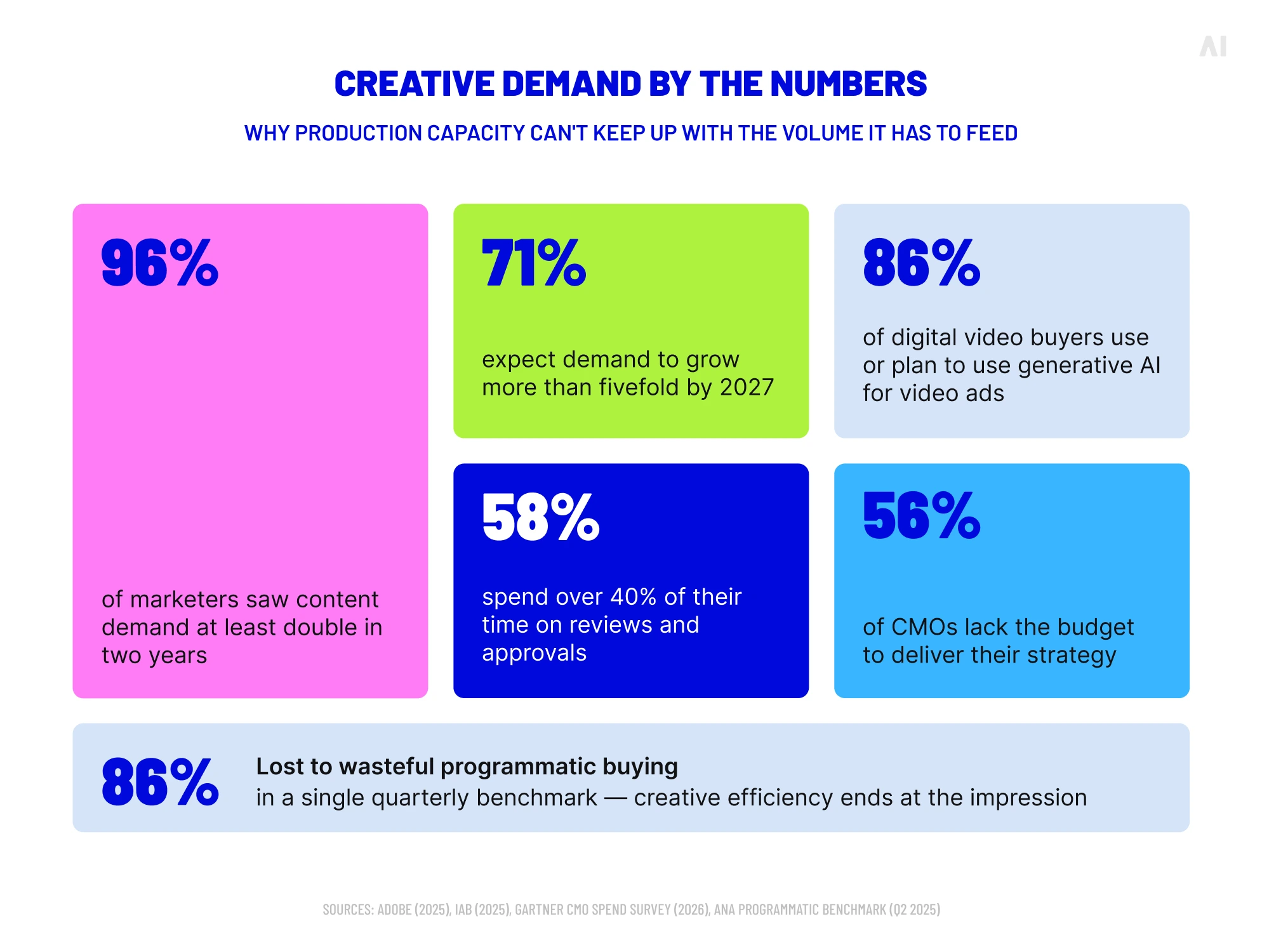
Marketers have spent years improving audience targeting, bidding, and measurement. Creative production has received less operational attention, even as the workload behind it has grown sharply. In a 2025 study of more than 1,600 marketers, Adobe found that 96% had seen content demand at least double during the previous two years. Seventy-one percent expected demand to rise more than fivefold by 2027.
TL;DR: Creative production scaling
- Creative demand multiplies while most production capacity grows linearly. Products, audiences, placements, markets, and refreshes compound the workload.
- The bottleneck may sit outside design. Briefing, adaptation, approval, compliance, tagging, trafficking, and reporting can each hold up an otherwise strong campaign.
- Every scaling model has a suitable use. Hiring strengthens concept development; partners add specialist or recurring capacity; templates cover simple work; direct AI speeds exploration; hybrid production combines speed with judgment.
- Asset count is a weak success measure on its own. Creative has to be tested, identified consistently, and tied to media and business outcomes.
- High-volume programs need governance by design. Brand rules, rights, specifications, accessibility, and human approval should be built into the workflow.
Ideas are the smaller part of the job. A single concept now has to survive dozens of specifications, audience treatments, languages, offers, approval routes, and launch dates. A social asset can tire before the next production batch is ready, while a CTV campaign may need several lengths and calls to action from the outset.
There are five common responses: hire, outsource, introduce templates, give teams direct access to generative AI, or combine AI-assisted production with human direction. Choosing among them starts with finding the real bottleneck. Whichever model wins, it then has to connect production with testing, governance, measurement, and media quality.
What is creative production scaling?
Creative production scaling is the process of increasing the number and variety of usable advertising assets without requiring a proportional increase in headcount, time, or cost. It covers original production as well as resizing, versioning, localization, video cutdowns, audio, interactive formats, and channel-specific adaptations.
This differs from scaling creativity. Automation can reproduce a component, fit a layout, create a language version, or generate a range of visual directions. People still decide what the campaign should say, which cultural references are appropriate, how the brand should sound, and when an idea is genuinely good.
An AI marketing platform can support those decisions with faster analysis and execution, but it does not remove the need for a clear proposition or experienced creative judgment.
Many teams diagnose the problem too broadly. They ask for “more creative” when the concept is already approved and the delay lies in producing 60 channel-ready adaptations. A scalable model protects the creative task while industrializing the repetitive production around it.
Why scaling creative is so hard
The arithmetic works against traditional workflows. Every additional audience, product, placement, format, market, and refresh adds another branch to the production plan. Yet the team often works through one brief, one layout, one review, and one export at a time.
The creative volume problem
Consider a mid-size advertiser promoting four products to three audiences with three message angles in two markets. The campaign uses six display placements, five paid-social placements, and two CTV formats. Each asset family is refreshed three times during the quarter.
The theoretical requirement is 4 × 3 × 3 × 2 × 13 × 3 = 2,808 deliverables: 1,296 display assets, 1,080 social assets, and 432 CTV assets. This is an illustrative upper bound, not an industry benchmark. A good plan would prioritize the combinations with the strongest commercial case instead of producing every possible permutation.
Even after that prioritization, the remaining volume can exceed the capacity of a team built around campaign launches rather than continuous adaptation. The workload also includes briefs, source-file management, copy changes, subtitles, legal lines, naming, exports, uploads, and corrections. Counting only finished files hides much of the labor.
More channels, more variations
“Resize this for social” sounds simple until a vertical crop loses the focal point or the platform interface covers the CTA. A six-second cut requires a new opening, faster brand recognition, and a message that works with limited time.
The same principle applies across display, online video, CTV, audio, and rich media ads. Each brings its own durations, safe zones, file weights, captions, aspect ratios, and interaction rules. An offer may be valid in one state but unavailable in another; a regulated category may require different disclaimers by region.
A late price change can affect copy, design, legal review, file names, trafficking, and the test plan. Without modular source assets and clear ownership, one edit can reopen the workflow.
Ad fatigue and creative refreshes
Ad fatigue describes the decline in response that can occur when the same audience sees the same execution too often. There is no universal exposure threshold. The pace depends on audience size, channel, message, placement, campaign objective, and the strength of the work. The operational consequence is consistent: teams need enough fresh material to respond before performance deteriorates.
Adobe’s study found that 37% of marketers said paid-social campaigns lacked enough fresh variation, while 32% said they lacked enough content to reach all intended audiences. A narrow library forces media teams into an awkward choice. They can keep spending behind a tired asset, reduce delivery, or wait for production. Each option limits the campaign.
Performance should therefore determine the refresh calendar. Display click-through rate can contribute to the diagnosis, but it should be read alongside frequency, viewability, video completion, conversion rate, cost per action, brand lift, and the campaign objective. A falling CTR may indicate fatigue; it may also reflect a placement change, audience saturation, or an offer that has lost relevance.
⚡ Creative demand multiplies across channels and audiences; most production capacity still expands one person or one asset at a time.
The five approaches to scaling creative production
Most organizations use a combination of the following models, even if they describe the setup differently. The right mix depends on which work needs original thinking, which work repeats, how variable demand is, and how much control the organization needs.
Few teams have the budget to absorb this. Gartner’s 2026 CMO Spend Survey found that 56% of CMOs lacked the budget required to deliver their strategy and 54% reported insufficient resources. Adding people can still be sensible, but it rarely covers every production peak.
1. Hiring more in-house designers
Hiring is the right response when the organization lacks creative leadership, senior craft, or strong campaign concepts. Internal designers accumulate knowledge that is difficult to reproduce in a short brief and can defend a coherent visual system.
The limitation is throughput. One additional designer provides one person’s capacity against a requirement that can multiply across hundreds of variants. Motion, 3D, sound, CTV, HTML5, and localization may also require different skills. Permanent hiring for every peak creates fixed cost during lower-demand periods.
Internal creative talent is usually most valuable when focused on propositions, concept systems, art direction, and high-risk work. Repetitive adaptation can then be handled through another model under that team’s guidance.
2. Outsourcing to agencies or freelancers
External specialists provide burst capacity and skills that are expensive to retain in-house. They suit hero films, complex animation, product visualization, specialist audio, and defined campaign launches.
Standing, high-volume production presents different economics.
- Per-asset pricing rises when each market, placement, and copy variation becomes a separate deliverable.
- Multi-day turnarounds can be too slow for live performance campaigns.
- More suppliers also mean more briefs, transfers, status checks, and reviews.
A production partner can still work well at scale when the relationship is designed around capacity, service levels, reusable systems, and continuous learning rather than isolated asset orders.
3. Self-serve templating tools
Tools such as Canva and Adobe Express make simple production accessible to non-designers. An approved template can remove a long queue for routine graphics and basic social variations.
The production burden has moved to the marketer, who selects imagery, edits copy, checks crops, exports files, and requests approval. At enterprise volume, loose permissions and duplicated templates can produce outdated claims and off-brand combinations.
Self-service works best inside a controlled library with locked components, defined user roles, current legal language, and a route for exceptions. It becomes less suitable as motion, localization, accessibility, regulated claims, or sophisticated testing enter the brief.
4. Prompting generative AI directly
Generative AI is becoming part of video production at unusual speed. IAB reported that 86% of digital video buyers were using or planned to use it to create video advertising. Buyers projected that AI-generated creative would account for 40% of ads by 2026.
Direct access is useful for visual exploration, rough scripts, storyboards, alternative copy, and early motion tests. It can produce several directions in the time previously required for one.
Raw output is rarely a production system. A model does not automatically know current brand rules, product details, rights, platform safe zones, accessibility requirements, or regional legal language. Images may distort products; video can introduce continuity errors; text and logos often need rebuilding. AI performance marketing requires disciplined inputs, review, and measurement.
5. Hybrid AI and human production models
Hybrid production assigns repetitive and computational tasks to AI: generating routes, adapting dimensions, creating cutdowns, organizing assets, tagging files, and proposing variations. Human designers direct the visual system, correct outputs, assess context, and approve the work.
Modular design makes this model more useful. The team defines reusable backgrounds, product shots, message blocks, calls to action, end cards, legal lines, and motion behaviors. Design tokens establish typography, color, spacing, and component rules. Dynamic templates produce controlled variation.
This is where AI in marketing automation becomes operationally useful. The goal is a repeatable production route with named owners and measurable service levels. Human judgment remains concentrated where a mistake carries the greatest creative, commercial, or reputational cost.
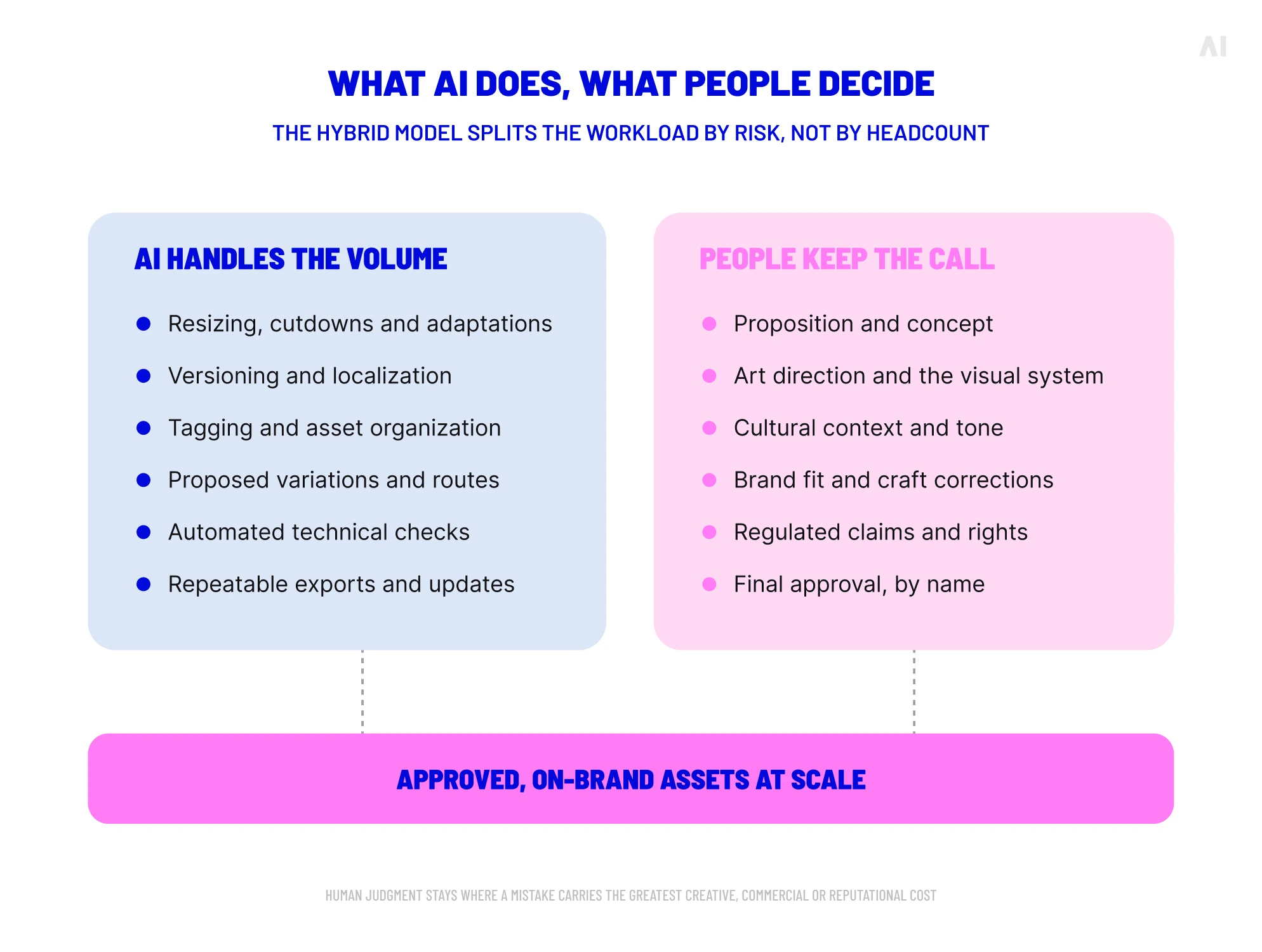
For recurring multichannel campaigns, the hybrid model offers the best balance of speed, quality, and consistency. It requires clean source assets, documented rules, governed prompts, maintained templates, and assigned approvers. That groundwork is the price of the speed.
Tools for scaling creative production
No single application covers the full creative supply chain. Most scalable setups combine several categories:
- Design and editing software for original craft, source files, motion, audio, and finishing.
- Generative AI for exploration, draft production, version ideas, and selected production tasks.
- Creative automation for resizing, templating, feeds, versioning, and repeatable exports.
- Digital asset management for approved files, rights, taxonomy, retrieval, and version control.
- Workflow management for briefs, owners, approvals, deadlines, and audit trails.
- Testing and measurement for prelaunch feedback, live experiments, asset-level reporting, and business outcomes.
The applications have to operate as a connected process. A sophisticated generator adds little if the approved logo lives in someone’s inbox, file names change between teams, or performance data cannot identify the asset that ran. A marketing intelligence platform can bring planning and performance signals together.
Technology works best after the organization has defined its taxonomy, source of truth, approval rights, and handoffs. Buying software before doing that can digitize an inefficient process without shortening it.
Identify your creative bottleneck
Teams feel the delay when a campaign misses its launch date, but the cause may appear earlier: an incomplete brief, unclear ownership, slow legal review, or an asset taxonomy that hides the approved file.
Audit your team’s time
Track one representative week of creative work. Separate tasks that require creative judgment from production and coordination:
- Creative: research, proposition, concept development, copy direction, art direction, and senior review.
- Production: resizing, versioning, cutdowns, localization, captions, legal-line changes, exports, and file preparation.
- Operations: briefing, scheduling, asset retrieval, status updates, approval routing, uploads, tagging, and reporting.
Record approval rounds, brief-to-live time, revisions, versioning hours, missed dates, and recurring errors. The results may show that designers are absorbing work no other team owns.
Adobe found that 89% of marketers sent content through at least three approval stages, while 58% said more than 40% of their time went to reviews and approvals. Removing one unnecessary review or improving the brief can release capacity without another tool.
Production vs. talent bottlenecks
A talent bottleneck appears when concepts are generic, the proposition is unclear, or the craft is weak. It may require a senior creative hire, specialist agency, or stronger research.
A production bottleneck appears when approved ideas cannot be adapted fast enough. Automation, a production partner, better source files, or simpler approvals will usually address it more directly.
Measurement creates a third failure mode. If a team cannot tell which variation influenced the outcome, producing additional variations creates a larger archive and little new knowledge.
Build vs. partner
Internal capability can be economical when demand is steady, formats are predictable, and the organization can support templates, QA, and governance. A partner suits fluctuating volume, changing channels, specialist formats, or an internal team at capacity.
Evaluate quarterly volume, variation complexity, internal skills, rights requirements, specification changes, and the cost of missed launches. A mixed model often keeps concepts and brand systems inside while a partner handles repeatable execution.
⚡ Before increasing output, find the stage where approved ideas stop moving.
Testing ad creative at scale
Producing more variants only helps when the organization can learn from them. Without a test structure, a large creative library becomes an expensive collection of unproven options.
Volume without testing
Begin with a hypothesis. Compare a product-led opening with a problem-led one, or two calls to action. Keep enough elements constant to explain the result. Changing headline, image, offer, format, and audience together prevents a useful reading.
Four forms of evaluation serve different purposes:
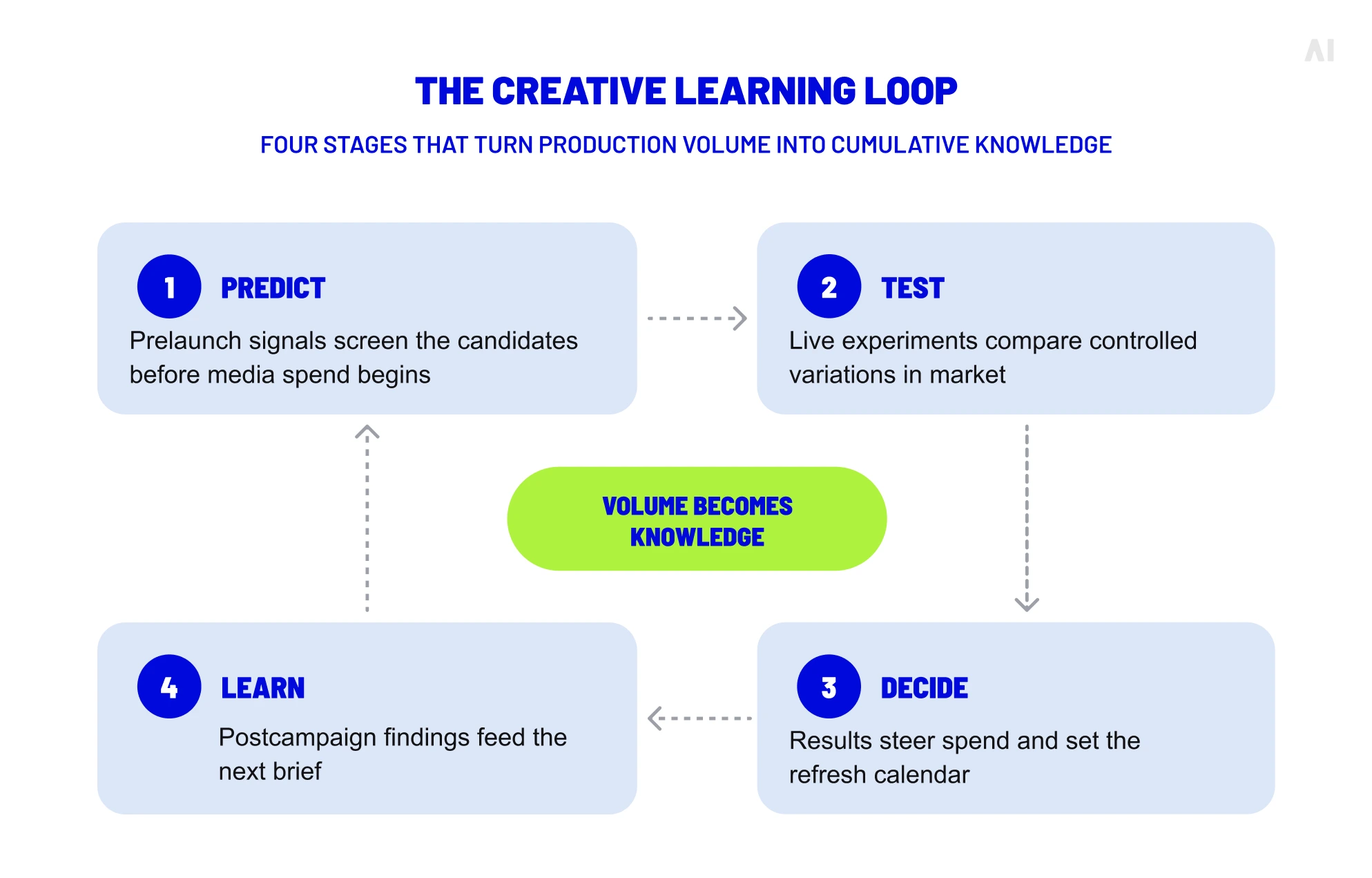
1. Predictive prelaunch evaluation uses modeled or simulated audience response to identify promising concepts and potential weaknesses before media spending begins.
2. Live A/B or multivariate testing compares controlled variations in the market.
3. Dynamic creative optimization assembles or selects variations during delivery according to rules and performance signals.
4. Postcampaign analysis connects asset-level results with spend, audiences, placements, conversions, and longer-term outcomes.
A synthetic focus group provides a directional prediction rather than the causal evidence of a live experiment. Dynamic creative optimization operates during delivery. It can allocate impressions across combinations but cannot rescue an unclear proposition or poor source assets.
Testing should cover message, visual direction, offer, CTA, format, duration, opening frame, and audience treatment. The goal is a series of usable lessons, not a single permanent winner. Audience response changes as frequency, competition, seasonality, and context change.
Measure creative performance
Use three levels of measurement. Creative diagnostics include attention signals, video hold or completion, interaction, and signs of fatigue. Media outcomes include CTR, VCR, CPM, frequency, cost per visit, and cost per acquisition. Business outcomes include qualified leads, sales, ROAS, brand lift, and incrementality.
Those levels should meet in the same advertising intelligence system. Asset IDs must survive production, trafficking, and reporting. “Video 4” is not useful analysis without its message, audience, version, and approval record.
Prelaunch signals should guide what enters the live test. Live results should guide spend and refresh decisions. Postcampaign analysis should inform the next brief. That loop turns production volume into cumulative knowledge.
⚡ More assets create an advantage only when every variation contributes to a structured learning system.
The governance challenge of scaling creative
At low volume, a reviewer may catch a wrong logo or disclaimer by memory. Across hundreds of assets, governance must move earlier and divide automated checks from human judgment.
Brand consistency and compliance
Begin with a controlled source library for approved logos, fonts, colors, product images, claims, legal lines, rights, and expiration dates. Platform rules add safe zones, captions, accessibility, duration, and interaction requirements. Online video advertising adds sound, subtitle, aspect-ratio, and completion considerations.
Automated checks can flag missing disclaimers, incorrect dimensions, out-of-date prices, low color contrast, or absent captions. Human review remains essential for tone, cultural context, emotional quality, misleading implications, and brand fit. Approval rights should be explicit: who can approve a concept, a copy change, a regional claim, and a final export?
Many organizations have adopted AI tools faster than these controls. The IAB State of Data 2025 study found that 70% of agencies, brands, and publishers had yet to integrate AI fully across planning, activation, and analysis. Across 18 measures such as formal training, road maps, defined use cases, and governance boards, no individual measure was being used or planned by more than 49% of respondents.
Governance should also record asset provenance: which source material, model, prompt, template, editor, and approver contributed to the final file. That record becomes valuable when a claim changes, a right expires, or a platform asks for documentation.
👉 For a closer distinction between unsafe content and environments that are safe but unsuitable for a particular brand, see Brand Safety vs. Brand Suitability in Modern Advertising.
AI creative risks
Recent campaigns show how quickly technical execution can become a public brand issue. Coca-Cola’s 2025 AI holiday advertising drew criticism for visual inconsistencies and uncanny details; The Verge reported that the campaign followed similar backlash the year before. In the Netherlands, McDonald’s withdrew an AI-generated Christmas ad after a strong negative response on social media.
Neither case proves that audiences reject AI-made advertising outright. What they punish is weak detail and off-brand work—and at scale, one unchecked problem can surface across many markets and placements at once.
The safer model combines approved tools, protected inputs, documented rights, automated technical checks, and named human approvers. The closer an asset sits to the brand’s identity or a regulated claim, the more senior that review should be.
⚡ At high volume, governance has to be built into the production workflow rather than added after generation.
How to scale ad creative production with AI
Scaling depends on an operating model that connects brand judgment, production, testing, campaign outcomes, and suitable inventory. AI Digital covers each of those functions with a distinct capability.
AI Creative Studio: AI plus human review
AI Creative Studio combines AI-native production with human oversight across video, motion, social, audio, static, HTML5 rich media, and interactive CTV formats.
One approved concept can be extended across platforms, audiences, sizes, and languages through bulk versioning, resizing, localization, and updates. Human art direction and QA keep generated output aligned with the strategy.
The Studio supports rapid prototyping, concept development, asset tagging, and prelaunch audience feedback. Its Synthetic Focus Group can prioritize promising candidates for live testing. This predictive signal is a decision aid rather than controlled market evidence.
The division of labor answers the practical question of how to scale creative production with AI: generation and automation expand exploration and execute the repeatable variations, while people keep responsibility for the idea, brand fit, final craft, and approval.
Elevate: connect creative performance with campaign intelligence
Elevate is AI Digital’s marketing intelligence platform for research, strategic planning, optimization, reporting, and analysis. It brings pre-campaign intelligence and post-launch results into a common environment, including media KPIs, revenue metrics, business outcomes, Marketing Mix Modeling, and Path to Conversion.
With consistent tagging, teams can compare creative variants by audience, publisher, geography, spend, sales, conversion rate, and ROAS. Path to Conversion adds context about ads and touchpoints that appeared before a conversion.
Elevate should be treated as the planning and campaign-intelligence layer, while specialized prelaunch tests and platform experiments supply their own diagnostic signals. The connection is valuable: a fatigue indicator, attention result, or test outcome carries more meaning when analysts can read it beside delivery, audience, cost, and business performance.
Smart Supply and Open Garden: reach quality inventory
Creative efficiency ends at the impression. A fast production system cannot recover spend lost to invalid traffic, unsuitable placements, avoidable intermediaries, or weak supply paths. The Association of National Advertisers estimated that wasteful programmatic media buying accounted for $26.8 billion in its Q2 2025 benchmark.
- Smart Supply addresses this delivery layer through direct SSP access, traffic filtering, outcome-led Deal IDs, and in-flight performance adjustments. Its filters are designed to remove fraud, invalid traffic, low-quality placements, and non-brand-safe inventory before buying, with reporting that provides visibility into placements, traffic sources, and performance. Human oversight complements the automated selection and adjustment process.
- The Open Garden Framework is vendor-neutral and technology-agnostic, connecting data, inventory, platforms, and outcomes across DSPs, SSPs, and data partners. Smart Supply improves programmatic supply; Open Garden provides the broader framework for platform choice, interoperability, and cross-channel coordination.
Together, these layers connect creative production with the conditions under which creative is evaluated. A campaign cannot learn fairly from a variant if one execution receives high-quality, viewable placements and another is concentrated in weak inventory. Supply path optimization and asset-level measurement help analysts tell the difference between a creative problem and a delivery problem.
Implementation roadmap: scaling creative production
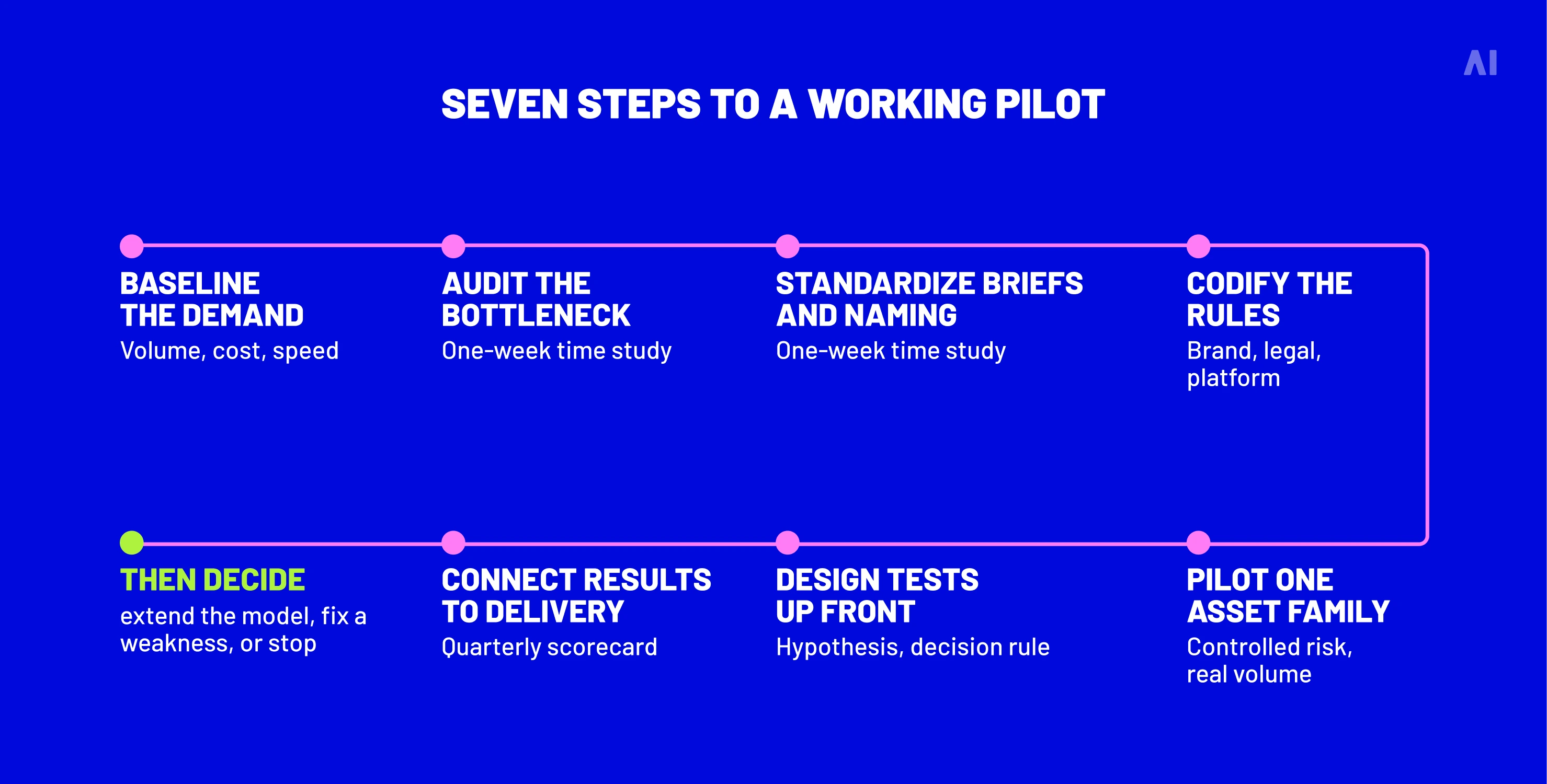
A company does not need to replace every design, project-management, or buying tool at once. A focused pilot can prove the operating model while limiting cost and risk.
1. Establish the demand baseline
Count the assets delivered during the previous quarter by campaign, format, channel, market, and refresh. Record internal hours, agency spend, average turnaround, revisions, and missed dates. Include production work that rarely appears in final-asset counts, such as captions, legal changes, file preparation, and uploads.
Output: a demand baseline showing volume, cost, speed, and variation complexity.
2. Audit the bottleneck
Run the one-week time study described above. Follow several assets from brief to live delivery and record each wait, handoff, rejection, and correction. Compare the evidence with Table 3 before choosing software or a partner.
Output: a bottleneck report that names the constrained stage and its likely cause.
3. Standardize briefs, naming, and metadata
Every brief should define the audience, objective, proposition, offer, mandatory elements, required variations, channels, markets, owners, and test hypothesis. Establish a naming convention and persistent asset ID that connect the source file, approved export, platform upload, and performance record.
Output: a structured brief, taxonomy, and asset-identification standard.
4. Codify brand, platform, and compliance rules
Convert guidelines into usable production instructions. Mark which elements are fixed, which can vary, which claims require legal approval, and which technical checks can be automated. Include rights, accessibility, regional rules, and expiration dates.
Output: a creative governance playbook with approval roles and escalation routes.
5. Pilot one repetitive asset family
Choose work with meaningful volume and controlled risk: paid-social adaptations, display versions, video cutdowns, or localization. Keep the original team and project-management system in place while introducing the new production model. Compare turnaround, cost, revision count, approval time, and error rate with the baseline.
Output: a pilot batch and evidence on production efficiency.
6. Design testing and measurement before launch
Define the hypothesis, controlled variable, audience, success metrics, budget, and decision rule. Confirm that asset IDs will reach the reporting layer. Marketing effectiveness measurement challenges often begin when taxonomy and test design are added after delivery has started.
Output: a test matrix and asset-level measurement plan.
7. Connect creative results with delivery quality
Review creative performance by audience, placement, publisher, supply source, frequency, and business outcome. Use the findings to update the next brief, template, and refresh schedule. A data-driven marketing strategy becomes more useful when creative operations contribute consistent inputs rather than occasional campaign postmortems.
Output: a quarterly scorecard covering production speed, quality, cost, learning, and campaign results.
The pilot should end with a decision: extend the model, correct a specific weakness, or stop. Scaling a flawed workflow simply distributes the flaw across more assets.
Ready to scale creative production?
Sustainable creative scaling begins with a precise diagnosis. Some organizations need stronger concepts. Others need faster adaptation, clearer approvals, better testing, or higher-quality delivery. The production model should follow that evidence.
The strongest operating model links modular production with human judgment, embedded governance, structured testing, campaign intelligence, and supply quality. That is how higher output becomes better marketing rather than a larger file archive.
Talk to AI Digital about assessing your current workflow and selecting a practical pilot for scaling creative production.