AI Video Ads: How to Produce at Scale Without a Film Crew


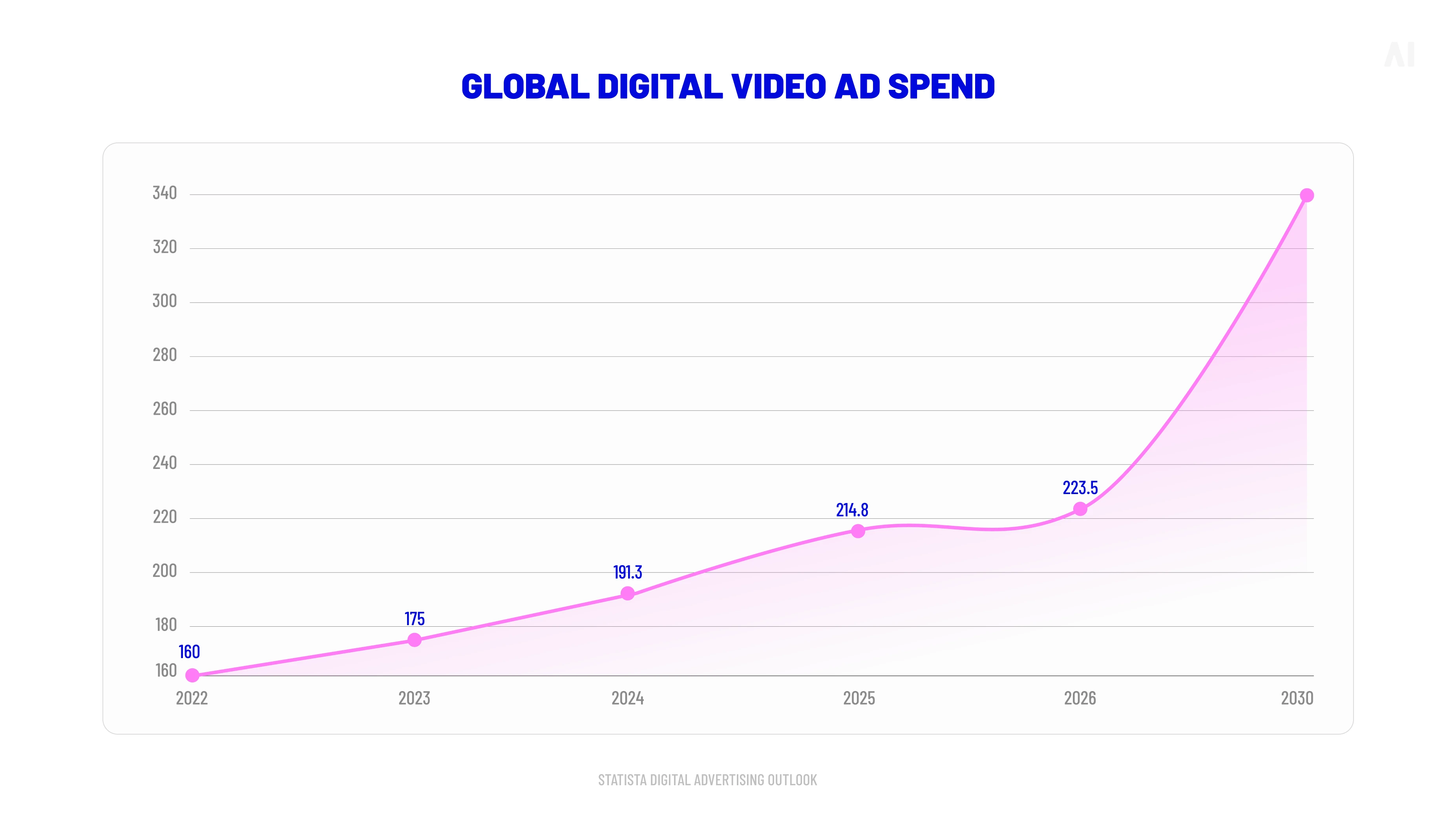
AI is changing video ad production from a sequence of isolated projects into a faster, more adaptable creative system. According to IAB’s digital video research, 86% of buyers were already using or planning to use generative AI for video creative, with buyers expecting the technology to support 40% of video ads in 2026. Instead of organizing another shoot whenever a campaign needs a new hook, language, spokesperson, aspect ratio, or product angle, brands can now use AI to generate and assemble footage, develop scripts and voiceovers, animate static assets, and adapt approved concepts for different platforms and markets.
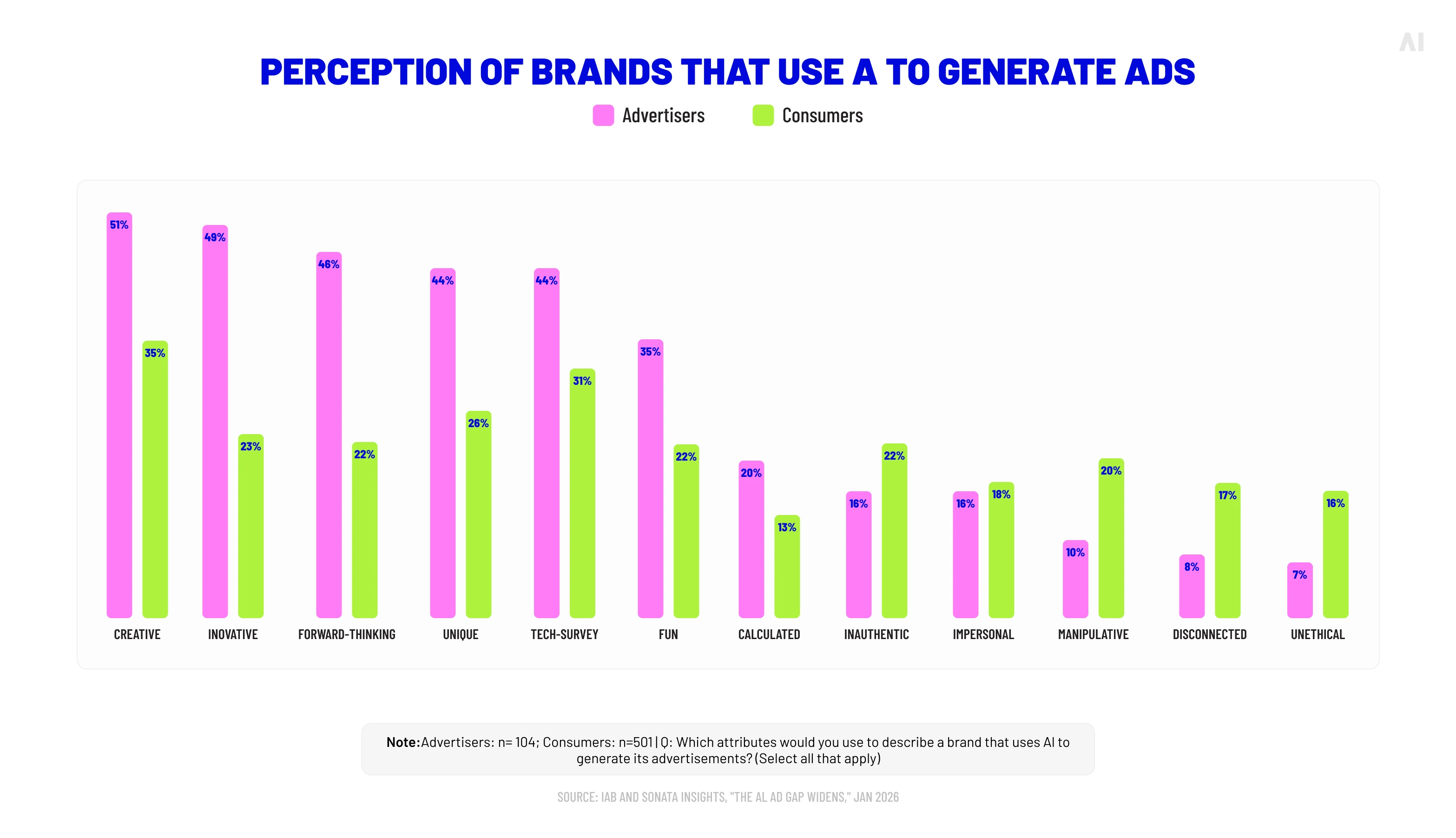
Adoption, however, is moving faster than operational maturity. Smartly’s 2026 Digital Advertising Trends research found that 95% of surveyed marketers were testing AI for creative production, yet 42% of generative AI users still described their approach as being in the initial testing stage. The same research found that three in four marketers were concerned that AI-generated creative could make brands look and sound alike, while 86% had already encountered AI output resembling a competitor’s content.
These findings expose the real creative bottleneck behind scaling ad production: generating assets is becoming easier, but producing distinctive, accurate, approved, and platform-ready advertising at scale still requires a structured workflow.
Effective AI video ad production therefore involves more than entering a prompt and accepting the first output. It requires teams to establish clear creative hypotheses, reusable brand and product inputs, controlled variables, human approval stages, version governance, and a feedback loop connecting campaign results to the next production cycle. Production efficiency must also be measured separately from advertising effectiveness: creating more videos at a lower cost does not mean those videos will generate stronger attention, conversions, or business outcomes.
This guide explains how to create video ads with AI through a repeatable, video-specific workflow—from defining the concept and preparing source assets to generating, adapting, reviewing, and testing variations. It also examines how to scale production without losing creative control, maintain quality and audience trust, evaluate production costs and campaign performance, and determine when AI-led production is appropriate—and when a traditional or hybrid shoot remains the better creative decision.
TL;DR: Key Takeaways
- AI reduces repeated production work by supporting video generation, editing, voiceovers, localization, resizing, and creative adaptation without requiring a new shoot for every execution.
- Scalable production depends on reusable inputs and controlled variables, not dozens of unrelated AI-generated assets.
- Human strategy and oversight remain essential for creative direction, product accuracy, brand consistency, rights, approvals, and quality assurance.
- More video assets do not automatically produce better campaign results; production efficiency and advertising performance must be measured separately.
- The strongest model connects faster production with structured testing, using performance feedback to guide the next creative iteration.
What Are AI Video Ads?
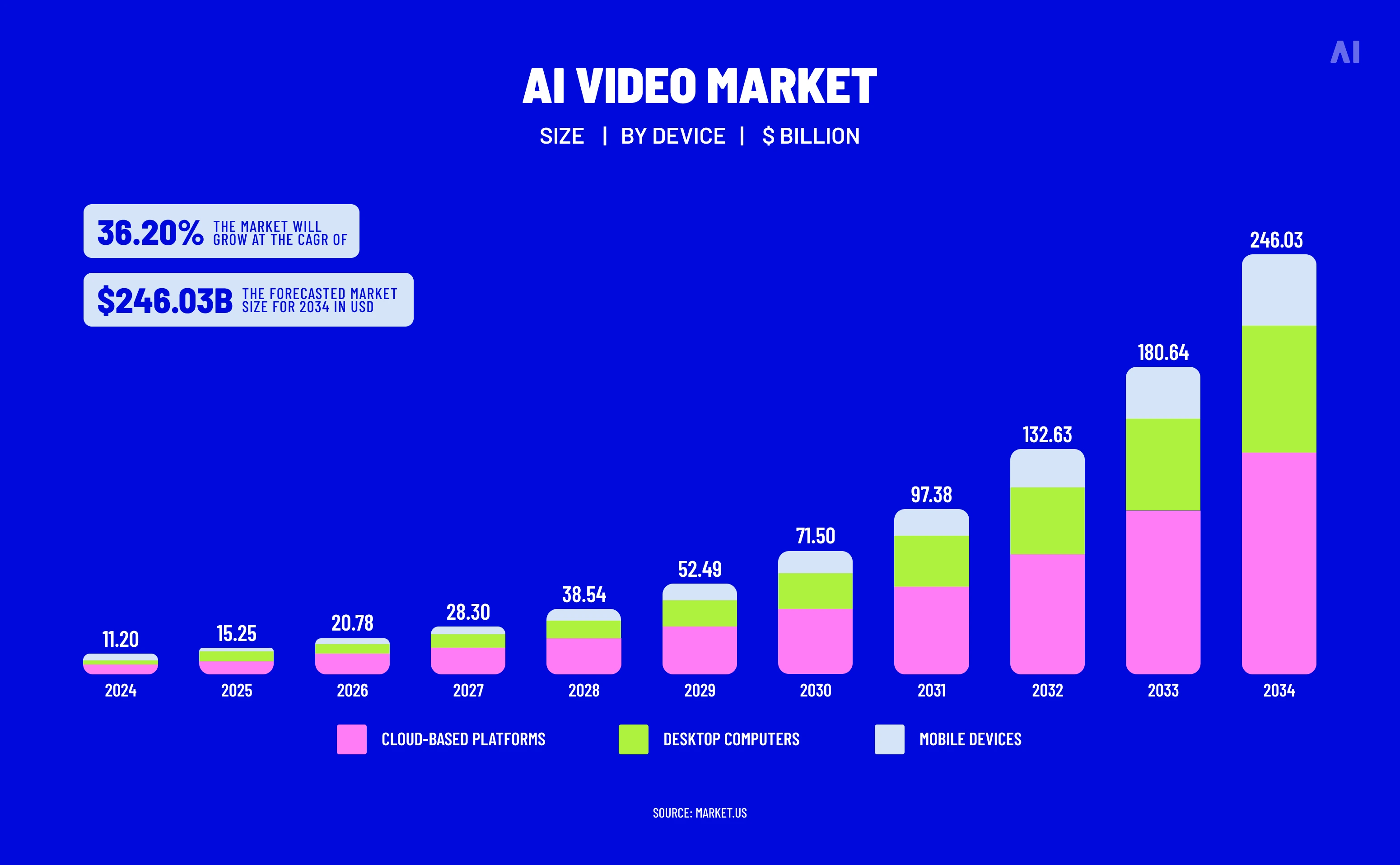
AI video ads are advertising videos created, adapted, or assembled using generative AI and other AI-assisted production technologies. Depending on the execution, AI may generate scripts, visuals, presenters, voices, motion, captions, or complete scenes. It can also transform existing product images and footage into new video assets or adapt an approved video for additional platforms, audiences, and markets.
Common types of AI video advertising include:
- UGC-style video: Creator-style advertising produced with AI-generated scenes, presenters, or voices. It should not be presented as genuine user-generated content or a real customer endorsement unless it comes from an actual, authorized customer.
- Spokesperson or avatar video: A synthetic or digitally generated presenter delivers an approved brand message, product explanation, or offer.
- Product demonstrations: AI animates product images, generates contextual scenes, or combines real product footage with synthetic elements to illustrate features and use cases.
- Image-to-video creative: Static product photography, campaign imagery, or design assets are converted into motion-led video.
- Voiceover-led ads: AI-generated or human voiceovers are combined with product footage, motion graphics, captions, or generated visuals.
- Short-form social video: Fast-paced, platform-specific creative is produced for placements such as vertical feeds, Stories, and short-form video environments.
- Localized and adapted versions: Existing concepts are modified with new languages, voiceovers, captions, offers, formats, or market-specific messaging.
Not every AI video ad is generated entirely from scratch. In many cases, AI supports selected production stages—such as scripting, storyboarding, voice generation, editing, resizing, or localization—while the core footage and creative direction remain human-produced. In other cases, most visual and audio components may be generated, with people responsible for strategy, brand alignment, factual accuracy, rights clearance, and final approval.
⚡️The appropriate production model depends on the creative concept, product, channel, audience, and required level of authenticity.
What AI Changes About Traditional Video Ad Production
Traditional video production usually treats each major execution as a separate project. A new audience, market, spokesperson, format, or campaign refresh can require additional filming, editing, voice recording, and post-production. AI changes this model by allowing teams to reuse approved inputs and generate controlled variations without rebuilding every asset from the beginning.
The central advantage is therefore not fully automated video creation. It is reducing the amount of production work that must be repeated for every execution. A brand can retain its approved product information, visual identity, core footage, claims, and campaign concept while varying selected components such as the opening hook, spokesperson, voice, CTA, language, duration, or aspect ratio.
This creates a more flexible production system, but it does not make every variation useful. Generating dozens of unrelated videos can introduce inconsistent messaging, synthetic-looking output, inaccurate product details, and unnecessary approval work. Scalable production depends on defining which elements are fixed, which variables are being tested, and why each version exists.
AI also does not remove the need for original filming. Authentic testimonials, complex physical demonstrations, real performances, premium cinematography, and highly controlled product interactions may still require a traditional shoot. In many campaigns, the strongest model is hybrid: teams film the source material that needs to be real and use AI to extend, adapt, localize, and version it.
⚡️AI changes video production most effectively when it reduces repeated execution work while preserving human creative direction, editing, quality control, and accountability.
How to Create Video Ads With AI: A Scalable Production Workflow
Learning how to create video ads with AI involves more than selecting a generation tool. A scalable workflow must connect creative strategy, approved source material, production, platform adaptation, quality control, and campaign learning. The following seven-step process helps teams produce meaningful variations without allowing speed or volume to weaken brand consistency.
Step 1: Define the Goal and the Variables You Want to Test
Begin with the advertising decision the video needs to influence. Define the campaign objective, target audience, product, offer, core message, supporting proof points, platform, and CTA before generating scripts or visuals. These elements establish what the creative must communicate and how its effectiveness will eventually be evaluated.
Next, develop a creative hypothesis: a specific explanation of why a message or execution might influence the intended audience. For example, a software company might hypothesize that showing how quickly users can complete a task will be more persuasive than listing the product’s technical features.
Use the hypothesis to determine which creative variables should change. These may include:
- the opening hook;
- audience or product angle;
- spokesperson or presenter;
- visual treatment;
- proof point;
- offer or CTA;
- video length;
- pacing or narrative structure.
Keep other important elements fixed so the resulting versions can be compared meaningfully. A campaign could combine two audience angles, three hooks, and two CTAs to produce 12 planned variations. Each version would have a defined purpose, unlike dozens of unrelated AI-generated videos with no clear testing logic.
⚡️Scalable production starts with structured creative decisions—not generation volume.
Step 2: Build a Reusable Creative Brief and Source-Asset Library
AI output is only as dependable as the information and creative direction supporting it. Create a reusable brief containing the campaign objective, audience, approved messaging, product details, claims, offer terms, proof points, CTA, tone, and platform requirements.
The accompanying source-asset library should include:
- logos, fonts, colors, and brand guidelines;
- approved product images and existing footage;
- packaging and interface references;
- campaign photography and visual inspiration;
- verified product descriptions and claims;
- voice and pronunciation guidance;
- music, footage, and imagery with documented usage rights;
- prohibited messages, visuals, and brand treatments.
These inputs provide a consistent foundation for script generation, image-to-video production, voiceovers, and format adaptation. They also reduce repeated corrections. If the model receives incomplete product information or inconsistent visual references, those problems can be reproduced across every version.
The library should be maintained as an operational resource rather than assembled again for each campaign. When product facts, claims, prices, branding, or legal requirements change, teams can update the approved source once and apply it to future production cycles.
Step 3: Generate Script and Hook Variations
AI can accelerate early script development by producing alternative hooks, product explanations, objection-handling messages, benefit statements, spokesperson scripts, and CTAs. The goal is not to accept every suggestion, but to explore multiple expressions of an approved creative strategy efficiently.
Give each variation a role. One script might lead with a customer problem, another with a product demonstration, and a third with a specific proof point. The underlying offer and verified product information can remain fixed, making the change deliberate and easier to evaluate.
Generated scripts must stay grounded in the approved brief. AI should not invent product functions, performance claims, research findings, reviews, or customer experiences. It should also never fabricate a testimonial or write a first-person account that suggests a person used a product when they did not.
If testimonial-based creative is used, the underlying statement must come from a genuine customer, remain faithful to that person’s experience, and have the necessary approval. Human reviewers should verify both the substance of the claim and how it is presented before the script advances to production.
Step 4: Generate or Assemble the Video Assets
Once the scripts and concepts are approved, choose a production route that matches the brand, product, creative objective, and required level of realism. Different executions may use:
- fully or partially generated visual scenes;
- product images converted into motion;
- AI-assisted UGC-style creative;
- synthetic spokesperson or avatar video;
- AI-generated or human voiceovers;
- licensed stock footage combined with AI-generated elements;
- original footage enhanced through AI editing;
- hybrid production combining filmed and generated assets.
Image-to-video techniques may work well for stylized product reveals or motion-led social creative, while real footage may be more appropriate for detailed demonstrations or products involving complex physical interaction. Synthetic presenters can support high-volume educational or spokesperson formats, but their appearance, voice, delivery, and relationship to the brand require careful review.
When using UGC-style or avatar creative, clearly distinguish between a fictional or branded presenter and a genuine customer. A synthetic presenter may communicate approved product information, but should not claim to have bought, used, or recommended the product unless the endorsement is real and properly authorized. Teams developing these formats can explore the more detailed process for creating AI spokesperson videos at scale.
⚡️This stage will often require several generation and editing passes. Treat initial outputs as production material to evaluate and refine—not automatically finished advertisements.
Step 5: Adapt the Creative for Each Platform and Format
A video designed for one placement should not simply be resized and distributed everywhere. Each version must account for the platform’s viewing environment, technical specifications, and creative conventions.
Review the required aspect ratio, resolution, duration, pacing, safe zones, captions, end card, CTA, and audio treatment. The opening moments may also need to change depending on whether the video appears in a fast-moving vertical feed, an in-stream placement, a connected TV environment, or another format.
Design for sound-off comprehension where relevant by using readable captions and visual context. Check that essential product information, logos, and CTAs remain visible within each placement’s safe zones. Rather than assuming one universal ideal length, use current platform guidance, placement requirements, campaign objectives, and actual performance data to determine the appropriate execution.
⚡️Platform adaptation should preserve the concept while changing how that concept is delivered.
Step 6: Apply Human Quality Control Before Launch
Every video should pass through human review before entering a live campaign. AI can accelerate production, but it cannot be assumed to understand product truth, brand nuance, audience expectations, or the complete legal context of an advertisement.
Quality control should cover:
- factual and product accuracy;
- approved claims, prices, and offer terms;
- distorted people, objects, or product details;
- unrealistic motion and continuity errors;
- unintended text, symbols, or generated elements;
- logos, colors, fonts, and typography;
- voice suitability and pronunciation;
- caption accuracy and synchronization;
- pacing, framing, and platform specifications;
- music, image, footage, likeness, and voice rights;
- required disclosures and market-specific restrictions.
Reviewers should also assess the complete impression created by the ad. Individual statements might appear accurate while their combination produces a misleading claim or synthetic presenter appears to be offering a genuine testimonial.
Disclosure, likeness, consent, and content-rights requirements differ across jurisdictions, industries, and advertising platforms. Teams should verify the current rules applying to the intended market and placement instead of assuming that a single disclosure practice is sufficient everywhere. Maintain a record of source assets, permissions, approvals, and final versions so that accountability does not disappear as production volume increases.
Step 7: Launch, Learn, and Feed Results Into the Next Production Cycle
AI video production becomes scalable when campaign results inform what the team creates next. Launch a controlled group of approved variants, collect the performance signals relevant to the campaign objective, and identify which creative directions deserve further investigation.
Evaluate creative performance using appropriate measures such as early-view behavior, completion rate, clicks, conversions, cost per acquisition, return on ad spend, or brand-lift results. Production metrics—including turnaround time, revision rate, approval rate, localization speed, and cost per usable asset—should be tracked separately. A fast workflow is not automatically an effective advertising campaign.
Compare variations under sufficiently similar audience, media, placement, budget, and campaign conditions. If multiple elements change simultaneously, a stronger result cannot be attributed confidently to one hook, visual, presenter, or CTA. Likewise, one winning ad does not prove that every individual component caused its success.
Use the findings to develop the next hypothesis: refine a promising message, explore a different expression of the same benefit, or remove a creative direction that repeatedly underperforms. The objective is not to reproduce every apparent winner indefinitely, but to build a faster learning loop between production and media performance.
This iterative approach turns AI video ad creation into a repeatable system: define, produce, adapt, review, launch, learn, and improve. A broader framework can then help teams automate creative production and scale what works without confusing higher output with stronger advertising performance.
How to Scale AI Video Production Without Losing Control
Scaling AI video production requires more than generating additional assets. Teams need an operating system that determines what can change, what must remain consistent, who approves each version, and how assets are organized across campaigns, platforms, audiences, and markets. Without these controls, faster production can multiply inconsistencies, approval delays, and low-value variations.
Separate Fixed Brand Elements From Creative Variables
Start by dividing each campaign into fixed elements and controlled variables.
Fixed elements protect accuracy and brand identity. They may include:
- logos, colors, fonts, and visual codes;
- approved product information and mandatory claims;
- core offer details and legal language;
- prohibited messages or visual treatments;
- product representation standards;
- rights, consent, and disclosure requirements.
Creative variables are the elements a team intentionally changes to test a hypothesis or adapt an execution. These can include the opening hook, message angle, spokesperson, visual style, CTA, language, duration, voice, or platform format.
This separation allows a brand to explore meaningful creative differences without changing everything at once. For example, a campaign might keep its product facts, offer, branding, and proof points fixed while testing three hooks and two visual treatments. Every version remains recognizable and accurate, but the team can still learn which creative direction performs more effectively.
The purpose is not to make every ad look identical. It is to define where variation is valuable and where consistency is non-negotiable.
Build Modular Creative Instead of Rebuilding Every Video
Reusable creative components can reduce the work required to produce each new version. Depending on the concept, these modules might include:
- alternative openings and hooks;
- approved product sequences;
- demonstrations and feature explanations;
- proof points and offer segments;
- voiceover passages;
- CTAs and end cards;
- captions and disclosure elements;
- platform-specific layouts.
A team could combine an approved product demonstration with different audience-specific openings, voiceovers, and end cards instead of recreating the full video for every placement. The same structure can support new languages, durations, and aspect ratios while preserving the strongest parts of the original execution.
Modularity should support the creative idea rather than dictate it. Some narrative, emotional, or cinematic concepts depend on a continuous performance and cannot be divided into interchangeable parts without weakening their impact. Teams should therefore identify which assets benefit from modular production and which should remain complete, deliberately crafted executions.
Automate Repeatable Tasks but Keep High-Judgment Decisions Human-Led
The appropriate level of automation depends on the task, its risk, and the quality of the available inputs. AI can accelerate repeatable production work, but its output should not be considered automatically accurate, approved, or ready to publish.
Automation is most useful when rules and source materials are clear. Tasks involving brand positioning, claims, rights, audience trust, or performance interpretation require greater human judgment because mistakes can affect more than production efficiency.
Build Versioning, Localization, and Approval Into the Workflow
Version control should be planned before production begins. Establish a naming system that identifies the campaign, concept, audience, hook, language, format, duration, and revision status of every asset. This makes it easier to understand what changed between versions, locate approved files, and connect campaign results to the correct creative.
The production plan should also define:
- required aspect ratios and platform specifications;
- languages, captions, and voiceover versions;
- market-specific offers, claims, and disclosures;
- review stages and responsible approvers;
- file naming and asset-storage conventions;
- final approval and publishing status.
Localization should not be treated as simple machine translation. Language, humor, presenter style, product terminology, cultural references, pacing, and disclosure requirements may need to change by market. A translated script can provide a starting point, but local or native-language reviewers should confirm that the final execution is accurate, natural, and appropriate.
Approval responsibilities should be equally explicit. Creative teams may own visual quality, product teams may verify features, legal teams may review claims and rights, and local-market teams may approve language and cultural relevance. Defining those responsibilities in advance prevents high-volume production from creating a larger approval bottleneck.
A structured approach to creative workflow management and production automation connects these components into one repeatable system. The goal is not unlimited generation—it is controlled production in which every version can be identified, reviewed, deployed, and evaluated with confidence.
How to Keep AI Video Ads High Quality at Scale
AI can multiply production output, but it can multiply production mistakes just as quickly. An inaccurate product detail, inconsistent logo, awkward voice, or misleading claim may appear in dozens of versions before anyone notices it. Maintaining quality at scale therefore requires reliable inputs, explicit review criteria, and clear accountability—not simply stronger generation models.
Start With Reliable Inputs and Clear Creative Direction
Consistent output begins with a controlled source of truth. Teams should provide AI systems and production partners with approved product data, brand guidelines, high-quality reference assets, verified claims, visual standards, and a specific creative objective.
Useful inputs include:
- current product images, packaging, and interface references;
- approved descriptions, benefits, offers, and proof points;
- logos, colors, fonts, and composition rules;
- examples of acceptable visual styles and motion;
- voice, tone, and pronunciation guidance;
- prohibited claims, objects, settings, and brand treatments;
- platform, audience, and market requirements.
These inputs matter more than finding a supposedly “perfect prompt.” A detailed prompt cannot correct unreliable product information, unclear positioning, missing rights, or contradictory visual references. As production expands, structured inputs also make it easier to identify whether a problem came from the source material, creative direction, generation process, or final edit.
Creative objectives should be equally precise. Instead of requesting “an engaging product video,” specify the audience, message, desired response, visual approach, placement, and variable being tested. Clear direction reduces random variation and gives reviewers an objective basis for deciding whether an asset is usable.
Check Visuals, Voice, Product Details, and Continuity
AI-generated footage can appear polished at first glance while containing errors that undermine credibility. Every execution should therefore be reviewed frame by frame and evaluated as a complete advertisement.
Visual review should check for distorted people, hands, products, packaging, logos, interfaces, and background objects. Product colors, dimensions, controls, labels, and functions should match reality. Reviewers should also identify inconsistent lighting, disappearing objects, unexplained scene changes, unrealistic motion, and continuity errors between shots.
Text and audio require separate inspection. Generated text may be misspelled or unreadable, while voiceovers can use the wrong pronunciation, emphasis, pacing, or emotional tone. Captions should accurately reflect the spoken message and remain synchronized, legible, and correctly positioned across formats.
The final edit should be assessed for:
- a clear and coherent sequence;
- appropriate pacing for the placement;
- accurate product representation;
- consistent voice and visual identity;
- readable captions and on-screen text;
- correct logos, end cards, offers, and CTAs;
- smooth transitions between filmed and generated material.
Human review should happen before launch, not only after performance problems or audience complaints reveal an error. Higher-risk ads—including regulated products, sensitive claims, realistic synthetic people, or market-specific offers—may require additional legal, product, or local-market approval.
Protect Brand, Rights, and Audience Trust
Technical quality does not guarantee that an AI video is appropriate to publish. High-volume production can introduce unauthorized likenesses or voices, fabricated endorsements, misleading personalization, inconsistent branding, and content that appears to document a real event or customer experience when it does not.
Brands should establish governance covering the origin and permitted use of every important asset. This includes consent for human likenesses and voice models, licenses for footage and music, authorization for testimonials, documentation of approved product claims, and records of the generated and edited versions.
Synthetic presenters must not be positioned as genuine customers who personally used or recommend a product. The FTC’s endorsement guidance makes clear that endorsers cannot describe an experience with a product they have not tried or make claims the advertiser cannot substantiate. UGC-style creative should therefore be identified and reviewed as branded advertising rather than treated as authentic customer content.
Disclosure requirements depend on the jurisdiction, platform, and nature of the generated material. For example, Article 50 of the EU AI Act includes transparency obligations for certain AI-generated or manipulated image, audio, and video content, including deepfakes. This does not mean every AI-assisted edit requires the same label, but it does mean teams should verify the rules applying to each market and execution.
⚡️Most importantly, reviewers should consider how an audience is likely to interpret the finished ad. If realistic synthetic content could create a false impression about who is speaking, what occurred, or how a product performs, visual quality alone is not enough to make it trustworthy.
Common failure modes
- Scaling a weak concept: Producing more versions of an idea that lacks a clear audience insight.
- Creating meaningless variations: Changing elements without a defined hypothesis or purpose.
- Publishing generic output: Using synthetic creative that lacks distinctive brand characteristics.
- Misrepresenting the product: Showing incorrect packaging, functions, proportions, or results.
- Adapting platforms poorly: Resizing assets without reconsidering pacing, framing, captions, or CTAs.
- Allowing brand inconsistency: Applying conflicting visual, verbal, or tonal treatments across versions.
- Misusing likenesses or testimonials: Using unauthorized voices, faces, or fabricated customer experiences.
- Measuring volume instead of value: Treating the number of generated assets as evidence of production or campaign success.
How to Measure Whether AI Video Ads Are Actually Working
Measuring AI video advertising requires separating two questions: Did AI improve the production process, and did the resulting ads improve campaign performance? A team can produce videos faster without improving advertising outcomes, just as a strong-performing ad may still be inefficient to produce or adapt.
Production efficiency should be evaluated using metrics such as:
- turnaround time from brief to approved asset;
- time required to adapt an asset for another platform;
- localization time by market or language;
- number of review and revision cycles;
- approval or rejection rate;
- time from concept approval to campaign launch;
- cost per usable or approved variant.
The denominator matters. Cost per generated asset can appear extremely low when it includes unusable, inaccurate, or rejected output. Cost per approved asset provides a more meaningful measure because it includes the generation, editing, review, and revision work required to produce something that can actually run.
Advertising effectiveness should be assessed separately using KPIs connected to the campaign objective. These may include early-view or hold rates, completion rate, click-through rate, conversion rate, cost per acquisition, return on ad spend, qualified leads, sales, or brand-lift results. No single metric is appropriate for every campaign or placement.
Creative tests should compare variants under reasonably similar conditions, including audience, placement, budget, optimization settings, campaign timing, and media delivery. If one version uses a different hook, presenter, offer, visual treatment, and CTA, a stronger result cannot confidently be attributed to any single change.
Performance data should guide the next production cycle rather than trigger automatic replication. A promising hook may justify another controlled test, while an underperforming visual direction may need to be revised or discontinued. One winning ad does not prove that every component caused the result or that the same execution will work across other audiences and channels.
The objective of performance creative is to connect creative decisions to measurable campaign learning. For AI video production, success means building that learning loop faster—not simply generating the largest possible number of assets.
What Does AI Video Ad Production Cost?
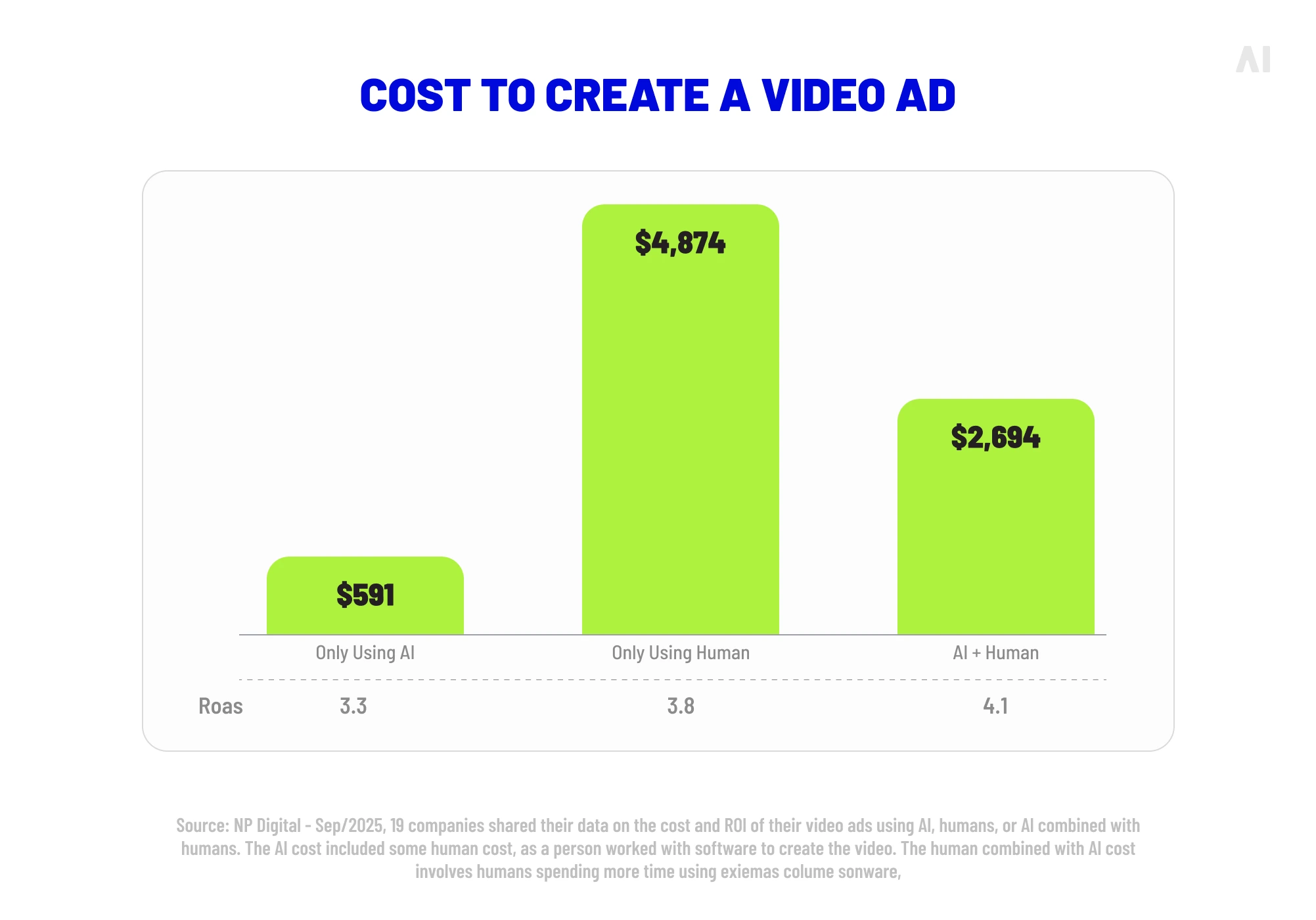
There is no universal price for creating AI video ads. Costs depend on how much of the production process is generated, adapted, filmed, edited, reviewed, and localized—and on the quality level required for the final execution.
The main cost drivers include:
- AI platforms and infrastructure: Subscription fees, generation credits, rendering, storage, collaboration tools, and enterprise access.
- Generation volume: The number of attempts required to produce usable scenes, voices, scripts, or complete videos.
- Length and complexity: Longer videos, detailed motion, multiple scenes, realistic people, and precise product interactions generally require more production work.
- Voice and avatar requirements: Custom voices, multilingual versions, synthetic presenters, and likeness licensing can add costs.
- Creative direction and editing: Human strategy, storyboarding, compositing, pacing, sound design, color correction, and final finishing remain important.
- Source assets and licensing: Product photography, existing footage, stock media, music, fonts, creator content, and usage rights may need to be acquired or produced.
- Localization: Translation, cultural adaptation, local voiceovers, captions, market-specific claims, and native-language review create additional work.
- Quality assurance and revisions: Product, brand, legal, technical, and platform reviews should be included in the production estimate.
- Enterprise workflow needs: Approval systems, asset management, security, integration, governance, and version tracking can affect the total investment.
Tool subscription or generation costs represent only one part of the budget. A more accurate calculation includes all work needed to turn generated material into approved, platform-ready advertising:
When citing vendor prices, use current official pricing and clarify what the amount covers. A monthly subscription may provide generation access, but it does not necessarily include creative strategy, editing, licensing, localization, quality control, or the cost of discarded outputs.
AI can reduce the need to recreate every element from scratch, particularly when producing adaptations and controlled variations. However, its economic value should be evaluated through total production cost, turnaround time, usable output, and campaign results—not through an isolated claim about cheaper generation.
When Traditional or Hybrid Video Production Still Makes More Sense
AI production is not the strongest option for every video concept. Traditional filming remains valuable when the creative depends on authentic human performance, original environments, precise physical interaction, or a level of cinematic control that generated footage cannot reliably deliver.
A traditional or hybrid model may be more appropriate for:
- genuine customer testimonials and creator endorsements;
- emotionally nuanced performances from real actors;
- detailed demonstrations involving hands, machinery, or physical products;
- food, beauty, fashion, automotive, and other categories requiring exact product representation;
- original location footage or documentary-style storytelling;
- premium brand films requiring controlled cinematography and art direction;
- sensitive uses of likeness, voice, identity, or audience trust.
Hybrid production often provides the most practical balance. A team might film real people, products, and locations once, then use AI to create new backgrounds, voice versions, downcuts, captions, formats, or localized adaptations. This preserves the parts of the execution that need to be authentic while reducing repetitive post-production and reshooting.
The decision should follow the creative requirement rather than an assumption that AI is always faster or more advanced. Traditional production, AI-assisted production, and fully generated video are complementary options. The right model is the one that delivers the required authenticity, control, scalability, and quality for the specific campaign.
How AI Digital Helps Scale AI-Native Video Creative
AI Digital’s AI Creative Studio combines AI-native production workflows with human creative expertise to help brands produce, adapt, and iterate video advertising across fragmented digital environments. The service is designed to increase production capacity while keeping creative strategy, brand discipline, and final judgment in human hands.
Its video capabilities include:
- cinematic, TV-grade AI video and motion graphics;
- high-fidelity AI-generated UGC-style and platform-native video;
- AI and human voiceovers supported by audio engineering;
- static-to-video production;
- multi-platform versioning and cross-channel format adaptation;
- automated aspect-ratio resizing and video downcuts;
- localized variant tagging;
- creative variation, rapid prototyping, and asset repurposing.
These capabilities can support multiple stages of the production workflow covered in this guide. Teams can develop original source creative, transform existing static assets into motion, produce UGC-style or voiceover-led executions, and extend approved concepts into additional formats and versions. Once a direction is established, videos can be adapted for different channels, aspect ratios, audiences, and distribution environments without requiring every execution to be rebuilt from the beginning.
The approach is particularly useful when campaigns need a continuous supply of platform-ready creative rather than a single master video. One concept can provide the foundation for vertical social versions, shorter downcuts, alternative voice treatments, and other controlled adaptations. AI accelerates the repeatable production work, while experienced creative professionals shape the concept, review the output, and ensure that each asset fits its intended media environment.
AI Creative Studio should not be viewed as an autonomous replacement for production teams or creative decision-making. It does not remove the need for approved inputs, human direction, brand review, rights clearance, quality assurance, or performance analysis.
⚡️Its value lies in connecting AI-assisted production speed with human taste and media expertise, helping brands expand creative output without giving up oversight.
Scale Video Production, Not Just Video Volume
The central advantage of AI video production is not the ability to generate an unlimited number of assets. It is the opportunity to build a faster and more repeatable system for turning creative ideas into approved videos, adapting them across channels and markets, and using campaign results to guide the next production cycle.
That system depends on several elements working together:
- clear creative objectives and hypotheses;
- reliable product information and reusable source assets;
- defined brand rules and controlled variables;
- AI-assisted generation, editing, and adaptation;
- human review for quality, accuracy, rights, and trust;
- structured creative testing;
- performance feedback that informs future iterations.
Without that structure, higher output can simply produce more inconsistent or ineffective advertising. With it, teams can spend less time recreating routine production work and more time refining the ideas, messages, and executions that deserve further investment.
⚡️The goal is not to replace filming or human creativity. It is to stop rebuilding every video from scratch when approved creative components can be produced, adapted, and improved more efficiently.
Brands ready to develop a more scalable creative and media system can contact AI Digital to discuss their programmatic goals.