

In 2026, the operating assumption changes. A misconfigured tag, an outdated consent rule, or a vendor setting you forgot existed can scale into thousands of downstream data events. When a state attorney general can move from notice to enforcement without a grace period, the question becomes simple: can you prove your stack behaved correctly, end to end, today?
That’s privacy’s hard landing. Not a new principle, but a new posture. And it pushes media leaders to treat privacy as an execution layer inside the supply chain, not a policy document that lives somewhere else.
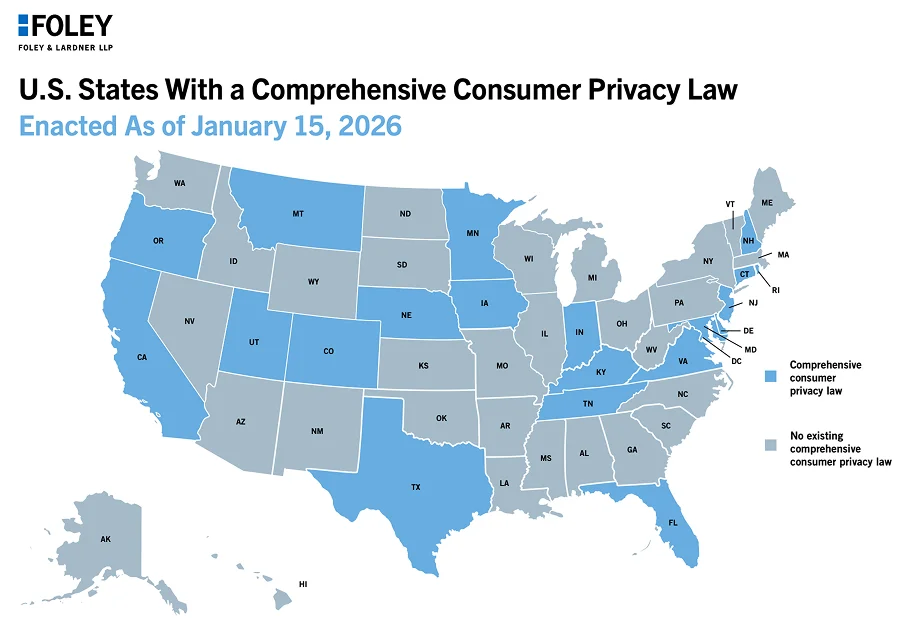
The cure period era is ending, and enforcement math changes
Cure periods were always a temporary bridge between new laws and real enforcement. That bridge is coming up fast.
The 60-day cure period under the Colorado Privacy Act sunset on January 1, 2025, so enforcement actions no longer have to pause while businesses remediate after the fact.
Then Oregon followed with a 30-day cure window that expires January 1, 2026; the Oregon DOJ has described the law as being in its cure period until that date.(Oregon Department of Justice)
And Rhode Island shows the direction of travel: no cure period at all, with civil penalties that can reach up to $10,000 per violation.
For programmatic teams, “per violation” isn’t an abstract concept. At scale, it’s the difference between a contained issue and a compounding one, especially when data moves across multiple vendors and signals don’t propagate consistently. If the plan is to catch privacy problems after launch, what you have isn’t a model you can rely on; it’s a risk you’re accepting and hoping won’t compound.
{{Privacys-Hard-Landing-in-2026-1="/tables"}}
Universal opt-out is not a banner problem
The second shift is easy to underestimate because it sounds technical: universal opt-out signals.
Global Privacy Control (GPC) is a browser-level signal consumers can enable, and the California Department of Justice is clear that covered businesses must treat a user-enabled GPC as a valid request to opt out of sale or sharing.
Meanwhile, the Oregon Department of Justice has highlighted a “Universal Opt-Out” tool for residents as part of its public-facing privacy education.
Regulators are also coordinating. In 2025, a multi-state group announced investigative activity focused on whether businesses are honoring GPC signals—an early signal that “preference signals” are not an academic topic anymore.
Even with a clean CMP implementation, universal opt-out still fails if the downstream plumbing doesn’t carry the signal reliably, because honoring it on the site while losing it in vendor flows creates a gap between stated policy and actual behavior.
⚡ In a large-scale academic crawl, only 15% of sites with a California-relevant GPP section opted users out of “selling” via the GPP string after a Global Privacy Control signal in April 2024. That’s the hard part of universal opt-out in one number: the signal can be valid, present, and still fail to make it through the chain.
Treat universal opt-out like any other control that matters: implement it, test it, and keep testing it. Most failures happen through drift, not intent:
- a new tag template ships without the right rule,
- a partner changes its ingestion logic,
- a measurement integration keeps collecting while activation stops,
- reporting no longer matches reality.
If your team can’t detect those changes quickly and calmly, you’ll end up discovering them the hard way, at the exact moment you’d rather be focused on everything else.

Sensitive data is expanding, and two categories hit media directly
State laws aren’t only multiplying. Definitions are evolving, and the list of “sensitive” categories is getting longer. Two areas are especially relevant for media teams.
Precise geolocation is turning from signal into liability
Oregon’s privacy law now bans the sale of “precise geolocation data,” defined as location accurate within a radius of 1,750 feet.
That threshold has practical consequences, because the kinds of high-precision signals it covers are exactly what power common tactics like conquesting, venue-based targeting, and some approaches to foot-traffic attribution. The point isn’t that location-based tactics disappear overnight. It’s that the consent, disclosure, and governance bar rises, especially for anything that looks like device-level precision without explicit, granular permission.
The moment you struggle to name the partners touching precise location, you’ve learned something important: the stack isn’t well-inventoried, and that’s the risk.
{{Privacys-Hard-Landing-in-2026-2="/tables"}}
Neural data is the headline, but the real story is scope creep
Connecticut is moving to classify “neural data” as sensitive, with updates tied to July 1, 2026.
Most marketing teams aren’t collecting anything that looks like brain-activity data, but the point isn’t that everyone suddenly will; it’s that state laws are expanding the sensitive-data perimeter in ways that follow new technologies and the inferences they enable. As targeting and measurement become more model-driven, the question starts to shift from “what did we collect?” to “what did we derive, predict, or infer from it?”, and a sensitive-data strategy that lives as a static list will struggle to keep up.
The youth shield changes audience design, not just disclosures
Youth privacy is often treated like a clause you add to a contract. In 2026, it behaves more like a constraint on audience design.
Oregon amendments, for example, include restrictions that prohibit profiling and targeted advertising to consumers under 16.
Maryland’s “knew or should have known” approach changes the burden of knowledge. It pushes agencies toward cautious-by-design planning, especially in content environments that could plausibly skew young.
The practical implication is uncomfortable but clear: “we didn’t intend to reach minors” is a harder argument to make when your supply choices make that outcome foreseeable. That’s why guardrails need to sit upstream—in planning and activation—rather than relying on legal review as the last line of defense.
Where privacy breaks first in real media execution
When privacy becomes operational, the failure points are usually mundane. They’re also predictable.
- The “new partner” moment. A team adds a data provider, a measurement vendor, or a specialty SSP to solve a performance problem. Contracts get signed. Tags get implemented. But opt-out handling and data-sharing definitions don’t get translated into day-to-day execution. This is how “we thought it was covered” becomes “we can’t prove it.”
- The “measurement gap.” Many teams turn off targeted activation correctly when opt-out is present, but measurement keeps running on a different set of rules. The result is a stack that behaves inconsistently across activation, attribution, and reporting—exactly where internal stakeholders expect consistency.
⚡ According to Adjust, the industry-wide ATT opt-in rate was 35% in Q2 2025 among users shown the prompt—so most iOS users are not available for app-level tracking by default. That’s why “we’ll fix attribution later” doesn’t hold up anymore: you need measurement designs that remain useful even when identity is missing.
- The “template drift.” A global site template changes, or a new consent category is introduced, and suddenly a previously compliant configuration isn’t compliant anymore. Because nobody gets a Slack alert when that happens, it can persist for weeks.
If these sound familiar, it’s because they’re not edge cases. They’re the default modes of failure in complex systems.
What a privacy-first operating model looks like for media teams
A privacy-first operating model treats privacy like a supply chain discipline: map it, monitor it, and minimize the number of places the system can fail.
The controls that matter most in 2026 are straightforward:
- Build a live map of data movement. You should be able to explain where data can flow across tags, pixels/SDKs, measurement partners, DSPs, SSPs, and any intermediaries.
⚡ A cookie behavior study found 25.4% of users accept cookies, while 68.9% close or ignore the banner—meaning large chunks of visit-level data never become measurable in the first place. If your reporting assumes full-funnel observability, you’re likely evaluating outcomes on a partial dataset and calling it “performance.”
- Make universal opt-out measurable. Implement GPC recognition, then test and monitor it. Drift is the enemy.
- Re-qualify vendors by proof. Ask how opt-out states are handled, logged, and enforced; what gets shared downstream; and how “sale/share” is interpreted in practice. Vague answers are a risk signal.
- Create a high-scrutiny bucket. If a tactic depends on precise location, youth-adjacent audiences, or sensitive inference, it belongs in a stricter workflow until consent and controls are provable.
{{Privacys-Hard-Landing-in-2026-3="/tables"}}
If you need a practical starting point, run a 30-day pressure test:
- choose one major property and one major campaign type,
- verify GPC handling through activation and measurement,
- inventory every vendor receiving data in that flow,
- and document what “sale/share” means in those integrations.
You’ll learn more from that exercise than from another round of “policy alignment” meetings.
Where transparency helps when state laws diverge
A growing patchwork of state laws means “compliance” is ongoing behavior across a stack. If you can’t see where budget ran, what intermediaries were involved, or how preference signals were honored, you can’t answer the questions that matter when scrutiny rises, and you can’t fix issues quickly when something drifts.
This is the narrow lane where AI Digital’s Open Garden belongs. Open Garden is a framework for operating outside black-box constraints so you can map how media decisions get made, what data is used, and where it flows—not just in theory, but in the day-to-day mechanics of planning, activation, and measurement. It’s less about finding a loophole in the ecosystem and more about building a version of buying where the “why” and “how” remain visible enough to govern.
Smart Supply is a practical expression of that same discipline on the supply side. It’s a bias toward fewer unnecessary hops, clearer accountability, and repeatable controls—qualifying inventory based on what can be validated (signal handling, disclosure, brand safety context, measurement behavior), and prioritizing placements you can explain to a legal team, a client, or a regulator without hand-waving.
The point is simple and structural: greater auditability in media buying reduces uncertainty, which is exactly what you need when the privacy rulebook is moving underneath you.
Closing: the 2026 checklist that actually matters
Privacy’s hard landing isn’t about a single regulation headline. It’s about closing the gap between what we say we do and what our systems actually do.
Audit where you’ve been relying on cure periods. Validate universal opt-out handling end to end. Reassess any tactic that depends on precise location or could plausibly touch youth audiences. Then put monitoring in place, so compliance isn’t a quarterly scramble.
2026 won’t reward the teams who sound the most prepared. It’ll reward the teams who can prove their stack behaves.
If anything in this article sparked questions (or you want a second set of eyes on your current approach), reach out to AI Digital. We’re happy to talk through how privacy laws apply to your media and measurement stack and help you build a practical path forward.


.webp)