The Commerce-First Chatbot—The OpenAI & Criteo Strategic Alliance
Scott Welton
April 3, 2026
11
minutes read
OpenAI has started testing ads inside ChatGPT for logged-in adult users in the U.S. on the Free and Go tiers. The company is explicit about the tradeoff it’s trying to avoid: ads that fund access without changing answers or leaking conversation data to advertisers.
Then came the more interesting development: Criteo became the first adtech partner integrated into the ChatGPT ad pilot. The pitch centres on commerce intelligence surfacing inside conversational discovery, where people actively seek recommendations rather than simply searching for products they already know they want.
What makes the combination significant is that it's one of the first real proofs that conversational AI can monetize without degrading the user experience. For brands and agencies, it also crystallizes something bigger: we're entering agentic commerce, where chat doesn't just inform—it shortlists, validates, and increasingly enables purchase.
TL;DR: Three takeaways to keep in mind
Conversational intent is a different species of demand. In Criteo’s aggregated observations across 500 U.S. retailers (Feb 2026), users referred from LLM platforms like ChatGPT convert at ~1.5x the rate of other referral channels.
Commerce intelligence is becoming the decision layer. Criteo’s thesis is straightforward: recommendation quality rises when you use structured commerce signals, not just product descriptions.
The “recommendation” is the new shelf space. The winners will be the brands that make their product truth usable for AI systems and measurable for finance teams.
The pilot is small, but the signal is big
OpenAI’s stated principles read like a checklist of everything that has gone wrong in ad-funded platforms over the last decade: keep answers independent, keep conversations private from advertisers, clearly separate sponsored content, and give users control.
That framing isn’t PR fluff. It’s an admission that answer-led interfaces have a tighter tolerance for anything that feels like influence. OpenAI is already building guardrails around integrity and safety, including an “ads integrity” effort and “know your customer” style verification to reduce scam risk.
If you're a CMO, this should sharpen your focus. Ads in chat are a given. The question worth answering is what kind of ads can survive inside an interface people treat like an advisor.
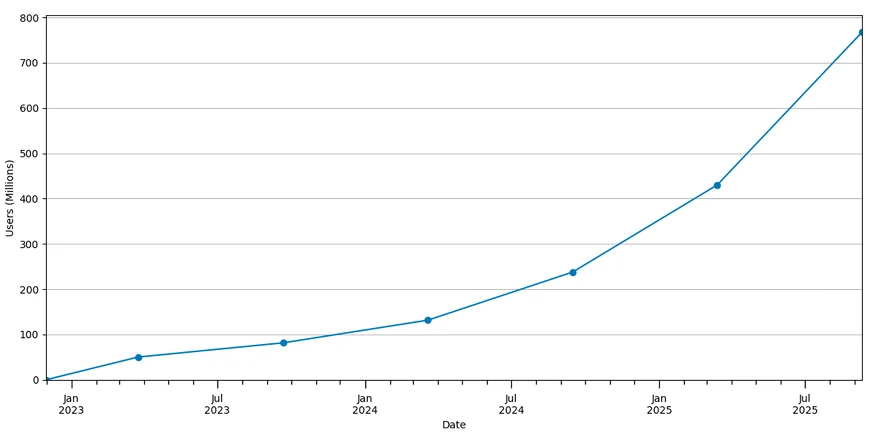
Pic. Weekly active ChatGPT users on consumer plans (Free, Plus, Pro), shown as point-in-time snapshots every six months, 2022–2025 (Source).
Conversational intent isn’t funnel-stage theater
Too much media planning still runs on broad, comfortable abstractions—awareness, consideration, conversion—without interrogating what those stages actually look like now.
None of that vocabulary holds up in conversational discovery. People arrive with a request that already carries budget, constraints, preferences, and timing baked in. They're not browsing; they're handing over a brief.
{{26-The-Commerce-First-Chatbot-1="/tables"}}
A more accurate model looks like this:
Ask → shortlist → validate → act
Ask: “What’s the best running shoe for marathon training if I overpronate?”
Shortlist: The assistant narrows options based on constraints and known tradeoffs.
Validate: Specs, reviews, fit guidance, price, availability, shipping, returns.
Act: Click out, or increasingly, buy in place.
The 1.5x conversion lift starts to make sense in that light. There's no magic performance here—just what happens when the input is high-intent by design.
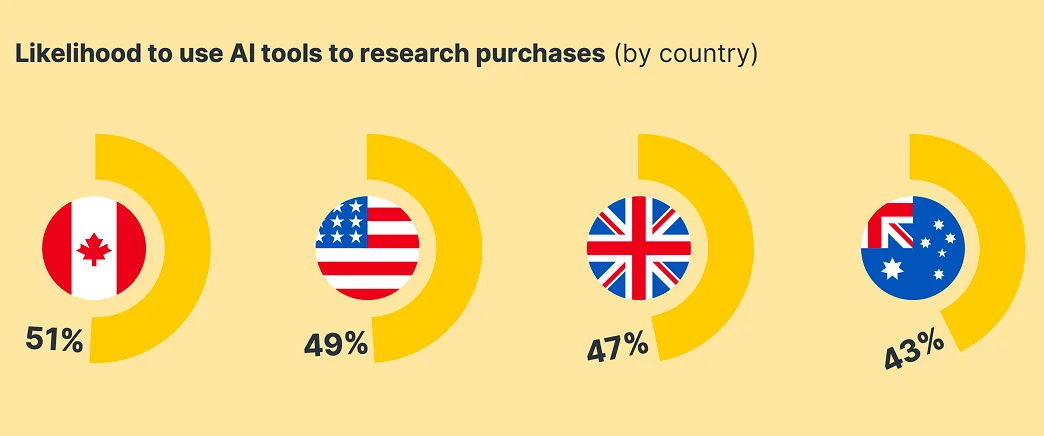
Pic. Consumer appetite for AI-assisted shopping research by country (Source).
Why Criteo matters here
Criteo’s advantage has never been “it can serve an ad.” Plenty of platforms can do that. The advantage is commerce intelligence: signals derived from transactions, product catalogs, retailer relationships, and decisioning tuned for outcomes.
Criteo describes its footprint as 17,000 advertisers, more than $4B in annual media spend activation, and unique access to over $1T in annual commerce sales. That’s the kind of foundation you need if you want sponsored placements in a chat interface to feel like helpful options rather than interruptions.
It also sets up the real strategic shift: ChatGPT ads stop looking like an exotic experiment and start looking like a commerce channel with a familiar operating model.
The conversion premium is real, but it’s not the whole story
Yes, early indicators suggest LLM referrals can outperform other referral traffic. But that doesn’t mean you should treat ChatGPT like another performance faucet and turn the handle.
The real opportunity is upstream: influencing what makes the shortlist.
{{26-The-Commerce-First-Chatbot-2="/tables"}}
Criteo has been explicit that recommendation quality improves when the system has access to structured commerce signals. In internal testing (Jan 2026), Criteo reported up to a 60% improvement in recommendation relevancy versus approaches based only on product descriptions.
Call that what it is: an early warning to every brand with messy product data. If your catalog is inconsistent, your availability is unreliable, or your variant attributes are incomplete, you’re going to lose recommendation share, even if you “win” an impression.
The “VIP gate” and why it won’t last
Right now, access is constrained. Reports around the ad pilot have referenced high minimum commitments and premium pricing, with early coverage citing a $200,000 minimum and CPMs around $60.
That’s not a long-term market structure. That’s a controlled test.
But it’s still telling that major holding companies are participating, even under those constraints. Adweek reported investment from Omnicom, WPP, and Dentsu, with Omnicom noting dozens of clients securing placements.
Criteo’s integration is the piece that points toward scale. If conversational ads are going to become a durable channel, they need buying and measurement workflows that don’t require bespoke relationships for every experiment. This partnership is a step in that direction.
Trust is the constraint in answer-led media
The market is already testing two paths.
As mentioned, OpenAI is building an ad model with explicit guardrails about answer independence and conversation privacy. At the same time, Perplexity has publicly moved away from advertising, arguing that even well-labeled ads can make users suspicious of the product’s objectivity.
You don’t have to pick a side in that debate to learn from it.
The practical implication for advertisers is straightforward. Anything that feels like it bends the answer will burn out fast. Being additive to the experience is the baseline requirement for showing up at all.
Looking ahead: agentic commerce makes product feeds a growth lever
The alliance lands at the same time OpenAI is publishing concrete plumbing for commerce inside ChatGPT. The Agentic Commerce Protocol and Instant Checkout are designed to let merchants provide product feeds, integrate checkout APIs, and enable purchases through the interface.
The knock-on effect is a redefinition of "optimization." It expands well beyond creative and bid strategy into data structure, fulfilment truth, and user experience continuity.
It also accelerates a discipline many teams are already circling: generative engine optimization (GEO)—making sure your brand and products are represented accurately and usefully in AI-driven discovery. Even the academic community is formalizing this concept and the mechanics behind it.
How to prepare now: a practical checklist
If you’re treating this like a 2026 media test, you’ll miss the bigger change. Treat it like an operating model shift.
Clean up product truth for machines, not just humans. Variant attributes, category taxonomy, sizing logic, shipping and returns, availability, and price consistency decide whether you’re recommendable. Instant Checkout and product feed requirements make that direction of travel explicit.
Decide what you’re optimizing for. Impressions and clicks will show up first because they’re easy to instrument. Senior teams should define success in business terms: incremental demand, new-to-brand customers, contribution margin, and downstream repeat.
Separate “influence” from “harvest”. Conversational discovery is often an advisor moment. Retargeting might capture the final action, but it won’t tell you what created the shortlist. Build measurement that can isolate incremental impact.
Put governance around claims and safety. In chat, brand safety isn’t only about where the ad appears. It’s also about what the ad implies and how it relates to the user’s request. The integrity work OpenAI is doing is a hint at how sensitive this surface will be.
Invest where transparency stays intact. As new surfaces emerge, the risk is drifting into black-box buying where you can’t explain why spend moved or why a product was favored. That’s where an open, accountable approach becomes a competitive advantage.
Where AI Digital fits in this new surface
Agentic commerce will reward teams that can move fast without losing control of measurement and governance.
Our perspective at AI Digital is rooted in three ideas:
Open Garden: keep transparency and portability as new discovery environments grow, so strategy and data ownership don’t get trapped inside one platform’s rules.
Smart Supply: select supply for quality and outcomes, especially as conversational inventory expands and the market experiments with new buying paths.
Elevate: unify planning, optimization, and insights across channels, with a workflow that helps teams ask better questions and act on the answers quickly.
The goal isn't to chase every new format. It's to build the foundation that lets you test what matters, measure what counts, and scale what holds up.
Closing thought: win the recommendation
The OpenAI–Criteo partnership doesn’t guarantee that conversational ads become the next mega-channel. It does something more valuable: it shows what a viable model could look like when commerce signals, decisioning, and trust guardrails work together.
If your team wants to take advantage of this shift, start with product truth and measurement design. The media plan will follow.
If you’d like to talk through how to structure tests, build governance, and measure incrementality as conversational commerce scales, reach out. I am always happy to talk!
Blind spot
Key issues
Business impact
AI Digital solution
Lack of transparency in AI models
• Platforms own AI models and train on proprietary data • Brands have little visibility into decision-making • "Walled gardens" restrict data access
• Inefficient ad spend • Limited strategic control • Eroded consumer trust • Potential budget mismanagement
Open Garden framework providing: • Complete transparency • DSP-agnostic execution • Cross-platform data & insights
Optimizing ads vs. optimizing impact
• AI excels at short-term metrics but may struggle with brand building • Consumers can detect AI-generated content • Efficiency might come at cost of authenticity
• Short-term gains at expense of brand health • Potential loss of authentic connection • Reduced effectiveness in storytelling
Smart Supply offering: • Human oversight of AI recommendations • Custom KPI alignment beyond clicks • Brand-safe inventory verification
The illusion of personalization
• Segment optimization rebranded as personalization • First-party data infrastructure challenges • Personalization vs. surveillance concerns
• Potential mismatch between promise and reality • Privacy concerns affecting consumer trust • Cost barriers for smaller businesses
Elevate platform features: • Real-time AI + human intelligence • First-party data activation • Ethical personalization strategies
AI-Driven efficiency vs. decision-making
• AI shifting from tool to decision-maker • Black box optimization like Google Performance Max • Human oversight limitations
• Strategic control loss • Difficulty questioning AI outputs • Inability to measure granular impact • Potential brand damage from mistakes
Managed Service with: • Human strategists overseeing AI • Custom KPI optimization • Complete campaign transparency
Fig. 1. Summary of AI blind spots in advertising
Dimension
Walled garden advantage
Walled garden limitation
Strategic impact
Audience access
Massive, engaged user bases
Limited visibility beyond platform
Reach without understanding
Data control
Sophisticated targeting tools
Data remains siloed within platform
Fragmented customer view
Measurement
Detailed in-platform metrics
Inconsistent cross-platform standards
Difficult performance comparison
Intelligence
Platform-specific insights
Limited data portability
Restricted strategic learning
Optimization
Powerful automated tools
Black-box algorithms
Reduced marketer control
Fig. 2. Strategic trade-offs in walled garden advertising.
Core issue
Platform priority
Walled garden limitation
Real-world example
Attribution opacity
Claiming maximum credit for conversions
Limited visibility into true conversion paths
Meta and TikTok's conflicting attribution models after iOS privacy updates
Data restrictions
Maintaining proprietary data control
Inability to combine platform data with other sources
Amazon DSP's limitations on detailed performance data exports
Cross-channel blindspots
Keeping advertisers within ecosystem
Fragmented view of customer journey
YouTube/DV360 campaigns lacking integration with non-Google platforms
Black box algorithms
Optimizing for platform revenue
Reduced control over campaign execution
Self-serve platforms using opaque ML models with little advertiser input
Performance reporting
Presenting platform in best light
Discrepancies between platform-reported and independently measured results
Consistently higher performance metrics in platform reports vs. third-party measurement
Fig. 1. The Walled garden misalignment: Platform interests vs. advertiser needs.
Key dimension
Challenge
Strategic imperative
ROAS volatility
Softer returns across digital channels
Shift from soft KPIs to measurable revenue impact
Media planning
Static plans no longer effective
Develop agile, modular approaches adaptable to changing conditions
Brand/performance
Traditional division dissolving
Create full-funnel strategies balancing long-term equity with short-term conversion
Capability
Key features
Benefits
Performance data
Elevate forecasting tool
• Vertical-specific insights • Historical data from past economic turbulence • "Cascade planning" functionality • Real-time adaptation
• Provides agility to adjust campaign strategy based on performance • Shows which media channels work best to drive efficient and effective performance • Confident budget reallocation • Reduces reaction time to market shifts
• Dataset from 10,000+ campaigns • Cuts response time from weeks to minutes
• Reaches people most likely to buy • Avoids wasted impressions and budgets on poor-performing placements • Context-aligned messaging
• 25+ billion bid requests analyzed daily • 18% improvement in working media efficiency • 26% increase in engagement during recessions
Full-funnel accountability
• Links awareness campaigns to lower funnel outcomes • Tests if ads actually drive new business • Measures brand perception changes • "Ask Elevate" AI Chat Assistant
• Upper-funnel to outcome connection • Sentiment shift tracking • Personalized messaging • Helps balance immediate sales vs. long-term brand building
• Natural language data queries • True business impact measurement
Open Garden approach
• Cross-platform and channel planning • Not locked into specific platforms • Unified cross-platform reach • Shows exactly where money is spent
• Reduces complexity across channels • Performance-based ad placement • Rapid budget reallocation • Eliminates platform-specific commitments and provides platform-based optimization and agility
• Coverage across all inventory sources • Provides full visibility into spending • Avoids the inability to pivot across platform as you’re not in a singular platform
Fig. 1. How AI Digital helps during economic uncertainty.
Trend
What it means for marketers
Supply & demand lines are blurring
Platforms from Google (P-Max) to Microsoft are merging optimization and inventory in one opaque box. Expect more bundled “best available” media where the algorithm, not the trader, decides channel and publisher mix.
Walled gardens get taller
Microsoft’s O&O set now spans Bing, Xbox, Outlook, Edge and LinkedIn, which just launched revenue-sharing video programs to lure creators and ad dollars. (Business Insider)
Retail & commerce media shape strategy
Microsoft’s Curate lets retailers and data owners package first-party segments, an echo of Amazon’s and Walmart’s approaches. Agencies must master seller-defined audiences as well as buyer-side tactics.
AI oversight becomes critical
Closed AI bidding means fewer levers for traders. Independent verification, incrementality testing and commercial guardrails rise in importance.
Fig. 1. Platform trends and their implications.
Metric
Connected TV (CTV)
Linear TV
Video Completion Rate
94.5%
70%
Purchase Rate After Ad
23%
12%
Ad Attention Rate
57% (prefer CTV ads)
54.5%
Viewer Reach (U.S.)
85% of households
228 million viewers
Retail Media Trends 2025
Access Complete consumer behaviour analyses and competitor benchmarks.
Identify and categorize audience groups based on behaviors, preferences, and characteristics
Michaels Stores: Implemented a genAI platform that increased email personalization from 20% to 95%, leading to a 41% boost in SMS click through rates and a 25% increase in engagement.
Estée Lauder: Partnered with Google Cloud to leverage genAI technologies for real-time consumer feedback monitoring and analyzing consumer sentiment across various channels.
High
Medium
Automated ad campaigns
Automate ad creation, placement, and optimization across various platforms
Showmax: Partnered with AI firms toautomate ad creation and testing, reducing production time by 70% while streamlining their quality assurance process.
Headway: Employed AI tools for ad creation and optimization, boosting performance by 40% and reaching 3.3 billion impressions while incorporating AI-generated content in 20% of their paid campaigns.
High
High
Brand sentiment tracking
Monitor and analyze public opinion about a brand across multiple channels in real time
L’Oréal: Analyzed millions of online comments, images, and videos to identify potential product innovation opportunities, effectively tracking brand sentiment and consumer trends.
Kellogg Company: Used AI to scan trending recipes featuring cereal, leveraging this data to launch targeted social campaigns that capitalize on positive brand sentiment and culinary trends.
High
Low
Campaign strategy optimization
Analyze data to predict optimal campaign approaches, channels, and timing
DoorDash: Leveraged Google’s AI-powered Demand Gen tool, which boosted its conversion rate by 15 times and improved cost per action efficiency by 50% compared with previous campaigns.
Kitsch: Employed Meta’s Advantage+ shopping campaigns with AI-powered tools to optimize campaigns, identifying and delivering top-performing ads to high-value consumers.
High
High
Content strategy
Generate content ideas, predict performance, and optimize distribution strategies
JPMorgan Chase: Collaborated with Persado to develop LLMs for marketing copy, achieving up to 450% higher clickthrough rates compared with human-written ads in pilot tests.
Hotel Chocolat: Employed genAI for concept development and production of its Velvetiser TV ad, which earned the highest-ever System1 score for adomestic appliance commercial.
High
High
Personalization strategy development
Create tailored messaging and experiences for consumers at scale
Stitch Fix: Uses genAI to help stylists interpret customer feedback and provide product recommendations, effectively personalizing shopping experiences.
Instacart: Uses genAI to offer customers personalized recipes, mealplanning ideas, and shopping lists based on individual preferences and habits.
Medium
Medium
Share article
Url copied to clipboard
No items found.
Subscribe to our Newsletter
THANK YOU FOR YOUR SUBSCRIPTION
Oops! Something went wrong while submitting the form.
Questions? We have answers
Have other questions?
If you have more questions, contact us so we can help.