The Economics of Attention — Managing Creative Decay During Seasonal Migrations

Come June, the audience doesn't shrink so much as shift. People close the laptop, leave the living room, and take their attention outside—to the train platform, the beach town, the sidewalk table outside a café. The screen time is still there, only broken into smaller pieces now, snatched on a phone held at arm's length in the sun, between other things. None of this surprises anyone; the migration arrives on schedule every year. What tends to catch marketers out is the bill for meeting it with the same creative they were running in March.
The reflex, when summer engagement softens, is to trim spend and wait for autumn. That instinct treats the season as a lull to be endured. The more expensive mistake is harder to see: keeping budgets roughly intact while leaving the assets behind them untouched, and assuming a static ad will hold its value while the person watching it has changed posture, device, and mood entirely. Creative that sits still through a seasonal shift does not merely go unnoticed. It begins, in measurable ways, to cost more.
Attention has become something you can price
For years, "attention" was the sort of word that sounded important in a conference keynote and meant little on a spreadsheet. That changed in November 2025, when the IAB and the Media Rating Council finalized the industry's first Attention Measurement Guidelines, built with input from more than 200 organizations across brands, agencies, and platforms. The significance is less the methodology than the mere fact of a shared standard: attention is now something the industry has agreed to measure, compare, and eventually audit. It has acquired the one property that turns a concept into an asset—a price.
Treating attention as priced supply rather than a free byproduct of reach changes how the summer problem looks. Supply contracts in the warmer months—not because people care less, but because the contexts in which they can be reached become shorter, brighter, and more mobile. A dense, copy-heavy banner built for a sedentary desktop viewer is, in effect, priced for a market that has temporarily left. The IAB itself is careful to note that attention is a leading indicator, not an outcome to chase for its own sake. The useful reading for a marketer is narrower: the asset has to suit the moment of exposure, and in summer that moment is glanced-at and gone.
The algorithmic cost of standing still
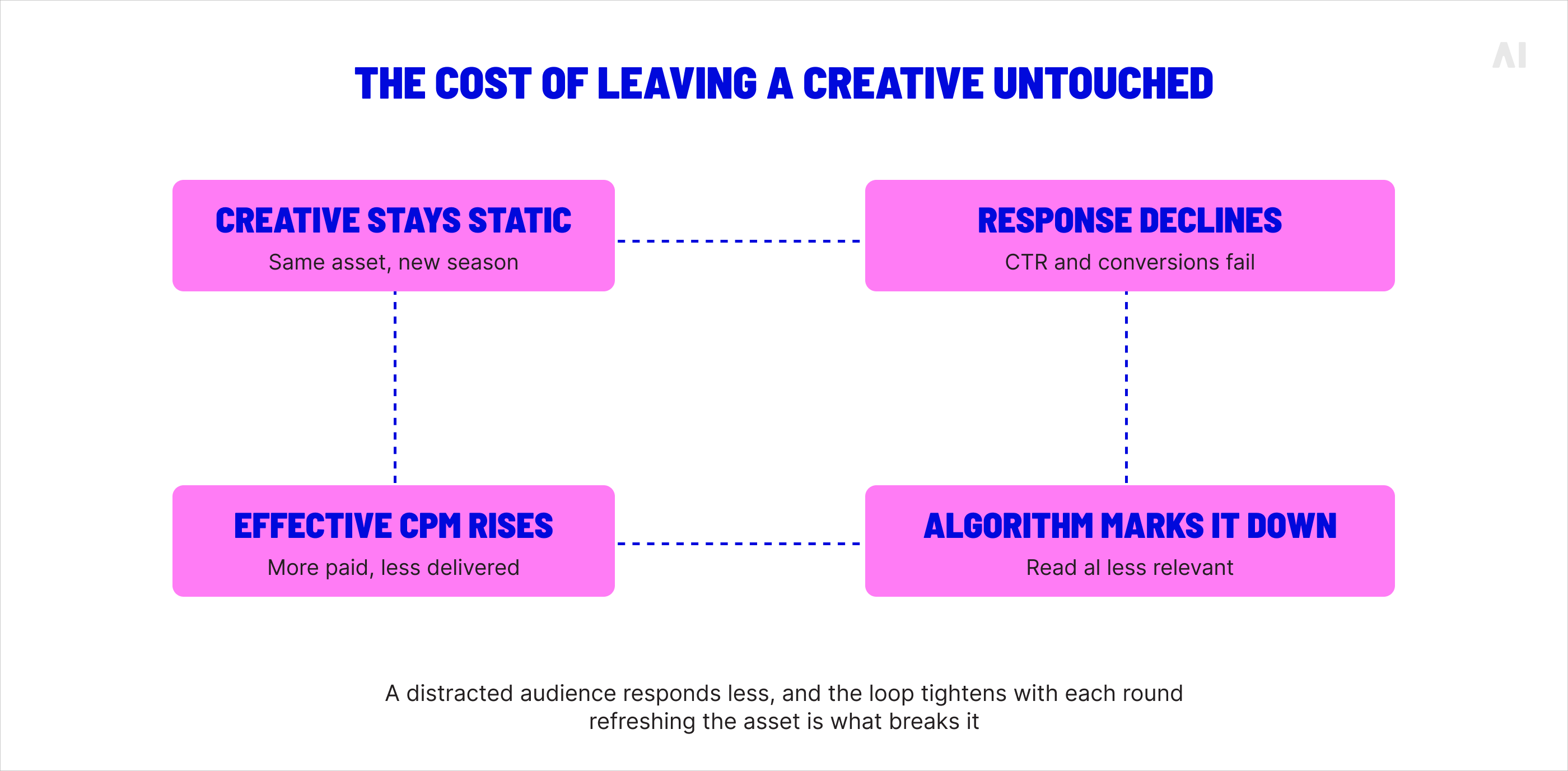
This is where the economics turn concrete. Automated bidding does not reward loyalty to a creative; it reads responsiveness. When click-through and conversion signals on an asset decline, the system infers that the ad has become less relevant and adjusts accordingly—serving it less efficiently and charging more to place it. Let an asset go stale and the effective CPM climbs to meet it.
That mechanism has sharpened considerably. Meta's Andromeda overhaul, rolled out across 2025, rebuilt ad retrieval so that each individual creative now functions as its own targeting signal—the system reads the asset to decide who should see it. One consequence is that visually or conceptually repetitive creative is actively suppressed before it reaches an auction. The window in which an asset stays "fresh" to the machine has narrowed from quarters to, in some categories, a matter of weeks. A creative rotation that felt diligent two years ago now reads to the algorithm as a plateau.
The practical implication is unglamorous but clarifying. Refreshing creative through a seasonal transition is not a branding nicety. It is the maintenance cost of keeping auction efficiency intact, and skipping it means paying a premium to deliver a tired message to a distracted audience.
Matching the message to a moving target
Refreshing for summer is often mistaken for a coat of seasonal paint—sunglasses on the model, a beach in the background. The more demanding work is contextual rather than decorative. An asset earns its place by reflecting the mindset of someone in motion, which usually means trading elaboration for immediacy: a clear proposition, a single legible action, utility that makes sense on a phone in three seconds rather than three paragraphs.
There is a subtlety worth keeping. The goal is not to maximize attention at all costs, but to match the right level of it to the objective. A performance prompt aimed at a commuter does not need the same depth of engagement as a considered upper-funnel story; it needs to land cleanly in the small window available. Summer behavior makes this concrete—with over half of Americans planning to travel in recent seasons, a value proposition framed around immediate, on-the-go usefulness simply fits the buyer's circumstances better than one built around long deliberation.
Following the audience into the physical world
If the audience has gone outside, the obvious response is to meet it there. What has changed is how cleanly the outside world now connects back to the device in the pocket. Programmatic digital out-of-home has matured from a standalone reach buy into something planned and measured within the same workflow as display and video—and the money is following. In VIOOH's 2026 State of the Nation research, US marketers said they expect to raise programmatic DOOH investment by an average of 49% over the following 18 months, the highest figure of any market surveyed, with most of that budget reallocated from other digital channels.
Sequencing is what turns this from a channel-shopping exercise into a strategy. A screen at a transit hub or a busy shopping street can establish exposure, and mobile can then carry the message forward as the same person moves through their day—frequency held steady across a physical journey rather than hammered into a single feed. Done with restraint, it intercepts the audience where they actually are without the saturation that drives people to tune out.
Recalibrating the scoreboard
All of which raises an awkward measurement question. If summer exposure lands on someone in transit, the purchase may not arrive until they are home, on a different device, weeks later—and a last-click model will quietly credit that sale to whatever channel happened to be standing nearest the finish line. Judged on immediate conversions alone, a well-built summer campaign can look like underperformance, which is precisely the reading that triggers a premature budget cut.
The more honest scoreboard looks for latent demand: lift in branded search, growth in direct traffic, movement in the metrics that signal interest forming rather than interest closing. Google's decision to formalize search lift studies within its experiments tools, alongside the steady mainstreaming of marketing mix modeling, reflects a broader correction—an acknowledgment that upper-funnel work creates demand that surfaces later, often somewhere else entirely.
Measuring summer against that downstream pipeline, rather than against a spring conversion benchmark, is what keeps a sound investment from being abandoned just before it pays off in the autumn.
Closing thought
The whole argument rests on a single recognition. When attention grows scarcer and more mobile, untouched creative drains money—taxing auction efficiency and ceding ground just as the year's most competitive months arrive. Holding position through summer takes coordination: creative refresh, cross-channel continuity, and lag-aware measurement working as one discipline rather than three chores handled in separate corners.
That coordination is genuinely hard to run by hand across a dozen platforms and a moving audience—which is the kind of problem Elevate was built to take on. If the seasonal shift is already showing up in your numbers, it is worth a conversation with the team at AI Digital.