The Selection Economy: How AEO and GEO Are Redefining Brand Authority

That shift is bigger than a feature release. When the interface answers more completely, fewer people leave to compare options, click through to sources, or explore beyond the first screen. We’re moving into a Selection Economy—an environment where brands compete to be included, cited, and recommended inside generated responses, not merely to “rank well.”
In this article, I’m going to look at what’s driving the change, what it does to consideration and measurement, and what brands can do to stay legible (and credible) when discovery is increasingly mediated by generative systems.
The interface changed, so the economics are changing
Google has been explicit about pushing Search toward a conversational flow: AI Overviews that invite follow-up questions, and a deeper “AI Mode” experience. Whether you love that direction or not, it changes the economic model of discovery. The more the page answers, the less incentive there is to click.
Pew Research Center’s analysis of U.S. browsing data makes the behavioral shift hard to ignore. When an AI summary appeared, users clicked a traditional result link in 8% of visits—versus 15% when no AI summary appeared. Clicks on links inside the summary itself were rarer still: 1% of visits. Pew also found that users ended their browsing session after visiting a page with an AI summary 26% of the time, compared with 16% on pages with only traditional results.

It’s tempting to reduce this to “SEO is dead,” but that’s not the right diagnosis. What’s happening is more specific: the unit of competition is moving from the click to the citation and the recommendation.
From visibility to veracity
For years, marketers treated clicks as a workable proxy for intent. In a ranked-list world, the click was a visible choice. In a generated-answer world, that proxy breaks. The model can satisfy the intent without sending you the visit, and it can still influence the decision without ever naming you.
That’s why AEO (answer engine optimization) and GEO (generative engine optimization) matter. Not because they’re the newest acronyms, but because they describe a new gate. Generative systems don’t only sort results; they synthesize a stance. If your claims can’t be verified across credible sources, the model either hedges, omits, or defaults to something it trusts more.
This is where “brand authority” starts to feel less like a story you tell and more like a record you can prove. The systems making selections are effectively asking:
- Are the brand’s key claims consistent across reputable sources?
- Do those sources agree on the entity (name, product, category, differentiators)?
- Can the claim be traced back to something structured, specific, and stable?
When those conditions are met, models cite you confidently. When they aren’t, you may be present on the web and still absent from the answer.
Consideration is collapsing, and “page one” is no longer the battlefield
Traditional funnels assumed a visible comparison step: the user browses options, evaluates tradeoffs, and clicks deeper. Generative systems still compare, but they do it behind the curtain. They ingest multiple sources, compress the tradeoffs, then output a narrative with a small shortlist or a single recommendation.
That creates a winner-take-most dynamic that’s easy to underestimate. A brand can be “in the market” and still be missing at the moment a buyer asks the question that triggers selection.
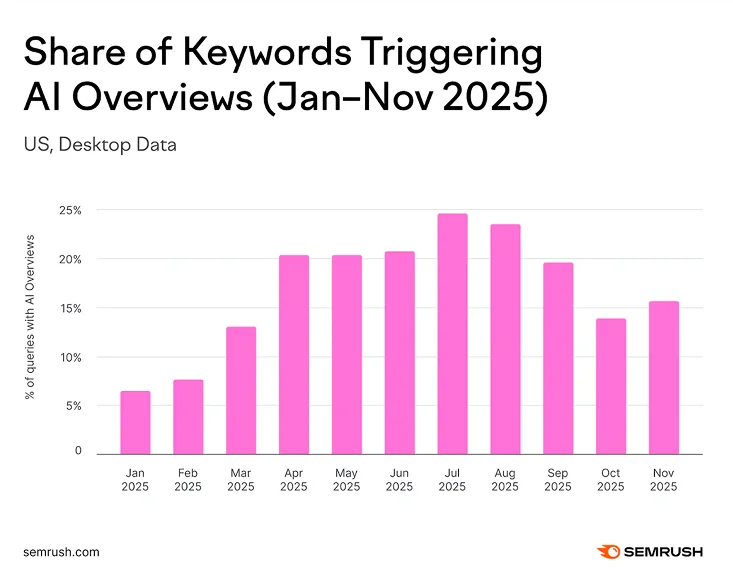
There’s also a second-order effect: answer layers are drifting into more commercially meaningful queries. Semrush’s analysis of 10M+ keywords across 2025 shows AI Overviews stabilizing at around 16% of queries by late 2025 after earlier volatility. The larger point is that coverage isn’t limited to definitions and trivia. As the feature expands, it becomes a brand-defense issue, not an “upper funnel” experiment.
If you’re leading growth, brand, or performance, this reframes the job. You’re no longer competing for a slot in a list. You’re competing to be the system’s final answer in the moment that matters.
Semantic authority: making your brand legible to machines
SEO used to reward the shape of a page. GEO rewards the shape of a brand’s footprint.
The brands that show up consistently in answer layers tend to share one advantage: they are easier to verify. Their core claims are repeated coherently across high-trust sources, and they’re expressed in ways that machines can parse without guessing.
A practical way to organize this is what I call a claim graph:
- Core claims: What you want to be known for—category, outcomes, constraints, proof. Not ten messages. Two or three that you can defend.
- Evidence nodes: Third-party validation, standards, methodology pages, leadership credentials, transparent comparisons, documentation. These are the assets that make a claim feel solid instead of promotional.
- Consistency surfaces: Where the brand appears across the open web: publisher coverage, listings, industry knowledge bases, community citations, partner pages, structured data.
- Update discipline: A cadence for refreshing what must stay current (pricing, availability, compliance, product lines) without rewriting everything into vague language.
This is where media and creative strategy meet. Strong messaging still matters. But messaging that can’t be corroborated becomes harder for machines to repeat.
A new scoreboard: measuring inclusion, accuracy, and recommendation
Most organizations still report what the legacy funnel made easy to report: impressions, clicks, sessions, rankings. Those aren’t useless, but they no longer tell you whether you’re being selected or whether you’re being described correctly.
A better approach is to focus on three things that map to how answer layers behave. Think of it as an Inclusion Index: a simple way to track whether you’re showing up, being described accurately, and getting recommended when the questions that matter are asked:
{{26-How-AEO-GEO-are-Redefining-BrandAuthority="/tables"}}
There are signs that platforms recognize the pressure they’ve created. Google, for example, is iterating on how sources are shown in AI answers, including more prominent source indicators and grouped previews.
Referral traffic from AI assistants is also becoming trackable at scale. Similarweb’s 2025 Generative AI report estimates that AI platforms drove over 1.1B referral visits in June 2025, up 357% year over year.
The implication is not to “chase AI traffic" but to accept that selection is happening whether you measure it or not. If you don’t have a way to spot omission, misattribution, or competitor defaulting, you’ll diagnose problems late.
The governance fight is now explicit
This shift isn’t only a product evolution. It’s also a conflict over who gets to summarize the web and under what terms.
For instance, in February 2026, the European Publishers Council filed an antitrust complaint with the EU focused on Google’s AI Overviews, arguing that AI-generated summaries use publisher content without effective consent or compensation and undermine the economics of journalism.
Regulatory intervention, publisher negotiations, platform UI tweaks—however it plays out, the rules aren't settling down anytime soon. Brands that anchor their discovery strategy to a single platform will be the first to feel every shift.
The Open Garden approach: portability over black-box dependence
Meanwhile, walled gardens are getting better at ingesting brand value without returning much in the way of traffic. That’s the zero-click reality in its most practical form: you can shape the buyer’s decision and still never see the visit.
The counter-move is content portability. Build your core narrative so it’s technically robust—structured, corroborated, and consistent enough that it travels cleanly across generative engines. If you leave your story to a black-box algorithm, you’re accepting whatever interpretation it decides to synthesize. If you own the underlying data structures and evidence trails, you give those systems far less room to improvise.
This is the logic behind AI Digital’s Open Garden model: an engine-agnostic way to strengthen what machines can verify, so your authority holds up across ecosystems rather than being trapped inside one platform’s ruleset.
Open Garden works because it treats “being selected” as a cross-platform outcome. Instead of optimizing for one engine’s quirks, it focuses on the durable layer underneath: entity consistency, evidence-backed claims, and a footprint that can be referenced without distortion. When answer layers shift UI, weighting, or citation behavior, that foundation still holds, so the brand narrative stays stable even as the distribution mechanics change.
Closing thoughts: signal, not verdict
There’s a mistake I see brands making already: treating generated answers as a verdict. They’re not. They’re a signal—about what the ecosystem believes is true, which sources it trusts, and which narratives are easiest to justify.
That’s also why this moment is an opportunity. If you can make your claims clearer, more consistent, and more provable than your competitors’, you don’t just gain traffic. You gain default status in the places where decisions begin.
So yes, keep doing the basics well. But add a new discipline alongside them: treat semantic authority as brand infrastructure. In the Selection Economy, that infrastructure is what keeps you visible when visibility is no longer the point.
If you want a practical way to approach that shift, AI Digital’s Open Garden model is built for it—engine-agnostic, evidence-led, and designed around content portability so your core narrative stays consistent across generative systems as the rules keep changing. If you’d like to talk through what this could look like for your category (and where your brand is currently being selected, omitted, or misframed), get in touch, and we’ll compare notes.