7 Real-World AI in Retail Examples Transforming the Shopping Experience in 2026

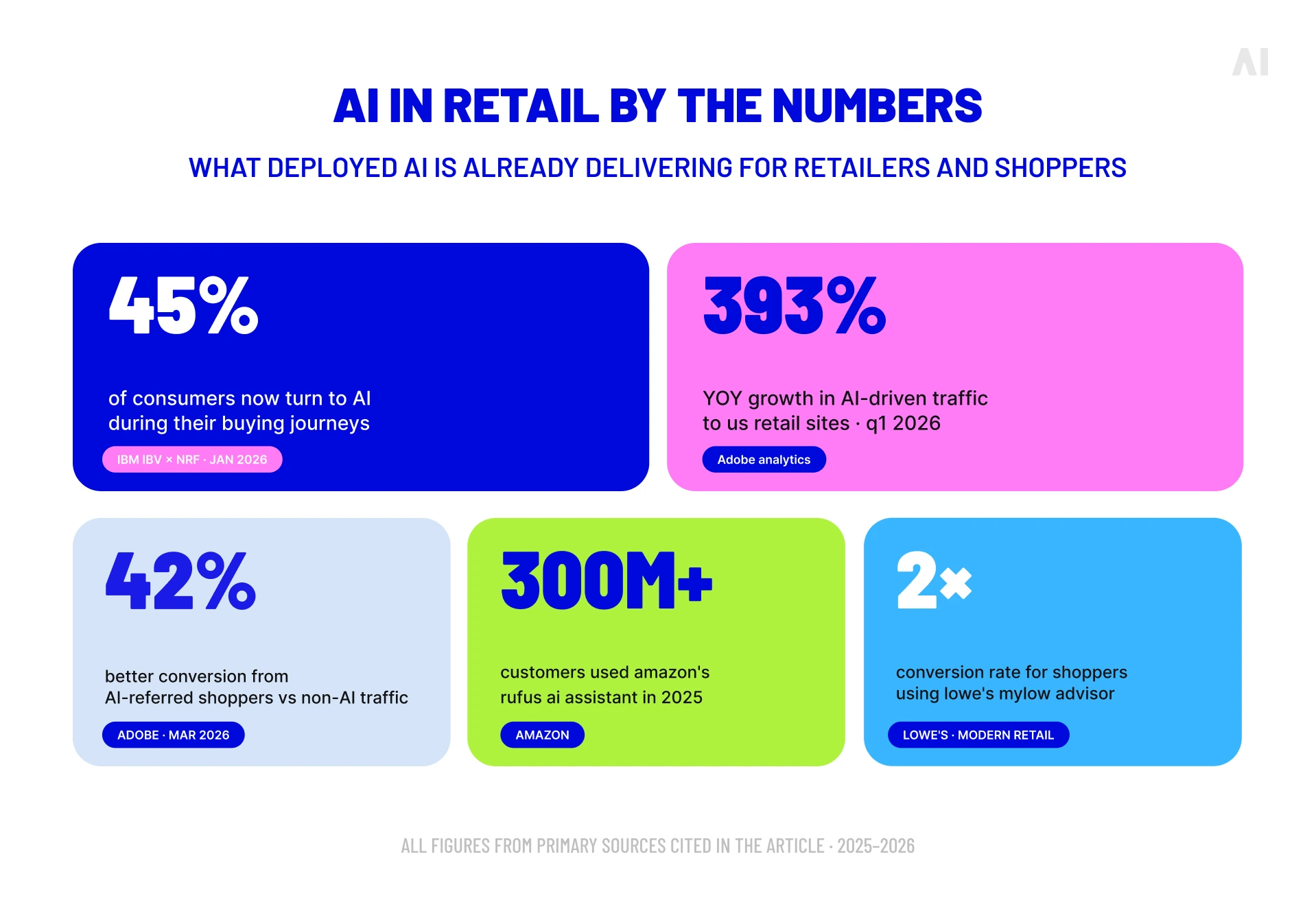
The most instructive AI in retail examples are no longer pilots buried in press releases. They are live systems that millions of shoppers touch every day, often without noticing. Retailers are investing because the shopping journey itself has become more digital, more conversational, and more data-driven, and because customers increasingly expect help before they know exactly what they want. A global study from the IBM Institute for Business Value and NRF found that 45% of consumers now turn to AI during their buying journeys: 41% use it to research products, 33% to interpret reviews, and 31% to hunt for deals.
TL;DR: key takeaways
- Retail AI operates on both sides of the counter. Some of the strongest AI use cases in retail are invisible to shoppers, working through inventory systems and associate tools rather than customer-facing apps.
- Every successful example starts with a specific friction point: uncertain purchases, hard-to-find expertise, slow answers, or stock in the wrong place. None started with "we need AI."
- Reliable product, customer, and operational data remain the foundation. The retailers using AI most effectively invested in data quality and connected systems first.
- Generative and agentic AI are widening how people discover and buy, from mood-based drink suggestions to assistants that complete approved purchases automatically.
- AI augments employees as well as automating processes. Associate copilots at Target and Lowe's show that better-informed staff is a customer experience upgrade in its own right.
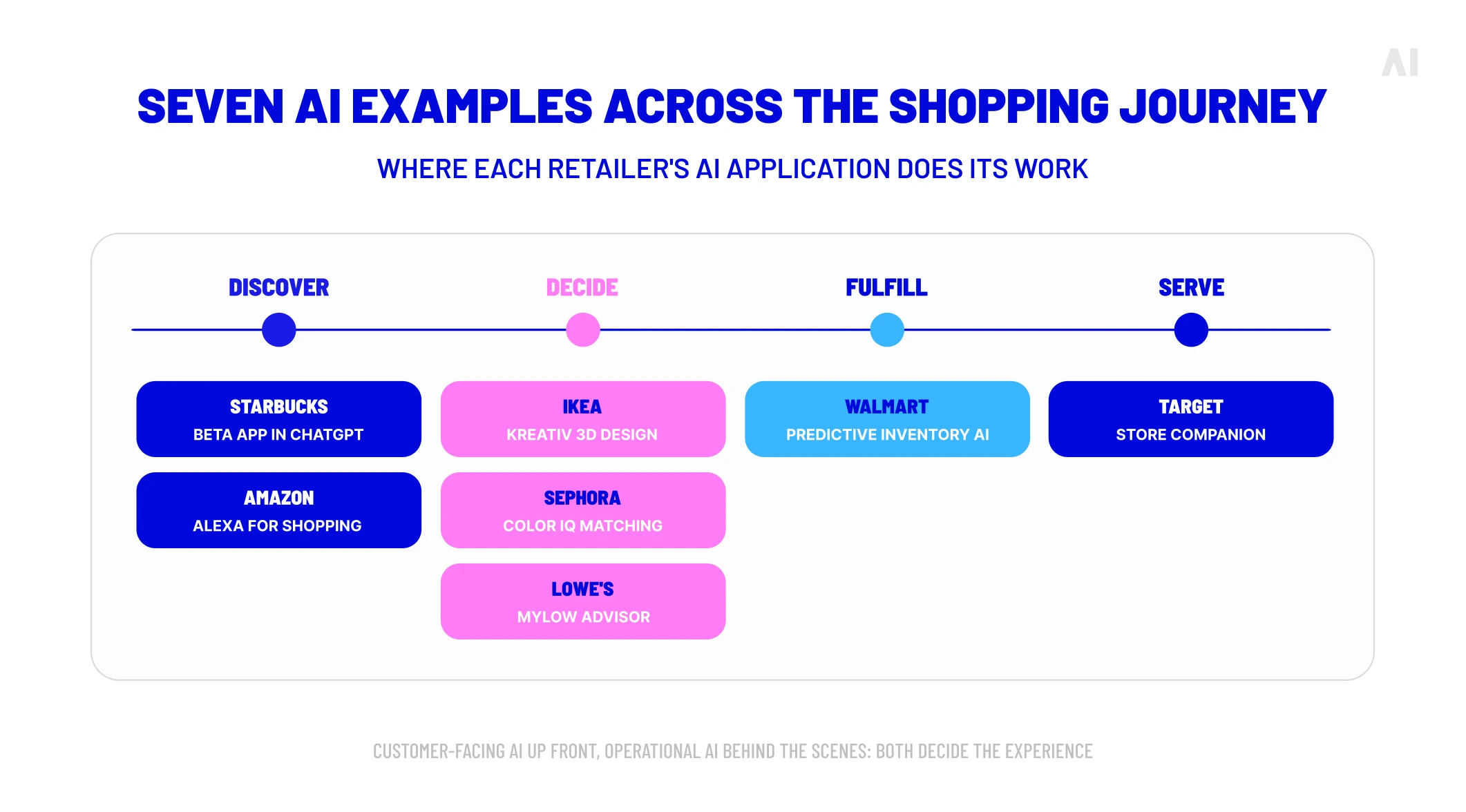
This article looks at seven current, deployed examples of AI in retail from recognizable brands rather than hypothetical use cases. Together they span conversational and agentic shopping, visualization, personalized shade matching, employee assistance, and inventory intelligence, the same territory covered in our broader guide to how artificial intelligence is transforming digital marketing strategies in 2026. For each one, we connect the business problem, the AI application, how it works, and the practical value it delivers.
7 real-world examples of AI in retail
The table below summarizes the seven retailers using AI that we examine in detail, and the function each application serves.
These artificial intelligence in retail examples share a common logic: a defined retail problem, an AI application matched to it, a clear mechanism, and measurable practical value.
1. Amazon: Alexa for Shopping turns product search into agentic shopping
Customers were starting shopping conversations on one Amazon surface and finishing them on another, with nothing carrying over. Amazon's answer, launched in May 2026, was to evolve Rufus, the AI shopping assistant that helped over 300 million customers in 2025, into Alexa for Shopping, combining Rufus's product expertise with the personal context of Alexa+. Shoppers ask questions directly in the search bar, generate side-by-side comparisons, view up to a year of price history, and build personalized buying guides.
Then come the actions it takes on a shopper's behalf: Auto-Buy purchases an item automatically when it hits a target price, Scheduled Actions handle routine restocking, and the Buy for Me feature can complete approved purchases from other retailers' stores. Each capability is a distinct feature rather than one monolithic system, but the combined effect is the same: the distance between discovery, evaluation, and purchase keeps shrinking.
2. IKEA: IKEA Kreativ lets shoppers visualize products in their own rooms
Furniture is a classic high-consideration purchase: expensive, bulky, and hard to return if the sofa swallows the room. IKEA Kreativ exists to shrink that uncertainty. Using the Kreativ Scene Scanner in the IKEA app, shoppers photograph their room and the system assembles a lifelike, editable 3D replica with accurate dimensions and perspective.
The technology, developed by Geomagical Labs, the Silicon Valley AI company Ingka Group acquired in 2020, combines neural networks trained to recognize the geometry of indoor spaces, stereo vision, computational photography, and mixed reality graphics. Crucially, AI can erase some or all existing furniture from the scene, so customers design from a clean slate, placing true-to-scale IKEA products, swapping alternatives, and saving or sharing designs before adding items to the cart.
Earlier AR apps simply floated furniture over a live camera feed. Kreativ removes the single biggest doubt in furniture buying: whether the product will actually work in the space.
⚡ The strongest retail AI applications do not showcase technology. They remove a specific doubt that stands between a shopper and a confident purchase.
3. Lowe's: Mylow turns AI into an on-demand home improvement expert
Home improvement is a category where shoppers often need expertise before they can even name the product. Mylow, developed with OpenAI, meets that need with conversational project guidance: how to fix a leaky faucet, what fertilizer suits a lawn, how to plan a kitchen refresh. It links project advice to product discovery, recommending the right tools and materials and refining suggestions by budget or zip code.
Launched in March 2025 for MyLowe's Rewards members, it now works by voice or chat on the Lowe's website and app, and Lowe's reports that shoppers who use Mylow convert at double the rate of those who do not. This is expert-style guidance rather than a generic shopping assistant. The AI earns the sale by first solving the project problem, the way a trusted red-vested associate would.
4. Sephora: Color iQ uses AI to personalize shade matching
Foundation matching is intensely individual, and getting it wrong is one of beauty retail's oldest frustrations. Sephora's Color iQ addresses it with proprietary AI technology developed in-house that assesses three dimensions of skin tone: depth, undertone, and saturation, where standard industry matching accounts for only the first two. A handheld scan captures the shopper's skin tone, and an algorithm built on a dataset of more than 10,000 skin tones generates a Color iQ code that Beauty Advisors use to connect clients with relevant complexion shades across thousands of foundation SKUs.
The system is deliberately assistive rather than autonomous: the AI narrows the field, the advisor applies judgment, and no match is promised as perfect. The saturation dimension also makes matching meaningfully more inclusive across deeper skin tones. It is a focused case of AI-driven personalization applied where personalization genuinely decides the purchase.
5. Starbucks: AI turns mood and images into product discovery
Starbucks noticed that customers increasingly begin with a feeling rather than a menu. Its answer is the beta Starbucks app in ChatGPT, launched April 15, 2026. US customers enable the app in ChatGPT's directory, tag @Starbucks, and describe what they are in the mood for ("something bright to start my morning") or upload a photo that captures the moment: the weather, an outfit, a workspace. The AI translates that input into tailored drink suggestions, which customers can customize, assign to a nearby store, and carry through to checkout in the Starbucks app or website.
This is multimodal, conversational product discovery rather than a shopping assistant in the Amazon mold: it works from feelings and images, not specifications and price histories. As a beta, Starbucks is explicitly using it to listen and refine, but discovery is already escaping the keyword search box.
6. Target: Store Companion gives retail associates an AI copilot
Not every valuable AI use case in retail faces the shopper. Target's Store Companion, a GenAI-powered chatbot built in-house from real store FAQs and process documents, runs on the handheld devices team members already carry across Target's nearly 2,000 US stores.
Associates ask operational questions in plain language, from signing a guest up for a Target Circle Card to restarting a register after a power outage, and get instructions in seconds. It also coaches new and seasonal team members, compressing the time it takes to become genuinely useful on the floor.
Shoppers feel the difference secondhand: associates spend less time hunting through internal documentation and more time with guests, and they answer with confidence rather than a shrug.
⚡ Employee-facing AI is a customer experience investment wearing an operations badge.
7. Walmart: AI predicts demand and keeps inventory moving
Nothing undermines a shopping experience faster than an empty shelf. Walmart attacks availability with several distinct AI systems rather than one product. A multi-horizon recurrent neural network, built entirely in-house, forecasts demand across short, medium, and long terms using demand history, planned events, and live trends. Its self-healing inventory platform detects stock imbalances and reroutes products toward stores where demand exists, and is now scaling from the US into markets like Canada, Mexico, and Costa Rica.
In January 2026, ahead of Winter Storm Fern, Walmart used forecasting and simulation to position ice melt and water days earlier than previously possible and to reroute hundreds of thousands of goods around at-risk facilities. Customers never see the models. They just find what they came for.
What retailers can learn from these AI examples
Seven brands, seven applications, and the same few patterns underneath. These are the lessons retail companies using AI successfully tend to share.
Start with a specific shopping or operational friction point
Every example above began with a defined problem:
- product discovery that demanded expertise (Lowe's),
- uncertainty before a large purchase (IKEA),
- individual matching that defeated generic recommendations (Sephora),
- repetitive associate questions (Target), or
- stock sitting in the wrong place (Walmart).
None began with a mandate to "do something with AI." The friction point determines the right technique, as the table below shows.
Build AI on reliable retail data and connected systems
AI applications in retail are only as good as the data beneath them.
- Alexa for Shopping draws on catalog data, reviews, inventory status, and purchase history.
- Mylow depends on accurate product and local availability data.
- Walmart's forecasting runs on demand history, event calendars, and live operational signals.
- Sephora's matching rests on a curated dataset of skin tones.
Disconnected inputs, stale product feeds, or missing permissions can make even sophisticated models unhelpful, which is why data infrastructure sits at the center of every serious retail digital marketing strategy.
Before evaluating any AI vendor, retailers should audit the inputs the system will depend on:
- Product and inventory data that is complete, current, and consistent across channels
- Customer signals and permissions, from purchase history to preferences, collected with proper consent
- System connections, including the APIs and CRM/CDP integrations that keep information flowing in real time
Weak answers on any of these predict a weak AI outcome, whatever the vendor demo promised.
Protect trust with accuracy, privacy, and human oversight
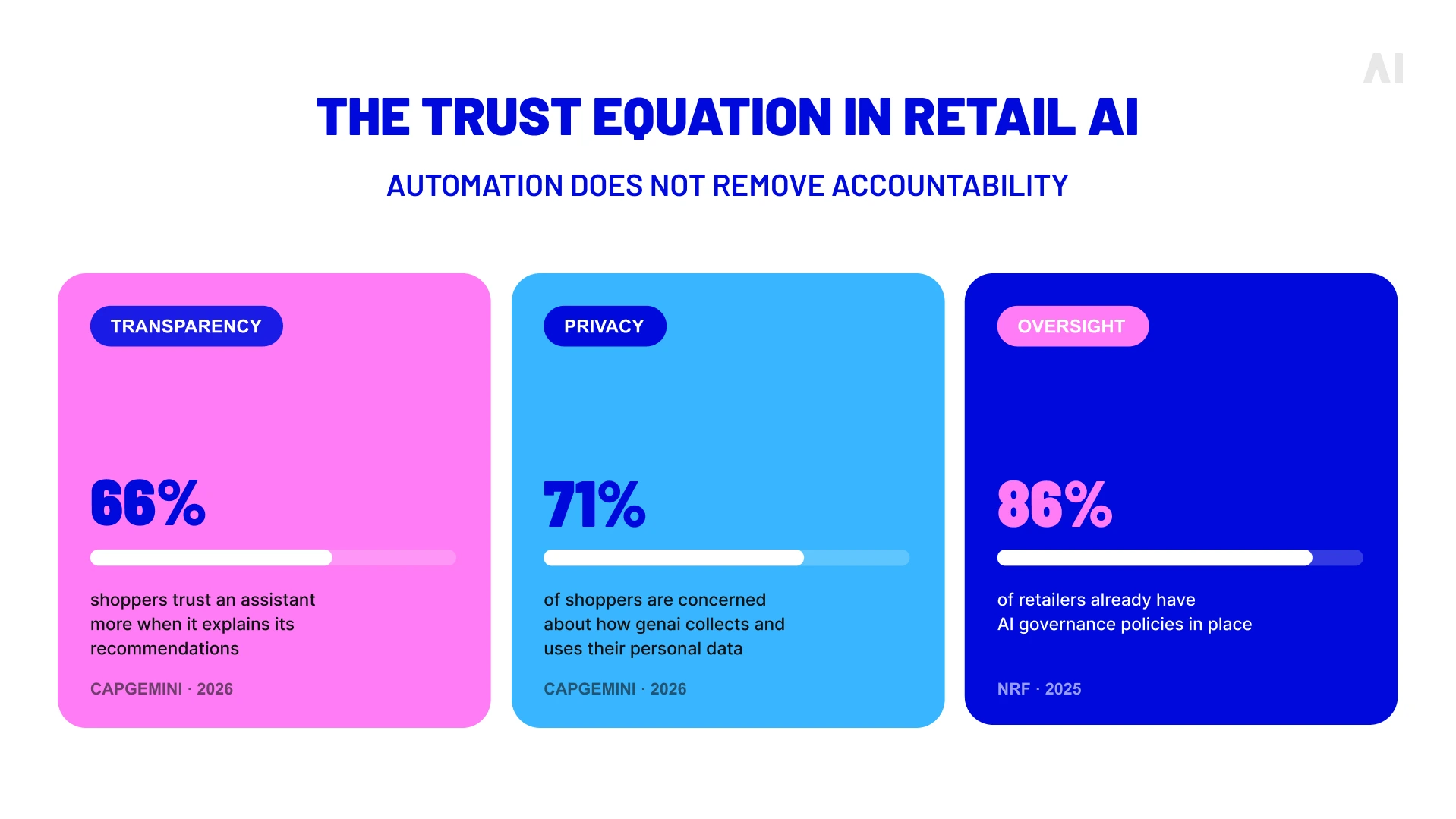
Automation does not remove accountability. Sephora keeps Beauty Advisors in the loop, Starbucks labels its experience a beta and gathers feedback, and Amazon requires approval settings for automated purchases.
Consumer sentiment explains the care: Capgemini's 2026 consumer research found that 71% of shoppers are concerned about how generative AI collects and uses their personal data, while two-thirds trust a digital assistant more when it explains its recommendations.
Retailers are responding with structure: 86% already have AI governance policies in place, according to NRF research. Privacy, consent, bias controls, brand standards, and clear escalation paths to humans are not obstacles to hyper-personalization; they are the conditions under which customers accept it.
⚡ Customers do not reward retailers for using AI. They reward retailers whose AI is accurate, respectful of their data, and honest about its limits.
What comes next for AI in retail
Adobe Analytics reports that traffic from AI sources to US retail sites grew 393% year over year in the first quarter of 2026, and that by March, AI-referred visitors converted 42% better than non-AI traffic, a complete reversal from a year earlier. Four developments look set to accelerate from here:
- Agentic commerce will mature from price-triggered purchases into fuller delegated shopping, forcing retailers to make product data machine-readable.
- Conversational and multimodal discovery will spread beyond early movers as customers grow used to describing intent rather than typing keywords.
- Employee copilots will become standard equipment in stores, not experiments.
- Commerce, retail media, creative, and measurement will pull tighter together, because AI systems perform best when signals flow across all four.
The distinctions between predictive, generative, and agentic AI, summarized in the table below, will decide where each retailer invests first.
How AI Digital supports AI-powered retail marketing
AI Digital does not operate retailer inventory systems, virtual try-on tools, or in-store shopping assistants. Where it does work is the marketing and advertising layer that surrounds them: helping retail brands turn shopper and first-party signals into smarter media, sharper personalization, scalable creative, and honest measurement.
Activate retail and first-party signals across media
The same lesson that governs on-site AI governs advertising: useful AI depends on relevant, connected data. Marketers can apply first-party purchase data, shopper behavior, and retail media signals to build audience strategies that reflect real buying patterns rather than demographic guesswork, then activate them across channels including the fast-growing ecosystem of retail media networks.
The goal is media that behaves like the best retail AI: matched to a specific intent, informed by real signals, and measured against outcomes rather than impressions.
Scale creative and turn campaign data into decisions
Retail marketing burns through creative: formats multiply, campaigns localize, and seasonal windows compress.
AI Creative Studio supports production and adaptation at scale, pairing AI capacity with human creative judgment so volume does not dilute quality.
On the intelligence side, Elevate works as a vendor-agnostic planning, optimization, and measurement layer across 12+ DSPs, connecting campaign media metrics to revenue and business outcomes through transparent dashboards.
Neither product touches store operations or inventory. Both apply the same discipline this article has traced through seven retailers: start with the friction, feed the system good data, and judge it by results.
AI is changing the shopping journey, not just the technology stack
Across all seven examples of AI in retail, value came from improving a concrete stage of the journey: intent, discovery, decision, purchase, fulfillment, or service.
- Amazon compressed research and checkout.
- IKEA and Sephora removed pre-purchase doubt.
- Lowe's supplied expertise at the moment of intent.
- Starbucks met customers at inspiration.
- Target and Walmart strengthened the operational floor that every shopping experience stands on.
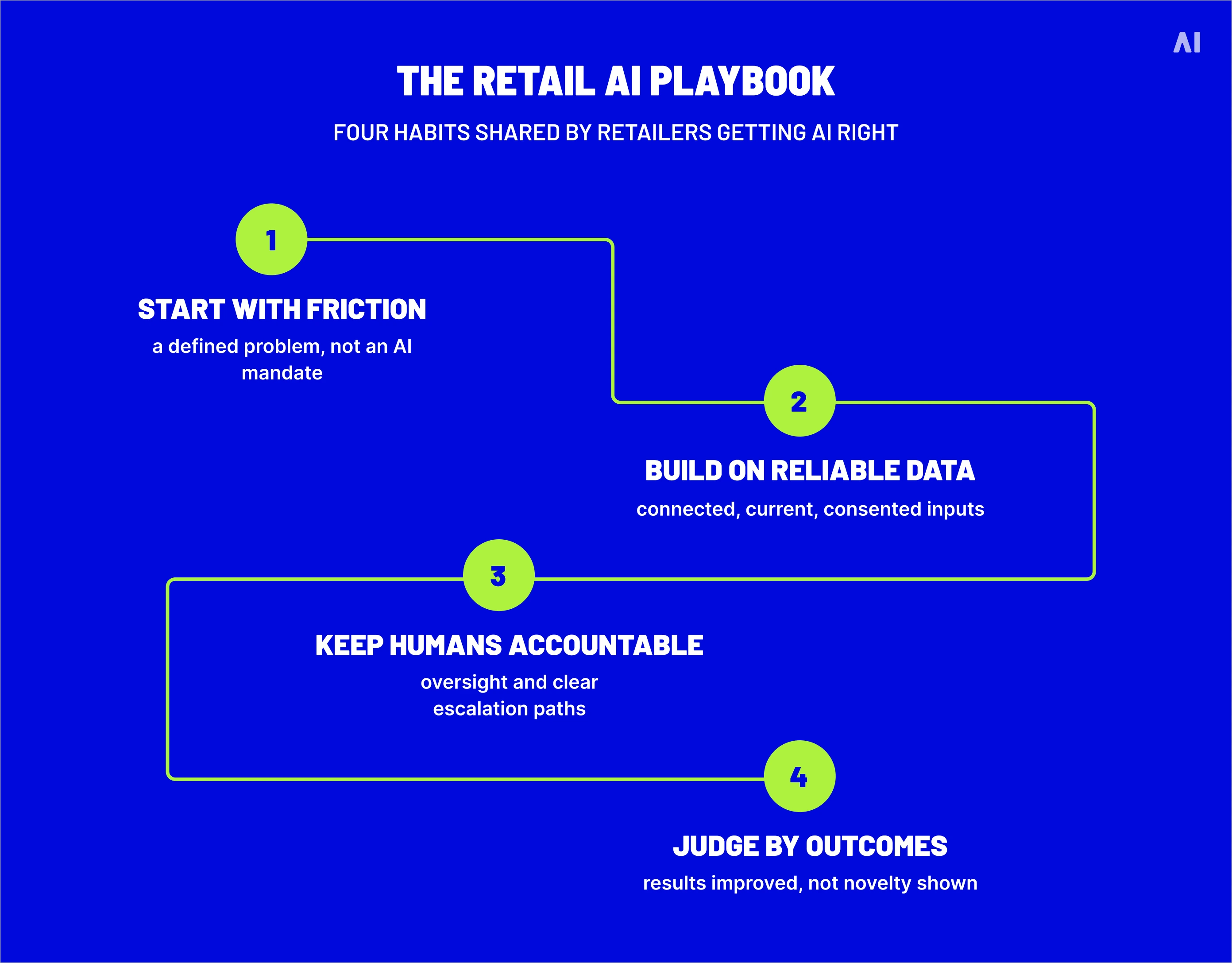
The same four habits run through every success here: start with customer or operational friction, build on reliable data, keep humans accountable, and judge AI by the outcome it improves rather than the novelty it demonstrates.
If you are ready to apply that same discipline to your retail marketing, media, and measurement, get in touch with AI Digital to start the conversation.
.webp)