.webp)
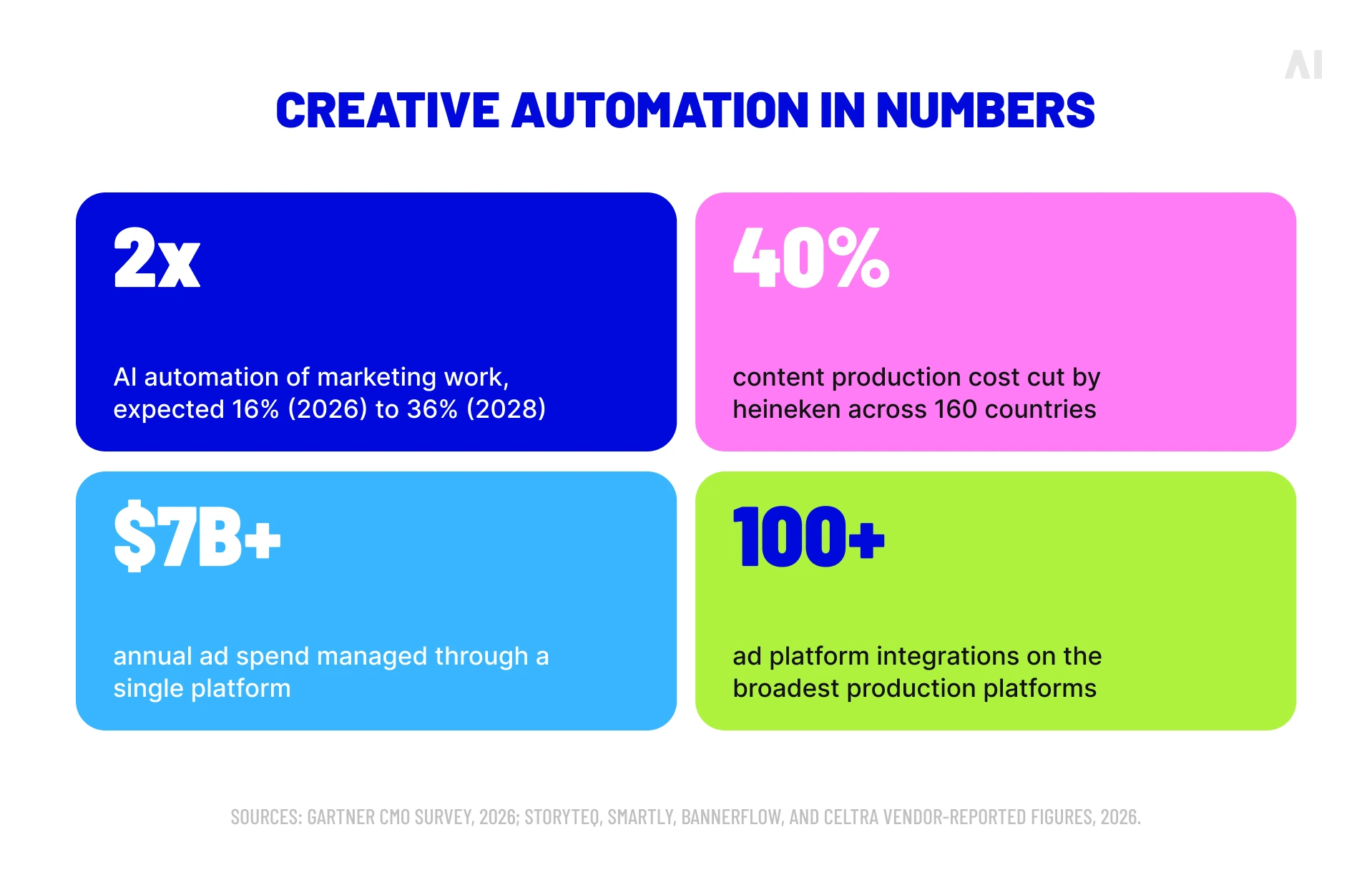
Campaign volume keeps outgrowing the teams asked to produce it. Every new channel, audience segment, product line, and market multiplies the asset variations a brand needs, and manual design workflows buckle under that arithmetic long before quality does. Demand for creative automation software has climbed accordingly: in Gartner's survey of 402 CMOs, marketing leaders said they expect AI-driven automation of marketing work to more than double, from 16% in 2026 to 36% by 2028, and producing, adapting, and versioning creative is the work automation absorbs first.
TL;DR: automation tools and platforms
- There is no universally best creative automation platform. The eight products here solve different problems for different production models, and several of them barely compete with each other.
- Scope varies enormously. Some platforms produce assets and stop there; others carry campaigns through publishing, ad serving, media optimization, and measurement.
- Match the tool to your production bottleneck. A team drowning in paid social variations needs different software than a global brand localizing one master campaign into 40 markets.
- Governance and integrations often outweigh AI features. Locked templates, approval workflows, and clean DAM, PIM, and feed connections determine whether automation holds up at scale. A long list of AI features does not.
- Pricing transparency is inconsistent. Two of the eight publish plans, one publishes its pricing model, and the rest require a sales conversation. Public monthly pricing is not the same thing as total cost of ownership.
- Test before you commit. Shortlist two or three platforms and run a real campaign workflow through each. A vendor demo will not surface the friction your own templates, data, and approval chains will.
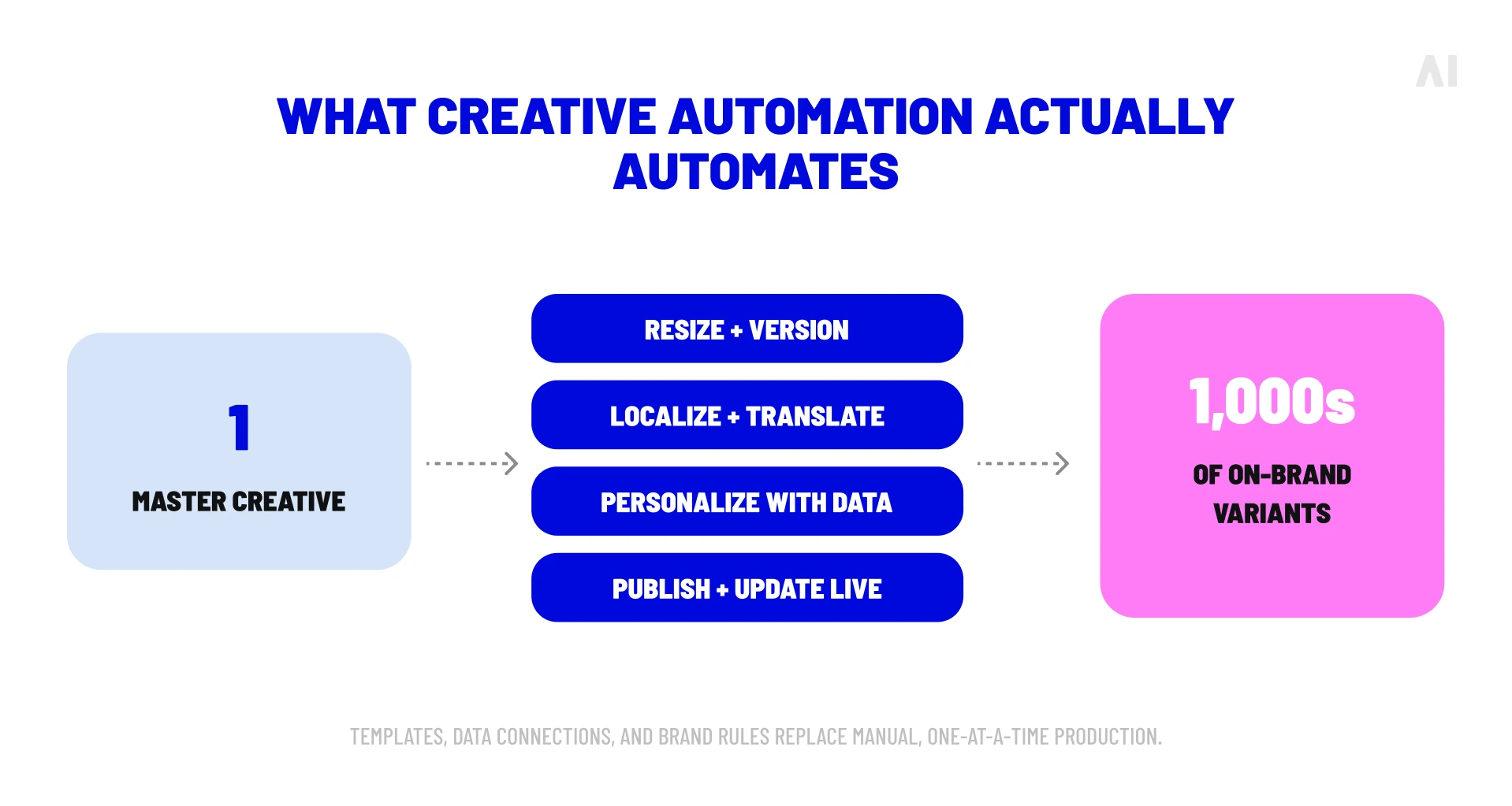
This guide compares eight of the best creative automation platforms available in 2026, with a firm boundary around the category: specialized creative automation tools and advertising-production platforms, not general design editors, standalone AI image generators, project management software, or DAM-only products. Even within that boundary, the shortlisted products differ substantially in scope, from end-to-end advertising platforms that fold in media buying to focused solutions for smart templates, catalog creative, localization, paid social, or API-driven production. A buyer who understands those differences has already done most of the choosing.
Creative automation platforms: quick comparison
How we selected and evaluated the platforms
Every product in this guide had to clear the same bar.
- Each one is active and commercially available in 2026.
- Each provides meaningful creative automation rather than only a manual design surface.
- Each supports campaign-asset production, adaptation, versioning, or activation at scale.
- Each publishes enough official information to support a fair comparison.
- And each represents a distinct, relevant use case, because a list of eight near-identical tools would help nobody.
We then evaluated every platform against the same criteria:
- Primary use case and platform type
- Templates and versioning
- Supported formats and channels
- Data, feed, DAM, PIM, and API connections
- Localization and personalization
- Brand governance
- Collaboration and approvals
- Testing and analytics
- Publishing or activation
- Scalability and implementation effort
- Usability
- Pricing transparency
This is a curated editorial shortlist rather than an exhaustive market map. Strong products exist outside these eight. We did not conduct hands-on testing for this comparison; the analysis is based on current official product pages, documentation, pricing pages, product demos, and other publicly available information, all reviewed in 2026.
⚡ The most expensive mistake in this category is buying scope you will not use. An end-to-end advertising platform and a smart-template engine can both be excellent and still be wrong for you.
8 creative automation tools and platforms to consider in 2026
The reviews below follow the same format so you can compare like with like. They appear in alphabetical order.
Bannerflow: best for high-volume multi-format advertising
Best for: In-house marketing teams producing large volumes of display, social, and video advertising across multiple markets.
Platform type: Creative management and advertising production.
Overview: Founded in Stockholm in 2010, Bannerflow exists so that a team can design a master creative once, then scale, localize, publish, and update it everywhere from one place. Its Creative Studio handles HTML5, video, and rich media production, with generative fill, background removal, in-platform video editing, and direct Figma import.
Key capabilities:
- Automated resizing and versioning across formats and languages
- Feed-based dynamic content with a DCO add-on
- Centralized collaboration with live comments, approvals, and locked brand elements
- Scheduled publishing and real-time updates to live campaigns
- Creative analytics
- Integrations with more than 100 advertising platforms across display, social, affiliate, and DOOH
- Certification as an Amazon Ads third-party ad server
Strengths: Depth from production through publishing without leaving the platform, strong ease-of-use ratings relative to enterprise rivals, and the ability to update live creative without rebuilding or republishing.
Main limitations: The focus is advertising production and deployment. It is not a general content creation tool, a project management system, or a print production engine, and pricing requires a consultation.
Pricing availability: Contact sales. Plans are tailored to team size and usage.
Verdict: A strong fit for in-house teams that want enterprise-grade ad production they can operate without a dedicated ops function.
Celtra: best for enterprise omnichannel creative production
Best for: Enterprise creative, marketing, and media teams producing and adapting high volumes of campaign creative across channels and markets.
Platform type: Enterprise creative automation.
Overview: Celtra is one of the category's most established enterprise players, used by brands including Unilever, Spotify, Adidas, and Bloomberg. Its platform turns approved concepts into modular templates, then generates on-brand variations for every placement, audience, and market at a scale manual workflows cannot reach.
Key capabilities:
- Modular, locked-down templates with granular brand governance
- Node-based generative AI design for images, animation, and video
- Automated adaptation and localization
- Collaboration and approval workflows
- Distribution to more than 100 media platforms
- Ad serving, priced on impressions and video starts
- Add-ons including Dynamic Product Ads, predictive AI, custom API integrations, and Creative Services
Strengths: Template governance at genuine enterprise scale, breadth of formats from rich media to dynamic commerce creative, and mature onboarding and support.
Main limitations: Celtra rewards planning. Expect a real implementation phase, deliberate template architecture, governance design, and integration work with your DAM and PIM before the efficiency gains arrive. Commercial terms are custom, and the platform is more than a small team producing occasional assets needs.
Pricing availability: Custom quote, based on seats, creative volume, and ad-serving impressions.
Verdict: The safest choice for complex, distributed enterprise creative operations willing to invest in setup.
CHILI GraFx: best for API-first digital and print production
Best for: Organizations, retailers, agencies, and technology partners producing brand-controlled print, static digital, and animated digital assets, often inside their own systems.
Platform type: API-first smart-template infrastructure.
Overview: CHILI GraFx, from CHILI publish, is less a destination app than a production engine. Its Smart Templates lock brand-critical elements while letting text, imagery, prices, and layouts adapt intelligently, and a single design system can output print-ready PDFs, static digital assets, and animations from one source.
Key capabilities:
- GraFx Studio template editor with imports from InDesign, Photoshop, and Illustrator
- A Connector Framework linking templates to DAM, PIM, CRM, and pricing data
- A fully exposed API and SDK for headless or embedded workflows
- Self-service brand portals
- The GraFx Genie AI assistant
- Uncapped end-user seats on every package; only Template Designer seats are limited
Strengths: The rare platform that treats print and digital as equal citizens, unusually strong data-driven production for retail use cases like leaflets and price signage, and genuine developer-grade integration options.
Main limitations: It expects technical integration, template expertise, and a clearly designed production environment. Teams wanting a plug-and-play ad builder should look elsewhere.
Pricing availability: Public pricing model. CHILI publish documents its package structure, designer seats, and render quotas, with overage renders around €0.10 each, though full price cards require a conversation.
Verdict: The infrastructure pick for organizations building creative automation into their own stack, especially where print still counts.
Hunch: best for paid social and feed-based creative
Best for: Performance teams and agencies running high-volume, product-led campaigns on paid social.
Platform type: Paid social automation.
Overview: Hunch connects creative production, product feeds, and campaign management for Meta, Snapchat, and TikTok, with TikTok the most recent addition to what the company calls a single cross-channel control center. It is a Meta Business Partner and a Snapchat and TikTok partner, and everything about the product is oriented toward performance advertising.
Key capabilities:
- Data-driven templates for image and video creative, including catalog product video that turns flat feed data into motion
- Feed enrichment with sources like Google Sheets and Shopify
- Smart Product Sets built from GA4 and conversion data
- Bulk localization, with campaigns personalized by language, location, and even weather
- Direct publishing to Meta and Snapchat
- A built-in review tool for flagging and approvals
- Unified reporting across all three channels
Strengths: Production, localization, and campaign launch in one workflow, unusually deep catalog and DPA capabilities, and hands-on strategic support.
Main limitations: Hunch is not a universal omnichannel platform, and it does not pretend to be. Its strongest capabilities remain concentrated in paid social, so display-heavy or print-inclusive operations will need something else alongside it.
Pricing availability: Contact sales. Pricing is usage-based and not published.
Verdict: For teams whose budget lives on Meta, Snapchat, and TikTok, this focus is a feature rather than a gap.
Marpipe: best for catalog creative and product-feed advertising
Best for: Ecommerce and product-led advertisers that want their dynamic product ads to look designed rather than generated.
Platform type: Catalog creative platform.
Overview: Marpipe calls itself the operating system for catalog ads, a fair description of what it does: layer branded templates, badges, reviews, pricing logic, and video on top of raw product feeds, then output enriched catalogs to every major DPA surface.
Key capabilities:
- Free feed management with no SKU cap
- Feed enrichment and field transformation
- Branded catalog templates with conditional design rules by category or attribute
- Product-level video
- SKU-level performance analysis with automatic removal of low performers
- Creative testing across templates
- Feed outputs to Meta, Google, TikTok, Pinterest, and Snapchat
Strengths: A self-serve product teams run without vendor hand-holding, a flat monthly fee with no percentage of ad spend or revenue, and a free tier that lowers the cost of finding out whether it fits.
Main limitations: The specialization cuts both ways. Marpipe is a catalog creative tool rather than a full enterprise creative operations platform, so brand campaigns and non-feed formats sit outside its remit.
Pricing availability: Public plans: a free feed-management tier, Startup at $199 per month capped at 500 SKUs, and Enterprise pricing scaling with catalog size. Verify current figures on the official pricing page.
Verdict: Shortlist it whenever dynamic product ads are your biggest creative lever; its approach applies dynamic creative optimization principles at the SKU level.
Smartly: best for connecting creative and media workflows
Best for: Enterprise brands and agencies that want creative production, media activation, and measurement operating as one system.
Platform type: Creative and media advertising platform.
Overview: Smartly has the broadest scope in this guide. Its three suites, Creative, Media, and Intelligence, cover asset production, cross-channel campaign management, budget automation, and measurement, and the company was ranked a leader in The Forrester Wave for creative advertising technologies. It supports 800+ brands and manages over $7 billion in annual ad spend.
Key capabilities:
- AI-assisted creative production and DCO for image, video, UGC, and display formats
- Automated campaign workflows and predictive budget allocation
- Channel coverage spanning Meta, TikTok, Pinterest, Snapchat, Google, Amazon, Reddit, and Spotify
- CTV activation across 200+ streaming services, plus the open web
- Cross-channel reporting, experimentation, and brand measurement
- The Synapse AI orchestration layer introduced in 2026
Strengths: Genuine unification of creative and media in one platform, unmatched channel breadth in this shortlist, and enterprise-grade services and support.
Main limitations: All that scope is the trade-off. Teams that only need asset production will pay for, and manage, far more platform than the job requires, and pricing tied to media spend suits media-led organizations better than creative-led ones. Implementation and training are substantial.
Pricing availability: Custom quote, typically based on media spend and feature scope.
Verdict: The strongest option when creative and media operations genuinely need to converge, and an oversized one when they do not.
Storyteq: best for global content adaptation and localization
Best for: Global brands adapting master campaigns across markets, languages, formats, and distributed teams.
Platform type: Content marketing and localization platform.
Overview: Storyteq positions itself as a broader content marketing platform rather than a standalone creative automation tool, and was named a leader in the 2026 Gartner Magic Quadrant for content marketing platforms for the fourth time. Its three connected modules, Content Portal, Adaptation Studio, and Collaboration Hub, cover asset management, versioning, and workflow in one system.
Key capabilities:
- Adaptation Studio turns approved master assets into dynamic templates that generate thousands of localized variants
- AI Translations covering more than 60 languages, trained on brand reference materials
- Imports from Photoshop, Figma, and After Effects
- Batch creation via CSV and API
- An object-level AI-tagged DAM
- Brief-to-approval workflows
- Halo Intelligence recommendations on which adaptations are likely to perform
- Output spanning video, HTML5, statics, and print
Strengths: Localization depth few rivals match, governance that lets local teams self-serve without breaking brand, and evidence at serious scale: Heineken cut content production costs by 40% while operating across 160 countries on the platform.
Main limitations: Its breadth means buying a content platform, not just an automation tool, with a setup fee, an annual license, and an implementation phase to match.
Pricing availability: Contact sales. License packages vary by modules and scale.
Verdict: The clear candidate when multi-market adaptation, rather than raw ad output, is the bottleneck.
The Brief: best for self-service AI-assisted ad creation and publishing
Best for: Teams and agencies wanting AI-assisted ad production with self-service access and public pricing.
Platform type: Self-service AI ad creation platform.
Overview: The Brief is the current brand of the platform formerly known as Creatopy, rebranded in October 2025 and rebuilt around four connected AI agents: Discover for research, Create for ad generation, Launch for publishing, and Optimize for performance analysis. The familiar editor survived the transition; the campaign lifecycle around it is new, and this review evaluates the current product rather than the historical Creatopy feature set.
Key capabilities:
- Ad Studio for design, animation, and resizing to 50+ formats, with Photoshop and Figma import
- AI generation of images, video, copy, and translations on every plan
- Brand kits with locked elements
- Collaboration, roles, and approvals on team plans
- Direct publishing to Meta, Google Ads, CM360, and DV360, with HTML5 export for 40+ networks
- Ad serving with dynamic personalization
- Feed-driven production and API distribution on Enterprise
Strengths: Self-service access with a free trial, published plans, and a complete path from research to live campaign at this price point.
Main limitations: The agent-based lifecycle is recent, some capabilities are still maturing plan by plan, and full governance sits in the top tier. Confirm which features your plan includes.
Pricing availability: Public plans across Pro, Ultra, Team, and Enterprise tiers, with capacity and seats scaling by plan; check current rates on the official pricing page.
Verdict: The most accessible entry point in this shortlist, with more substance behind the public pricing than the price alone suggests.
⚡ Feature lists converge; production models do not. Choose for the campaign work your team repeats every week rather than for the most polished demo.
How to choose the right creative automation platform
Eight reviews in, a pattern emerges: this is a decision about production needs, not feature counts. The framework below ties the evaluation to how your team works.
Match the platform to your primary production model
Start by naming the bottleneck that hurts most, because each production model points to a different corner of the market.
- Enterprise omnichannel production needs modular templates and governance.
- Global localization needs adaptation workflows and market-level permissions.
- Paid social needs feed connections and native publishing.
- Catalog advertising needs SKU-level creative.
- Creative testing needs variation generation and clean measurement.
- Self-service production needs accessible tooling and transparent plans.
- API-driven output needs infrastructure, not an interface.
- And combined creative and media operations need a platform that carries campaigns past the asset stage.
Identify your primary bottleneck before you build a shortlist. Teams that skip this step end up comparing platforms that were never solving the same problem.
Check formats, channels, data, and integrations
Once the shortlist exists, verify the unglamorous details.
- Confirm support for every format you actually ship: image, video, HTML5, rich media, motion, CTV, social, display, retail media, and print where relevant.
- Confirm the data plumbing: product feeds, DAM and PIM integrations, design-file imports, APIs, ad-platform connections, and publishing or ad-serving options.
- Then confirm compatibility with your current martech stack, down to the specific systems.
A generic "integrations available" line on a website is not sufficient evidence. Ask the vendor to demonstrate the exact connection, the direction of data flow, the permissions model, and the implementation work required on your side. Integration gaps are the most common reason creative automation software underdelivers, and they surface late, after contracts are signed and templates are half built.
Evaluate governance, AI, measurement, and total cost
Governance decides whether automation scales safely. Compare roles and permissions, approval workflows, brand controls and locked template elements, and localization review processes.
On AI, weigh capabilities against oversight: generation features now appear across the whole category, so what separates platforms is how well each one keeps humans in control of what ships.
This is the same balance that determines success with AI in marketing automation more broadly: the technology compounds the quality of the process around it.
Then interrogate cost properly. Public monthly pricing does not establish the total cost of ownership, and a custom enterprise quote does not automatically make a platform unsuitable. Build the full picture before comparing numbers.
Do not let AI capabilities outweigh workflow fit, control, data quality, usability, or adoption requirements. An impressive generation demo that your team cannot govern will cost more than it saves.
Test the platform against a real campaign workflow
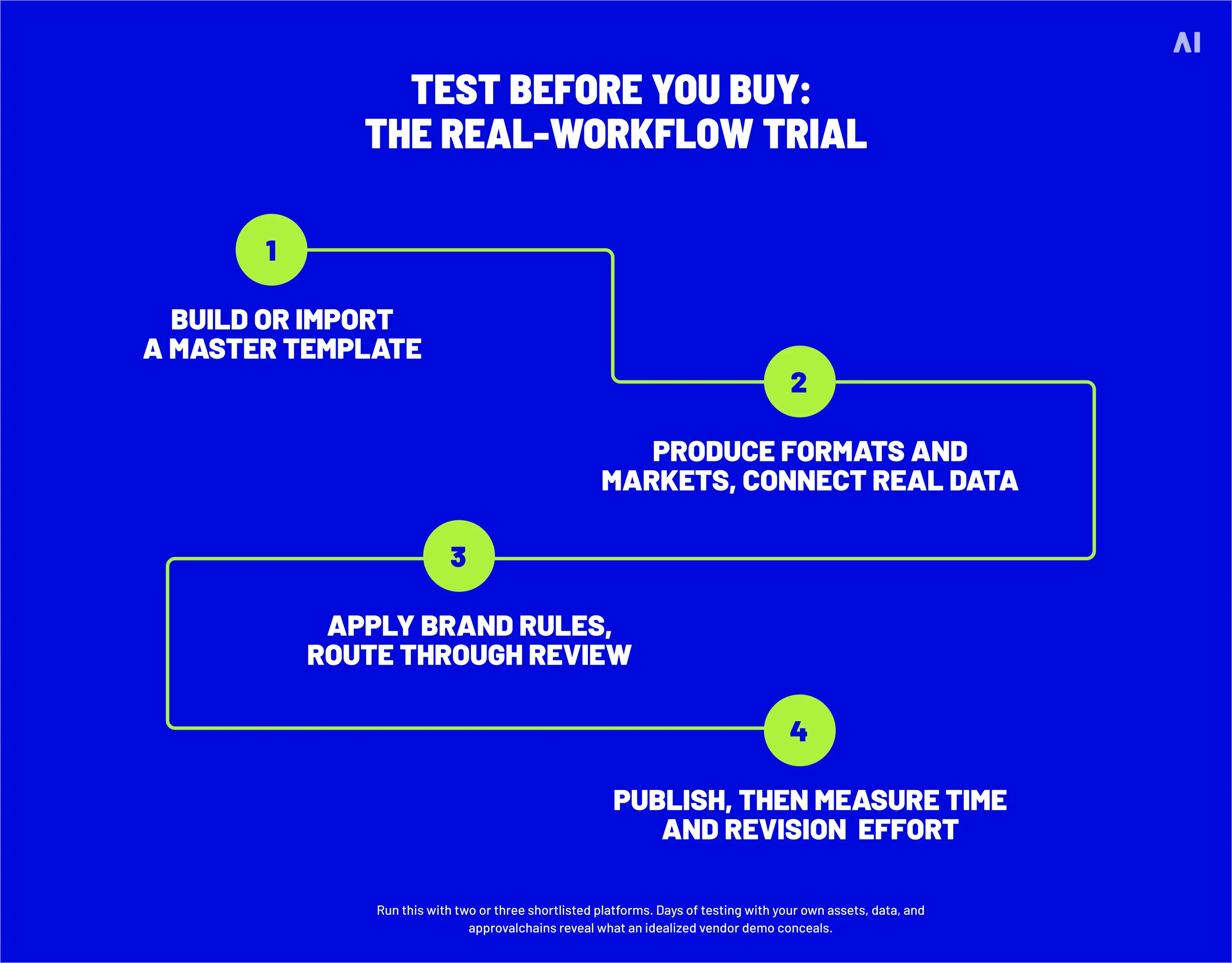
Finally, shortlist two or three products and run a representative workflow through each.
- Build or import a master template.
- Produce multiple formats or market versions.
- Connect your real data, feeds, or product catalog.
- Apply your brand rules.
- Route assets through review and approval.
- Export or publish to a live or sandbox destination. Then measure production time and revision effort against your current process.
The exercise takes days rather than months, and it surfaces what an idealized vendor demo conceals: how the platform behaves with your assets, your data quality, and your approval chains. Avoid choosing a platform on the strength of the demo alone.
How AI Digital helps scale creative production
Every platform in this guide assumes an internal team with the capacity to configure templates, connect data, enforce governance, and operate the system week after week. For some organizations that assumption holds. For others, the real constraint is people: there is no team to run the platform, or the team that exists is already at capacity, and buying more software leaves that unchanged.
A creative production partner covers that gap, alongside a self-service platform or instead of one. AI Digital's AI Creative Studio pairs AI-powered production with human creative direction across the work these platforms automate:
- original asset production,
- resizing and versioning at scale,
- localization and channel adaptation,
- rapid prototyping,
- creative testing and iteration, and
- repurposing existing content into new formats.
AI provides the scale; creative directors, designers, and strategists provide the taste and the judgment.
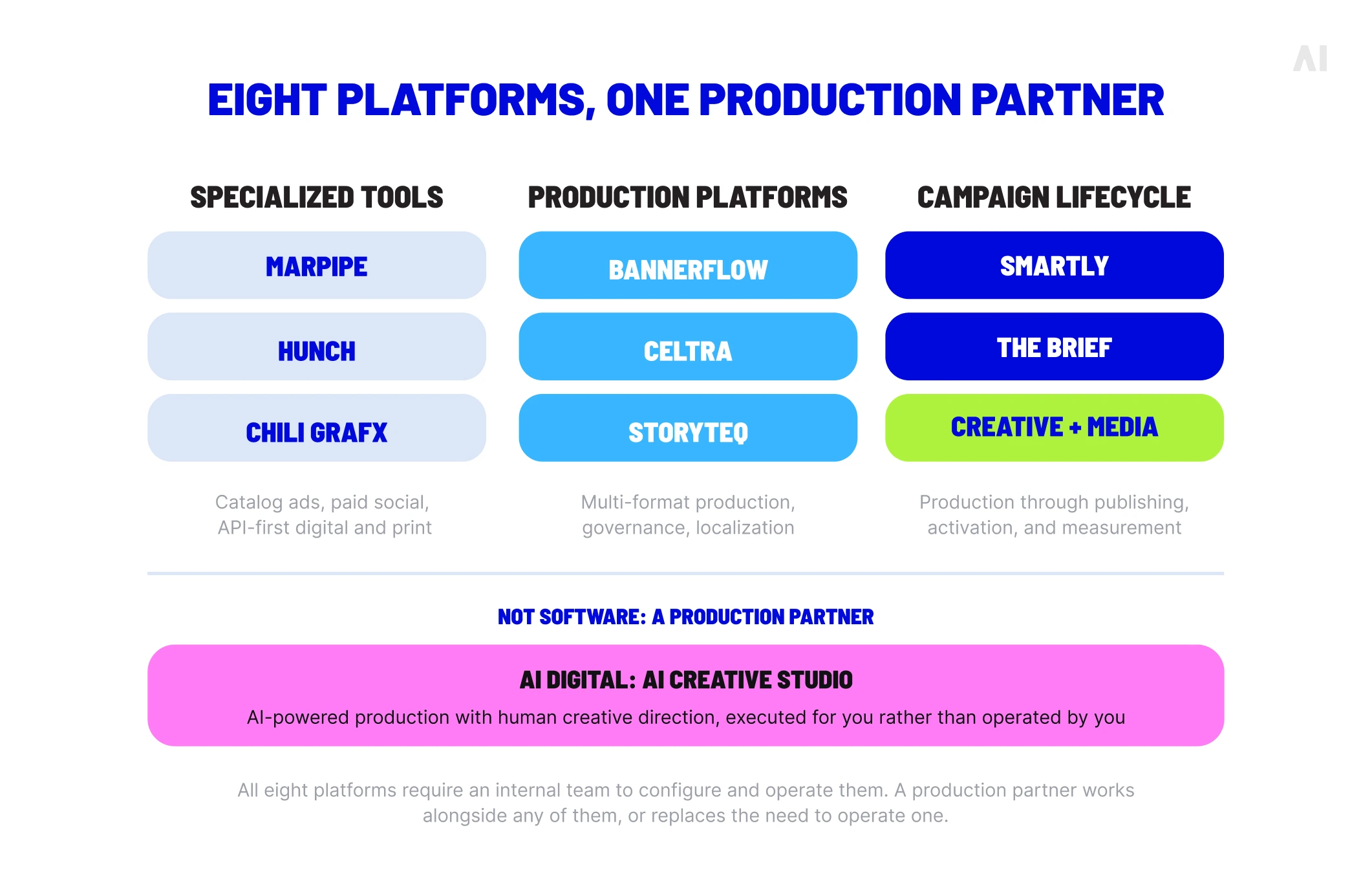
The two models ask different things of you.
- Buying software means your team configures and operates the process.
- Working with a production partner means the process is executed for you, briefed and approved by you, and scaled without adding headcount.
Many enterprise teams end up with both: a platform for the always-on production their internal team owns, and a partner for overflow, new-market launches, and the creative work that needs more than templates.
⚡ Platforms scale a process your team already runs. A production partner supplies the process, and the people, when your team cannot.
Choose the right platform for your creative operations
The right creative automation platform is the one that fits your production bottleneck, channels, asset formats, campaign volume, data sources, integrations, governance requirements, team model, budget, and implementation readiness. The length of that list is the honest part of the advice. The eight products here appear alphabetically rather than ranked, because a ranking would flatten exactly the differences that make the decision meaningful.
The strongest decision will come from testing shortlisted platforms against a real campaign workflow rather than trusting feature pages, this guide included. And if the evaluation surfaces a capacity problem as much as a tooling one, it may be worth a conversation about whether AI Digital's creative-production model could complement the platforms and team you already have. Get in touch and we can talk it through against your actual production numbers.