Built to pivot: preparing for Apple's next move


What iOS 27 blocked
The scope became clear through a bug report The Trade Desk filed with Apple's WebKit team on September 21. Alongside adsrvr.org, the domains it listed cover Unified ID 2.0, ID5, LiveRamp, Permutive and Audigent. The Trade Desk called adsrvr.org its "core ad request and delivery domain, not identity," and in a test on yahoo.com its bids were blocked in Safari while Google's went through. Because browsers must use Apple's WebKit engine to run on iPhones and iPads, the block reached other mobile browsers too.
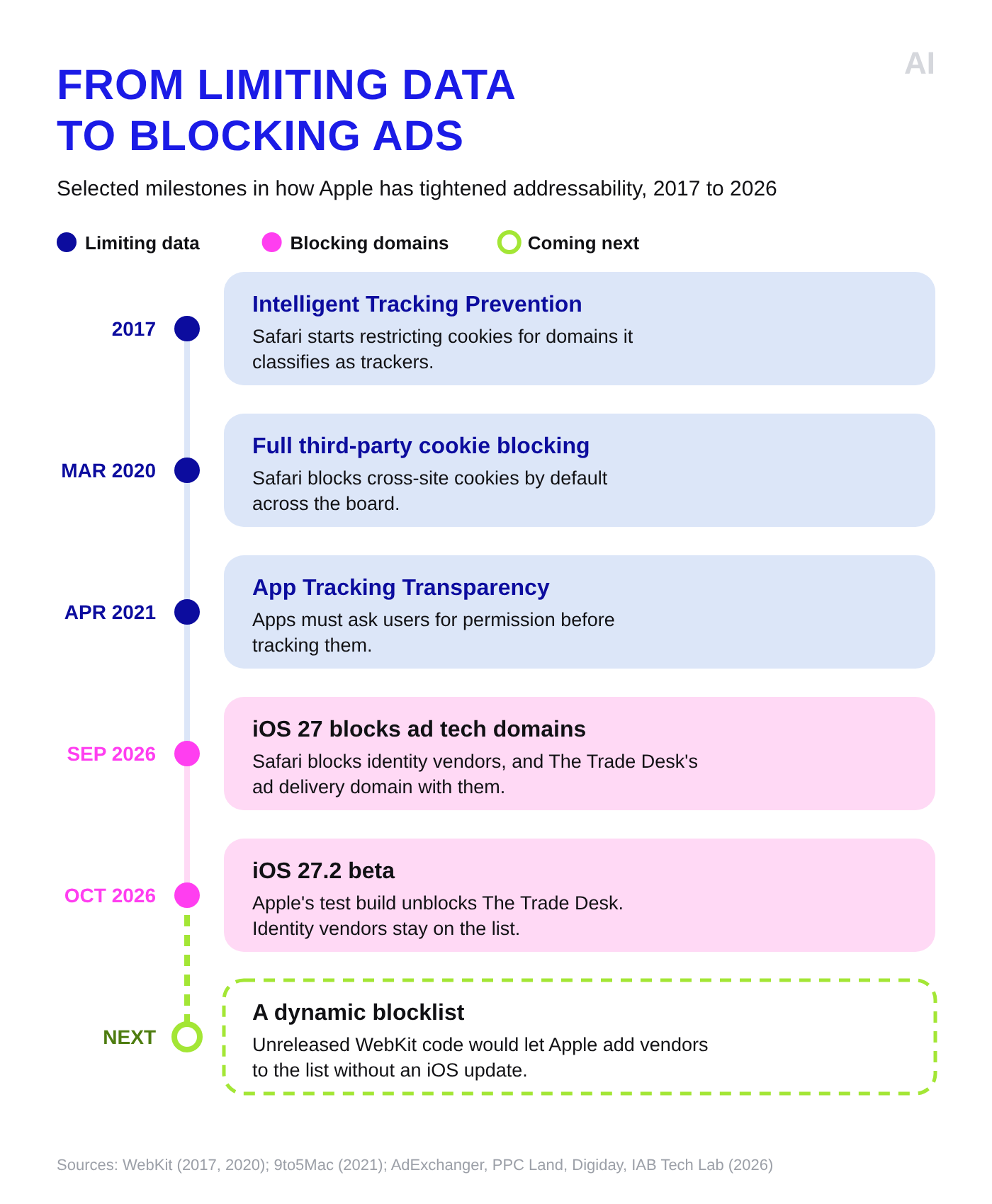
On October 5, Apple asked The Trade Desk to test an iOS 27.2 beta, which, according to AdExchanger, removes adsrvr.org from the blocklist. The fix reaches users only when iOS 27.2 becomes the live version, which could take three or four weeks, and until then any device updated to iOS 27 keeps blocking the DSP's ads. LiveRamp, UID2 and other identity providers remain blocked, and ADOTAT, citing unnamed sources, reports that ID5 is not coming off the list.
One domain, two jobs
The Trade Desk's outage looks like collateral damage. The block seemed aimed at match.adsrvr.org, the DSP's cookie-sync endpoint, but Safari blocks at the domain level and took the ad-serving traffic down with it. The lesson reaches well beyond one DSP. Any vendor that runs identity matching and ad delivery on shared infrastructure carries the same exposure, and so does any campaign that relies on that vendor as its only route to an audience.
Vendors are already adapting. Permutive rotated to a new domain, which a source familiar with the decision described to AdExchanger as a temporary patch while the company moves a small number of clients to a first-party setup. The IAB Tech Lab's Trusted Server takes a structural route, running bid calls on a publisher-controlled server so that "WebKit never sees the bids and has nothing to block," with production-level tests expected by early 2027. Neither fix will be in place for every publisher and vendor a campaign touches, so the buy side needs a plan of its own.
Why the next change may arrive without notice
Apple's reach makes each of these decisions consequential. Safari accounted for 30.42% of US browser usage in September 2026, and iOS held 53.59% of the US mobile operating system market over the same month. Apple has tightened addressability across that audience for nearly a decade, from Intelligent Tracking Prevention in 2017 to full third-party cookie blocking in Safari in March 2020 and App Tracking Transparency requirements for all apps from April 2021.
iOS 27 departs from that history in two ways. Ahead of ITP and ATT, Apple published guidance and held sessions at its developer conference, while this time the blocked companies were left to figure it out themselves.
Apple has also written code into WebKit that will let it add vendors to the list without a new version of iOS. Digiday reports that the code hasn't shipped yet, and the IAB Tech Lab's Rowena Lam describes it as an unreleased update. AdExchanger's sources say the list covers hundreds of CDPs, ad tech and martech companies, though a Digiday test of more than 70 ad tech domains found only the original handful blocked, and Apple has confirmed neither the list's size nor its contents. Where earlier changes limited the data advertisers could use, this one decided whether an ad could load at all, and once the dynamic list goes live, the next block could arrive overnight.
Where AI Digital stands
We don't anticipate major scale or media efficiency concerns today. AdExchanger describes iOS 27's install base as still small, though it grows each day, which gives buyers time to adjust before the restrictions reach most devices. Because we are platform agnostic, we can move delivery to another DSP or supply path when one narrows, and our teams are monitoring inventory, CPMs and performance on Apple devices as adoption climbs.
Our preparation began well before this update. Our 2023 Cookie-less Future POV called for a "neutral and elastic" approach across DSPs, data and inventory, and the Open Garden Framework puts that approach into practice:
- Platform agnostic: We select the right DSP and supply path for each campaign, so no single platform's decision can take a plan offline.
- Multiple paths to every audience: Open web, CTV, audio and more give each campaign room to reroute when one channel narrows.
- Measurement on your business data: Results are anchored in outcomes you own, so they hold up when a platform switches off an identifier.
AI Digital builds with AI every day, and that work runs on constant testing and a habit of treating today's playbook as provisional. A media team needs the same habits when a major platform changes the rules, and they pay off most when the team spots the change before it shows up in a report.
Four questions to ask your media partners
Before iOS 27.2 ships and Apple's wider list comes into play, brands can pressure-test their readiness with four questions.
- Can our media plan move across platforms and channels if one path is restricted?
- How are we preparing for privacy changes that limit traditional identifiers?
- Which strategies, such as contextual, first-party data and CTV, will hold up as addressability tightens?
- Are our partners watching platform and policy changes closely enough to adjust before results suffer?
The bottom line
This time, a fix is on its way. The next companies on Apple's list may get neither a fix nor a warning. Brands that stay ahead will work with partners built to pivot, with flexible buying, independent measurement and a team that treats change as the default.
If any of the four questions above is hard to answer, connect with the AI Digital Growth Director to work through them against your current plans. Together, we can pinpoint where your campaigns depend on a single platform or identifier and build the flexibility to keep them running as Apple’s rules change.