
For most of the past two years, marketers have been busy re-plumbing the data stack. Data Manager APIs took over from cookie-dependent infrastructure, server-side tagging closed the consent gap that had been quietly degrading conversion volume, and Conversions APIs reconnected purchase data to bid algorithms that had grown half-blind to it. Behind those rebuilds, clean rooms, identity graphs, and CRM integrations finally drew the board-level attention they had spent years failing to attract. Most of that work is now broadly done.
The figures from the other side of the rebuild are sobering. Triple Whale's 2025 benchmarks, drawn from more than 18,000 brands, show median Google Ads ROAS down roughly 10% year-over-year and median CPA up around 12%, even as click-through rates rose across nearly every vertical. The pipes work; the strategy running through them is not converting all that fresh data into profit.
From connection to quality
The reason well-instrumented programs are now underperforming has less to do with the technology than with how it is being used. A bigger first-party dataset, on its own, only adds volume to the same volume-chasing logic. The signals inside it—which customer is loyal, which is one-and-done, which carries the margin worth spending against—still need to be refined before they mean anything to a bidding algorithm.
The activation gap is what authoritative sources are now naming directly. Experian's 2026 Digital Trends report finds that activating first-party data across channels can reduce customer acquisition costs by up to 50% and lift revenue by 10–15%, while the ratio of brands that own the data to brands that use it across channels remains uncomfortably wide. IAB's State of Data 2026 reaches a similar conclusion from a different angle: the systems used to translate data into outcomes are under more strain in 2026 than they were before the privacy rebuild, because AI has accelerated expectations faster than measurement quality has caught up.
Quantity of first-party data is no longer a differentiator. The ability to refine it into usable signal is.
What value-based bidding actually does
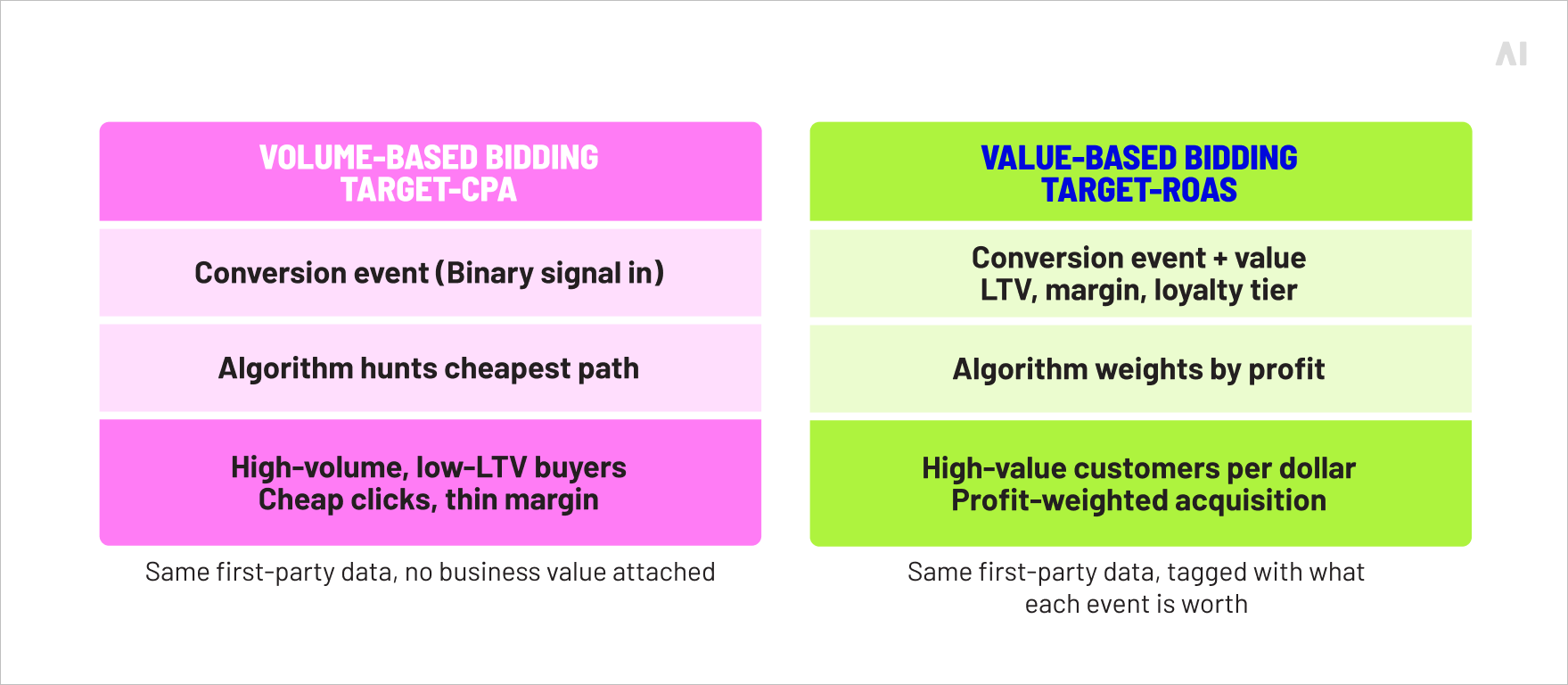
Value-based bidding is the operational answer to the signal-quality problem. Where target-CPA tells the algorithm to find conversions cheaply, target-ROAS—fed first-party value signals like predicted lifetime value, margin tier, and loyalty depth—tells it to find profit. Each conversion gets a different value attached, and the algorithm hunts accordingly.

Google's own published median is a 14% increase in conversion value when accounts move from target-CPA to target-ROAS at similar return on ad spend, as cited by Think with Google. The same source documents H&M's restructured paid search program: after rebuilding around first-party data from its Membership club and switching to value-based bidding, the retailer reported paid search revenue up more than 70% year-over-year and new customer acquisition up 65%, both at a stronger ROAS.
Read the H&M numbers carefully, and the lift says less about the size of the gain than about the bid logic that produced it:
- Before VBB, the optimization was unintentionally biased toward the customers most likely to buy—H&M's existing loyalists.
- The bid model was efficient at the wrong job.
- Once value signals were attached to the conversions the algorithm cared about, it started looking for the customers the brand actually needed.
VBB is what converts a clean first-party dataset from a defensive privacy asset into an offensive performance one
{{26-Signal-Over-Source-The-Era-of-Value-Based-Bidding-1="/tables"}}
The collapse of the data silo
VBB only works to the limit of the signals reaching the bidder. The richest signals—lifetime value, margin contribution, repeat-purchase probability, loyalty tier—typically sit inside CRM and ERP systems controlled by finance, retention, or product teams. Media buying teams often see them weeks late, or only in monthly reports, by which point the bidder has already optimized on whatever proxies were available.
The ANA spent the back half of 2025 trying to fix this framing. Its data framework released in December 2025 reframes first-party data leadership as transformation rather than hygiene, meaning the wall between brand data and media data has to come down before the math improves. The framework's case-in-point is a beauty brand that connected first-party signals to its bidding via the Conversions API, delivering a 20% incremental sales lift and a 173% rise in ROAS.
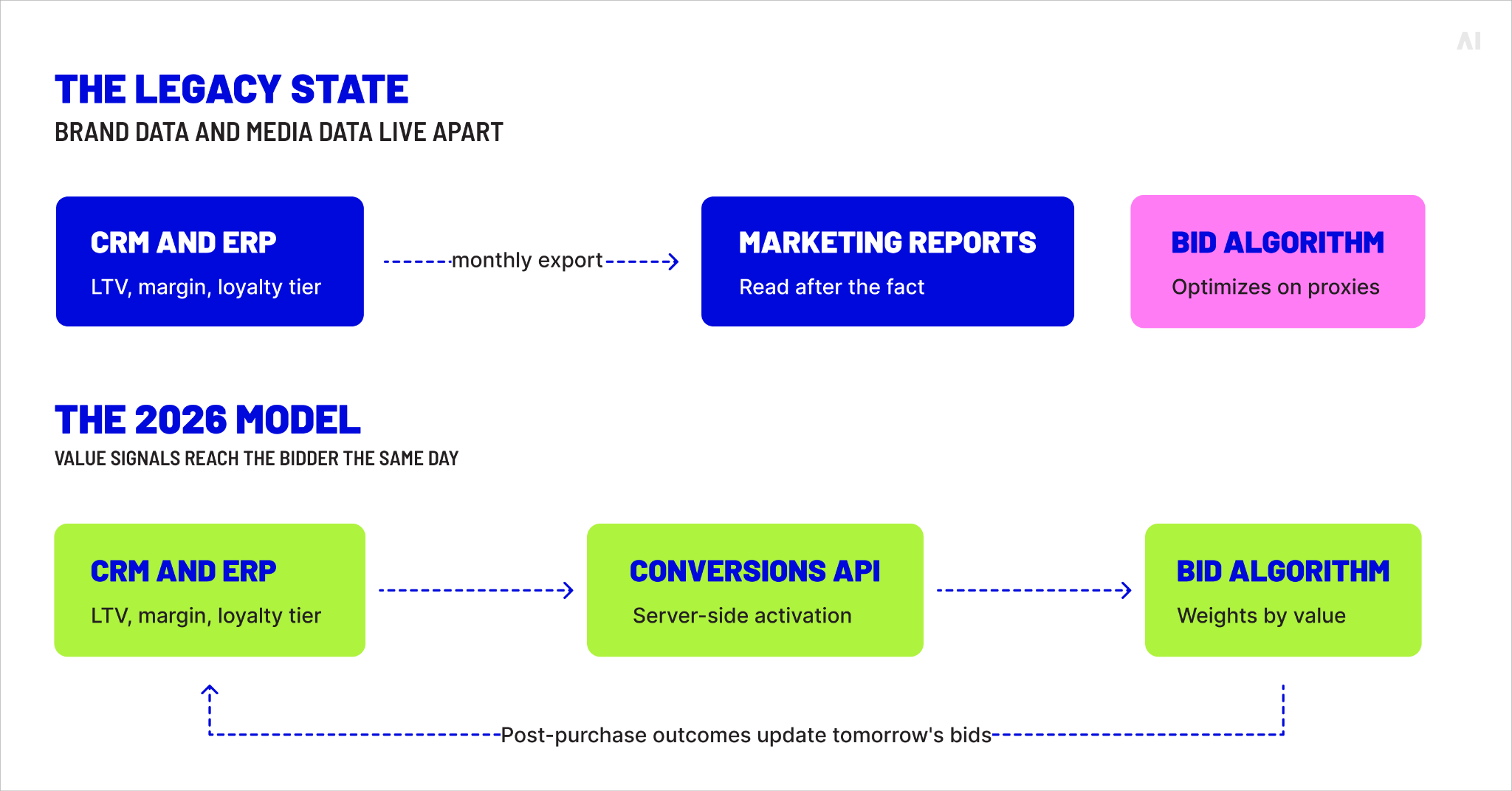
The 2026 version of mature looks different from the 2024 version. Where mature once meant "we have a CDP," it now means post-purchase data updates the bid model the same day. The algorithm spends today against what it learned about value yesterday—and that kind of dynamic feedback loop is what stops the bidder from re-acquiring last week's cheap, low-margin buyer.
Why a neutral interpreter matters
There is a quieter problem inside VBB that gets less coverage. If the platform interpreting your first-party data also profits from the impressions it tells you to buy, the optimization logic is structurally biased.
The pull toward closed-loop ecosystems is now explicit. eMarketer's coverage of The Trade Desk's Performance Mode launch frames the dynamic plainly: even independent DSPs are being pushed toward bundling supply, optimization, and reporting into a single CPM, mirroring how Performance Max and Advantage+ already operate. The convenience is real, and so is the lock-in. Once a brand cannot trace which audience signal drove which placement at what cost, attribution becomes a story the platform tells rather than a fact the brand verifies.
The argument against this is data sovereignty. Walled gardens deserve their share of spend on the merits—they convert. What they should not own is the interpretation layer above them. A vendor-agnostic activation environment, working across multiple DSPs, keeps first-party data inside the brand's control while still putting it to work where the audience actually is. The interpreter is not the seller.
Closing the loop in the physical world
The final test of any signal is whether it shows up in physical revenue. This is where VBB has historically been weakest—bid models tuned for online ROAS often have no idea whether the customer they bought walked into the store, finished a phone order, or counted toward a household's third reorder. Verified Walk-In and Household Association close that loop, mapping digital exposure to real-world purchase behavior.
The infrastructure for this matured visibly in 2025. Adsquare's real-time Attribution Dashboard, launched in June, replaced static post-campaign reports with live store-visit data; in one published case, Walmart Mexico recorded a 17% year-over-year uplift in store visits across 12 million ad impressions. Innovid and iSpot launched comparable solutions inside the same six months. The pattern is consistent: programmatic exposure is increasingly being judged against verified in-store outcomes rather than modeled ones.

For brands working inside AI Digital's intelligence stack, the validation is internal as well as external. Pairing value-based bidding with marketing mix modeling that runs continuously rather than quarterly produces 4–7% improvements in budget distribution and 5–20% uplift in client retention—gains that come from the same signal-quality logic, applied one layer up. The bidder is finding higher-value customers; the model is making sure budget actually flows to the channels reaching them.
What comes next
The 2026 advantage is not held by brands with the largest first-party datasets. It is held by those spending against signal quality, validating against physical outcomes, and refusing to let any single platform own the interpretation. The plumbing era is closing; the strategy era is open.
This is the work AI Digital was built for: managed value-based bidding across 15+ DSPs, an Open Garden activation environment that keeps first-party data sovereign, and outcome-grade measurement that runs all the way to the store door. The next dollar of media spend should know more about your customer than the platform you spend it on does.