The Zero-Click Paradox—Monetizing Invisible Attention in 2026
Steven Miller
June 5, 2026
5
minutes read
We have spent years treating the click as the cleanest proof that marketing worked. Visible, countable, easy to report up the chain. That habit now hides as much as it reveals. When Pew Research found that users click a traditional search result only 8% of the time after encountering a Google AI summary—down from 15% without one—the number did not signal a broken funnel. It signalled a funnel that had already closed before anyone noticed. Bain's research confirms the pattern from the other side, finding roughly 60% of searches ending with no onward navigation. The click persists, but the moment of resolution has moved earlier—into the interface itself, where AI delivers the answer before the user ever reaches for a link.
This is uncomfortable if your entire measurement stack depends on session data. It is also a misreading of what is actually happening. A brand can be the decisive factor in a purchase—named, recommended, framed as the category leader—and show nothing in Google Analytics.
That gap between influence and attribution is the zero-click paradox. And ignoring it will cost more than adapting to it.
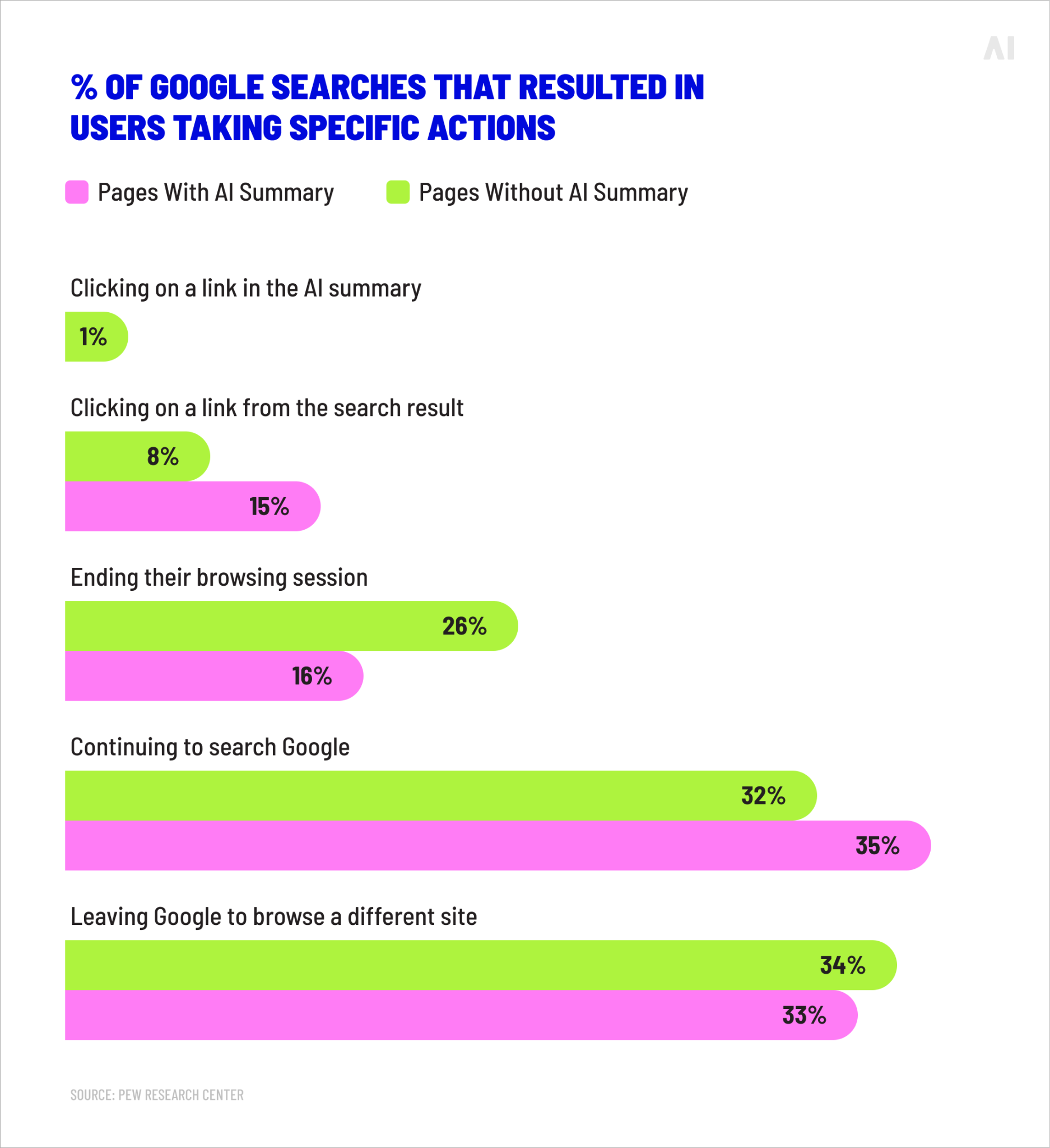
Pic. % of Google searches in March 2025 resulting in users taking or not taking certain actions (Source).
The scale is no longer hypothetical
At I/O 2025, Google confirmed that AI Overviews had reached 1.5 billion monthly users across 200 countries and territories. By late 2025, Conductor's analysis of 21.9 million searches found that 25% of all queries were triggering an AI Overview—up from roughly 16% just a quarter earlier. And when they did, the effect on clicks was severe: Ahrefs' study of 300,000 keywords found that they now reduce the click-through rate for the top-ranking result by 58%, nearly double the 34.5% decline the same team measured eight months prior.
These are not edge cases. McKinsey's consumer research found that half of all consumers now intentionally seek out AI-powered search engines, and that unprepared brands could see traditional search traffic decline by 20% to 50%. Reuters Institute reported that publishers expect search-engine traffic to fall by more than 40% over the next three years.
The instinct is to read those numbers as a crisis. They are, but not the crisis most teams are planning for. Traffic may fall. The harder question—the one worth building around—is whether influence is disappearing, or whether it has simply moved somewhere your current tools cannot see it.
Pic. Consumers & use of AI-powered search for decision-making (Source).
Winning the interaction, losing the dashboard
Consider what actually happens when an AI system fields a high-intent query. A user asks which platform suits their needs, or which provider offers the best terms, or which product has the strongest track record. The AI synthesizes evidence from across the web—reviews, technical documentation, editorial coverage, third-party validation—and presents a recommendation. The user gets a decision. The brand gets nothing in the analytics.
But "nothing" is the wrong word. The brand was named. It was positioned as the answer. The user left with a preference they did not have thirty seconds earlier. That is not a failed impression. It is a high-intent impression that resolved earlier than the reporting model expected.
McKinsey's data puts weight behind this: 44% of AI-powered search users now call it their primary source of insight for buying decisions, ahead of traditional search, retailer sites, and review platforms. If people are deciding inside the AI layer, then the job is no longer to rank on a results page. It is to be chosen, cited, and framed correctly inside the answer itself.
Pic. AI-powered search is the most preferred source of information among users (Source).
What replaces the click
Not a single metric. A tighter cluster of them:
Recommendation rate—how often the AI names your brand as a top choice.
Citation presence—whether your evidence appears in the synthesised response.
Sentiment accuracy—whether the AI's framing matches the story you are actually telling.
Brand inclusion rate—the frequency with which you appear at all.
The question shifts from "did they click?" to "what happened next?" Did branded search rise? Did direct traffic lift? Did assisted conversions move? Did recall improve among exposed audiences?
There is already evidence that the two patterns—zero-click resolution and high-quality referral—coexist rather than cancel each other out.Adobe found that traffic from generative AI tools to retail sites rose 693% year over year during the 2025 holiday season, and that those AI referrals converted at a 31% higher rate than traffic from other sources. Fewer visits, but better ones. The volume game is thinning. The value game is getting sharper.
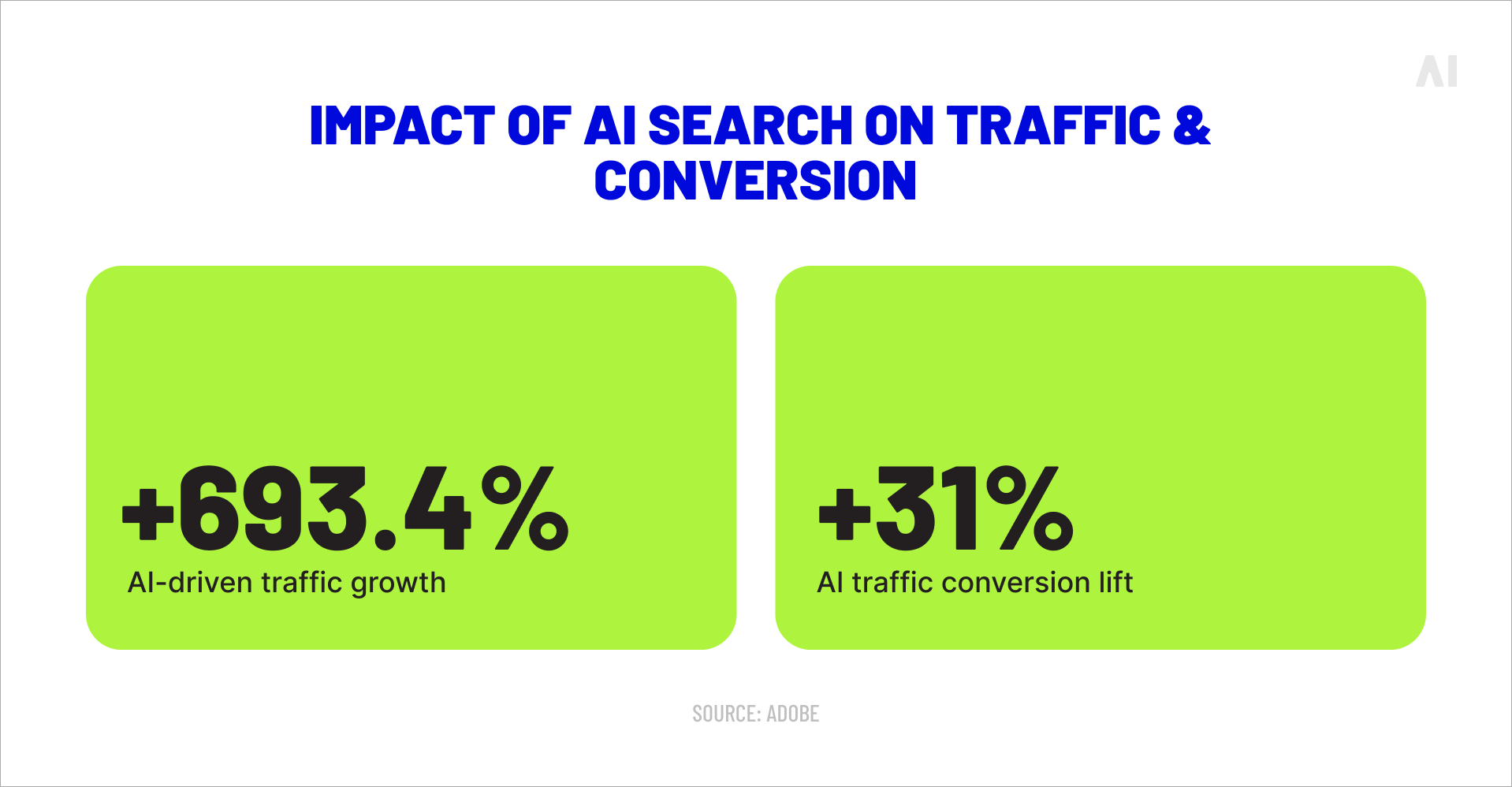
Pic. Impact of AI search on traffic & conversion (Source).
Paid visibility arrives, but trust still has to be earned
OpenAI began testing ads in ChatGPT in the US in early 2026, initially for logged-in users on the Free and Go tiers. The ads are clearly labelled and visually separated from the answer. Industry projections put AI search ad spend at roughly $2 billion this year, scaling to around $26 billion by 2029. Conversational interfaces are becoming media environments, not just answer engines.
But placement can buy visibility. It cannot buy trust. If the organic answer contradicts your paid claim—if the AI's synthesized evidence frames a competitor as stronger, or if your brand appears with weak validation and vague differentiation—the ad unit does little more than spotlight the gap. At a premium CPM, that is an expensive way to expose a positioning problem.
The useful takeaway is not that paid presence in AI search is pointless. It is that paid and organic work harder when they agree with each other. A brand that dominates both the recommendation and the sponsored placement leaves the user with a single, reinforced conclusion. A brand that shows up in the ad but not in the answer creates friction where there should be none.
The real moat: being easy for machines to trust
McKinsey makes a point that deserves more attention than it tends to get: a brand's own websites may account for only 5% to 10% of the sources an AI search system references. The rest—reviews, editorial coverage, technical documentation, third-party benchmarks, forum discussions—is assembled from a wider evidence field. Your reputation in AI systems is being built from material you may not control, and in many cases, may not even be tracking.
This changes what "content strategy" means. The old model optimized for search engine crawlers. The next model optimizes for synthesis—content built to withstand summarization, to survive compression, to remain accurate and attributable after an AI has distilled it into three sentences. Clearer claims, tighter evidence, and stronger third-party validation. More consistent language across every surface the AI can reach.
Call it evidence marketing if you want a label. The point is that the brands most likely to survive the zero-click era are not the loudest but the most citable.
Reading the full picture
The old model of digital success was tidy: win the click, win the customer. The next model is less neat but closer to how decisions are actually made. Be the answer. Be the citation. Be the name that survives synthesis intact. Then prove—with independent, cross-platform measurement—that this visibility changed behavior, whether or not it produced an immediate visit.
This is where an Open Garden approach earns its relevance. Not as a media-buying philosophy alone, but as a way of auditing how a brand is represented across fragmented systems—where it appears, how it is framed, whether performance is being distorted by one platform's self-reporting. DSP-agnostic execution, cross-platform visibility, and KPI-led optimization are not abstract principles here. They are the operational prerequisites for measuring influence that no longer fits inside a click.
If this shift is already showing up in your reporting—if traffic is down but branded search is up, if conversions are holding but attribution looks thinner—the planning and measurement models may be the thing that need replacing. That is exactly the conversation AI Digital is built to have. So why not get in touch!

Blind spot
Key issues
Business impact
AI Digital solution
Lack of transparency in AI models
• Platforms own AI models and train on proprietary data • Brands have little visibility into decision-making • "Walled gardens" restrict data access
• Inefficient ad spend • Limited strategic control • Eroded consumer trust • Potential budget mismanagement
Open Garden framework providing: • Complete transparency • DSP-agnostic execution • Cross-platform data & insights
Optimizing ads vs. optimizing impact
• AI excels at short-term metrics but may struggle with brand building • Consumers can detect AI-generated content • Efficiency might come at cost of authenticity
• Short-term gains at expense of brand health • Potential loss of authentic connection • Reduced effectiveness in storytelling
Smart Supply offering: • Human oversight of AI recommendations • Custom KPI alignment beyond clicks • Brand-safe inventory verification
The illusion of personalization
• Segment optimization rebranded as personalization • First-party data infrastructure challenges • Personalization vs. surveillance concerns
• Potential mismatch between promise and reality • Privacy concerns affecting consumer trust • Cost barriers for smaller businesses
Elevate platform features: • Real-time AI + human intelligence • First-party data activation • Ethical personalization strategies
AI-Driven efficiency vs. decision-making
• AI shifting from tool to decision-maker • Black box optimization like Google Performance Max • Human oversight limitations
• Strategic control loss • Difficulty questioning AI outputs • Inability to measure granular impact • Potential brand damage from mistakes
Managed Service with: • Human strategists overseeing AI • Custom KPI optimization • Complete campaign transparency
Fig. 1. Summary of AI blind spots in advertising
Dimension
Walled garden advantage
Walled garden limitation
Strategic impact
Audience access
Massive, engaged user bases
Limited visibility beyond platform
Reach without understanding
Data control
Sophisticated targeting tools
Data remains siloed within platform
Fragmented customer view
Measurement
Detailed in-platform metrics
Inconsistent cross-platform standards
Difficult performance comparison
Intelligence
Platform-specific insights
Limited data portability
Restricted strategic learning
Optimization
Powerful automated tools
Black-box algorithms
Reduced marketer control
Fig. 2. Strategic trade-offs in walled garden advertising.
Core issue
Platform priority
Walled garden limitation
Real-world example
Attribution opacity
Claiming maximum credit for conversions
Limited visibility into true conversion paths
Meta and TikTok's conflicting attribution models after iOS privacy updates
Data restrictions
Maintaining proprietary data control
Inability to combine platform data with other sources
Amazon DSP's limitations on detailed performance data exports
Cross-channel blindspots
Keeping advertisers within ecosystem
Fragmented view of customer journey
YouTube/DV360 campaigns lacking integration with non-Google platforms
Black box algorithms
Optimizing for platform revenue
Reduced control over campaign execution
Self-serve platforms using opaque ML models with little advertiser input
Performance reporting
Presenting platform in best light
Discrepancies between platform-reported and independently measured results
Consistently higher performance metrics in platform reports vs. third-party measurement
Fig. 1. The Walled garden misalignment: Platform interests vs. advertiser needs.
Key dimension
Challenge
Strategic imperative
ROAS volatility
Softer returns across digital channels
Shift from soft KPIs to measurable revenue impact
Media planning
Static plans no longer effective
Develop agile, modular approaches adaptable to changing conditions
Brand/performance
Traditional division dissolving
Create full-funnel strategies balancing long-term equity with short-term conversion
Capability
Key features
Benefits
Performance data
Elevate forecasting tool
• Vertical-specific insights • Historical data from past economic turbulence • "Cascade planning" functionality • Real-time adaptation
• Provides agility to adjust campaign strategy based on performance • Shows which media channels work best to drive efficient and effective performance • Confident budget reallocation • Reduces reaction time to market shifts
• Dataset from 10,000+ campaigns • Cuts response time from weeks to minutes
• Reaches people most likely to buy • Avoids wasted impressions and budgets on poor-performing placements • Context-aligned messaging
• 25+ billion bid requests analyzed daily • 18% improvement in working media efficiency • 26% increase in engagement during recessions
Full-funnel accountability
• Links awareness campaigns to lower funnel outcomes • Tests if ads actually drive new business • Measures brand perception changes • "Ask Elevate" AI Chat Assistant
• Upper-funnel to outcome connection • Sentiment shift tracking • Personalized messaging • Helps balance immediate sales vs. long-term brand building
• Natural language data queries • True business impact measurement
Open Garden approach
• Cross-platform and channel planning • Not locked into specific platforms • Unified cross-platform reach • Shows exactly where money is spent
• Reduces complexity across channels • Performance-based ad placement • Rapid budget reallocation • Eliminates platform-specific commitments and provides platform-based optimization and agility
• Coverage across all inventory sources • Provides full visibility into spending • Avoids the inability to pivot across platform as you’re not in a singular platform
Fig. 1. How AI Digital helps during economic uncertainty.
Trend
What it means for marketers
Supply & demand lines are blurring
Platforms from Google (P-Max) to Microsoft are merging optimization and inventory in one opaque box. Expect more bundled “best available” media where the algorithm, not the trader, decides channel and publisher mix.
Walled gardens get taller
Microsoft’s O&O set now spans Bing, Xbox, Outlook, Edge and LinkedIn, which just launched revenue-sharing video programs to lure creators and ad dollars. (Business Insider)
Retail & commerce media shape strategy
Microsoft’s Curate lets retailers and data owners package first-party segments, an echo of Amazon’s and Walmart’s approaches. Agencies must master seller-defined audiences as well as buyer-side tactics.
AI oversight becomes critical
Closed AI bidding means fewer levers for traders. Independent verification, incrementality testing and commercial guardrails rise in importance.
Fig. 1. Platform trends and their implications.
Metric
Connected TV (CTV)
Linear TV
Video Completion Rate
94.5%
70%
Purchase Rate After Ad
23%
12%
Ad Attention Rate
57% (prefer CTV ads)
54.5%
Viewer Reach (U.S.)
85% of households
228 million viewers
Retail Media Trends 2025
Access Complete consumer behaviour analyses and competitor benchmarks.
Identify and categorize audience groups based on behaviors, preferences, and characteristics
Michaels Stores: Implemented a genAI platform that increased email personalization from 20% to 95%, leading to a 41% boost in SMS click through rates and a 25% increase in engagement.
Estée Lauder: Partnered with Google Cloud to leverage genAI technologies for real-time consumer feedback monitoring and analyzing consumer sentiment across various channels.
High
Medium
Automated ad campaigns
Automate ad creation, placement, and optimization across various platforms
Showmax: Partnered with AI firms toautomate ad creation and testing, reducing production time by 70% while streamlining their quality assurance process.
Headway: Employed AI tools for ad creation and optimization, boosting performance by 40% and reaching 3.3 billion impressions while incorporating AI-generated content in 20% of their paid campaigns.
High
High
Brand sentiment tracking
Monitor and analyze public opinion about a brand across multiple channels in real time
L’Oréal: Analyzed millions of online comments, images, and videos to identify potential product innovation opportunities, effectively tracking brand sentiment and consumer trends.
Kellogg Company: Used AI to scan trending recipes featuring cereal, leveraging this data to launch targeted social campaigns that capitalize on positive brand sentiment and culinary trends.
High
Low
Campaign strategy optimization
Analyze data to predict optimal campaign approaches, channels, and timing
DoorDash: Leveraged Google’s AI-powered Demand Gen tool, which boosted its conversion rate by 15 times and improved cost per action efficiency by 50% compared with previous campaigns.
Kitsch: Employed Meta’s Advantage+ shopping campaigns with AI-powered tools to optimize campaigns, identifying and delivering top-performing ads to high-value consumers.
High
High
Content strategy
Generate content ideas, predict performance, and optimize distribution strategies
JPMorgan Chase: Collaborated with Persado to develop LLMs for marketing copy, achieving up to 450% higher clickthrough rates compared with human-written ads in pilot tests.
Hotel Chocolat: Employed genAI for concept development and production of its Velvetiser TV ad, which earned the highest-ever System1 score for adomestic appliance commercial.
High
High
Personalization strategy development
Create tailored messaging and experiences for consumers at scale
Stitch Fix: Uses genAI to help stylists interpret customer feedback and provide product recommendations, effectively personalizing shopping experiences.
Instacart: Uses genAI to offer customers personalized recipes, mealplanning ideas, and shopping lists based on individual preferences and habits.
Medium
Medium
Share article
Url copied to clipboard
No items found.
Subscribe to our Newsletter
THANK YOU FOR YOUR SUBSCRIPTION
Oops! Something went wrong while submitting the form.
Questions? We have answers
Have other questions?
If you have more questions, contact us so we can help.