Unifying the B2B Funnel—The Macro Impact of the Amazon-LinkedIn CTV Alliance

The marketing director who closes a laptop at seven and opens a streaming service at eight does not become a different person in the gap. The job, the budget authority, the half-formed shortlist of vendors all travel with them to the sofa. Corporate media planning has spent years pretending otherwise, treating the working day and the evening as separate jurisdictions with separate rules. The arrangement announced this spring between Amazon Ads and LinkedIn reads less like a product launch and more like the correction of that pretense.
Under the deal, advertisers can now buy LinkedIn CTV Ads through Amazon DSP, carrying LinkedIn's first-party professional signals—job title, seniority, industry—onto premium streaming inventory, and activating those audiences alongside Amazon's own within a single campaign. The mechanics are narrow and US-only for now. The implication is broader: the largest screen in the house has become a credible place to reach the people who sign enterprise contracts.
The separation that never held up
For most of the programmatic era, B2B capital was funneled into cluttered, small-screen text environments during office hours, on the assumption that decision-makers could only be caught at their desks. Premium video, the format best suited to building institutional trust, was largely ceded to consumer brands. That division of labor rested on a habit of thought rather than any evidence about how executives actually spend their attention.
LinkedIn's pitch leans on the obvious counterpoint—it reports that its CTV Ads run 2.2 times more effective than other CTV platforms and 4.3 times more effective than linear, figures worth reading as a vendor's own and treating accordingly. The structural argument holds up regardless. Decision-makers are omni-channel consumers, and a complex enterprise proposition lands with more weight on a full screen in a relaxed evening than in a feed skimmed between meetings.
Paying for precision instead of guesswork
Television always exacted a tax for precision. To isolate corporate buyers, marketers indexed against financial-news programming, leaned on geographic clusters, or trusted probabilistic IP matching—each method a polite way of paying for waste. The alliance swaps statistical inference for authenticated platform data, injecting verified job function, seniority, company size and vertical directly into the streaming bidstream, and routing it through Microsoft Monetize as the supply path.
The claim is worth keeping proportionate. This is some way short of account-level targeting, and the more sober trade-press reading frames it as a useful middle ground between blunt broad-reach CTV and the granularity of an ABM list. That middle ground is exactly where its value sits. Replacing inferred audiences with declared ones lowers the risk on every impression, which in turn makes the downstream signals—branded search lift, the quality of a retargeting pool, eventual pipeline influence—far easier to defend when the budget review arrives.
Fewer hands on the buy
Fragmented execution is its own slow leak. Splitting a budget across disconnected demand platforms stacks intermediary margins, frustrates frequency capping and blurs attribution until no one can say with confidence where the money went. Consolidating professional and consumer audiences within one buy-side workflow removes a layer of that friction and hands procurement leads a clearer view of where capital actually lands.
There is a tension here worth naming rather than smoothing over. Routing more spend through a single dominant platform is a form of centralization in its own right, and the discipline that counts comes down to whether the supply path beneath it stays legible. The wider market has already reached that conclusion: transparency is hardening from hygiene factor into competitive advantage, with buyers increasingly walking away from supply chains they cannot inspect. Consolidation earns its keep only when it arrives with visibility attached.
One contact is never the decision
The strongest case for professional targeting on the big screen has little to do with screens at all. It comes down to who decides. Enterprise purchases are rarely settled by an individual; Forrester puts the average buying group at thirteen people, with the great majority of purchases spanning two or more departments. Targeting that reaches a single contact addresses one chair at a crowded table and leaves the rest cold.
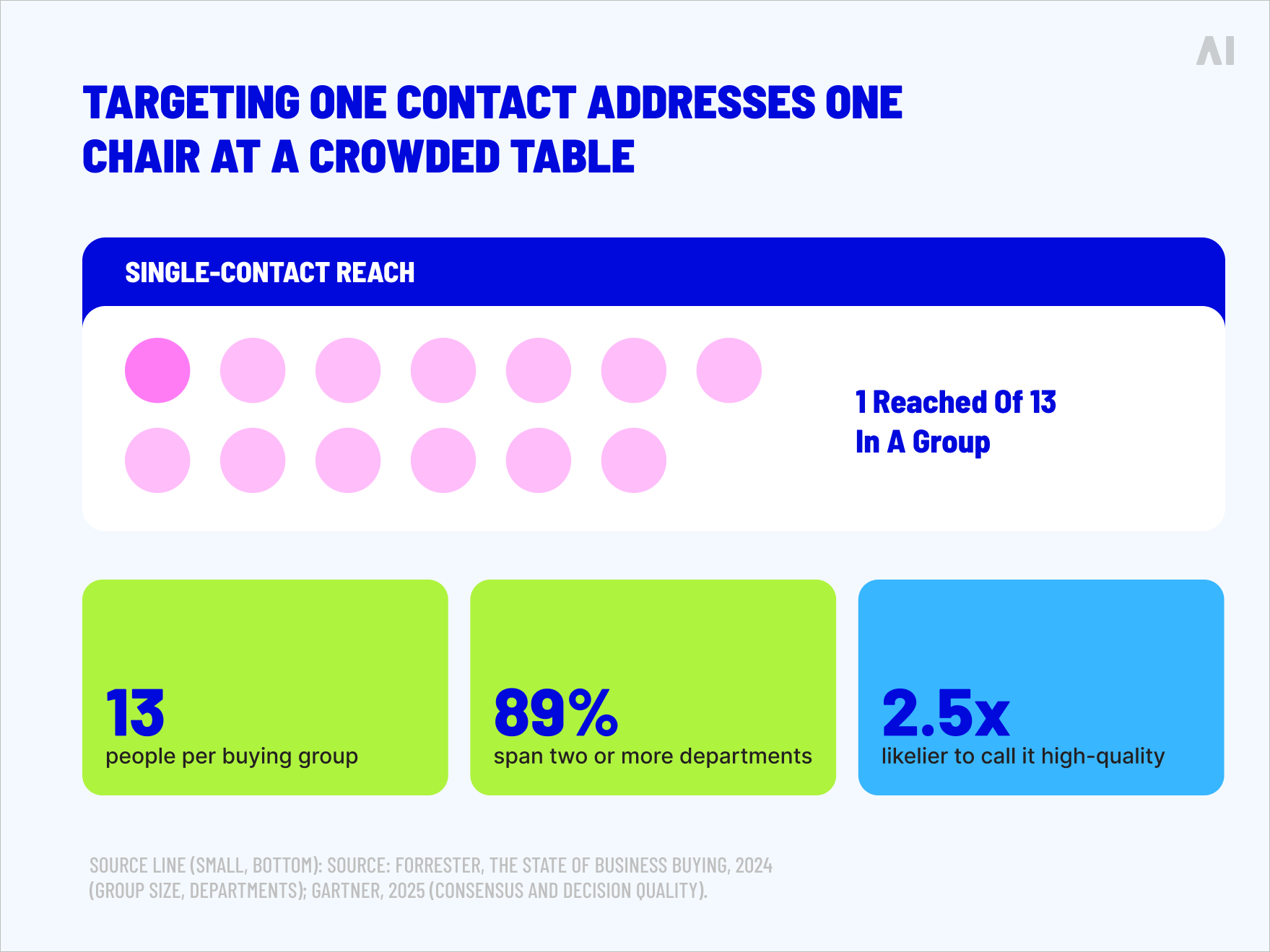
Familiarity built across that whole group is no soft ambition. Gartner finds that 74% of buying teams experience unhealthy conflict during the decision, and that groups which do reach consensus are two and a half times more likely to call the outcome a high-quality one. Establishing a brand across the committee in parallel, before internal disagreement has time to set, attacks one of the primary causes of stalled enterprise deals: institutional indecision. Broad recognition across an authenticated cohort shortens the distance to agreement.
A scoreboard that fits the medium
All of which exposes how poorly the usual metrics fit. Judging large-screen video by immediate click-through or form-fill rates is a category error that quietly undervalues everything happening at the top of the funnel. The behavior of the buying group makes the case plainly: most committees have effectively chosen a vendor before a salesperson is ever contacted, and buyers spend only a sliver of their time in front of suppliers at all.

If the decision is largely made in absentia, upper-funnel video does its real work on the shortlist long before anyone fills in a form. That argues for a different scoreboard—downstream search lift, direct traffic, the close rate within targeted accounts, the velocity of the pipeline they feed. Read that way, the premium attached to streaming inventory looks less like an indulgence and more like a cost with a traceable return.
Closing thoughts
Strip away the announcement and a plain argument remains. Follow the professional across screens, because they never really log off. Insist that execution flow through unified, transparent workflows rather than a patchwork of platforms each taking a margin. And grade upper-funnel video on its capacity to align a buying committee and move a deal, rather than on the reflexes it triggers in the first few seconds. The alliance invents none of this; what it removes is a long-standing excuse for ignoring it.
The harder work is operational—choosing inventory, holding supply paths to account, and reading the results against business outcomes rather than media vanity. That is the conversation AI Digital is glad to have with any team weighing what the alliance means for their own funnel.