Blockchain in advertising: how it can improve transparency and trust


Blockchain in advertising has been proposed, piloted and shelved more times than most marketing technologies get a chance to fail. It keeps returning because the underlying problem never went away. Buyers still struggle to trace a dollar from insertion order to impression, and the sums involved have grown. US digital advertising revenue reached $294.6 billion in 2025, according to the IAB and PwC, with programmatic advertising rising 20.5% year over year to $162.4 billion.
Money at that scale, moving through that many hands, creates a verification problem no single participant can fix alone. This article covers the mechanics of blockchain technology as applied to advertising, the use cases with substance behind them, the hard limits, the current implementations worth studying, and a framework for deciding whether blockchain for advertising answers a problem you already have.
TL;DR: Blockchain in advertising
- Blockchain gives participating organizations a shared transaction record that is difficult to alter after the fact, which is a coordination tool rather than a truth machine.
- The strongest applications involve transparency, verification records, data provenance and settlement, not fraud elimination or attribution.
- Recording data on a ledger does nothing to make that data accurate. Every verification signal still originates in off-chain systems.
- Value depends on multiple independent parties participating in a compatible system, which is the hardest part of any implementation.
- Existing tools, including industry transparency standards and log-level data reconciliation, already solve much of the problem more cheaply.
- Blockchain earns its place only when several parties need a shared, auditable record and no trusted central source of truth exists.
What is blockchain in advertising?
Blockchain in advertising means using distributed ledger technology to record, verify or coordinate transactions and data between participants in the advertising ecosystem. Advertisers, agencies, exchanges, publishers and verification vendors reference a common set of entries rather than reconciling separate private databases after the fact.
- None of this requires cryptocurrency. A ledger can record impression counts, contract terms, consent events or settlement instructions without any token changing hands. Some implementations use tokens; the technology does not demand it.
- Nor does it require a public blockchain. Many enterprise applications run on permissioned systems where participation is controlled and data visibility is restricted to approved parties. In advertising, where pricing terms and audience data are commercially sensitive, that distinction usually decides whether an implementation is viable at all.
What blockchain adds to programmatic advertising is a shared reference point: a record that multiple parties can consult and that resists retrospective editing. Whether the information written into that record was ever accurate is a separate question, and the technology leaves it untouched.
⚡ A ledger changes who can see a record and how easily it can be altered later. It changes nothing about whether the record was accurate when it was written.
Why digital advertising has a trust problem
Digital advertising struggles with trust because of how it is built. A media buy passes through demand-side platforms, exchanges, supply-side platforms, resellers, verification vendors and publishers, and every one of those systems keeps its own count, under its own definitions, with no obligation to agree with anyone else's.
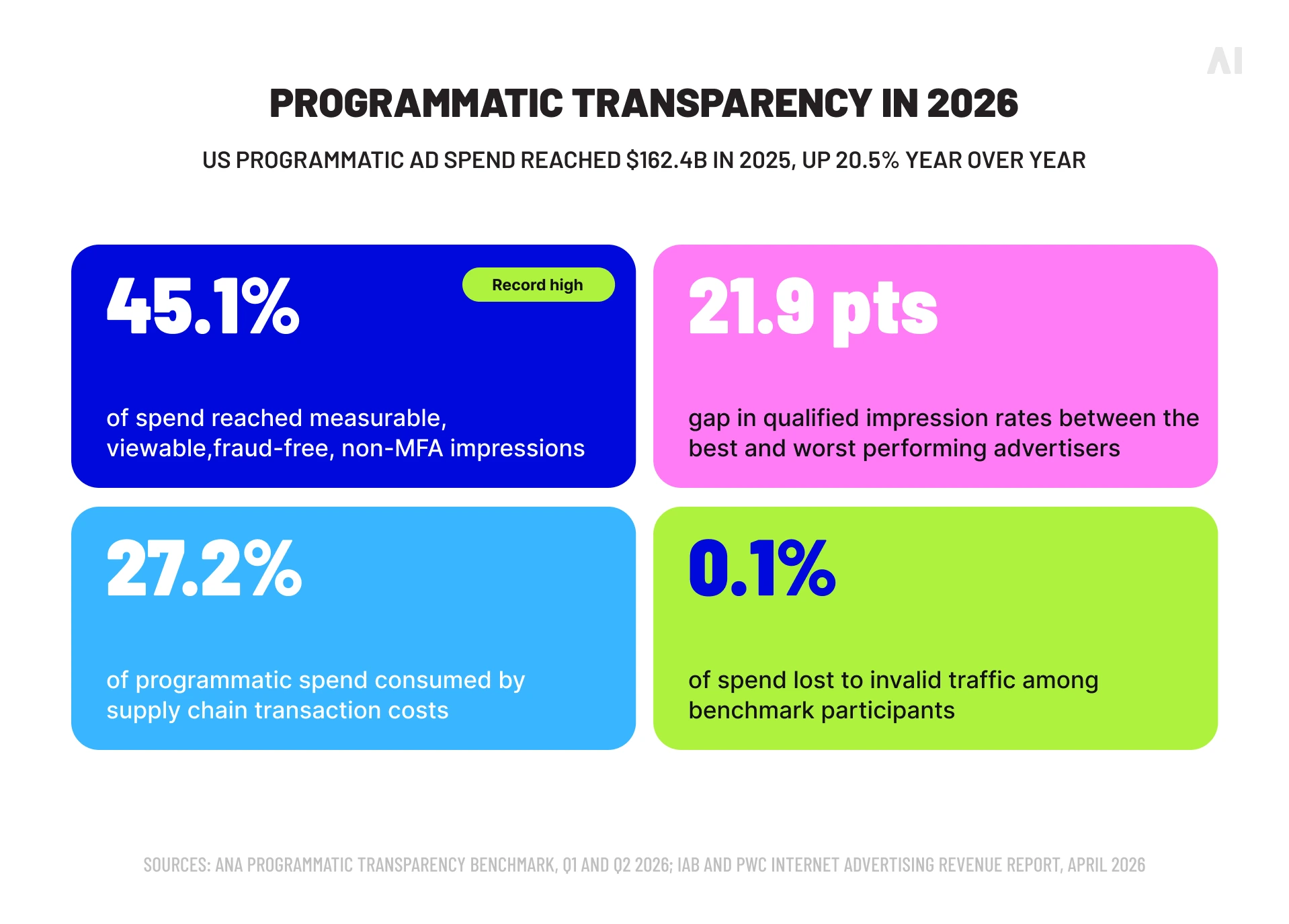
The industry has clawed back some ground. The Association of National Advertisers reported in its Q2 2026 Programmatic Transparency Benchmark that working-media efficiency reached a record high, with 45.1% of programmatic investment reaching measurable, viewable, fraud-free and non-MFA impressions, up from 43.3% the previous quarter. That is the best result the benchmark has recorded. It also means more than half of programmatic spend still fails to land on an impression that meets basic quality criteria.
💡 For a fuller treatment of how fragmentation undermines accountability, see our analysis of digital advertising transparency in a fragmented ecosystem.
Fragmented and opaque supply chains
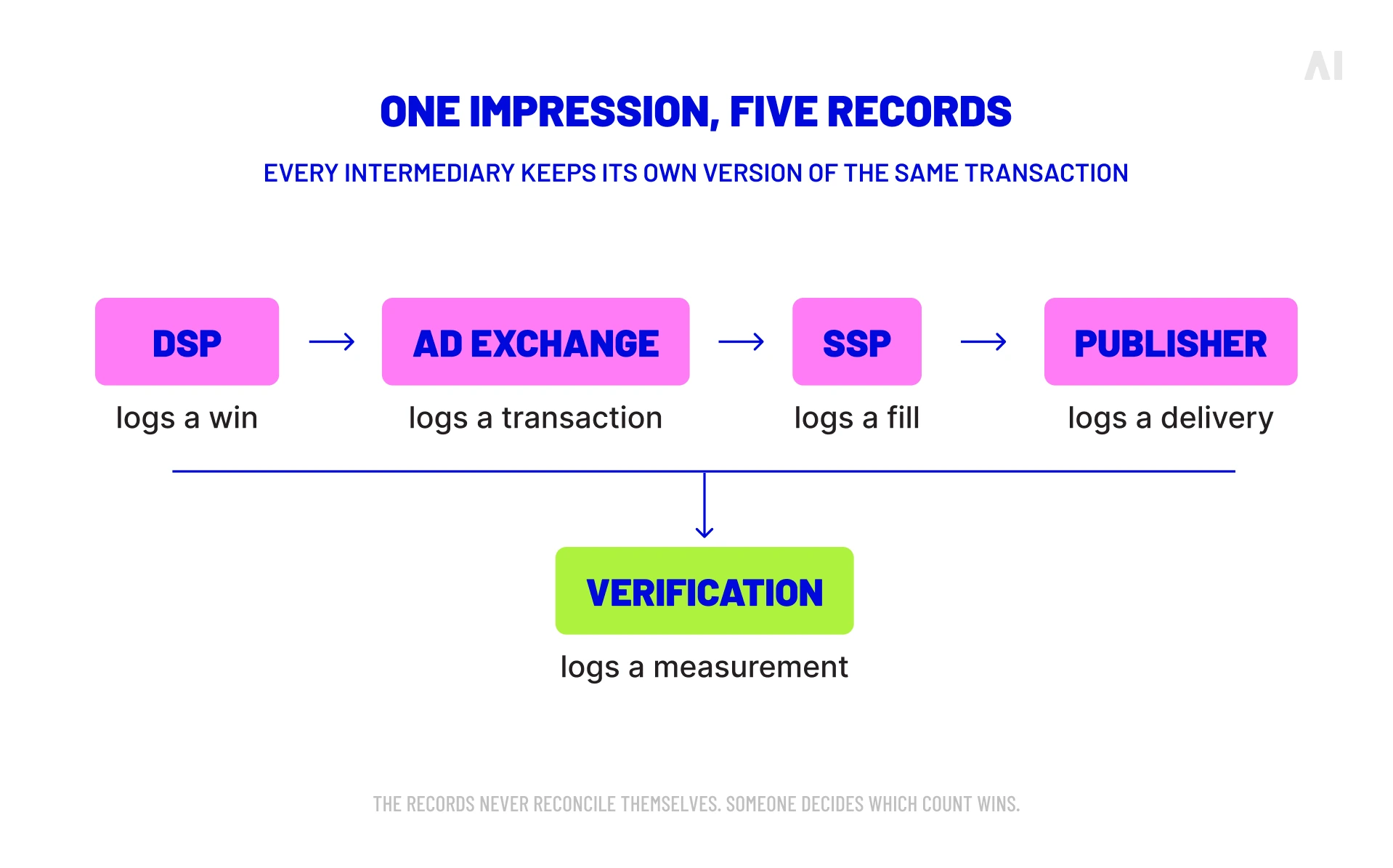
A single impression can generate half a dozen records.
- The DSP logs a win.
- The exchange logs a transaction.
- The SSP logs a fill.
- The publisher logs a delivery.
- The verification vendor logs a measurement event.
Each record is technically correct within its own system and none of them reconcile automatically with the others.
How much that costs depends on who you are. The ANA's Q1 2026 benchmark found that higher-performing advertisers converted 54.0% of programmatic spend into qualified impressions while lower performers converted 32.1%, a 21.9-point spread and the widest the benchmark has recorded. Two advertisers buying the same inventory through the same channels can end up with radically different outcomes based on how well they can see what they bought.
Those parallel records eventually collide, usually at reconciliation. When the DSP reports one impression count and the publisher reports another, someone decides which record wins, and that decision tends to go to whoever holds more leverage in the relationship. Advertisers frequently lack the log-level data to adjudicate at all.
Fragmentation extends beyond delivery numbers into identity, consent and measurement records, each held under different retention rules. The instinct to solve this by putting everything on a shared ledger runs immediately into a problem: consumer data does not belong on a blockchain, and treating a ledger as a place to park identity records creates legal exposure rather than clarity. The reconciliation problem and the personal data problem need different solutions.
💡 Our breakdown of how the digital advertising supply chain works maps these relationships in detail.
Invalid traffic and verification gaps
Ad fraud compounds the reporting problem because the advertiser depends on intermediaries to report on the quality of inventory those same intermediaries sold. The incentives are not aligned, and the data is not independent.
Blockchain proponents position this as the technology's flagship use case, which requires collapsing two distinct problems into one.
- The first is whether a transaction record can be trusted not to change after it is written.
- The second is whether the event described in that record ever happened as described.
Distributed ledgers address the first problem well. They do not address the second at all. An impression served to a bot, recorded faithfully on a blockchain, becomes a permanent and tamper-resistant record of a fraudulent impression. The ledger cannot inspect the device, evaluate the traffic pattern or determine whether a human was present. Those judgments require ad verification systems that sit entirely off-chain, and the ledger accepts whatever those systems report.
How blockchain works in the advertising ecosystem
Consider a concrete transaction. An advertiser buys a display impression through a DSP. The bid passes to an exchange, which routes it through an SSP, which fills it from a publisher's inventory. A verification vendor measures viewability. Five parties, one impression, five records.
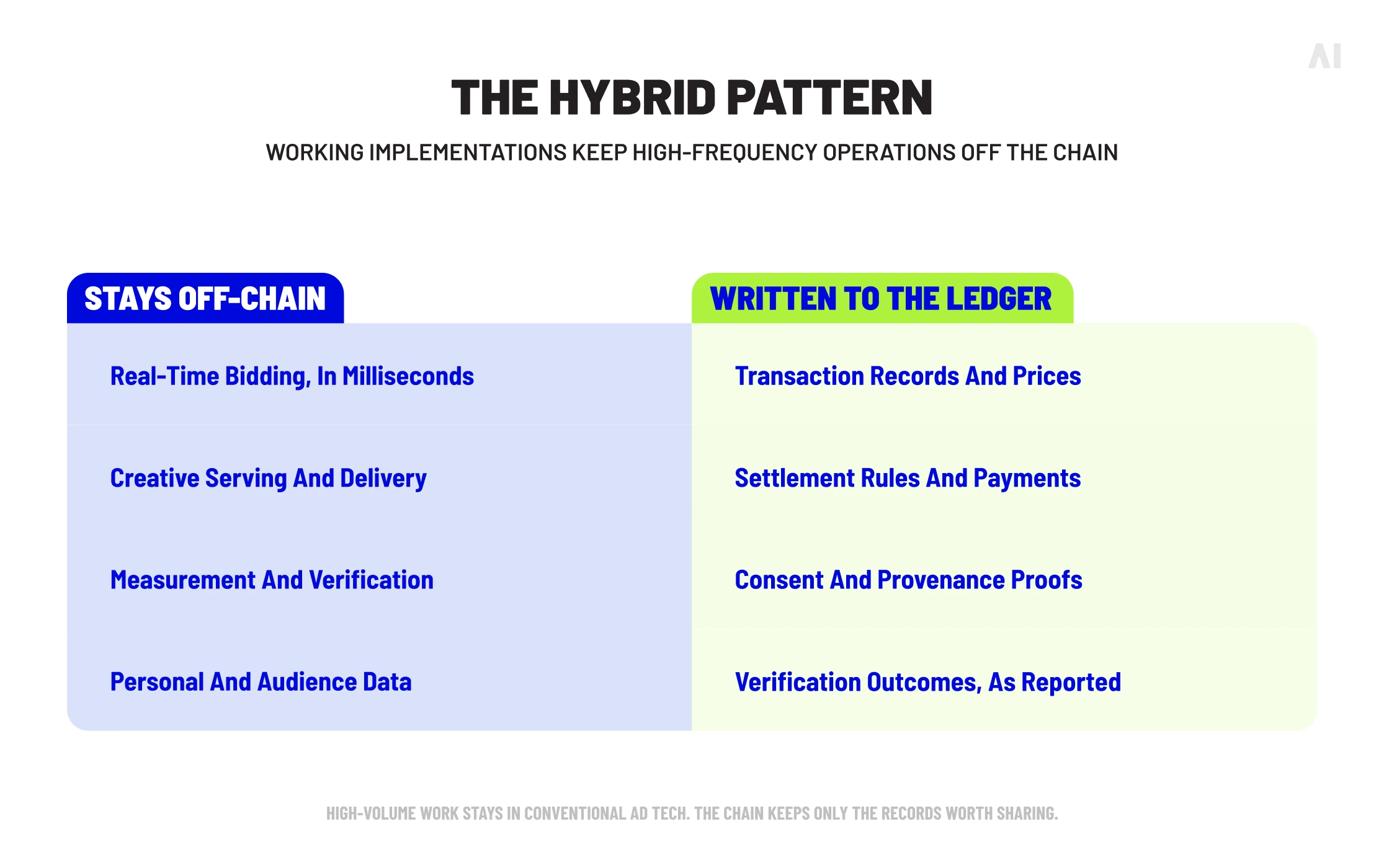
In a blockchain implementation, some subset of that activity is written to a ledger all five parties can reference: the transaction identifier, the price, the parties involved, the timestamp, possibly the verification outcome.
What cannot be written to the ledger is the judgment itself. Whether the impression was viewable, whether the traffic was valid, whether the user was real, all of that arrives from systems the blockchain does not control and cannot audit. The ledger records conclusions. It does not reach them.
Shared and tamper-resistant records
The practical benefit is a common history. Instead of five disconnected logs reconciled by email three weeks after the campaign ends, participants reference entries they have all agreed to, written as the campaign runs.
Cryptographic validation makes those entries difficult to alter retrospectively. If a party later disputes a transaction, the record of what was agreed at the time survives, and discrepancies between the shared record and a participant's internal reporting become visible rather than deniable.
One boundary line runs through everything else in this article. Immutability protects a record after it is written. It says nothing about the record's accuracy at the moment of writing. Garbage entered into a blockchain becomes permanent, verifiable garbage.
Smart contracts and automated transactions
Smart contracts extend the shared ledger from record-keeping into execution. Code holds a predefined rule, the rule executes when specified conditions are met, and no party has to initiate the action manually. Release payment when verified impressions reach an agreed threshold. Trigger a rebate when viewability falls below a contracted floor. Settle a publisher invoice on delivery confirmation rather than on net-60 terms.
The mechanism is genuinely useful for reducing reconciliation friction and payment disputes. It carries the same dependency as everything else in this architecture. Smart contracts execute on inputs supplied by ad servers, measurement platforms, verification vendors and APIs. Automating a rule guarantees the rule runs consistently. It provides no assurance that the input triggering it was correct.
Smart contracts also are not mandatory. Several blockchain advertising implementations use a shared ledger purely for recording and auditability, with settlement handled through conventional finance. The two capabilities are separable.
Public vs. permissioned blockchain models
Choosing between a public and a permissioned architecture settles most of the practical questions before anyone writes a line of code. Public networks are open to any participant and visible to everyone. Permissioned systems restrict who can join, who can validate and who can read which records. Advertising applications weigh these differently depending on what needs protecting:
- Transparency: public networks maximize external auditability; permissioned systems limit visibility to approved parties.
- Commercial confidentiality: pricing, margins and audience data are competitive assets that most buyers and sellers will not publish openly.
- Performance: permissioned systems typically offer higher throughput and faster confirmation because they involve fewer validators.
- Governance: permissioned networks need an agreed operator or consortium, which is a commercial negotiation rather than a technical one.
- Regulatory posture: European data protection authorities have expressed a clear preference for permissioned architectures, covered in more detail below.
Key use cases of blockchain in advertising
Strip away the speculative applications and four remain, each dependent on conditions that have to be true before the technology delivers anything. Those conditions, rather than the technology, are where most implementations stall.
Supply chain transparency and spend traceability
A shared record of media transactions lets buyers, intermediaries and sellers trace how spend moved between them. Discrepancies surface during the campaign rather than during an audit six months later, and the record of who took what is available to every participant rather than to whichever party controls the reporting.
This is the use case most often oversold. Blockchain does not remove intermediaries from the supply chain, and it does not guarantee lower media costs. Recording a fee makes it visible; it does not make it smaller.
The ANA's Q1 2026 data suggests the fee argument targets the wrong problem entirely. Transaction costs differed by just 2.4 percentage points between the highest and lowest performing advertisers, while media productivity losses differed by 19.4 percentage points. The gap between good and bad programmatic outcomes is overwhelmingly about inventory quality, not intermediary margin. A technology sold primarily on fee reduction addresses the smaller of the two variables.
Ad verification records and fraud auditability
Cryptographically verifiable records support auditability. A consistent, shared record of transactions and verification events makes later manipulation easier to detect and gives disputing parties something to point at. Where a discrepancy exists between what a buyer paid for and what a seller delivered, the shared record narrows the argument.
That narrows disputes between counterparties, which is a genuine service to trust. Detecting fraud is a different job entirely. Blockchain cannot independently determine whether an impression, device, user, publisher or input signal was genuine, and every claim to the contrary rests on confusing record integrity with event verification. Reliable fraud prevention still depends on measurement, verification and identity systems operating off-chain.
The evidence suggests those off-chain systems are performing. The ANA's Q2 2026 benchmark found spend lost to invalid traffic holding at 0.1%. Among advertisers running disciplined log-level reconciliation, invalid traffic has been reduced to a rounding error by conventional means. An article arguing that blockchain is needed to solve ad fraud would be arguing against the current data.
A shared event record does offer something to measurement teams. When participating systems agree on which interactions were recorded, downstream attribution models receive cleaner inputs and reconciliation discrepancies narrow. The ledger contributes better raw material. It does not determine causal contribution, resolve cross-device identity or measure incrementality, all of which remain modeling problems that no amount of record integrity solves.
⚡ Cleaner inputs are worth having. They are not the same thing as answers, and a shared ledger supplies the first without touching the second.
Data provenance, consent, and privacy
Blockchain-based systems can record proofs that data was collected under specified permissions, that a consent event occurred at a given time, or that a dataset originated from a particular source, while the underlying personal information stays off-chain. Cryptographic proofs and hashed references do the attestation work without exposing the data itself.
Recording a consent event on a ledger does not make that consent legally valid. Validity depends on how consent was obtained, what the user was told and whether the processing falls within the stated purpose. A timestamp proves when something was recorded, not that it was lawful.
A second warning sits alongside that one: immutable storage of personal data is a liability rather than a privacy feature. The European Data Protection Board adopted the final version of its Guidelines 02/2025 on processing personal data through blockchain technologies on 7 July 2026. The guidance encourages organizations to favor permissioned architectures and to document their reasoning if they choose a more decentralized model. It also treats both transaction metadata and content data as personal data in principle, a category that may extend to encrypted and hashed data. Advertisers building consent infrastructure on a public ledger should read that carefully and take specialist advice on their own jurisdiction.
Payments and settlement
Media payments run on long cycles, manual reconciliation and disputed invoices. A shared record of what was delivered removes much of the argument, and smart contracts can automate settlement once delivery is confirmed, releasing publisher payment in days rather than months.
None of this involves cryptocurrency speculation or crypto-sector advertising, both of which have muddied the conversation for years. This is treasury operations, not trading.
There is meaningful headroom here. The ANA's Q2 2026 benchmark put transaction costs at 27.2% of programmatic spend, rising even as impression quality improved. Much of that represents genuine services rendered and is not recoverable through better settlement infrastructure. But reconciliation labor, payment float and dispute resolution all sit inside the figure, and all are addressable through shared records.
Blockchain advertising examples and industry initiatives
Three current implementations show distinct applications: an on-chain exchange, a consumer rewards model in transition, and an enterprise ledger built by a manufacturer.
Alkimi Exchange: on-chain programmatic transactions
Alkimi operates a programmatic exchange with transaction records and settlement on the Sui network, having migrated from its earlier infrastructure. The architecture, described in a joint announcement with Sui, splits responsibilities across several components:
- Sui coordinates transactions between advertisers and publishers,
- Walrus handles data storage at scale,
- Nautilus validates impressions and runs reconciliation logic inside trusted execution environments, and
- Seal encrypts access to impression data and metadata.
That split, more than the fee schedule, is what a marketer should take from the example. The chain handles coordination and settlement, impression validation happens in secure hardware enclaves rather than on-chain, and commercially sensitive data is encrypted rather than published. The company states a published fee model of 3% of ad spend on display, 5% on video and 8% on connected TV, and claims volume of more than 25 million impressions per day. Alkimi and Sui have named brands including AWS, TikTok, Currys and Polestar as engaging with the platform.
Everything downstream of the ledger remains conventional ad tech: creative serves through standard infrastructure, inventory comes from ordinary publishers, and the measurement stack looks like any other exchange's.
Brave Ads and BAT: token-based advertising and user rewards
Brave built the best-known consumer application of blockchain advertising: an opt-in model where users receive Basic Attention Token in exchange for attention to privacy-preserving ads, with matching performed on the user's device rather than on a server. The browser reports over 120 million users and more than two million verified websites and creators.
The model is now changing substantially. Brave's BAT Roadmap 4.0, published on 9 July 2026, states that the Brave Ads notification unit will begin a gradual sunset by the end of 2026. Notifications will increasingly surface offers from participating brands through a Rewards Offer Wall rather than functioning as ad units, and rewards will extend toward purchases, wallet activity and loyalty through a stablecoin protocol and a payment card.
Anyone reading Brave as a blockchain case study should hold onto a couple of details the coverage tends to blur.
- Individual ad impressions were never written to a public blockchain.
- The token operates in the rewards and payments layer while ad delivery runs on conventional infrastructure.
- The retreat from attention-based token rewards toward transactional utility is itself evidence about how hard the original model proved to sustain.
LG Electronics and Arbitrum: an enterprise ledger for ad inventory
LG Electronics is building a blockchain network for advertising, reported by Fortune in June 2026. Working with Arbitrum, the company built its own layer-2 network allowing transactions to be batched cheaply. The platform gives advertisers and publishers a shared database of ad inventory and records how consumers interacted with the ads. LG piloted the project with a Japanese agency it declined to name and said it would evaluate a commercial launch later in the year.
Here the pattern is enterprise rather than token: a single large participant building shared infrastructure it expects partners to join, with nothing for consumers to hold or trade. It is also still pre-commercial, which is the honest status of most serious blockchain for advertising work.
Arbitrum cofounder Steven Goldfeder offered the appropriate caveat in the same report, observing that when companies ask whether they should launch a blockchain, the answer for most of them is no.
Limitations and challenges of blockchain in advertising
Blockchain improves trust between participants only when the underlying data, integrations, governance and incentives are already sound. Four constraints have kept adoption limited, and none of them is close to resolved.
Blockchain cannot verify bad input data
Hard to alter and true are different properties, and the space between them accounts for most of what blockchain cannot do:
- Ledgers accept what they are given. Cryptographic validation confirms an entry has not changed, never that it was correct.
- Every advertising signal originates off-chain. Impression counts come from ad servers, quality judgments from verification vendors, conversions from analytics platforms.
- The oracle problem is unsolved in practice. Whoever supplies data to the chain becomes the party you have to trust, which reintroduces the dependency the architecture was meant to remove.
- Permanence cuts both ways. An error written to a ledger is durable, auditable and extremely awkward to correct.
Scalability, latency, and cost
Programmatic auctions resolve in tens of milliseconds and run at volumes measured in millions of requests per second. Blockchain architecture has to be evaluated against those numbers rather than against a general impression of throughput: confirmation times, storage costs, transaction fees and operational overhead all scale with volume in ways that break naive designs immediately.
No serious implementation puts every auction decision or full advertising payload on-chain in real time. The workable pattern is hybrid, as the Alkimi architecture illustrates, with high-frequency operations running off-chain and the ledger reserved for records that benefit from being shared and durable. Ask any vendor exactly which operations touch the chain, at what frequency, and what the cost curve looks like at your spend level.
Privacy and regulatory constraints
Immutability sits in direct tension with data protection law. Rights to correction and erasure assume that records can be corrected and erased, which is precisely what a well-designed ledger prevents.
The EDPB guidance addresses this directly, and its practical instruction is that personal data should not be stored on-chain, with a data protection impact assessment expected before deployment. The final version did soften one point from the consultation draft, indicating that nodes performing purely technical validation may fall outside the controller role where they do not determine purposes or essential means. That reduces one category of exposure without changing the central constraint.
US advertisers should not read this as a European problem. State comprehensive privacy laws grant deletion rights that create the same structural conflict, and a compliance architecture built around permanence will encounter it in both jurisdictions. Requirements are jurisdiction-specific and changing; verify current obligations with counsel rather than relying on any general summary, including this one.
Integration, interoperability, and industry adoption
A shared ledger with one participant is a database with extra steps. Value materializes only when advertisers, publishers, platforms and intermediaries all join a compatible system, which requires competitors to agree on governance, data standards and cost allocation.
History offers a useful benchmark for how long coordination takes. Supply chain transparency standards including ads.txt, sellers.json and the SupplyChain object are free, technically trivial and demonstrably useful, and adoption has still taken years to approach completeness, with meaningful gaps persisting in app and connected TV environments. Those standards ask a publisher to host a text file. A blockchain implementation asks organizations to re-plumb transaction infrastructure and share operational data with commercial rivals. Coordination costs scale with what is being asked.
When does blockchain actually make sense for advertisers?
The decision reduces to a single diagnostic question: do several independent parties need a shared, auditable record, and is there no trusted central source of truth available?
- If both conditions hold, distributed ledger technology has a genuine claim.
- If either fails, a database, a contract or an existing industry standard will be faster, cheaper and easier to govern.
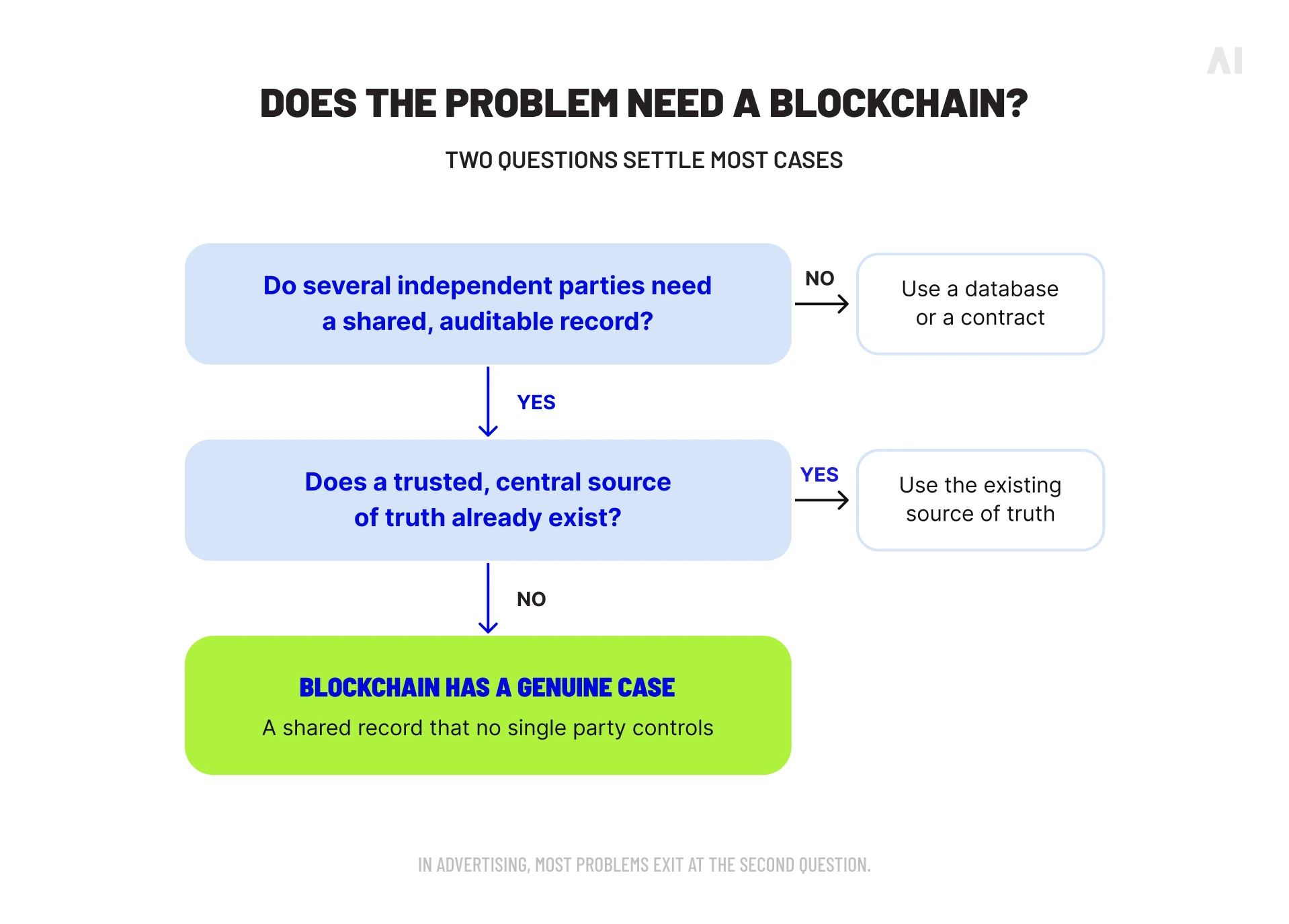
The second condition is where most cases collapse, because the advertising industry has been building trusted central sources of truth for years and they work. Consider TAG TrustNet, an industry utility launched by the Trustworthy Accountability Group with Fiducia and used to power the ANA benchmark. It matches impression-level log data from buyers, platforms and sellers against one another, resolves the differences, and maintains a single agreed record for each impression, updated close to real time.
Set that against the blockchain pitch and the overlap is almost total. A shared record spanning independent parties, covering every impression, kept current as campaigns run, and none of it requiring a ledger, a token, or a renegotiation of anyone's infrastructure.
Similar reasoning applies to spend traceability more broadly, where supply path optimization and log-level data analysis let buyers see and control their paths using tools that exist today.
The bottom row is where blockchain has an uncontested case. Everywhere else, a simpler answer already exists.
⚡ Blockchain rarely loses the argument in advertising. It loses the race, to cheaper tools that reached the finish line years earlier.
How AI Digital supports transparent programmatic advertising
Blockchain is one possible route to advertising transparency. It is not the one AI Digital has taken, and the reasoning follows directly from the analysis above: the diagnosis is shared, the infrastructure choice is different.
The problem worth solving is that buyers cannot see or control their supply paths, and depend on intermediaries whose incentives diverge from their own. Smart Supply addresses that through transparent, DSP-agnostic programmatic supply, giving advertisers visibility into the paths their spend travels and the ability to act on what they find. No ledger required, because the buyer and their supply partners do not need a trustless system; they need visibility and leverage.
The Open Garden Framework extends the same logic to orchestration. It is a vendor-neutral, DSP-agnostic operating model for coordinating platforms, inventory, data and outcomes across fragmented environments, where the neutrality is structural rather than contractual. An orchestration layer with no stake in which platform wins has no reason to obscure where the money went.
Neither product uses blockchain technology. Both target the same failure the blockchain proposition targets, which is the reason this article treats the technology seriously rather than dismissively.
Build a more transparent advertising strategy
Blockchain in digital advertising can improve trust where several parties need a shared, verifiable transaction record and no one of them can be trusted to keep it. That is a real category of problem, and it is narrower than the marketing around the technology suggests.
Whatever the underlying technology, infrastructure should serve a defined problem rather than become the strategy. Transparent supply, reliable verification, credible data governance and measurable business outcomes are what advertisers are actually buying. A ledger underneath any of it is an implementation detail, and a costly one to get wrong.
Ready to see where your media spend is going? Get in touch with AI Digital.