Kindness Is Not Weakness: What Building a Great Place to Work Actually Takes
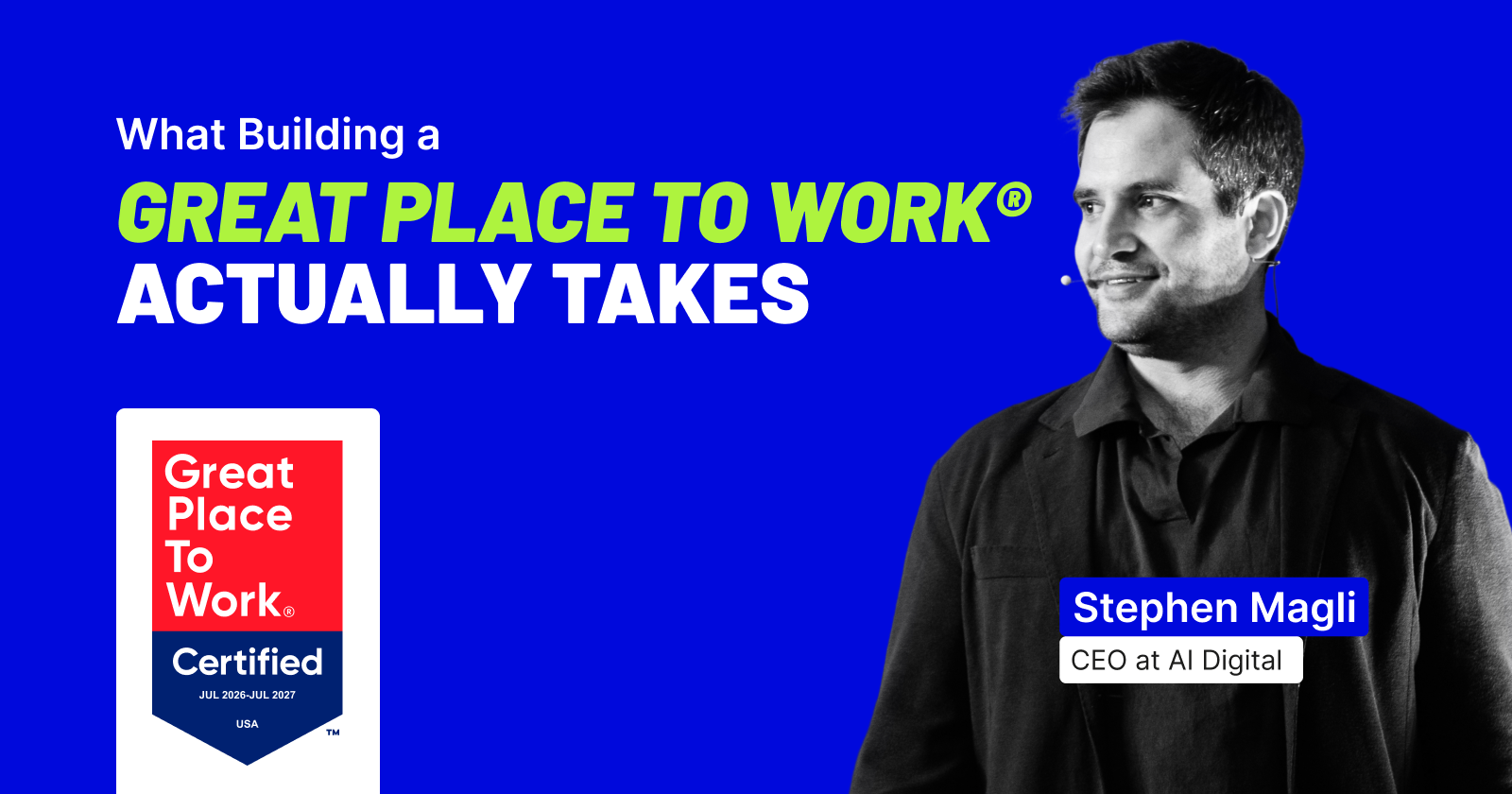
AI Digital has earned Great Place to Work certification for the second year in a row—and this time, the scores are even higher. What makes this certification especially meaningful is that leadership can't win it on their own. It's based entirely on what employees say about their own experience, across a survey that covers everything from leadership behavior and benefits to respect and innovation. There's nowhere to hide.
This year, AI Digital's US team returned a 94% overall score. Leadership behavior and engagement both came in at 95%, support and caring at 94%, and innovation and respect at 93%. Hospitality, fittingly for a company that prides itself on how it treats people, reached 97%.
No perks budget buys numbers like these. They come from a culture built deliberately over years. Eight years into AI Digital's story, a pattern is clear: the companies people love working for get a handful of things right—and keep getting them right, year after year.
Days later, the same employee feedback carried AI Digital onto the 2026 Fortune Best Small Workplaces™ list. The two honors are linked by design. Certification is the entry ticket. The Fortune list is the ranking that follows, compiled by Great Place to Work from more than 30,000 employee survey responses at certified companies.
The ranking caps off a busy year. AI Digital has grown to a global team of more than 650 specialists, presented the next era of Elevate, its AI intelligence platform, and launched its AI Creative Studio, with a new AI innovation center in Miami due to open later this year. Scaling that quickly is exactly when cultures tend to fray—and AI Digital's survey scores rose anyway.
That kind of resilience isn't something perks buy. It's built deliberately over years. Eight of them have taught AI Digital that the companies people love working for get a handful of things right and keep getting them right, year after year.
Start with kindness, and never mistake it for weakness
Most people know what it feels like to sit in a meeting with a good idea and realize nobody is going to listen. For AI Digital's CEO, Stephen, that feeling lasted for years—and it's the reason the company exists. "When I suggested improvements, the answer was, 'Go start your own company,'" he recalls. "So I did. And I promised myself that no one here would ever feel the way I felt."
A founding promise is easy to make and hard to keep, especially through the growth AI Digital has seen. The company now employs hundreds of people, and the survey suggests the promise has held: employees report feeling heard, supported, and respected. For Stephen, this outranks any commercial milestone. "What makes me proudest is that we've remained a kind company and a great place to work while we scaled," he says.
He has little patience for the assumption that a gentle culture produces a gentle competitor. "Kindness is not weakness. You could ask a few of our competitors about that one." The two things feed each other, in his experience. People who feel safe and valued compete harder, because they're competing for a place they actually care about.
Prioritize process over results
Daily habits build culture; ambitious targets rarely do. Perhaps the clearest evidence that a principle has genuinely taken root is hearing it repeated by people who never compared notes—and that's exactly what happened at AI Digital's recent all-company gathering in Barcelona, where one leader after another built their presentation around the same idea: process over results.
Stephen found the convergence telling. "I'd rather we never fixate on being 'the best' at any one thing," he explains. "I want us focused on what we can control, which is our process and the work we put in every day. That's what drives the outcome."
Anyone who has worked toward a quarterly target they couldn't control knows how draining that can be. People spend more time trying to look productive than doing their best work. Process over results removes that fear. When a missed short-term goal is acceptable because the work behind it was sound, people stop performing for a chart and put their attention back into the work itself. Taking a smart risk becomes reasonable rather than reckless. The company's horizon reinforces the point: AI Digital is building for the next ten years, not the next 365 days—and a decade is a far kinder timescale to work inside than a hockey stick.
Remember that people beat technology
AI Digital is a technology company, and its platform is central to what it sells. Ask its CEO where the advantage really sits, though, and the answer has nothing to do with the product. "Honestly, it doesn't matter what we build," Stephen says. "What makes AI Digital special is our people. They push me to be better every day. I still can't quite believe how much smarter and more talented everyone around me is."
Plenty of executives say something similar; fewer let it change how they behave. At AI Digital it shows up in small, repeated gestures: good work gets acknowledged publicly and often, because being seen is half of what makes effort feel worthwhile. And leadership stays within reach. "If anyone on the team needs anything, I really am available," Stephen says. "And I mean that literally." Open-door policies are usually decorative. A 95% score for leadership behavior suggests that here, people have actually tried the door and found it open.
Learn together, and future-proof your people
There's genuine anxiety in marketing right now, and pretending otherwise serves nobody. AI is remaking the profession quickly enough that many people wonder whether their skills will still be needed in ten years. AI Digital's leadership chooses candor over reassurance. "We're all learning and figuring it out together," Stephen says. "I say that openly, because pretending otherwise helps no one."
Candor alone would be cold comfort, so it comes with a commitment. Much of what marketers do today will be commoditized by AI within a decade, and AI Digital treats keeping its people ahead of that curve as the employer's job, not each employee's private worry. Being AI-first, in the company's definition, means using the technology to make every person better at what they do, never to pile busywork on top of them. For employees watching AI arrive with a mixture of curiosity and dread, the difference between a company that invests in them and one that plans around them is enormous—and it's hard not to see that difference reflected in the engagement scores above.
Why certification is worth pursuing
So why enter at all? Certifications can slide into vanity, and AI Digital's answer is that this one earns its keep as an accountability mechanism. Yes, it helps attract talent in a competitive hiring market. But what the company actually uses it for is listening: the survey hands the floor to employees and tells leadership, in precise terms, where things are working and where they are not.
Two consecutive certifications with rising scores carry a simple lesson. A great place to work is never declared from the top. It's reported from below, one survey response at a time, by the people who live inside the culture every day. The certificate is nice. The listening is the point.
The Fortune list adds a dimension the certification alone cannot: comparison. Certification measures a company against a fixed standard; the Best Small Workplaces ranking measures it against every other certified employer of its size in the country, on the same 60-question employee survey. For a leadership team that talks about process over results, an outside benchmark of that kind is a useful check. It confirms that the process is producing something people elsewhere would recognize as unusual, and it sets next year's bar in plain sight.
Whatever that bar turns out to be, the way to clear it will not change. A great place to work is never declared from the top. It's reported from below, one survey response at a time, by the people who live inside the culture every day. The certificate is nice. The listening is the point.