The television advertising landscape for 2026 is defined by a powerful convergence of pressure and opportunity. Marketers are caught between the need for massive, brand-building reach and the relentless demand for measurable, cost-efficient performance. As Connected TV (CTV) ad spending soars—projected to reach $32.57 billion in 2026 and on track to surpass traditional TV spending by 2028—the rules of engagement are being rewritten. Streaming now commands basically half of all U.S. TV viewing time, yet the ecosystem grows more fragmented and complex by the day.
In this high-stakes environment, budgets are under unprecedented scrutiny. A significant 70% of CTV advertisers plan to increase their streaming budgets in 2026, with an average rise of 17%, but this growth often comes from reallocating funds away from linear TV, digital display, and social media. The pressure to "do more with less" is acute, leading savvy growth marketers and performance teams to re-evaluate every lever in their media mix.
For the performance-driven marketer, it presents a tantalising proposition—access to the premium TV screen at a fraction of the upfront cost. Yet, this opportunity is shrouded in misconception.
💡Many still equate "remnant" with "low-quality," a lingering association from the digital display era that industry experts argue is fundamentally flawed in today's TV landscape. The reality is far more nuanced. Remnant is a strategic tool with defined benefits, tangible risks, and specific use cases.
⚡️This article addresses a central planning question for 2026: Is remnant TV a smart media buying option, and for whom does it make sense? It provides a clear framework for understanding how remnant TV advertising works, outlines its benefits and limitations, compares it with premium and upfront media buying models, and offers practical guidance for incorporating remnant inventory into modern TV planning and media buying strategies.
What is remnant TV inventory?
Remnant TV inventory consists of television ad slots that remain unsold after upfront and scatter buying commitments are completed. These placements can exist across both linear TV and connected TV (CTV) environments, including ad-supported streaming platforms. Instead of allowing this inventory to go unused, broadcasters and publishers make it available through remnant TV advertising, typically closer to airtime and at lower rates than premium placements.
Remnant inventory is a structural outcome of how TV advertising markets operate. During the upfronts, networks sell high-demand inventory months in advance, then adjust supply through scatter buying as viewership patterns shift. When actual demand does not fully match forecasts, remaining ad slots move into the remnant pool. EMarketer estimates indicate that approximately 10–20% of linear TV inventory can remain unsold in a typical quarter, with availability varying by season, network, and economic conditions. In CTV environments, unsold inventory also emerges as platforms scale faster than advertiser demand can absorb.
From a media buying perspective, remnant TV advertising differs fundamentally from traditional premium buying models. Premium inventory is purchased with advance scheduling, negotiated delivery expectations, and greater certainty around placement and audience reach. Remnant ads are typically sold without guaranteed placement, fixed program context, or consistent delivery volumes, which introduces volatility into campaign execution and measurement.
Because of these characteristics, remnant advertising has historically been used for direct-response–oriented objectives rather than brand-led campaigns. Lower CPMs can support efficient reach or frequency extension, especially as premium TV CPMs continue to rise, but the lack of guarantees limits suitability for launches or tightly controlled brand environments.
💡As CTV advertising continues to expand, remnant inventory now plays a role across both linear and streaming ecosystems. U.S. CTV ad spend is projected to exceed $40 billion annually in the mid-2020s, increasing the volume of inventory that can enter remnant channels when demand fluctuates.
How remnant differs in linear vs. CTV
The way remnant inventory behaves varies significantly between linear TV and connected TV (CTV). While both involve unsold ad slots, the buying mechanics, delivery predictability, and measurement standards differ in ways that materially affect media buying decisions. The table below summarizes the key differences marketers should consider when evaluating remnant TV advertising across environments.
{{Should-You-Buy-Remnant-TV-in-2026-1="/tables"}}
⚡️Understanding these differences CTV vs Linear TV is critical for modern TV planning. Linear remnant inventory emphasizes cost efficiency at the expense of control, while CTV remnant inventory introduces more data and targeting flexibility but still carries delivery variability. Evaluating these trade-offs helps marketers determine where remnant ads can add value within a broader TV advertising and media buying strategy.
Why remnant inventory exists
Remnant inventory exists because TV advertising supply and demand rarely align perfectly in real time. Networks must lock in large portions of inventory months in advance during the upfronts, then rebalance through scatter buying as ratings, seasonality, and advertiser demand evolve. When actual demand falls short of projections, unsold ad slots remain and those slots become remnant TV inventory.

For networks and streaming platforms, remnant inventory is a direct result of monetization pressure. TV inventory is time-bound: once a program airs, unused impressions lose all value. Sales teams therefore prioritize monetizing leftover supply, even at discounted rates, rather than letting it expire. Industry data indicates that roughly 10–20% of linear TV inventory can remain unsold in an average quarter, with higher percentages during low-demand seasons or periods of economic uncertainty. Forecasting tools and audience modeling reduce waste, but they cannot eliminate it.

For advertisers, remnant inventory exists because budgets and planning cycles are uneven. Marketing teams frequently need to activate campaigns quickly, add incremental reach, or adjust spend late in the quarter. Remnant TV advertising offers lower CPMs and faster activation compared to premium media buying, making it appealing for tactical needs rather than long-term commitments. As premium and upfront TV CPMs continue to rise, the demand for flexible, lower-cost options has increased.
Data-driven buying has changed remnant behavior—but not removed it. The dashboards and delivery systems shown in CTV environments illustrate how automated pacing and targeting improve efficiency, yet they also create new sources of remnant supply. In streaming, inventory can become available when audience growth outpaces advertiser demand, when campaigns underdeliver, or when pacing algorithms slow spend. With U.S. CTV ad spend projected to exceed $40 billion annually, the absolute volume of inventory entering remnant channels continues to grow alongside the market.

Demand cycles ultimately determine when remnant inventory is most available. Off-peak quarters, post-holiday slowdowns, and macroeconomic pullbacks increase unsold supply, while election years, major live events, and strong economic periods reduce it.
💡This cyclical pattern—visible in both linear schedules and CTV inventory systems—is why remnant advertising remains a permanent feature of TV advertising, not a temporary inefficiency.
⚡️Understanding these mechanics helps marketers evaluate when remnant inventory reflects a genuine buying opportunity—and when it signals broader shifts in market demand that require more cautious media planning.
Key advantages of remnant TV advertising
Remnant TV advertising offers a distinct set of advantages for marketers who prioritize efficiency, speed, and tactical flexibility. While it is not a substitute for premium or upfront media buying, remnant inventory can play a valuable supporting role in modern TV advertising strategies—particularly under budget pressure or tight timelines. Below are the core benefits marketers should evaluate when considering remnant ads in 2026 planning.
Lower cost and efficient CPMs
Lower CPMs are the primary driver of demand for remnant TV advertising. Because remnant inventory consists of unsold ad slots, it is typically priced below premium inventory secured through upfront commitments. In many markets, remnant CPMs can be 30–60% lower than premium linear TV rates, depending on timing, demand cycles, and available supply.
💡This cost efficiency allows advertisers to extend reach, increase frequency, or maintain TV presence when budgets are constrained.
⚡️For performance-oriented teams, lower CPMs can improve cost-per-outcome metrics when remnant inventory is used for incremental exposure rather than primary delivery. For a deeper understanding of how CPMs function across TV buying models, see What is CPM in TV Advertising.
Flexibility and speed to market
Remnant advertising enables faster activation than traditional TV media buying. Unlike upfront deals that require long lead times and fixed commitments, remnant inventory can often be purchased and deployed within days—or even hours—of airtime. This makes it particularly useful for:
- Late-stage budget reallocations
- Short-term promotions or seasonal pushes
- Reactive campaigns tied to market or competitive changes
This flexibility is especially relevant in 2026, as marketing teams increasingly need to respond quickly to performance data and shifting priorities across channels.
Occasional access to premium slots
Remnant inventory can sometimes include placements within premium programming. When forecasted demand for high-quality content does not fully materialize, unsold ad slots may appear in environments that would normally command premium pricing. While access to these placements is inconsistent and cannot be guaranteed, remnant TV advertising can occasionally deliver exposure alongside high-value content at a reduced cost.
This dynamic can be advantageous for advertisers seeking opportunistic reach within strong programming without committing to long-term premium buys.
Ideal for testing audiences and creative variations
Remnant TV advertising is well suited for controlled testing. Lower costs and shorter commitments allow marketers to experiment with:
- New audience segments
- Different creative formats or messaging
- Regional or daypart-specific strategies
💡In both linear TV and CTV environments, remnant ads can provide directional performance insights before budgets are scaled into premium inventory. This makes remnant inventory a practical testing layer within data-informed media buying frameworks.
Useful for filling gaps in a media mix
Remnant inventory is often used to smooth delivery gaps within a broader TV plan. Campaigns may underdeliver due to pacing issues, reach ceilings, or scheduling constraints in premium buys. In these cases, remnant TV advertising can supplement existing plans by adding incremental impressions without renegotiating core commitments.
Used this way, remnant ads function as a tactical support mechanism, enhancing continuity and efficiency rather than replacing structured TV planning.
The drawbacks
Remnant TV advertising comes with structural limitations that can materially affect performance if it is treated as a primary buying strategy. While lower costs are appealing, the trade-offs around scale, predictability, and control are significant and must be understood in advance.
{{Should-You-Buy-Remnant-TV-in-2026-2="/tables"}}
For these reasons, remnant TV advertising works best as a tactical layer not as the foundation of a TV strategy.
When remnant makes sense
Remnant TV advertising is most effective when used intentionally, with clear constraints and clearly defined success metrics. In the right scenarios, it can complement premium and upfront buys without introducing undue risk.
Remnant inventory is often a strong fit in the following real-world situations:
- Direct-response or performance-driven campaigns
When KPIs are tied to efficiency rather than guaranteed reach, lower CPMs can support cost-effective exposure without requiring premium placement control.
- Advertisers with small, variable, or inconsistent budgets
Remnant TV allows brands to stay present on television without long-term commitments or large upfront investments.
- Time-sensitive or reactive promotions
Campaigns tied to short windows—such as seasonal offers, regional launches, or competitive responses—benefit from the speed and flexibility of remnant activation.
- Late-year “use it or lose it” budgets
When remaining funds must be deployed quickly, remnant advertising can absorb spend without reopening or renegotiating upfront agreements.
- Early-stage testing in new markets or regions
Remnant ads provide a lower-risk way to assess audience response before scaling into premium inventory.
- Campaigns where reach is not the primary KPI
When success is measured by efficiency, frequency support, or directional learning rather than maximum reach, remnant inventory can play a supporting role.
⚡️In all of these cases, success depends on aligning remnant usage with the right digital marketing KPIs and expectations. For guidance on selecting and prioritizing performance metrics across channels, see our overview of Digital Marketing KPIs.
💡When remnant TV advertising is matched to the right objective, it can improve efficiency and flexibility without undermining overall TV planning. When it is mismatched, its limitations tend to surface quickly.
Remnant vs. Scatter vs. Upfront
Understanding the differences between remnant, scatter, and upfront buying is critical for effective TV planning and media buying in 2026. Each model serves a different purpose, offers a different level of control, and carries distinct trade-offs in cost, flexibility, and predictability. The table below provides a clear comparison framework to support informed decision-making.
{{Should-You-Buy-Remnant-TV-in-2026-3="/tables"}}
Upfront buying prioritizes certainty and scale, making it suitable for advertisers that require predictable delivery and premium environments. Scatter buying offers tactical flexibility for adjusting plans mid-flight as demand and performance change.
Remnant TV advertising, by contrast, trades guarantees and scale for lower costs and speed, making it most effective as a supplemental layer rather than a foundational strategy.
⚡️For a deeper look at how upfront commitments are evolving and what they mean for 2026 planning, see our article on Upfront Trends and Implications for Marketers.
Premium vs. Remnant inventory
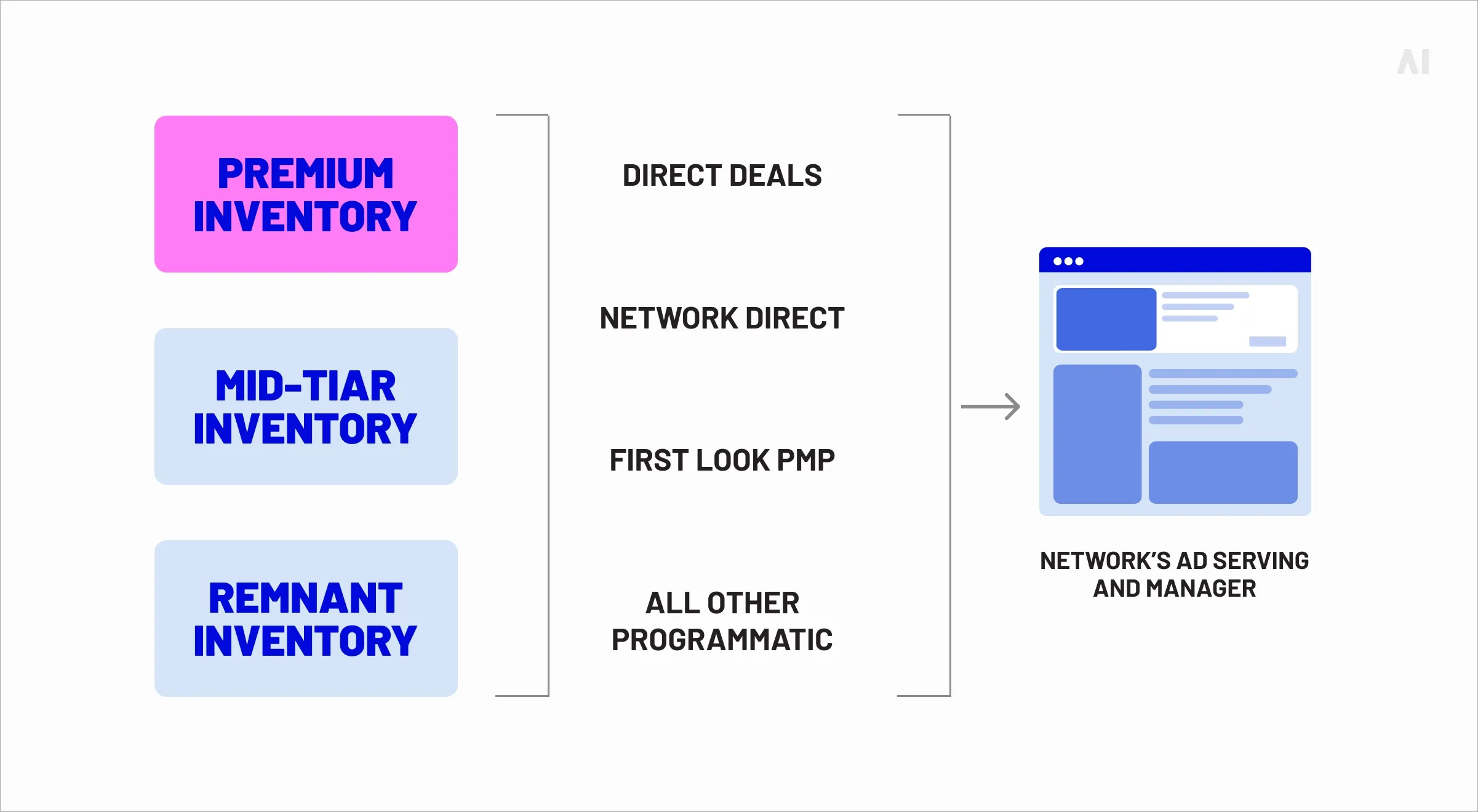
Premium and remnant inventory differ primarily in placement quality, demand dynamics, pricing structure, and certainty of delivery. Understanding these differences is essential for marketers evaluating how each inventory type supports specific tv advertising and media buying objectives.
Premium inventory is sold when demand is strongest and visibility is most valuable. These placements are typically secured through upfront or negotiated scatter deals and are associated with high-demand programming, predictable audience delivery, and defined scheduling parameters. Premium inventory commands higher CPMs because advertisers are paying for certainty—certainty of placement, audience context, and impression delivery. For brand campaigns, launches, or initiatives where reach quality and environment matter, premium inventory remains the foundation of most TV planning strategies.
Remnant inventory, by contrast, exists because demand did not fully materialize at the expected price point or time. Remnant TV advertising consists of unsold ad slots offered later in the buying cycle, often without guarantees around exact placement or volume. Pricing is lower because buyers assume greater risk related to delivery consistency, audience composition, and timing. While this can create efficiency advantages, it also introduces variability that premium inventory is designed to avoid.
From a pricing standpoint, premium inventory reflects scarcity and competition, while remnant inventory reflects surplus and timing. Premium CPMs are influenced by long-term demand forecasts and advertiser commitments, whereas remnant CPMs fluctuate based on short-term availability and market softness. This is why remnant advertising is typically used tactically rather than as a core delivery mechanism.
When remnant overlaps with premium inventory
Remnant inventory can occasionally include premium-quality placements, but only under specific market conditions. This overlap usually occurs when demand for otherwise high-value programming falls short of projections. Common scenarios include weaker-than-expected ratings, last-minute schedule changes, advertiser cancellations, or periods of broader economic slowdown that reduce overall ad spend. In these cases, ad slots within premium environments—such as strong scripted programming or high-viewership live content—may enter the remnant pool. However, access to these placements is inconsistent and cannot be planned or scaled reliably. Availability is typically short-lived, geographically uneven, and subject to rapid change as demand rebounds.
For marketers, this means that remnant TV advertising should not be treated as a dependable pathway to premium exposure, even though premium-quality slots may appear occasionally. When such overlap occurs, it should be viewed as an opportunistic upside rather than a predictable strategy.
💡The practical distinction is clear: premium inventory is purchased for certainty and control, while remnant inventory is purchased for flexibility and efficiency. Knowing when—and why—these two intersect allows media buyers to capitalize on opportunity without building plans on conditions they cannot guarantee.
Common mistakes marketers make
Remnant TV advertising can be effective when used deliberately, but many marketers undermine results by misapplying it. The following mistakes appear frequently in both linear TV and CTV media buying and often explain why remnant campaigns underperform expectations.
- Relying on remnant inventory as a primary buying strategy
One of the most common errors is treating remnant inventory as a substitute for premium or upfront buys. Because remnant supply is driven by leftover availability, it cannot support consistent scale or predictable delivery.
- Misunderstanding scalability and pacing
Remnant TV advertising does not scale on demand. Availability fluctuates based on broader market conditions, seasonality, and advertiser demand. Campaigns may deliver strongly one week and stall the next, making it unsuitable for objectives that require stable reach or frequency over time.
- Working with partners focused only on low CPMs
Another frequent mistake is selecting buying partners that optimize exclusively for cheap impressions. While lower CPMs are attractive, CPM alone does not indicate effectiveness. Partners who prioritize price over placement quality, audience relevance, or delivery consistency often introduce inefficiencies that offset perceived savings.
- Ignoring clearing rates and market signals
Marketers sometimes fail to monitor clearing rates—the prices at which inventory actually sells. Declining clearing rates often signal weak demand, lower-quality placements, or excess supply. Without this context, advertisers may misinterpret availability as opportunity rather than a warning sign.
- Overvaluing CPM savings without assessing audience quality
Lower costs can mask poor audience alignment. Remnant ads may reach viewers outside priority segments, especially in linear environments with limited targeting controls. When audience quality, context, or attention is weak, lower CPMs do not translate into better outcomes.
- Effective use of remnant TV advertising requires discipline.
Marketers who avoid these pitfalls tend to treat remnant inventory as a tactical layer—evaluated against clear KPIs, integrated into a broader TV advertising strategy, and assessed on more than price alone.
Conclusion: Should you buy remnant in 2026?
Remnant TV advertising can be a valuable part of a 2026 media strategy but only when it is used as a complement, not a foundation. Its strengths lie in cost efficiency, speed, and tactical flexibility. Its weaknesses lie in limited guarantees, inconsistent scale, and reduced predictability. The difference between success and failure is not the inventory itself, but how intelligently it is planned, evaluated, and governed.
In practice, remnant works best when marketers:
- Use it to extend reach or frequency alongside premium and upfront buys
- Apply it to performance-driven or time-sensitive campaigns
- Treat it as a testing and optimization layer, not a core delivery mechanism
It tends to fail when advertisers expect guaranteed scale, consistent audience quality, or long-term stability from inventory that is, by definition, dependent on fluctuating demand.
This is where modern media intelligence becomes critical. As TV and CTV buying grow more complex, marketers need more than access to inventory—they need visibility into supply quality, pricing dynamics, and performance signals across channels. Without that intelligence, remnant buying becomes reactive and opaque, increasing risk rather than efficiency.
Elevate by AI Digital is designed to address this exact challenge. By combining transparent supply insights, AI-driven optimization, and cross-channel media intelligence, Elevate helps advertisers understand when remnant inventory creates value and when it should be avoided. Instead of optimizing solely for low CPMs, Elevate evaluates inventory based on delivery consistency, audience alignment, and real performance impact—allowing remnant TV to function as a controlled, intentional lever within a broader strategy.
With Elevate, remnant inventory is not treated as “cheap TV,” but as one variable in a balanced, data-driven media buying framework—alongside premium, scatter, and CTV investments. This approach enables marketers to preserve efficiency without sacrificing strategic control, even under budget pressure.
💡For advertisers planning 2026 media strategies, the takeaway is clear: buy remnant TV only when it is guided by transparent intelligence and integrated into a broader TV and digital ecosystem.
⚡️To learn more about how AI-powered transparency reshapes modern media buying, explore our Elevate: Transparent AI Media Intelligence.
In a fragmented, high-pressure TV landscape, remnant inventory is not a shortcut—but with the right intelligence layer, it can be a smart, disciplined advantage.
.webp)