AI Attribution in Marketing: How It Works in a Fragmented Media Landscape


AI attribution in marketing has become more difficult because the customer journey is no longer contained within one channel, device, or reporting platform. A prospective customer may first encounter a brand through connected TV, research it through search on a mobile device, see a paid social ad, click an email, and convert later through a website or sales team. Each interaction may be recorded differently—or not at all—across platforms, privacy settings, identifiers, and closed media environments.
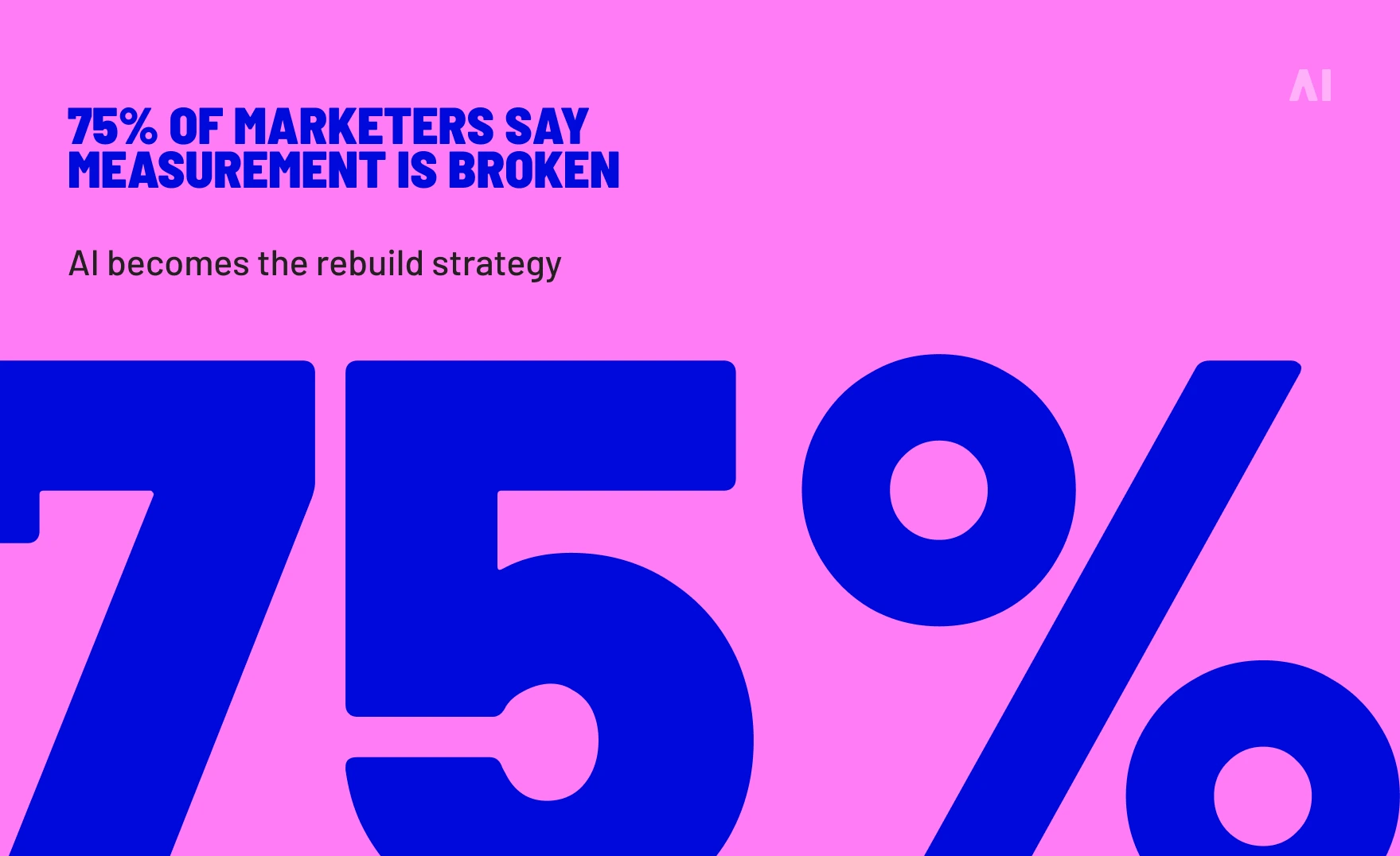
The pressure to make sense of this complexity is growing. McKinsey’s 2026 State of Marketing Europe report found that 94% of marketing organisations still have low or moderate generative AI maturity, while only 3% of CMOs can demonstrate marketing ROI above 50% of spend. These figures are not measures of attribution accuracy, but they underline the gap between investment in AI and the ability to turn fragmented marketing data into confident commercial decisions.
AI attribution can help marketers analyse larger volumes of observable interactions and assign credit using data-driven patterns rather than a fixed rule such as last-touch or first-touch attribution. However, it is not a complete record of reality: its outputs depend on the quality, consistency, and coverage of the data available to the model. Missing signals, walled gardens, identity gaps, and offline activity still shape what any attribution system can see.
This guide explains what AI attribution is, how it works, and how it differs from rule-based attribution. It also explores where it can support cross-channel optimisation, what data and governance it requires, and why attribution credit should be treated as a decision signal—not proof that a particular marketing activity caused a conversion.
TL;DR: Key Takeaways
- AI attribution uses machine learning and data-driven methods to estimate how conversion credit may be distributed across recorded marketing touchpoints.
- It is useful when customer journeys span channels, devices, platforms, and offline activity that simple first-touch or last-touch rules cannot represent well.
- AI can analyse complex patterns across observable interactions at scale, but its outputs depend on the quality, consistency, and coverage of the available data.
- Missing signals, identity gaps, privacy restrictions, and walled gardens still limit what any attribution model can see.
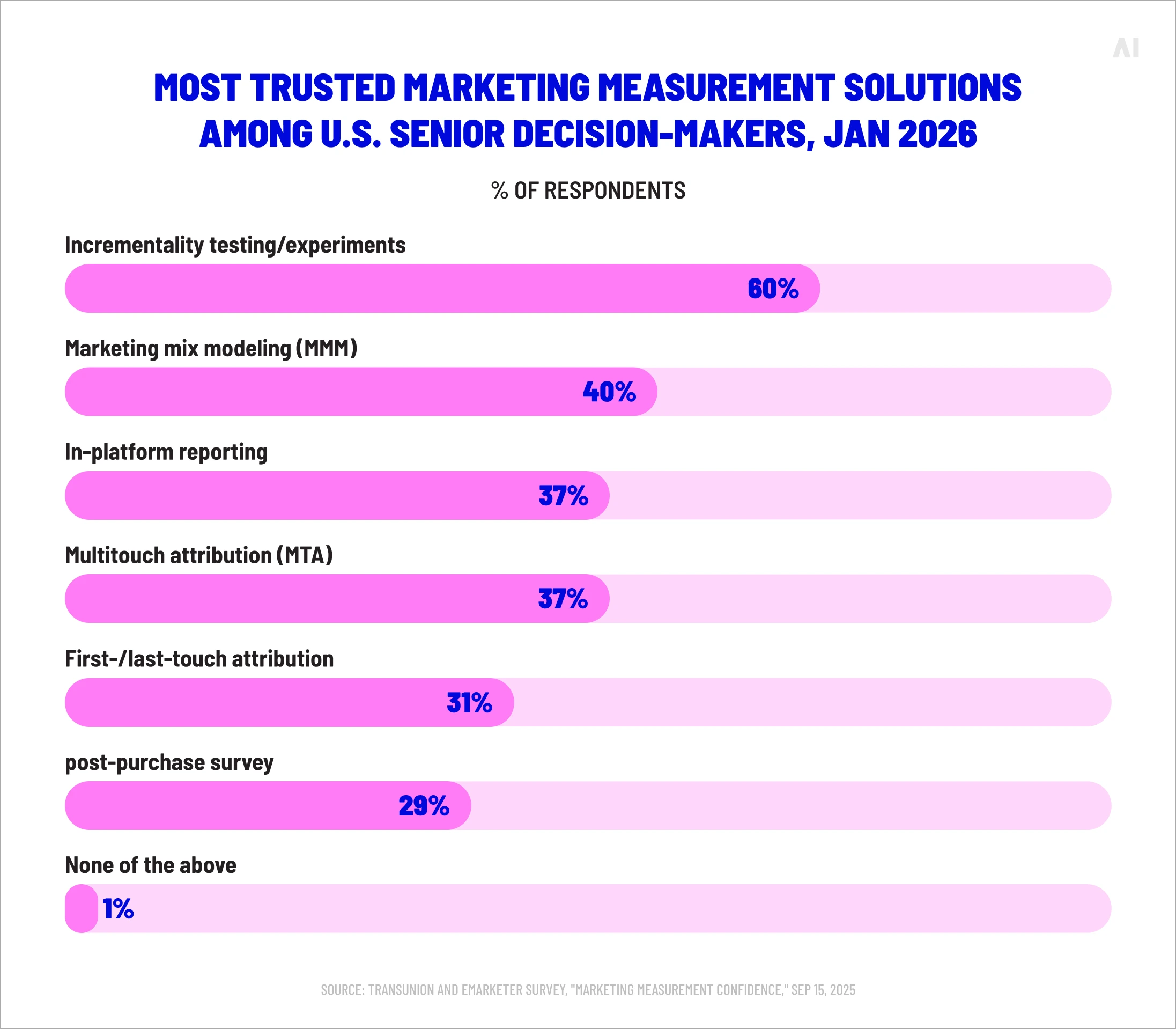
- Attribution credit is a decision signal, not proof of causal impact. Questions about whether marketing activity created additional results require incrementality testing, experimentation, MMM, or other complementary measurement methods.
What Is AI Attribution?
AI attribution in marketing uses machine learning and other data-driven methods to analyse recorded marketing interactions and estimate how conversion credit should be distributed across touchpoints.
Unlike first-touch, last-touch, linear, or time-decay attribution, AI-driven marketing attribution does not apply one fixed rule to every customer journey. It can analyse patterns in the available data—such as channel combinations, timing, sequences, and conversion outcomes—to produce data-informed attribution weights. For example, it may identify that video, paid social, and branded search frequently appear together before conversion, rather than giving all credit to the final click.
AI attribution is an umbrella term rather than one standard model. Providers may describe similar approaches as algorithmic, machine learning, or data-driven attribution, and their methods can differ significantly. The output should therefore be treated as an estimate based on observable data, not as definitive proof of what caused an individual conversion.
It is also distinct from other measurement approaches:
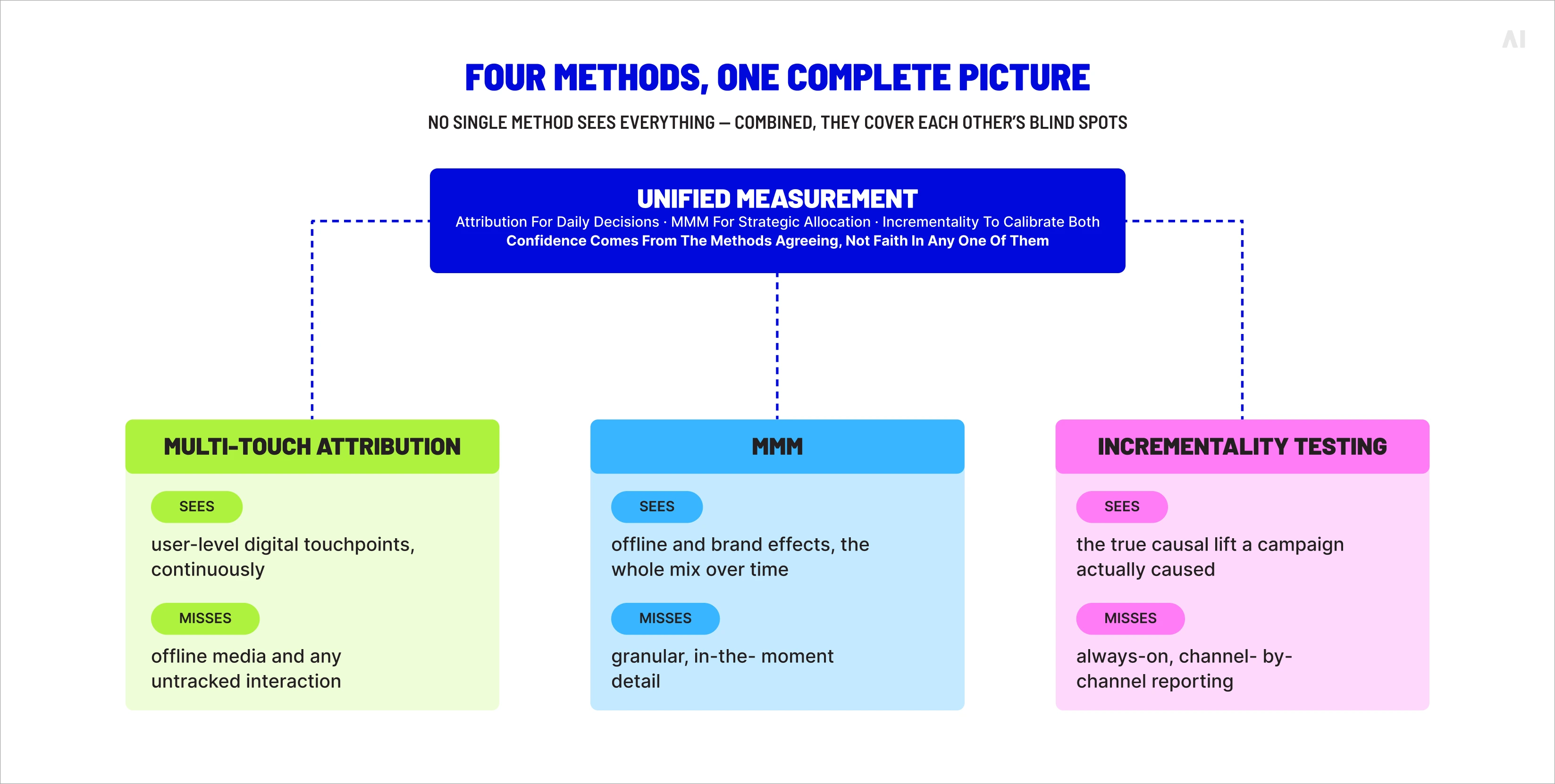
- Marketing mix modelling estimates broader channel contribution using aggregate historical data.
- Incrementality testing measures causal lift by asking what would have happened without a campaign.
- Conversion modelling estimates the likelihood of unobserved conversions; it does not determine how credit should be distributed across touchpoints.
In this context, AI attribution does not refer to attributing AI-generated content or measuring traffic from AI search platforms.
Why Attribution Is Harder in a Fragmented Media Landscape
Modern customer journeys rarely follow one clear path. They can span multiple channels, devices, platforms, and offline interactions, while the data that represents those interactions remains incomplete or disconnected. AI attribution can help teams analyse more complex observable journeys, but it cannot recover touchpoints that were never measured.
Cross-Channel and Cross-Device Customer Journeys
A customer may discover a brand through streaming video, research it through search on mobile, return through a social ad, and convert later on a desktop site. In B2B, the journey may also include webinars, content downloads, sales calls, and CRM activity.
This makes fixed-rule attribution less reliable. Last-touch models may over-credit the final interaction, while first-touch models can overlook the channels that helped move a prospect towards conversion. AI attribution can examine patterns across recorded touchpoints at scale, giving marketers a more flexible view of cross-channel participation.
AI attribution can examine patterns across recorded touchpoints at scale, giving marketers a more flexible view of how channels participate in conversion paths. This is particularly important in cross-channel marketing measurement, where performance must be assessed across connected but distinct media environments.
Signal Loss, Walled Gardens, and Fragmented Data
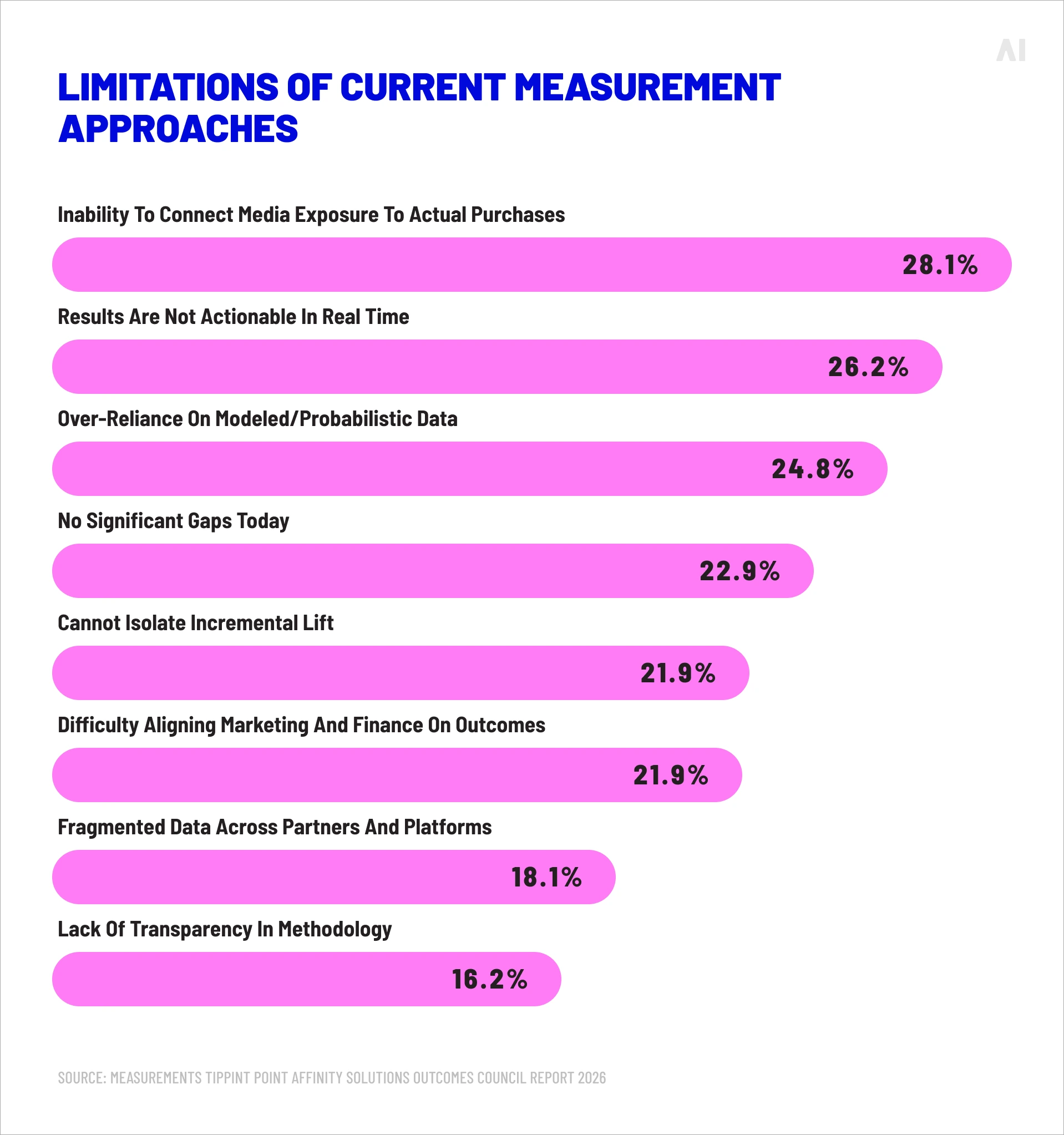
Privacy controls, consent restrictions, browser limitations, disconnected platforms, inconsistent identifiers, and offline activity all create gaps in the measurable customer journey. Walled gardens can also report platform performance without providing the detailed data needed to connect activity reliably across other channels.
AI-based attribution can analyse available signals and may model some patterns where appropriate. However, it cannot recreate an exact person-level journey when no usable data exists. Estimating whether an unobserved conversion occurred is a conversion-modelling task; allocating credit across recorded interactions is an attribution-modelling task.
Understanding these constraints is central to addressing the most common marketing attribution challenges, from identity gaps and inconsistent identifiers to limited platform-level visibility.
How AI-Powered Attribution Works
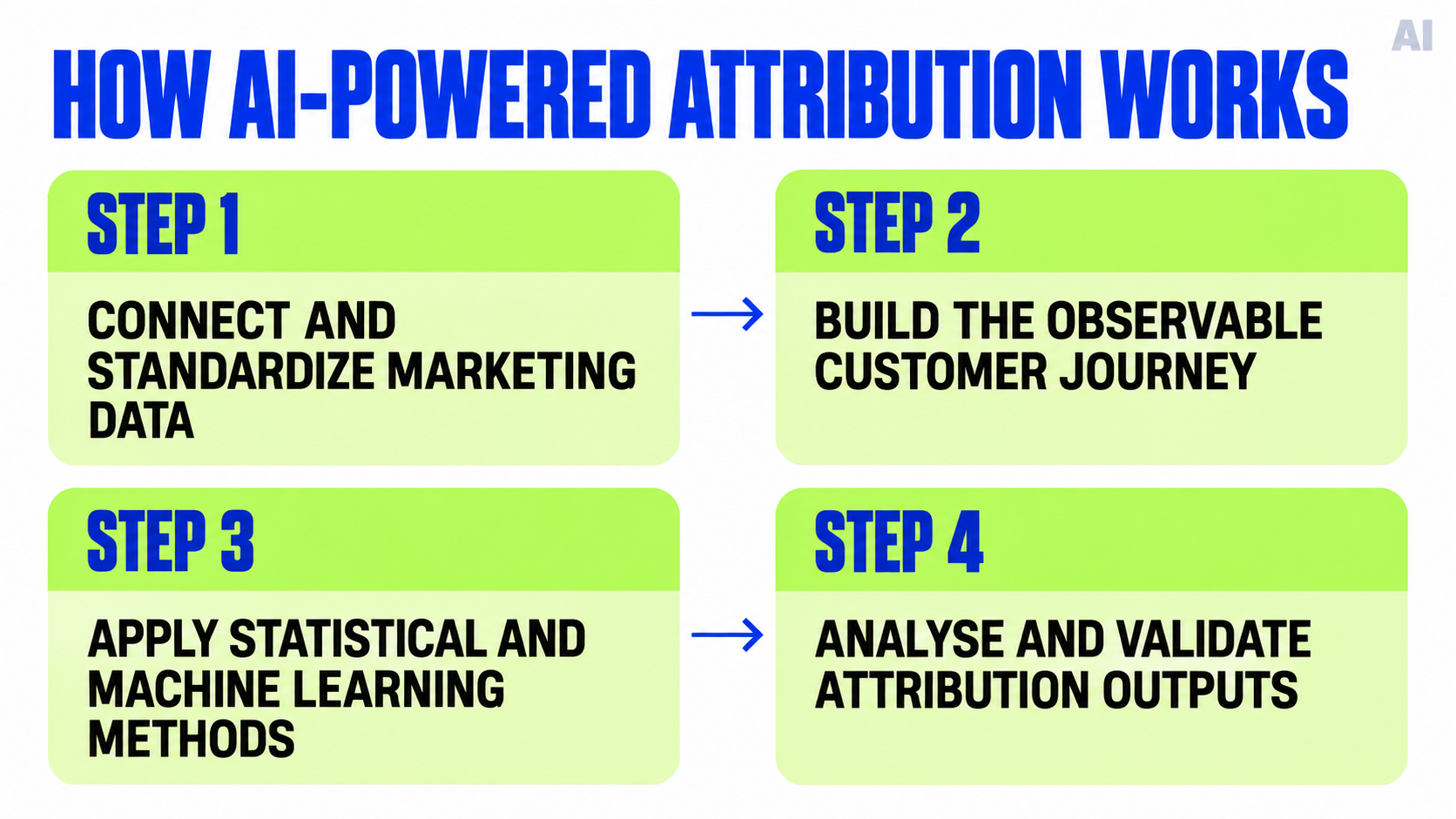
AI-powered attribution typically moves from connected marketing data to estimated attribution outputs through four stages. The precise workflow varies by provider, platform, and measurement environment: some approaches rely more heavily on statistical modelling, while others use machine learning or proprietary data-driven methods. In every case, the usefulness of the result depends on the quality and scope of the data that enters the process.
Step 1: Connect and Standardize Marketing Data
The process begins by bringing together relevant data from advertising platforms, web and app analytics, CRM systems, ecommerce platforms, sales data, and other available sources. The goal is not to connect every possible dataset, but to use inputs that are reliable and relevant to the measurement question.
Consistency is essential. Campaign names, channel definitions, conversion events, timestamps, currencies, and customer identifiers should follow clear rules. If one team records a lead at form submission while another records it only after qualification, the model may be analysing different outcomes under the same label. More data does not automatically improve AI attribution if the inputs are incomplete, duplicated, or poorly defined.
Step 2: Build the Observable Customer Journey
The next step is to connect eligible events into a journey where possible. Identity and event data may help link ad exposures, website activity, email engagement, app events, and CRM outcomes across channels or devices.
However, this represents the observable customer journey, not every interaction that occurred in reality. Some users cannot be recognised across devices, some platform activity remains aggregated, and offline touchpoints may be unavailable. A useful attribution model should make this distinction clear rather than treating the measured path as a complete customer history.
Step 3: Apply Statistical and Machine Learning Methods
Models then analyse relationships, sequences, and recurring patterns among recorded touchpoints and conversion outcomes. This can support data-driven attribution weighting—for example, estimating how different channel combinations tend to appear across converting and non-converting journeys.
The methodology is not universal. Different providers may use different model types, attribution windows, eligibility rules, and assumptions. AI can identify patterns within the available data, but it does not automatically reveal the objectively true influence of every marketing interaction.
Step 4: Analyse and Validate Attribution Outputs
Attribution outputs should be reviewed alongside business context, data quality, and the decision they are intended to support. A channel receiving more credit may deserve further investigation, but it does not automatically prove that increasing spend will produce incremental growth.
Teams should validate results over time, monitor changes in customer behaviour and data coverage, and compare attribution signals with other measurement methods where appropriate. Human oversight remains essential: AI attribution is most valuable when it supports informed decisions, not when it is treated as an unquestionable answer.
AI/Data-Driven Attribution vs. Rule-Based Attribution Models
Rule-based attribution models distribute conversion credit according to predefined logic. First-touch attribution gives all credit to the first recorded interaction, last-touch gives it to the final interaction, while linear and time-decay models split credit according to fixed formulas.
AI- or data-driven attribution uses observed marketing data to estimate weighting across touchpoints instead of applying the same rule to every journey. This can make it more responsive to complex recorded paths, but it also introduces greater dependence on data quality, model assumptions, and provider methodology.
Neither approach is automatically right for every organisation. Rule-based models can be useful when teams need a simple, transparent reporting framework or have limited data. Data-driven attribution may be more useful when marketers need to analyse larger volumes of cross-channel journeys and have the measurement maturity to evaluate the output responsibly.
Not every data-driven attribution product is marketed as “AI,” and providers use different methodologies, attribution windows, and eligibility rules. More sophisticated modelling does not automatically make a result more accurate—or prove that a channel caused a conversion.
Teams comparing fixed rules with more flexible approaches should first understand the strengths and trade-offs of different marketing attribution models.
Why AI Attribution Matters for Modern Marketers

Marketing teams are under pressure to explain which activity supports growth, yet the data behind that answer is rarely straightforward. AI attribution can help teams analyse more complex sets of recorded interactions than fixed rules or manual reporting alone.
The need for better measurement is clear:
- 94% of European marketing organisations still report low or moderate generative AI maturity.
- Only 3% of CMOs can demonstrate marketing ROI above 50% of total marketing spend.
- Among the 6% of organisations with mature generative AI use, leaders report average efficiency gains of 22%.
These figures do not prove that AI attribution improves performance. They show, however, why marketers are looking for more reliable ways to connect data, assess channel roles, and make decisions with greater confidence.
Analyse Complex Customer Journeys at Scale
Customer journeys can involve thousands of interactions across search, social, video, display, email, websites, apps, and CRM activity. AI-driven attribution can process these recorded signals at a scale that would be difficult to assess manually.
That does not make the output automatically accurate. Incomplete tracking, inconsistent campaign data, and unclear conversion definitions can still distort the analysis. Better models need better inputs.
Identify Cross-Channel Patterns That Simple Rules Can Miss
First-touch and last-touch models assign credit based on a touchpoint’s position in the journey. AI attribution can instead examine recurring patterns across recorded paths.
For example, it may reveal that a video campaign often appears early in high-value journeys, even when it rarely receives final-click credit. This identifies a relationship within the available data—not proof that the video campaign caused the conversion.
Support Better-Informed Optimisation and Budget Decisions
AI attribution can give teams another lens for assessing channels, campaigns, audiences, and media allocation. It may flag under-credited activity, identify useful channel combinations, or show where deeper investigation is needed.
Budget decisions should still account for creative quality, reach, data coverage, marginal returns, and evidence from incrementality testing or marketing mix modelling. Attribution is most useful as a decision tool, not a standalone answer.
What AI Attribution Needs to Work Well
AI attribution is not improved simply by adding more data sources. It needs relevant, reliable, and consistently defined inputs—plus a clear understanding of the decisions the analysis is meant to support.
Challenges and Limitations of AI Attribution
AI can make attribution analysis more scalable and flexible, but it does not remove the underlying limits of measurement. Some limitations come from what the system cannot observe; others come from how models interpret the data they do have.
Missing Data Still Creates Missing Touchpoints
Privacy restrictions, consent choices, walled gardens, offline behaviour, incomplete integrations, and identity gaps can all prevent interactions from appearing in the measured journey. A customer may see an ad on one device, research on another, speak to a sales representative, and convert later—without every step being connected in the data.
Modelling may help estimate some patterns when the available data and methodology support it. However, it cannot recreate an exact person-level journey or recover a touchpoint for which no usable signal exists.
Models Can Be Difficult to Explain and Validate
AI attribution models reflect the assumptions, definitions, and data used to build them. Customer behaviour can change, media platforms can change their reporting, and data quality can decline over time. This may cause model outputs to drift away from current business reality.
Not every data-driven model is a black box, and a more complex model is not always better. Marketers should favour appropriate methods that can be reviewed, validated, and explained to the people making decisions.
Attribution Credit Does Not Prove Causal Impact
An attribution model can identify relationships among recorded touchpoints and allocate estimated credit across them. It cannot automatically establish what would have happened if a campaign, channel, or interaction had not occurred.
For example, a channel may appear frequently before conversion because it influences demand—or because it reaches people who were already likely to convert. That is why marketers should understand the difference between incrementality and attribution when interpreting AI-driven results.
When AI Attribution Is Useful — and When It Is Not Enough
AI attribution is most useful when the question concerns observable customer journeys and the estimated role of touchpoints within them. It becomes less sufficient when marketers need to establish causal lift, measure activity that is largely unobserved, or make long-term budget decisions across the full media mix.
AI attribution should therefore sit within a broader measurement strategy, rather than replace it. Teams that combine journey analysis with causal and aggregate measurement are better placed to understand both what happened and what is likely to drive growth. This is the central idea behind why full-funnel attribution matters in modern marketing.
How AI Digital Supports Cross-Channel Attribution and Measurement
AI Digital helps marketers work with fragmented media data through cross-channel intelligence, reporting, and an open operating framework. Rather than positioning one platform as a universal attribution engine, this approach brings together available signals, reporting capabilities, and measurement methods to support more informed media decisions.
Elevate for Journey Analysis and Reporting
Elevate supports cross-channel analysis through Path to Conversion and Advanced Reporting. Path to Conversion helps teams visualise recorded touchpoints before conversion, while Advanced Reporting centralises core performance metrics across integrated DSPs, search, and social sources.
This gives marketers a clearer view of the interactions available in their measurement environment and reduces the need to interpret channel performance through isolated dashboards. It does not mean every real-world interaction is visible, every customer can be identified across devices, or the platform can prove the causal impact of an individual touchpoint.
Open Garden for Cross-Platform Measurement
AI Digital’s Open Garden Framework is a vendor-neutral, DSP-agnostic operating model designed for fragmented programmatic environments. It supports flexibility across DSPs, SSPs, data partners, and inventory sources rather than tying measurement and activation to one closed platform.
Its AI-powered intelligence layer includes overlap modelling, budget-allocation simulations, saturation curves, and cross-channel attribution logic. The framework also supports unified cross-channel measurement through attribution alignment, frequency harmonisation, and vendor interoperability.
Open Garden does not eliminate walled gardens, missing data, attribution assumptions, or measurement uncertainty. Its value lies in helping teams work more consistently across the signals and platforms that are available, while retaining a clearer view of the limitations behind the results.
Use AI Attribution as a Decision Tool, Not a Source of Absolute Truth
AI attribution can make complex marketing data more useful, but it cannot remove the limits of the measurement environment. Its value depends on reliable inputs, an appropriate methodology, clear measurement questions, and ongoing validation. More sophisticated analysis does not eliminate missing touchpoints, model assumptions, or the difference between attribution credit and causal impact.
- Define the decision first. Be clear whether you need to understand conversion paths, optimise a campaign, assess causal lift, or plan long-term budget allocation.
- Audit the data behind the model. Check conversion definitions, campaign taxonomy, identifiers, timestamps, and gaps in platform or offline data before interpreting results.
- Use attribution alongside other evidence. Combine journey-level insights with experiments, incrementality testing, MMM, and commercial context where relevant.
- Review outputs regularly. Customer behaviour, media platforms, and data quality change over time, so attribution models and assumptions should be revisited.
- Keep human judgement in the process. Treat unexpected results as a prompt for investigation—not an automatic instruction to move budget.
Teams looking to build a more connected approach to cross-channel measurement can discuss their measurement challenges with AI Digital.