First-Touch vs Last-Touch Attribution: What Each Model Actually Measures


Attribution reports often sit close to campaign optimization and budget decisions. If paid display appears to generate the most valuable customers, a team may expand prospecting. If email appears to close the most sales, it may receive more investment instead. Yet the apparent winner can depend as much on the attribution model as on the customer’s behavior.
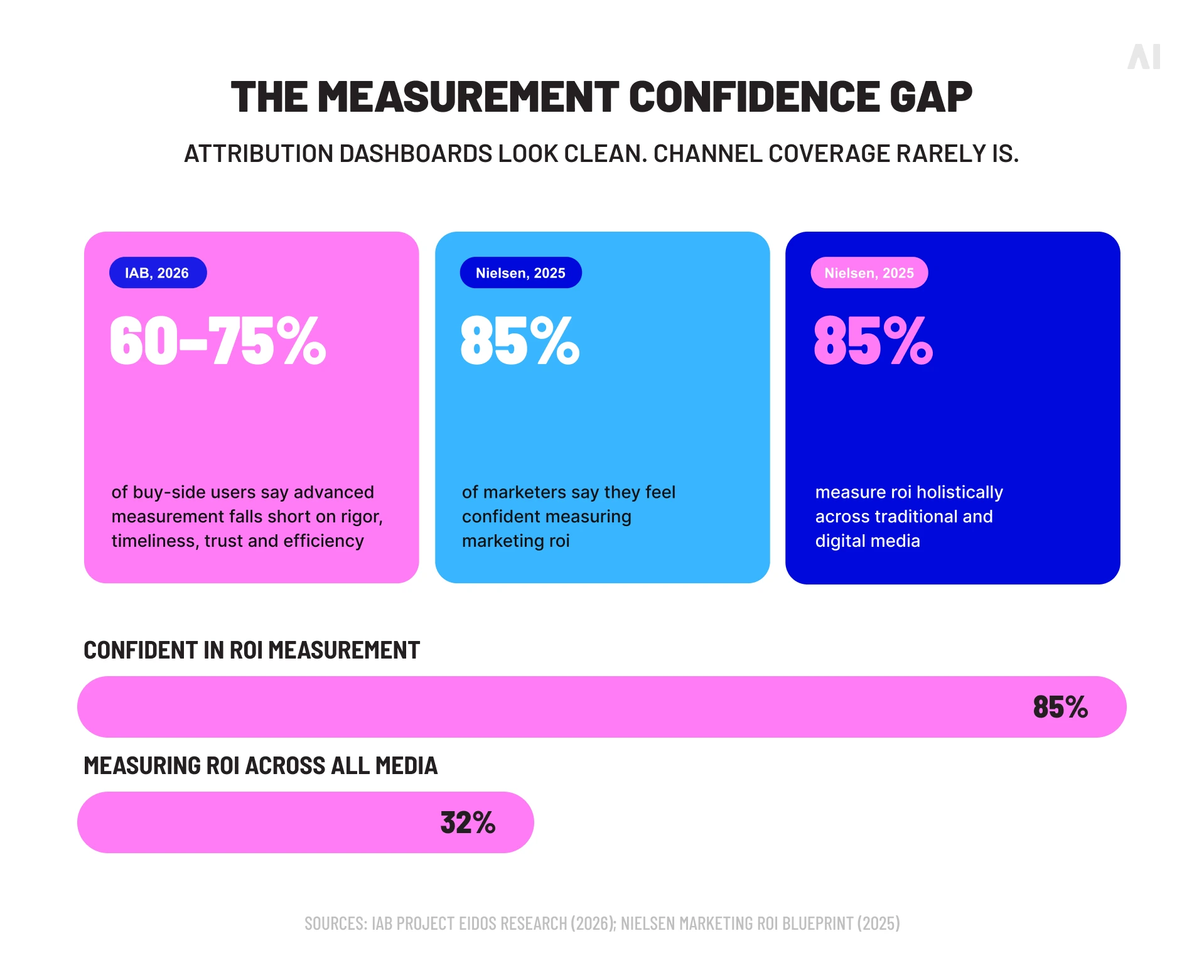
That distinction has become harder to ignore. In the IAB’s 2026 research, 60% to 75% of buy-side users said advanced measurement fell short on rigor, timeliness, trust and efficiency. The difficulty begins with a basic reporting choice: should the first recorded interaction receive the conversion, or the last one?
TL;DR: Key takeaways
- First-touch attribution assigns all conversion credit to the first eligible recorded marketing interaction in the attribution path.
- Last-touch attribution assigns all credit to the final eligible recorded marketing interaction before conversion.
- First-touch is most useful for questions about observable acquisition and discovery. Last-touch is most useful for questions about the recorded closing interaction.
- Both are single-touch attribution models. Every intermediate interaction receives no credit, even when it was recorded and played a useful role.
- Attribution credit follows a predefined rule. It does not demonstrate that the credited touchpoint caused the conversion.
- Lookback windows, channel eligibility, direct-traffic rules, identity resolution and missing data can all change which interaction appears first or last.
Each model provides a practical reporting lens, provided it is not treated as a complete account of marketing performance.
This comparison applies both rules to the same journey, identifies the questions each can answer and examines the tracking conditions that determine which interaction appears first or last.
What is first-touch attribution?
First-touch attribution is a single-touch model that assigns 100% of conversion credit to the first eligible recorded marketing interaction in the attribution path. If a customer first enters the measured journey through a display ad, then returns through search, social and email before buying, the display interaction receives the entire conversion.
The first-touch attribution model is primarily an acquisition lens. It can help marketers identify which observable channels introduce prospects, generate new tracked users or begin paths that eventually lead to a desired action. This makes it useful for comparing discovery channels and assessing where recorded demand enters the funnel.
The word “recorded” carries much of the definition. Adobe, for example, defines first touch as the first touchpoint seen within the selected attribution lookback window. An earlier interaction outside that window cannot receive credit. The same applies to an exposure that occurred offline, on an unconnected device or in an environment the measurement system cannot observe.
⚡ First touch identifies where a recorded path begins, not necessarily where customer awareness began.
What is last-touch attribution?
Last-touch attribution assigns 100% of conversion credit to the final eligible recorded marketing interaction before conversion. In the same sequence of display, search, social and email, the email click receives all the credit if it is the final qualifying touchpoint before the customer acts.
The last-touch attribution model focuses on the closing end of the measured journey. It can be useful for short sales cycles, direct-response campaigns and analyses of final conversion interactions.
Its position in the journey does not make the last touch the sole influence on the decision. Branded search may capture a customer who already knows which company they want. A retargeting ad may reach someone returning to complete an intended purchase. An email may provide the convenient route back to a product discovered elsewhere.
Last-touch reporting cannot determine how much demand earlier channels created or how likely the conversion was before the last interaction occurred.
First-touch vs last-touch attribution: Key differences
Both approaches belong to the family of single-touch marketing attribution models. They use simple position-based rules, assigning the conversion to one interaction and excluding all others from the credit calculation. Their difference lies in which end of the path they favor.
“Touch” also needs to be distinguished from “click.” Google’s definition of a marketing touchpoint can include site visits, impressions, engaged views, emails, downloads and usage. Another measurement system may recognize a narrower or different set of events. First-click and last-click attribution are therefore specific versions of the broader touch-based concept.
Model availability varies too. Adobe Analytics supports first-touch and last-touch analysis with configurable scopes and windows. GA4, however, removed first-click and several other rule-based models from selectable attribution reporting in November 2023. Its “First user source” acquisition field is not a selectable first-touch conversion model. A shared model name also does not guarantee that two platforms define the path, touchpoint or conversion identically.
Same customer journey, different attribution result
Consider a customer who follows this recorded path:
Paid display click → Organic search visit → Paid social click → Email click → Conversion
The interactions and conversion remain identical under both models. The allocation changes.
First-touch reporting gives the conversion to paid display because it occupies the opening position. Last-touch gives it to email because it is the final eligible interaction. Organic search and paid social receive nothing under either rule, even though the system recorded them.
The table shows conversion credit, not contribution or causal impact. It assumes that clicks and visits are eligible, all four interactions belong to one recognized customer and the sequence falls within the applicable attribution window.
Real reports may treat impressions, direct visits and identity differently. A seemingly small configuration change can alter the path before the first-touch or last-touch rule is applied.
⚡ The customer journey does not change when the attribution model changes. Only the reporting result does.
Strengths and limitations of first-touch and last-touch attribution
The value of each model depends on the question placed in front of it. Both offer an uncomplicated answer, but each produces that clarity by removing most of the journey from its credit calculation.
First-touch attribution: Strengths and limitations
First-touch attribution is easy to explain and well suited to acquisition reporting. It can reveal which observable channels most often begin tracked paths that later convert.
It also gives early display, video, social and content interactions a defined place in performance analysis when they might disappear from lower-funnel reporting.
Its restriction is equally clear. Once the first touch has been selected, everything after it loses conversion credit. The model cannot distinguish a prospect who converted after one brief return from another who needed weeks of nurturing, product research, sales contact and repeated exposure. It can also overstate an opening channel merely because that channel is good at generating trackable entries.
Most importantly, the first observable touch may sit halfway through the real journey. The model cannot recover exposures excluded by time, consent, device changes or missing data.
Last-touch attribution: Strengths and limitations
Last-touch attribution offers a direct view of the interaction immediately preceding conversion. It can help marketers inspect closing behavior, compare direct-response placements or monitor short-cycle campaigns.
Its simplicity also makes results easy to communicate. The report produces one credited channel for each conversion rather than fractional allocations that require additional interpretation.
Its bias falls toward channels near the transaction. Email, retargeting and branded search often meet customers after awareness and consideration have developed, making them appear to create demand they primarily collect.
That bias can feed back into investment. If a company repeatedly funds the channels receiving last-touch credit while reducing discovery activity, the available pool of interested customers may eventually contract. Last-touch alone cannot reveal this dependency because it excludes the earlier interactions by design.
When to use first-touch vs last-touch attribution
Selection should begin with the business question. A marketer examining acquisition sources needs a different reporting lens from one studying how customers return immediately before purchase.
A practical selection process can follow five steps:
- Define the outcome. A first purchase, qualified lead, renewal and repeat order represent different customer decisions.
- Write the measurement question in plain language. Decide if the analysis concerns acquisition, the final recorded interaction or contribution across the full path.
- Inspect the available data. Confirm which channels, devices and offline activities can enter the attribution path.
- Check the settings. Review the attribution window, eligible interactions, conversion definition and treatment of direct traffic.
- Match the model to the question. Use its output only within the boundaries established above.
Viewing both reports side by side may reveal that one group of channels commonly introduces prospects while another closes recorded journeys. It still cannot quantify the interactions between them. The business question should determine the model, not the desired result.
What first-touch and last-touch attribution both miss
Every single-touch attribution model compresses a sequence into one credited event. Research visits, product comparisons, repeated ad exposure, reviews, sales conversations and nurturing emails may all appear in the recorded path while receiving no credit. This is credit omission, an intentional consequence of the model.
Observation omission occurs earlier. An offline conversation, unconnected device, untagged campaign or interaction outside a platform’s data boundary may never enter the customer journey attribution record. Switching from first-touch to last-touch cannot restore information that was never observed.
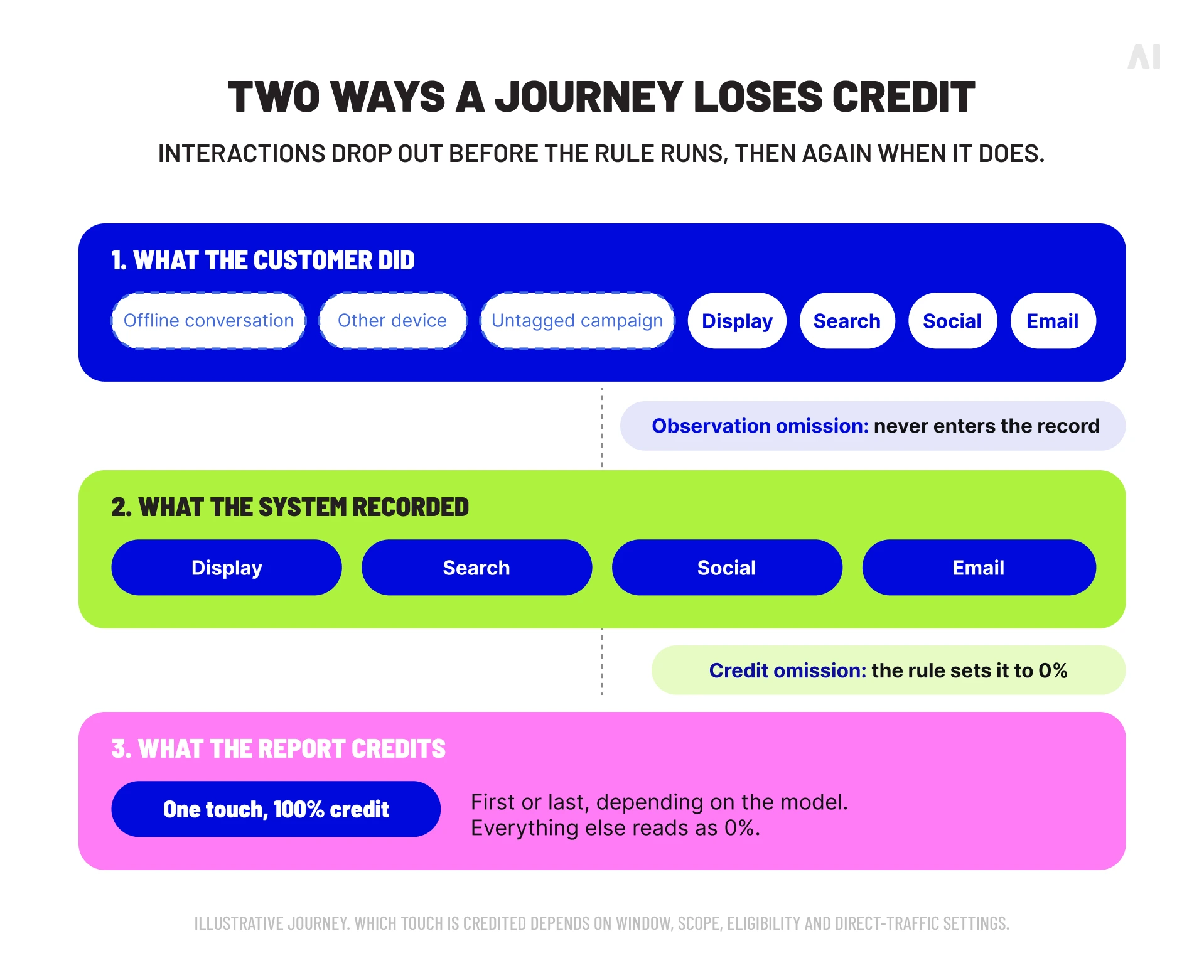
Long consideration cycles expose both problems. An early campaign can fall outside the attribution window, while several recorded interactions inside the window are reduced to one winner. The resulting report may be internally consistent while representing only a thin portion of the buying process.
The gap between confidence and comprehensive practice is substantial. Nielsen reported in 2025 that 85% of marketers expressed confidence in measuring ROI, while only 32% measured it holistically across traditional and digital media. A clean dashboard can therefore coexist with incomplete channel coverage.
Multi-touch attribution gives intermediate interactions some credit, but it introduces its own assumptions about weighting. The immediate lesson is narrower: a single-touch result cannot describe how several recorded interactions worked together.
Attribution credit does not prove causality
Attribution determines where a recorded conversion is assigned. Causal measurement asks how many conversions occurred because of the marketing activity and would not have occurred without it.
Imagine a customer who has already decided to buy. They return through a retargeting ad and check out. Last-touch attribution gives the ad the conversion because it was the final eligible interaction. The rule has no control group and no counterfactual, so it cannot establish that the ad changed the outcome. First-touch has the same limitation at the beginning of the path.
Experiments approach the question differently.
- Google describes Conversion Lift as a method that compares a treatment group exposed to advertising with a control group that is not exposed, using the difference in conversions to estimate lift.
- The IAB’s guidelines for incremental measurement likewise distinguish causal experiments from directional platform reporting.
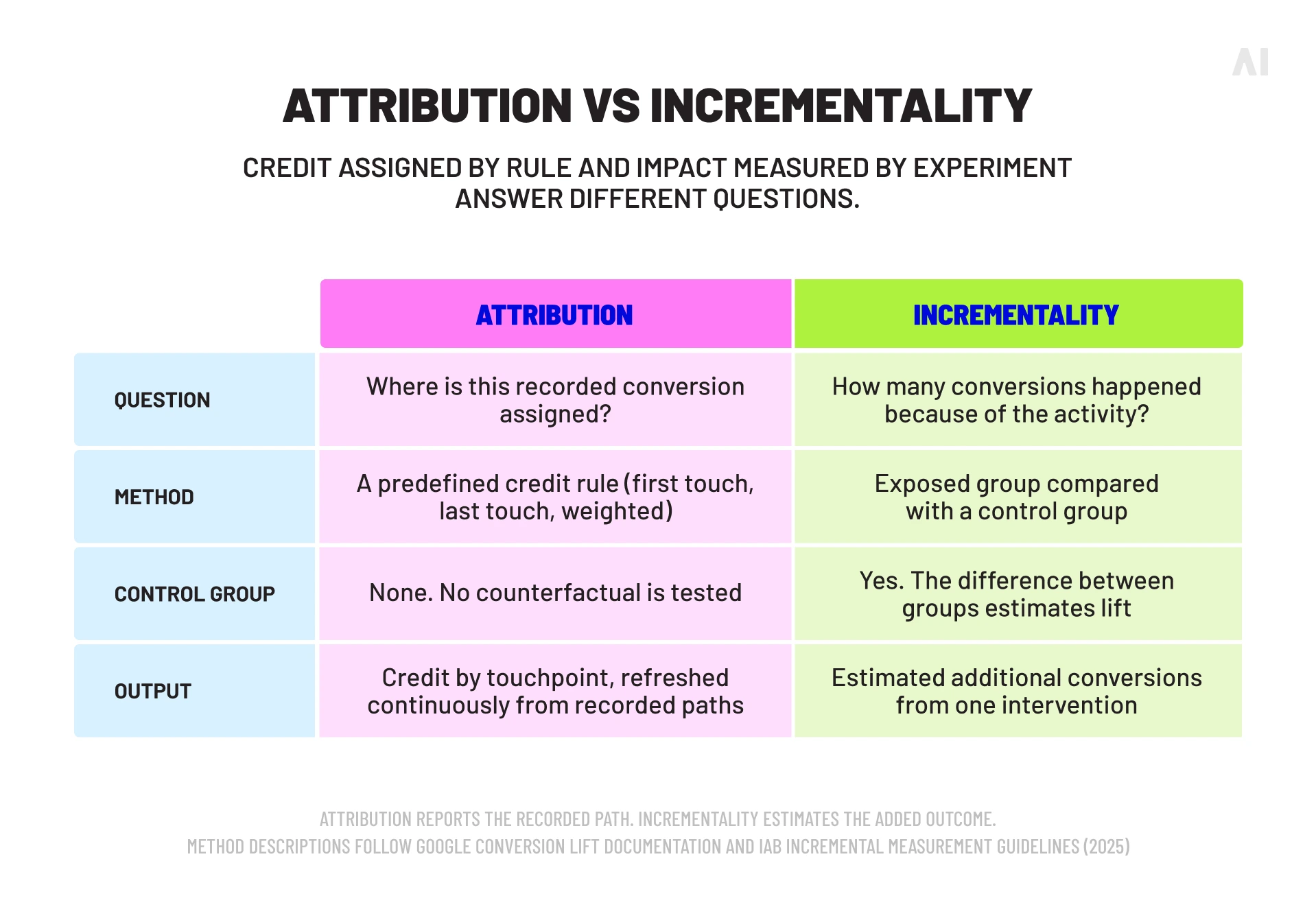
Attribution and incrementality can support different decisions. Attribution supplies an ongoing view of recorded paths and assigned credit. Incrementality investigates the additional outcome associated with an intervention. Confusing the two can turn a convenient reporting rule into an unsupported claim about business impact.
⚡ A touchpoint can receive all the credit without causing any additional conversions.
💡 For a fuller comparison, see incrementality vs attribution.
How tracking rules and data gaps change attribution results
The credit rule is only one part of attribution tracking. Before a model selects a first or last touch, the measurement system decides which activity belongs in the path.
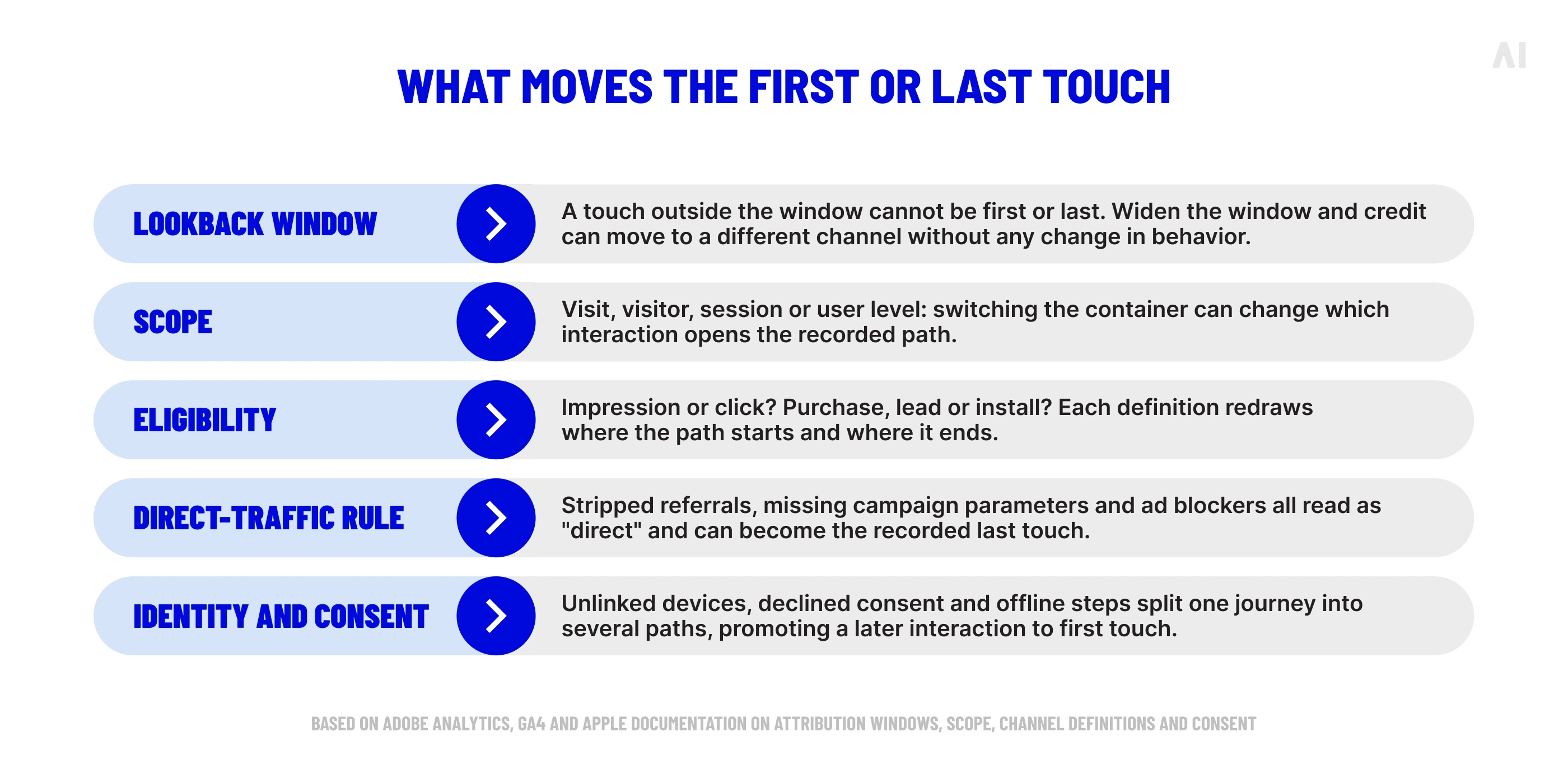
Attribution windows and eligibility rules change which touch gets credit
An attribution window establishes how far back the system looks from the conversion. If the original display interaction falls outside that window, organic search may become the first eligible touch. A wider window could return the credit to display without any change in customer behavior.
Scope can have a similar effect. Adobe’s documentation shows how changing from a visit-level container to a visitor-level container can change the interaction receiving first-touch credit. GA4 separately organizes acquisition information at user, session and event level. Its first-user dimensions remain attached to the source that acquired the user, while session values can change when the person returns and event-scoped reporting follows the selected attribution model.
Eligibility introduces another variable. One platform may count a view-through impression while another requires a click. Conversion definitions can also differ: a purchase, form submission, app installation and qualified lead each create a different endpoint for the path.
Direct traffic is not universal shorthand for one customer behavior. Google uses “direct” when traffic does not have a clear referral source. Typed URLs and bookmarks can produce it, but so can missing campaign parameters, redirects that strip referral information and ad blockers. How a platform treats that visit can change the recorded last touch.
Two reports labeled “last-touch” can consequently disagree while both follow their configured rules correctly.
Missing touchpoints can change the observed customer journey
Even carefully aligned settings cannot include interactions the system never receives. A customer may discover a brand on one device, research it while logged out on another and purchase in a store. Without a reliable connection between those events, the measured journey can split one person into several incomplete paths.
Consent requirements create additional gaps. Google acknowledges that Analytics can be missing data for users who decline consent. Behavioral modeling can estimate some activity from consented data when a property qualifies, but an estimate remains different from a directly observed, user-level sequence.
Device policies affect what can be connected as well. Apple requires apps to receive permission before linking user or device data across other companies’ apps, websites or offline properties for advertising measurement. Without that permission, the device advertising identifier is unavailable for such tracking.
Walled-garden restrictions, unavailable offline data, broken tags and inconsistent campaign naming can remove still more interactions. These losses affect the two models differently. Missing early exposure can promote a later interaction to first touch. Missing activity close to the sale can leave an earlier interaction recorded as the last touch.
An attribution audit should therefore examine data coverage alongside the model setting.
💡 AI Digital’s guide to marketing attribution challenges explores these broader attribution limitations and sources of reporting distortion.
How AI Digital supports attribution and cross-channel measurement
Single-touch reporting becomes more informative when marketers can view it alongside a wider set of channel and journey data. AI Digital’s Elevate platform supports this through Path to Conversion and Advanced Reporting.
- Path to Conversion helps teams visualize the cross-screen touchpoints available before conversion.
- Advanced Reporting centralizes core performance metrics across 12+ integrated DSPs, search and social, reducing the need to interpret each platform report in isolation.
AI Digital’s search and social capabilities also connect demand creation, high-intent search behavior, social engagement, retargeting and outcomes where those actions can be tracked.
The benefit is broader context. A marketer can examine which available interactions preceded conversion and compare performance across connected media sources instead of relying exclusively on one platform’s preferred credit rule.
Coverage still depends on the integrations, permissions and signals available. Elevate does not make an unobserved offline encounter visible or turn a first-touch or last-touch result into causal proof. It gives teams a broader base from which to interpret attribution, question apparent channel winners and identify areas that need additional analysis.
⚡ Better cross-channel visibility makes attribution more useful, but it does not turn attribution into causal proof.
Conclusion on first touch vs last touch attribution: Choose the attribution model that matches the question
First-touch attribution is useful when the goal is to identify the earliest observable interaction associated with acquisition. Last-touch attribution is useful when the analysis concerns the final eligible interaction before conversion. Each offers a clear answer because it deliberately excludes the rest of the path from conversion credit.
Complex journeys require more than a single credited touchpoint. Cross-channel reporting can reveal more of the sequence, while incrementality testing, experiments and broader measurement methods can address questions that positional attribution cannot.
Before moving budget, define the decision, inspect the available data and confirm that the model answers the question being asked. If your team needs a more connected view of media performance and customer journeys, get in touch with AI Digital.