Incremental reach explained: how advertisers expand audiences across channels


Advertising audiences no longer sit neatly inside one channel. A viewer might encounter the same campaign while watching television, scrolling through social media, listening to a podcast and reading the news. Every platform can report reach, yet those figures do not reveal how many of the same people appear in several reports.
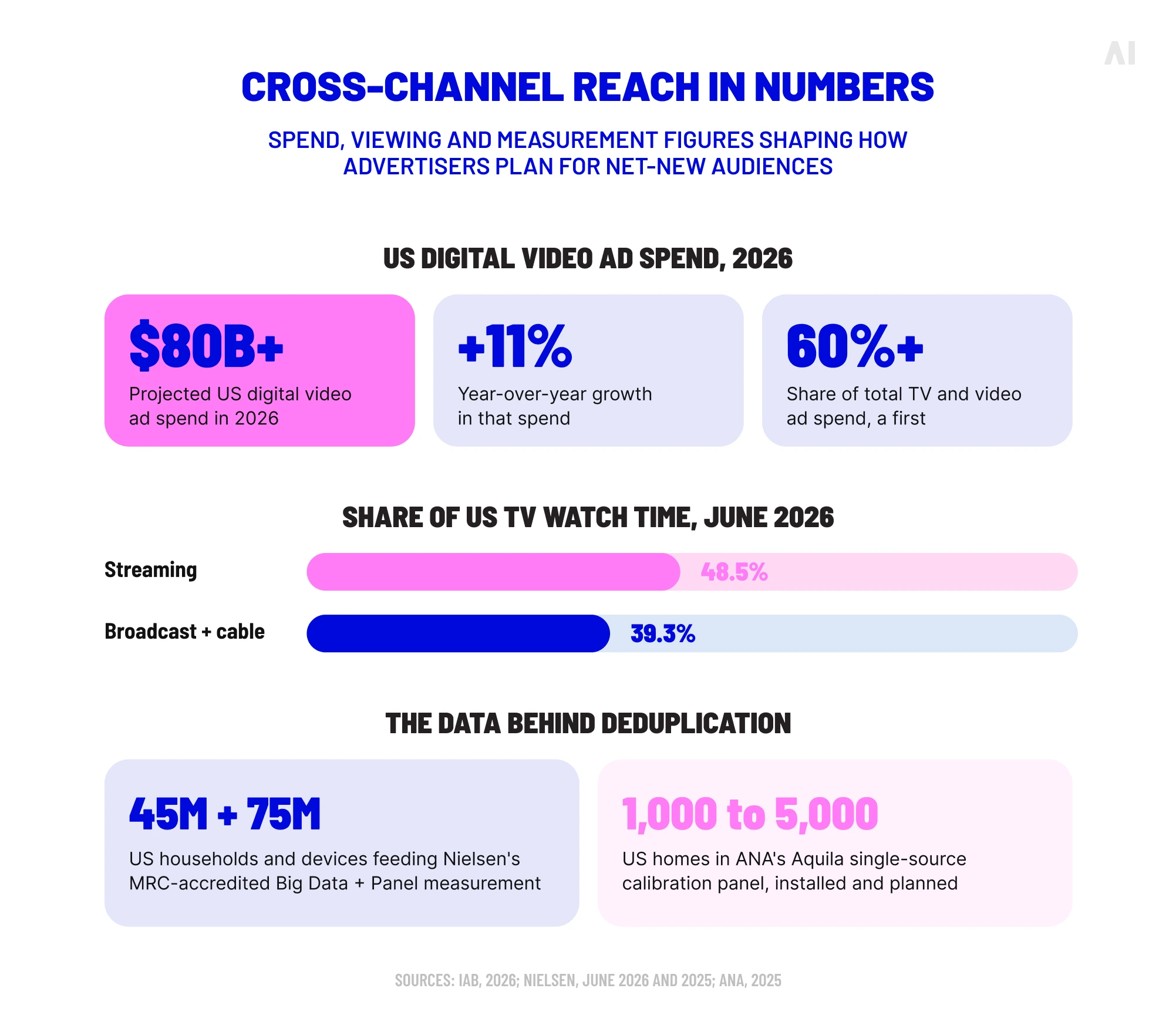
The investment behind those exposures is growing. US digital video spending is projected to surpass $80 billion in 2026, rising 11% year over year and exceeding 60% of total TV and video advertising spend for the first time. As budgets spread across connected TV (CTV), online video and social video, advertisers need to know which additions expand audience coverage and which mostly add another exposure among people already reached.
That is the role of incremental reach. This guide covers its calculation, audience deduplication, channel combinations, measurement limits and use alongside frequency, cost and business outcomes.
TL;DR: key takeaways
Incremental reach becomes useful when its baseline, measurement unit and denominator are explicit. Six principles cover most of the practical work:
- Incremental reach measures the additional unique audience reached beyond an existing campaign, channel or media mix.
- Standalone platform reach figures cannot simply be added because the same person or household may appear in several audiences.
- Deduplication must use a consistent unit, such as people or households, across a comparable population and period.
- A channel with extensive standalone reach may add little net-new coverage when it overlaps heavily with the baseline.
- Low incremental reach does not automatically make a channel ineffective. Repeated exposure can still support awareness, recall or action.
- Reach expansion should be assessed alongside frequency distribution, audience quality, media cost and business results.
What is incremental reach?
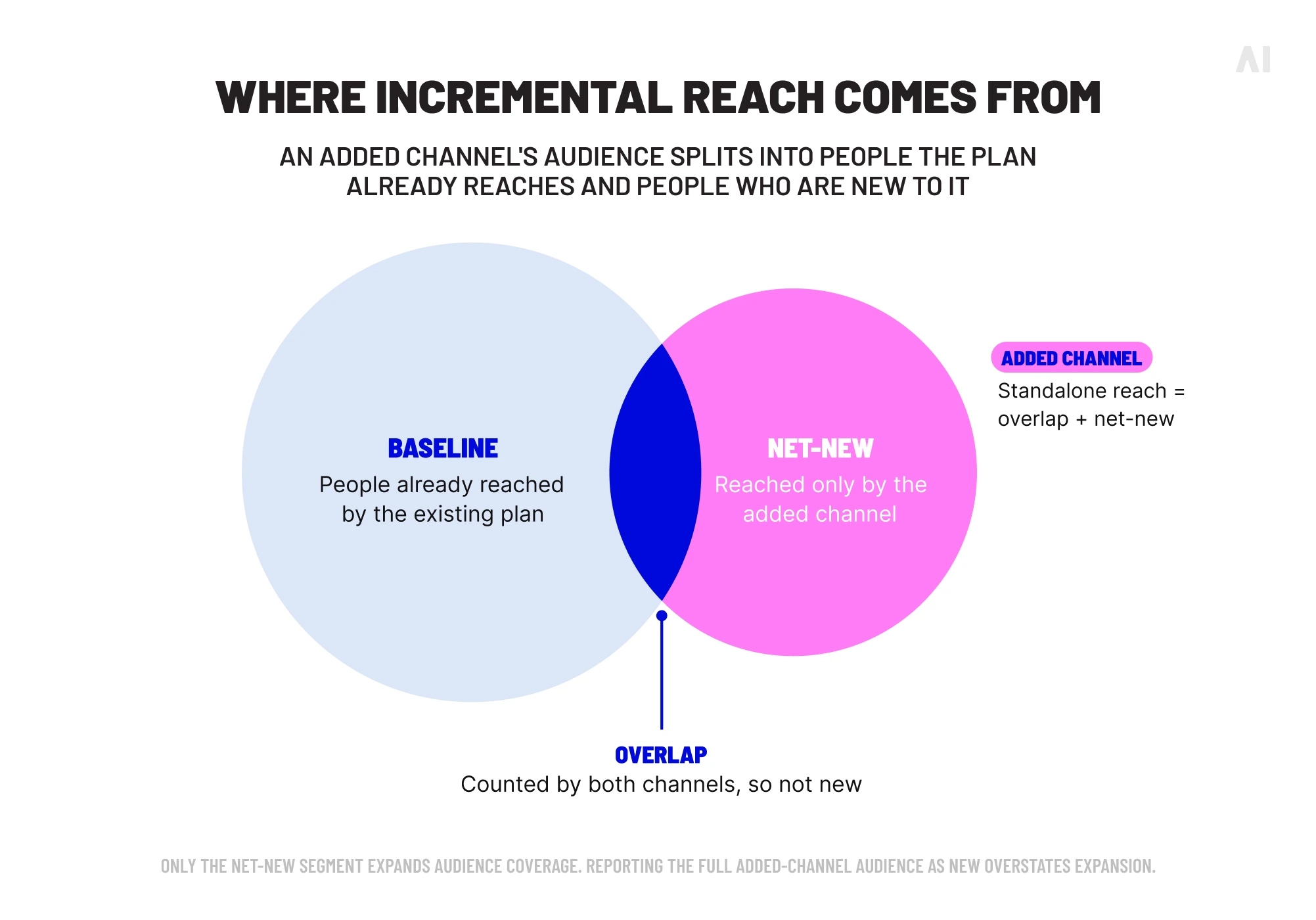
Incremental reach is the number of additional unique people or households exposed after a channel, campaign or other media investment is added to a defined baseline. If a paid social campaign is already running, for example, incremental reach would isolate the people reached by a new display campaign who had not previously been exposed through paid social.
The baseline is central to the definition. Streaming TV may provide incremental reach beyond a linear TV schedule, but the result will change if the baseline also includes online video and paid social. The metric therefore describes audience expansion relative to a particular starting point, not an inherent property of the added channel.
Incremental reach is also an exposure metric. It does not show how many additional people converted, how much revenue the campaign caused or which channel deserves credit for an outcome. Those questions require other forms of measurement.
The metric can be expressed as an absolute audience or percentage. The former reports net-new people or households. The latter places that audience against a stated denominator, often baseline reach. Because reporting systems use different denominators, the calculation should accompany the percentage.
⚡ Incremental reach isolates the audience an added channel contributes beyond the existing media plan.
Incremental reach vs. total reach vs. frequency
Reach and frequency describe different aspects of media delivery.
- Total reach measures the deduplicated audience across the campaign or media mix.
- Incremental reach isolates the part added beyond a baseline.
- Frequency describes how often the reached audience was exposed, either as an average or as a distribution.
Impressions answer another question: how many exposures were delivered? Adding a channel may increase them substantially while barely changing the unique audience. If most users have already seen the campaign, the added delivery contributes frequency rather than much incremental reach.
Repetition can help a message register, particularly when the creative is unfamiliar or the purchase cycle is long. Planners must determine how much is useful and when another impression would be better directed toward someone new.
Why incremental reach matters in cross-channel advertising
Cross-channel campaigns operate across environments with different viewing habits and partially overlapping users. In June 2026, streaming acounted for 48.5% of US television watch time, compared with 39.3% for broadcast and cable combined. A video plan may therefore need both traditional and streaming inventory, but their reported audiences cannot be treated as entirely separate groups.
Incremental reach helps planners evaluate what each addition contributes to the full mix. A platform may offer impressive scale on its own while reaching many viewers already covered elsewhere. Another may report a smaller audience but provide access to people the baseline reaches poorly. The second channel could make a greater contribution to audience expansion.
This changes how efficiency is interpreted. A low CPM can make impressions inexpensive without making net-new audience delivery inexpensive. Cost per incremental person or household, where reliable measurement is available, provides another view of channel contribution.
The same analysis can reveal saturation. As a campaign spends more within one environment, a growing share of delivery may return to people already reached. Advertisers can then compare the value of further repetition with the potential audience added through another channel. A coordinated cross-platform advertising strategy makes those trade-offs visible across the plan rather than leaving each platform to assess itself.
A product launch may prioritize broad unique coverage, while a retargeting or consideration campaign may favor additional exposures among a smaller audience. The mix should reflect that objective.
How to calculate and measure incremental reach
The basic incremental reach formula is simple. Producing trustworthy inputs is more difficult because the baseline and combined audience must use compatible definitions, populations, periods and identity methods.
Google’s Cross-Media Reach documentation captures the central measurement rule: impressions can be summed, while reach is duplicative because one person can be reached by several campaigns. Cross-channel incremental reach therefore depends on a deduplicated combined audience, not the sum of platform dashboards.
Step 1: define the baseline
Start with the campaign, channel or media mix against which the additional investment will be assessed, such as a linear TV schedule, paid social campaign or every channel already in the plan.
Record the target population, geography, campaign dates and unit of reach. A comparison fails if one platform reports US adults, another all users and a third devices. Because reach builds over time, align the measurement windows as well.
Changing the baseline changes the answer. A digital audio campaign may add considerable reach beyond online video alone, then contribute less when paid social and radio are already part of the baseline.
Step 2: deduplicate overlapping audiences
Next, divide the added channel’s audience into people already reached and people found only in the new channel. The first group represents overlap. The second is the incremental audience.
Audience deduplication may rely on authenticated identifiers, panels, identity graphs, clean rooms or statistical models. Each has limits and assumptions. Keep the reporting unit consistent: household-level overlap cannot be subtracted from person-level reach, and devices should not be presented as unique people.
Step 3: calculate the incremental audience
The core relationship is:
Absolute incremental reach = deduplicated combined reach − baseline reach
The supplied example can be resolved as follows.
The additional channel increased reach by 15% relative to the original baseline. That denominator needs to remain visible. Another reporting system might divide the incremental audience by the added channel’s standalone reach or by the total eligible population, producing a different percentage from the same audiences.
This calculation supports allocation only when its inputs are comparable. A wider cross-channel marketing measurement framework should document the source, unit, window, population and modeling method behind every reach figure.
How advertisers can increase incremental reach
Increasing incremental reach involves finding relevant people who remain underexposed, not merely adding platforms or impressions. Three planning decisions have the greatest influence.
Add channels that reach complementary audiences
A channel is most useful for audience expansion when it provides access to people the existing mix misses or reaches inefficiently. Planners can examine overlap by demographic group, geography, behavior, content environment and device use to identify those gaps.
Standalone scale offers limited guidance here. A large social platform may duplicate much of an established online-video audience. A more focused audio, CTV or publisher group may have lower total reach but a higher proportion of exclusive users. Relevance remains essential: reaching additional people outside the intended market does not improve the plan.
Balance incremental reach and frequency
Budget assigned to net-new users cannot produce another exposure among people already reached at the same time. That creates a practical trade-off between audience breadth and message reinforcement.
The appropriate balance depends on the objective, category and creative. A launch may favor rapid coverage; a considered purchase may require several encounters. Frequency distributions can reveal whether a plan reaches most people usefully or repeatedly serves a smaller group.
Watch for audience saturation and marginal reach
Marginal reach is the unique audience added by the next unit of spending. Early investment in a channel may reach many new people. Later investment often produces fewer new users because much of the reachable audience has already been exposed.
Compare the marginal contribution of more spend in the current channel with the likely incremental reach of a complementary one. Include cost, audience quality and expected outcomes, since the largest added audience may not be the most valuable.
⚡ The strongest media mix balances net-new audience coverage with useful repetition.
Incremental reach examples across channels
The calculation remains the same across media, although the available identities and measurement units change. These hypothetical scenarios show how partial audience overlap affects three common channel combinations.
Streaming TV and linear TV
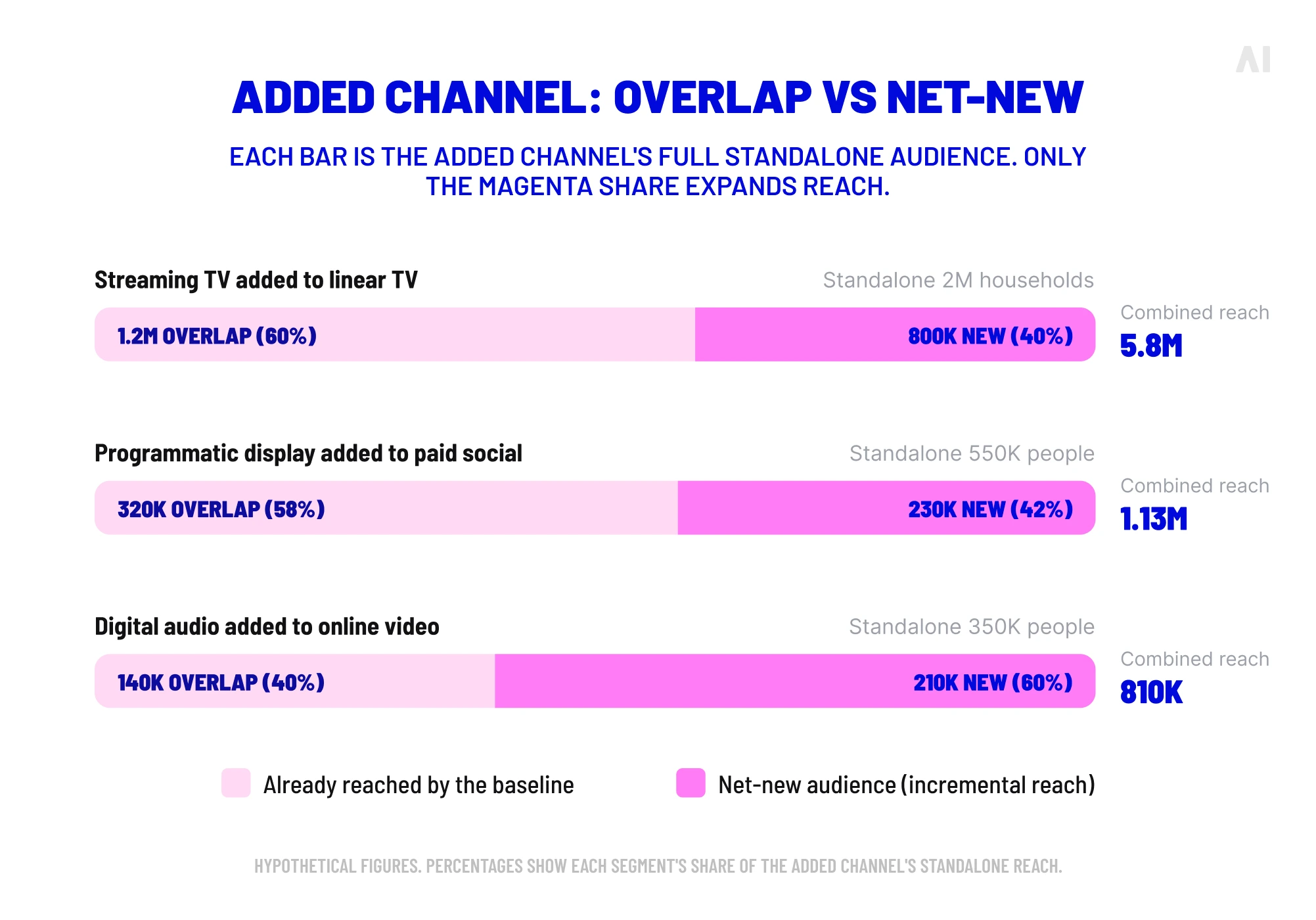
Suppose a linear campaign reaches 5 million households. A streaming extension reaches 2 million households, of which 1.2 million were also exposed through linear television. Streaming contributes 800,000 net-new households and brings deduplicated combined reach to 5.8 million.
Counting the full streaming audience as incremental would overstate expansion because it would include households found in both environments. The example also needs to remain at household level unless the measurement provider can produce compatible person-level estimates for both parts of the plan.
Programmatic display and paid social
Consider a paid social campaign reaching 900,000 people. Programmatic display then reaches 550,000, with 320,000 appearing in both audiences. The display extension contributes 230,000 additional people, producing a combined deduplicated audience of 1.13 million.
The value of display comes from the users it reaches beyond social, not from treating its full reported audience as new. Access to publishers, formats and buying environments through programmatic advertising can widen coverage, although the result will depend on targeting, inventory and the quality of cross-environment identity resolution.
Digital audio and video
Imagine an online-video campaign reaching 600,000 people. Digital audio reaches 350,000 during listening occasions, including 140,000 people already exposed to the video campaign. Audio adds 210,000 new people and raises combined reach to 810,000.
Different consumption contexts can make channels complementary. Audio may reach people while they commute, exercise or work away from a screen, yet still overlap with video. The example demonstrates additional coverage, not proof that audio is cheaper or more effective.
Incremental reach vs. incrementality and attribution
Incremental reach, incrementality and attribution are sometimes grouped together because all three inform media evaluation. They answer separate questions and rely on different evidence.
Incremental reach vs. incrementality
Incremental reach asks how many additional people or households were exposed beyond a baseline. Incrementality asks how many additional business outcomes occurred because marketing ran.
The IAB and IAB Europe guidelines define incrementality through causal impact: additional outcomes directly driven by marketing compared with what would have occurred without it. Establishing that counterfactual can require randomized holdouts, matched markets or modeled controls.
A channel can consequently add a large new audience without producing detectable incremental sales. The newly reached people may have little interest in the offer, encounter weak creative or need more time before acting. Exposure is a necessary input for many campaigns, but it is not a causal outcome.
Incremental reach vs. attribution
Attribution assigns credit to recorded marketing interactions associated with a conversion. It can describe which eligible touchpoint appeared last, which channels occurred along a recorded path or how a model distributes credit. Incremental reach evaluates audience expansion instead.
A channel may introduce the brand to many new people but receive little last-touch credit because later search, email or direct visits capture the conversion. Conversely, a retargeting campaign may collect substantial attributed revenue while reaching few people beyond those already exposed.
💡 AI Digital’s guide to incrementality vs. attribution examines the distinction between assigned credit and causal contribution in greater detail.
Incremental reach adds a third lens focused specifically on exposure.
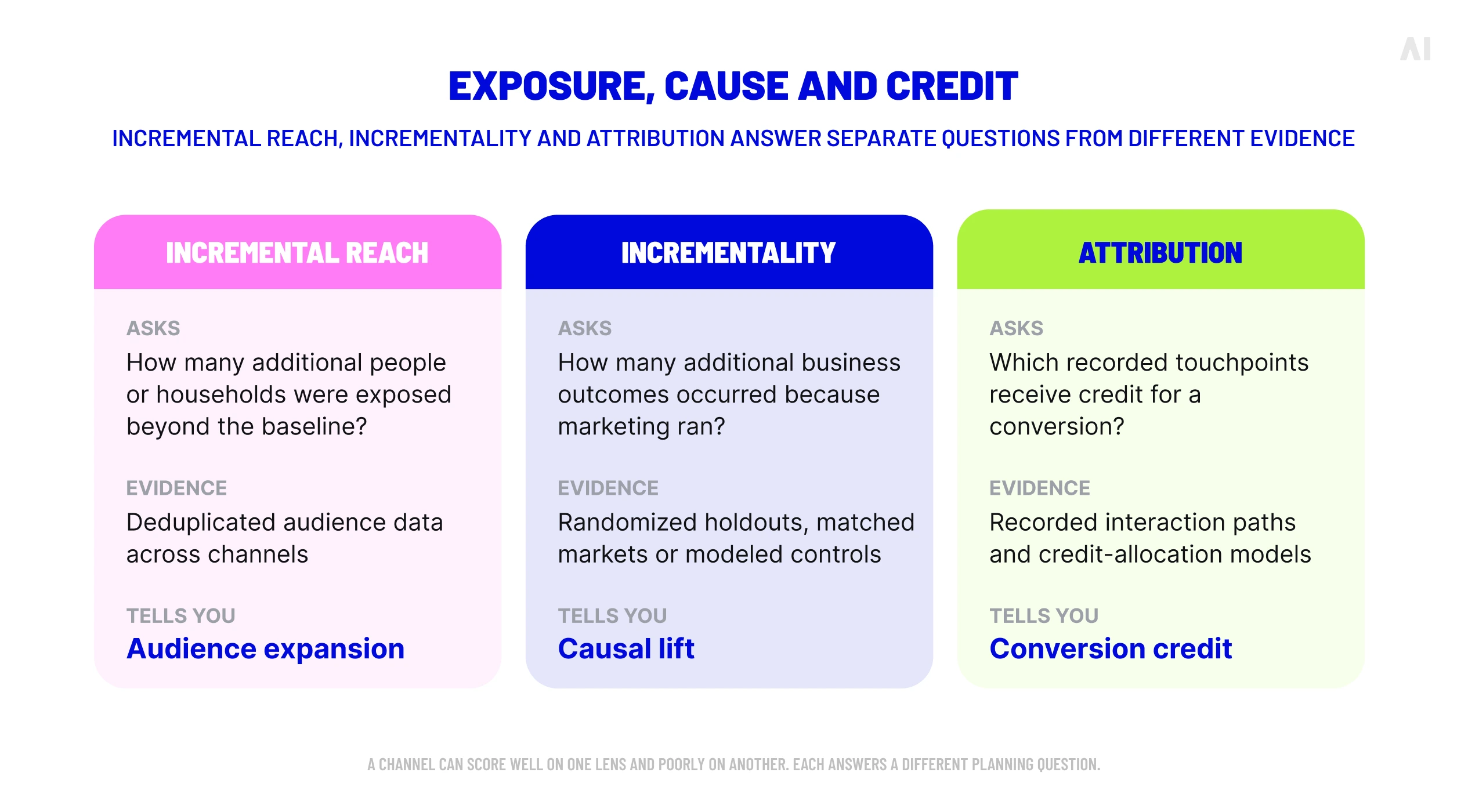
⚡ Audience expansion, conversion credit and causal lift answer three different measurement questions.
Challenges of measuring incremental reach across channels
The subtraction works only when the measurement system can identify overlap credibly across devices, platforms and locations.
Identity, deduplication and co-viewing
One person may appear as several identifiers across browsers, apps, phones, computers and televisions. At the same time, a shared television may represent several viewers. Deduplication must resolve both problems without assuming that one identifier always equals one person.
Panels provide one route from device activity to people. ANA’s Aquila initiative reported in 2025 that its single-source calibration panel had been installed in more than 1,000 US homes, with plans to expand to 5,000. The panel is intended to help personify platform datasets and support privacy-preserving reach and frequency reporting.
Large device datasets solve another part of the measurement problem. Nielsen’s MRC-accredited Big Data + Panel system combines information from 45 million US households and 75 million devices with representative panel measurement. The distinction is important: device data provides scale, while panels help assign viewing to people and calibrate estimates to the population.
Platforms use their own modeled approaches as well. Google explains that its unique reach models combine aggregated behavior with signals such as census and probability-survey inputs to deduplicate across sessions, formats, networks and devices. Its separate co-viewing methodology estimates the additional viewers watching together on CTV screens.
None of these approaches makes deduplication perfect. Results reflect the identities, panels, platform data, model assumptions and privacy thresholds available to the system.
Fragmented platform reporting and reach definitions
Walled gardens limit external access to event-level data, and their dashboards may define audiences differently. One platform may report modeled people, another authenticated accounts and another devices or households. Even two person-level estimates may cover different populations or campaign windows.
Industry work such as the World Federation of Advertisers’ Halo framework demonstrates the infrastructure required for privacy-preserving, deduplicated reach and frequency across media owners. Shared methods, publisher participation and governance are all part of the solution.
Strong cross-platform measurement governance begins with these definitions. If the units, populations and windows cannot be reconciled, platform reach figures should remain separate rather than being presented as deduplicated cross-channel reach.
How AI Digital supports cross-channel audience planning and measurement
Incremental reach sits inside a larger allocation process. Teams still need research, audience intelligence, strategic planning, optimization and reporting to decide which channels deserve investment and how those decisions affect campaign objectives.
Elevate brings those functions together through Research & Intelligence, Strategic Planning, Optimization & Reporting and an AI Agents Library. The platform can help media teams assess audiences and competitors, develop plans around defined KPIs, review campaign information and turn reporting into actions across fragmented advertising environments.
That visibility can help teams locate audience gaps, consider channel additions and relate reach expansion to performance. Human judgment remains necessary to establish the baseline, examine the methodology and determine the metric’s weight.
Elevate should not be interpreted as a dedicated incremental reach methodology or an automatic cross-platform audience-deduplication product. Its role here is the wider planning, intelligence and reporting structure within which advertisers evaluate additional investment.
Expand audience reach without losing measurement clarity
Incremental reach gives advertisers a disciplined way to ask what another channel or budget increase adds to the existing audience. Its value depends on a visible baseline, a consistent unit of reach and credible audience deduplication.
The result should then be considered alongside frequency, media efficiency, audience quality and business outcomes. That combination helps planners distinguish genuine coverage gains from another layer of exposure and allocate investment according to the job each channel performs.
To discuss how AI Digital approaches cross-channel audience planning, optimization and measurement, get in touch with the team.