Frequency Capping Explained: How Advertisers Control Ad Exposure Across Channels


Frequency capping has become harder to manage because media exposure no longer happens inside one clean channel. The same customer may see a brand’s ads on Connected TV, scroll past them on social media, encounter display placements on publisher sites, and hear the same campaign in digital audio—all within the same day.
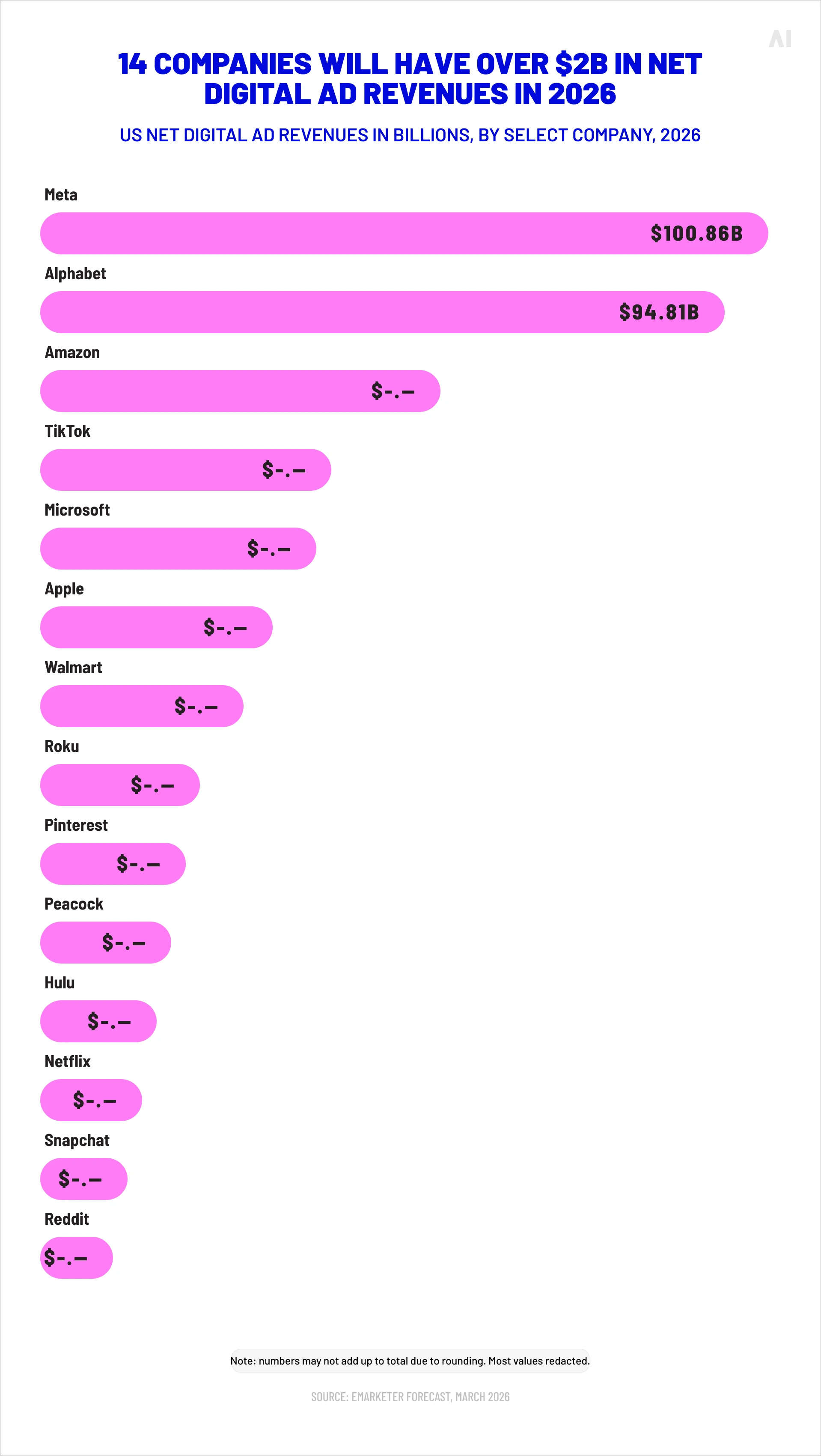
eMarketer estimates that U.S. digital ad spending will surpass $300 billion in 2026, with Connected TV alone expected to exceed $40 billion in spend. That expansion creates more opportunities for reach, but also more risk of cumulative overexposure when platforms manage frequency separately.
The problem is not that advertisers lack a frequency cap. It is that most caps are still enforced inside individual platforms. A campaign may control exposure in a DSP, Meta, Google, Amazon, or a CTV buying platform, yet still fail to understand how often the same audience is being reached across all of them combined. That fragmentation can lead to saturation, wasted impressions, declining engagement, and a worse customer experience.
For enterprise advertisers, effective frequency management now requires a cross-channel view of exposure, not just platform-level controls. The goal is no longer simply to limit impressions inside one campaign; it is to coordinate reach, repetition, creative rotation, and measurement across the entire media mix so budgets work harder without exhausting the audience.
What Is Frequency Capping?
Frequency capping is the practice of limiting how many times an individual user, household, or audience segment is exposed to the same advertisement within a defined period. A frequency cap helps advertisers control repetition so campaigns can build recognition without creating saturation, fatigue, or unnecessary media waste.
In practice, frequency caps can be applied at different levels, including:
- Ad level: Limiting exposure to a specific creative.
- Campaign level: Controlling how often users see ads from one campaign.
- Line-item level: Managing exposure within a specific buying tactic or placement.
- Audience level: Adjusting exposure based on user behavior, intent, or funnel stage.
- Platform level: Applying limits inside a DSP, social platform, CTV platform, or ad network.
The purpose is not to reduce reach blindly. It is to balance reach, repetition, customer experience, and budget efficiency. Too little exposure may weaken recall, while too much exposure can waste impressions and irritate the audience.
Frequency capping is especially important in programmatic advertising, where campaigns can run across many publishers, exchanges, devices, and formats at once. For cross-channel campaigns, frequency control also needs to be connected to measurement.
⚡️AI Digital’s guide, Cross-Channel Marketing Measurement: Challenges and Solutions, explores how marketers evaluate duplicated reach and cumulative exposure across fragmented media environments.
How a Frequency Cap Works
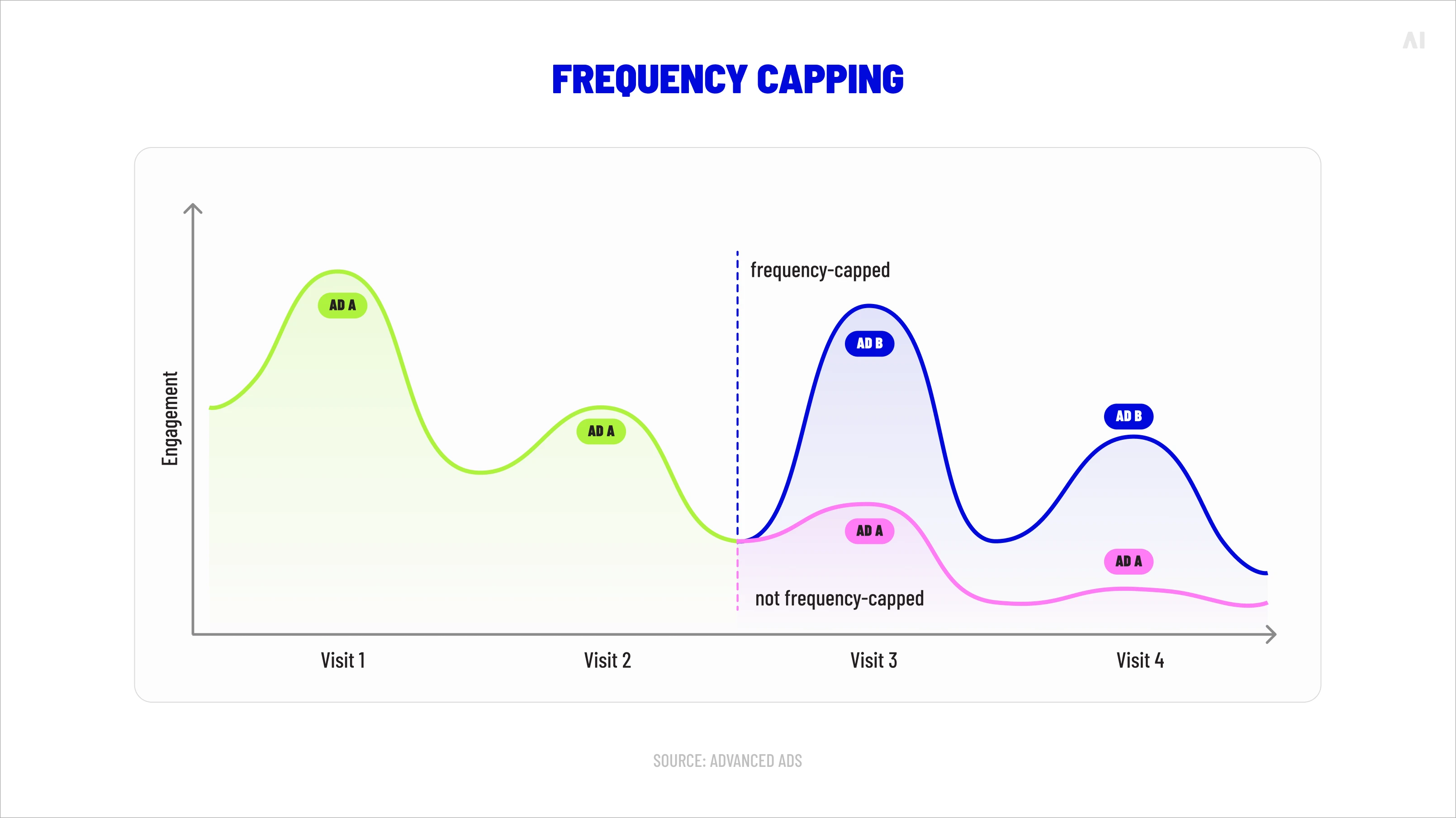
A frequency cap works by counting how many impressions have been served to a user or identifier within a selected timeframe. Once the user reaches the defined limit, the platform stops serving that ad or campaign to them until the cap resets.
For example, if a campaign has a cap of three impressions per user per day, the platform can show the ad up to three times in that daily window. After the third impression, that user becomes temporarily ineligible for the same campaign.
To enforce frequency limits, platforms rely on identifiers such as:
- Cookies for browser-based environments.
- Device IDs for mobile apps and connected devices.
- Authenticated IDs from logged-in users.
- Household IDs in some CTV and streaming environments.
💡This process is easier inside one platform than across multiple systems. A DSP may recognize a user in programmatic display, but Meta, Google, Amazon, and CTV platforms may each apply their own frequency logic separately. To understand the buying infrastructure behind these controls, read AI Digital’s guide to demand-side platforms.
Selecting the Right Timeframe
The timeframe determines how quickly a frequency cap resets. Choosing the wrong window can either limit campaign scale too aggressively or allow too much repeated exposure.
Common frequency cap windows include:
- Hourly caps: Useful for high-volume campaigns where overexposure can happen quickly.
- Daily caps: Common for display, social, video, and retargeting campaigns.
- Weekly caps: Helpful for balancing reach and repetition in awareness or consideration campaigns.
- Monthly caps: Useful for longer buying cycles, seasonal campaigns, or B2B audiences.
- Lifetime caps: Best for preventing excessive exposure across the full campaign duration.
Shorter windows give advertisers tighter control over saturation, while longer windows support pacing across extended campaigns. For example, a daily cap may protect users from seeing the same retargeting ad too often, while a weekly cap may be better for broad brand awareness campaigns that need repeated exposure over time.
The right timeframe depends on campaign objective, audience size, creative rotation, purchase cycle, and channel mix. A narrow retargeting audience may need stricter controls, while a broad awareness campaign may tolerate more repetition if creative is varied and performance remains stable.
Benefits of Frequency Capping
The main benefit of frequency capping is control. A campaign needs enough repetition to build memory, but too much exposure can create saturation, waste budget, and weaken the customer experience. A well-managed frequency cap helps advertisers find the point where repeated exposure still adds value without overwhelming the same audience.
For performance teams, frequency capping supports three practical goals:
- Protecting reach: Budget is not over-concentrated on the same users.
- Reducing wasted impressions: Ads stop serving once additional exposure is unlikely to improve outcomes.
- Improving customer experience: Audiences are less likely to feel followed, interrupted, or irritated by the same brand.
- Maintaining campaign efficiency: Marketers can monitor when frequency begins to hurt CTR, CPA, VTR, or conversion quality.
This matters because consumers are increasingly resistant to repetitive advertising. Gartner’s 2026 consumer survey found that 81% of U.S. consumers try to ignore or tune out ads, 52% actively take steps to block ads, and 24% of Gen Z consumers say retargeted ads negatively affect their perception of the advertised brand. That makes frequency management both a performance issue and a brand perception issue.
Frequency management should also connect to broader performance measurement. AI Digital’s guide to digital marketing KPIs explains how marketers evaluate campaign performance beyond surface-level metrics.
⚡️Our another guide, Marketing Measurement Strategy: How to Measure and Optimize Performance Across Channels, explores how these KPIs connect across fragmented media environments.
Frequency vs. Reach
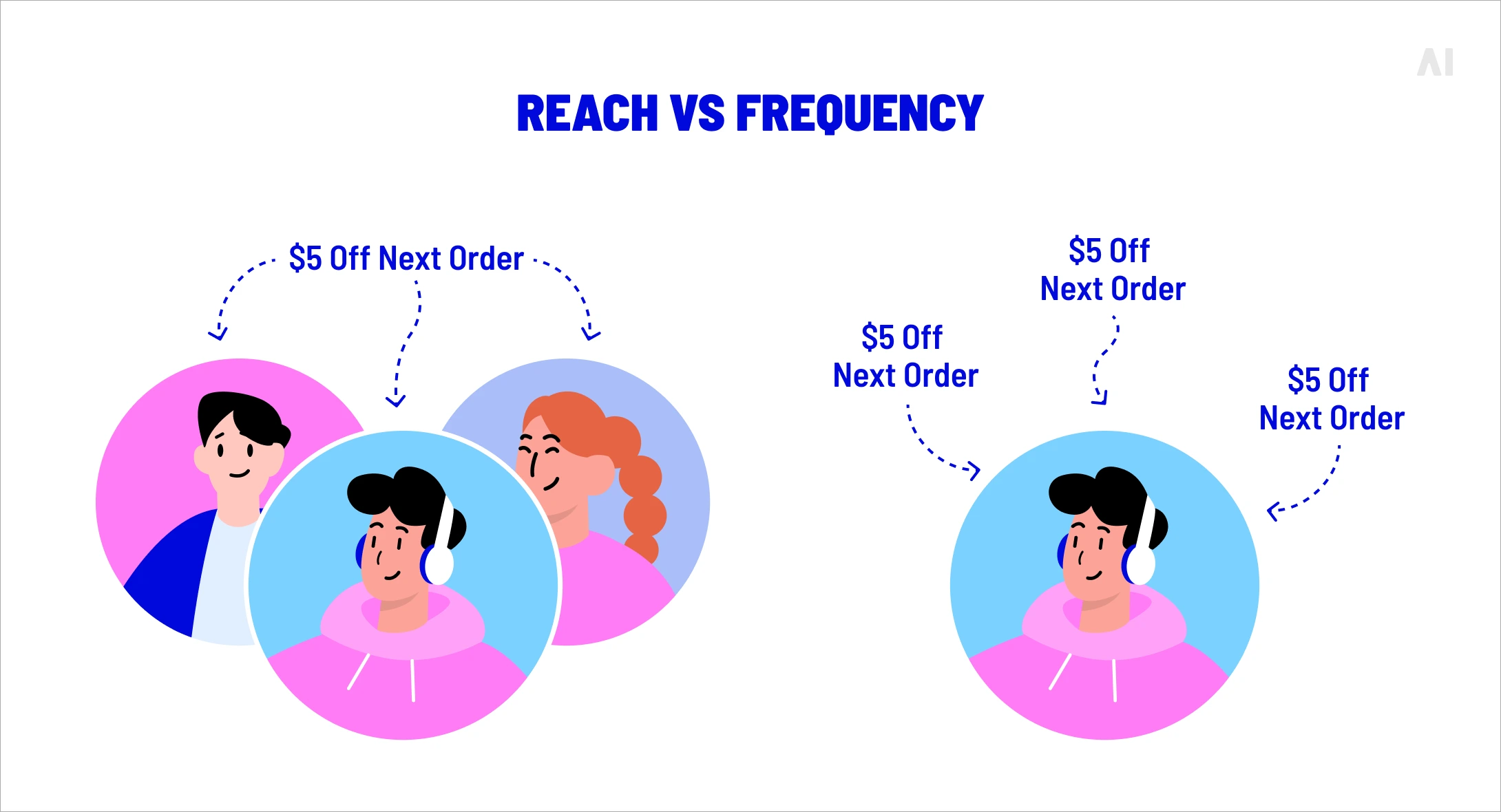
Reach and frequency compete for the same budget. When advertisers increase frequency, they show ads more often to the same people. When they prioritize reach, they distribute impressions across a larger audience.
The right balance depends on campaign intent:
- Awareness campaigns usually need broad reach with moderate repetition.
- Consideration campaigns need enough exposure to educate the audience without overloading them.
- Retargeting campaigns can support higher frequency because the audience has already shown intent.
- CTV and video campaigns often require stricter caps because each impression is more visible, immersive, and expensive.
The key is to avoid treating frequency as a fixed benchmark. A healthy cap for a broad awareness campaign may be too low for retargeting and too high for premium video.
⚡️AI Digital’s guide, The Reach vs Frequency Challenge in Omnichannel Campaigns, explains how advertisers can manage this trade-off across connected channels.
Preventing Ad Fatigue
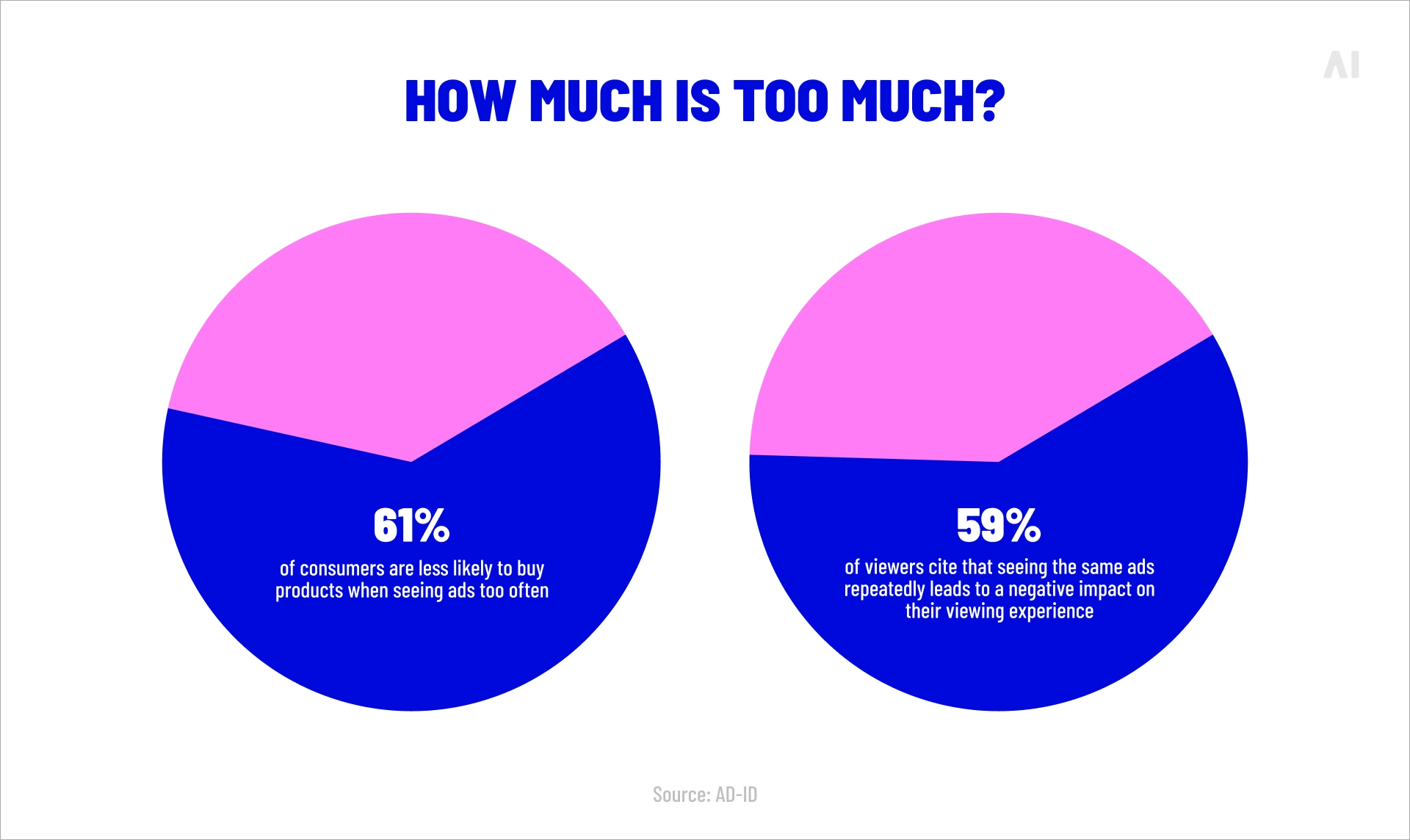
Ad fatigue happens when repeated exposure stops improving performance and starts reducing engagement. At first, repetition can build memory. After a certain point, the same creative becomes easier to ignore.
Common warning signs include:
- Declining click-through rate.
- Lower video completion rate.
- Rising CPA or CPC.
- Falling conversion rate from previously responsive audiences.
- Increased negative feedback, hides, unsubscribes, or muted ads.
A frequency cap helps slow this decline by limiting how often a person sees the same campaign within a defined window. However, caps work best when paired with creative rotation, audience segmentation, and sequential messaging. If the same ad is shown repeatedly, even a reasonable cap can still lead to fatigue.
Reducing Budget Waste
Every impression has an opportunity cost. When a campaign keeps serving ads to users who are already saturated, budget is pulled away from people who have not yet been reached or who may be more likely to convert.
Frequency capping helps reduce waste by allowing advertisers to:
- Stop over-serving low-value impressions.
- Reallocate spend toward underexposed audiences.
- Improve incremental reach.
- Reduce inefficient retargeting.
- Preserve performance across longer campaign flights.
The goal is not to minimize exposure. The goal is to make each exposure more intentional. Strong frequency capping helps advertisers spend less on repetition that no longer contributes to performance and more on the audiences, channels, and creative variations that still drive measurable value.
Frequency Capping Best Practices by Campaign Type
There is no universal frequency cap that works for every campaign. The right setting depends on the campaign objective, audience size, buying channel, creative rotation, and how close the audience is to conversion.
A broad brand awareness campaign can usually tolerate moderate repetition because the goal is memory-building. A narrow retargeting campaign needs tighter monitoring because the audience is smaller and can reach saturation quickly. Premium video and CTV campaigns often require more conservative frequency management because each impression is more visible and typically more expensive.
Google Ads defines frequency capping as a feature that limits how often Display or Video ads appear to the same person, while Display & Video 360 allows caps at campaign, insertion order, and line-item levels—meaning advertisers can control exposure at multiple layers of the media plan.
Awareness and Branding Campaigns
For upper-funnel campaigns, the goal is not to minimize exposure. It is to create enough repetition for audiences to remember the brand without making the campaign feel repetitive.
A practical starting point for awareness campaigns is often 2–4 impressions per user per week, then adjusting based on reach, recall, engagement, and media cost. Broader audiences can usually support lighter caps because the campaign has more room to scale.
Use awareness-focused frequency caps when you want to:
- Build brand recognition.
- Launch a new product or market entry campaign.
- Reinforce positioning across a broad audience.
- Avoid over-serving the same users while reach is still available.
Audience quality matters as much as exposure. AI Digital’s guide to targeting options for brand awareness explains how advertisers structure upper-funnel audiences without relying only on broad reach.
Retargeting and Conversion Campaigns
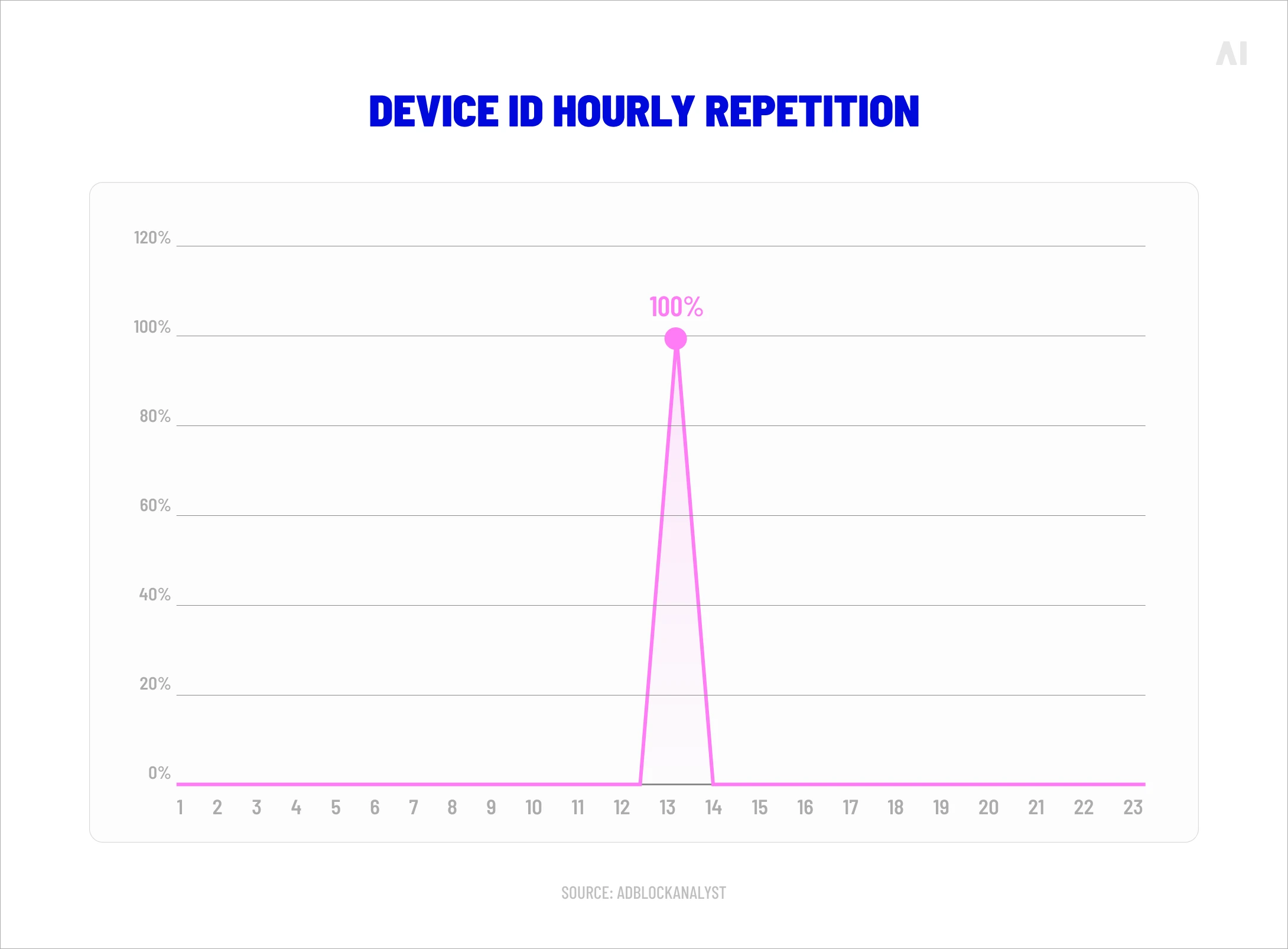
Retargeting campaigns often require a different frequency strategy because the audience has already shown intent. Someone who visited a pricing page, added a product to cart, or engaged with a demo video may need more repetition than a cold prospect.
💡A reasonable starting point is 3–7 impressions per user per week, depending on purchase intent and sales cycle length. However, smaller audiences can fatigue quickly, so performance should be monitored closely.
Use higher retargeting frequency only when:
- The audience has clear commercial intent.
- Creative is rotated regularly.
- The offer is time-sensitive.
- Conversions continue improving as frequency increases.
⚡️For video-led remarketing, AI Digital’s guide to CTV retargeting explains how advertisers reconnect with audiences across streaming environments.
CTV and Video Advertising
CTV and premium video advertising require more conservative frequency management because the ad experience is highly visible, often full-screen, and harder to ignore than standard display. In household-based environments, the same ad may also be seen by multiple people using the same device or account.
A practical starting range is 2–5 impressions per household per week for CTV and 2–4 impressions per user per week for online video, depending on the platform and campaign objective.
Marketers should pay attention to:
- Household-level exposure.
- Cross-device duplication.
- Completion rate by frequency level.
- Creative fatigue across repeated views.
- Whether CTV exposure is also being reinforced by display, social, or audio.
⚡️To understand the channel context, AI Digital’s guide to Connected TV advertising explains how CTV inventory works, while its guide to programmatic video advertising covers buying video inventory across publishers, CTV, OTT, and apps.
When Higher Frequency Makes Sense
Higher frequency is not always a mistake. In some cases, more aggressive exposure can improve performance when the campaign has a clear reason for repetition.
Higher caps may make sense for:
- Sequential storytelling: Each exposure introduces a new message.
- Product launches: Brands need repeated exposure in a short window.
- Live events: Urgency matters before a fixed date.
- Limited-time promotions: Frequency supports short-term action.
- High-intent retargeting: Audiences are close to conversion.
The key is to make higher frequency intentional. If the same creative is repeated without variation, performance can decline quickly. If each exposure moves the customer through a different message, offer, or proof point, higher frequency can support momentum.
⚡️Our new article, The 6 Key Benefits of Retargeting Ads [+ What Are They], explores when repeated exposure helps convert high-intent audiences.
Common Frequency Capping Mistakes
Setting a frequency cap is only the first step. Many campaigns still waste spend because advertisers apply frequency limits too broadly, ignore creative fatigue, or manage exposure inside each platform without understanding total audience saturation.
Effective frequency capping requires more than choosing a number. It depends on the relationship between exposure, creative quality, audience intent, channel behavior, and cross-channel measurement.
One Frequency Cap Doesn't Fit Every Channel
A common mistake is applying the same frequency cap across display, video, CTV, social, and retargeting campaigns. Each channel creates a different customer experience, so exposure should be managed differently.
For example:
- Display ads are often less intrusive and can support slightly higher frequency.
- CTV and video ads are more visible, immersive, and harder to ignore.
- Social ads compete inside fast-moving feeds, where creative freshness matters.
- Retargeting campaigns reach smaller, higher-intent audiences that can saturate quickly.
A cap that works well for display may be too aggressive for CTV or too restrictive for retargeting. Strong frequency capping best practices start with channel-specific limits based on campaign objective, format, audience size, and performance data.
Ignoring Creative Fatigue
Even a well-configured frequency cap cannot protect performance if the same creative is shown too often. Repeated exposure may build recognition at first, but over time, the audience can become less responsive.
Signs of creative fatigue include:
- Falling CTR or engagement rate.
- Lower video completion rates.
- Rising CPA or CPC.
- Declining conversion quality.
- More negative feedback, hides, or muted ads.
To reduce fatigue, advertisers should rotate creative regularly, refresh messaging before performance drops, and use sequential storytelling where each exposure adds something new. A user who sees three different messages across the funnel is less likely to feel irritated than someone who sees the same ad three times in one day.
Campaign-Level vs. Audience-Level Caps
Campaign-level frequency caps are useful, but they can still create uneven exposure across audience groups. One audience segment may see an ad too often, while another receives too little exposure to build recall or drive action.
Audience-level caps give advertisers more control by adjusting exposure based on funnel stage and intent. For example:
- Cold audiences may need lower frequency and broader reach.
- Engaged visitors may need moderate repetition with educational messaging.
- High-intent users may justify higher frequency for a limited time.
- Converted customers should often be suppressed from acquisition campaigns.
This approach prevents one generic frequency cap from treating every user the same, even when their relationship with the brand is different.
Forgetting Cross-Channel Duplication
The biggest frequency management mistake is assuming platform-level caps control total exposure. In reality, each platform often enforces its own limit independently. A user may be capped inside Meta, Google, a DSP, and a CTV platform, but still see the same brand repeatedly across all of them combined.
This creates several risks:
- Duplicated impressions across platforms.
- Higher cumulative frequency than planned.
- Budget waste from overexposed audiences.
- Poor customer experience from repetitive messaging.
- Misleading performance reporting when each platform claims its own contribution.
Solving this requires unified measurement, audience de-duplication, and cross-channel visibility. Without that broader view, advertisers may believe their frequency strategy is controlled when the audience is actually experiencing the campaign everywhere at once.
Cross-Channel Frequency Capping
Managing frequency capping inside one platform is relatively straightforward. A DSP, social platform, or CTV buying tool can usually count impressions, apply a frequency cap, and stop serving the same campaign once the user reaches the limit.
The challenge starts when the same campaign runs across multiple channels at once. A customer may see the same brand across CTV, programmatic display, paid social, audio, digital out-of-home, and retail media, while each platform manages exposure separately. From the advertiser’s dashboard, every platform may appear controlled. From the customer’s perspective, the campaign may feel repetitive.
This is why cross-channel frequency management is no longer just a media-buying detail. It is a budget efficiency and customer experience problem. When exposure is managed in silos, advertisers risk:
- Duplicated impressions across platforms.
- Audience saturation among already-reached users.
- Wasted spend on impressions that add little incremental value.
- Inconsistent reporting across different measurement systems.
- Brand irritation when customers see the same message too often.
⚡️The issue is closely tied to fragmented data environments. AI Digital’s guide to walled gardens explains why major platforms limit how data moves across ecosystems, while its article on data fragmentation in advertising explores how disconnected systems make unified campaign measurement harder.
Why Platform Caps Aren't Enough
Platform-level caps are necessary, but they do not equal true cross-channel control. Each platform can only limit what it can see.
For example, a user may be capped at:
- 5 impressions on Google Display.
- 5 impressions on Meta.
- 3 impressions through a DSP.
Individually, each platform is respecting its own frequency cap. Collectively, the same user may receive 13 or more impressions from the same brand in a single day, especially if CTV, audio, or retail media are also active.
This creates a false sense of control. The advertiser may believe exposure is managed because every platform has a cap in place. In reality, the customer experiences the campaign across all channels combined. Only cross-channel coordination can reveal whether frequency is building useful recall or pushing the audience into saturation.
Identity Fragmentation: The Root Cause
Effective cross-channel frequency capping depends on recognizing when different impressions belong to the same user, household, or audience segment. That is difficult because identifiers are fragmented across environments.
Advertisers may need to connect signals from:
- Browser cookies.
- Mobile device IDs.
- CTV household IDs.
- Logged-in platform accounts.
- CRM or first-party customer data.
- Publisher-level identifiers.
These identifiers rarely align perfectly. Walled gardens keep much of their audience data inside their own platforms, while privacy regulations and third-party cookie deprecation have reduced the reliability of older tracking methods. Device fragmentation adds another layer of complexity because the same customer may interact with a brand on a phone, laptop, smart TV, and tablet.
This is why advertisers increasingly rely on first-party data, privacy-safe collaboration, and independent measurement. AI Digital’s guide to data clean rooms explains how brands and media partners can collaborate without directly exposing raw user-level data. For campaigns where identity resolution is limited, contextual advertising can also help advertisers reach relevant environments without depending entirely on individual-level identifiers.
Our new guide, What Is an Identity Spine in Modern Marketing?, will explore how advertisers connect identity signals across fragmented ecosystems.
Walled Garden Challenges
Walled gardens such as Google, Meta, and Amazon create a specific problem for cross-channel frequency management. They offer strong targeting and optimization inside their own ecosystems, but they do not provide full user-level visibility across competing platforms.
As a result, an advertiser may be able to control frequency inside each walled garden but still lack a unified view of total exposure. Google may know how often a user saw the campaign in its ecosystem. Meta may know the same for its own inventory. Amazon may report exposure inside its retail and streaming environments. But no single platform can fully show the combined customer experience across all three.
Solving this requires infrastructure outside individual platforms, including independent measurement, data clean room approaches, and cross-channel reporting systems. AI Digital’s guide to alternatives to walled gardens explains how advertisers can reduce dependency on closed ecosystems and build more transparent measurement strategies.
Without that broader view, advertisers can only manage frequency in fragments. With cross-channel visibility, they can identify duplication, reduce overexposure, and reallocate spend toward audiences that still have room for incremental reach.
Implementing Frequency Capping
Implementing frequency capping means deciding where exposure limits should be applied, how strict those limits should be, and how they should interact with pacing, creative rotation, and audience suppression. In programmatic environments, this is usually managed inside a DSP or buying platform, where advertisers can configure caps at different levels of the campaign structure.
The goal is not simply to restrict delivery. The goal is to control repeated exposure while still allowing campaigns to reach enough qualified users to perform. A strong implementation process should answer four questions:
- Who should be capped?
- Which campaign, audience, or creative should the cap apply to?
- What timeframe should be used?
- What should happen after a user reaches the cap?
DSP-Level Frequency Controls
In demand-side platforms, frequency caps can usually be configured at multiple levels, such as advertiser, campaign, insertion order, or line item. This structure gives marketers flexibility, but it also requires careful planning.
For example:
- Advertiser-level caps help control exposure across a broader account.
- Campaign-level caps manage repetition within a specific initiative.
- Insertion order caps control pacing across a group of related line items.
- Line-item caps provide the most granular control for specific audiences, formats, or placements.
Display & Video 360, for example, allows frequency caps to be set at the campaign, insertion order, or line-item level. These decisions affect both delivery and pacing, because stricter caps may slow spend if the eligible audience is too small.
Platform Differences in Frequency Capping
Frequency controls vary significantly by platform. Google Ads supports frequency capping for Display and Video campaigns, but the mechanics differ: Display caps can apply at campaign, ad group, or ad level, while Video frequency caps are set at the campaign level and can limit impressions, views, or both.
Meta offers frequency controls for auction and reservation buying, but availability depends on campaign setup and objective. Amazon DSP allows advertisers to set caps at hourly, daily, or shorter interval levels, and frequency groups can help manage frequency across multiple campaigns.
These differences matter because platform-specific caps do not prevent cumulative exposure across ecosystems. A user may be capped inside Google, Meta, Amazon, and a DSP separately but still receive too many total impressions from the same brand.
⚡️To understand how these buying systems connect, AI Digital’s guide to DSPs, SSPs, and ad exchanges explains the core infrastructure behind programmatic media buying.
Creative Rotation
Frequency caps are more effective when paired with creative rotation. If a user sees the same ad multiple times, even a conservative cap can lead to fatigue. Rotating creative extends campaign effectiveness by giving each exposure a different role.
Useful creative rotation strategies include:
- Sequential messaging, where each ad introduces a new benefit or proof point.
- Format variation, such as switching between static display, video, and short-form assets.
- Offer rotation, especially for promotions or retargeting campaigns.
- Refresh schedules, where creative is replaced before performance declines.
This approach lets advertisers maintain repetition without making every impression feel identical.
Audience Suppression
Audience suppression complements frequency capping by removing users who should no longer receive the same message. Instead of only limiting how often someone sees an ad, suppression determines whether they should continue seeing it at all.
Common suppression audiences include:
- Converted customers.
- Users who reached a high exposure threshold.
- Existing customers excluded from acquisition campaigns.
- Low-intent users who have not responded after repeated exposure.
- Audiences moved into a different funnel stage.
Suppression improves efficiency by reducing wasted impressions and improving the customer experience.
⚡️AI Digital’s guide to DSP vs. DMP explains how media buying and audience data systems work together. Our other article, CDP vs DMP: What’s the Difference in Modern Advertising?, explores how customer data platforms and data management platforms support segmentation, suppression, and activation across campaigns.
Measuring the Impact of Frequency Capping
A frequency cap should not be judged only by whether it reduces impressions. The real question is whether it improves campaign efficiency, protects the customer experience, and helps advertisers reach the point where exposure creates value without causing saturation.
To evaluate whether frequency capping is working, marketers should monitor performance by exposure level, not just overall campaign averages. Key metrics include:
- Average frequency: How often each user or household sees the campaign.
- Frequency distribution: How many users saw the ad once, twice, five times, or more.
- CTR by frequency level: Whether engagement improves or declines after repeated exposure.
- CPA by frequency level: Whether additional impressions continue to support efficient conversions.
- Incremental reach: Whether the cap helps budget reach new users instead of over-serving the same audience.
- Conversion rate by exposure band: Whether performance improves after a certain number of impressions or starts to decline.
- Creative performance by frequency: Whether fatigue is tied to exposure volume or specific ad variations.
A/B testing can also help identify the optimal exposure threshold. For example, one audience group may receive a cap of three impressions per week, while another receives six. If the higher-frequency group generates only marginal additional conversions at a much higher CPA, the stricter cap may be more efficient.
The goal is to find the point of diminishing returns. Once additional impressions stop improving engagement, conversions, or revenue, the cap should be adjusted and budget reallocated toward underexposed audiences or higher-performing channels.
For a deeper look at why campaign reporting can become difficult across fragmented platforms, read AI Digital’s guide to marketing effectiveness measurement challenges.
⚡️AI Digital’s new guides, What Is Incrementality Testing in Marketing and Digital Marketing Measurement Across Channels: Why Modern Attribution Is No Longer Enough, also explore how advertisers can measure true incremental impact beyond platform-reported conversions.
Solving Cross-Channel Frequency Management with AI Digital
Cross-channel frequency capping becomes difficult when advertisers cannot see total exposure across every channel. A brand may set separate caps for programmatic display, CTV, paid social, retail media, and direct publisher buys. But without unified visibility, it is hard to know whether those impressions are building useful repetition or creating audience fatigue.
Solving this problem requires more than changing platform settings. Advertisers need infrastructure that can:
- Make media buying more transparent.
- Connect campaign data across channels.
- Identify cumulative exposure.
- Support independent measurement outside closed ecosystems.
- Turn fragmented reporting into actionable optimization.
This is where AI Digital helps advertisers move from siloed platform reports to coordinated media management. AI Digital’s guide to a marketing intelligence platform explains how unified intelligence connects data, performance, and decision-making across channels.
⚡️From Data to Decisions: How Marketing Intelligence Transforms Performance Strategy, explores how marketers can turn fragmented campaign data into smarter optimization.
Transparent Media Buying
Frequency management is easier when advertisers know where their ads are running. If media is bought through dozens of unclear intermediaries, it becomes harder to understand where impressions are going, which audiences are being reached, and where duplication may be happening.
AI Digital’s Smart Supply gives advertisers access to a curated and transparent programmatic supply path. By reducing unnecessary intermediaries and improving visibility into inventory sources, advertisers can manage exposure with more confidence.
This matters for frequency control because cleaner supply paths make it easier to:
- Track where impressions are served.
- Reduce duplicated exposure.
- Improve inventory quality.
- Identify inefficient media paths.
- Make frequency de-duplication more reliable.
Creative at Scale Across Both Channels
Frequency management is not only a media problem. It is also a creative problem.
When advertisers run both programmatic and direct media campaigns, they need creative assets for multiple formats, publishers, devices, and audience stages. Without enough variation, even a well-configured frequency cap may not prevent fatigue. Audiences may not be overexposed to the campaign overall, but they may still see the same message too many times.
AI Digital’s AI Creative Studio helps reduce this bottleneck by supporting faster creative production at scale while maintaining brand consistency. This makes it easier to:
- Rotate messages across channels.
- Adapt assets for different formats.
- Refresh creative before performance declines.
- Support sequential storytelling.
- Keep campaigns consistent without slowing execution.
Unified Campaign Measurement
Platform reports rarely show the full customer experience. A user may appear under the cap in one platform but still be overexposed across the full media mix.
AI Digital’s Elevate provides cross-channel campaign intelligence that helps advertisers understand cumulative exposure, performance trends, and budget allocation across channels.
This visibility helps teams identify:
- Where frequency is too high.
- Where reach is underdeveloped.
- Which channels are duplicating exposure.
- Where budget should be reallocated.
- Which cap adjustments should be made mid-flight.
💡Instead of optimizing each platform in isolation, advertisers can make frequency decisions based on the broader campaign picture.
Independent Measurement
True cross-channel frequency control requires measurement that is not limited by one platform’s reporting environment. No single walled garden can provide a neutral view of how often the same audience sees a brand across publishers, platforms, devices, and channels.
AI Digital’s Open Garden Framework supports independent, non-walled measurement by helping advertisers connect audience and performance data across fragmented environments. This gives marketers a clearer view of cumulative exposure and reduces reliance on closed platform reporting.
⚡️For a deeper explanation, AI Digital’s guide to the Open Garden Framework explains how independent infrastructure supports more transparent, cross-channel media measurement.
Optimize Campaign Performance with Frequency Capping
Frequency capping is more than a technical campaign setting. Used well, it becomes a strategic lever for improving media efficiency, protecting brand perception, and reducing wasted budget across paid media.
The core challenge is not simply setting a frequency cap inside one platform. Most advertisers can already do that. The harder problem is managing total exposure across a fragmented ecosystem where the same customer may see the same brand across CTV, display, social, audio, retail media, and programmatic campaigns.
To make frequency management work at scale, advertisers need to combine:
- Channel-specific caps that reflect how each format is experienced.
- Creative rotation to prevent fatigue as exposure increases.
- Audience suppression to stop wasting impressions on converted or saturated users.
- Performance measurement by frequency level to identify the point of diminishing returns.
- Cross-channel visibility to understand cumulative exposure across platforms.
As media buying becomes more complex, the most effective advertisers will treat frequency management as part of broader campaign intelligence, not as an isolated setting. Transparent supply paths, unified measurement, and independent reporting make it easier to understand where impressions are going, which audiences are overexposed, and where budget can be reallocated for better results. AI Digital’s new guide, Why Frequency Management Matters in Modern Advertising, explores this strategic shift in more detail.
⚡️To learn how AI Digital can help improve cross-channel media efficiency, campaign measurement, and frequency control, get in touch with the AI Digital team.

.webp)