Smart TV Advertising: What It Is and How It Fits Into the CTV Ecosystem

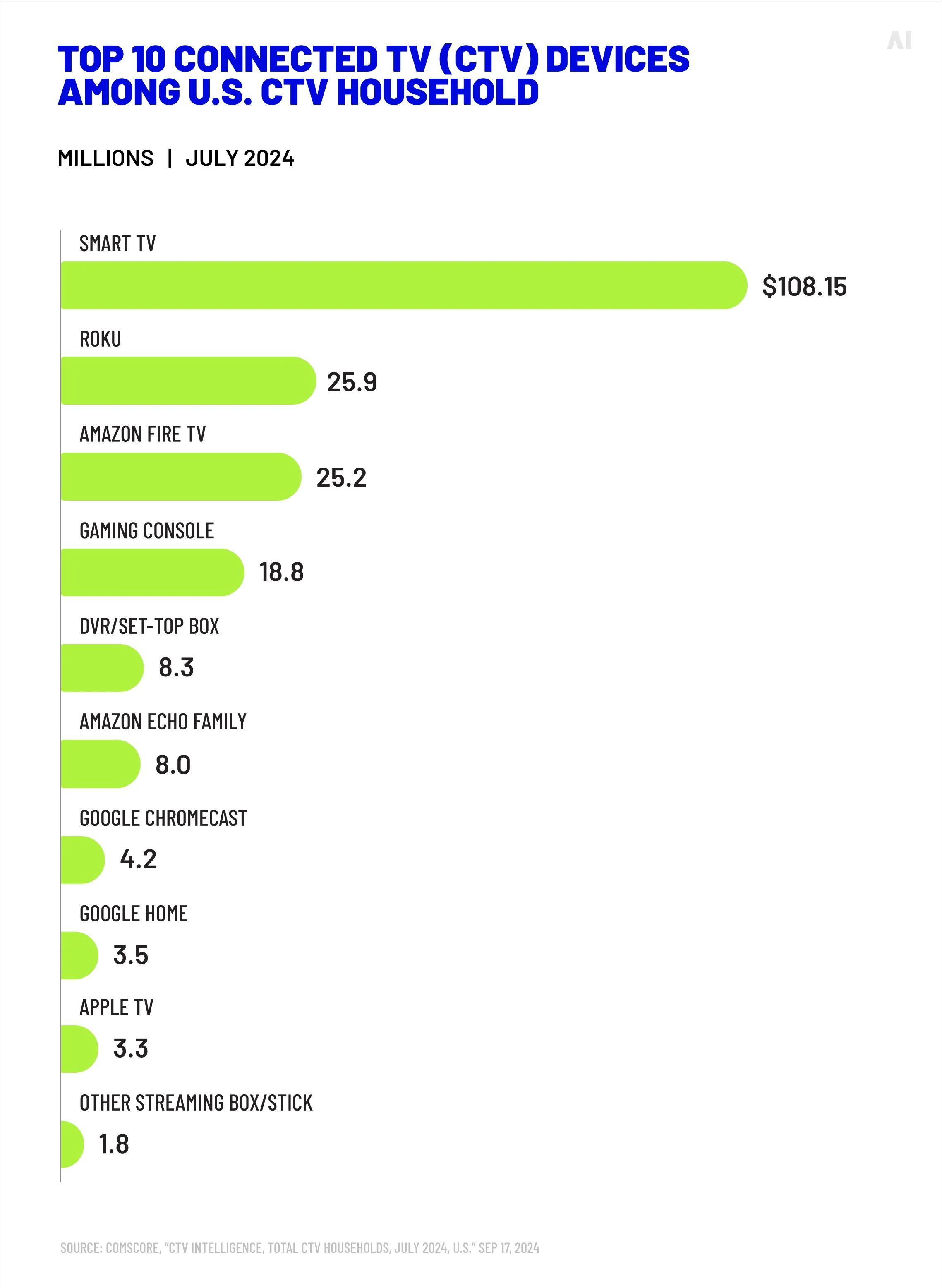
Over the past few years, Smart TVs have taken over as the default way US households stream video. In mid-2024, 67.5 million US households were using Smart TVs, making them the most popular CTV device in connected homes.
That shift matters for marketers. When a viewer turns on a Samsung, LG or Google TV set, they don’t start in a specific app. They land on an operating system (OS) homescreen that controls what they see first, how they discover content, and which ads appear before any show or movie starts. For advertisers, that homescreen is now a premium surface, not just a utility menu.
At the same time, CTV audiences keep growing. In 2024, around 233.9 million people in the US watched CTV, across roughly 115 million households. Smart TV platforms sit right in the middle of that growth, combining:
- OS-level visibility (homescreen and navigation real estate)
- Deterministic device identifiers and viewing data rather than cookies
- Real-time optimization and attribution, more like digital performance channels than traditional TV
💡 If you want a refresher on the broader TV mix, AI Digital’s guide to TV advertising walks through how linear, CTV and streaming fit together.
In the rest of this guide, we’ll focus specifically on Smart TV advertising: what it is, how it works, the main ad formats and platforms, the realities of measurement and fragmentation, and how a Smart TV–focused partner can turn this complexity into performance.
⚡ Smart TVs turned the TV menu into premium media real estate. That first screen is now one of the most influential placements in a CTV campaign.
What is Smart TV advertising?
Smart TV advertising is the practice of buying ad placements that are delivered directly through the TV’s native operating system, not just through individual streaming apps.
In concrete terms, that means ad inventory running on platforms such as:
- Samsung Tizen
- LG webOS
- Google TV / Android TV
These operating systems control the homescreen, the app grid, recommendation rails, search, and often a built-in free streaming service (FAST). Smart TV advertising taps into all of that.
Two important distinctions:
- OS-level vs. app-level inventory
- Smart TV advertising = placements controlled by the TV OS itself (homescreen banners, sponsored tiles, system-level video, OS-owned FAST like Samsung TV Plus or LG Channels).
- CTV / streaming inventory = ad slots inside individual apps (Hulu, YouTube, Freevee, Pluto TV, etc.), regardless of which device those apps run on.
- Device-level identity vs. cookie-based identity
- Smart TV platforms use device identifiers and household-level data, not third-party cookies or mobile ad IDs. This is crucial for targeting and frequency management across the TV environment.
{{26-Smart-TV-Advertising-SEO-1="/tables"}}
💡 If you want a broader CTV refresher, the AI Digital guides on connected TV advertising and streaming TV advertising give useful context on how app-level buying works across devices.
How Smart TV fits into the CTV ecosystem
Within the CTV universe, Smart TV is a subset with special privileges.
- CTV: Any internet-connected device that delivers TV content on a large screen (Smart TVs, Roku, Amazon Fire TV, Apple TV, game consoles, set-top boxes).
- Smart TV: A television set with an embedded operating system and app store, capable of streaming without external hardware.
Every Smart TV is a CTV device. Not every CTV device is a Smart TV.

Why Smart TV matters so much inside CTV:
- Default entry point: For many households, the Smart TV OS is the starting point for streaming. People hit the power button and land on Samsung, LG or Google TV—not Roku or a cable EPG.
- Platform-level placements: Smart TV OS owners can sell ad units outside of any individual app:
- Homescreen banners and takeovers
- Sponsored content tiles in recommendation rails
- Featured app placements
- Branded rows in built-in FAST services
- Richer first-party viewing data: Many Smart TVs use Automatic Content Recognition (ACR) to identify what’s playing on screen, whether it’s linear broadcast, OTT, or HDMI inputs. That provides a glass-level view of viewing behaviour that external dongles don’t always see.
Think of Smart TV advertising as a highly strategic slice of CTV: it doesn’t replace app-level CTV buying, but it adds OS-controlled inventory and data that can shift performance.
💡 You’ll see this trend come up in AI Digital’s piece on 5 CTV advertising trends, where Smart TV OS control and homescreen attention are core themes.
Smart TV vs. traditional TV
Smart TV advertising differs from traditional linear TV in several important ways: targeting, control, formats, and measurement.
{{26-Smart-TV-Advertising-SEO-2="/tables"}}
Targeting and audience control
When you compare Smart TV ads with linear TV, targeting is the first big shift. Both reach living-room audiences, but they do it in very different ways.
- Traditional TV – In the linear world, you still plan mostly around content and time slots, using programmes as a proxy for audience:
- Buy: specific programmes, dayparts, and networks.
- Targeting is inferred: you pick a show that over-indexes for your target demo and hope ratings hold.
- Smart TV advertising – Smart TV advertising flips that model. Instead of starting with channels and shows, you start with the viewer you want to reach:
- Buy: audiences and devices, regardless of which shows they watch.
- Platforms like Samsung Ads and LG Ad Solutions build segments using deterministic viewing data, device graphs and, in some cases, cross-device behaviour.
This means you can, for example, target households that haven’t seen your linear TV spots or retarget viewers who watched a competitor’s ad, based on ACR signals.
⚡ The biggest shift is moving from buying programs to buying people and households.
Ad experience and formats
The viewing experience also changes once the TV is connected. Smart TV platforms add new surfaces and formats that simply do not exist in a traditional break:
- Linear TV is limited to 30- and 15-second spot breaks inside live or time-shifted programming.
- Smart TV offers:
- Homescreen banners and takeovers
- Sponsored carousels and navigation tiles
- In-app CTV video inside AVOD/FAST streams
- Interactive, shoppable and remote-driven experiences
We’ll unpack these formats in more depth later, but the key point is: Smart TV lets you reach viewers before they choose what to watch, not just inside ad breaks.
Measurement and performance
This is where the gap becomes obvious:
- A May 2025 analysis using Incrmntal data found that CTV generated 10× more conversions than linear TV while using just 60% of the linear budget, across campaigns for more than 50 brands.
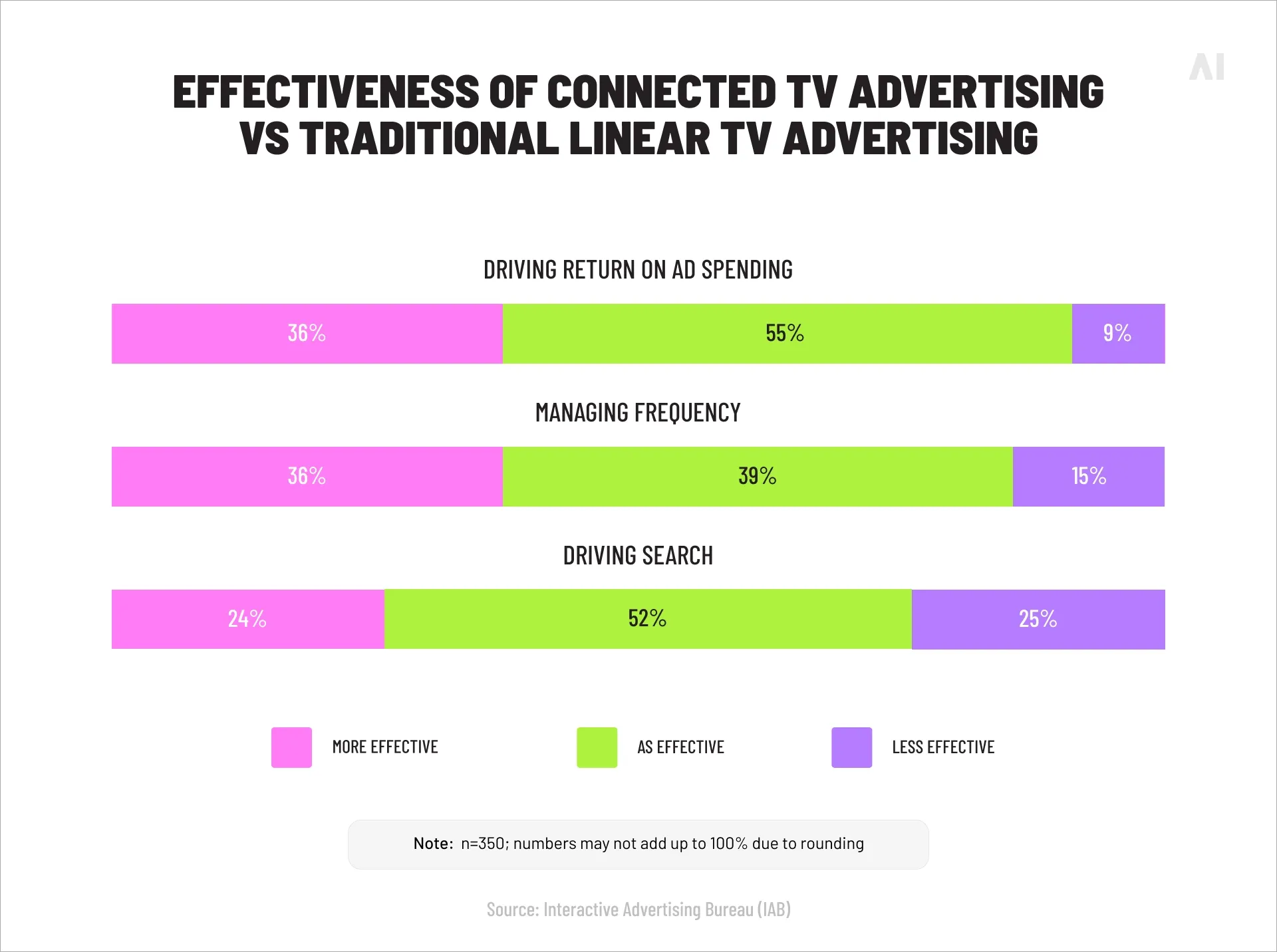
- In a separate study, 91% of advertisers said CTV is as effective or more effective than linear TV at driving return on ad spend, highlighting how quickly the channel has matured.
Smart TV platforms sit at the heart of that shift. Because they use deterministic device IDs and can tie exposures to outcomes (site visits, app installs, even retail activity in some cases), TV stops being a purely upper-funnel channel and starts behaving more like paid social or programmatic.
For a deeper comparison of the two worlds, you can pair this guide with AI Digital’s article on CTV vs linear TV.
⚡ Smart TV advertising keeps the impact of a 55-inch screen, but gives you the control and accountability of digital.
How Smart TV platforms deliver ads
Smart TV platforms deliver ads through the operating system itself as well as through OS-owned apps. That delivery chain looks a little different from web or mobile.
1. OS-level placements
The Smart TV OS controls what appears on:
- The homescreen (hero banners, carousels, app rows)
- Navigation menus (content rails, app store, search results)
- System notifications and overlays
When you buy Smart TV ads at the OS level, you’re reserving space in those surfaces. For example:
- A hero banner at the top of the Samsung TV home UI
- A sponsored row on LG’s webOS interface promoting your series premiere
- A featured tile on Google TV’s “Top picks” row
These impressions are served based on device-level IDs and OS data. They do not rely on browser cookies or mobile ad IDs, which makes them resilient to privacy and ID changes.
2. Built-in FAST and OS-owned channels
Most Smart TV OS owners now operate their own free ad-supported streaming services:
- Samsung TV Plus on Samsung TVs
- LG Channels on LG TVs
- Google TV’s FAST rail that aggregates free channels across distribution partners
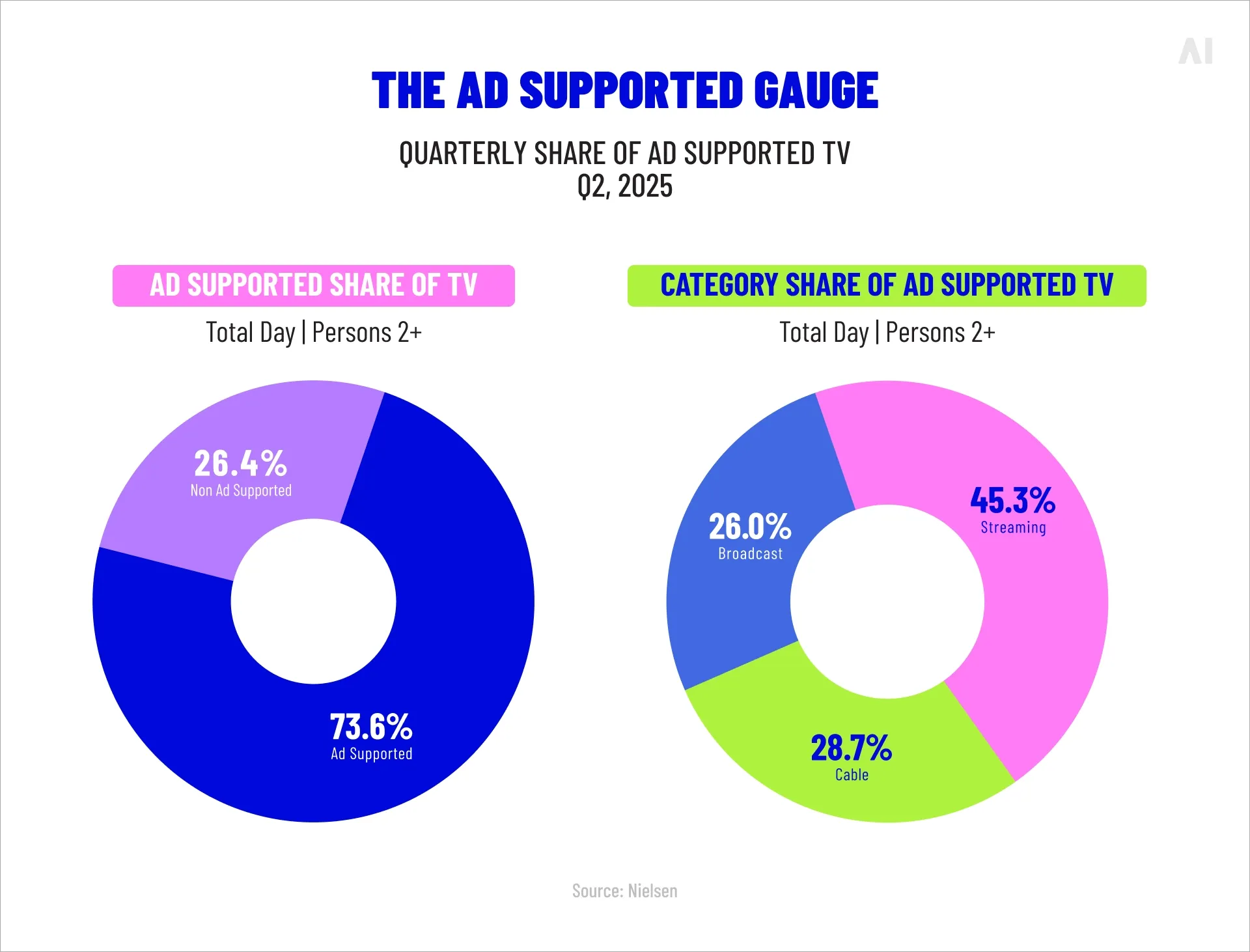
These services behave like any other streaming network, but the OS owner controls both the app and the underlying inventory. For instance, Samsung TV Plus is now a top-five app on Samsung Smart TVs and the leading FAST service on nearly 80 million sets in the US.
Ads here are typically sold programmatically or via platform-direct deals, and they can be bundled with homescreen placements for combined reach and frequency.
3. App-level delivery via Smart TV ad marketplaces
Smart TV platforms also plug into wider CTV ad marketplaces:
- The OS or a linked SSP aggregates inventory from third-party apps.
- A demand-side platform (DSP) such as The Trade Desk, Google DV360, or Amazon DSP bids on impressions in real time.
- The Smart TV ad server then fills the slot in the app with the winning video ad.
This is what enables in-app video advertising at scale across dozens or hundreds of streaming publishers on Smart TVs, even when the OS doesn’t own the app.
4. Deterministic device identifiers
Under the hood, Smart TVs rely on:
- Device IDs and household graphs maintained by the OS owner
- Optional ACR data that logs what appears on screen at the pixel level
- Cross-device graphs (e.g. linking a Samsung TV to Samsung mobile devices) where available
This deterministic identity layer allows:
- Frequency capping at the device or household level
- Audience targeting based on viewing behaviour, not inferred demographics
- Attribution that links TV impressions to online or offline actions
In short, Smart TV platforms deliver ads through a closed but very precise device-driven workflow, which is why so many marketers now treat Smart TV as a performance channel rather than just TV “extension”.

⚡ Once you understand how the OS serves impressions, Smart TV stops feeling mysterious and starts looking like any other addressable channel.
Smart TV ad models and format types
Once you understand how the OS delivers ads, the next step is picking the right Smart TV ad formats. Each format serves a different purpose in the funnel.
Homescreen placements
Homescreen placements are the signature Smart TV ad format. They appear on the TV’s main screen as soon as it powers on.
Common variants include:
- Hero banners / mastheads – Large image or video units at the top of the homescreen. Often used for:
- New series launches
- Film releases
- Major retail events or brand campaigns
- Sponsored content tiles – Branded content cards that sit alongside organic recommendations. Clicking the tile opens a streaming app, a specific episode, or a branded destination.
- Featured app placements – Promoted positions in the app grid or app store, ideal for streaming services, games or retail apps trying to drive installs.
Why homescreen matters:
Recent data from LG Ad Solutions found that home screen ads on Smart TVs generate an average of 7 seconds of attentive viewing, deliver 16% higher attention retention and score 27% stronger ad ratings compared with standard digital placements; 85% of viewers describe them as clear, informative and brand-building.
That combination of visibility and user acceptance makes homescreen inventory incredibly valuable for:
- Reach and awareness bursts
- Announcing launches or seasonal offers
- Creating “prime shelf” presence for streaming apps or brands
⚡ If CTV is the new store, the Smart TV homescreen is the end-cap display everyone walks past on their way in.
In-navigation units
In-navigation units appear while viewers browse and decide what to watch, rather than when content is playing.
Examples include:
- Sponsored rows in content discovery carousels
- Branded tiles in search results or “Because you watched…” rails
- Featured collections (e.g. “Summer thrillers presented by [Brand]”)
These formats work well when you want to:
- Influence choice at the decision point: For example, a studio sponsoring a “Kids & Family” rail to steer families toward its titles.
- Support homescreen bursts: Homescreen hero plus in-navigation tiles gives a brand more than one touchpoint during the same viewing session.
Because they are native to the OS UI, in-navigation units feel like part of the browsing experience. The challenge is creative clarity: viewers should understand that a tile is sponsored, and what happens when they click it.
In-app video ads
In-app video ads are the bridge between Smart TV advertising and broader CTV advertising.
These are the standard video spots you see when streaming ad-supported content:
- Pre-rolls and mid-rolls in AVOD apps like Hulu or Freevee
- Ad breaks inside FAST channels (Samsung TV Plus, LG Channels, Pluto TV, Tubi, etc.)
- Short form video ads inside apps like YouTube on TV
Smart TV platforms participate in these buys in two ways:
- Their own streaming apps:
- Samsung TV Plus
- LG Channels
- Google TV’s own aggregated FAST experiences
- Ad marketplaces and SSP partnerships: Smart TVs expose app inventory to programmatic buyers via SSPs, so you can book in-app video across many apps while still applying device-level targeting.
Why these matter in a Smart TV plan:
- They provide scale and frequency, since viewers spend most of their time inside content.
- They’re ideal for mid-funnel objectives such as site visitation or app installs.
- When combined with OS-level placements, they create strong sequencing: a viewer sees a homescreen hero, then a 30-second spot in a FAST channel, then a retargeted ad on another device.
Interactive and shoppable Smart TV formats
Interactive and shoppable Smart TV formats turn TV from a passive medium into an action channel.
Typical interaction models include:
- Remote-control interaction – These formats keep everything on the TV itself, so viewers can respond with a single click of the remote:
- “Press OK to learn more” overlays
- Product carousels or quizzes controlled entirely by the remote
Roku has reported that viewers are five to 10 times more likely to click a shoppable ad with their remote than to scan a QR code, underscoring how powerful remote-based interaction can be.
- QR code-enabled journeys – Here, the TV and the smartphone work together, with the screen acting as the launchpad for a richer mobile experience:
- Viewers scan a QR code on the Smart TV screen with their phone.
- They land on a product page, coupon, or lead form.
Campaigns from brands such as Mondelez and Walmart have seen QR-driven CTV ads deliver as much as 10× higher conversions than CTV benchmarks in some cases.
- Shoppable overlays and “action ads” – These units push TV further down the funnel, turning passive exposure into a direct path to purchase or sampling:
- Amazon and Roku offer formats where a viewer can add an item to their cart or request a sample directly from the TV.
- Roku’s Action Ads, for example, let viewers complete simple actions via the remote and later redeem offers on mobile or in store.
- Branded mini-experiences – In this case, the ad itself becomes the experience, inviting viewers to play, vote or explore rather than just watch:
- Interactive games, polls, or immersive experiences run in ad breaks, often on OEM platforms like Samsung Ads.
These formats are still early, but they already change how TV fits into the funnel. Instead of waiting for someone to search later, you can:
- Grab attention on a large screen.
- Offer a low-friction action (remote click, QR scan, sample request).
- Measure immediate responses and downstream outcomes.
{{26-Smart-TV-Advertising-SEO-3="/tables"}}
Major Smart TV advertising platforms
Several Smart TV ecosystems dominate the US market. Each one brings different scale, data and formats—and, importantly, each feels a bit like its own walled garden.
Here’s a simplified view of the main players.
Roku
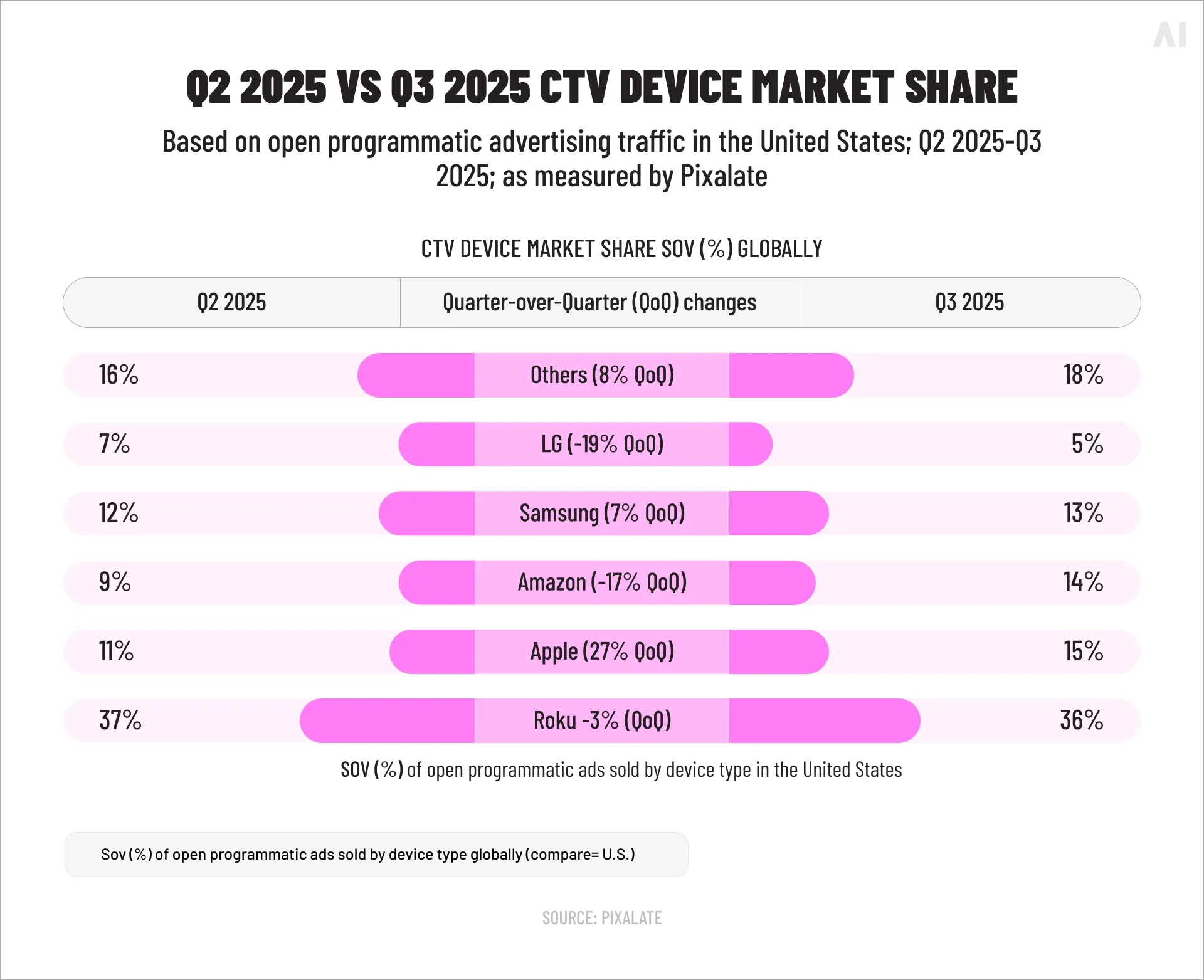
Roku is the dominant CTV device platform in the US and a major force in Smart TV usage. In Q2 2025, Pixalate reported that Roku led North America with 37% of CTV device market share, ahead of Amazon (17%), Samsung (12%), Apple (12%) and LG (7%). Roku also disclosed over 90 million active accounts globally as of January 2025, with The Roku Channel reaching around 145 million US viewers. That combination of device share and owned content makes Roku one of the largest single CTV advertising environments.
Data – Roku’s strength lies in its platform-level view of streaming behaviour:
- Every device is tied to a Roku account, which feeds into Roku’s household graph.
- The OneView ad platform measures advertising reach and frequency across TV streaming, traditional TV, mobile and desktop, enabling cross-screen planning and incremental reach analysis.
- Roku uses clean rooms and partner integrations so advertisers can match their audiences to Roku streamers in a privacy-safe way.
Roku also invests heavily in traffic quality. A recent DoubleVerify partnership uses Roku’s Advertising Watermark to authenticate device traffic and has already contributed to a substantial drop in spoofed Roku impressions across the ecosystem.
Formats – Roku offers a broad set of ad types that fall into four main families: native, destination, video and channel ads. In practice, that includes:
- Native and homescreen formats
- Home screen banner units and branded tiles on the Roku OS interface.
- Sponsored positions in the Roku Channel Store and within discovery rows.
- Video ads
- Standard 15- and 30-second spots across The Roku Channel and partner apps, reached through Roku’s ad network.
- Contextual and audience-targeted CTV video that can be bought through OneView or managed service.
- Action Ads and shoppable formats
- Action Ads add a clickable overlay that prompts viewers to use the Roku remote (e.g. “Press OK”) and then send a text message or link with more information.
- Through a partnership with Shopify, brands can connect their storefronts so viewers can receive product details or buy using Roku Pay from shoppable ads.
These formats are designed to turn passive TV viewing into direct engagement, especially when you pair standard video with remote-based calls to action.
Walled-garden impact – Roku behaves like a platform-centric walled garden:
- Premium OS inventory and Roku Channel placements are controlled by Roku and usually accessed through Roku’s sales teams and OneView, not generic open exchanges.
- Roku’s audience graph and engagement data stay inside its environment, although advertisers can use clean rooms and third-party measurement partners to evaluate performance.
- A 2025 partnership with Amazon Ads will allow Amazon’s DSP to tap Roku’s logged-in audience layer, giving buyers a single view across Roku and Fire TV and access to an estimated 80 million US CTV households through one system.
For Smart TV and CTV planners, Roku is effectively a must-have pillar alongside Samsung and LG: it delivers unmatched device share, a powerful owned channel in The Roku Channel and a mature set of shoppable and interactive ad formats that can anchor a performance-focused TV strategy.
📍 NB: Roku sits slightly differently to Samsung and LG. It isn’t a TV manufacturer first; it is a TV operating system and CTV platform that shows up in two ways: built directly into “Roku TV” sets from OEMs like TCL and Hisense, and as plug-in streaming devices that turn any HDMI TV into a connected screen. For media planning, you can treat Roku as a Smart TV/CTV ecosystem, because the same Roku OS, data and ad stack run across both Roku TVs and Roku streaming devices.
Samsung Ads
Samsung is the single largest Smart TV manufacturer in US homes. In early 2025, Samsung Ads reported around 67–68 million Samsung Smart TVs in US households, accounting for roughly 32% of all Smart TVs and present in 45% of US Smart TV homes.
Samsung’s State of CTV insights are built on more than 77 million active Samsung Smart TVs in the US.
Data:
- Extensive ACR data covering both linear and streaming viewing on Samsung TVs.
- Deterministic first-party device and usage data that links TV viewing with apps and, in some markets, Samsung mobile devices.
- Audience segments built on genres, networks, competitive ad exposure, and cross-device behaviour.
Formats:
- Homescreen mastheads and sponsored tiles on Samsung Tizen OS
- Inventory inside Samsung TV Plus, a leading FAST app on Samsung TVs
- Cross-device and interactive formats such as remote-controlled mini-games and QR-enabled units
💡 You can explore the full offering at Samsung Ads.
Walled-garden impact – Samsung’s richest ACR data and OS-level formats are only available through Samsung Ads and approved partners. For buyers, that means:
- Direct relationships or specific DSP integrations are often required.
- Measurement is strong inside the Samsung universe but needs to be reconciled with other platforms for a complete view.
LG Ad Solutions
According to LG Ad Solutions, the company now reaches around 45 million LG Smart TVs in the US and roughly 200 million globally.
Its FAST service, LG Channels, offers over 4,000 channels worldwide, built through partnerships with networks such as A+E, AMC and NBCUniversal.
Data:
- Proprietary ACR data from LG webOS TVs across more than 30 countries, used for deterministic targeting and measurement.
- Partnerships with measurement providers and data platforms to fuse LG ACR into broader TV ratings and attribution.
Formats:
- High-impact home screen ads on LG webOS, which LG positions as CTV’s fastest growing attention opportunity.
- Native tiles and branded rows in LG’s interface.
- Video inventory in LG Channels, including curated branded collections.
💡 Learn more at LG Ad Solutions.
Walled-garden impact – LG is more open to programmatic access than some peers: in several markets, LG has enabled home screen inventory to be bought programmatically via SSPs. Even so, premium placements and ACR-powered segments still sit inside LG’s own platform. Buyers typically:
- Work with LG Ad Solutions directly for strategic campaigns.
- Use LG’s measurement and research products to understand impact across screens.
Google TV / Android TV
Google TV and Android TV power Smart TVs and streaming devices from Sony, TCL, Hisense, Nvidia and others. While Google doesn’t publish a single US-only number for TV OS penetration, its influence comes from two fronts:
- Tens of millions of Google TV / Android TV devices in market.
- The dominance of YouTube and YouTube TV as CTV destinations; in 2024, eMarketer forecast YouTube’s US CTV ad revenue at around $3.34 billion, among the top two CTV ad sellers alongside Hulu.
Data:
- Logged-in Google accounts on Smart TVs, enabling targeting based on Google’s broader identity graph and interest data.
- Deep behavioural data from YouTube watch history, which informs CTV ad targeting on that platform.
Formats:
- Sponsored rows and hero units on the Google TV interface, promoting shows or apps.
- Standard and advanced video formats on YouTube on TV, including CTV-specific mastheads and sequential storytelling units.
- Emerging shoppable and second-screen integrations between YouTube on TV and mobile.
💡 You can see consumer-facing information on Google TV; for advertisers, YouTube and Google Ads / DV360 provide the buying surface.
Walled-garden impact – YouTube and Google TV behave like a hybrid:
- You can buy a lot of CTV inventory across devices through DV360 as part of an open marketplace.
- But YouTube’s richest signals and some formats are most effective when you stay inside the Google Ads / DV360 stack.
💡 For Smart TV–specific advertising, Google TV is most often part of a wider Google video strategy, where you co-ordinate YouTube, YouTube TV and partner inventory.
{{26-Smart-TV-Advertising-SEO-4="/tables"}}
Other key Smart TV and CTV platforms
Beyond those four, several other platforms are critical for CTV reach and should sit alongside Smart TV OS buying:
- Amazon Fire TV
- Fire TV devices and Fire TV OS–powered Smart TVs are supported by Amazon DSP, with CTV ad revenue forecast to hit $3.13 billion in 2024, driven heavily by the new Prime Video ad tier.
- Amazon’s strength is its commerce data and the ability to link TV ad exposure to Amazon shopping behaviour.
- Vizio
- Vizio’s SmartCast platform powers millions of US TVs and supports homescreen placements plus its WatchFree+ FAST service.
- Vizio’s data arm, Inscape, is a key ACR provider and feeds several third-party measurement solutions.
In practice, your Smart TV advertising plan usually combines:
- OS-level buys on Samsung, LG and (where relevant) Google TV
- CTV device platforms like Roku and Fire TV
- App-level buying across premium streaming services
Key challenges in Smart TV advertising
Smart TV advertising is powerful, but it comes with real operational challenges. Being honest about these helps shape a practical strategy.
1. OS and device fragmentation
The Smart TV and CTV market is split across many operating systems and devices:
- Roku: 37% device share (US, Q2 2025)
- Amazon Fire TV: 17%
- Samsung: 12%
- Apple TV: 12%
- LG: 7%
- Others (Vizio, TCL, Sony, Xiaomi, etc.) fill out the rest.
On top of that, households often own multiple devices: a Samsung Smart TV in the living room, a Roku TV in the bedroom, and a Fire TV stick on a projector.
For marketers, that creates three issues:
- Planning across many platforms
- Overlapping reach and inconsistent frequency capping
- Differing creative specs and capabilities
⚡ Fragmentation isn’t going away — the real advantage comes from how well you manage it, not from hoping it disappears.
2. Limited access to premium homescreen inventory
Homescreen placements are high-impact and scarce. Smart TV OEMs protect them:
- Most homescreen inventory is sold directly by Samsung, LG, Vizio or Roku.
- Programmatic access exists in some cases (e.g. LG working with SSPs), but it’s still controlled.
This means:
- You need relationships and minimum spends to secure marquee slots.
- Homescreen availability can be constrained around big tentpole moments (Black Friday, major sports events, big streaming premieres).
Brands that don’t plan ahead or work with specialist partners may struggle to secure these units at all.
3. Measurement complexity and walled gardens
Each Smart TV ecosystem has its own:
- Identity graph
- Reporting stack
- Rules about what data leaves the platform
While OEMs share high-level insights, detailed ACR or user-level data is usually kept inside the garden. For example, Samsung’s competitive ACR insights are used to plan and optimize campaigns but are not sold as an external data feed.
Consequences:
- It’s difficult to build a single, deduplicated view of reach and frequency across Samsung, Roku, Amazon, LG and app-level CTV.
- Standardising metrics like attention, completion and interaction across formats (homescreen vs. in-stream vs. interactive) requires extra modelling.
- Third-party verification covers some areas (viewability, invalid traffic), yet not every platform supports identical methodologies.
Industry initiatives are improving this, and measurement tools increasingly incorporate ACR and cross-device graphs. But right now, CTV and Smart TV analytics still require stitching together multiple data sources.
💡AI Digital’s guide on CTV measurement: how to track performance, ROI and attribution digs deeper into this problem and the most practical solutions.
4. Privacy and data-use constraints
Smart TVs collect sensitive viewing data. Many devices use ACR to log everything that appears on the screen, including linear channels and HDMI inputs. That has prompted:
- Regulatory scrutiny
- Class-action lawsuits in past years
- Stricter opt-in and consent flows
Modern Smart TV ad strategies must respect:
- Regional privacy regulations (GDPR, CCPA, etc.)
- OEM-specific policies on data use
- Consumer expectations around transparency and control
From a marketer’s perspective, this means:
- Depending on aggregated, privacy-safe segments rather than raw logs
- Being comfortable with black-box modelling for some attribution
- Working with partners who can explain exactly how targeting and measurement align with regulations
5. Smart TV–optimized creative
Finally, many brands still repurpose linear TV spots for Smart TV environments without adapting them.
That’s a missed opportunity because:
- Homescreen creative lives in a static or semi-animated frame; it needs strong visuals, simple messaging and clear calls to action.
- In-navigation and tiles require legible typography at a distance and a compelling click reason.
- Interactive or shoppable ads need UX thinking: where to place prompts, how long to leave QR codes on screen, and how to make remote interactions feel natural.
A 30-second masterpiece built for broadcast can absolutely run in Smart TV environments, but it will work harder if you pair it with:
- Complementary homescreen layouts
- Cut-downs designed for FAST or premium AVOD contexts
- Tailored versions for different platforms and audience segments
⚡ The best Smart TV campaigns don’t just buy better inventory. They design creative that respects how people actually use their TV.
How a Smart TV ads partner can boost your campaigns
Given all that complexity, most brands do better when they partner with a Smart TV–focused specialist rather than trying to wrangle every platform in-house.
{{26-Smart-TV-Advertising-SEO-5="/tables"}}
Here’s how the right partner helps.
1. Orchestrating fragmented platforms
A Smart TV partner that has pre-existing integrations with Samsung Ads, LG Ad Solutions, Roku, Amazon, Google TV and major AVOD/FAST publishers can:
- Consolidate planning and buying across OS-level and app-level inventory
- Enforce global frequency caps where IDs and clean rooms make that possible
- Help you sequence messaging logically: homescreen burst → FAST mid-roll → cross-device retargeting
💡 AI Digital’s AI based digital marketing solution help orchestrate campaigns across CTV (including Smart TV environments) and the rest of your digital media, rather than locking you into a single DSP or walled garden.
2. Securing premium homescreen and OS placements
Because Smart TV partners work with OEMs and platforms regularly, they can:
- Negotiate access to homescreen mastheads, sponsored tiles and featured app placements you might not get on your own.
- Bundle homescreen with in-stream and cross-device inventory to hit both awareness and performance goals.
- Use OS-level data (e.g. how often a household visits the homescreen, what they watch) to allocate those premium impressions efficiently.
In practice, that might look like:
- A national brand takeover on Samsung or LG home screens during a product launch.
- A mid-scale campaign using a mix of LG, Vizio and Roku home and navigation placements for a streaming app acquisition push.
3. Activating device-level and ACR-based targeting
Smart TV partners typically have:
- Access to OEM audience taxonomies (e.g. sports enthusiasts, auto intenders, heavy SVOD users).
- The ability to build custom ACR segments, such as households that watched a competitor’s live sports sponsorship or viewers who have not seen your last linear campaign.
Applied correctly, that data can:
- Reduce wastage by avoiding over-exposed homes.
- Increase incremental reach by focusing Smart TV budgets on light-TV or streaming-first households.
- Support competitive conquesting, where your Smart TV ads reach viewers after competitive spots.
💡 Learn more about AI-targeted advertising in our dedicated guide.
4. Building a consistent measurement framework
A capable Smart TV partner will help you:
- Define a common KPI stack across platforms:
- Reach and frequency
- Completion rates and attention where available
- Site visits, app events, conversions and sales
- Use the tools each platform offers (e.g. OEM ACR lift studies, CTV attribution partners, retail media signals) and map them into a single reporting framework.
- Run incrementality and lift tests across Smart TV and other channels. For example:
- Split regions or audience segments between linear-only vs. linear-plus-Smart-TV.
- Test homescreen plus in-stream vs. in-stream only.
This work is much easier when someone is already fluent in Samsung’s reporting, LG’s dashboards, Roku’s measurement options and the nuances of each.
5. Creative strategy tailored to Smart TV
Finally, a Smart TV-savvy partner will not just traffic your existing ads. They’ll help you:
- Design homescreen creative with thumb-stopping visuals and one clear message.
- Adapt long-form TV spots into multiple CTV-friendly lengths and sequences.
- Experiment with interactive and shoppable formats that create genuine engagement rather than gimmicks.
AI Digital combines Elevate’s AI-driven optimization with CTV/OTT performance data to iterate on creatives and placements during a campaign, so Smart TV activity is adjusted in-flight instead of being reviewed only at the end.
⚡ A Smart TV partner turns scattered OS placements, FAST inventory and data feeds into one coherent TV performance engine.
Conclusion: Smart TV advertising that connects and converts
Smart TV advertising has moved far beyond being a novelty. Smart TVs are now the leading CTV device in US connected homes, and their operating systems control the first impression viewers see on the big screen.
For marketers, that creates a powerful combination:
- Large-screen attention via homescreen and in-stream placements
- Device-level precision powered by deterministic identifiers and, in many cases, ACR data
- Measurable performance, with CTV campaigns now proven to drive significantly more conversions than linear TV at lower spend levels
Smart TV advertising is not the whole of CTV, but it has become one of its most strategic components. It’s where you can influence choice before a viewer picks a show, and where you can connect traditional TV storytelling with shoppable journeys and cross-device attribution.
Brands that invest in Smart TV now—homescreen and navigation units, CTV video, and interactive formats—are effectively building the next generation of TV plans. Those plans reach high-value streaming audiences, deliver accountable results, and create a data spine that can support the rest of the media mix.
If you want help turning Smart TV into a core part of your growth engine, explore AI Digital’s what we do overview and see how TV, data and AI come together in one environment.