What Is Programmatic Guaranteed? How It Works and When Advertisers Use It


Programmatic guaranteed is a core buying model in programmatic advertising that enables advertisers to secure premium inventory at a fixed price with guaranteed delivery of impressions. Unlike auction-based environments—where CPMs fluctuate and delivery is not assured—programmatic guaranteed deals provide control over pricing, placement, and volume, making them particularly valuable for high-priority campaigns.
Industry data underscores this shift toward more controlled buying models. The Interactive Advertising Bureau reports that over 85% of digital display advertising is now traded programmatically, yet much of it still relies on auction dynamics that introduce volatility. At the same time, the World Federation of Advertisers identifies transparency, supply chain efficiency, and predictable outcomes as top concerns among global advertisers—factors that directly support the adoption of programmatic guaranteed deals.
By combining the certainty of direct buying with the automation of programmatic execution through DSPs and SSPs, programmatic guaranteed has become a strategic tool for accessing premium publisher inventory with reduced risk. This article explains what is programmatic guaranteed, how a programmatic guaranteed deal works, how it compares to other deal types, and when advertisers and publishers should use it within a modern media strategy.
What is programmatic guaranteed?
Programmatic guaranteed is a type of programmatic direct deal in which an advertiser and a publisher agree in advance on a fixed CPM (cost per thousand impressions) and a guaranteed number of impressions to be delivered over a defined campaign period. In a programmatic guaranteed deal, the publisher reserves specific inventory for the advertiser, ensuring both pricing stability and delivery certainty before the campaign begins.
Unlike auction-based buying—where impressions are won through real-time bidding—programmatic guaranteed deals eliminate competition and volatility, giving advertisers full control over where their ads will appear and how much they will pay. This makes the model particularly suitable for campaigns that require predictable outcomes and access to premium inventory.
💡At the same time, programmatic guaranteed differs from traditional direct media buying in how campaigns are executed. While the commercial terms are agreed directly between advertiser and publisher, delivery, targeting, and reporting are handled through programmatic infrastructure such as DSPs and SSPs. This allows advertisers to maintain automation, centralized campaign management, and standardized measurement, which are core advantages of programmatic advertising.
Within the broader ecosystem, programmatic guaranteed sits alongside other transaction models such as open auctions, private marketplaces (PMPs), and preferred deals—but represents the highest level of control and certainty among them.
.%2520.webp)
⚡️For a deeper understanding of how these models fit into the overall landscape, see this guide to AI Digital’s overview of programmatic advertising.
Core elements of a programmatic guaranteed deal
A programmatic guaranteed deal is defined by a set of structured components that ensure predictable delivery, controlled pricing, and premium inventory access. Unlike auction-based buying, where outcomes depend on bidding dynamics, programmatic guaranteed relies on pre-negotiated terms and reserved supply, executed through programmatic infrastructure.
%2520.webp)
⚡️These deals are built on four core elements: fixed pricing, reserved inventory, guaranteed impressions, and platform-based execution. Together, they create a model that combines commercial certainty with operational automation—a key characteristic of modern AdTech ecosystems (see AI Digital: Adtech Explained)
Fixed CPM pricing
In programmatic guaranteed, pricing is established through a fixed CPM negotiated in advance between the advertiser and the publisher. This removes the variability of auction-based pricing, where CPMs can fluctuate based on demand, competition, and audience availability.
%2520.webp)
For advertisers, this structure enables:
- Accurate budget forecasting
- Stable cost control across the campaign lifecycle
For publishers, it ensures:
- Predictable revenue from premium inventory
- Better yield management compared to uncertain auction outcomes
⚡️Understanding how CPM functions across channels is essential for evaluating these deals (see AI Digital: How CPM Influences in TV Advertising)
Reserved premium inventory
A defining feature of any programmatic guaranteed deal is that the publisher reserves specific inventory exclusively for the advertiser. This inventory is removed from open auctions and other deal types, ensuring that it is not subject to competitive bidding.
In practice, this often includes:
- Homepage takeovers
- High-impact display formats
- Premium video and CTV placements
- Contextually valuable editorial environments
This level of access is particularly important because premium inventory is often limited and highly competitive, and may not be consistently available through auction-based buying.
Guaranteed impressions
Another critical component is the guarantee of impression delivery. In a programmatic guaranteed deal, the publisher contractually commits to delivering a specific number of impressions within a defined campaign timeframe.
This ensures that advertisers can:
- Achieve planned reach and frequency goals
- Avoid underdelivery risks common in auction environments
- Execute time-sensitive campaigns with confidence
Unlike auction-based models—where delivery depends on bid competitiveness—programmatic guaranteed ensures that campaign objectives are met regardless of market fluctuations.
Platforms and ad servers in programmatic guaranteed advertising
Although pricing and volume are negotiated directly, execution is fully handled through programmatic infrastructure, including:
- Ad servers (e.g., publisher-side platforms for inventory management)
- Demand-Side Platforms (DSPs) used by advertisers
- Supply-Side Platforms (SSPs) used by publishers
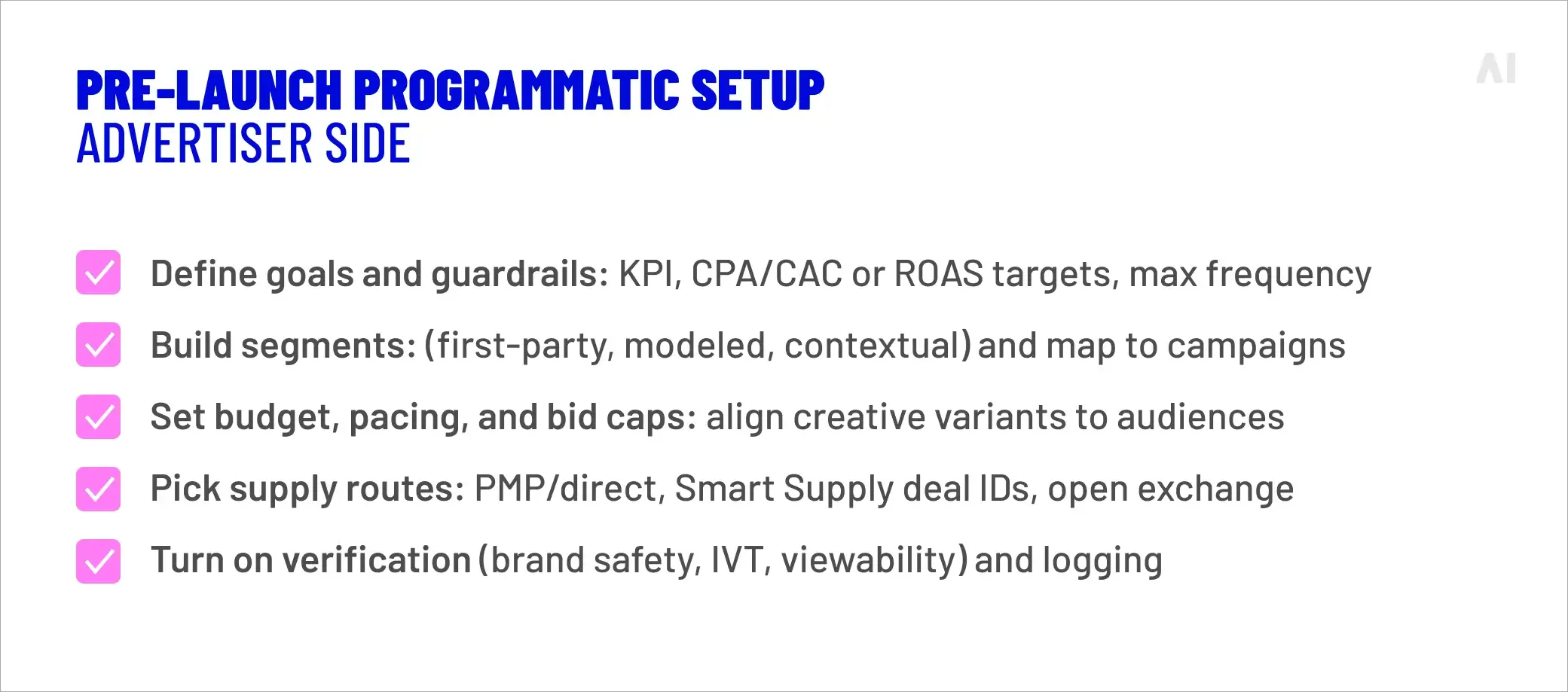
In a typical workflow:
- The publisher configures the deal in an ad server (e.g., Google Ad Manager)
- A deal ID is generated and linked to reserved inventory
- The advertiser activates the deal in their DSP, applying targeting and creatives
- Delivery and reporting occur programmatically across systems
This infrastructure ensures that programmatic guaranteed deals retain the scalability, targeting precision, and measurement consistency of programmatic advertising.
⚡️For a deeper understanding of how execution layers support programmatic guaranteed deals, explore AI Digital’s guide on Demand Side Platforms, which explains how advertisers activate and manage campaigns through DSPs, as well as the article What Is a Supply-Side Platform (SSP) and How SSPs Work in Programmatic Advertising, which outlines how publishers control, package, and deliver inventory within programmatic environments.
How programmatic guaranteed works
_%2520.webp)
A programmatic guaranteed deal follows a structured workflow that combines direct negotiation with programmatic execution, ensuring both predictability and operational efficiency.
1. Negotiation and agreement
The process begins with a direct agreement between the advertiser (or agency) and the publisher. Both parties define:
- A fixed CPM
- A guaranteed number of impressions
- Campaign flight dates
- Targeting parameters (audience, geography, context)
- Ad formats (display, video, CTV)
This upfront negotiation is what distinguishes programmatic guaranteed from auction-based buying.
2. Deal setup in the ad server
The publisher configures the agreement within their ad server (e.g., Google Ad Manager):
- A deal ID is generated
- Inventory is reserved specifically for the advertiser
- Delivery priority is assigned to ensure contractual fulfillment
3. Campaign activation in the DSP
The advertiser activates the deal in their DSP using the deal ID:
- Creatives are uploaded
- Targeting and frequency settings are applied
- Budget pacing is configured
Even though pricing and volume are fixed, advertisers retain control over execution and optimization settings.
4. Delivery and monitoring
Campaign delivery occurs automatically through programmatic infrastructure. Both advertiser and publisher monitor performance using:
- DSP and ad server reporting
- Metrics such as impressions delivered, viewability, completion rates, and pacing
This combination of predefined terms and real-time reporting ensures that campaigns meet delivery commitments while maintaining visibility into performance.
Programmatic guaranteed vs other programmatic deals
To fully understand programmatic guaranteed, it is essential to compare it with other common buying models. The key differences lie in pricing mechanisms, inventory access, and delivery certainty.
{{26-Programmatic-Guaranteed-1="/tables"}}
⚡️For a deeper breakdown of auction-based buying mechanics, refer to AI Digital’s guide on AI Digital, Programmatic vs RTB and its detailed explanation of AI Digital, Real-time Bidding guide.
Programmatic guaranteed vs Private Marketplace (PMP)
A Private Marketplace (PMP) is an invitation-only auction where a select group of advertisers competes for premium inventory. While access is restricted, pricing is still determined through real-time bidding, meaning outcomes are not guaranteed.
In contrast, a programmatic guaranteed deal is a one-to-one agreement between advertiser and publisher:
- No bidding takes place
- Pricing and volume are fixed in advance
- Inventory is reserved exclusively
This makes programmatic guaranteed significantly more predictable than PMP buying.
Programmatic guaranteed vs Preferred deals
Preferred deals provide advertisers with priority access to inventory at a negotiated CPM, but they do not include any obligation to purchase or guarantee of delivery.
Key distinction:
- In preferred deals, advertisers can choose whether to bid when impressions become available
- In programmatic guaranteed deals, both parties are contractually committed:
- The advertiser commits to spend
- The publisher commits to deliver impressions
As a result, preferred deals offer flexibility, while programmatic guaranteed offers certainty.
Programmatic guaranteed vs Open auction
The open auction is the most common form of programmatic buying, where impressions are sold via real-time bidding among multiple advertisers.
Key differences:
- Open auction: dynamic pricing, no delivery guarantee, broad inventory access
- Programmatic guaranteed: fixed pricing, guaranteed impressions, reserved inventory
While open auctions provide scale and cost efficiency, they introduce:
- Price volatility
- Uncertain delivery
- Variable inventory quality
By contrast, programmatic guaranteed deals eliminate these variables, making them better suited for campaigns that require control, consistency, and premium placements.
Benefits of programmatic guaranteed
Programmatic guaranteed provides a set of structural advantages for both advertisers and publishers by combining the certainty of direct buying with the efficiency of programmatic execution. In a market where auction-based environments introduce pricing volatility and delivery uncertainty, programmatic guaranteed deals offer predictable outcomes, controlled inventory access, and greater transparency. Industry research from the World Federation of Advertisers consistently identifies transparency and supply chain control as key priorities for advertisers, reinforcing the relevance of guaranteed buying models in modern media strategies.
Advantages for advertisers
For advertisers, programmatic guaranteed enables a higher level of control over both cost and delivery, which is difficult to achieve in auction-based buying. By operating on a fixed CPM negotiated in advance, advertisers can plan budgets with precision and avoid the fluctuations that occur in real-time bidding environments. At the same time, the guarantee of impression delivery ensures that campaigns meet their intended reach and frequency targets without the risk of underdelivery.
Another key advantage is access to premium inventory and high-quality placements, which are often limited or inconsistently available through open auctions. This includes homepage placements, premium editorial environments, and high-demand formats such as video and CTV. Because inventory is pre-agreed, advertisers also benefit from greater transparency and brand safety, knowing exactly where their ads will appear. As highlighted by the Interactive Advertising Bureau, concerns around supply quality and transparency remain central in programmatic advertising, making controlled deal types like programmatic guaranteed increasingly valuable.
Advantages for publishers
For publishers, programmatic guaranteed deals create more stable and predictable revenue streams, reducing reliance on fluctuating auction demand. By securing commitments in advance, publishers can better forecast revenue and manage their business with greater financial certainty. This is particularly important for premium inventory, where value can be diluted in open auction environments due to pricing pressure and competition.
In addition, programmatic guaranteed allows publishers to monetize premium placements more effectively by allocating them to high-value advertisers under agreed terms. This improves yield management and ensures that scarce inventory is not undersold. These deals also support stronger, long-term relationships with advertisers, shifting interactions from transactional bidding to more strategic partnerships. Over time, this enables publishers to balance guaranteed demand with auction-based demand more efficiently, optimizing both revenue stability and overall inventory performance.
Limitations of programmatic guaranteed
While programmatic guaranteed offers control and predictability, it also introduces trade-offs that advertisers and publishers must consider within a broader media strategy. The most significant limitation is reduced flexibility. Because pricing, inventory, and impression volumes are agreed in advance, advertisers have less ability to adjust spend dynamically based on real-time performance signals, as they would in auction-based environments.
There is also a higher level of financial commitment. Advertisers are contractually obligated to spend the agreed budget, regardless of how market conditions evolve during the campaign. This can limit optimization opportunities and, in some cases, result in higher effective CPMs compared to auction-based buying, where pricing can fluctuate based on demand.
From the publisher perspective, inventory reservation carries opportunity cost. By allocating premium placements to a guaranteed deal, publishers risk missing out on potentially higher yields that could be achieved in competitive auctions—especially during periods of high demand. As a result, programmatic guaranteed requires careful inventory planning to balance revenue stability with yield optimization.
When to use programmatic guaranteed
Programmatic guaranteed delivers the most value in scenarios where predictability, control, and premium inventory access are more important than flexibility. It is particularly effective for campaigns that cannot rely on auction dynamics due to timing constraints, visibility requirements, or limited inventory availability.
In practice, most advanced media strategies do not rely exclusively on one buying model. Instead, advertisers combine:
- Programmatic guaranteed for control and premium access
- Private marketplaces and auctions for scale and efficiency
This hybrid approach allows teams to balance reach, cost efficiency, transparency, and delivery certainty across campaigns.
Brand awareness campaigns
For large-scale brand awareness initiatives, programmatic guaranteed deals ensure consistent reach and high visibility. By securing premium placements in advance, advertisers can maintain stable exposure across trusted publisher environments, which is critical for brand positioning. This approach reduces the risk of fragmented delivery or inconsistent placement quality that often occurs in open auctions.
Premium video and CTV placements
Programmatic guaranteed is widely used in premium video and connected TV (CTV) environments, where inventory is both limited and highly competitive. Advertisers often need to secure placements in advance to avoid bidding wars and ensure campaign delivery.
⚡️As CTV adoption continues to accelerate, demand for high-quality, premium video inventory has increased significantly, making programmatic guaranteed access more strategically important for advertisers. Unlike open web display, CTV supply is inherently limited and often concentrated among a smaller number of premium publishers and platforms, which intensifies competition and drives pricing pressure in auction environments. In this context, programmatic guaranteed deals enable advertisers to secure inventory in advance, ensuring both delivery and placement quality in high-demand environments. For a more detailed understanding of how CTV buying works and why inventory access is increasingly constrained, refer to AI Digital’s guide on AI Digital, CTV Media Buying and its overview of AI Digital, Connected TV Advertising.
Seasonal or high-impact campaigns
During peak periods—such as product launches, holiday seasons, or major cultural and commercial events—competition for premium inventory intensifies. In these scenarios, programmatic guaranteed deals allow advertisers to secure placements in advance, ensuring that campaigns are delivered as planned without exposure to auction volatility.
This is particularly important for campaigns with fixed timelines and high business impact, where underdelivery or inconsistent visibility could directly affect performance outcomes.
How to launch a programmatic guaranteed deal
Launching a programmatic guaranteed deal requires close coordination between advertisers and publishers, combining direct negotiation with programmatic execution workflows. While the commercial terms are agreed upfront, activation and delivery rely on ad tech infrastructure, ensuring both control and operational efficiency.
⚡️This process is typically integrated into broader media planning strategies (see AI Digital: Media Planning and Buying), where guaranteed deals are aligned with campaign objectives, budget allocation, and channel mix.
Negotiate inventory and pricing
The process begins with a direct negotiation between the advertiser (or agency) and the publisher. Both parties define the key parameters of the programmatic guaranteed deal, including:
- Fixed CPM
- Total number of guaranteed impressions
- Campaign duration and flight dates
- Targeting criteria (audience, geography, context)
- Ad formats (display, video, CTV)
This stage establishes the commercial and strategic foundation of the campaign, ensuring alignment on both performance expectations and inventory quality before execution begins.
Set up the deal in ad servers
Once terms are finalized, the publisher configures the deal within their ad server (such as Google Ad Manager). This involves:
- Reserving the agreed inventory exclusively for the advertiser
- Assigning delivery priority to meet contractual commitments
- Generating a deal ID, which represents the agreement within programmatic systems
This step ensures that the inventory is secured and technically available for activation through programmatic platforms.
Activate campaigns in DSPs
The advertiser activates the programmatic guaranteed deal within their Demand-Side Platform (DSP) by applying the deal ID provided by the publisher. At this stage, they:
- Upload creatives
- Configure targeting parameters
- Set frequency caps and pacing controls
- Align delivery with campaign timelines
Although pricing and volume are fixed, advertisers still retain execution-level control, allowing them to optimize how impressions are distributed across audiences and devices.
Monitor delivery and performance
Once the campaign is live, both advertiser and publisher continuously monitor:
- Delivery pacing against guaranteed impressions
- Viewability and engagement metrics
- Completion rates (for video and CTV)
- Frequency and audience reach
This monitoring ensures that contractual delivery obligations are met while maintaining campaign performance standards.
⚡️Increasingly, advertisers also rely on AI-driven planning and forecasting tools to improve outcomes before and during execution. Solutions such as Elevate enable teams to analyze inventory availability, forecast delivery scenarios, and optimize allocation across guaranteed and auction-based channels, reinforcing a more data-driven and predictable approach to programmatic media buying.
Programmatic guaranteed in modern media strategies
In modern media planning, programmatic guaranteed is rarely used in isolation. Instead, it functions as a strategic layer within omnichannel programmatic strategies, where advertisers combine different buying models to balance control, scale, efficiency, and transparency. Guaranteed deals are typically used to secure premium, high-impact inventory, while auction-based buying is used to extend reach and optimize cost efficiency.
This hybrid approach reflects a broader industry shift toward curated supply and supply path optimization, where advertisers prioritize how inventory is accessed, not just where ads are delivered. In this context, programmatic guaranteed deals provide direct, transparent access to premium publisher inventory, reducing reliance on complex and opaque supply chains.
⚡️Solutions such as Smart Supply support this strategy by helping advertisers analyze supply paths, prioritize high-quality inventory sources, and eliminate unnecessary intermediaries. When combined with programmatic guaranteed, this approach enables a more efficient, transparent, and performance-oriented media buying framework, where premium placements are secured in advance and supported by optimized supply access across the open web.
Programmatic guaranteed: Key takeaways for advertisers and publishers
Programmatic guaranteed is a core programmatic buying model that combines the certainty of direct deals with the automation of programmatic execution. It allows advertisers and publishers to agree on a fixed CPM, reserved inventory, and guaranteed impression delivery, ensuring predictable campaign outcomes and controlled access to premium placements.
- Compared to other programmatic deal types—such as private marketplaces, preferred deals, and open auctions—programmatic guaranteed offers the highest level of control and delivery certainty, but with reduced flexibility. This makes it particularly valuable for campaigns that require high visibility, strict timelines, and premium environments, including brand awareness initiatives, CTV campaigns, and seasonal activations.
- For advertisers, the model provides predictable pricing, guaranteed reach, improved transparency, and stronger brand safety. For publishers, it enables stable revenue, better monetization of premium inventory, and stronger long-term partnerships with buyers. At the same time, both sides must balance guaranteed deals with auction-based buying to maintain flexibility and optimize performance across the media mix.
⚡️As programmatic ecosystems continue to evolve, programmatic guaranteed will remain a critical tool for securing quality inventory and reducing uncertainty, particularly in high-demand environments. To explore how these strategies can be applied to your media planning and buying approach, get in touch with AI Digital.