TV Attribution Analytics: How Advertisers Measure TV Performance


Television no longer operates as a self-contained channel. In June 2026, streaming accounted for 48.5% of US television watch time, according to Nielsen's June Gauge report. Viewers move among broadcast, cable and streaming, then respond through websites, apps, search and stores.
That behavior makes TV attribution measurement more useful and more complicated. TV attribution analytics can connect television activity with observable responses, but every result depends on data coverage, matching and attribution rules. This guide explains the principal methods, insights and limitations across linear and digital environments.
TL;DR: Key takeaways
- TV attribution connects eligible television exposures or ad occurrences with later responses or business outcomes.
- Attribution may examine website visits, app activity, leads, purchases, store visits or other defined conversion events when suitable data is available.
- Response-based models analyze activity around known TV airings, while impression-based models connect household or device exposure data with subsequent outcomes.
- Matching rules, data coverage, response lag and the attribution window can materially affect the reported result.
- Attribution supports campaign comparison and optimization, but attributed outcomes should not automatically be interpreted as incremental outcomes.
What is TV attribution?
TV attribution is the process of connecting a television ad exposure or known ad occurrence with a subsequent measurable action according to a defined methodology. The outcome might be a site visit, app session, lead, purchase, subscription, store visit or another event relevant to the campaign.
A TV attribution model specifies which exposures and outcomes are eligible, how they are connected and how credit is assigned. The Media Rating Council's Outcomes and Data Quality Standards describe attribution as associating outcomes such as leads, sales or visits with advertising exposure. They require documented definitions and a methodology appropriate to the campaign.
There is no single method used across all television. TV advertising attribution may draw on spot logs, response patterns, ad-serving records, smart-TV data, household matching or panels. The phrase TV ads attribution is shorthand for this family of methods, although two reports may use very different data and assumptions.
TV attribution vs. TV audience measurement
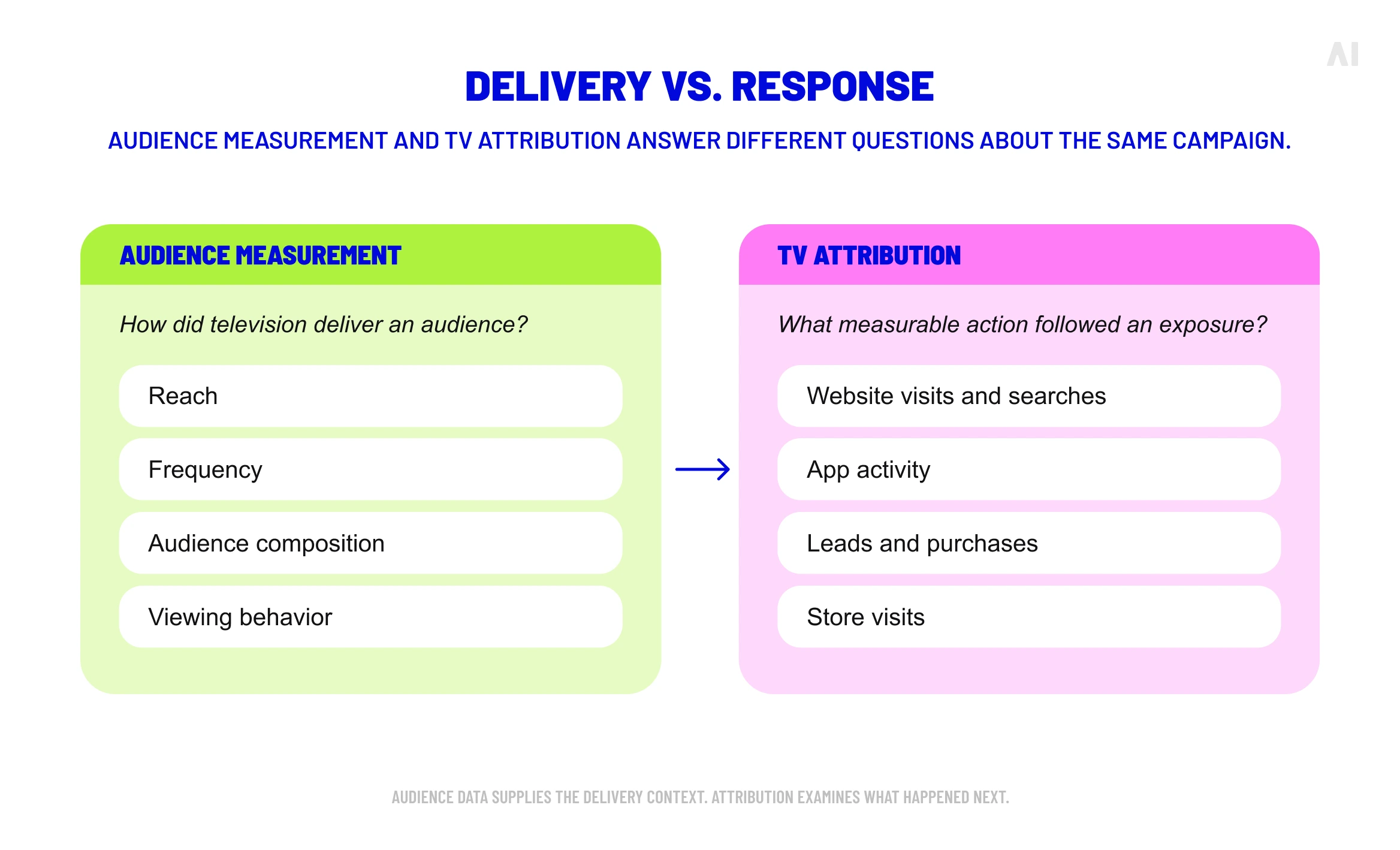
Audience measurement describes delivery and viewing through reach, frequency, audience composition and viewing behavior. Attribution asks what measurable action followed an eligible ad occurrence or exposure.
The disciplines work together, but their outputs remain distinct. Attribution needs a defensible account of the advertising activity, while audience data provides delivery context. A campaign can achieve broad reach without producing immediate observable response. A smaller group of high-intent households can generate a strong attributed conversion rate without representing broad reach.
In connected TV, delivery, exposure quality, audience and outcomes may come from different systems.
💡 AI Digital's guide to CTV measurement and its principal metrics examines these layers.
⚡ Audience measurement describes delivery. Attribution examines what happened after an eligible exposure or ad occurrence.
How TV attribution works
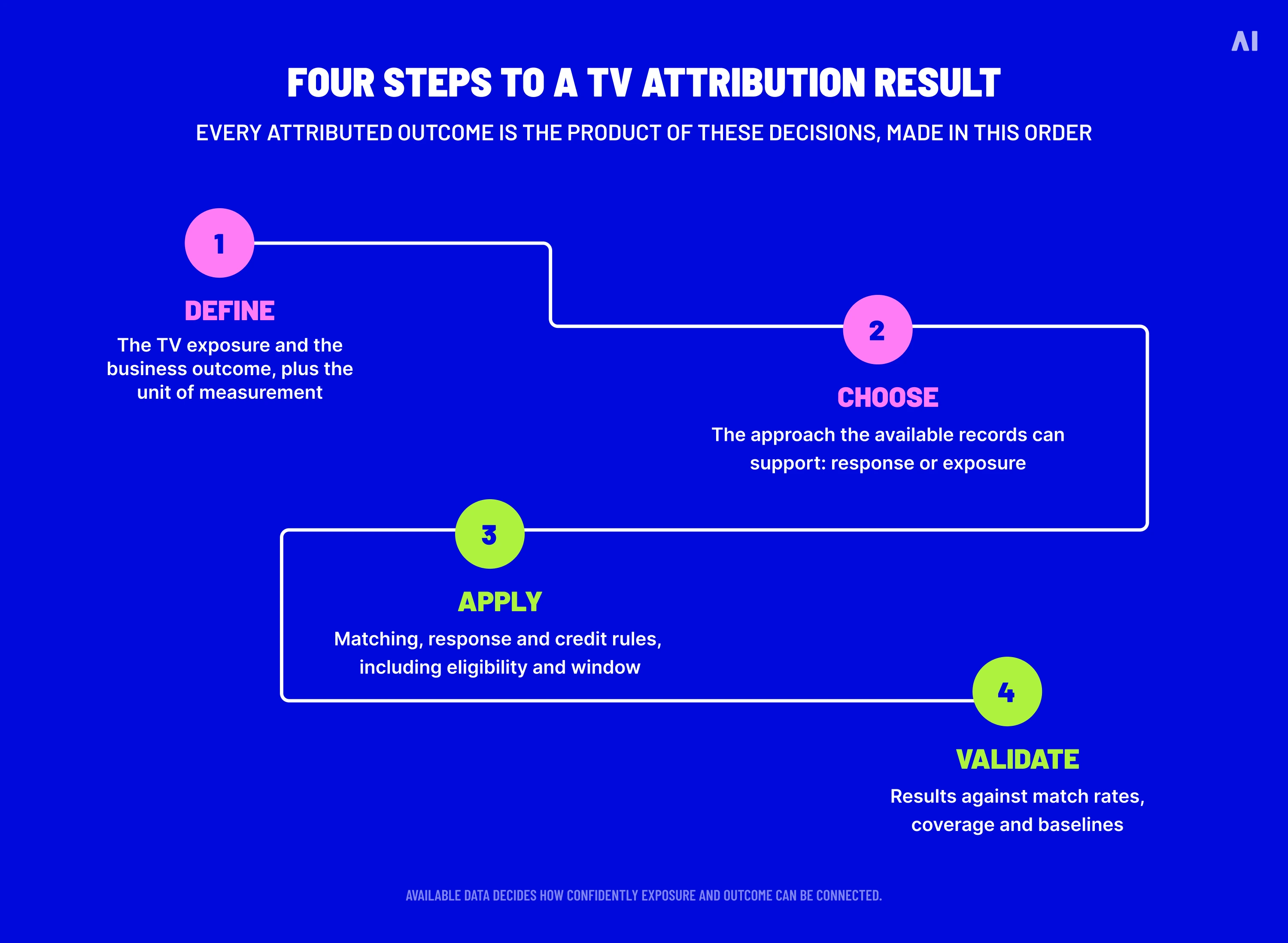
A practical workflow combines television activity, an observable outcome, attribution rules and analysis. Available data determines how confidently they can be connected:
- Define the exposure and outcome.
- Select an approach that the available records can support.
- Apply matching, response and credit rules.
- Analyze the result and validate its assumptions.
Step 1: Define the TV exposure and business outcome
Define the advertising event and result to be measured. Exposure inputs may include spot logs, ad-server records, automatic content recognition (ACR), smart-TV data or panels. Outcomes may come from websites, apps, CRM systems, purchase records or foot-traffic providers.
Specify the measurement unit. A spot airing, served impression, television device, household and person represent different things. Treating them as interchangeable creates false precision.
Step 2: Choose the attribution approach based on available data
Without household or impression-level data, a response-based method may compare activity following known airings with an expected baseline. With suitable exposure records, an impression-based method may connect or model them against later outcomes.
The choice depends on the environment, campaign scale, outcome, coverage and decision the analysis must support.
Step 3: Apply matching, response and attribution rules
The methodology determines which outcomes receive credit. It may involve time-based modeling, deterministic or probabilistic matching, household graphs, geographic signals or control groups.
Eligibility rules define which impressions count, how overlaps are handled and how long a response remains attributable. Household matching does not prove that a particular person watched or converted.
Step 4: Analyze and validate the results
Advertisers may compare attributed activity by campaign, creative, network, daypart, placement, geography or audience. Granularity and reporting speed depend on the underlying records.
Review results alongside match rates, coverage and baseline assumptions. Changes can reflect performance, altered data feeds, conversion definitions or attribution settings.
Main approaches to TV attribution
Most implementations analyze response around an airing or match outcomes against impression-level exposure. Some providers combine both approaches.
Response- or spike-based attribution
Response-based attribution compares activity after a known airing with an expected baseline. It can estimate associated above-baseline response without household impression records for every viewer.
Innovid's published linear TV methodology, for example, describes a probabilistic spike model combining ad-occurrence data with website or app activity. It establishes a baseline and assigns probability-weighted response above it. This is a provider-specific implementation.
TV spot attribution is sensitive to the response period, traffic variation, seasonality and competing airings. Closely timed spots complicate credit assignment. Post-airing growth can be associated with TV activity without proving that every additional visit was caused by the spot.
Impression- or exposure-based attribution
Impression-based attribution starts with records indicating delivery to an eligible device or household, then matches or models those records against later outcomes. It may support reach, frequency, exposure-pattern and longer-window analysis.
A smart-TV or CTV record may identify a device or household rather than a viewer. Identity resolution, sample coverage, extrapolation, control design and conversion matching affect the result.
Cross-device and household matching as an attribution support layer
Television exposure often occurs on one screen and response on another. Cross-device attribution can use logins, hashed identifiers, household associations or probabilistic graphs to connect eligible exposure with later activity on another device.
Matching supports attribution without constituting a complete model. Deterministic connections generally provide stronger evidence than probabilistic ones, although both face coverage and consent limits. AI Digital's overview of cross-channel attribution explains how identity resolution supplies records for attribution analysis.
⚡ Household exposure, device activity and person-level behavior describe different measurement units.
Hybrid models may use both approaches to extend coverage or compare immediate and longer-term response.
What TV attribution can actually tell advertisers
TV attribution analysis is most useful when it answers a defined campaign question and preserves the limitations of the evidence.
Which campaigns, spots and placements are associated with response
Advertisers can compare response patterns across creatives, campaigns, networks, dayparts, placements and geographies. The findings are associations produced by a particular methodology, so comparisons need consistent definitions and data sources.
How TV exposure connects with digital actions
Attribution can examine relationships between television activity and later site visits, searches, app sessions, leads or purchases, especially when interest starts on TV and action occurs elsewhere.
Programmatic environments may provide additional delivery signals.
💡 AI Digital's guide to programmatic TV advertising covers common activation and measurement techniques.
Where TV media investment may be optimized
Attributed response can inform creative rotation, planning, placement evaluation and budget allocation. A planner might investigate a weak network, test a promising daypart or compare creatives against the same outcome.
Optimization still requires judgment. Moving spend toward the highest-attributed placement can change reach, frequency, audience mix and marginal performance. Attribution supplies evidence rather than a guarantee.
Linear TV vs. CTV attribution: What changes?
Linear and streaming television often provide different exposure signals. Linear measurement may use spot occurrences, panels, set-top-box records, ACR or smart-TV data. CTV may provide impression-level events where the publisher and measurement setup allow it.
IAB projects that US digital video advertising will exceed $80 billion and account for more than 60% of total TV and video ad spending in 2026. Its definition includes CTV, online video and social video. The 2026 IAB Digital Video Ad Spend & Strategy findings provide the market context.
The division is not absolute. Linear campaigns can use impression-based smart-TV data, while CTV reporting may be incomplete across publishers. Assess the records available to the specific campaign.
How attribution windows and response lag affect TV measurement
An attribution window determines how long after an eligible exposure an outcome can receive credit. Response lag describes how quickly people tend to act. The concepts are related but distinct.
Site visits may follow a direct-response spot quickly, while purchases and high-consideration decisions can take longer. Narrow windows miss delayed activity; wider ones increase the chance of crediting outcomes that would have occurred anyway.
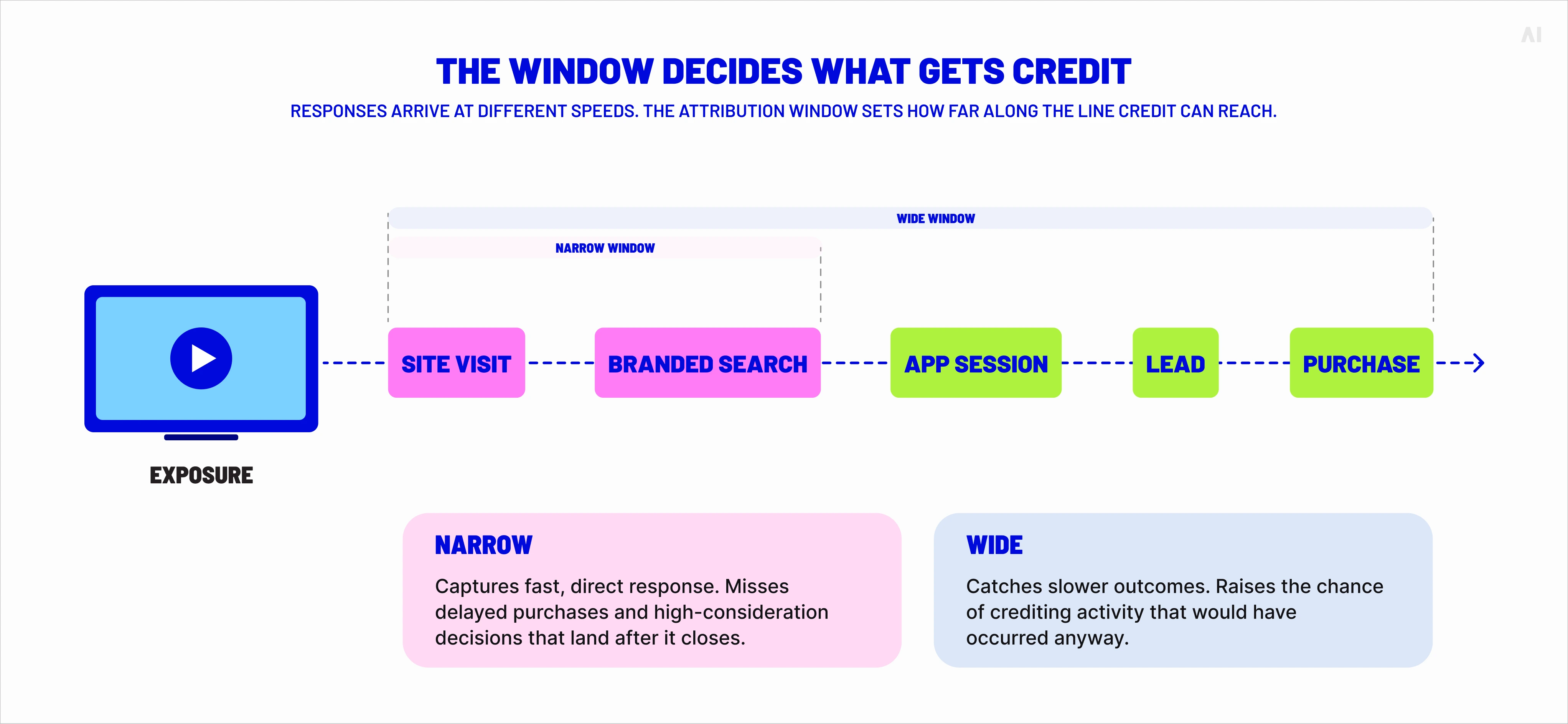
Choose the window according to the objective, decision cycle, environment and methodology. Document it, test sensitivity where feasible and avoid direct comparisons between reports using different windows.
⚡ Every attributed outcome reflects a chosen window, a defined data set and a set of eligibility rules.
Challenges and limitations of TV analytics attribution
In IAB's 2025 survey of US buy-side advertising decision-makers, 36% cited executing cross-channel media measurement as an investment challenge, and an equal share cited demonstrating media incrementality. The IAB Outlook Study reported the issues separately, underscoring the distinction between connected reporting and causal proof.
Identity, household measurement and co-viewing
Television is commonly watched on shared screens. A household exposure record cannot establish which resident was present, paid attention or converted. A device graph may connect several screens while leaving the individual journey unresolved.
Reports should label household, device and person-level metrics accurately and disclose material co-viewing or matching assumptions.
Data coverage and methodology can change the result
Two providers can report different outcomes because they use different exposure data, identity graphs, baselines, rules, windows or conversion sources. Panels and smart-TV data may also represent different populations.
Consistent TV campaign measurement requires monitoring coverage, match rates, missing intervals and methodology changes. Compare vendors only after their definitions, units and eligible populations align.
TV attribution does not automatically prove incremental impact
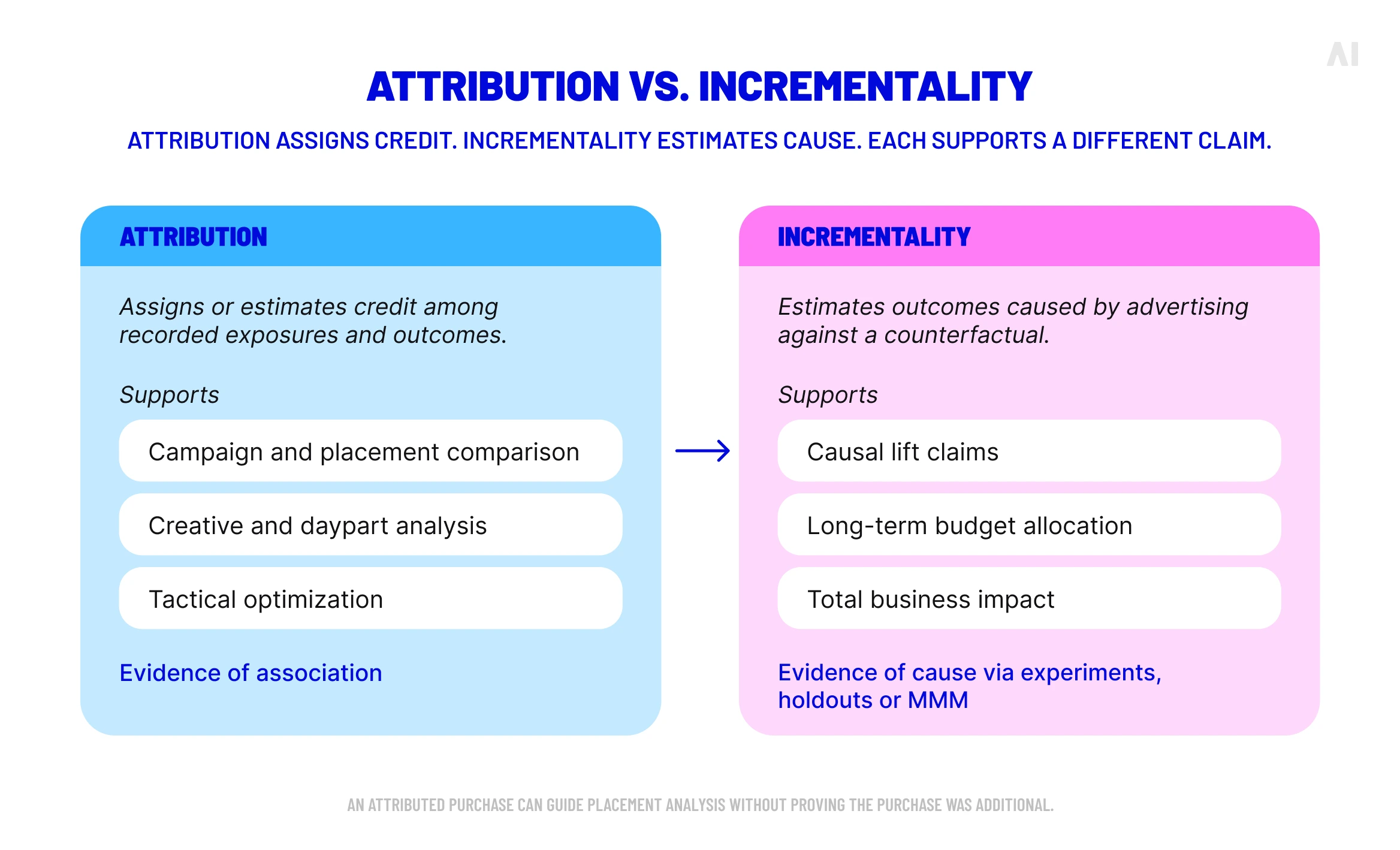
Attribution assigns or estimates credit among recorded events. Incrementality estimates outcomes caused by advertising against a counterfactual. Each supports different claims.
An attributed purchase can inform creative or placement analysis without establishing that the purchase was additional. Experiments, holdouts, matched markets or other counterfactual methods may be needed for causal questions.
💡 AI Digital's guide to incrementality versus attribution explains how the methods work together.
Best practices for TV attribution measurement
Effective television attribution uses a transparent, consistent method suited to the decision. Agree this checklist before launch and revisit it when the campaign or data setup changes.
This discipline gives TV advertising measurement a stable basis and makes disagreements easier to diagnose.
How AI Digital supports TV attribution and cross-screen measurement
AI Digital supports cross-screen campaigns through programmatic activation, attribution options, cross-channel intelligence and a vendor-neutral framework. Methodology and outcomes depend on the campaign, inventory, data and measurement partners.
Programmatic TV and outcome measurement
AI Digital's programmatic media capabilities cover CTV and OTT alongside display, online video, native, live sports and retargeting, with granular reporting where available.
Attribution options include site engagement, conversions, foot traffic, brand lift and custom measurement. Granularity, outcomes and windows need to be established for each campaign.
Elevate for cross-screen journey analysis and reporting
Elevate provides Path to Conversion and Advanced Reporting. It can analyze available cross-screen touchpoints before conversion and centralize core metrics from integrated DSPs, search and social sources.
The resulting view still reflects the sources, identity signals and events available. It does not reconstruct every viewer's behavior.
Open Garden for cross-platform measurement
AI Digital's Open Garden Framework is a vendor-neutral, DSP-agnostic structure spanning DSPs, SSPs and data partners. It supports attribution alignment, frequency harmonization, overlap modeling and interoperability.
The framework incorporates ACR integrations from Comscore and SambaTV, plus foot-traffic data from Cuebiq and Adsquare. Walled-garden restrictions, identity gaps and provider differences still limit comparison.
Turn TV attribution into better measurement, not false certainty
TV attribution analytics can connect television activity with measurable response and inform campaign, creative, placement and budget decisions. Conclusions depend on data coverage, measurement units, identity assumptions and attribution rules.
Attribution can guide tactical optimization. Decisions about causal lift, long-term allocation or total business impact require experiments, incrementality analysis, MMM or other suitable evidence.
If you want to build a television measurement approach around the outcomes, data and buying environments available to your campaign, talk to AI Digital.