
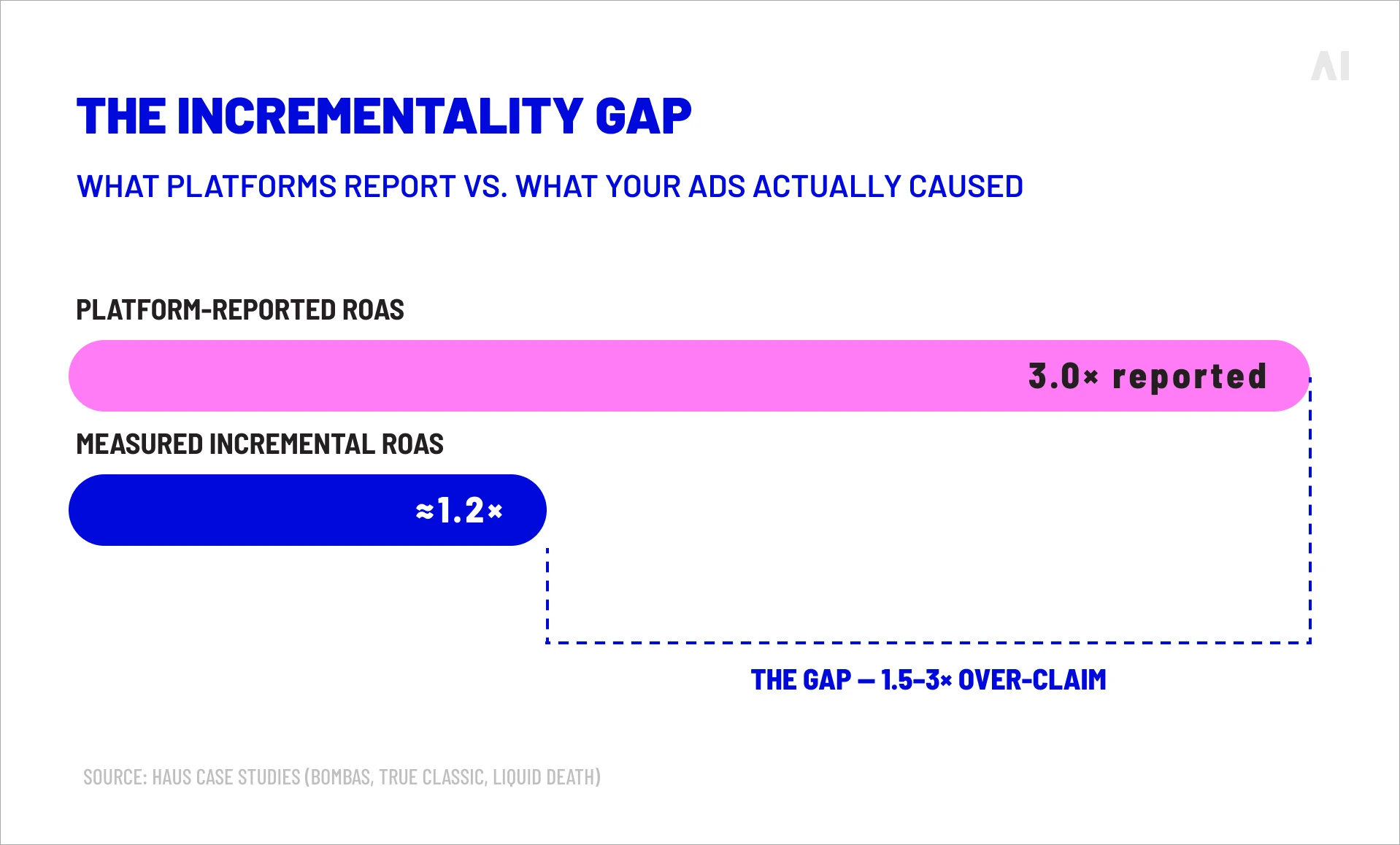
The disagreement is built in. Search, social, email, and your web analytics were each designed to watch one slice of the journey and to argue its case, so each reports a version of events tilted toward the channel it represents. Assemble those versions into a single picture and it will not hold together: the totals overstate what happened, and budget drifts toward whichever report reads best rather than whichever channel did the work. In Haus case studies for brands such as Bombas and Liquid Death, platform-reported ROAS overstated the incremental figure by roughly 1.5 to 3 times, widest on brand search and retargeting.
Cross-channel attribution tools exist to give you one account you can defend. Instead of accepting each platform's self-report, they collect data from every channel, rebuild the journey a customer actually took, and measure what each touchpoint contributed to the sale.
This piece covers the criteria that separate a capable platform from a limited one, profiles the ten leading tools, compares the attribution models they use, and gives you a framework for choosing.
💡 For the wider argument behind it—that platform attribution alone no longer measures modern marketing—see Digital marketing measurement across channels: why modern attribution is no longer enough, and for where the problem begins, see data fragmentation in advertising.
What are cross-channel attribution tools?
Cross channel attribution tools connect a customer's interactions across every marketing channel—paid search, paid social, email, organic, connected TV, and offline—and measure how much each one contributed to a conversion and to revenue. Rather than relying on each platform's own account of its performance, they pull the data into one place, rebuild the journey a customer actually took, and assign credit across it.
The problem they address is structural. Ad platforms report only on the activity they can see inside their own walls, and each is incentivized to claim as much credit as possible. Run the same campaign across three platforms and each may count the same sale, so the totals inflate and contradict one another. That is why independent, cross-channel measurement has become essential: a single, consistent view sitting above the platforms, rather than a pile of self-reported scorecards that cannot be reconciled.
This is also why modern attribution has grown beyond a single model.
💡 Understanding the differences between approaches, and their limits, is its own topic, covered in Marketing attribution models: types, comparison, and limitations and Marketing measurement vs attribution vs MMM: what's the difference.
How we evaluated marketing attribution tools
We assessed each platform against the criteria that separate a capable tool from a limited one, applied consistently across the comparison.
- Channel data coverage—how many of your channels the tool can actually collect data from, including offline and streaming, not just the major paid platforms.
- Identity resolution—how well it stitches a single customer's activity across sessions, devices, and browsers, since match quality sets the ceiling on everything else.
- Attribution model flexibility—whether you can compare several models rather than accept one fixed answer.
- Integration depth—the quality of connections to your ad platforms, CRM, data warehouse, and analytics stack.
- Privacy and cookieless readiness—reliance on first-party and server-side data, plus consent-mode support and regional compliance.
- Reporting quality—how clearly the tool turns data into decisions for both practitioners and executives.
- AI-powered insights—whether machine learning adds analytical value or simply relabels a dashboard.
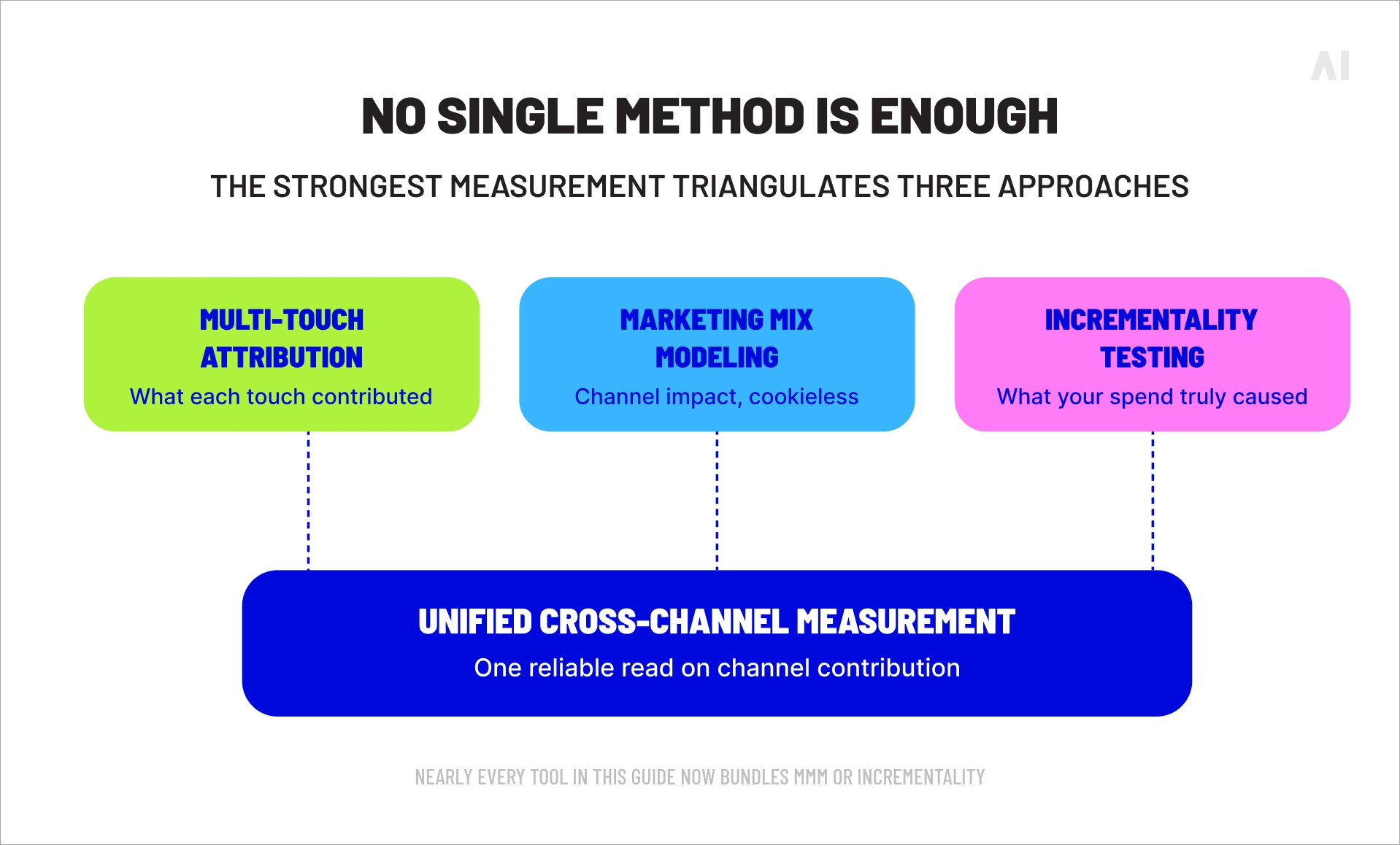
- Support for unified measurement—whether the tool connects attribution to incrementality testing and marketing mix modeling.
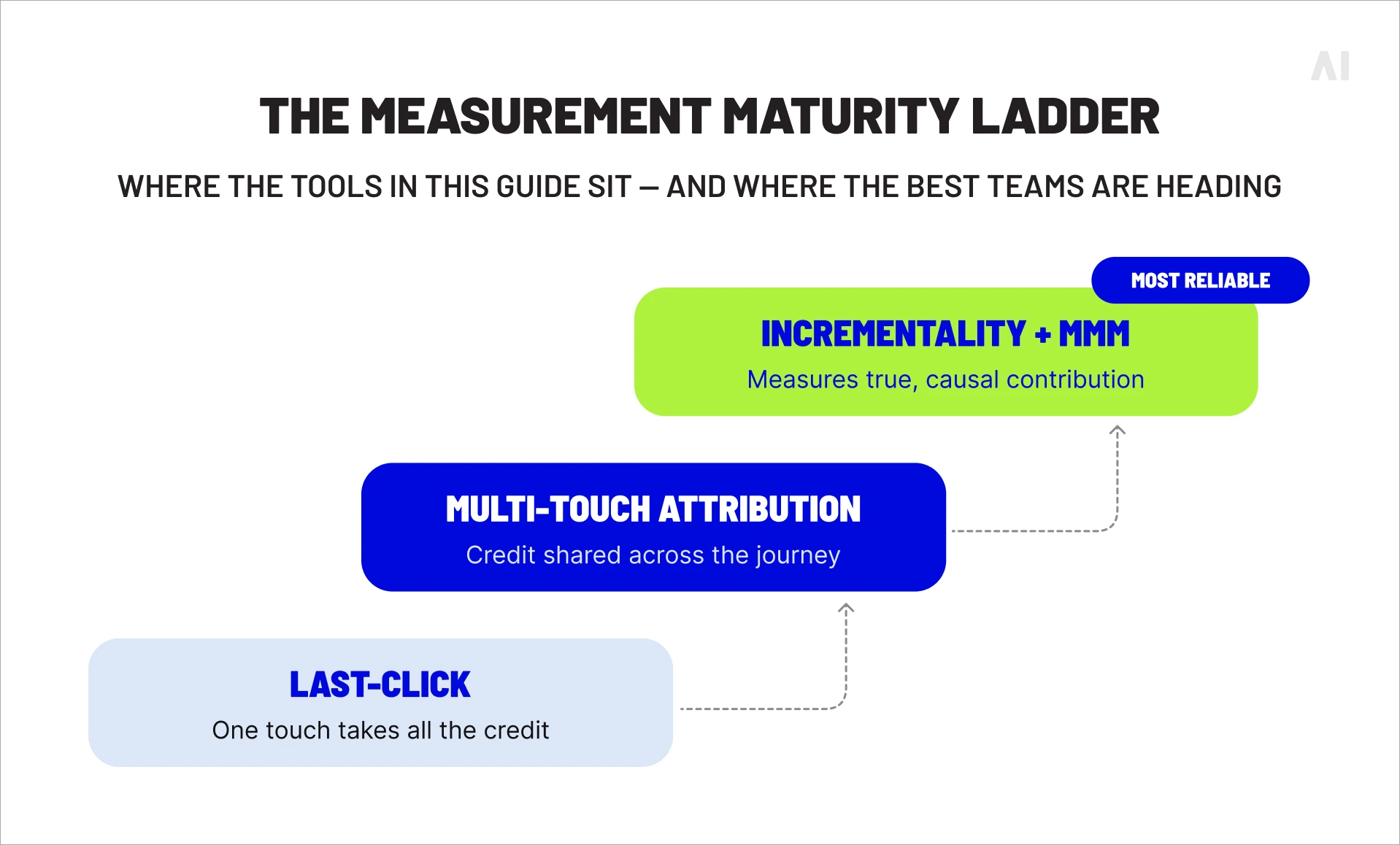
That last point reflects where measurement has moved. A useful way to picture it, credited to analytics leader Avinash Kaushik, is a maturity ladder: last-click at the bottom, multi-touch attribution in the middle, and incrementality testing with marketing mix modeling at the top. The strongest tools help you climb it rather than keeping you on the lowest rung.
10 best cross-channel attribution tools in 2026
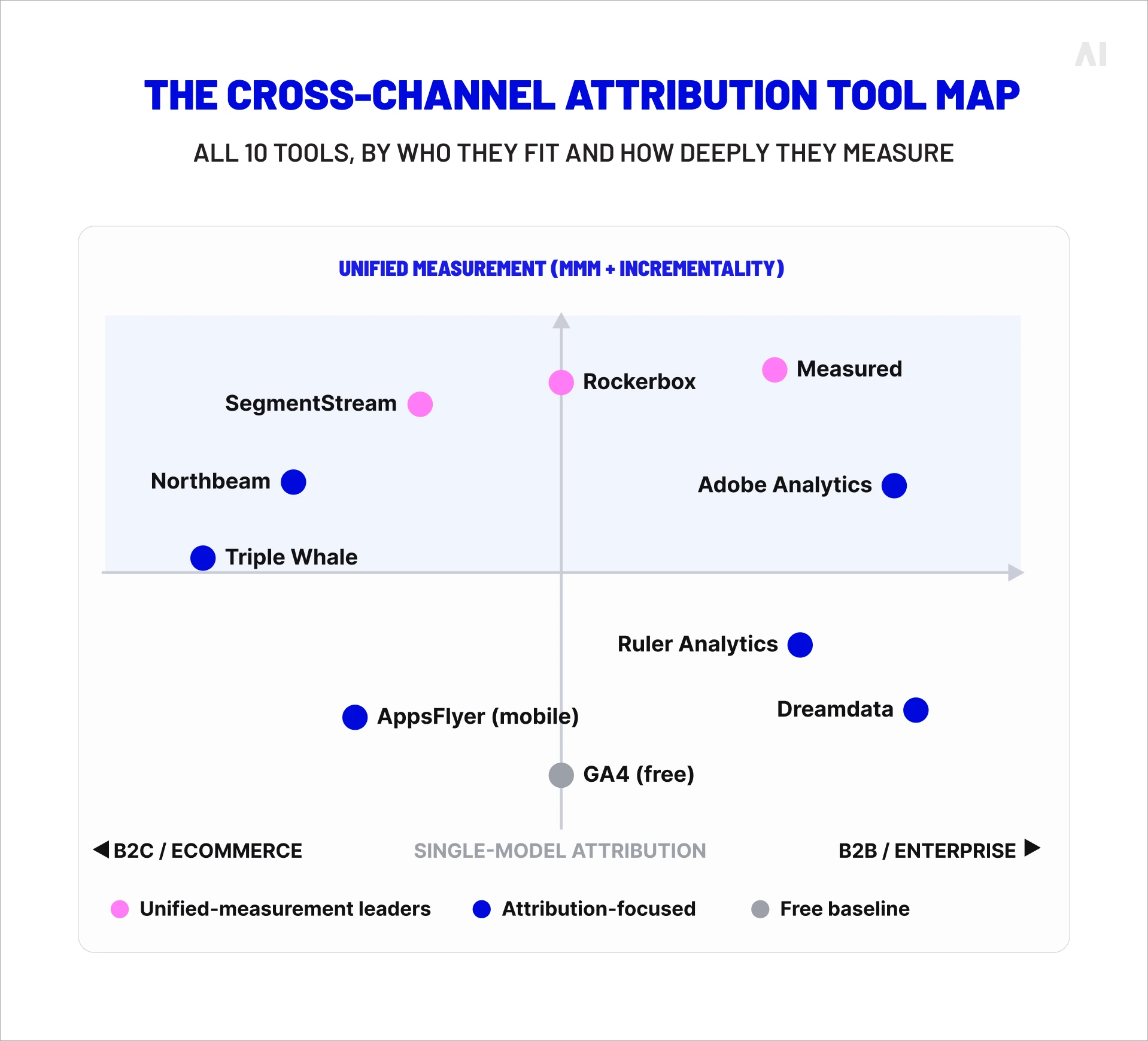
The marketing attribution platforms below span different segments—ecommerce, B2B, enterprise, and mobile-first—and the right choice depends on your channel mix, data volume, and team maturity. Each profile follows the same structure so you can compare them quickly: what the tool does, its standout strengths, and where it falls short.
💡 For why the underlying problem persists across all of them, see Why cross-platform measurement is still broken in a walled garden world.
1. SegmentStream
SegmentStream began as a cookieless conversion-modeling platform and has since rebuilt itself around AI-native measurement. It reconstructs customer journeys from aggregated signals rather than individual cookies, stitching sessions across devices and browsers with a mix of deterministic and probabilistic matching.
In 2026 its defining feature is a measurement engine that connects to AI agents: through a Model Context Protocol interface, teams can query attribution, reallocate budget, and run geo-holdout incrementality tests from tools such as Claude or ChatGPT, or from the platform's own dashboard.
Beyond Google Ads and Meta, it now ingests data from more than a dozen ad platforms, plus GA4, BigQuery, and major CRMs, and offers self-serve Online and Full Funnel plans alongside a sales-led Enterprise tier. That makes it a strong fit for teams that want budget decisions, not just reports.
The drawbacks come with the approach: the modeling carries a steeper learning curve than a rules-based tool, reviewers note the interface can lag, and results depend on clean, error-free data feeds. It is also less suited to journeys that close largely offline unless you connect a CRM.
2. Rockerbox
Rockerbox consolidates paid, organic, email, and offline data into a single attribution view, then layers marketing mix modeling and incrementality testing on top so teams can triangulate channel performance from three angles at once. Its 75-plus integrations cover the usual paid platforms plus Shopify, data warehouses such as Snowflake and BigQuery, and streaming and offline sources, which is why it suits omnichannel and mid-market brands as much as ecommerce.
In March 2025 Rockerbox was acquired by DoubleVerify for around $82 million, and it now sits inside DV's wider measurement and activation suite. The Shopify integration remains a strength for retail brands running catalog ads alongside podcast, direct mail, or connected TV spend.
Pricing is sales-led with no public rate card; third-party contract data suggests annual costs from the mid-five figures for mid-market brands into six figures at enterprise scale. Onboarding is guided rather than plug-and-play, so expect a setup period before the unified view is reliable. If you have outgrown single-model attribution and want MMM and incrementality in one place, few tools cover more ground.
3. Northbeam
Northbeam is a machine-learning attribution engine built for direct-to-consumer and ecommerce brands with large paid budgets—typically $500,000 or more a year, and often much higher. It combines deterministic and probabilistic signals with view-through conversions, then reconciles the total so attributed sales sum to 100% of real orders rather than the inflated figures ad platforms report between them.
Where it stands apart is creative-level attribution: teams can see which specific ads and audiences drive profit, supported by channel-pacing guidance and a dashboard that refreshes several times a day. Marketing mix modeling and predictive revenue forecasting sit on the higher tier, which appeals to brands that need measurement they can defend to a finance team.
Pricing is pageview-based and annual, starting around $1,000 to $1,500 a month with no free plan or trial, and rising to roughly $2,500 or more for the tier that unlocks creative analytics, MMM, and API access. Onboarding runs four to six weeks, and the tool rewards teams with in-house analytics capacity. Its main gaps are offline and B2B coverage, and a learning curve for non-technical users.
4. Triple Whale
Triple Whale is built natively around Shopify, and for DTC operators it has become a near-default. Its first-party Triple Pixel, branded Sonar, captures conversions server-side to recover the visibility lost after Apple's iOS privacy changes, feeding a probabilistic multi-touch model, cohort lifetime-value analysis, and a creative analytics workspace called Creative Cockpit. Its Moby AI agent now answers performance questions and runs recurring reporting inside the platform and in Slack.
A free plan offers first- and last-click attribution and blended reporting. Paid plans are tiered by gross merchandise value, starting around $129 to $219 a month for smaller stores and scaling to $1,500 to $3,000 or more as revenue grows, with marketing mix modeling and geo-lift incrementality in a separate Compass add-on.
There are clear trade-offs. Triple Whale is Shopify-first and less suited to complex B2B or non-Shopify omnichannel retail, its expanding feature set can overwhelm smaller teams, and GMV-based pricing can penalize high-revenue, thin-margin brands. For a Shopify brand with a dedicated media buyer, though, few tools match its speed and creative depth.
5. Ruler Analytics
Ruler Analytics solves a different problem: connecting anonymous web sessions to closed revenue inside a CRM. It tracks visitors at the individual level across calls, form fills, and live chat, then attributes the eventual sale back to the specific keyword, campaign, and channel that started the journey. It also pushes that revenue data back into GA4, Google Ads, and Meta, so bidding can optimize toward pipeline rather than raw leads.
Built in the UK, it integrates with Salesforce, HubSpot, Pipedrive, and Microsoft Dynamics, plus more than a thousand tools via Zapier, and offers six attribution models. More recently it has added a marketing mix modeling layer to capture impression-based and offline channels. Published pricing runs from £199 a month for 5,000 visits to £1,149 for 100,000, with custom pricing above that, on a rolling monthly license.
It suits lead-generation and considered-purchase businesses rather than ecommerce conversion tracking, and it depends on a connected, well-maintained CRM to earn its keep.
💡 For where it fits best, see Best attribution models for B2B and long sales cycles.
6. Dreamdata
Dreamdata is purpose-built for B2B, where a single deal can involve six to ten stakeholders and a buying cycle measured in months. Rather than crediting individual contacts, it maps every touchpoint across an entire account and ties it to pipeline and revenue at the company level, so a channel earns credit even when the colleague it influenced never personally clicked.
Native integrations with Salesforce, HubSpot, and LinkedIn—including the Conversions API and company intelligence—sit at its core, alongside Google Ads, Meta, and major marketing-automation tools. It offers first-touch, last-touch, and U- and W-shaped models plus custom logic, and has grown beyond reporting into activation, with audience building and buying signals that sync to ad platforms.
A free plan is available; paid plans begin around $750 a month on the Activation Starter tier and rise to custom enterprise pricing. The catch is data hygiene: setup takes two to eight weeks, results depend on clean CRM data, and the platform is overkill for straightforward B2C. For B2B teams that need to prove marketing's contribution to revenue, little else goes as deep.
7. AppsFlyer
AppsFlyer is the leading mobile measurement partner, and app-first businesses can rarely do without it. It attributes installs, in-app events, and re-engagement across more than 10,000 integrated networks, with built-in fraud protection through Protect360 and deep linking for smooth user journeys.
On iOS, its measurement is built around Apple's privacy frameworks: SKAN 4 through its Conversion Studio, plus the newer AdAttributionKit that now serves as Apple's successor framework for app-ad attribution. A predictive layer models the gaps that aggregated, privacy-safe reporting leaves behind, and its single-source-of-truth logic deduplicates installs across SKAN and traditional attribution.
Pricing is usage-based: a free Zero tier covers early-stage apps up to a set volume, while the Growth plan charges roughly $0.07 per conversion, with negotiated enterprise rates at scale. The main limitation is scope—AppsFlyer is mobile-focused and less suited to web-only or offline-heavy measurement—and its cost climbs with conversion volume, so growing apps should model the numbers before committing.
8. Measured
Measured puts causal experiments, rather than rule-based models, at the center of media evaluation. Its approach runs geo-based holdout tests and A/B experiments to establish whether a channel drives incremental sales, then uses those results as priors to calibrate a marketing mix model, a triangulation that connects controlled experiments, statistical modeling, and live platform data.
With more than 300 integrations, weekly model refreshes, and a privacy-compliant marketing data warehouse, it is trusted by large advertisers including Unilever, Paramount, and Intuit to measure billions in spend. It works as the bridge between traditional attribution and unified measurement, answering the question attribution cannot: what would have happened without the ad.
Pricing is enterprise and custom, commonly starting around $50,000 a year and often well into six figures. The trade-offs follow from the method: experiments need enough volume to reach statistical significance, tests are often set up manually with limited concurrency, and insight takes longer to arrive than from a real-time dashboard. For brands large enough to run it properly, it delivers measurement that stands up to scrutiny.
9. Google Analytics 4
Google Analytics 4 is the free starting point for cross-channel reporting, and for many teams it is the first attribution tool they use. Its data-driven attribution model applies machine learning to distribute credit across touchpoints, and it remains a reasonable neutral baseline for comparing channels.
Be clear about the limits, though. As of 2026 GA4 offers only three models—data-driven, the default, plus two last-click variants—after Google removed first-click, linear, time-decay, and position-based models in November 2023. Data-driven attribution also needs roughly 400 conversions per key event, and below that threshold it falls back to last-click without telling you. More fundamentally, GA4 leans toward Google's own channels, sees only digital touchpoints, and offers no connected-TV or media-agnostic measurement.
It is not a replacement for independent attribution, and Google's model is correlational rather than causal. Treat it as a free baseline, then validate against tools that can see beyond the Google ecosystem—see our guides to alternatives to walled gardens and connected-TV advertising.
10. Adobe Analytics
Adobe Analytics is an enterprise-grade analytics and attribution platform for organizations with complex journeys and large volumes of first-party data. It uses algorithmic, machine-learning attribution rather than fixed rules, alongside advanced segmentation, custom models, and AI-powered insights through Adobe Sensei.
Its modern center of gravity is Customer Journey Analytics, built on the Adobe Experience Platform, which works with raw, event-level data to analyze person-level journeys across online and offline channels. A generative-AI Data Insights Agent, introduced in 2025, lets teams ask questions in plain language and get visualizations back without writing queries, and Adobe now offers a unified marketing-mix-and-attribution measurement capability on top.
Pricing is custom and not published; industry estimates put full deployments between $50,000 and $200,000 or more a year, before implementation costs that can run from $20,000 into six figures.
The limits are the price of the power: high implementation complexity, a steep learning curve, and an investment that only makes sense for large organizations with the technical resources to support it. For mid-market teams, lighter tools usually deliver better value.
Cross-channel attribution tools: which one fits your business?
The table below compares the featured digital marketing attribution tools side by side—the business each suits best, the models it supports, the channels it covers, where pricing starts, and its core strength and limitation.
How to select the best attribution tool
Use this seven-step framework to match a platform to your actual needs rather than its feature list.
💡 It works as a standalone checklist and as part of building a broader approach, covered in Creating a data-driven marketing strategy.
Step 1. Map your channel mix
Start by listing every channel that touches your customers—paid search, paid social, organic, email, connected TV, and offline—and confirm the tool can collect data from all of them. A platform that covers 80% of your spend will still leave you optimizing on a partial picture, and the channels it misses are often the upper-funnel ones that seed demand. If television, podcast, or direct mail carry meaningful budget, prioritize tools with proper offline and streaming coverage.
Step 2. Define your primary attribution goal
Decide what you most need the tool to do: optimize campaigns day to day, allocate budget across channels, analyze the full customer journey, or report performance to executives. Different platforms excel at different jobs. A DTC brand killing creative daily has very different needs from a B2B team proving pipeline contribution to the board, and buying a tool built for the wrong job is the most common source of buyer's regret.
Step 3. Assess your data readiness
Data-driven models only work above a minimum volume, so audit your first-party data infrastructure, CRM cleanliness, and monthly conversion count before you commit. Google's own data-driven model needs hundreds of conversions per event to function; below that it reverts to last-click without warning. If your conversion volume is thin or your CRM data is messy, fix the foundation first, because no attribution model can rescue unreliable inputs.
Step 4. Confirm privacy and compliance requirements
Check GDPR and CCPA compliance, server-side tracking, and consent-mode support—mandatory in the EU and increasingly expected everywhere. Cookieless readiness is no longer optional, so favor tools that lean on first-party and server-side data rather than third-party cookies. If you handle sensitive data or operate across regulated markets, a data clean room may belong in your stack as well.
Step 5. Evaluate attribution model flexibility
Decide whether you need a single model or the ability to compare several and combine attribution with broader measurement. The strongest setups do not rely on one number; they read data-driven attribution alongside incrementality tests and marketing mix modeling, using each to check the others. Tools that let you switch models and view them side by side make that triangulation far easier.
Step 6. Consider total cost of ownership
Compare the full investment, not the subscription line alone. Licensing is only part of it; factor in implementation, integrations, onboarding, and ongoing maintenance, along with usage-based charges that scale with conversions, pageviews, or GMV. A cheaper tool that needs a data engineer to run can cost more than a pricier one that works out of the box. Tie the decision back to the KPIs the tool is meant to move.
Step 7. Avoid common mistakes
The common pitfalls are worth naming: relying on GA4 alone, overlooking offline and CRM data, feeding the model poor first-party data, running data-driven attribution on too few conversions, and treating attribution as a substitute for MMM or incrementality testing. Each one produces confident numbers that point in the wrong direction. Much of the risk traces back to fragmented data—see also Marketing attribution challenges: why traditional attribution models don't work anymore.
Tools that strengthen attribution across channels
No attribution tool is better than the data feeding it. Accurate measurement depends on clean inputs, a consistent way to compare channels, and transparent media that produces trustworthy campaign data in the first place. The following AI Digital solutions work alongside the tools above to improve data quality, unify measurement, and generate more reliable attribution insights across programmatic advertising and beyond.
AI-powered marketing intelligence
AI Digital Elevate is a marketing intelligence platform that unifies cross-channel data and turns it into decisions. Elevate is not a DSP: it does not buy or serve ads, and instead sits across more than a dozen DSPs and the wider digital ecosystem as an intelligence, planning, and measurement layer.
Its Path to Conversion analysis and marketing mix modeling support cross-channel attribution directly, while AI Audience Segments, Competitive Analysis, and an AI-Assisted Media Planner turn measurement into forward-looking plans.
💡 For teams weighing an intelligence platform against a conventional setup, our comparison of an AI marketing platform and a traditional martech stack is a useful starting point.
Unified cross-channel measurement
AI Digital's Open Garden framework is a vendor-neutral alternative to the walled gardens that fragment measurement. Working across more than 15 DSPs, it standardizes data on consistent definitions so that a conversion, an audience, and a channel mean the same thing wherever they are measured—the reliable foundation that cross-channel attribution depends on.
Built on three pillars of transparency, customization, and efficiency, it gives marketers a way to compare performance across platforms on equal terms rather than accepting each platform's self-graded scorecard.
Transparent media supply
AI Digital Smart Supply improves attribution accuracy upstream, at the point where media is bought. By curating supply paths to each client's KPIs and cutting out the bid-stream noise that muddies reporting, it raises the quality and transparency of the inventory a campaign runs on, which means cleaner data flowing into measurement and reporting. It is DSP-agnostic and free to use, with custom deal IDs issued per inventory type.
💡 For the mechanics, see our explainers on digital advertising transparency.
Which cross-channel attribution tool is right for you?
There is no single best cross-channel attribution tool—only the one that fits your business model, channel mix, data maturity, and reporting needs. A Shopify brand optimizing paid social daily, a B2B team proving pipeline over a six-month cycle, and an enterprise measuring television alongside digital will each land on a different answer, and all three can be right.
The common thread is honesty about what attribution can and cannot do. Even the best model distributes credit based on correlation; to know what your marketing genuinely caused, pair it with incrementality testing and marketing mix modeling. The market has already reached this conclusion, and nearly every tool profiled here has added MMM or incrementality to its core attribution.
If you are assessing your current measurement and want help selecting and implementing the right solution, get in touch with AI Digital. We will help you build a measurement approach that reflects reality, not the self-reported numbers of the platforms you buy from.