CTV Attribution in a Fragmented Streaming Ecosystem

A single connected TV campaign now runs across a dozen streaming apps and several DSPs at once, each measuring exposure against its own identity graph and its own rules for what counts as a view. The result is a stack of performance reports that contradict each other, with no arbiter to decide which is right.
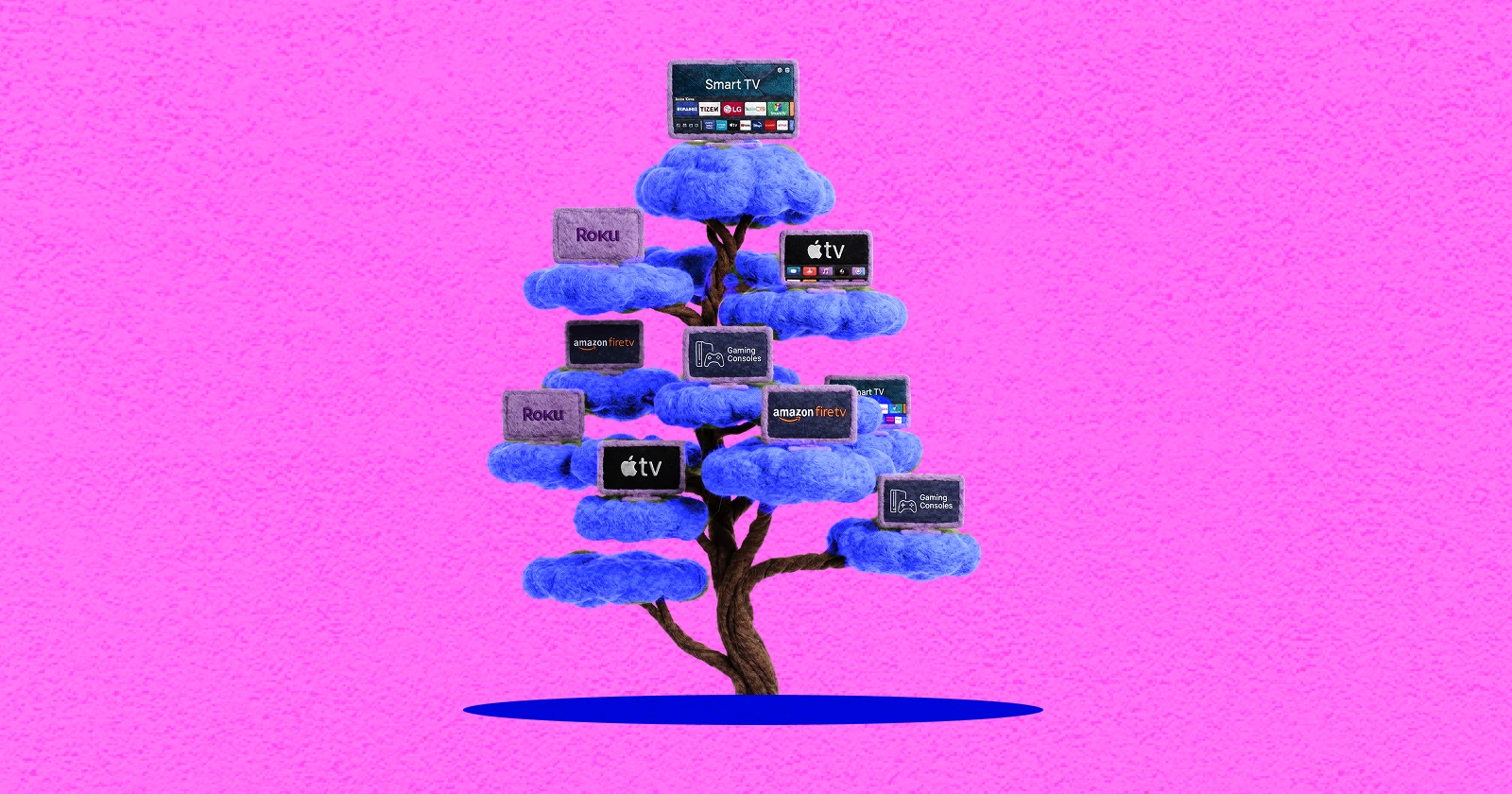
Ask two of the most authoritative bodies in American advertising how much money will go into streaming this year, and the answers arrive $8.65 billion apart. IAB projects US connected TV ad spend at $29.3 billion in 2026. eMarketer puts it at $37.95 billion. Neither has made an error. They simply file YouTube in different places—IAB counts it under social video, eMarketer counts YouTube inventory delivered to a television screen as CTV. Anyone who has spent a quarter reconciling CTV attribution reports will recognize the pattern, because it is the same disagreement playing out inside a single campaign, one platform at a time.
TL;DR: CTV attribution
The short version:
- CTV attribution is harder than web or mobile attribution because one campaign spans multiple platforms, devices, and identity systems, none sharing a definition of a visit, a view, or a conversion.
- Platform-reported numbers are not a single source of truth. Each platform measures only its own exposures and has a commercial interest in claiming the conversions it can see.
- Accuracy depends on three things: cross-device identity resolution, attribution windows standardized across every platform in the buy, and independent verification sitting above the platforms.
- Supply-path transparency is a prerequisite, not an add-on. Attribution calculated on inflated impressions produces confident, useless answers.
- Incrementality testing is the only method that proves causation. Exposure-based models describe correlation; holdout and geo experiments measure what the advertising caused.
YouTube alone accounted for 13.8% of all US television watch-time in May 2026, the largest share of any distributor, while streaming as a whole reached a record 48.6% of total TV usage, according to Nielsen's The Gauge. The category two respected forecasters cannot agree on is, in other words, the biggest single block of American viewing.
TV advertising attribution once meant reconciling a handful of national networks against a panel. It now means reconciling dozens of apps, several buying platforms, and identity systems that were never designed to speak to one another.
Fragmentation of this kind is permanent rather than transitional. Streaming continues to add new services and ad-supported tiers. Meanwhile, server-side ad insertion—the technology used to deliver most premium inventory—removes many of the signals needed for measurement. Privacy changes across devices are also weakening the identifiers used to connect ad exposure with outcomes.
What follows covers how CTV attribution works, which models suit which questions, how cross-device measurement is constructed, and how to build a vendor-neutral strategy that survives a marketplace this fractured.
💡 For the channel fundamentals, see our guide to connected TV advertising.
What is CTV attribution
CTV attribution connects a streaming ad exposure to a downstream outcome—a site visit, an app install, a purchase—when the exposure happened on a television and the outcome happened somewhere else. Because nobody clicks a television, the connection is made through view-through signals and cross-device matching rather than a tracked click. An impression is recorded against a device or household identifier, and conversions occurring within a defined window on any device associated with that household are credited back.
👉 How credit gets assigned across a customer journey more broadly—first touch, last touch, linear, time decay, algorithmic—is covered in our explainer on marketing attribution models, and the buying mechanics behind these impressions are set out in our guide to CTV media buying.
Why connected TV attribution is fragmented
Connected TV attribution breaks down because one campaign is measured many times over by parties who never compare notes. A media plan might run across twelve streaming apps, bought through four DSPs, reaching viewers via direct deals, private marketplaces, and open auctions simultaneously. Every route generates its own impression log, applies its own identity graph, and reports against its own definition of a qualified view.
Households make the overlap unavoidable: 90% of US households hold a paid streaming subscription, averaging four services each, with 68% of subscribers now on ad-supported tiers—a rise of more than twenty percentage points since 2024, according to Deloitte's 2026 Digital Media Trends. A campaign of any scale therefore reaches the same homes repeatedly, and each app reports that reach as though it were the only one involved.
Three consequences follow, and they compound:
- Inflated totals. Sum the platform reports and the campaign appears to have reached more households and driven more conversions than it did.
- Duplicated credit. The same purchase is counted by every platform whose pixel saw an exposure inside its own window.
- Non-comparable metrics. One platform's completed view is another's two-second impression, so the numbers cannot be added even when the labels match.
Some 86% of US media professionals say they would move more linear budget into CTV if show-level targeting and reporting were available, and 47% name limited content-level data as a primary barrier to spending more, according to March 2026 research from Gracenote, Nielsen's content intelligence unit. The money is waiting on the measurement.
👉 Our analysis of data fragmentation in advertising traces the same dynamic across other channels, and our guide to digital marketing measurement covers the frameworks used to consolidate disparate sources.
The walled-garden attribution problem
When a platform sells the inventory, serves the ad, records the exposure, and reports the outcome, it is grading its own homework. Every incentive points toward a generous reading of credit, and nobody external is checking the arithmetic.
Consider a household on three ad-supported services that buys something on a laptop four days after the campaign starts.
- Platform A served an impression Tuesday and claims the sale.
- Platform B served one Wednesday and claims it too.
- Platform C ran a spot Thursday evening and, working inside a seven-day view-through window, claims it as well.
Three reports, three conversions, one purchase. No reconciliation layer sits between them, so the advertiser receives three internally consistent documents that are collectively wrong by 200%.
Even the buying methods IAB classifies as most trustworthy—publisher-direct insertion orders, programmatic guaranteed, publisher-direct self-service—earn high confidence in inventory transparency from only 57% of buyers, according to the IAB 2026 Digital Video Ad Spend & Strategy Report, which surveyed 360 verified US decision-makers. Confidence falls steadily from there: 47% for preferred deals, 45% for private marketplaces, 41% for commerce and retail media networks, and 33% for open exchange and real-time bidding.
⚡ Three internally consistent reports can still be collectively wrong by 200%. Without a reconciliation layer, every platform in a campaign is entitled to claim the same conversion.
👉 Our examination of walled gardens covers why these environments resist external verification, and our guide to alternatives to walled garden buying sets out what interoperable activation looks like.
How SSAI affects CTV attribution
Server-side ad insertion delivers most premium streaming inventory, and it exists for sound reasons: it stitches advertising into the content stream before delivery, so playback runs without buffering or format jumps, and ad blockers cannot separate the advertising from the programming. Everything it does well for delivery, it undoes for measurement.
Client-side delivery generates a request from the viewer's device to the ad server, carrying device-level context—identifiers, user agent, IP—that attribution vendors use to match an exposure to a household. SSAI removes that request. The ad decision happens on a server several steps removed from the viewer, and how much contextual detail survives varies by publisher, by SSAI vendor, and sometimes by individual integration. The IAB and MRC guidance on SSAI and OTT measurement remains the governing standard and acknowledges directly that server-side delivery complicates impression validation.
An advertiser running across eight publishers may see strong household matching on three, moderate matching on three more, and something close to guesswork on the remaining two, with no way to tell from the reports which is which. Conversion APIs recover part of what is lost by passing outcome signals server-to-server instead of relying on client-side pixels, and IAB Tech Lab's October 2025 guidance reported two-thirds of advertisers seeing improved return on ad spend after implementing them—though adoption across publishers remains patchy, and the underlying signal loss persists.
Inventory quality and MFA
An attribution model applied to bad impressions returns a confident answer to the wrong question. Made-for-advertising inventory, spoofed apps, and non-human traffic all generate impressions that enter reporting exactly as legitimate ones do, diluting the denominator every conversion rate is calculated against.
DoubleVerify's 2026 Global Insights report, published in May 2026, detected 140% more CTV fraud schemes and variants in the first quarter of 2026 than a year earlier, alongside a tenfold increase in fraudulent CTV apps. More telling for anyone modeling streaming performance is the gap between protected and unprotected campaigns: fraud and invalid traffic ran below 1% on the former against roughly 9% on the latter. Where nearly one impression in eleven is invalid, the attribution built on top of it is fiction with a confidence interval attached.
Among buyers reporting low confidence in open exchange purchasing, IAB found 56% citing fraud or invalid traffic, 48% an inability to verify the publisher or content source, and 44% uncertainty about program-level placement. No attribution methodology solves any of that after the fact, which is why supply path optimization belongs in the measurement conversation rather than being filed as a separate efficiency exercise.
CTV attribution models and measurement techniques
No single model answers every question about streaming performance. Each assigns credit differently, suits a particular set of conditions, and carries a limitation that becomes acute where nobody clicks.
👉 B2B advertisers face an additional layer around long consideration cycles and multiple decision-makers; our guide to the best attribution models for B2B covers that case.
View-through vs. click-based attribution
Television is a lean-back medium with a remote control rather than a pointing device. The interaction a click-based model needs does not happen at scale, which is how view-through attribution became the streaming default—by elimination rather than design.
Among buyers rating CTV as middling or lagging for lower-funnel outcomes, IAB found 39% citing the absence of direct click-through capability as their leading obstacle, 38% pointing to the need for a second device, and 33% naming fragmented reach across platforms. The conversion path runs through a phone or a laptop, and measurement has to follow it there.
View-through attribution credits exposure instead, and its weakness is plain: an exposure followed by a conversion is not proof the exposure produced it. Someone already intending to buy converts regardless, and a view-through model cannot tell that case from genuine influence. Widen the window and it absorbs more coincidence. Narrow it and real influence goes uncounted. Every advertiser using view-through is making a judgment about that trade, articulated or not.
Multi-touch attribution and media mix modeling
MTA and MMM answer different questions on different timescales, and CTV benefits from having both rather than choosing.
- Multi-touch attribution works at the level of individual journeys, distributing credit across recorded touchpoints fast enough to inform this week's optimization. Its dependence on persistent identity is also its constraint: where identifiers are degraded, as they routinely are across streaming, MTA reconstructs journeys from partial evidence and reports the result with unwarranted precision.
- Media mix modeling comes at it from the opposite end. Regressing aggregate spend against aggregate outcomes requires no user-level data, which makes MMM durable under privacy restriction and able to account for channels individual tracking cannot see—linear TV, out-of-home, and the portion of CTV that identity resolution misses. What it gives up is speed: MMM produces quarterly guidance on channel allocation, never a reason to move budget between two streaming apps on Thursday. Run together, MTA supplies the in-flight signal while MMM validates the aggregate.
👉 Our overview of marketing measurement shows how both fit a wider framework.
Why incrementality testing matters more
Both models above describe patterns in observed data. Neither establishes that advertising caused anything, because both work from a single reality in which the campaign ran. The counterfactual—what would have happened otherwise—is unavailable to any observational method, however sophisticated.
Incrementality testing builds that counterfactual deliberately.
- A holdout design withholds exposure from a randomly selected share of the addressable audience and compares outcomes against the exposed group.
- A geo design pauses or scales activity in test markets while matched control markets run unchanged, then attributes the difference to the media.
Because geo testing works on aggregate regional data and needs no user-level identity, it suits CTV particularly well: the identity problems that undermine exposure-based attribution simply do not apply.
Campaigns reporting strong view-through performance often return modest incremental lift, because a large share of the credited conversions would have happened anyway, and that gap is the honest measure of what streaming contributed.
Attribution keeps campaigns running well week to week; incrementality establishes whether they deserve the budget at all.
How household and cross-device CTV attribution works
Almost every CTV conversion happens on a device other than the one that showed the ad. Household and cross-device attribution bridges that gap, linking a television exposure to activity on the phones, tablets, and laptops in the same home, and everything rests on identity resolution—establishing, with some level of confidence, that two devices belong together. Two methods dominate, and choosing between them involves a trade rather than a ranking.
👉 Most production systems use both. Our guide to cross-device targeting covers the activation side of the same infrastructure.
The CTV attribution workflow
Before comparing vendors or configuring windows, it helps to see the path an impression travels on its way to becoming a reported conversion. Six stages, in sequence:
- Ad delivery. A DSP wins the impression and the creative is inserted into the content stream, usually server-side, then delivered to the viewer's device.
- Exposure recording. The impression is logged with whatever signals survived delivery—typically a device or household identifier, timestamp, IP, app, and content context.
- Household matching. The exposure identifier is resolved against an identity graph to associate the television with other devices in the home.
- Conversion capture. A visit, install, or purchase is recorded on one of those devices, via pixel, SDK, or server-side conversion API.
- Reconciliation. The conversion is checked against exposures across every platform in the campaign, duplicate claims are removed, and credit is assigned by the chosen model and window.
- Reporting. Results are consolidated into one view showing deduplicated reach, frequency, and attributed outcomes across the whole buy.
Stage five is where most CTV measurement fails. Platform-native systems handle stages one through four competently, then skip reconciliation entirely, because they cannot see exposures they did not serve. Deduplication requires a vantage point above the platforms, and no platform occupies it.
Deterministic vs. probabilistic identity resolution
Deterministic matching relies on something the household actively provided:
- an email used to log into an app,
- an account identifier shared through a clean room,
- a hashed customer record matched against a publisher's authenticated base.
When it lands, it is reliable. Where authentication is absent, as it is across much of streaming inventory, it returns nothing at all.
Probabilistic matching infers the relationship, drawing on shared IP addresses, device fingerprints, and behavioral correlation to estimate that a television and a phone belong to one home. Coverage improves dramatically while precision softens, and it degrades in predictable places—apartment buildings, shared networks, constant VPN use, unusually high device counts.
Advertisers should expect measurement partners to be candid about the ratio between the two, since a vendor reporting 90% household match rates without disclosing how much of that rests on inference is offering precision it cannot support.
Building a household graph
A household graph is the structure underneath all of this: a maintained map of which devices belong to which homes, refreshed as households change. Four sources typically contribute:
- First-party data—CRM records, loyalty accounts, and authenticated logins the advertiser already owns, matched via hashed identifiers.
- ACR partnerships—automatic content recognition data from smart TV manufacturers, anchoring the television within a household.
- Device relationship signals—IP co-occurrence, network topology, and behavioral patterns that link devices probabilistically.
- Clean-room collaboration—privacy-preserving environments where advertiser and publisher match records without either exposing raw data.
A graph drawing on all four will outperform one leaning on any single input, and the reason is not only coverage. Relying entirely on a single vendor's identity graph recreates the walled-garden dynamic with different branding: that vendor's coverage becomes the ceiling, its blind spots become the advertiser's, and its methodology cannot be checked against anything.
⚡ Relying entirely on one vendor's identity graph rebuilds the walled garden with different branding. Its coverage becomes your ceiling and its blind spots become yours.
Best practices for implementing CTV attribution across platforms
Decisions made in a campaign's first week determine whether reporting will be comparable in its twelfth. Most CTV attribution problems turn out to be configuration choices nobody revisited rather than analytical failures discovered at quarter end. The Open Garden Framework addresses interoperability by enabling activation across more than fifteen DSPs without locking measurement into any one, while Elevate consolidates the resulting reporting. The specifics below apply to any stack.
Configure view-through windows
Attribution windows are the most consequential setting in CTV measurement and the most frequently left on default. Platforms ship with different defaults—24 hours, seven days, fourteen, thirty—and a campaign running across five platforms on five windows produces five reports that cannot be compared, let alone summed.
Standardizing them requires three decisions:
- Choose one window and apply it everywhere. Fourteen days suits considered purchases; shorter windows suit impulse categories and app installs. Consistency across the buy is more important than the specific length.
- Normalize retrospectively where platforms cannot comply. Some environments forbid custom windows. Request raw exposure and conversion timestamps and apply the standard window during analysis instead.
- Document the choice and hold it. Changing a window mid-campaign makes before-and-after comparison meaningless, and the change is rarely recorded where an analyst will find it later.
Consistent windows will not eliminate duplicate credit on their own, since one conversion can still fall inside several platforms' windows at once. What they make possible is deduplication, which has to come first.
Choose the right CTV measurement solution
Advertisers rarely pick a single measurement solution, and those who try find the gaps late, because each category answers only part of the question.
Most mature programs run a DSP layer for daily optimization, an independent layer for verification, and a measurement platform for consolidation. That redundancy is deliberate, and it rests on a simple principle: no vendor should be the only source of evidence for its own performance.
Connected TV attribution mistakes
The failures that damage CTV measurement fall into two groups—technical faults in implementation, and interpretive errors in reading the output.
👉 Our review of marketing effectiveness measurement challenges covers the broader pattern.
Implementation challenges
Technical problems here are unglamorous and expensive. They rarely announce themselves, and by the time a discrepancy surfaces in a quarterly review the affected data is already in the record. The recurring errors, with their fixes:
- Inconsistent attribution windows across platforms—standardize to one window and normalize any platform that cannot comply.
- Pixel or SDK failures after a site release—monitor conversion volume daily and alert on anomalies rather than auditing quarterly.
- Identity loss through server-side delivery—implement conversion APIs and ask publishers directly about their SSAI configuration.
- Restricted device identifiers on major CTV platforms—build household-level rather than device-level measurement.
- Declining third-party cookies on the conversion side—move conversion capture server-side and lean on first-party identifiers.
- Privacy regulation limiting retention and matching—confirm consent coverage per market and keep clean-room collaboration in reserve.
- Inconsistent campaign tagging across DSPs—enforce one naming convention before launch; retrospective mapping is expensive and imperfect.
None of these is difficult in isolation, and they accumulate because responsibility for them sits between agency, advertiser, and platform, with each party assuming another is watching.
Measurement challenges
The interpretive errors do more damage, because they produce decisions rather than discrepancies.
Treating platform-reported results as a single source of truth is the most common. Trust in those numbers is already low—a July 2026 survey from Jamloop found only 33% of marketers fully trust platform-reported performance claims—yet the same numbers drive optimization because they are the ones in the interface.
- Applying last-click logic to a channel with no clicks then guarantees CTV appears to underperform, since credit lands on whichever search or social touchpoint sat nearest the conversion.
- Skipping cross-platform deduplication leaves inflated totals in place, flattering the channel in the opposite direction.
- And declining incrementality tests because a holdout costs revenue means never establishing whether the attributed performance was real.
⚡ Last-click logic makes streaming look worthless. Undeduplicated platform reports make it look extraordinary. Both are artifacts of measurement design rather than findings about performance.
Why independent CTV measurement matters
Attribution assigns credit for outcomes that occurred. Measurement is the broader discipline of establishing what a campaign did—attribution, but also incrementality, reach and frequency, and validation across the media mix.
Platform-native tools do the first reasonably well inside their own boundaries and cannot do the second at all, because it requires seeing outside them.
Independent measurement carries real costs—integration effort, vendor fees, the loss of a convenient single dashboard—and produces numbers an advertiser can defend in a boardroom.
👉 Our guide to building a marketing measurement framework covers how to structure that decision, and our comparison of measurement and attribution against MMM explains where each method's authority begins and ends.
Building a reliable CTV attribution strategy
Four capabilities separate CTV measurement that informs decisions from CTV measurement that fills a slide. They reinforce each other, and a program missing any one will produce numbers that look complete while resting on an unexamined assumption.
👉 Our guide to unified marketing measurement sets out the architecture these sit within.
1. Unify cross-platform reporting
Deduplication cannot happen while data lives in separate systems, which makes consolidation the precondition for everything that follows. Once exposures from every DSP and platform sit in one place under consistent definitions, duplicate conversion claims become visible and resolvable, deduplicated reach can be calculated, and frequency can be assessed across the whole buy rather than per line item.
Elevate exists for that job. A DSP-agnostic marketing intelligence platform sitting across more than twelve DSPs, it brings cross-platform performance into a single reporting view rather than leaving analysts to reconcile a dozen exports by hand. Elevate does not bid, serve ads, or sell media, and that separation is exactly what makes its view of platform performance a neutral one.
2. Connect CTV exposure across devices
Cross-device identity resolution sets the ceiling on attribution accuracy. Exposure on a television that cannot be linked to the household's other screens is, for measurement purposes, an impression that led nowhere.
An interoperable approach—authenticated first-party data, clean-room collaboration with publishers, and probabilistic inference where authentication is unavailable—will outperform any single-source graph and degrade gracefully when one input weakens.
Privacy-first design belongs in that architecture from the outset, since consent coverage, data minimization, and clean-room matching are the conditions under which household measurement stays viable as regulation tightens.
3. Strengthen cross-platform transparency
Attribution accuracy rests on inventory quality, and inventory quality rests on knowing what is actually being bought. The DoubleVerify comparison cited earlier is a measurement problem wearing the costume of a fraud problem.
Smart Supply works on the supply side of that equation. A supply-side selection and optimization tool rather than a media vendor, it operates across nine or more SSPs to align inventory with campaign KPIs, comes at no cost with no minimum spend, and returns deal IDs within 24 hours.
The Open Garden Framework covers activation, enabling DSP-agnostic buying across more than fifteen platforms on three principles—transparency, customization, and efficiency—so measurement is never hostage to one buying environment.
4. Validate performance
Controlled experimentation turns attribution from a reporting exercise into evidence, and running it properly takes more creative than most teams can produce at the necessary cadence. Lift studies need matched variants. Holdout tests need enough variation to isolate the variable being tested. Always-on incrementality programs need a steady supply of assets across formats, refreshed often enough that creative fatigue does not confound the read.
IAB found 62% of digital video buyers now using generative AI in creative production, up from 51% a year earlier, with AI-produced or AI-adjusted assets accounting for 33% of all digital video creative in 2026 and projected to reach 43% by 2027.
AI Creative Studio is designed around that volume requirement, pairing AI-native production with human creative direction. Its core capabilities include:
- Adaptation at scale: One concept can quickly become multiple platform-specific formats, sizes and localised versions.
- Faster experimentation: Rapid prototyping makes it easier to create and test more creative variations.
- Pre-launch insights: AI creative intelligence, including a synthetic focus group, estimates how each version may perform before it goes live.
Streaming gets a further benefit: interactive overlays and QR-enabled formats create the on-screen action a non-clickable channel otherwise lacks, generating measurable response without asking the viewer to reach for a second device.
Overcome fragmentation in CTV attribution
Streaming fragmented faster than the measurement built to assess it. Campaigns run across platforms that each hold a partial view, apply an identity graph nobody else can inspect, and report results irreconcilable with any other source in the plan. The consequence is not a marginal loss of precision but a set of confident, mutually contradictory numbers an advertiser is expected to act on.
Four things change that.
- Independent measurement establishes a source of truth no seller controls.
- Cross-device identity resolution connects television exposure to the screens where conversion happens.
- Transparent supply paths ensure the impressions being modeled are real.
- Incrementality testing establishes what the media caused, as distinct from what it merely accompanied.
Together they turn TV ads attribution from an exercise in reconciling vendor claims into something a CMO can defend.
AI Digital works with brands and agencies on precisely this: Elevate for consolidated, DSP-agnostic reporting and intelligence, Smart Supply for supply-path quality, the Open Garden Framework for vendor-neutral activation, and AI Creative Studio for the creative volume rigorous testing requires. If your streaming reporting currently depends on whichever platform produced it, get in touch.