How AI Improves Marketing ROI (and What Metrics Actually Change)

.webp)
Most of the evidence that AI improves marketing comes from companies selling AI, or from platforms grading their own work. Neither is a disinterested party, which leaves a lot of CMOs holding a large budget and a thin file. So the work falls to the marketing team, and ROI with AI turns out to be an unusually difficult thing to calculate.
TL;DR
- AI improves marketing ROI through four routes: cheaper acquisition, stronger retention, faster creative and campaign operations, and better allocation decisions. Only the first two show up directly in financial metrics.
- CPA, CAC and conversion rate move first. ROAS, customer lifetime value and the LTV:CAC ratio are what prove business value.
- Efficiency gains are real but they are a cost story, not a revenue story. Reporting them as ROI is the most common error in the category.
- Ad platforms measure their own contribution and cannot see what happened elsewhere. Independent cross-channel measurement is the only way to size AI's real effect.
- Without a baseline captured before deployment, AI's contribution cannot be isolated after it.
- Incrementality testing, not attribution reporting, produces the strongest evidence that AI caused the improvement.
The figure rarely arrives clean. It arrives as a bundle—some genuine business improvement, some inflated platform reporting, and a large volume of operational efficiency that feels valuable but never reaches the P&L. Separating the three is the central problem of AI marketing ROI, and the reason so many marketing leaders can describe in detail what their AI tools do without being able to say what those tools earned.
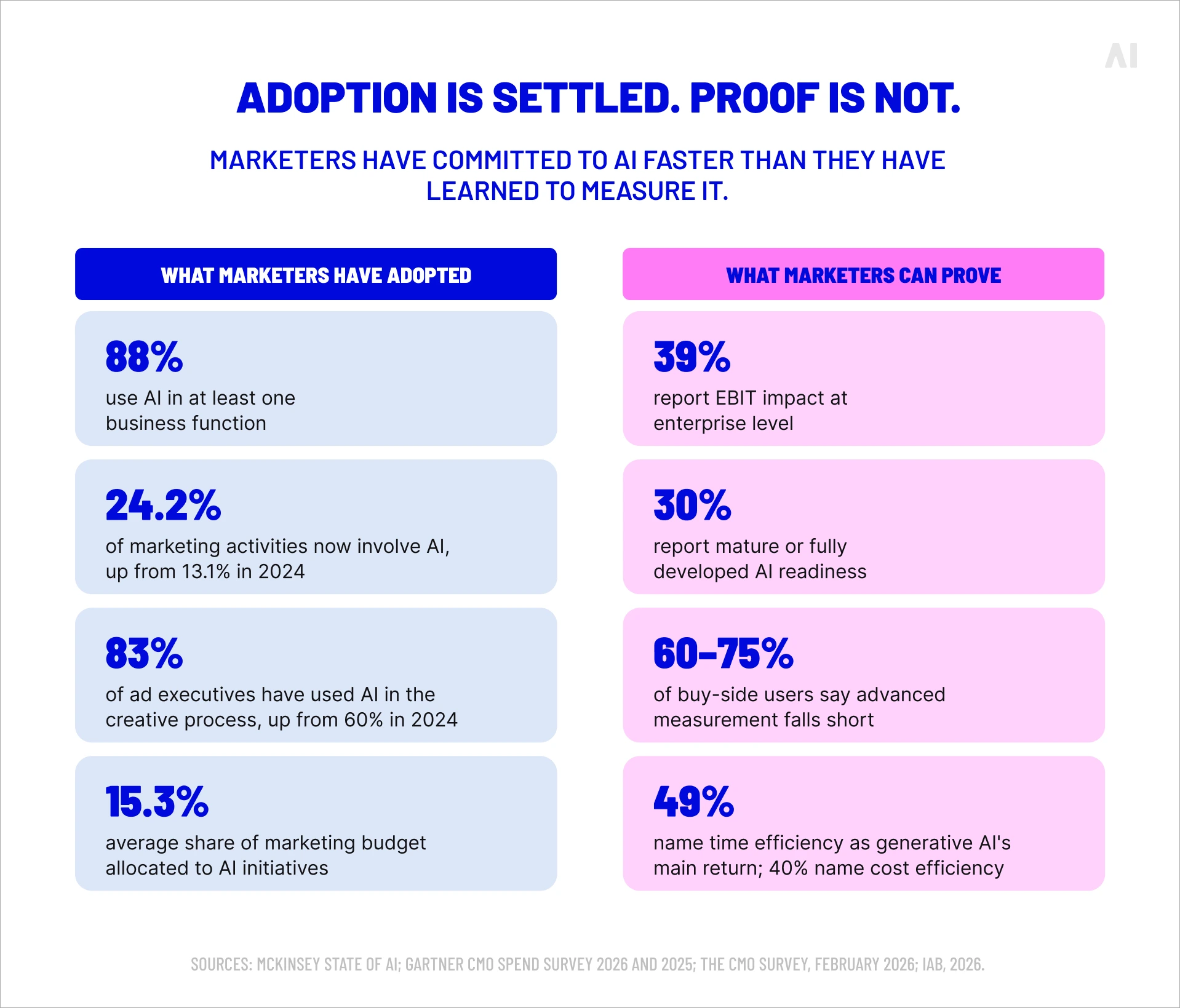
Activity has outpaced proof. McKinsey's global survey found that 88% of respondents say their organizations regularly use AI in at least one business function, yet just 39% report EBIT impact at the enterprise level. Marketing's version of that gap is widened by an ad ecosystem in which the platforms doing the optimizing also grade the results.
This article covers where AI improves performance across acquisition, retention, creative and measurement; which KPIs actually change; and how to build a measurement framework that survives contact with a CFO. It also looks at the categories of AI marketing solutions with proven ROI, and at the conditions under which AI delivers very little.
⚡Enhancing marketing ROI with AI begins with knowing which of your numbers to trust.
How AI improves marketing ROI
AI raises marketing return through four routes, and they behave very differently on a balance sheet.
- Acquisition efficiency moves fastest and is the easiest to observe. Models that predict conversion likelihood, allocate budget across placements and filter low-value inventory reduce the cost of buying each customer.
- Customer retention works more slowly. Propensity models, churn scoring and lifecycle automation extend the revenue earned from customers already acquired. Harder to measure than acquisition gains, and they compound in a way acquisition gains do not.
- Operational automation absorbs the repetitive work that consumes marketing hours—copy production, asset resizing, reporting, campaign QA, briefing. The saving is genuine. Whether it converts into money depends entirely on what those hours get redeployed to.
- Decision quality is the least visible of the four. Forecasting, media mix analysis and scenario planning improve the choices made before a campaign runs, and allocation decisions rarely appear as a line in a performance report. Over several quarters they may be worth more than the other three combined.
Marketing leaders have committed real money to all four. Gartner's 2026 CMO Spend Survey, conducted among 401 marketing leaders in North America, the UK and Europe, found that CMOs allocate an average of 15.3% of marketing budgets to AI initiatives, that 70% consider becoming an AI leader a critical goal for 2026, and that only 30% report mature or fully developed AI readiness. Investment has outrun the discipline needed to measure it.
💡 Related read: Best Marketing Measurement Tools and Platforms (2025 Guide & Comparison)
AI solutions that improve marketing ROI
The debate has moved on from adoption. The Duke Fuqua CMO Survey, fielded among 308 US marketing leaders in January 2026, recorded that AI use rose from 13.1% of marketing activities in 2024 to 24.2% in 2026, with generative AI growing 220% from 7.0% to 22.4% over the same period. Nearly a quarter of everything a marketing department does now involves a model somewhere in the process.
Software choice rarely decides whether a deployment pays. What decides it is whether the tool was pointed at a business outcome or at a task. The categories below are organized by what they change rather than by what they are, each carrying a defensible ROI case and a different measurement burden.
💡 Our guide to AI in performance marketing covers how these capabilities operate inside a live program.
{{aimroi-1}}
Media buying and campaign optimization
AI has worked longest here, and the returns show up soonest.
- Bidding algorithms adjust in real time against conversion probability.
- Audience models find pockets of intent that manual segmentation misses.
- Budget optimizers move money between placements faster than any trading desk could.
- Cost per acquisition usually responds within weeks.
Nearly all of that optimization happens inside individual buying platforms, each seeing only its own inventory. An algorithm can be excellent at winning the right impressions and still be spending into a badly selected inventory pool.
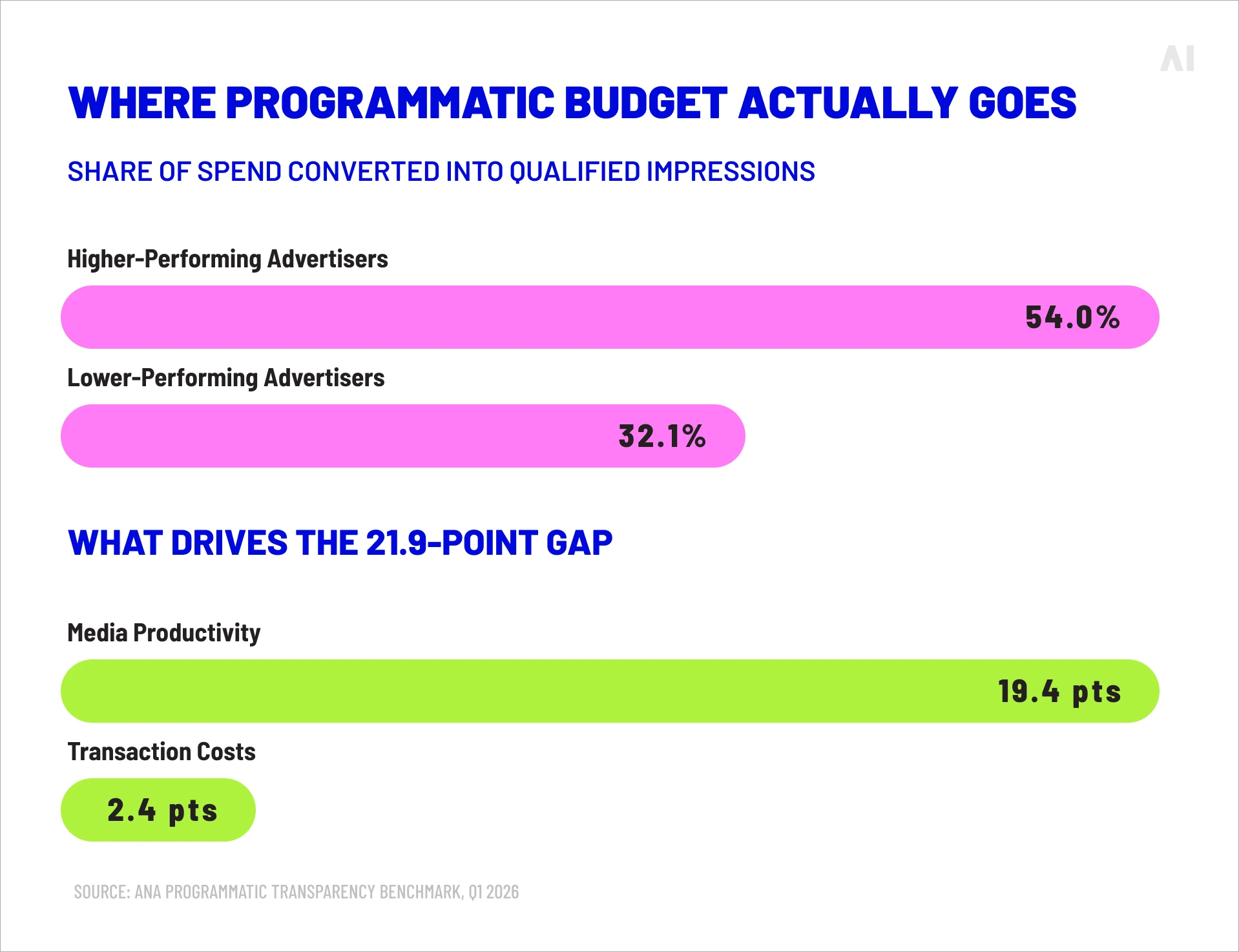
The ANA's Q1 2026 Programmatic Transparency Benchmark puts a figure on the difference. Higher-performing advertisers converted 54.0% of programmatic spend into qualified impressions while the lower-performing cohort converted just 32.1%—a 21.9-point gap, the widest the benchmark has recorded. The more useful number sits underneath it: the difference between the two groups came far more from media productivity, at 19.4 percentage points, than from transaction costs, at 2.4. Advertisers are not losing money mainly on fees. They are losing it on what they bought.
No amount of bidding sophistication corrects for inventory that should never have been bought. That work happens earlier, at the point of supply selection, which is where Smart Supply operates: a supply-side curation tool, rather than a media vendor, that builds inventory selections against a client's own KPIs across display, streaming video, CTV and streaming audio. Drawing on 9+ SSPs and inventory-agnostic by design, it neutralizes the bias built into any single platform's defaults. There is no cost and no minimum spend, and deal IDs are issued within 24 hours.
Above the inventory question sits the Open Garden framework, a DSP-agnostic alternative to the walled gardens operating across 15+ DSPs, built on transparency, customization and efficiency. AI does the optimizing; the framework determines what it is allowed to optimize across.
💡 How the two layers fit together is covered in our media planning and buying guide.
Personalization and customer retention
Acquisition efficiency has a ceiling. Retention's sits far higher, and the strongest AI ROI cases increasingly come from the customer base rather than the auction.
Engagement platforms such as Salesforce Marketing Cloud and HubSpot apply models to behavioral data to decide who receives what, and when. In practice that means
- segmenting customers by predicted value rather than declared attributes,
- recommending products from observed behavior rather than category rules,
- scoring churn risk early enough to intervene, and
- timing lifecycle communications to individual patterns rather than a fixed calendar.
Repeat purchase rates rise. Time between purchases shortens. Average order values increase where recommendations are well tuned. All three land in customer lifetime value, the metric carrying most weight in any serious ROI conversation.
Retention also punishes sloppy measurement harder than anything else in marketing. A customer who did not churn produces no event to count. Proving an intervention prevented a departure requires a control group of at-risk customers deliberately left alone—an experiment many organizations are reluctant to run and, for that reason, rarely run well.
💡 We go further into how these programs are built in our piece on AI-driven personalization.
Creative production
Generative tools have changed the economics of creative volume. Copy, images, variants, resizes and localizations that once took a studio a week now take an afternoon. Marketers moved quickly: IAB research published in January 2026 found that 83% of ad executives say their company has used AI in the creative process, up from 60% in 2024.
The same research found something less comfortable. 82% of those executives believe Gen Z and Millennial consumers feel positive about AI-generated advertising, while only 45% of those consumers actually do. Volume is cheap now. Audience tolerance is not, and the industry appears to be misjudging where it sits.
That gap points to where AI creative earns its keep: variant generation and testing throughput, rather than wholesale replacement of creative judgment. More variants tested means faster identification of what performs, which lifts conversion rates on the same media budget. Producing more mediocre assets faster does nothing.
AI Creative Studio is built on that distinction, working to a principle of AI scale with human taste across three pillars—traditional design services, AI-generated creatives, and AI tools for creative testing—supported by around $350,000 a year invested in AI-assisted production. The testing pillar is the one connected to revenue. Paired with dynamic creative optimization, the volume advantage becomes a performance advantage rather than an output statistic.
⚡ Time saved is a cost that moved. It is not a revenue that appeared.
Marketing measurement and decision-making
Nothing in the first three categories can be proven without this one.
Experimentation platforms such as Optimizely and the wider class of AI analytics tools unify data across channels, surface optimization opportunities and estimate contribution more accurately than rules-based attribution allows.
Enthusiasm on the buy side has outrun satisfaction. The IAB State of Data 2026 report, based on a survey of more than 400 senior planning and analytics decision-makers at US brands and agencies conducted with BWG Global, found that between 60% and 75% of buy-side users of advanced measurement say it falls short on rigor, timeliness, trust and efficiency, and that none believe all paid channels are well represented in current marketing mix models.
The IAB's diagnosis of AI's role in this is pointed: AI can unify data, automate analysis and increase measurement speed, but it lacks transparency and governance around data quality, which risks reinforcing exactly the black-box decisions marketers are already stuck with. An opaque model validating another opaque model has proven nothing.
An independent measurement layer, sitting outside the platforms doing the buying, answers that objection. Elevate is built for the position: an AI-powered, vendor- and DSP-agnostic intelligence, planning and measurement layer operating across 12+ DSPs and the wider digital ecosystem. It does not bid, serve ads or produce creative. Its function is to see across the platforms that do—through modules covering marketing mix modeling, path to conversion, competitive analysis, cookieless targeting and advanced planning, drawing on 150 billion data points a month.
Tools of this kind are known as marketing intelligence platforms, and independence from the media supply chain they evaluate is what defines them. That separation of duties is also what distinguishes them from the cross-channel marketing platforms that execute campaigns: one runs the media, the other judges it.
Which metrics change most with AI
Not every number that improves after an AI deployment is evidence of business value. Some are, some are leading indicators, and some are internal process metrics that have been promoted above their station.
- Business impact metrics carry financial consequence and belong in an ROI conversation.
- Operational efficiency metrics describe how the marketing function works and belong in a capacity conversation.
- Strategic planning metrics describe decision quality and sit between the two.
{{aimroi-2}}
Acquisition metrics: CPA, CAC, and conversion rate
These move first and fastest.
- Better targeting reduces impressions served to people who were never going to convert.
- Better bidding wins the impressions that convert at lower cost.
- Better inventory selection removes placements generating volume without outcomes.
- Cost per acquisition falls, conversion rate rises, customer acquisition cost follows.
Competition then erodes the advantage. When every advertiser in a category runs comparable optimization, early adopters keep a real efficiency premium and late adopters mostly buy parity. Gains that looked structural in the first two quarters often level off in the third and fourth, and reading that plateau as failure leads teams to churn through tools that were working correctly.
There is a definitional trap here too. CPA measures the cost of a recorded conversion, not the cost of a customer the campaign caused. A campaign can drive CPA down substantially by concentrating spend on people who were already going to buy. The number improves. The business does not.
Revenue metrics: ROAS, CLV, and LTV:CAC
Financial metrics carry the ROI argument because they connect marketing activity to money the company keeps.
- Return on ad spend is the most immediate, though it inherits every weakness of whichever attribution model produced it.
- Customer lifetime value is more durable and far more persuasive to a finance team, capturing the revenue effect of retention work that acquisition metrics ignore.
- The LTV:CAC ratio is the most useful single figure of the three, holding acquisition cost and customer value in one frame and preventing the common error of celebrating a lower CAC achieved by acquiring worse customers.
Personalization increases purchase frequency. Churn prediction preserves revenue that would otherwise have left. Lifecycle optimization moves customers toward higher-value behaviors sooner.
All three are slow to register and demand a longer measurement window than most quarterly reporting allows, which is why lifetime value tends to be under-claimed in business cases that would be stronger for including it.
Campaign speed and creative efficiency
Production time collapses, asset volume multiplies, testing cycles that ran monthly run weekly, and reporting that took three days takes three hours.
All of it is real, immediate and easy to evidence, which is why it gets over-claimed. A halving of creative production time is an operational result. It becomes a financial result only when the freed capacity produces something that earns—more experiments run, more variants tested, more markets served, or headcount redeployed to work with revenue attached.
In an executive report this belongs under capacity. Record the hours. Record what they were redeployed to. Let the financial metrics report the money.
Forecasting and budget planning
Least visible of the four routes, and over a long enough horizon plausibly the most valuable. Models trained on historical performance, seasonality and channel interaction produce more accurate demand forecasts and better allocation recommendations than the spreadsheet-and-instinct method they replace. Getting allocation right before a campaign runs is worth more than optimizing well during it.
Buyers are moving this way fast. IAB's 2026 Outlook Study, drawing on more than 200 brand and agency buyers, found that 96% of buyers are aware of agentic AI for ad buying and 66% are increasing their focus on it, while cross-platform measurement was the third most-cited priority at 72%, up from 64% the previous year. Autonomous planning and independent verification are arriving together, which is fortunate, because the first is dangerous without the second.
Forecast accuracy is measurable in its own right—compare predicted against actual, track the error rate over time, and the improvement is unambiguous.
💡 Gains concentrate in sector-specific applications; our work on retail forecasting covers one.
Real-world examples of AI marketing ROI
The four scenarios below are composites rather than named case studies, chosen because these patterns recur across accounts.
Paid search
A mid-market retailer runs a large non-brand search program on manual bid management. Cost per acquisition has drifted upward for three quarters as competition intensifies.
Automated bidding is introduced against conversion value targets rather than volume targets, alongside audience signals that identify high-intent users within existing keyword sets. Budget reallocates continuously toward the query and audience combinations converting most efficiently.
CPA falls while conversion volume holds, because spend stops going to impressions with low conversion probability. The result carries a caveat. Part of the improvement will come from concentrating budget on branded and high-intent queries that would have converted regardless. Without a controlled test, the reported gain and the real gain are different numbers.
Email marketing
A subscription business sends a weekly newsletter and a monthly promotion to its full list on a fixed schedule. Open rates are stable and unremarkable; revenue per send has been flat for a year.
AI is applied to three variables:
- content selection based on individual browsing and purchase history,
- recommendations generated per recipient rather than per segment, and
- send timing optimized to each subscriber's engagement pattern.
Engagement rises, but the outcome carrying financial weight is downstream. Better recommendations increase purchase frequency, which increases revenue per customer, which increases lifetime value. Because email reaches an already-identified audience, measurement is comparatively clean—a holdout group on the standard schedule provides a direct control.
Customer retention
A telecommunications provider loses a predictable share of subscribers each month, most without warning. Retention effort is reactive, triggered by cancellation requests that arrive too late to influence.
A churn model scores the base weekly on behavioral signals—usage decline, support contacts, billing events, engagement drop-off—and flags accounts at elevated risk 60 to 90 days ahead of likely departure. Offers then go to accounts where intervention has historical success rather than to everyone who calls to cancel.
Retained revenue rises, lifting lifetime value, while retention spend falls, because incentives stop reaching customers who were never going to leave. The LTV:CAC ratio improves from both directions.
Creative optimization
A consumer brand tests four concepts per campaign because that is what studio capacity allows. Winners emerge after two to three weeks, by which point much of the flight has run on underperforming assets.
Generative production raises variant volume substantially at similar cost. Automated testing narrows the field faster, and dynamic optimization serves the strongest performers to the audiences responding to them.
Production cost per asset falls, time to identify a winner shortens, and conversion rate on the same media budget rises. Only the last of those is financial. The first two are the conditions that produced it, and reporting them as the outcome is the error the next section examines.
Why AI ROI is so hard to prove
Improving performance with AI is a solved problem in most channels. Proving that AI was the cause is not, and the obstacles are structural rather than technical.
The problem with platform metrics
Every major advertising platform reports on its own contribution using its own conversion window, identity resolution and definition of a view. Each measures honestly within its own boundaries. None can see what happened on the others.
The arithmetic consequence is familiar to anyone who has added up channel-level reporting and found more conversions than the business recorded. When several platforms each claim the same customer journey, the total exceeds reality. Introduce AI optimization and the distortion compounds, because the algorithms are optimizing toward the very signals the platform defines and rewards.
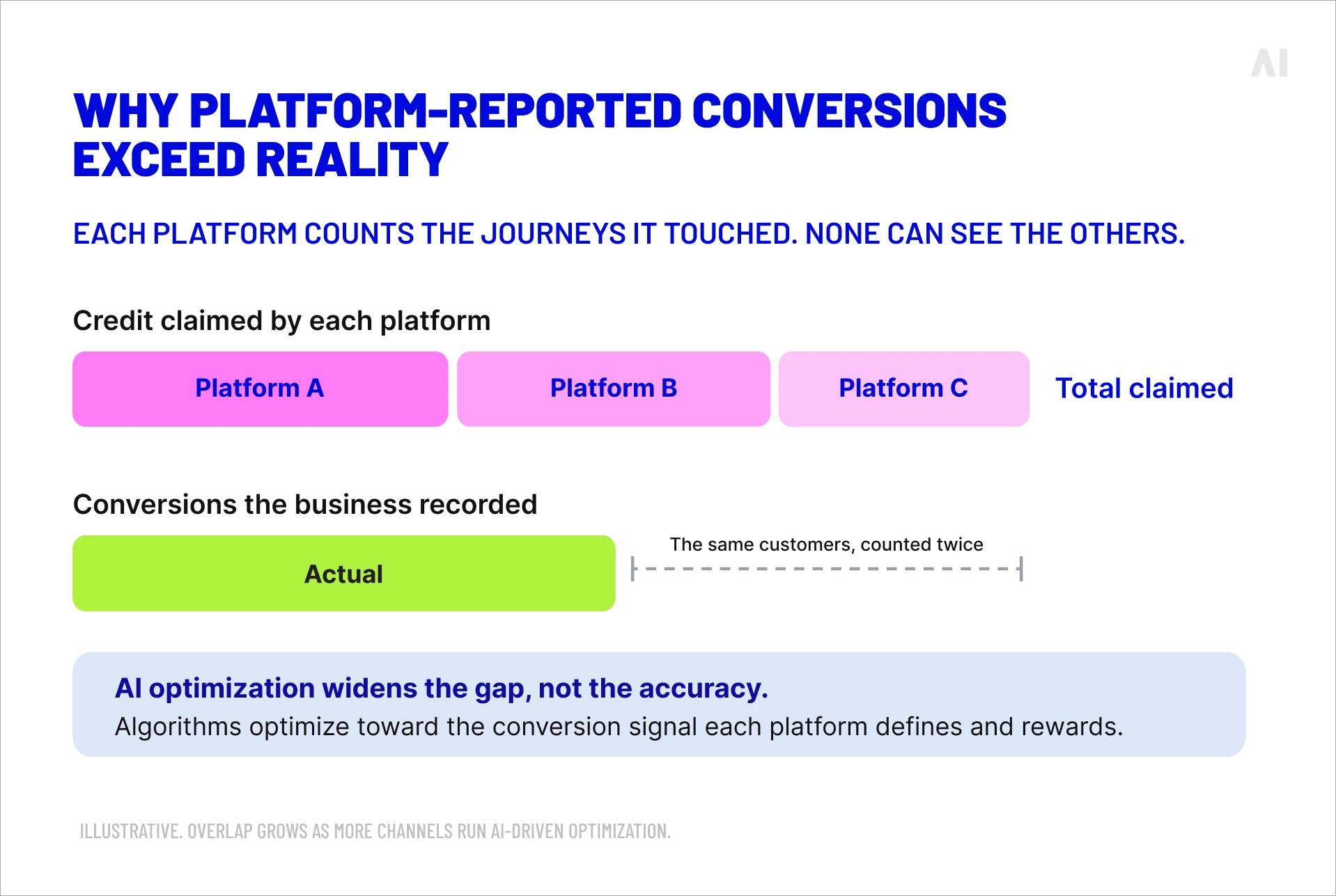
⚡ Every ad platform measures the world through its own conversion window. None of them can see the ones they missed.
Independent cross-channel measurement—conducted by a party with no financial stake in which channel wins—is the only reliable basis for evaluating AI marketing ROI.
💡 We examine where platform-reported numbers and business reality separate in our analysis of marketing effectiveness measurement challenges.
Productivity isn't ROI
The most common inflation of AI's value is not deliberate. It happens when a team reports the benefits it can see most clearly.
Gartner's 2025 CMO Spend Survey asked CMOs how generative AI investments were delivering return: improved time efficiency at 49%, improved cost efficiency at 40%, and increased capacity to produce content or handle more business at 27%. Two of the top three answers describe speed and workload. Only one describes cost, and none describes revenue.
Faster is not the same as more profitable. A team that produces twice the creative volume while spending the same media budget against the same audiences at the same conversion rate has not changed revenue. The saving is in labor cost, which only materializes if headcount reduces or the recovered hours generate something new. Neither happens automatically, and freed capacity is often absorbed by work of similar value.
Report efficiency gains as supporting evidence in a separate section, with a clear statement of what the recovered capacity was used for. That is defensible. Presenting hours saved as return is not.
The missing baseline problem
The simplest obstacle does the most damage: most teams cannot say what performance looked like before AI arrived, because nobody wrote it down.
Deployments rarely happen in isolation. AI lands alongside a new creative rotation, a budget increase, a seasonal peak or a competitor's retreat from the auction. Six months later performance is better, the improvement is credited to the most recent change, and there is no way to check.
Recording a baseline costs almost nothing and takes a week. Capture CPA, CAC, ROAS, conversion rate, customer lifetime value and production velocity across a representative period—long enough to cover a full purchase cycle, free of unusual events. Note the confounders present during that window. Then deploy.
⚡ Without a baseline, every AI result is an anecdote.
The AI marketing ROI framework
These four steps isolate AI's contribution from everything else happening in a marketing program. Skip one and the rest get weaker.
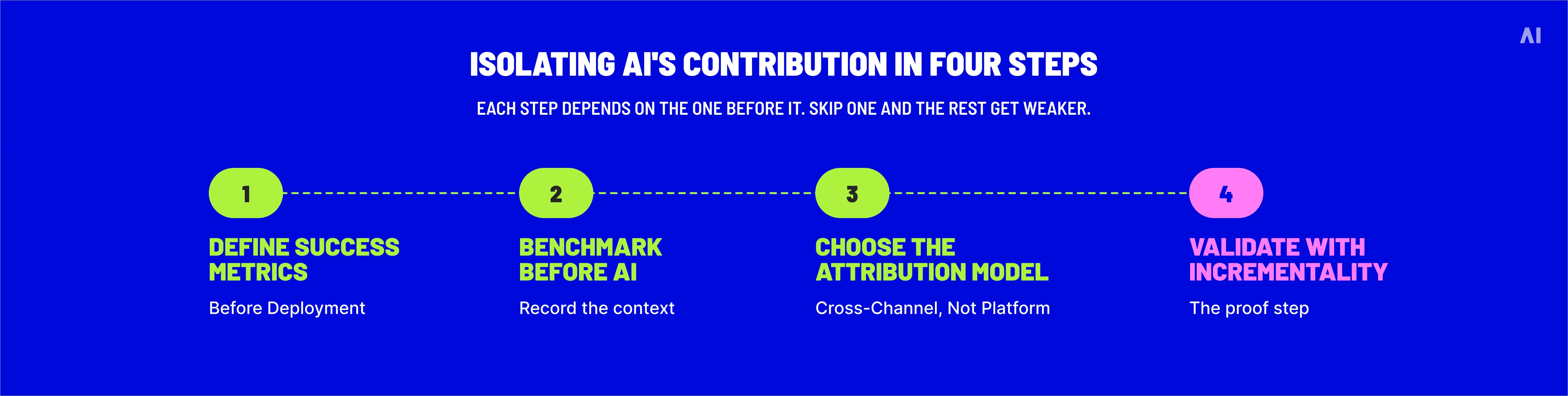
1. Define AI success metrics
Decide before deployment which KPIs the AI is expected to move, and be specific about the mechanism.
- A bidding algorithm should affect CPA and conversion rate.
- A personalization engine should affect repeat purchase rate and lifetime value.
- A creative tool should affect production velocity and test throughput.
- A forecasting model should affect forecast accuracy and allocation efficiency.
Selecting metrics after results arrive is how teams end up reporting whichever number happened to improve. Selecting them in advance converts a deployment into an experiment.
2. Benchmark performance before AI
Capture the baseline properly, which means more than writing down last quarter's figures:
- Use a representative period. A single strong month is not a baseline. Cover a full purchase cycle and avoid windows distorted by promotions or seasonal peaks.
- Record the context, not just the values. Note budget levels, creative in rotation, competitive conditions and planned changes. These are the confounders you will be asked about later.
- Segment the baseline. Aggregate figures hide the movement that follows. Record by channel, campaign type and customer segment so improvements can be traced to where AI was applied.
With those in place, the post-deployment comparison becomes a measurement rather than an assertion.
3. Choose the right attribution model
Attribution decides how credit is assigned, and that choice determines what the ROI calculation is capable of showing.
- Platform-reported attribution is immediate, granular and structurally incapable of seeing beyond its own environment.
- Cross-channel attribution assembles a unified view of the journey across platforms—the minimum requirement for evaluating a deployment spanning more than one channel.
- Marketing mix modeling works at higher altitude, using aggregate data to estimate channel contribution without user-level tracking: slower, less granular, far more resistant to signal loss.
Most mature programs run cross-channel attribution for operational decisions and marketing mix modeling for budget-level questions, then reconcile the two. Running only the platform's own numbers is the configuration that produces confident, wrong answers.
4. Validate with incrementality testing
Attribution assigns credit for conversions that occurred. Incrementality testing establishes whether they would have occurred anyway, and it is the only method answering that question directly.
The design is a controlled experiment. Split the audience by geography, user cohort or campaign, and run AI-assisted optimization against one group while the other continues on the previous approach. The difference between them is the incremental lift attributable to AI, with confounders neutralized by the split rather than argued about afterward.
Tests need enough conversion volume to reach statistical confidence—two weeks for lower-funnel channels, considerably longer for upper-funnel. The control group must also genuinely exclude the AI treatment; a control receiving a partial version of the same optimization measures nothing.
Incrementality results are frequently less flattering than platform reporting. That is the point of running them. A validated 11% lift is worth more in a boardroom than an unvalidated 40%, because it survives the follow-up question.
Mistakes when measuring AI marketing ROI
Most overstated AI business cases rest on the same handful of errors, and they tend to appear together.
- Accepting platform-reported metrics at face value. The most consequential of them. Optimizing toward the numbers a platform reports produces campaigns that perform well by that platform's definition. Whether they perform well for the business requires a separate measurement.
- Reporting productivity gains as financial return. Hours saved, assets produced and reports generated describe operational capacity. They belong in an ROI report as supporting context, clearly labeled, never in the headline figure.
- Skipping the before-and-after comparison. Without a baseline there is nothing to compare against, and the business case rests on an assertion that current performance beats some unrecorded prior state. It fails under scrutiny, usually in front of the CFO.
- Attributing every improvement to AI. Budgets change. Creative refreshes. Competitors enter and exit. A campaign that improved during an AI deployment improved for several reasons, and the honest report says so. Listing confounders alongside results strengthens the case, because it shows the analysis accounted for them.
Avoiding all of them requires one capability: a measurement practice operating independently of the systems being measured.
💡 Our marketing measurement guide sets out what that practice looks like.
How to report AI marketing ROI
Executives do not want a description of what the AI does. They want to know whether it earned its budget, whether the result is trustworthy, and what to do next. A report structured around those three questions performs better than one structured around capabilities.
{{aimroi-3}}
Lead with the financial metrics, because that is the section anyone actually reads. Keep efficiency gains visibly separate from financial gains, so nobody has to work out which is which. And state the caveats without being asked—volunteering them is what makes the rest of the report credible.
Framing is half of it; the plumbing is the other half. Reporting assembled by hand from platform exports is slow, inconsistent and hard to audit. A properly constructed digital marketing dashboard built on unified cross-channel data makes the before-and-after comparison reproducible, while advertising intelligence supplies the competitive context that explains why the numbers moved.
When AI delivers limited marketing ROI
Some deployments underperform for reasons no vendor can fix:
- Poor data quality. Models trained on incomplete, inconsistent or badly governed customer data produce confident and unreliable outputs. Data remediation is unglamorous and it is the prerequisite.
- Unclear objectives. A deployment without a defined success metric cannot fail, which means it also cannot succeed. It simply persists.
- Weak creative. Optimization distributes creative more efficiently. It does not improve it. A poorly conceived offer reaching a perfectly selected audience remains a poorly conceived offer.
- Insufficient volume. Machine learning needs data to learn from. Campaigns with low conversion volume, short flights or small audiences generate too little signal for models to beat sensible manual management.
- Wrong success metrics. Optimizing toward the wrong outcome delivers exactly what was asked for. A model targeting click volume produces click volume, at the expense of conversions nobody told it to value.
None of these are technology problems, and none can be resolved by better technology. Marketing strategy still decides the ceiling. AI decides how efficiently a program reaches it.
⚡ AI multiplies whatever your marketing already does. Multiply a weak offer and you get a faster weak offer.
Enhancing marketing ROI with AI
The four routes hold across every program that has made AI pay.
- Cheaper acquisition through better targeting, bidding and inventory selection.
- Stronger retention through personalization and churn prevention.
- Faster operations that free capacity for work with revenue attached.
- Better allocation decisions made before money is committed.
Measurement discipline is what divides the programs that can prove this from the ones that merely believe it:
- a baseline recorded before deployment,
- attribution that sees across platforms rather than within them,
- controlled tests establishing causation rather than correlation, and
- an honest separation between metrics describing efficiency and metrics describing money.
None of it is technically difficult. It is simply easier to skip, and skipping it is why so many AI investments remain unproven rather than unsuccessful.
AI Digital works across all four of those areas. Our tech suite spans the Open Garden framework, Elevate, AI Digital Labs and Smart Supply—DSP-agnostic media buying, independent cross-channel intelligence and measurement, innovation-as-a-service, and supply-side curation built to client KPIs. If you are trying to establish what your AI investment is actually returning, get in touch and we will show you how the measurement is constructed.