

Marketing measurement used to promise a neat answer. Spend went in, conversions came out, and attribution dashboards assigned credit to the clicks, impressions, and channels that appeared along the way. That promise was always more fragile than it looked, but privacy regulation, platform restrictions, iOS changes, cookie loss, retail media fragmentation, and the rise of walled-garden automation have made the cracks harder to ignore.
That is why media mix modeling, or MMM, has become relevant again. Unlike user-level attribution, MMM works from aggregate data: spend, impressions, reach, sales, revenue, pricing, promotions, seasonality, macro conditions, and other variables that influence business results. A good media mix model helps marketers estimate how different channels contribute to outcomes, where budget is reaching saturation, and how future investment scenarios might perform.
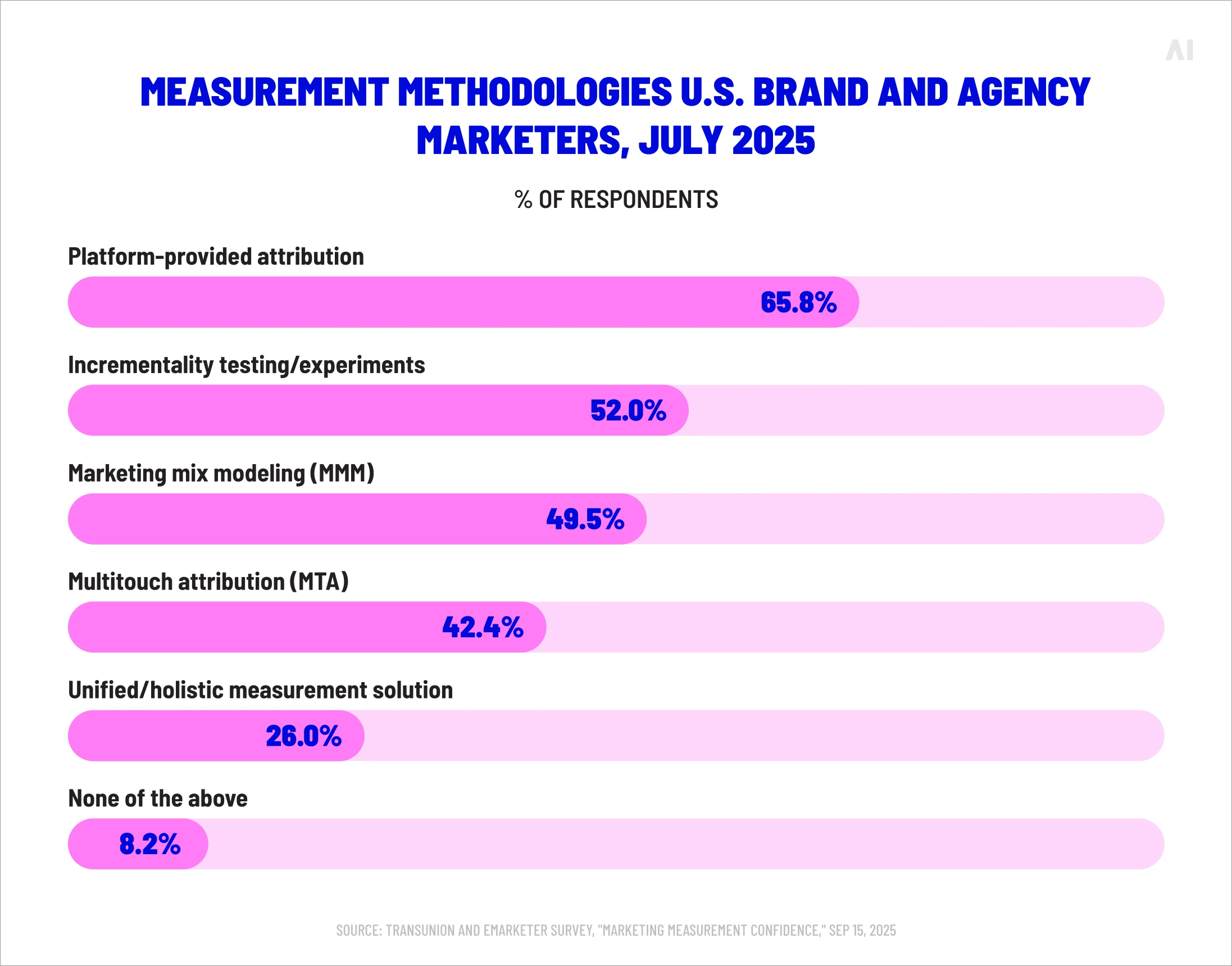
Interest is rising quickly. In 2025, EMARKETER reported that 46.9% of U.S. brand and agency marketers planned to invest in marketing mix modeling over the following year, based on research with TransUnion. That does not mean every team needs an enterprise marketing modelling platform tomorrow. It does mean more marketing leaders are looking for measurement that can survive weaker identifiers and still support planning.
This guide compares leading media mix modeling tools, marketing mix modeling tools, and MMM software options across open-source, managed, and enterprise categories. It is designed to help marketing leaders, performance teams, media buyers, analytics teams, and martech decision-makers evaluate MMM platforms with a clear view of what they can do, what they require, and where they can disappoint.
What makes a media mix model effective in 2026
A media mix model is only useful if it improves decisions. That sounds simple enough, but many MMM projects collapse under the weight of their own technical sophistication. The model may be statistically elegant, yet still fail to help a CMO decide how much to spend on CTV, whether paid social has reached saturation, or how far to cut search without damaging demand capture.
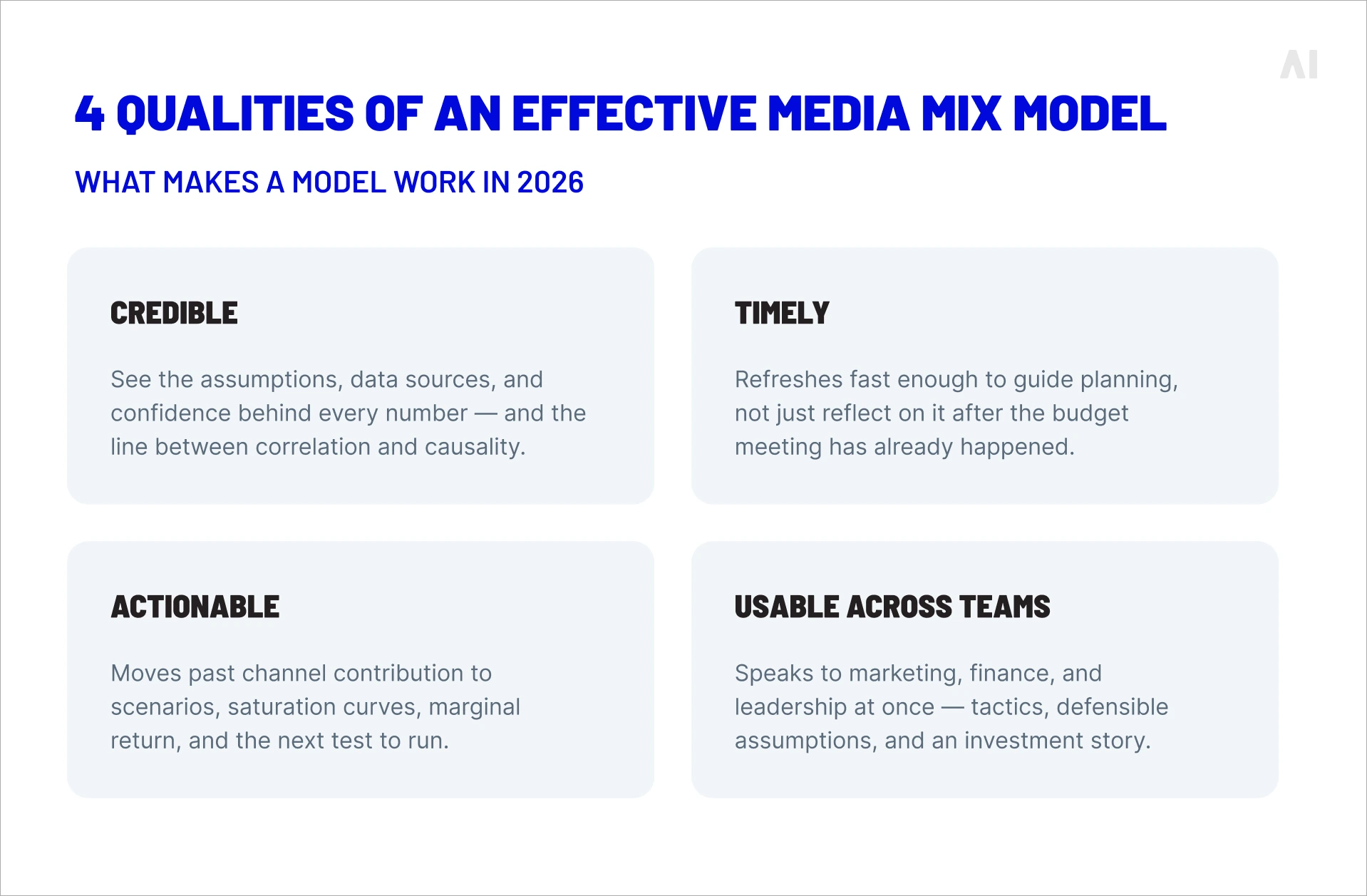
In 2026, an effective media mix model needs four qualities.
- First, it must be credible. Marketing, finance, analytics, and agency teams need to understand the model’s assumptions, its data sources, its confidence ranges, and the difference between correlation and causality.
- Second, it must be timely. A model that updates once a year may help with board-level reflection, but it will rarely guide budget planning in a market where media costs, inventory quality, retail signals, and consumer demand move faster.
- Third, it must be actionable. MMM should not stop at channel contribution. It should help teams compare scenarios, examine saturation curves, estimate marginal return, and decide what to test next.
- Fourth, it must be usable across departments. Marketing teams may need tactical recommendations, finance teams may need defensible assumptions, and executives may need a concise investment story.
IAB’s 2025 guide to modernizing MMM frames the discipline around privacy-safe, transparent, and decision-ready measurement, noting that planning cycles are faster, media delivery is fragmented, and privacy constraints limit identifiers. That framing is useful because it places MMM where it belongs: close to planning, budgeting, and accountability, not buried in a quarterly analytics readout.
⚡ A model that arrives after the decisions have been made is not a decision tool. It is an explanation—useful, perhaps, but too late to change anything.
Modern MMM also has to sit comfortably alongside other methods.
- Attribution can still help with short-term digital optimization where signals remain usable.
- Incrementality testing can validate specific causal questions.
- Brand tracking can show whether investment is building memory and preference.
MMM becomes strongest when it connects these inputs into a planning system rather than pretending to answer every question alone.
Academic vs. commercial MMM
Academic and commercial MMM often begin from the same statistical foundations, but they serve different audiences.
- An academic model may prioritize methodological rigor, clean assumptions, interpretability, and peer-level scrutiny. Those qualities matter. Without discipline, MMM can become a polished spreadsheet dressed as science.
- But a commercial model has a tougher job: it must also work inside a business where data is imperfect, deadlines are real, and stakeholders do not always agree on what success means.
Data science teams may want to examine priors, coefficients, decay curves, saturation functions, confidence intervals, and model diagnostics. Marketing teams usually ask different questions:
- Which channel is underfunded?
- Which one is over-credited by platform reporting?
- What happens if the budget is cut by 10%?
- What should be tested before the next planning cycle?
- Can finance trust the forecast?
The best MMM tools make that translation possible. They preserve enough methodological transparency for analytics teams to audit the work, while giving marketing and finance teams outputs they can use without needing to become statisticians.
Problems begin when the model becomes a performance. A vendor presents a dramatic waterfall chart, the room nods, and nobody changes the next media plan. A good marketing mix modeling tool should leave the organization with new decisions, not just new charts.
5 signs you need MMM
Many organizations arrive at MMM only after their existing measurement system stops producing believable answers. The trigger is rarely a single crisis. It is usually a slow accumulation of doubt.
Here are five signs your team may be ready for media mix modeling software.
- Customer acquisition costs are rising, but channel reports disagree on why. Paid social blames creative fatigue, search blames competition, programmatic points to reach quality, and finance sees only higher cost per sale.
- Last-click attribution still influences major budget decisions. If the final interaction receives too much credit, upper-funnel media, CTV, retail media, audio, out-of-home, and brand investment can look weaker than they are.
- User-level attribution has become less stable. Privacy rules, consent limits, platform restrictions, and modeled conversions make multi-touch attribution harder to trust across the full journey.
- Offline and brand activity sit outside the main measurement view. Store sales, trade promotions, retail partnerships, sponsorships, TV, CTV, and pricing changes can all affect outcomes, yet they are often absent from digital dashboards.
- Budget meetings depend on channel advocacy rather than shared evidence. When every team defends its own numbers, MMM can provide a more neutral planning layer.
Needing MMM does not automatically mean your organization is ready for a full enterprise MMM platform. It means the current measurement system is no longer enough. The next question is whether the business has the data, governance, and internal ownership to make MMM useful.
Preparing for MMM success
Buying a media mix modeling platform before the organization is ready can be expensive. The vendor may be capable, the model may be sound, and the final output may still fail because the inputs are inconsistent or nobody owns the recommendations after delivery.
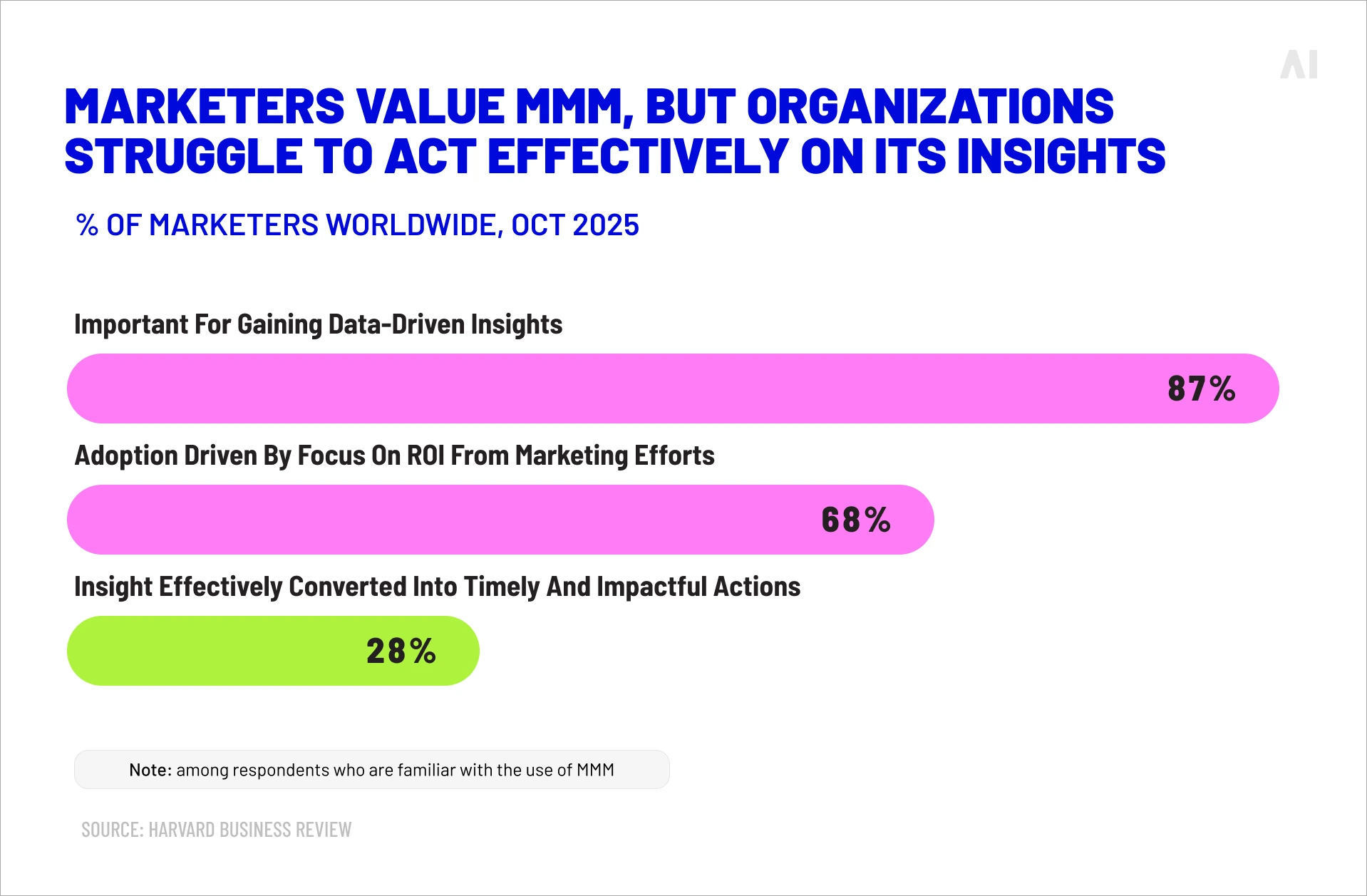
This is one of the biggest gaps in marketing measurement. Nielsen’s 2025 ROI work found that 85% of marketers expressed confidence in measuring ROI, but only 32% measured ROI holistically across traditional and digital media channels. That gap between confidence and practice is exactly where MMM projects can go wrong. Teams may believe they have a measurement foundation, only to discover that spend categories, conversion data, offline inputs, promo calendars, and finance definitions do not line up.
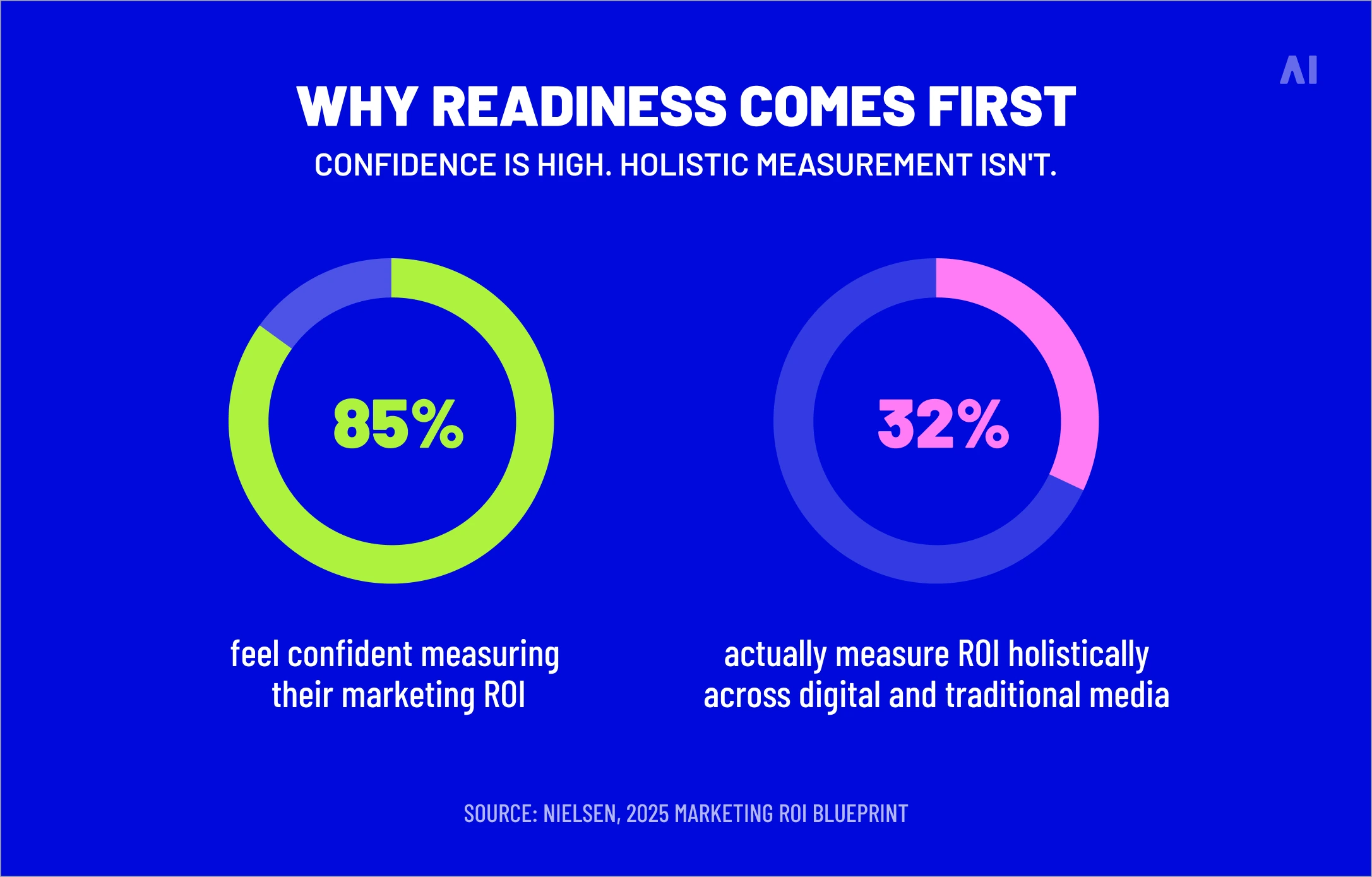
MMM readiness is an operating problem. A team needs clean enough data, a clear decision cadence, an internal owner, and a way to connect outputs to planning.
A useful readiness audit should happen before the RFP. It can reveal whether the organization should buy an enterprise platform, start with a managed MMM partner, use open-source software, or spend a quarter fixing data foundations first.
Minimum data requirements
There is no universal MMM data threshold, but most organizations need enough historical variation for the model to detect relationships between marketing activity and business outcomes.
- If spend never changes, the model has little to learn.
- If every channel rises and falls together, it becomes harder to isolate contribution.
- If promotions, pricing, or stockouts are missing, the model may give media credit for demand that came from somewhere else.
As a practical benchmark, many teams should aim for 18–24 months of historical data. More history can help when the business has strong seasonality, long purchase cycles, or large offline channels. Less history may work in some cases, especially with more granular geo-level data or strong experimental inputs, but buyers should be cautious about any vendor that treats thin data as a minor inconvenience.
The core dataset usually includes:
- Media spend and delivery by channel, campaign, region, or week.
- Business outcomes such as sales, revenue, qualified leads, subscriptions, app installs, or store visits.
- Calendar variables such as holidays, seasonality, promotional periods, product launches, and major events.
- Commercial variables such as price, discounts, distribution, inventory, store openings, and sales team activity.
- External variables such as macroeconomic indicators, weather, category demand, or competitor activity where relevant.
Granularity should match the business question. A national retail brand may need region-level data. A subscription business may need weekly channel-level spend and sign-ups. A CPG brand may need store-level or retailer-level sales if the goal is to understand trade, media, and distribution together.
The cleaner the data, the less time the MMM project spends arguing over definitions.
Common MMM implementation mistakes
MMM fails most often when the organization treats it as a vendor purchase instead of a measurement discipline. The platform can only model the world described by the data it receives.
The most common mistakes include:
- Poor channel mapping. Spend is grouped inconsistently, especially across paid social, programmatic display, CTV, retail media, and search.
- Missing offline or non-media inputs. Promotions, pricing, stockouts, store distribution, and sales activity can drive outcomes, but many MMM projects include them too late.
- Overreliance on platform-reported conversions. Platform reports are useful, but they are not neutral source-of-truth data.
- No validation plan. MMM should be checked against experiments, known business events, holdouts, or out-of-sample forecasts wherever possible.
- No internal owner. If the vendor presents the model and leaves, adoption often fades.
- Unclear decision rights. If no one knows who can move budget after the model recommends it, the output becomes informational.
- Expecting MMM to answer every question. MMM is strong for channel-level and budget-level planning. It is weaker for creative-level decisions, audience-level targeting, and campaign-level optimization unless paired with other methods.
A strong implementation plan should define who owns the model, who audits it, who receives outputs, how often recommendations are reviewed, and how decisions are documented after each refresh.
How to evaluate and choose an MMM tool
The right MMM tool depends less on the software category and more on the decision it needs to improve.
- A CMO preparing an annual budget has different needs from a performance team adjusting spend every week.
- A retailer with store-level data has different requirements from a SaaS company with a clean subscription funnel.
- A brand with in-house data science can consider open-source MMM in a way a lean marketing team probably cannot.
Budget pressure adds urgency. Gartner’s 2025 CMO Spend Survey found that marketing budgets stayed flat at 7.7% of overall company revenue for the second consecutive year. When budgets are tight, MMM becomes more than a measurement upgrade. It becomes a way to defend investment, identify waste, and explain trade-offs to finance.
Before comparing vendors, define the primary use case. Common use cases include:
- Annual budget allocation
- Quarterly investment planning
- Weekly spend reallocation
- Channel saturation analysis
- Forecasting under different budget scenarios
- Finance and board reporting
- Incrementality calibration
- Cross-channel measurement across offline and digital media
Once the business question is clear, the vendor conversation becomes far more productive.
Choose the right MMM approach
MMM software and services generally fall into three broad categories: open-source tools, managed services, and enterprise platforms. There are also hybrids that combine MMM with incrementality testing, attribution, planning tools, or broader commercial analytics.
Open-source MMM gives teams control, but control comes with responsibility. Managed MMM can reduce the technical burden, but buyers need to understand what the vendor is doing behind the interface. Enterprise platforms can support planning, governance, and cross-functional adoption, but they need serious implementation discipline.
Evaluate MMM vendors
A polished demo can hide weak assumptions. During evaluation, buyers should ask questions that reveal how the model works, how outputs are validated, and how easy it will be to use the platform after the first readout.
- Start with transparency. Can the vendor explain the model structure, assumptions, priors, decay curves, saturation effects, uncertainty ranges, and validation methods? The goal is not to make every marketer a statistician. The goal is to avoid buying a black box that cannot be defended when finance asks why $2 million should move from one channel to another.
- Next, assess refresh cadence. Some tools support weekly refreshes. Others operate monthly, quarterly, or around planning cycles. Faster is not always better if the data is weak, but the cadence must match the decision rhythm.
- Validation is equally important. MMM is observational. It estimates relationships from historical data. Where possible, vendors should calibrate or validate outputs against geo tests, lift tests, holdouts, natural experiments, known business events, or forecast accuracy.
- Data handling should also be clear. Who owns the input data? Who owns the model outputs? Can results be exported? What happens if the contract ends? Can the organization retain historical model runs and planning assumptions?
A strong RFP should cover:
- Model methodology and transparency
- Data requirements
- Refresh cadence
- Incrementality and experiment calibration
- Scenario planning and budget optimization
- Export options and data ownership
- Integration with BI, cloud, ad platforms, and planning tools
- Support model and internal training
- Pricing structure
- Renewal, portability, and exit terms
A vendor that cannot explain uncertainty clearly should not be trusted with budget recommendations.
Build your MMM shortlist
The best shortlist usually begins with fewer vendors, not more. Five similar demos can blur together quickly unless the buying team agrees on success criteria first.
A practical selection process looks like this:
- Define the budget decision MMM must improve.
- Audit data availability and quality.
- Decide which approach fits: open-source, managed, enterprise, hybrid, or stack-native.
- Shortlist three to five tools.
- Run a pilot using real historical data.
- Compare model outputs against known business events.
- Ask marketing, analytics, finance, and agency teams to review the recommendations.
- Confirm ownership of data, outputs, and future model runs.
- Agree how recommendations will influence planning.
The pilot should prove more than technical competence. It should show whether the tool changes a real decision. If the model only confirms what everyone already believed, it may still have value, but it has not yet earned a major platform investment.
8 best media mix modeling tools and platforms
The following media mix modeling tools and marketing mix modeling software platforms serve different types of buyers. Some are open-source frameworks. Some are managed measurement platforms. Some are enterprise planning systems. The right choice depends on data maturity, internal expertise, budget, and the decisions the model needs to support.
Measured
Measured is best suited to teams that want MMM connected to causal validation. Its platform covers incrementality testing, marketing mix modeling, media plan optimization, cross-channel reporting, benchmarks, and managed data connections. That makes it relevant for advertisers that do not want MMM sitting separately from testing and planning.
Measured’s strongest fit is likely among performance-oriented brands, retail advertisers, ecommerce teams, and paid social-heavy organizations that already know platform attribution has limits. The company’s positioning around causal MMM is important because traditional MMM can overread correlation if it is not calibrated against experiments or other validation methods.
The advantage is confidence. A model informed by incrementality tests gives marketers a stronger basis for budget decisions than a purely observational model. The drawback is complexity. Causal validation requires test design, budget, clean markets or holdouts, and organizational patience. Smaller teams may find the implementation and pricing harder to justify.
Measured should be on the shortlist when the buyer wants a marketing effectiveness system that combines MMM, experiments, reporting, and planning.
Recast
Recast is a strong option for teams that need frequent MMM readouts and a more modern, probabilistic approach. The company describes Recast MMM as a proprietary Bayesian marketing mix model designed to measure the incremental impact of marketing spend across channels, with forecasting, planning, and optimization features.
Its public materials also position Recast around causal MMM and GeoLift, which makes it relevant for marketers who want MMM and experiment-based validation closer together.
Recast is particularly interesting for companies that make regular spend decisions and want a model that can become part of ongoing planning. A weekly or frequent refresh cadence can be useful for growth teams, subscription businesses, ecommerce brands, and marketers with enough channel variation to learn from recent activity.
The trade-off is interpretability. Bayesian outputs can be powerful, but they require buyers to understand uncertainty. A Recast-style approach may be less comfortable for teams expecting deterministic answers or a static ROI ranking.
Recast should be considered by teams that want modern MMM, regular planning support, and a more agile alternative to traditional consulting-led MMM.
Nielsen/Circana
In August 2025, Circana completed its acquisition of Nielsen’s marketing mix modeling business. For buyers, that means the legacy Nielsen MMM capability now sits under Circana’s broader analytics and consumer data infrastructure.
This option is most relevant for large advertisers, CPG brands, retailers, and organizations that value deep syndicated data, store-level insight, and established executive credibility. Circana’s current MMM materials emphasize budget optimization, media effectiveness, granular analytics, and the ability to evaluate marketing efforts across channels.
The advantage is scale and category context. For brands selling through retail, store-level or granular commercial data can improve the model’s ability to separate media effects from distribution, pricing, promotion, and category movement.
The limitation is likely weight. This is not a lightweight self-serve tool for a small growth team. Buyers should expect a more consultative process, longer timelines, and heavier stakeholder involvement.
Nielsen/Circana should be on the shortlist for enterprise advertisers that need MMM connected to retail, CPG, syndicated data, and executive-level planning.
Analytic Partners
Analytic Partners is better understood as a commercial analytics and planning infrastructure provider than as a simple MMM tool. Its public materials cover Commercial Analytics, GPS Enterprise, ROI Genome, scenario planning, forecasting, and enterprise decision support.
This makes it a strong fit for large organizations with multiple brands, regions, business units, media channels, and stakeholder groups. The platform is designed for companies that need a structured planning system, not just a one-off model readout.
The ROI Genome is one of Analytic Partners’ main differentiators. It gives the company a large base of commercial analytics learning to draw from across categories, markets, and investment patterns. For an enterprise buyer, that kind of benchmark layer can be useful when internal data alone is not enough to guide decision-making.
The limitation is accessibility. Analytic Partners is unlikely to be the right fit for a lean team looking for a quick, low-cost MMM pilot. It suits organizations that can invest in process, governance, and long-term measurement maturity.
Analytic Partners should be considered by enterprises that want MMM embedded into broader commercial planning.
Google Meridian
Google Meridian is one of the most important open-source MMM options. Google describes Meridian as an open-source MMM framework whose code is visible and modifiable, giving users control over the model, data, and results. The documentation frames Meridian around three core business questions: how media performed, how future budgets should be allocated, and what ROI or marginal ROI looks like across channels.
Meridian is built for teams with Python capability and enough analytics maturity to own the modeling process. It supports features such as custom priors, geo-level modeling, reach and frequency, control variables, response curves, ROI analysis, and budget optimization.
The appeal is clear: transparency, flexibility, and ownership. An in-house analytics team can inspect the model, adapt it, and keep data under its own control. For organizations wary of black-box measurement, that is a serious advantage.
The limitation is also clear. Open-source does not mean easy. Meridian requires technical skill, clean data, model governance, and interpretation. It may be free to use, but implementation is not free if it consumes senior data science time.
Meridian should be shortlisted by organizations with strong analytics teams that want model ownership and are comfortable building MMM into their own measurement workflow.
Meta Robyn
Meta Robyn is another major open-source MMM framework. Meta describes Robyn as an experimental, AI/ML-powered and open-source marketing mix modeling package from Meta Marketing Science.
Robyn uses machine learning techniques including ridge regression, hyperparameter optimization, time-series decomposition, saturation curves, clustering, and budget allocation. Its GitHub documentation describes it as a semi-automated MMM package that helps define media efficiency and effectiveness, explore adstock rates and saturation curves, and support budget allocation.
Robyn is well suited to technical teams, digital-heavy advertisers, and organizations that want to experiment with MMM without committing immediately to a commercial platform. It can be especially relevant for performance marketers with granular digital spend and conversion data.
Its limitation is internal build effort. Robyn can reduce some modeling burden, but it does not remove the need for skilled users who understand data preparation, model selection, calibration, and business interpretation. Open-source MMM can also struggle with adoption if outputs remain confined to analytics teams.
Robyn should be considered by teams with data science resources, a strong appetite for experimentation, and enough internal discipline to turn model outputs into planning decisions.
Mutinex
Mutinex positions itself as a growth answers platform for marketing teams, with DataOS, GrowthOS, and MAITE. Its site describes DataOS as a way to connect disparate data points for marketing mix modeling, GrowthOS as a modeling platform for granular marketing investment decisions, and MAITE as an AI-powered commercial intelligence layer.
Mutinex is likely to appeal to marketing teams that want MMM outputs in a more accessible commercial interface. Rather than presenting MMM as a technical modeling exercise, Mutinex emphasizes decision-making, planning, and revenue growth.
In short, Mutinex belongs in the shortlist for marketers who want MMM to support faster investment decisions and who value validation as part of the operating process. That said, buyers should ask directly how geo tests, lift tests, or other experiments are incorporated into their specific package.
Mutinex should be considered by brands seeking a more commercial, planning-oriented MMM interface with AI-assisted decision support.
Adobe Mix Modeler
Adobe Mix Modeler is best suited to organizations already invested in Adobe’s data and experience ecosystem. Adobe’s documentation describes Mix Modeler as a tool powered by Adobe Sensei that helps marketers measure campaigns and optimize planning across paid, earned, and owned channels. It combines aggregate-level and event-level measurement, including MMM and MTA where available.
The platform’s planning functionality allows users to allocate budgets by business unit and channel, with planning integrated into trained model outputs based on harmonized data.
Adobe’s advantage is integration. For companies already using Adobe Experience Platform, Customer Journey Analytics, Adobe Journey Optimizer, and related tools, Mix Modeler can fit naturally into an existing data and planning environment.
The limitation is dependency. Adobe Mix Modeler is not the natural first choice for a company with little Adobe infrastructure. It also requires serious data harmonization and implementation work before the business can get full value.
Adobe Mix Modeler should be on the shortlist for Adobe-native enterprises that want MMM connected to broader customer journey analytics and planning workflows.
How programmatic intelligence enhances MMM
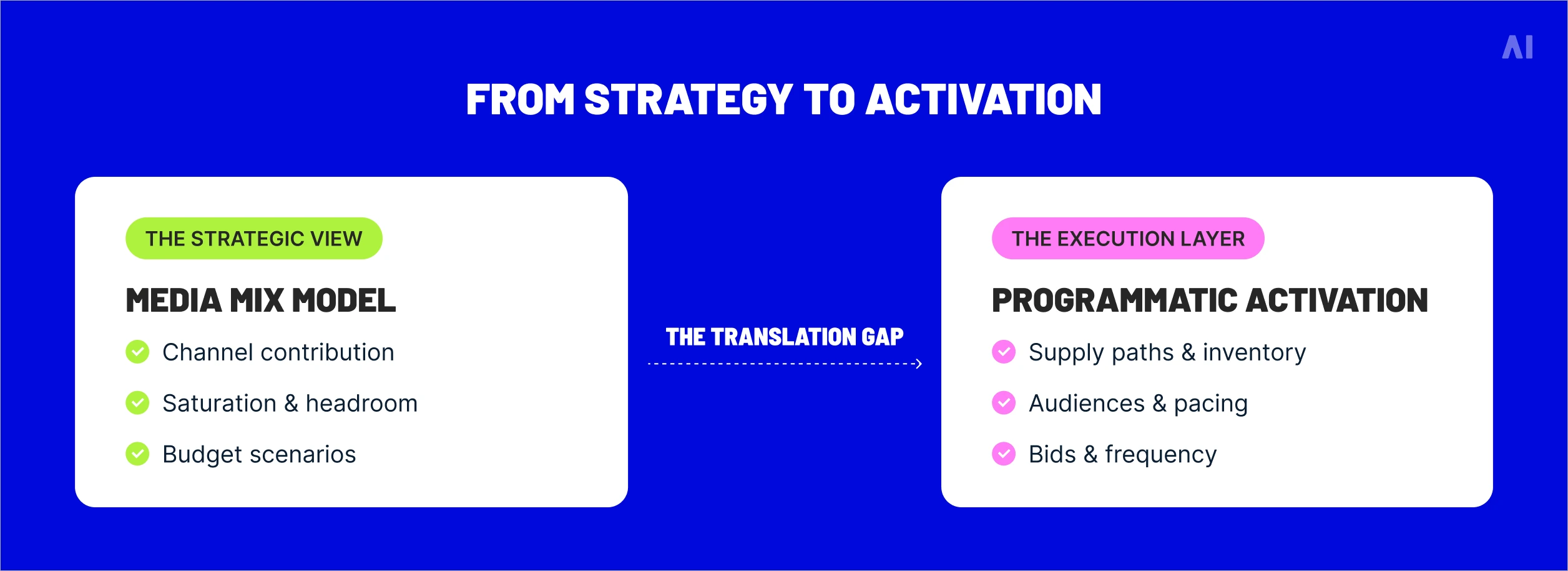
MMM can recommend where investment should move. Programmatic teams still need to decide how that recommendation becomes a media plan.
That is where programmatic intelligence becomes important. A model might suggest increasing CTV investment, reducing saturated paid social, protecting branded search, or testing retail media. Those recommendations still need to be translated into DSP settings, supply paths, inventory choices, audience strategies, pacing rules, frequency controls, bid logic, creative testing, and reporting.
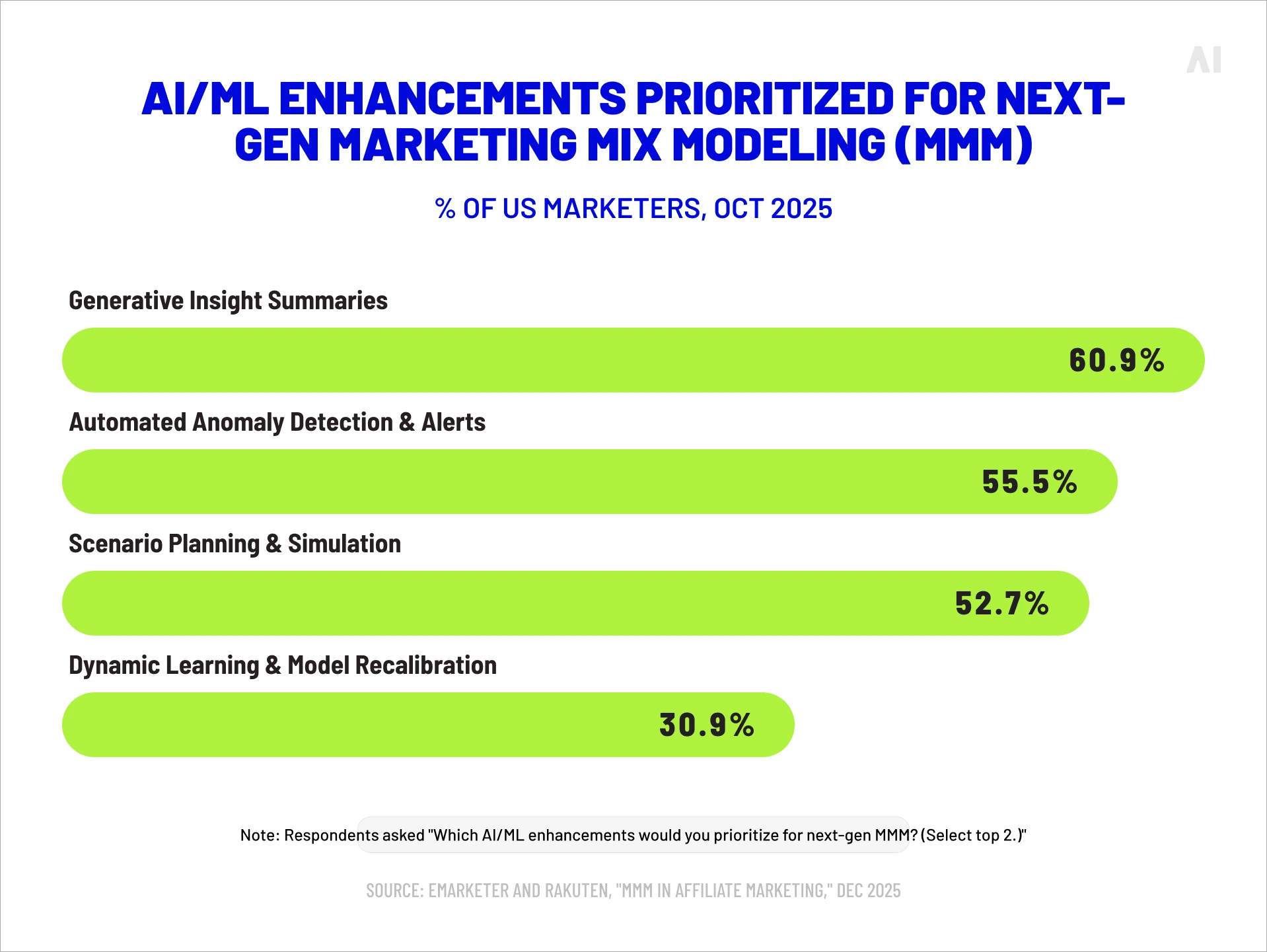
AI is increasingly being pulled into this translation layer. EMARKETER reported in January 2026 that 60.9% of U.S. marketers prioritized generative insight summaries as the top AI enhancement they wanted in next-generation MMM. That preference is revealing. Marketers are not only asking for more complex models. They want models that can explain what they found and support faster planning conversations.
⚡ MMM is good at pointing. It can tell you where to spend more and where to spend less. What it cannot do, on its own, is make that guidance land in the systems where the money actually gets moved around. That is the harder problem, and it is mostly an operational one.
Programmatic intelligence can help close the gap between strategic measurement and daily execution. It can connect model outputs to supply quality, audience performance, inventory curation, cross-channel pacing, and optimization signals. Without that connection, MMM risks becoming a slide in a planning deck rather than a working part of media operations.
Where MMM meets programmatic intelligence
MMM tends to operate at a higher level than daily media buying. It estimates contribution, saturation, and future response across channels. Programmatic buying operates inside a more granular system of platforms, auctions, audiences, inventory, deal IDs, supply paths, bids, and pacing decisions.
The connection between the two is often weak.
For example, a model may show that CTV has room for additional investment. That does not automatically tell a media team which inventory sources are clean, which publishers are duplicative, which supply paths add unnecessary cost, which audiences are overexposed, or which buying platform is best placed to activate the plan.
The same applies to paid social, retail media, display, video, and audio. MMM can help determine the role of a channel in the mix. Programmatic intelligence helps determine how that channel should be bought.
This distinction is especially important as media buying becomes more automated. Platform optimization systems can improve performance inside their own boundaries, but they do not usually optimize against a brand’s full commercial plan. MMM can provide the strategic view. Programmatic intelligence can help apply that view across real buying environments.
How AI Digital activates MMM insights
AI Digital fits here as an execution and intelligence partner around MMM, not as another media mix modeling tool. The role is to help brands turn measurement insight into better planning, supply choices, and programmatic activation.
- AI Digital’s Open Garden Framework is built around vendor-neutral media operations. Instead of locking planning and activation into one platform or one walled garden, Open Garden supports a more flexible connection between DSPs, SSPs, data partners, inventory sources, measurement inputs, and optimization workflows.
- Elevate functions as AI Digital’s marketing intelligence layer. It supports research, audience development, media planning, optimization, reporting, path-to-conversion analysis, brand studies, and AI-assisted workflows. In the MMM context, Elevate can help teams interpret planning signals and connect them with media decisions across channels.
- Smart Supply is the supply-side curation and SPO layer. It helps advertisers improve programmatic quality through customized deal IDs, supply filtering, performance optimization, and DSP- and SSP-agnostic activation. This is particularly relevant when MMM recommends greater investment in programmatic channels. More budget only helps if the supply path is clean enough to carry it efficiently.
Together, Open Garden, Elevate, and Smart Supply can help operationalize MMM outputs. A model might tell a brand to increase streaming video, test a new audience segment, reduce waste in display, or protect high-performing prospecting spend. AI Digital’s role is to help translate those recommendations into media planning, supply strategy, optimization, and reporting across the open web.
In short, MMM improves the planning conversation; programmatic intelligence improves the follow-through.
How MMM tools support better marketing decisions
Modern MMM tools are valuable because they help marketers move from reporting to planning. A dashboard can show what happened. A media mix modeling platform should help explain why it happened, what could happen next, and where the next dollar is likely to work hardest.
The strongest use cases include:
- Budget allocation
- Forecasting
- Scenario planning
- Channel saturation analysis
- Investment defense
- Cross-functional reporting
- Test prioritization
- Long-term media effectiveness planning
MMM does not remove uncertainty. It gives teams a more disciplined way to work with uncertainty. That distinction is important. A good model should not produce false precision. It should show ranges, assumptions, trade-offs, and confidence levels clearly enough for decision-makers to act with more control.
Connecting marketing to business results
Marketing teams often report activity: impressions, clicks, reach, frequency, video completion, cost per lead, cost per acquisition, and platform ROAS. Finance teams usually care about a different set of questions.
- Did revenue grow?
- Did profit improve?
- Was the marginal dollar worth spending?
- Which investments deserve protection when budgets tighten?
MMM helps connect marketing activity to commercial outcomes such as revenue, sales, customer acquisition, profitability, and long-term demand. It can also show how non-media factors influence performance, which helps prevent overclaiming.
That is particularly useful in executive reporting. A channel-level dashboard may be too tactical for a CFO. A media mix model can show how investment choices affect expected business outcomes, where returns appear saturated, and which budget scenarios carry the strongest case.
The best MMM platforms make marketing less dependent on platform-reported wins. They allow teams to tell a more complete story about how media contributes to growth.
Using MMM platforms for budget planning
Budget planning is where MMM earns its place.
A strong MMM platform can show how different spend levels are expected to perform across channels. It can help teams compare what happens if they increase CTV, reduce paid social, add retail media, hold search flat, or move spend from saturated channels into channels with more headroom.
Useful planning features include:
- Response curves showing how performance changes as spend rises.
- Saturation analysis showing where additional spend is likely to produce weaker returns.
- Scenario planning comparing different budget mixes.
- Forecasting estimating likely outcomes under different assumptions.
- Marginal ROI analysis showing where the next dollar may work hardest.
- Constraint-based planning allowing teams to plan around fixed budgets, channel minimums, or business-unit rules.
This is where marketing mix modeling tools become valuable beyond analytics. They give teams a structured way to discuss trade-offs. Instead of asking which channel “worked,” the conversation becomes more precise: where is the next increment of spend most likely to improve the business outcome we care about?
Building trust in marketing investments
Trust in MMM builds over time. The first model readout may be interesting. The third or fourth planning cycle is where the organization begins to see whether the model improves decisions.
Trust comes from several habits:
- Assumptions are documented.
- Data sources are consistent.
- Outputs are reviewed by marketing, analytics, and finance.
- Recommendations are tested where possible.
- Forecasts are compared with actual results.
- The model is updated when business conditions change.
- Uncertainty is shown rather than hidden.
⚡ Trust in MMM is built through repeated use: the model makes a recommendation, the team tests it, and the next planning cycle gets better.
This is also where model governance matters. If each team interprets MMM differently, trust erodes. If the organization agrees on how outputs will be used, how recommendations will be reviewed, and how decisions will be documented, MMM becomes part of the planning culture.
A good MMM platform should therefore support clarity, not only computation.
Should you invest in media mix modeling tools yet?
Not every organization should buy an MMM platform immediately. Some should. Others should fix their data, decision process, or measurement foundations first.
You are likely ready to evaluate media mix modeling tools if:
- Your media spend is large enough that allocation errors are expensive.
- You have at least 18–24 months of usable historical data.
- You invest across multiple channels with unclear cross-channel effects.
- Attribution reports have lost credibility with leadership.
- Offline, CTV, retail media, or brand channels are undermeasured.
- Finance is asking tougher questions about marketing ROI.
- Someone inside the business can own the model after implementation.
You may need to prepare further if:
- Spend data is inconsistent or incomplete.
- Marketing and finance use different outcome definitions.
- Promotional, pricing, or offline inputs are missing.
- Media spend is too small or too concentrated for meaningful modeling.
- No team is ready to act on recommendations.
- Leadership expects a dashboard rather than a planning discipline.
For teams that are ready, the next step is not simply to choose the most advanced model. It is to choose the MMM approach that fits the organization’s data maturity, budget, internal expertise, and planning rhythm.
AI Digital can help brands connect measurement, planning, media execution, and supply quality through its Open Garden Framework, Elevate, and Smart Supply. For organizations evaluating MMM or looking to make MMM insights actionable across programmatic media, get in touch.