How to improve marketing ROI across channels with ROI measurement tools

Every channel in a modern media plan reports its own version of success. Search counts a click, social counts a view-through, programmatic counts an impression, connected TV (CTV) counts a completed view, and email counts an open—each measured a different way, each convinced it drove the sale. Stitch those numbers together and the total revenue claimed usually exceeds the revenue that actually landed. That contradiction is the central problem in cross-channel performance, and it is why so many marketing leaders can grow spend without ever knowing which investments earn their keep.
Improving marketing ROI across channels starts with accepting that no single platform can grade its own homework. What it takes instead is a measurement framework—attribution, marketing mix modeling, and incrementality working together—supported by the right categories of digital marketing ROI tools to collect, connect, and interpret the data underneath.
This article walks through why cross-channel measurement breaks down, the categories of digital marketing ROI measurement tools that fix it, the metrics that reveal true performance, and how to hold measurement together as third-party signals continue to erode. The focus throughout is on tool categories and measurement strategy rather than a feature-by-feature comparison of individual software.
💡 No advertising platform is a neutral referee. Each one is scored on the conversions it can claim, so the credit it reports is a starting point for analysis, never the final word.
Why marketing ROI is difficult to measure across channels
Marketing ROI gets harder to measure with every channel you add, because customer journeys no longer travel in a straight line. A single purchase might begin with a CTV ad during a streaming show, continue through a paid social impression on a phone, pause for a branded search on a laptop, and close after a retargeting display ad days later. Each of those touchpoints lives inside a different platform, on a different device, measured against a different definition of a conversion. The result is three compounding barriers: fragmented data, attribution bias, and disconnected reporting.
The pressure to solve this is rising fast. Cross-platform measurement has climbed into the top three priorities for media buyers heading into 2026, cited by 72% of buyers, up from 64% a year earlier, according to the IAB's 2026 ad spend forecast. Marketers are not short of dashboards. They are short of a single, trustworthy answer.
The data silo problem
Customer data fragments the moment it is created. Paid search sits in one platform, paid social in another, programmatic and CTV in their respective demand-side platforms, web behavior in an analytics suite, purchases in a CRM, and lifecycle engagement in an email tool. None of these systems was designed to talk to the others, so each holds a partial record of the same customer. One person can appear as a cookie ID in the ad platform, an email address in the CRM, and an anonymous session in analytics, with nothing tying the three together.
That fragmentation produces three predictable failures.
- Journeys arrive incomplete, because no system sees the full path.
- Conversions get double-counted, because several platforms claim the same sale.
- And ROI calculations drift apart, because each tool applies its own logic to its own slice of data.
When numbers refuse to reconcile, confidence drains out of every decision built on top of them—the problem senior marketers in NIQ's CMO Outlook for 2026 named as their primary barrier to turning data into action.
💡 Closing these gaps is less about buying another reporting screen and more about unifying data at the source, a theme we return to when discussing data integration tools and how a connected martech stack prevents the silos from forming in the first place.
Platform-reported ROAS
Every major advertising platform measures conversions with its own attribution model, and every model is tuned to credit that platform generously. A view-through here, a seven-day click window there, a last-touch rule somewhere else—the definitions differ enough that two platforms can, and routinely do, claim the same conversion. Add up the platform-reported return on ad spend (ROAS) across a media plan and the sum tells you more about how each vendor counts than about what the campaign returned.
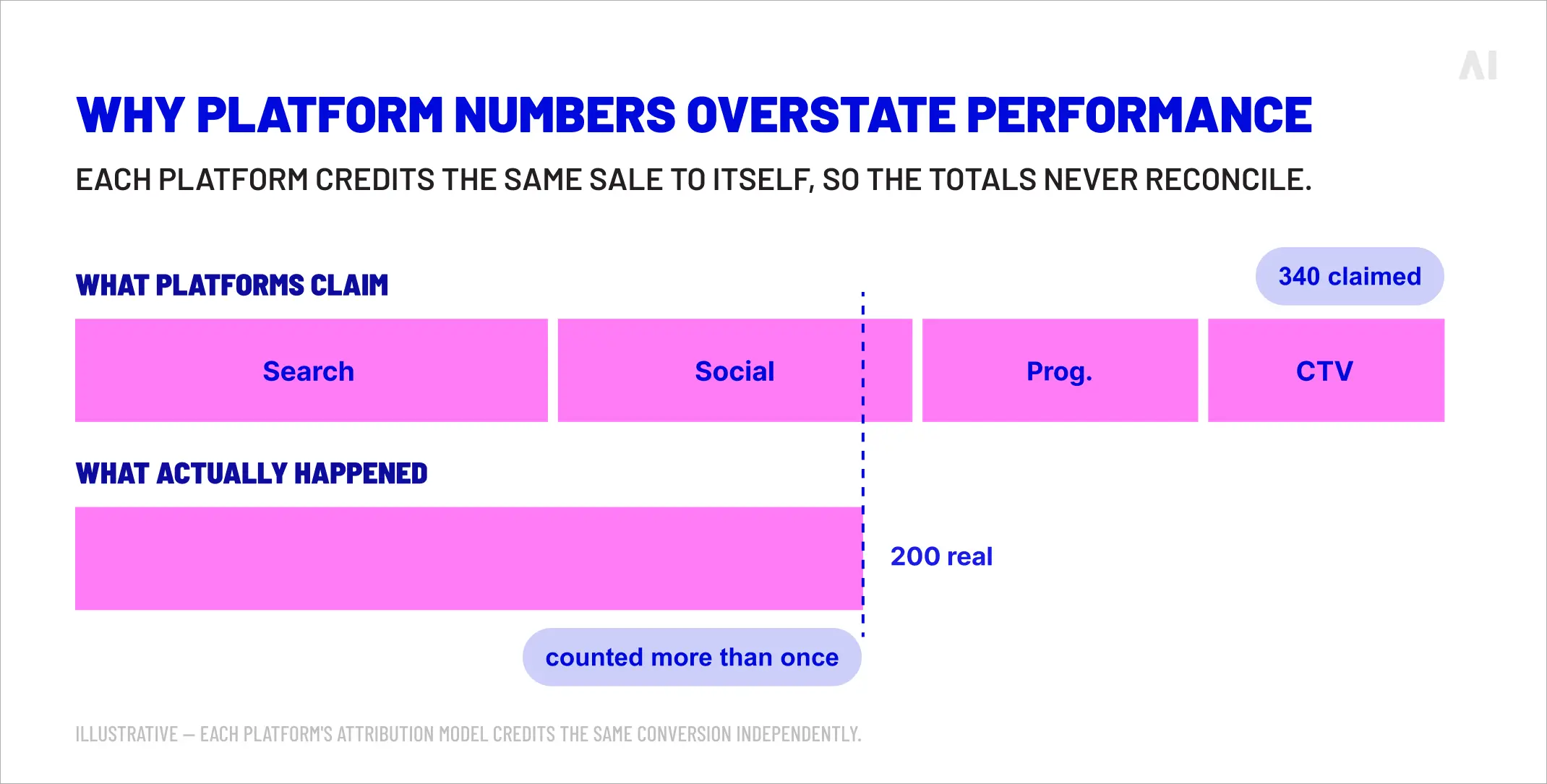
This is why platform-reported data deserves validation before it drives a budget decision. Independent measurement—data collected and modeled outside any single platform's incentives—consistently tells a more sober story than the in-platform numbers. In fact, 78% of US decision-makers believe at least 10% of their marketing budget is wasted because of insufficient measurement, with 7% putting that figure at 30% or more, per Haus's 2026 Marketing Decision Confidence Index.
Treating platform ROAS as one input to be checked, rather than the truth to be reported, is the first discipline of accurate cross-channel measurement.
💡 For a deeper look at why in-platform reporting overstates performance and what independent measurement corrects, see AI Digital's guides to the limits of walled-garden reporting and profit on ad spend as a sturdier alternative to raw ROAS.
Three measurement approaches for better marketing ROI
No single method measures cross-channel marketing ROI on its own. The three that work—attribution, marketing mix modeling (MMM), and incrementality testing—each answer a different question, and each covers for the others' blind spots.
- Attribution optimizes trackable digital channels day to day.
- MMM allocates budget across the whole portfolio, offline included.
- Incrementality proves whether spend caused results that would not have happened anyway.
Used together, they triangulate toward an answer no one method reaches alone.
.webp)
The industry has noticed the gap. 75% of buy-side leaders say their core measurement methods are underperforming, according to the IAB's 2026 State of Data report—a strong argument for combining approaches rather than leaning on any one.
💡 For detailed guidance, follow the dedicated articles on cross-channel attribution and marketing mix modeling.
Adoption reflects this move toward triangulation.
- Nearly half of US marketers—46.9%—plan to invest more in MMM over the coming year, and 27.6% now name it their single most reliable method, ahead of multi-touch attribution at 19.4%, per EMARKETER and TransUnion.
- Meanwhile 52% of US brand and agency marketers already run incrementality tests, a practice that has moved from data-science novelty to mainstream standard of proof.
- Trust follows the same line: 60% of senior decision-makers trust independent incrementality testing above any other method, twenty points clear of MMM and nearly double in-platform reporting, according to Haus.
.webp)
⚡ Attribution tells you where to steer today. Modeling tells you how to divide the budget. Incrementality tells you whether any of it was real. Skip one and the picture bends.
Types of digital marketing ROI tools
Behind every measurement approach sits a category of technology that makes it possible. Understanding those categories—what each one solves and where each one stops—is more useful than chasing a specific product name, because the right stack depends on the problems you are trying to solve, not on which vendor markets hardest.
💡 For a broader survey of the category, AI Digital's guide to the marketing intelligence platform explains where this layer fits.
Analytics and data collection tools
Analytics and data collection tools are the foundation everything else rests on. They record how customers interact with campaigns, sites, and content—sessions, events, engagement, conversions—and turn behavior into structured data. Without a clean collection layer, no downstream model has reliable inputs to work with.
Their limitation is scope. Most analytics tools see one environment well and the rest poorly, capturing a channel or a website in detail while missing the cross-channel path that produced the result. That is why analytics is necessary but never sufficient: it supplies the signal, then hands off to technologies that connect those signals across the journey.
💡 AI Digital's work on digital experience analytics goes deeper on getting the collection layer right.
Marketing attribution tools
Attribution tools connect touchpoints across channels and decide how much credit each one earns for a conversion. Different methodologies distribute that credit differently—first-touch, last-touch, linear, time-decay, or data-driven—and the choice changes which channels look valuable. Their real job is to answer a practical question: given everything a customer saw, where should the next dollar of optimization go?
The business problem attribution solves is channel-level tuning. It struggles, though, with anything it can't track—offline exposure, walled-garden view-throughs, cross-device gaps—which is why attribution belongs alongside modeling and testing rather than standing in for them.
💡 The AI Digital guides to customer-journey analytics and cross-channel attribution tooling expand on how to select a methodology that fits your sales cycle.
Marketing mix modeling tools
Marketing mix modeling tools analyze historical performance to estimate how much each channel—and factors well outside marketing, like seasonality or pricing—contributed to outcomes. Because MMM works on aggregate data rather than individual user tracking, it sidesteps the privacy and signal-loss problems that undercut attribution, and it can measure channels that leave no click trail at all.
That strategic strength comes with a practical cost: MMM answers the portfolio question, not the "which ad set do I pause today" question. The category has also opened up considerably. Google's open-source Meridian model and Meta's Robyn dropped the cost of entry, and the IAB published a vendor-neutral "Modernizing MMM" best-practice guide in December 2025 — signals that modeling has re-entered the mainstream rather than remaining the preserve of large analytics teams.
Business intelligence and reporting tools
Business intelligence (BI) and reporting platforms pull marketing, sales, and CRM data into unified dashboards that leadership can actually read. Their contribution is clarity for decision-makers: consolidated views, executive summaries, and the kind of strategic reporting that connects marketing activity to business questions a board will ask.
The caution here is a common misconception—that a dashboard equals insight. BI tools visualize data; they rarely unify it at the source. Point a polished dashboard at a fragmented data layer and you produce a well-designed disagreement rather than a resolved one. BI is the presentation layer, and it depends on the integration layer beneath it.
💡 AI Digital's guide to the digital marketing dashboard covers how to build reporting that informs rather than merely decorates.
Data integration tools
Data integration tools connect marketing platforms, CRM systems, analytics suites, and offline business data into one reconciled environment. They resolve identity across sources, normalize inconsistent metrics, and give every downstream model a common foundation to draw from. This is the plumbing that makes accurate ROI measurement possible in the first place.
Get integration right and reporting stops contradicting itself, because every tool references the same reconciled data. Get it wrong—through brittle point-to-point connections that multiply as tools are added—and no amount of dashboard polish will make the numbers agree.
💡 AI Digital's guides to the modern marketing data stack and integrated marketing systems explain how to build integration that scales.
Marketing intelligence platforms
Marketing intelligence platforms combine measurement, analytics, forecasting, and optimization into a single decision-support layer. Rather than asking teams to assemble insight from a dozen disconnected tools, they sit across the stack and turn unified data into planning, prediction, and recommendation. This is the category that moves an organization from reporting on the past to deciding about the future.
Their capability depends entirely on the quality of what feeds them. A marketing intelligence platform built on reconciled, cross-channel data becomes the closest thing to a single view of performance a marketing organization can hold.
💡 AI Digital's comparison of marketing intelligence versus marketing analytics clarifies where the line falls between describing performance and directing it.
How to choose digital marketing ROI tools
The right stack is defined by your business. Before investing in any category, the useful exercise is to map tools to goals: what decisions do you need to make, how complex is your channel mix, how mature is your data, and what does accurate measurement actually require in your context? Two lenses make this concrete—an evaluation framework and a maturity model.
Evaluation framework for ROI tools
A handful of questions separate tools that will serve you from tools that will lock you in. Ask each one before you commit.
- Data ownership. Do you own and control the underlying data, or does the tool hold it hostage?
- Independent measurement. Can it validate platform-reported numbers, or does it simply pass them through?
- Integration. Will it connect to your existing stack, or add another silo?
- Reporting transparency. Can you see how it reaches its conclusions, or is the model a black box?
- Scalability. Will it hold up as channels, spend, and data volume grow?
- Privacy readiness. Does it work in a world of first-party data and reduced tracking signals?
- Implementation complexity. How long until it delivers usable answers, and at what internal cost?
💡 These criteria favor tools that increase transparency and control rather than obscure them—the same principles behind AI Digital's guides to transparency in advertising and building a coherent ad tech stack.
Choose tools based on business maturity
Measurement needs grow with the organization, and adopting technology out of sequence wastes money.
- Early-stage teams get most of their value from solid analytics and clean data collection.
- Growing businesses add attribution to optimize a widening channel mix, and BI to report on it.
- Enterprises operating across many channels and markets need the full stack—integration, MMM, incrementality, and a marketing intelligence layer to hold it together.
The principle is to match the tool to the decision you actually face, not the decision you imagine facing three stages from now.
💡 AI Digital's overview of cross-channel marketing platforms maps how those needs evolve as complexity rises.
⚡ Buy for the decision in front of you, not the one two stages away. Measurement bought ahead of need becomes shelfware; measurement bought behind need becomes a blind spot.
Marketing metrics that actually measure ROI
Platform-reported ROAS is a starting point. A fuller read of cross-channel performance comes from combining several financial and marketing metrics, each correcting for the others' distortions. No single number captures marketing ROI accurately, which is precisely why the metrics below are read together rather than in isolation.
Comparison: marketing ROI metrics
The metrics that reveal true return sit closer to the business than to the ad platform. Each measures something the others miss.
Read together, these metrics answer questions ROAS alone can't: not just how much revenue a dollar returned, but whether that revenue was incremental, profitable, and durable.
💡 For the underlying formulas, see AI Digital's guide to CPM, CPC, and CPA and the walkthrough on calculating marketing ROI with worked examples.
Building a blended KPI reporting cadence
Metrics serve different decisions on different clocks, and forcing them onto one timetable produces bad calls.
- Tactical metrics—daily ROAS, cost per acquisition, pacing—guide in-flight optimization and belong on a daily or weekly cadence.
- Strategic metrics—LTV:CAC, contribution margin, MMM outputs—inform budget allocation and belong on a monthly or quarterly rhythm.
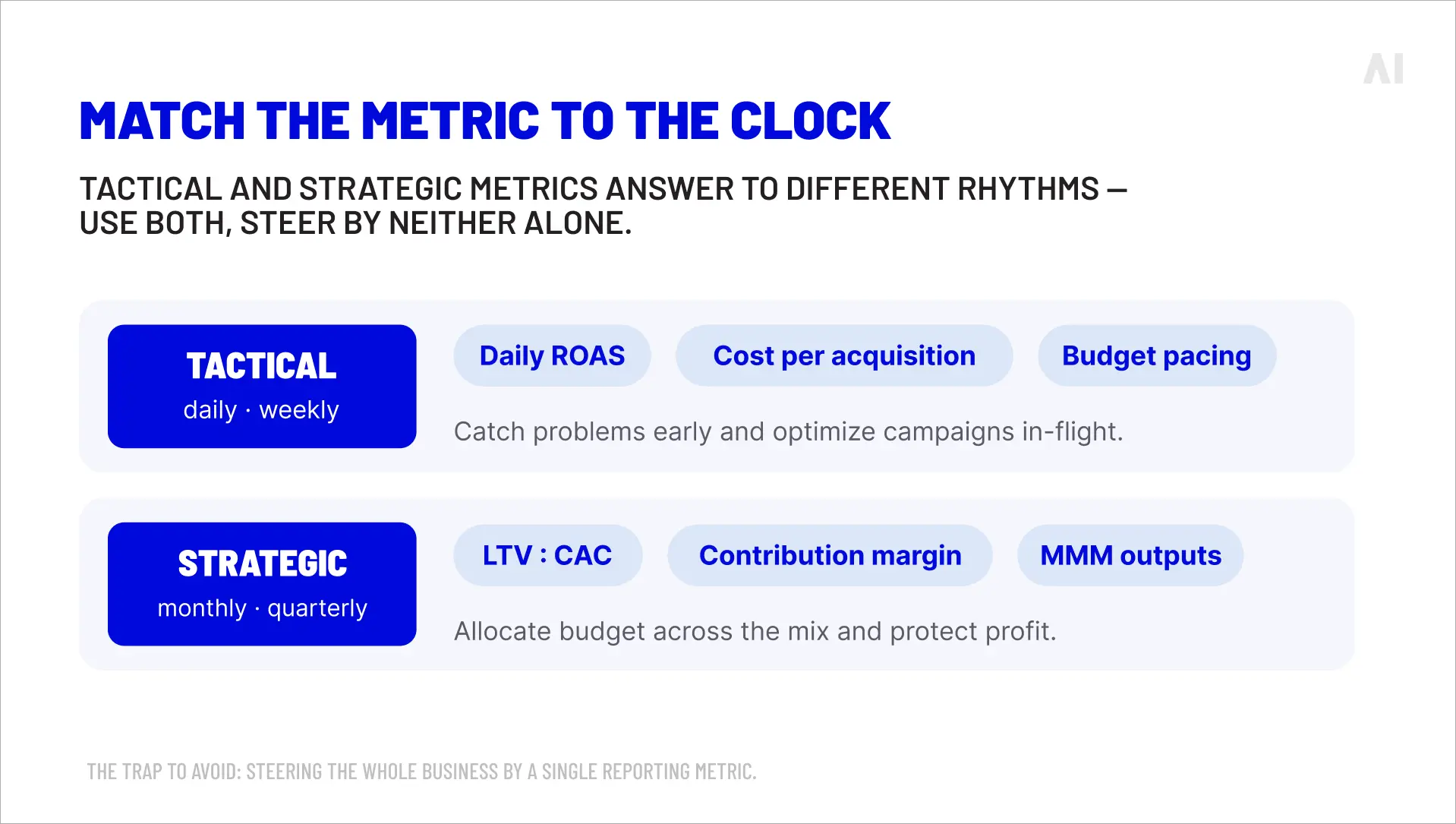
The mistake to avoid is steering the business by a single reporting metric. A blended cadence pairs the fast signals that catch problems early with the slow signals that keep the portfolio pointed at profit.
💡 AI Digital's breakdown of display advertising KPIs shows how to sequence tactical and strategic measures without letting one drown out the other.
How to improve marketing ROI across channels
Improving ROI channel by channel means recognizing that each one measures, optimizes, and wastes money differently—then applying unified measurement so you can compare them on equal terms. What follows is channel-specific, but the connective thread is the same: judge every channel against business outcomes and the whole portfolio, not against its own platform-reported scoreboard.
Paid search
Paid search rewards precision. ROI improves through tight keyword and audience segmentation, bidding strategies aligned to value rather than volume, and first-party data feeding smarter targeting. The deeper gain comes from connecting search spend to genuine business outcomes instead of platform-reported conversions, which tend to over-credit branded terms customers would have found anyway.
Evaluated in isolation, paid search flatters itself. Evaluated inside a unified measurement layer, its real contribution—and its overlap with other channels—comes into focus. This is where a marketing intelligence platform earns its place.
AI Digital's Elevate is built for exactly this: a vendor- and DSP-agnostic marketing intelligence platform that spans planning, optimization, and reporting across the whole digital ecosystem—so teams can judge paid search on real business outcomes against every other channel, not on each platform's own account of itself.
Paid social
Paid social has absorbed the heaviest measurement damage from signal loss, which makes reconstruction the priority. ROI improves by rebuilding the data pipe—server-side tracking and Conversions API implementations that recover conversions browser pixels now miss—and by pairing that with attribution and incrementality to separate real lift from claimed lift. On the creative side, continuous testing is the closest thing to a reliable performance lever social offers.
That testing discipline is where production capacity becomes a competitive advantage. AI Digital's AI Creative Studio applies an "AI scale, human taste" model—combining traditional design, AI-generated variants, and structured creative testing—so teams can feed paid social the volume of tested creative it needs to keep budgets efficient, without surrendering craft to automation.
Programmatic advertising
Programmatic is where media quality and ROI diverge most sharply. A campaign can post strong surface metrics while pouring budget into low-value inventory, which is why premium supply, supply path optimization, transparent buying, and independent measurement do more for programmatic ROI than any bidding tweak.
The ANA's Q2 2025 Programmatic Transparency Benchmark found that $26.8 billion in global programmatic value is lost each year to inefficiency—up 34% from $20 billion two years earlier, even as private marketplace deals rose to nearly 88% of spend and made-for-advertising exposure fell to a median of 0.8%.
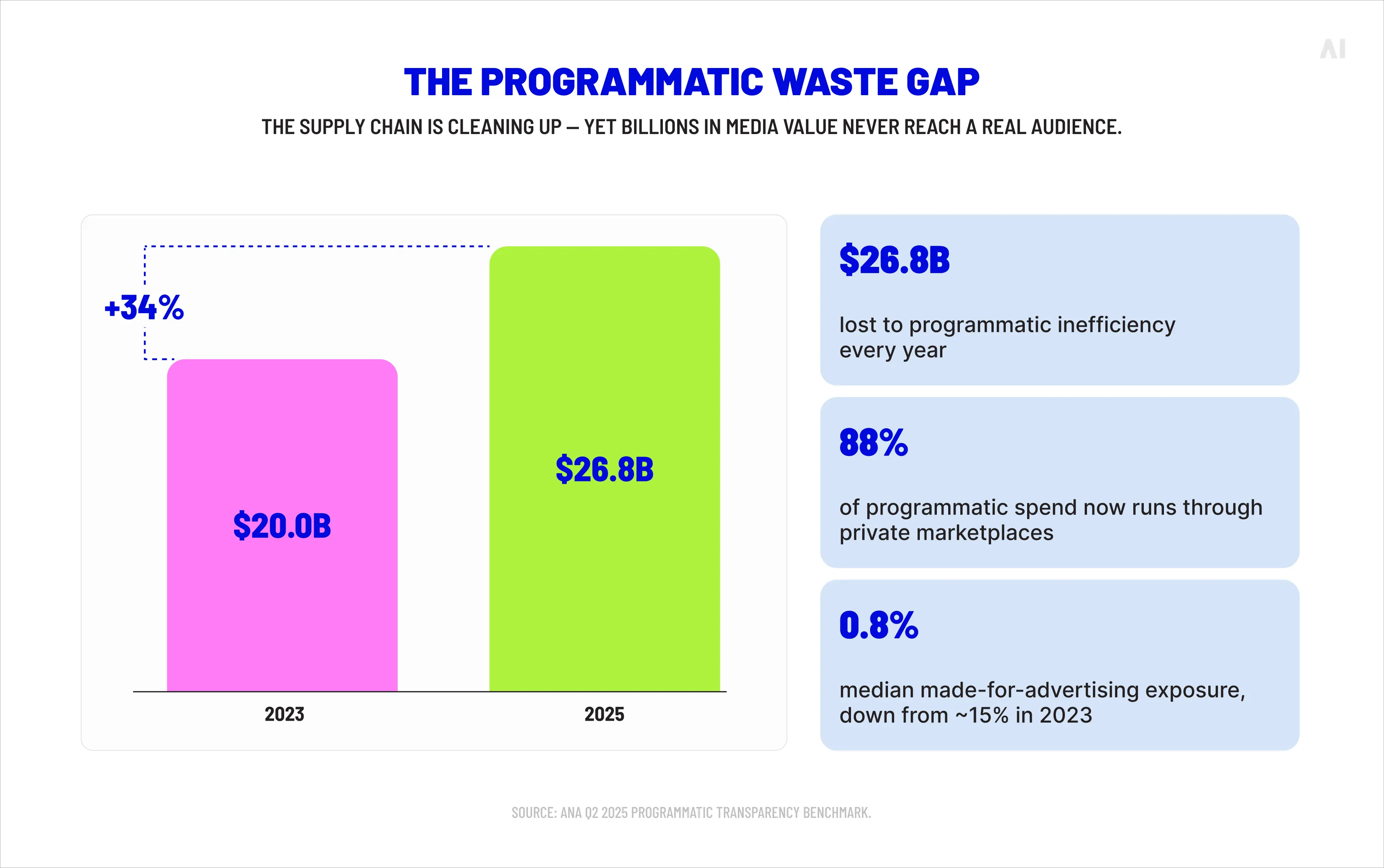
Two approaches attack that waste directly.
- Curating toward premium, relevant inventory keeps spend out of the low-value long tail—the thinking behind AI Digital's Smart Supply, a supply-side curation approach that builds deal packages against a client's KPIs across display, video, CTV, and audio.
- Measuring that inventory independently, across DSPs rather than inside any one, is the job of the Open Garden framework, which brings transparent, cross-channel evaluation to buying that platforms would otherwise grade themselves.
💡 For the fundamentals, see AI Digital's guides to programmatic advertising and supply path optimization.
Connected TV (CTV)
CTV is now too large to measure with borrowed metrics. US CTV ad spend is on track to reach roughly $38 billion in 2026, growing 13.8% year over year—second only to social among all channels, per the IAB, and digital video overall is set to take 61% of TV and video ad spend against linear's 39%, according to EMARKETER. At that scale, click-based thinking fails: CTV builds awareness and consideration that surface later, often crediting the eventual search click instead.
Improving CTV ROI means measuring it the way it actually works—through reach and frequency analysis, incrementality testing, and cross-channel attribution that places CTV inside the broader journey rather than judging it on completed views alone. Independent measurement and a unified intelligence layer are what let marketers see CTV's contribution honestly.
💡 AI Digital's guides to connected TV advertising and CTV measurement go deeper on both.
Common mistakes that reduce marketing ROI
Most ROI leakage traces back to a small set of repeatable measurement and optimization errors. Each one is fixable, and each fix compounds.
💡 AI Digital's guides to marketing attribution models and cross-platform measurement address several of these in depth.
Relying on last-click attribution
Last-click attribution hands 100% of the credit to the final touch and nothing to everything that made it possible. That systematically undervalues upper-funnel channels—programmatic, CTV, paid social—that create demand long before the closing click, and it pushes budget toward channels that merely harvest intent others generated. Pairing multi-touch attribution with incrementality testing corrects the bias by separating influence from mere proximity to the sale.
Measuring each channel in isolation
Judging each channel by its own dashboard produces an incomplete, often contradictory picture, because channels influence one another in ways no single platform can see. CTV lifts branded search; paid social assists conversions that email closes. Unified cross-channel measurement lets you optimize the whole portfolio—reallocating from channels that only capture demand to channels that create it—rather than tuning campaigns that look efficient alone but overlap in practice.
Accepting data without validation
Platform-reported ROAS overstates performance often enough that taking it at face value is a budgeting hazard. Because each platform's attribution model is built to credit itself, unvalidated numbers steer money toward whichever vendor counts most aggressively. Independent measurement provides the reliable baseline that platform data can't, and it is the discipline that turns reported performance into actual performance.
💡 AI Digital's work on marketing effectiveness measurement challenges covers how to build that validation habit.
Ignoring inventory quality
Campaign metrics can look healthy while spend drains into low-quality inventory that never reaches a real, attentive audience. Strong impressions and clicks mean little if they land on made-for-advertising sites or non-viewable placements. Premium inventory and supply path optimization reduce that waste directly, lifting media efficiency without touching the top-line budget.
💡 AI Digital's guide to a sustainable programmatic supply path explains how to build quality into buying from the start.
⚡ Cheap impressions are the most expensive thing in programmatic. Cost per thousand looks like a bargain right up until you measure what actually reached a person.
Marketing ROI in a privacy-first future
The signals marketing has leaned on for two decades are thinning, and measurement has to hold up without them. The picture is more nuanced than the "cookie apocalypse" headlines suggested: in April 2025 Google confirmed it would not deprecate third-party cookies in Chrome after all, and in October 2025 it retired most of its Privacy Sandbox APIs. Yet the direction of travel is unchanged. Safari and Firefox have blocked third-party cookies for years—roughly a third of web traffic where cross-site tracking already doesn't work—and consumers keep rejecting, deleting, and opting out regardless of any browser's default.
The strategies that keep ROI measurable in that environment are consistent, and each has a dedicated resource worth exploring.
- First-party data—information collected directly from your own customers, with consent—becomes the durable foundation for targeting and measurement.
- Server-side tracking recovers conversions that browser-side pixels lose.
- Independent, aggregate methods like MMM and incrementality keep working precisely because they never depended on individual identifiers.
- And open-internet signals plus contextual advertising offer reach outside the walled gardens.
💡 For the wider stakes, AI Digital's comparison of walled gardens and the open internet and its explainer on data clean rooms map where measurement is heading.
Turn cross-channel marketing ROI into a competitive advantage
Improving marketing ROI across channels was never going to come from optimizing a single campaign or buying one more tool. It comes from combining the pieces this article has walked through:
- unified measurement that reconciles fragmented data into one view,
- the right categories of digital marketing ROI tools matched to your business maturity,
- independent data that validates what platforms report, and
- a continuous optimization habit that keeps budget moving toward genuine incremental return.
Teams that build that system make smarter investment decisions than competitors still reading platform-reported dashboards at face value—and they compound that edge every quarter.
That is the work AI Digital does.
- Our marketing intelligence platform, Elevate, unifies cross-channel measurement and planning;
- Smart Supply and the Open Garden framework bring premium inventory and independent, transparent measurement to programmatic and CTV; and
- AI Creative Studio keeps performance channels fed with tested creative at scale.
If measuring and improving cross-channel ROI is the problem in front of you, get in touch with AI Digital to see how unified measurement fits your stack.