AI marketing platform comparison: features, use cases, and pricing


An honest AI marketing platform comparison begins with an admission: most of these products were never built to compete. One runs your CRM and email; another fires mobile push at scale; a third writes the ad copy. A fourth kind of tool does something the others cannot—it tells you whether any of it worked. Line them up in a single table and the winner looks obvious only because the criteria were rigged.
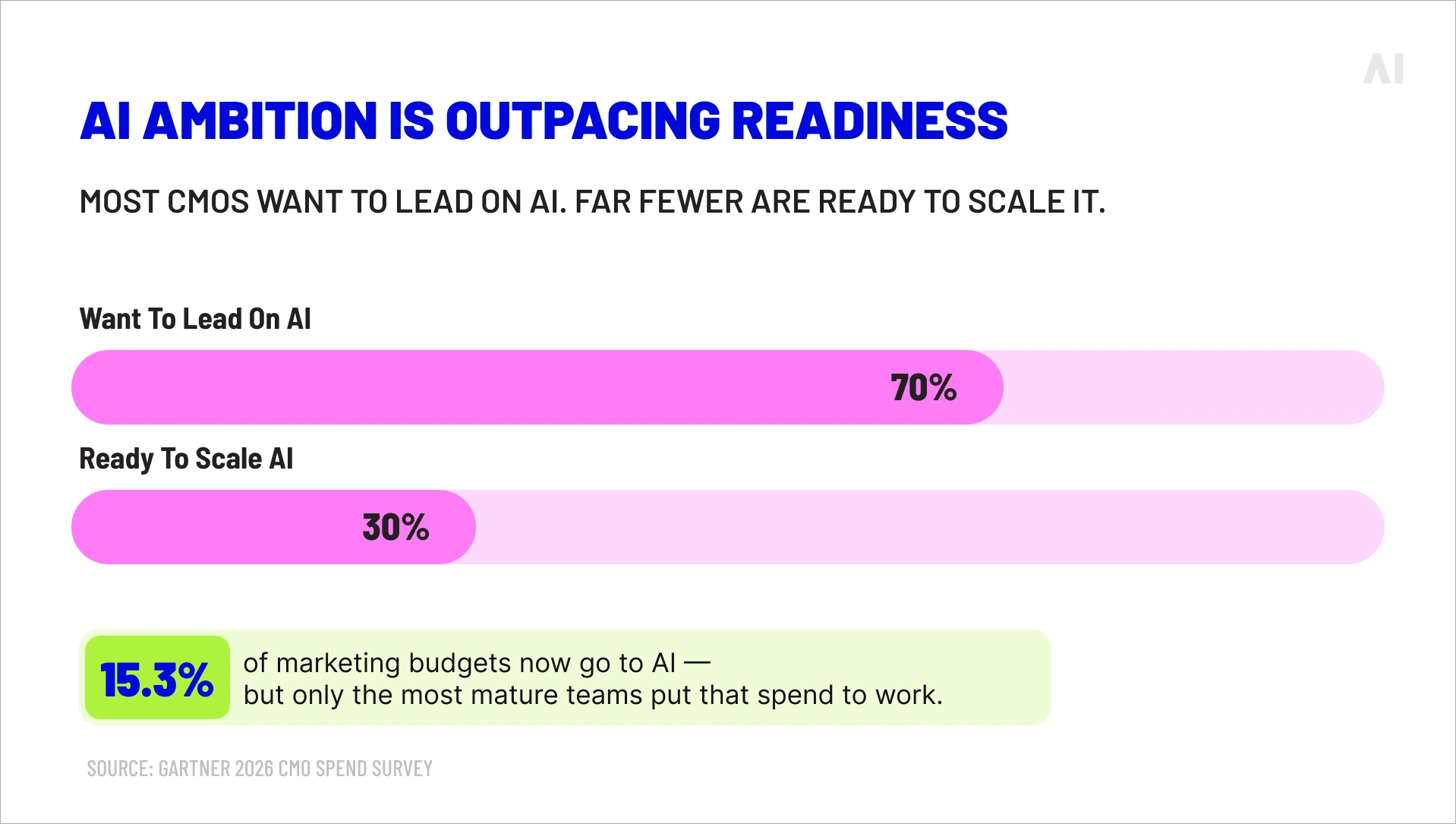
The mismatch is expensive to unwind. Gartner's 2026 CMO Spend Survey found that CMOs now put an average of 15.3% of their budgets into AI, yet only 30% say their organizations are ready to scale it. The money is arriving faster than the judgment to spend it well.
This guide compares seven of the best AI marketing platforms on the market against a consistent set of criteria: what each one does, who it suits, how it prices, and where it falls short. The aim is to help you find the platform that fits your goals, marketing maturity, and budget, not to crown a single champion.
What is an AI marketing platform?
An AI marketing platform is software that applies artificial intelligence across several marketing functions at once, rather than a single task. That usually spans automation, customer engagement, content creation, analytics, and campaign optimization, all connected to a shared store of customer or campaign data.
The distinction worth drawing is scope. A general-purpose chatbot can draft an email; an AI marketing platform decides who should receive that email, when, on which channel, and then measures what the send achieved. The intelligence is wired into a system of record and a workflow, not bolted on as a novelty.
Buyers get into trouble when they compare on feature count. A longer list of capabilities means little if half of them sit outside your use case or never integrate with your stack. The better test runs across business goals, use cases, integrations, scalability, measurement depth, and total cost of ownership. Judged that way, a lean platform aimed at your exact problem often beats a sprawling suite you will only half use.
AI marketing platforms vs. AI marketing tools
The quickest way to separate the two is by job size.
- An AI marketing tool does one thing well.
- An AI marketing platform runs a connected set of jobs across a shared data layer.
Jasper is a useful example of a tool. It generates strong marketing copy at speed, but it will not orchestrate a lifecycle journey or tell you which channel drove a conversion. A platform such as HubSpot or Salesforce sits underneath the work, holding the customer record, the automation logic, and the reporting in one place.
Tools tend to complement platforms rather than replace them. A content generator plugs into a suite that handles delivery and measurement. Problems start when a tool gets sold, or bought, as a full platform. Knowing which one you are evaluating saves a lot of wasted budget.
💡 Related read: AI marketing platform vs. traditional martech stack
Main types of AI marketing platforms
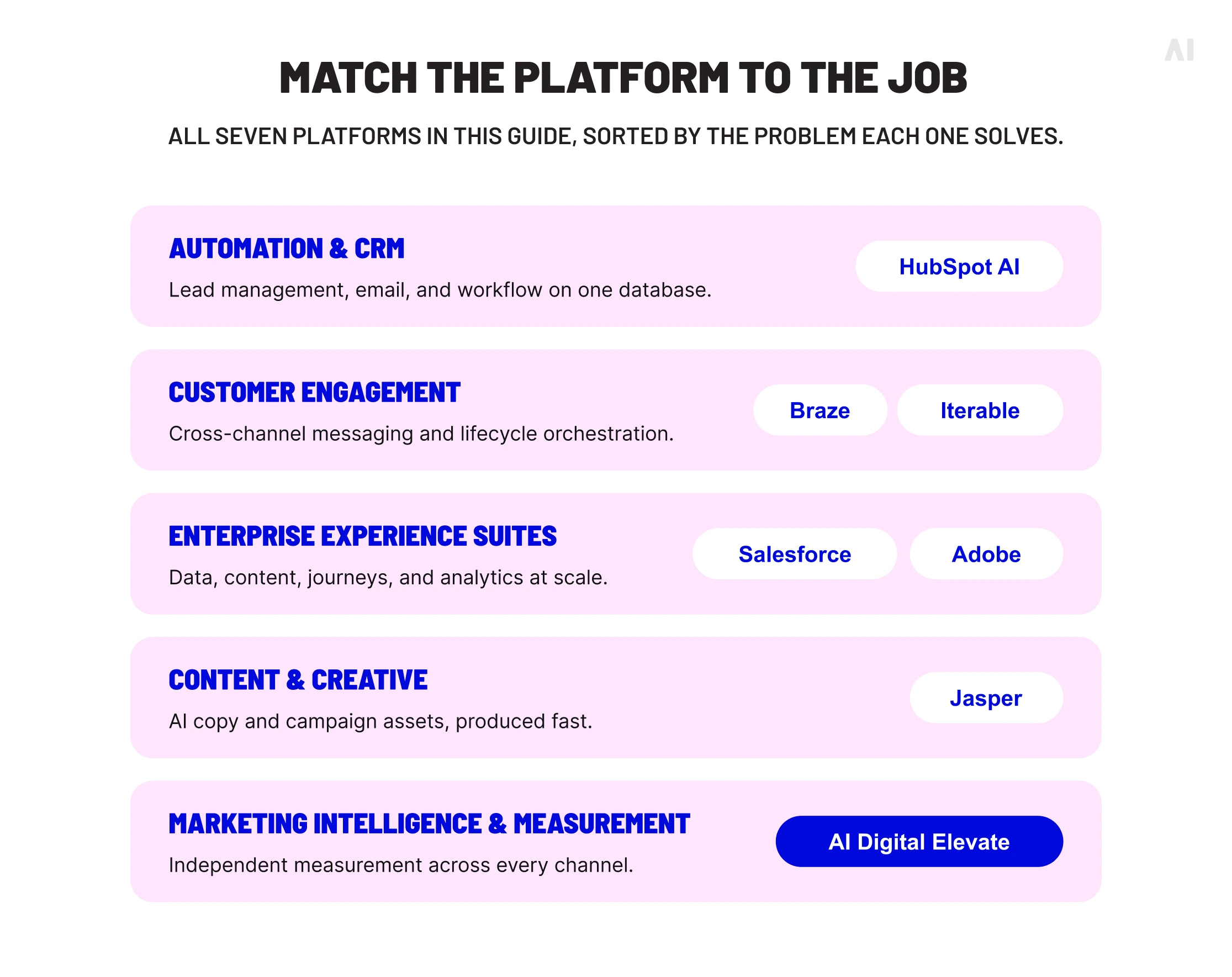
Before the reviews, it helps to sort the field into categories. Each solves a different core problem, and most buyers only need one or two.
- Marketing automation and CRM. Lead management, email, and workflow tied to a customer database. HubSpot is the reference point.
- Customer engagement. Cross-channel messaging and lifecycle orchestration, strongest in mobile and B2C. Braze and Iterable live here.
- Enterprise experience suites. Broad platforms spanning data, content, journeys, and analytics for large organizations. Salesforce and Adobe compete at this level.
- Content and creative. AI generation of copy and creative assets at scale. Jasper is the best-known example.
- Marketing intelligence and measurement. Independent research, planning, and cross-channel measurement that sits above the media itself. AI Digital Elevate occupies this category.
Keep these five buckets in mind as you read on. A platform that looks weak against another is usually built for a different bucket.
⚡ Comparing platforms built for different jobs is like scoring a sprinter against a swimmer. Pick the category you need before you pick a winner.
AI marketing platform comparison at a glance
Before the detail, here is a high-level view of the seven platforms in this guide. Use it to spot which ones belong to your category, then read the full reviews for the platforms that fit.
1. HubSpot AI
HubSpot uses AI to tie together CRM, marketing automation, content, and customer engagement inside one platform. Its AI layer, Breeze, launched in 2024 and expanded through 2026 into three parts: Breeze Assistant, a copilot for drafting and summarizing; Breeze Agents for autonomous work such as support resolution and prospecting; and Breeze Intelligence for data enrichment.
Key features cover AI-assisted CRM, marketing automation, email, content generation, lead scoring, and reporting, all sitting on HubSpot's own database with a deep integration marketplace.
Use cases skew toward SMBs and mid-market teams running inbound and B2B lead generation, plus customer lifecycle management across sales, marketing, and service.
On pricing, HubSpot keeps a free tier and low-cost Starter seats, then charges for the serious tooling: Marketing Hub Professional lists near $800 a month and Enterprise near $3,600 a month, billed annually. In April 2026 HubSpot moved its agents to outcome-based pricing, so the Customer Agent now costs $0.50 per resolved conversation rather than a flat per-conversation fee.
HubSpot reports that this agent resolves 65% of conversations and cuts resolution time by 39% across 8,000 customers.
The main limitation is data gravity. Breeze reasons only over information held inside HubSpot. If your team also runs Salesforce or stores product data in a warehouse, the AI cannot see it without workarounds, and credit costs climb quickly at high volume.
2. Salesforce (Agentforce Marketing)
Salesforce Marketing Cloud now trades under a new name. The company has folded its marketing product into Agentforce Marketing, part of a wider push around autonomous agents.
Two AI layers run underneath: Einstein handles prediction, such as lead and opportunity scoring, while Agentforce handles agentic work through the Atlas Reasoning Engine. Agentforce 360 reached general availability in the Spring 2026 release.
Key features include predictive analytics, customer journey orchestration, audience segmentation, omnichannel campaigns, and tight CRM integration.
Use cases center on enterprise marketing teams, especially organizations already standardized on Salesforce that want personalization and journeys running on the same data as sales and service.
Pricing reflects the enterprise positioning. According to a 2026 Salesforce pricing guide, Agentforce Marketing runs $1,500 per organization per month for the Growth edition and $3,250 for Advanced, billed annually. Agentforce itself is often billed by consumption at around $2 per conversation, and much of its value depends on Salesforce Data Cloud, a substantial add-on. Implementation typically starts around $25,000.
The limitation is cost and complexity. The headline license is rarely the real number once Data Cloud, Einstein add-ons, and integration work are counted, and production rollouts tend to run for months rather than weeks. The depth justifies the spend for Salesforce-native enterprises, and rarely for anyone smaller.
3. Adobe Experience Cloud
Adobe applies AI to customer experience, personalization, analytics, and content management, anchored by the Adobe Experience Platform (AEP). In 2025 Adobe added the AEP Agent Orchestrator and a set of purpose-built agents, and by Adobe Summit 2026 it had repositioned the whole suite around what it calls Customer Experience Orchestration. The older Adobe Sensei branding has largely given way to the Adobe AI Platform and Firefly, with GenStudio handling performance-marketing content.
Key features span personalization, customer journey analytics, content and digital asset management, and creative production through Firefly.
Use cases favor large enterprises in digital marketing and e-commerce, particularly organizations with big content teams that need creative and customer experience working off one data foundation. Adobe says more than a trillion experiences are activated through AEP each year.
Pricing is custom and enterprise-only, assembled from modules such as AEP, Experience Manager, Analytics, Journey Optimizer, and Firefly Services. There is no public rate card, so cost planning is a conversation about drivers rather than a look at a price list.
The limitation is the flip side of that breadth. Adobe rewards organizations with mature data and content operations, and overwhelms those without them. Implementation is heavy, and the platform earns its keep mainly when creative and customer experience live under one roof.
4. Braze
Braze uses AI to power customer engagement, lifecycle marketing, and cross-channel personalization, with a heritage in mobile. Its AI now sits under the BrazeAI banner, spanning a Decisioning Studio, autonomous agents, and the Sage AI generative tools, all built on the Canvas journey engine and the Braze Data Platform.
Key features include journey orchestration, AI-driven channel and send-time selection, lifecycle automation, and messaging across push, email, in-app, SMS, and WhatsApp.
Use cases are firmly B2C: retention, mobile marketing, and lifecycle campaigns for consumer brands operating at scale, from food delivery to streaming.
Pricing changed in January 2026, when Braze moved to a value-based model built on three dimensions: platform edition, monthly active users, and flexible credits for messages and AI tasks. Four tiers run from Go to Enterprise. Braze does not publish a rate card, and contracts are typically six figures a year, with entry deployments starting in the tens of thousands.
The limitation is that Braze prices for scale and rewards it. Monthly-active-user billing can produce unpredictable bills when usage spikes, implementation needs engineering time, and the platform is overkill for B2B lead management or email-only programs.
💡 Related reads: AI-driven personalization
5. Iterable
Iterable automates customer engagement and cross-channel campaigns, and in 2026 it went all in on autonomous marketing. Its Nova Intelligence suite added Nova Agent, which builds, audits, and optimizes campaigns on its own, alongside Nova Decisioning for channel, send-time, and frequency, plus predictive audiences and a new Command Center.
Key features cover lifecycle marketing, AI personalization, audience segmentation, omnichannel messaging, and workflow automation, with warehouse connectivity through its Smart Ingest layer.
Use cases target ecommerce and B2C teams focused on retention and personalized lifecycle campaigns, with a sweet spot in the mid-market.
Pricing is MAU-based and custom, typically $50,000 to $200,000 a year for mid-market deployments and higher for enterprise programs. Iterable is often positioned as the more affordable alternative to Braze at equivalent scale.
The limitation is that Iterable is an engagement platform, not a data platform. It merges profiles within its own system but does not resolve identity across every enterprise source, so teams that need a single governed customer record usually pair it with a dedicated CDP. Advanced Nova capabilities also carry add-on costs.
6. Jasper
Jasper uses generative AI to speed up marketing content and campaign production. Once a straightforward writing tool, it has grown into a marketing content platform with Jasper Studio for building no-code AI apps, agents for marketing tasks, and a brand-voice layer that keeps output on message. In 2026 it added tools to track how a brand appears inside AI answer engines, a nod to how discovery is changing.
Key features include AI copywriting, campaign content generation, brand voice controls, templates, and collaboration.
Use cases span content marketing, SEO, social, and email, particularly for creative teams and agencies producing at volume.
Pricing, per Jasper's plans page, starts at $39 a month for the Creator plan on annual billing and $59 a month for Pro, which supports up to five seats, with a custom Business tier for larger teams. All paid plans include unlimited generation, and a seven-day trial is available.
The limitation is scope. Jasper is a strong point solution, not a full platform, and complements a marketing suite rather than replacing one. Expect to pay more than you would for a general-purpose model on casual use, and to edit and fact-check the output before it ships.
7. AI Digital Elevate
Elevate is where this comparison turns, because it answers a different question from the six platforms above. It does not automate your emails or send your push notifications. It tells you what is working across every channel and what to do next. AI Digital relaunched Elevate in April 2026 as a marketing intelligence platform built on its Open Garden framework, designed as a glass-box alternative to black-box AI.
Key features unify research, planning, optimization, and reporting in one layer that stays vendor- and DSP-agnostic. Elevate builds channel-specific audience segments and personas, runs competitive analysis, and offers cookieless targeting alongside an AI-Assisted Media Planner trained on more than 8,000 campaigns across 12-plus DSPs.
On measurement, it delivers cross-channel attribution, Marketing Mix Modeling, and Path to Conversion analysis, plus an Ask Elevate assistant for plain-language queries. It draws on 150 billion data points a month and more than 10,000 audience attributes.
Use cases center on enterprise marketing measurement, cross-channel analytics, budget allocation, and independent, KPI-first performance optimization, especially for teams that have outgrown platform-native reporting.
Pricing works differently from everything else here. Elevate carries no separate or per-feature license. Its features are included within an AI Digital partnership, available as a short-term campaign engagement or an enterprise arrangement, which reframes the usual total-cost calculation.
The limitation: Elevate is a partnership and an intelligence layer. It will not replace your CRM or your engagement tool; it measures and optimizes the media those tools help you run.
💡 Related read: Best marketing intelligence platforms in 2026.
Which AI marketing platform fits your use case?
The reviews describe what each platform does; this section maps goals to shortlists. Match your primary objective to the recommendations below rather than re-reading every feature list.
Best for marketing automation
If your priority is lead nurturing, email, and workflow tied to a CRM, HubSpot is the natural starting point and arguably the best AI marketing automation platform for SMB and mid-market teams. Its Breeze agents automate research and outreach, and the free tier lowers the barrier to entry. For engagement-led automation in consumer lifecycle programs, Iterable is the stronger fit, with autonomous campaign building through Nova Agent. HubSpot owns the CRM-centered workflow; Iterable owns the behavior-triggered journey.
Best for enterprise marketing teams
Large organizations need scale, governance, security, and deep integrations. Salesforce, Adobe, and Braze all clear that bar, so the decision comes down to your center of gravity.
- Salesforce fits when the CRM is the heart of the operation and you want journeys running on the same data as sales.
- Adobe suits teams where creative, content, and customer experience lead, provided the data maturity is there to support them.
- Braze is the pick when mobile-first, real-time engagement drives revenue.
Best for marketing measurement and performance optimization
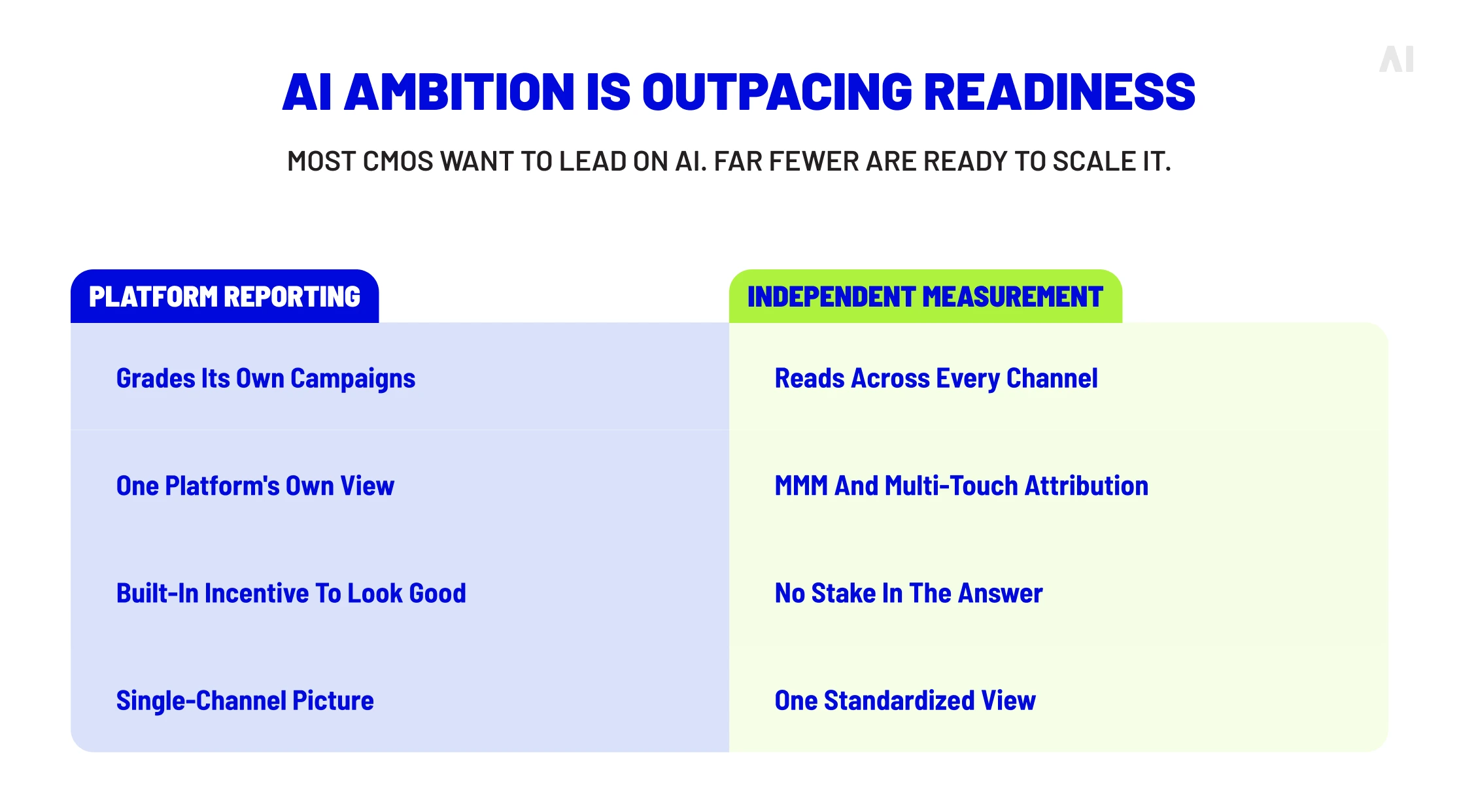
This is where independent measurement earns its place. Platform-native reporting has a built-in conflict: the system grading the campaign is the same system selling the media. When you need an objective read on what drove results across channels, you want a layer that has no stake in the answer.
Elevate is built for exactly this.
- Its Marketing Mix Modeling measures how awareness and upper-funnel channels influence overall performance,
- its Path to Conversion analysis shows the full journey rather than the last click, and
- its reporting standardizes data across every channel into one view.
- Analytics suites describe what happened inside their own walls;
- a KPI-first intelligence layer reads across all of them.
⚡ A platform that scores its own campaigns will always give itself a good grade.
Best for AI content creation
For pure content and creative production, the choice is between a specialist and a suite. Jasper is the specialist, purpose-built for marketing copy, brand voice, and campaign assets, and it suits teams whose bottleneck is output volume. Adobe Experience Cloud, through Firefly and GenStudio, is the suite option, better when creative production has to plug directly into a wider customer experience and content supply chain. Pick the specialist for speed and focus, the suite for integration.
Best for programmatic advertising and media buying
Here a common mistake is worth heading off. Google DV360 and The Trade Desk are demand-side platforms: they buy and serve media. Elevate does neither. It is the DSP-agnostic intelligence and planning layer that sits above them, working across whichever DSPs you use, including those two. That reframes the task. Instead of choosing Elevate or The Trade Desk, you want independent intelligence, planning, and measurement across every buying platform at once, with curated, transparent supply underneath. That supply-side curation comes from AI Digital's Smart Supply, which optimizes inventory to your KPIs rather than to platform incentives.
Side-by-side AI marketing platform comparison
The matrix below pulls the whole guide into one place, scored on consistent criteria. Read it by the job you need done rather than by counting rows. The strongest automation platform is not built to win on measurement.
AI marketing platform pricing models
AI marketing platforms price in four broad ways, and understanding the model counts as much as reading the number.
- Free and freemium. Entry access with paid upgrades, as with HubSpot's free CRM. Good for testing, rarely enough to run a serious program.
- Subscription and per-seat. A recurring fee by tier or user, standard for Jasper and HubSpot's hubs. Predictable, but costs rise with headcount.
- Usage and consumption. Charges tied to activity, such as HubSpot's per-resolution agents or Braze's active users and credits. Aligned to value, but harder to forecast.
- Enterprise and custom. Negotiated pricing for Salesforce, Adobe, and Braze at scale, usually with implementation as a separate line.
The move toward consumption pricing is now the dominant trend. Gartner's 2026 data shows martech's share of the marketing budget at a five-year low of 19.4%, while 56% of organizations have moved more spend into usage-based models. The flexibility has a catch: usage bills can balloon when a campaign spikes, which is why half of consumption-based buyers renegotiate contracts to keep costs in check.
The factors that drive price are consistent across vendors: the depth of AI capabilities, the number of integrations, seat or user counts, and implementation.
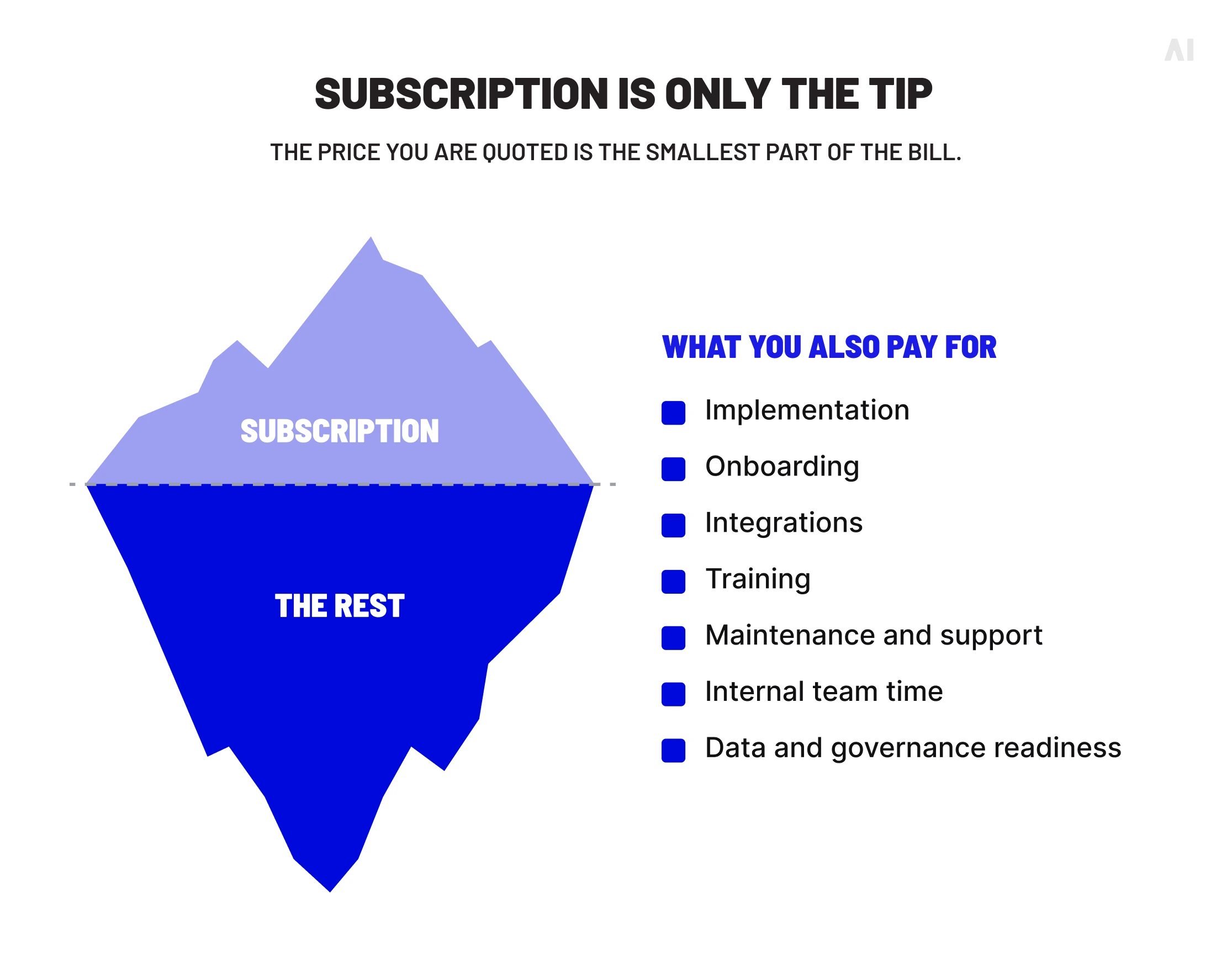
Counted properly—implementation, integration, and the internal time to run it—the platform with the lowest subscription often ends up costing the most. Elevate's included-in-partnership model sits outside that per-feature math entirely.
⚡ The cheapest subscription is rarely the cheapest platform.
How to choose the right AI marketing platform
With the field mapped, the decision comes down to a structured evaluation rather than another lap around the vendors. Three factors carry most of the weight.
1. Based on your primary goal
Start with the job, not the brand.
- If automation and lead management dominate, HubSpot is the obvious first look.
- Cross-channel engagement steers you toward Braze or Iterable.
- A content bottleneck makes the case for Jasper.
- And where measurement and media optimization lead, Elevate is the fit.
Naming that primary goal first clears most of the field before you compare a single feature.
2. Consider integration and scalability
A platform is only as strong as its connections.
- Check how it integrates with your CRM, advertising platforms, analytics tools, CDPs, and data warehouses, and how much engineering the integration demands.
- Then look ahead: implementation complexity, data management, and whether the platform scales with the business you expect to have in three years, not the one you have today.
3. Evaluate total cost of ownership
Subscription price is the smallest part of the bill. Add implementation, onboarding, integrations, training, maintenance, support, and the internal resource to run it.
Gartner found that 38% of marketers cite a lack of internal AI expertise as the top barrier to getting value from the technology, a reminder that people, not licenses, often decide whether a platform pays off.
The least expensive option on paper is frequently the most expensive to run.
Questions before choosing an AI marketing platform
A short checklist can validate a shortlist before you commit. Run each candidate through these:
- Does it integrate with your existing stack without heavy custom work?
- Can it scale with your business over the next few years?
- Does it provide independent measurement, or only platform reporting?
- What is the real total cost of ownership, beyond the subscription?
- Do your data foundations and team maturity support it?
If a platform stumbles on measurement independence, that is worth weighing carefully. It is the one gap that platform-native tools cannot close on their own.
Conclusion on top AI marketing platforms: Which AI marketing platform is right for you?
The right AI marketing platform depends on your goals, company size, marketing maturity, budget, integration needs, and long-term plans, not on which product has the longest feature list. Use the matrix and the evaluation framework above to narrow the field to your category, then pressure-test the shortlist against real total cost and real integration effort.
One pattern holds across all of it. Gartner's finding that 70% of CMOs want to lead on AI while only 30% feel ready to scale it points to a gap that tools alone do not close. The teams pulling ahead are pairing their platforms with independent measurement and human oversight, so they can tell optimization from genuine strategy.
That is the space AI Digital works in. Alongside Elevate's marketing intelligence platform, the company offers a managed media service across 15-plus DSPs, Smart Supply for curated and transparent inventory, and AI Digital Labs for custom AI strategy. If your challenge is measuring true performance across channels and acting on it, that is worth a conversation. You can get in touch to talk it through.
⚡ Buying AI and being ready to use it are two different purchases.