Digital Signage Advertising Networks: How They Work and Generate Measurable Revenue

Digital signage networks sit at a practical intersection: the real-world scale of out-of-home and the operational discipline of digital advertising. For advertisers, the appeal is straightforward. You can reach people when they’re out shopping, commuting, waiting, or moving through venues that matter—and you can do it with tighter control than traditional printed placements.
For media owners (retailers, transit operators, property groups, venue operators), a digital signage network is a monetization engine. It helps you sell “spare minutes” on screens, package impressions across locations, keep creative fresh without manual labor, and prove what ran so buyers keep coming back.
This guide breaks down what a digital signage advertising network is, how it works end-to-end, what infrastructure makes it reliable, and how modern networks drive measurable outcomes through targeting, monetization, and performance measurement. You’ll also get a grounded framework for choosing the right network approach, whether you’re building a small signage network in one location or operating digital signage networks at national scale.
💡 Related reading: What is digital out-of-home (DOOH) advertising
What is a digital signage advertising network?
A digital signage advertising network is the combination of people, software, and hardware that (1) packages screen time as ad inventory, (2) sells it to advertisers, (3) delivers creative to the right screens at the right time, and (4) verifies playback and reports performance.
If you already run digital signage for customer messaging (menus, in-store promos, wayfinding), you’re partway there. The difference is that a true signage advertising network behaves like media:
- It defines inventory in a consistent way (screens, loops, time slots, rules).
- It supports commercial workflows (rates, packaging, approvals, billing).
- It provides delivery accountability (proof-of-play, monitoring, make-goods).
- It enables measurement and optimization (impression models, pacing, insights).
In the broader DOOH ecosystem, digital signage networks are the “supply side” of physical screens. They connect advertisers to real-world placements in retail, transit, offices, gyms, campuses, healthcare, hospitality, and other venues where people spend time.
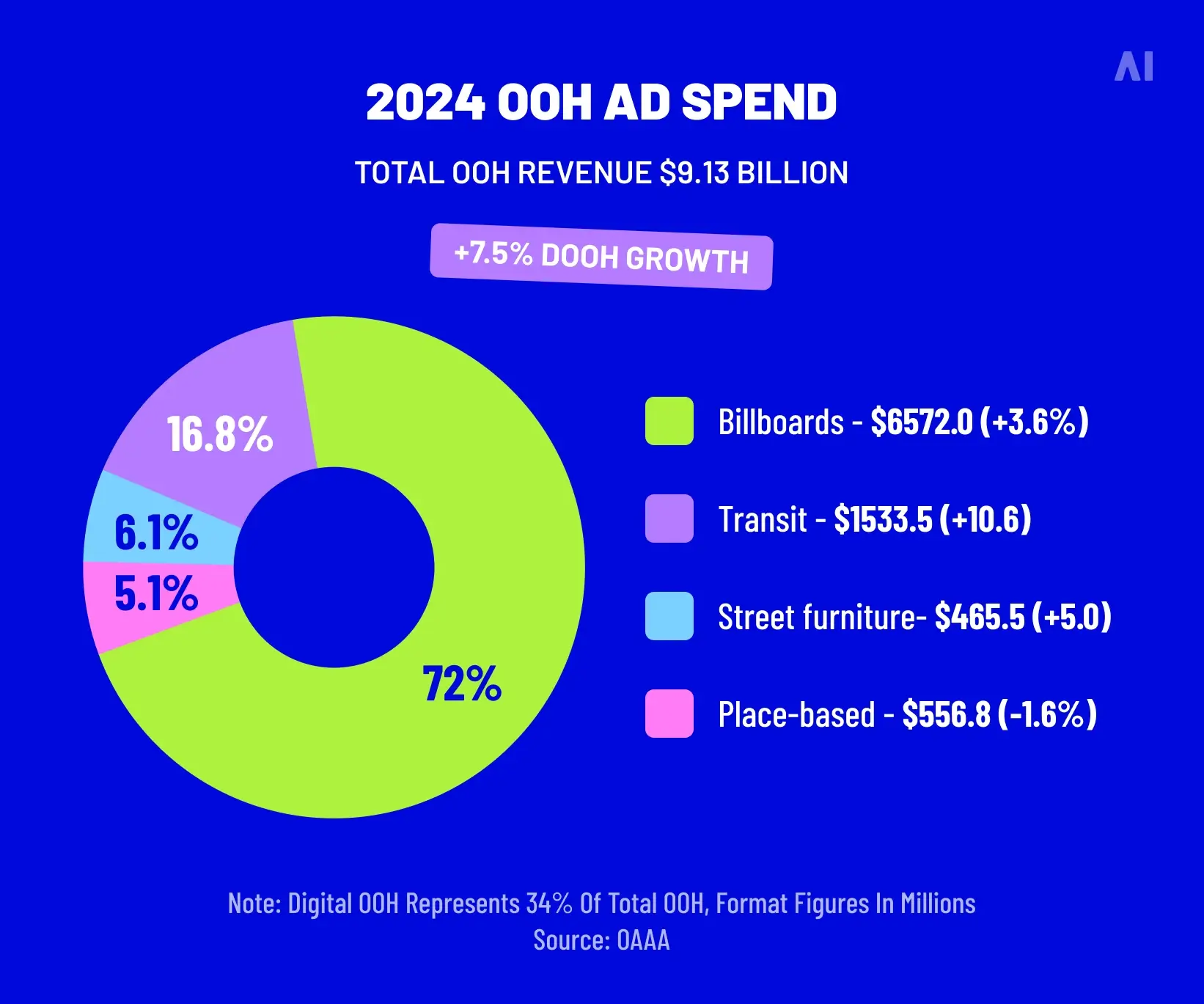
⚡ OOH revenue reached $2.86B in Q2 2025, with 3% year-over-year growth—a useful reminder that “real-world media” is still expanding while other channels fragment.
Who benefits?
- Advertisers get context, proximity, and real-world attention moments that complement CTV, mobile, and search.
- Retailers and venue operators monetize screen time while also improving in-venue experience.
- Transit operators and property groups bring structure and repeatability to media sales across locations.
- Publishers and media owners extend their footprint into place-based screens and bundle it with other channels.
💡 Related reading: DOOH advertising examples: Best practices and creative campaigns that drive results — AI Digital
How digital signage advertising networks work
At a high level, digital signage networks run on a predictable loop: sell inventory → deliver creative → confirm playback → report → optimize. The mechanics vary by network type (single-location, private multi-location, programmatic DOOH), but the logic stays consistent.
{{26-Digital-Signage-Advertising-Networks-SEO-1="/tables"}}
Here’s the workflow in plain business terms.
1. Inventory is defined and packaged
Before anyone buys, the network needs a shared language for what’s being sold. Inventory definitions typically include:
- Screen or screen group (one screen, a wall, a venue cluster, a city bundle)
- Play frequency (e.g., once per loop, X plays per hour)
- Dayparts (morning commute, lunch, evening, weekends)
- Creative rules (format, duration, audio policies, brightness considerations)
- Content adjacency rules (brand safety in physical spaces is still a thing)
- Pacing rules (steady delivery vs burst for specific periods)
The key is consistency. If every venue defines “a spot” differently, selling becomes slow, reporting becomes messy, and make-goods become constant.
2. Campaigns are booked (direct or programmatic)
Most digital signage advertising networks support two buying paths:
- Direct sales: A buyer agrees on placement, dates, and pricing with the media owner (or sales partner). This is common for high-value locations, sponsorships, seasonal packages, and integrated retail campaigns.
- Programmatic: Inventory is made available through automated buying. Buyers can bid and run campaigns with less manual coordination, often using DSP workflows they already know.
Neither is “better” by default. Many networks do best with a hybrid approach: direct for premium and predictable revenue, programmatic to fill unsold time and unlock incremental demand.
💡 Related reading: The best programmatic advertising platforms
3. Creative is uploaded, checked, and adapted
DOOH creative still needs operations. Even if the buyer provides “digital files,” the network must confirm:
- Correct format and resolution for each screen type
- Safe zone and legibility (distance matters more than you think)
- File size and codec compatibility (especially for video)
- Content approvals (venue restrictions, regulated categories, local policies)
- Timing (6s, 10s, 15s) aligned to the inventory product
This is where networks either build trust or lose it. A signage network that catches issues early prevents blank screens, failed playbacks, and campaign refunds.
4. Delivery is orchestrated across CMS and ad serving
This is the part many teams find confusing, so it helps to separate roles.
- A Content Management System (CMS) controls what screens show and when. Think scheduling, playlists, daypart rules, local overrides, and screen health monitoring.
- An ad server manages campaign logic: which ad should play, how often, and whether pacing is on track. It also helps track delivery (what was served, to where, and when).
In a mature digital signage advertising network, the CMS and ad server cooperate. The CMS provides the “stage” (the screen schedule). The ad server provides the “cast list” (the campaign decisioning).
5. Playback is monitored and verified
This is where digital signage networks become measurable media rather than “we think it ran.”
Verification commonly includes:
- Proof-of-play logs: device reports that the creative rendered at a timestamp
- Screen health signals: device online/offline, storage, temperature, player status
- Exception handling: missed plays due to downtime trigger make-goods or rescheduling
- Quality assurance: spot checks, screenshots, or third-party verification (more on this in the FAQ)
A practical point: “verification” in physical environments often needs layers. Logs are important, but so is the ability to detect misconfigurations (wrong playlist, wrong creative version, wrong daypart).
6. Reporting feeds optimization
Once delivery is stable, optimization becomes possible. Depending on sophistication, this can include:
- Pacing adjustments (smooth delivery vs burst)
- Screen mix refinements (more weight to high-traffic venues)
- Creative rotation based on performance signals
- Daypart changes aligned to real-world behaviors
⚡ If you can’t prove what played, where, and when, you don’t really have an ad network.
Core components of a digital signage network
When digital signage networks work well, it’s rarely because one tool is “great.” It’s because the infrastructure is designed to scale without falling apart under volume: more screens, more campaigns, more creative versions, more locations, more stakeholders.
Displays and hardware
In a digital signage network, hardware decisions shape revenue. Not because “a nicer screen sells better,” but because reliability and placement determine how much inventory you can confidently sell and fulfill.
Core hardware elements include:
- Displays: LCD/LED screens in different brightness levels and sizes, sometimes with outdoor-rated requirements (weatherproofing, high nits, protective enclosures).
- Media players: dedicated players, system-on-chip displays, or embedded devices that render content and report back to the network.
- Mounting and environment: wall mounts, kiosks, menu boards, window-facing units, transit shelters, elevator banks, and more.
What matters most is not the spec sheet. It’s the operational profile:
- Uptime: can the screen reliably play content for long stretches without manual resets?
- Remote manageability: can you update, reboot, and troubleshoot without a site visit?
- Consistency: are screen formats standardized enough to make creative ops manageable?
- Placement strategy: are screens positioned to be seen, not just installed where power was easiest?
If you sell advertising on digital signage, your hardware stack becomes part of your media product. That’s why many teams align hardware decisions with broader planning principles.
💡 Related reading: Media planning and buying: what they are, how they work, and best practices in 2026
A useful way to evaluate readiness is to run a simple hardware checklist. Here’s one that works for both small networks and multi-location builds.
Hardware readiness checklist (what to confirm before you sell at scale):
- Screen brightness and viewing angle match the environment (indoor vs window vs outdoor).
- Media player supports your creative formats and can cache content for offline playback.
- Remote monitoring is in place (online status, storage, playback reporting).
- Maintenance responsibility is clear (who replaces, who reboots, who escalates).
- Screen grouping is defined (by venue, by zone, by audience flow).
- Power, connectivity, and physical security are stable at each location.
Get these basics right and you reduce the two biggest profit killers in signage advertising networks: downtime and manual labor.
Content Management System (CMS)
A CMS is the operational center of most digital signage networks. It’s how you keep screen content consistent, scheduled, and controllable across locations.
A CMS typically handles:
- Central scheduling (playlists, loops, dayparts)
- Role-based access (local managers vs central ops)
- Content libraries and templates
- Approvals and publishing workflows
- Screen monitoring and troubleshooting
- Local overrides where needed (store-specific messaging, emergencies, local compliance)
For advertising on digital signage, the CMS also needs to behave like a media platform, not just a “content uploader.” That means the CMS should support:
- Ad slots inside playlists (so ads can be inserted without rebuilding the whole schedule)
- Separation between editorial content and paid content
- Consistent rules for duration, frequency, and pacing
- Reporting hooks for proof-of-play
One important distinction: a CMS helps you control screens; it does not automatically make you a monetized advertising network. Monetization requires the commercial and ad-tech layer (rates, trafficking workflows, demand connections, delivery accountability).
Network connectivity and cloud architecture
Connectivity is not exciting until it fails. Then it becomes your main operating cost.
Digital signage networks rely on connectivity to:
- Distribute creative files at the right time
- Update schedules quickly (especially for time-sensitive campaigns)
- Report playback logs and health signals back to the platform
- Enable remote troubleshooting and device management
Most modern networks use a cloud control plane plus edge playback:
- The cloud platform manages assets, schedules, campaign logic, and reporting.
- Devices cache content locally so screens can keep playing even if connectivity drops.
- When the connection returns, logs sync and schedules reconcile.
From a business perspective, the goal is predictable delivery. That requires:
- Caching strategies (so offline time doesn’t equal blank screens)
- Bandwidth awareness (so large video files don’t saturate weak connections)
- Security (device authentication, encrypted traffic, access control)
- Monitoring (alerts when devices go offline or fall behind on updates)
Advertising technology stack
Once a signage network sells advertising, it inherits the same expectations buyers have in digital: control, transparency, and predictable reporting.
The core ad-tech components usually include:
- Ad server: campaign setup, decisioning, pacing, frequency rules, and delivery logs
- SSP (Supply-Side Platform): connects your inventory to programmatic demand and manages deal types (open auction, private marketplace, programmatic guaranteed)
- Programmatic pipes: integrations that allow automated buying and standardized reporting
{{26-Digital-Signage-Advertising-Networks-SEO-2="/tables"}}
A simple way to think about it:
- The CMS ensures the screen has a slot available.
- The ad server decides which creative should fill that slot.
- The SSP helps you sell that slot to a wider pool of buyers through automated transactions.
💡Related reading: Ad server vs DSP: Key differences and similarities.
⚡ Programmatic doesn’t replace direct sales. It fills gaps and helps price inventory smarter.
Types of digital signage networks
Different digital signage networks exist because different businesses want different outcomes. Some want an internal network to improve in-venue messaging. Others want a full advertising network with monetization. Others want programmatic scale.
Below are the three common models and how to choose between them.
{{26-Digital-Signage-Advertising-Networks-SEO-3="/tables"}}
Single-location
A single-location signage advertising network is a controlled environment: one store, one gym, one clinic, one office lobby, one venue. It’s often the smartest starting point because you can validate the basics before scaling.
Typical goals include:
- Sell local sponsorships (nearby businesses, partners, local services)
- Promote on-site offers (as “house ads” alongside paid spots)
- Test pricing, creative formats, and operational workflows
- Learn what “proof” buyers need to trust your reporting
This model is also where teams realize what they’re really building: not a screen, but an operational system. Even small networks need content checks, scheduling rules, and a way to handle missed plays.
Multi-location private
A private multi-location digital signage advertising network is usually owned by a retailer, a property group, a venue operator, or a transit authority. The defining trait is control: inventory, rules, and data governance remain inside one organization.
This model works well when:
- You have consistent venues and want scalable packaging (regional or national buys)
- Brand safety and adjacency matter (you control what runs)
- You want to build first-party insights from venue behavior
- You prefer stable direct revenue over volatile auction dynamics
Private networks also make it easier to standardize creative specs and reporting. That consistency becomes a competitive advantage when advertisers compare options.
Programmatic DOOH
Programmatic DOOH networks connect screen inventory to automated buying. This expands demand beyond direct relationships and makes buying easier for advertisers who already run programmatic media.
⚡ Programmatically traded DOOH is forecast to reach 10.9% of total DOOH revenues in 2025, totaling $2.2B globally—big enough to matter, still small enough that direct sales and sponsorship products remain central.
Programmatic models can include:
- Open auction (more volume, less control)
- Private marketplace deals (more control, curated buyers)
- Programmatic guaranteed (predictability with automation)
For many signage networks, programmatic is an optimization layer rather than the whole strategy. It helps monetize unsold inventory, smooth out seasonality, and bring in buyers who would not negotiate direct buys.
💡 Related reading: Digital transit advertising: How DOOH extends reach beyond online media
Business benefits of digital signage advertising networks
This section focuses on outcomes. The tech enables these benefits, but the value shows up in revenue, efficiency, relevance, and measurement.
Revenue and monetization opportunities
A digital signage advertising network gives you multiple ways to monetize screen time, and you can mix them without confusing buyers if your products are well defined.
Common monetization models include:
- Direct sales: sponsorships, fixed packages, seasonal campaigns, category exclusivity
- Programmatic revenue: auction-based demand that improves fill for remnant inventory
- Hybrid models: premium screens sold direct, secondary inventory sold programmatically
- Bundled offers: signage plus social, email, onsite promotions, or loyalty placements
- Performance-linked products: where appropriate, tie pricing to outcomes like store visits or lift (with clear assumptions)
{{26-Digital-Signage-Advertising-Networks-SEO-4="/tables"}}
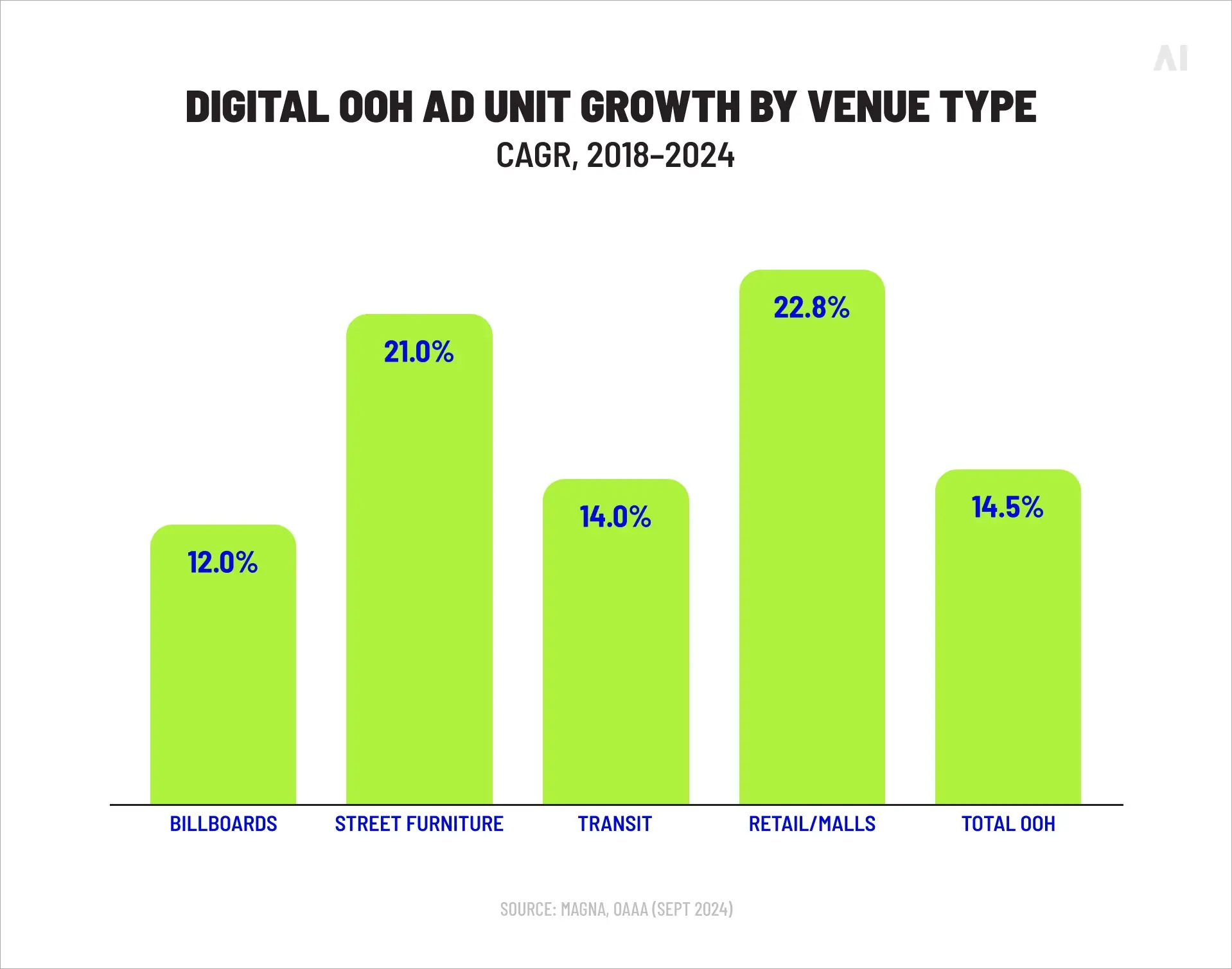
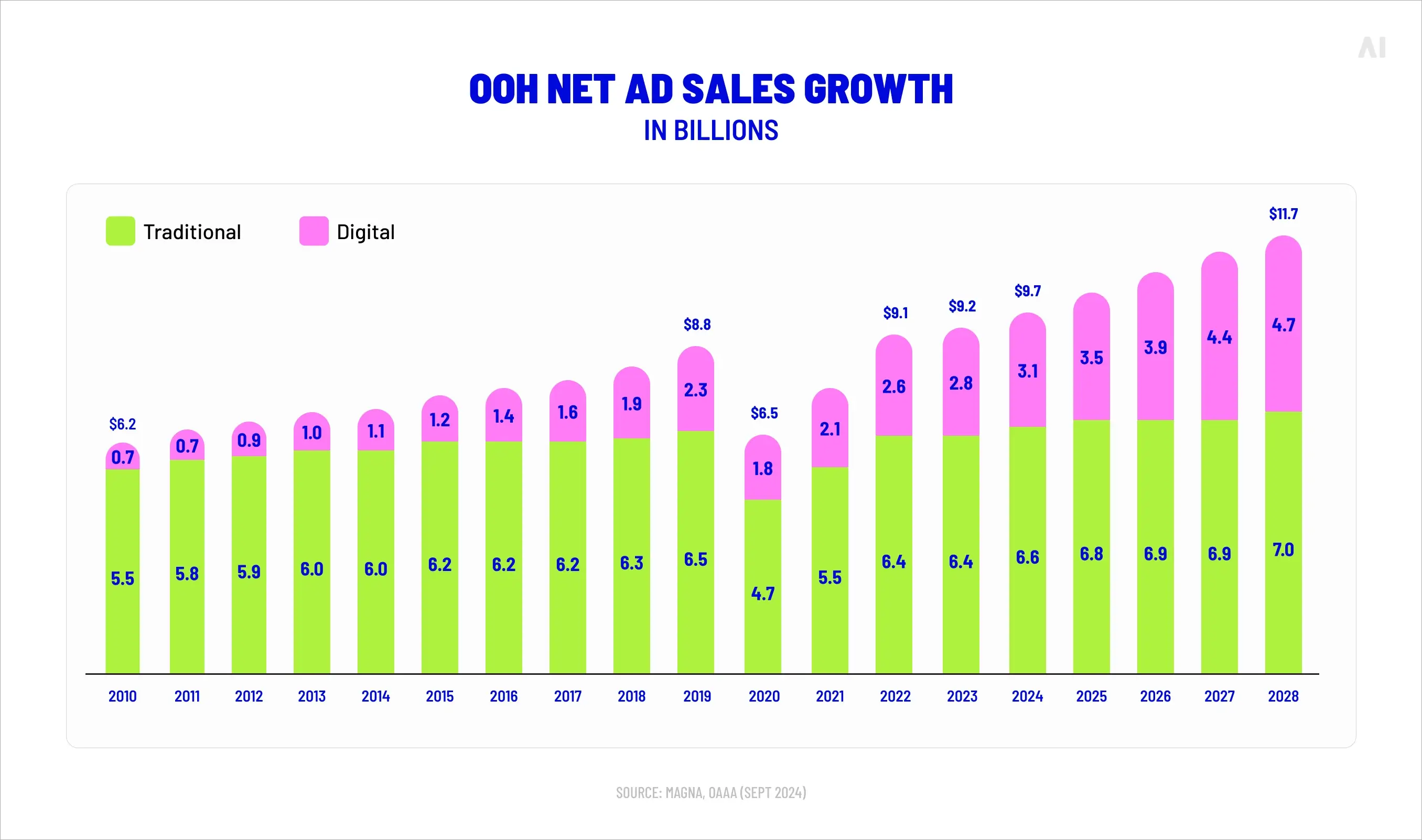
For U.S. market context, MAGNA’s Spring 2025 forecast projected out-of-home sales growing to reach the $10B milestone in 2025, with digital OOH revenue up +12% to $3.5B (35% of total OOH sales). That is not “digital signage only,” but it reflects the broader direction: digital screen-based inventory is where pricing power and growth are concentrating.
📍 A practical monetization tip: treat your network like a portfolio. Define a small set of inventory products that make buying easy, then offer custom packages only when there’s real incremental value.
A simple starting product set (easy for buyers, manageable for operators):
- Always-on reach package (steady pacing across all screens)
- Daypart package (commute, lunch, evening, weekend)
- Venue cluster package (specific neighborhoods, store formats, or location types)
- Seasonal sponsorship (exclusive or high share of voice for a time window)
- Test-and-learn (short flight with clear reporting and a path to scale)
You can expand later. Early on, clarity beats complexity.

Advanced targeting and personalization
Targeting in digital signage networks looks different from cookie-based digital advertising. It’s grounded in place, time, and context. That can be a strength because it forces you to define why the environment matters.
⚡ Personalization works best when it’s built on a small number of repeatable packages. If every campaign needs a bespoke screen list and custom rules, your network becomes expensive to operate and hard to scale.
Common targeting approaches include:
- Location targeting: specific venues, neighborhoods, or screen zones within a venue
- Time-based targeting: dayparts aligned to real-world behavior (morning commute, lunch rush, post-work shopping)
- Context targeting: weather, local events, store conditions (inventory levels, promotions)
- Audience-informed targeting: aggregated insights based on venue patterns or modeled audiences (privacy-safe)
Personalization does not always mean “one-to-one.” In most signage advertising networks, personalization means “right message for this context,” repeated reliably across the screens that share that context.
💡 Related reading: Personalized advertising: benefits, challenges & best practices & Programmatic Ad Targeting: Best Strategies, Tools, and Tactics in 2026.
Scalability and campaign flexibility
The operational benefit of a digital signage network is that it reduces friction. Once your inventory, workflows, and delivery systems are standardized, scaling becomes a matter of adding screens and demand, not reinventing how everything works.
Flexibility shows up in day-to-day moments:
- Creative swaps without reprinting or reinstalling
- Fast updates for pricing changes, promotions, or compliance edits
- Rapid response to local conditions (weather shifts, event surges, store-level needs)
- Ability to run multiple campaigns across the same screen set without chaos
For advertisers, this means campaigns can be adjusted mid-flight. For media owners, it means fewer manual interventions and fewer “sorry, we can’t do that” conversations.
Performance measurement and insights
Measurement is one of the main reasons advertisers treat digital signage advertising as a serious channel rather than a brand-only experiment. But measurement needs discipline to be credible.
Strong networks typically offer:
- Proof-of-play reporting (what played, where, when)
- Impression estimation (based on traffic or audience models)
- Viewability/visibility considerations (screen orientation, obstruction, dwell time)
- Attribution options where appropriate (store visit lift, site search lift, sales correlations)
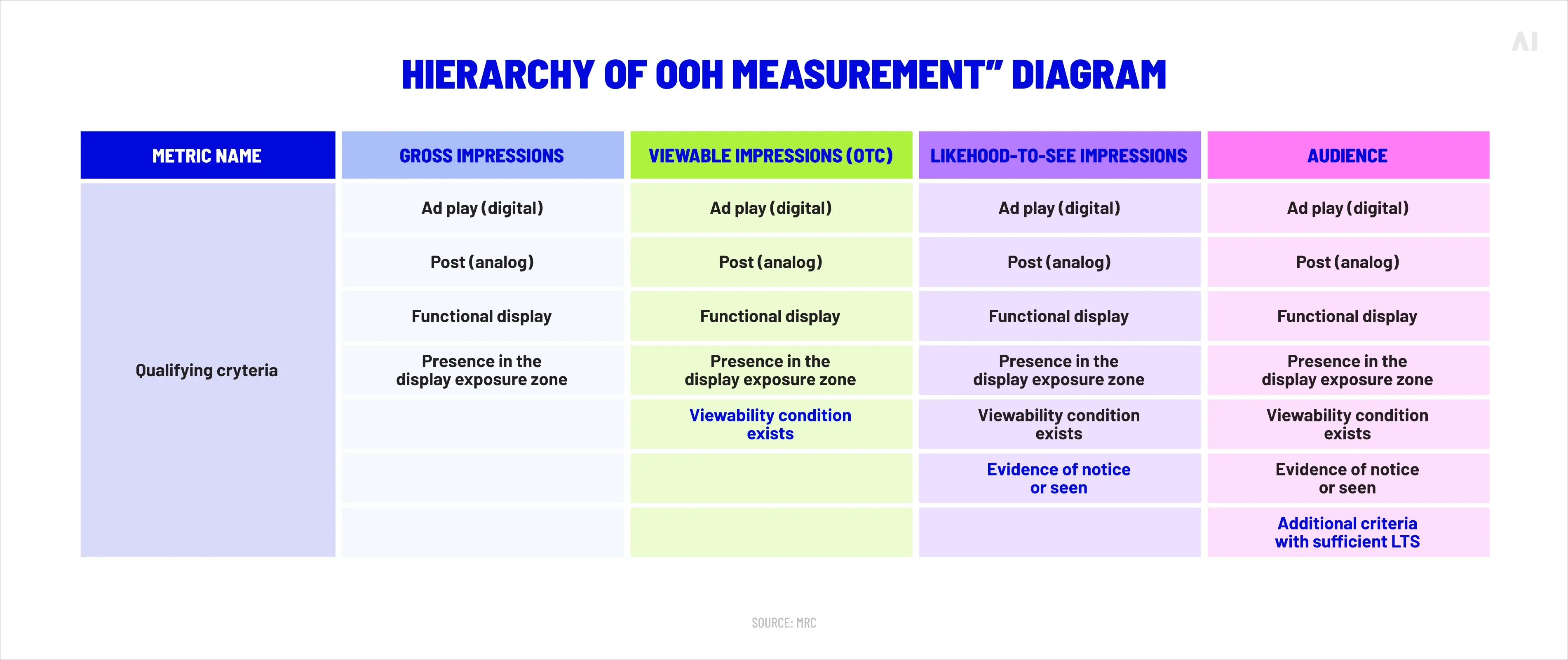
Industry standards are also tightening. In December 2025, the Media Rating Council published final out-of-home measurement standards (combined phases), outlining requirements and guidance for metrics and methodology, including concepts like rendered impressions, viewability, and the need for disclosure around methodology and limitations.
This is a useful shift for buyers and sellers. It pushes networks to be more transparent about how they calculate performance, what “impressions” mean in physical spaces, and where uncertainty still exists.
💡 Related reading: 15 essential digital marketing KPIs & Foot traffic attribution explained.
Advanced capabilities of modern digital signage networks
Once the basics are stable (inventory definition, delivery reliability, proof-of-play), “advanced” stops meaning flashy tech and starts meaning better control. You’re no longer simply buying or selling screens. You’re buying or selling rules: where an ad is eligible to run, when it should run, and what version of the message makes sense in that moment.
These capabilities tend to matter most when you’re competing for larger budgets, plugging DOOH into omnichannel planning, or trying to prove that performance moves with context, not just spend.
Location-based targeting
Location-based targeting in signage networks is not just “choose the city.” It’s how you slice the screen estate so the environment does more of the work for you.
At the network level, location targeting often happens at the screen-cluster level:
- Store format (flagship vs neighborhood)
- Placement type (entrance, checkout, aisle endcap, waiting area)
- Audience flow (fast-moving corridors vs dwell-heavy zones)
⚡ Targeting fails when “where it can run” is vague. Tight eligibility rules (venue type, placement, daypart, restrictions) keep campaigns clean—and keep your sales team from selling what ops can’t deliver.
A mature network treats location as a signal in two ways:
- Operational signal: what screens are available, healthy, and eligible right now (including any brand restrictions).
- Strategic signal: what environments match campaign intent (high intent, high dwell, high repeat exposure, proximity to purchase).
In a Broadsign case study, telehealth brand Wisp ran programmatic DOOH across 2,839 screens in the New York DMA, mixing large-format for reach with panels near high-traffic areas and in-pharmacy screens for “high intent” moments. The campaign reported a 4× lift in brand preference vs. top competitors and a +107% lift in purchase consideration—a useful illustration of why “where on the journey” can matter as much as “how many screens.”
📍 Practical setup tip: if you want location targeting to scale, don’t rely on tribal knowledge (“those screens are good”). Tag screens consistently (venue type, placement type, audience flow, nearby POIs). That tagging becomes the foundation for packages, PMPs, and reporting.
💡 Related reading: The future of location-based marketing: From geo-targeting to location intelligence.
Time-based and contextual scheduling
Time-based scheduling is a workhorse feature. It’s simple, but it changes results because human behavior changes by hour and day. A coffee message at 8:30 a.m. is not the same as a coffee message at 3:00 p.m.
Contextual scheduling goes further by connecting creative to conditions such as:
- Weather (hot drink vs cold drink creative, indoor vs outdoor activity)
- Local events (sports games, concerts, conferences)
- Store conditions (inventory status, promotions, queue length where available)
- Transit context (commuter peaks vs off-peak)
The business advantage is relevance without personal data. You’re matching message to moment.
Sprite’s 2025 “Turn Up Refreshment” campaign used real-time data to drive contextual out-of-home placements, combining geo-location with weather/temperature signals to deploy digital creative “when and where people are feeling the heat.” That’s contextual scheduling in plain terms: the ad is eligible only when conditions match the promise.
How this works in practice (without making ops miserable):
- You pre-approve a small set of creative variants (hot / mild / fallback).
- You define trigger rules (temperature threshold, time window, venue eligibility).
- You keep a “default” creative ready, so the campaign still delivers when triggers aren’t met.
💡 Related reading: Contextual advertising: How to reach high-intent buyers without personal data & Programmatic contextual targeting: How it all works together.
Data-driven audience targeting
Audience targeting in digital signage networks typically relies on aggregated insights rather than individual identity. It can include:
- Venue-based audience profiles (who typically visits, when, and for how long)
- Modeled segments (built from third-party or first-party patterns)
- Performance learnings (which venue clusters consistently drive lift for certain categories)
The best use of this capability is not to claim precision you can’t support. It’s to make planning smarter: choose the right environments, set realistic expectations, then validate with measurement.
Intimissimi worked with Blindspot on a data-driven DOOH effort across major U.S. cities (including New York and Los Angeles), using mobile-location insights to target shoppers likely to visit, and a test-and-control methodology to isolate impact. The case study reports a +53.55% lift in foot traffic among exposed audiences compared to control—an example of audience targeting paired with a measurement design that buyers can actually interrogate.
What this implies for network operators: you need more than a segment label. You need the ability to explain:
- what the segment represents (behavioral patterns, not personal identity),
- where it’s likely to be present (venue types, dayparts),
- and how performance was validated (control design, holdout logic, incrementality framing).
Place Exchange’s H1 2025 trends (shared via OAAA) show programmatic OOH activity spreading across venue types and deal mechanisms. On that platform, private marketplace deals represented 96% of spend, and the number of programmatic screens available grew 16% from H2 2024 to H1 2025—growth driven primarily by new inventory in entertainment, retail, and health locations. That combination (more curated supply + more diverse venues) is a big enabler for audience-based planning.
Dynamic content optimization
Dynamic content optimization (DCO) in digital signage networks often means creative that updates based on data feeds or rules. It’s not “swap the file mid-campaign.” It’s “serve the right approved version when conditions change.”
Typical DCO patterns include:
- Price or offer updates pulled from a product feed
- Countdown creative for limited-time promotions
- Location-specific messaging (“Available in this store today”)
- Creative rotation based on response signals (where available)
What DCO changes operationally: you stop building 40 separate creatives for 40 scenarios. You build one modular template with controlled fields (headline, offer, location line, CTA), then govern it with rules and approvals. That usually lowers production overhead while increasing relevance—assuming you’ve done the setup work (data feed quality, fallback logic, approval workflows).
Broadsign’s programmatic DOOH overview describes how campaigns can combine contextual and aggregated signals (time of day, location/environment, weather, events) with dynamic activation and DCO so different approved variants can run based on real-world conditions rather than one static message. The same overview highlights Visit Arizona using programmatic DOOH paired with mobile retargeting and arrival-based measurement and reporting a 30% lift in arrivals.
⚡ A screen network turns location into a media signal and measurement into the differentiator.
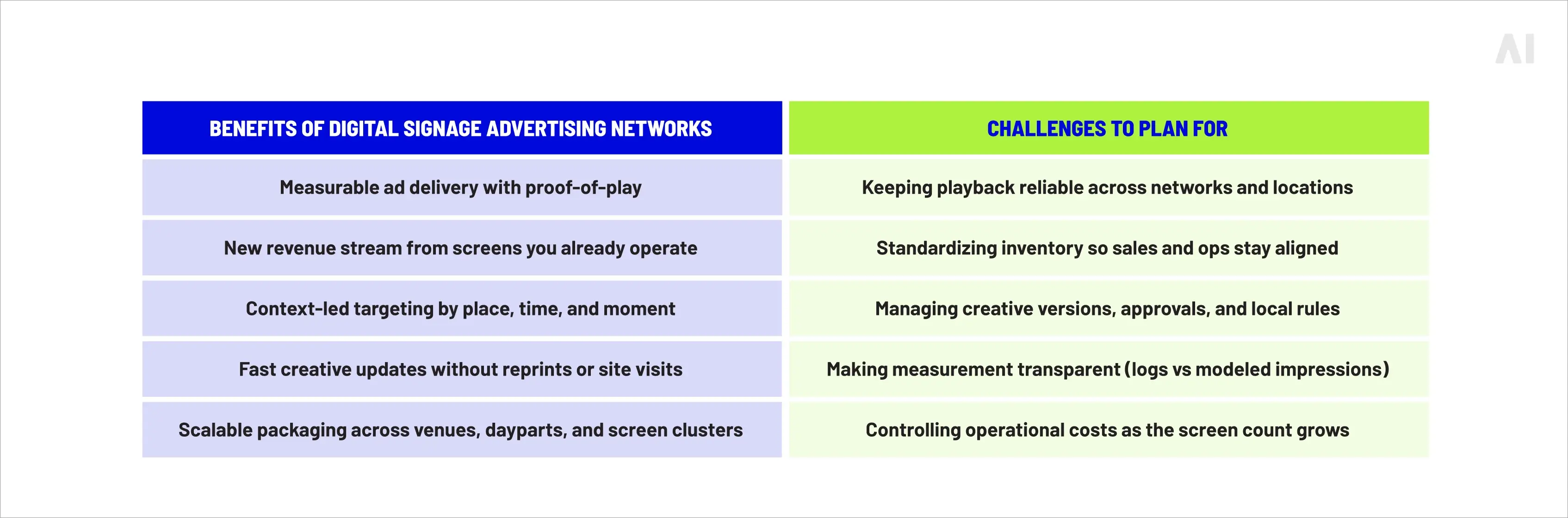
Key challenges in operating digital signage networks
None of these challenges are deal-breakers. They’re simply the realities you need to plan for if you want a digital signage advertising network that is scalable, sellable, and credible.
Infrastructure scaling
Scaling screens is not linear. Going from 10 to 100 screens is a different game than going from 1,000 to 10,000.
As networks grow, the main pressure points tend to be:
- Device provisioning and lifecycle management
- Replacement cycles and hardware standardization
- Monitoring volume (alerts can become noise if not managed well)
- Service models (who fixes what, and how fast)
A practical mitigation is to treat operations as a product. Define service tiers, uptime expectations, and escalation paths, then align your sales promises to what your ops team can actually deliver.
Content management at scale
Content complexity grows faster than screen count.
Even simple networks run into:
- Too many versions (formats, durations, localized variants)
- Approval bottlenecks (legal, brand, venue-specific restrictions)
- Playlist conflicts (house content vs paid campaigns vs emergency messages)
- Creative fatigue (the same ad running too often in a dwell-heavy zone)
One useful discipline is to standardize creative templates and inventory products early. That way, the system shapes the work instead of every campaign creating a new exception.
Connectivity and playback reliability
Connectivity issues rarely show up in sales conversations, but they show up in campaign delivery.
⚡ Every offline hour is unsellable inventory and a reporting headache. Treat uptime like yield: monitor it, quantify it, and build make-goods into the operating model so issues don’t become arguments.
Common failure modes include:
- Weak Wi-Fi in venues that were never designed for media delivery
- Video file sizes that overwhelm bandwidth
- Players that fall behind on updates
- Screens that keep playing an old playlist because they can’t sync
The operational solution is a mix of caching, monitoring, and clear make-good policies. Buyers do not expect perfection. They do expect transparency and accountability when issues happen.
Measuring campaign performance accurately
Measurement is where optimism can become overstatement if you’re not careful.
In physical environments, impressions are often modeled. That’s fine, as long as you are clear about:
- What you measure directly (proof-of-play, device status)
- What you estimate (audience exposure, reach, frequency)
- What assumptions you use (traffic counts, dwell time, visibility factors)
- What the limitations are (obstruction, multi-person viewing, repeat exposure)
⚡ Start with what you can prove (playback logs and pacing). Then layer audience models and outcomes on top—clearly labeled—so buyers understand what’s measured, what’s estimated, and what’s inferred.
The MRC standards (mentioned earlier) emphasize disclosure and methodological rigor for out-of-home measurement, including definitions and guidance around metrics such as rendered impressions and viewability concepts. You don’t need to be “perfect” to be credible, but you do need to be consistent and transparent.
How to choose the right digital signage ads network
Choosing a digital signage advertising network is rarely about one feature. It’s about whether the system fits your business model and whether you can operate it day to day without hidden costs (extra labour, downtime, make-goods, and constant “manual fixes” that don’t show up in the demo).
Technology and integration
Start by mapping your current environment:
- Do you already have a CMS for digital signage, and is it stable across all locations?
- Do you need advertising functionality, or do you already have an ad server (or a selling workflow) you want to keep?
- Do you plan to sell direct only, or do you want programmatic demand as a fill layer?
- What reporting do buyers expect (proof-of-play, impression models, verification options), and how frequently do they need it?
Then evaluate integration points. The goal is not “more integrations.” It’s fewer handoffs and fewer places where delivery can break:
- CMS and ad server interoperability (slot logic, scheduling rules, reporting hooks)
- SSP connectivity (deal types, controls, reporting consistency)
- Data and measurement integrations (traffic feeds, attribution partners, dashboards)
- APIs for automation (campaign trafficking, creative updates, device reporting)
A simple litmus test: if you can’t explain, in one sentence, what system is responsible for scheduling, what system is responsible for decisioning, and what system is responsible for verification, you’re likely buying overlap.
💡 Related reading: What is a supply-side platform (SSP)?
Here’s a decision checklist you can use in vendor conversations.
- How does the platform verify playback and handle missed delivery (automatic make-goods, re-pacing, alerts)?
- What reporting is available by screen, venue, and time window, and can we export it cleanly?
- How are impressions calculated, and what inputs are used (traffic counts, dwell models, venue data)?
- Can we define inventory products consistently (dayparts, packages, screen clusters) without rebuilding schedules each time?
- How does the system manage creative approvals and version control (who can publish, who can override locally)?
- What happens when a screen goes offline for 24 hours, and how do we prove delivery recovery?
- Can the network support both direct and programmatic without conflicting rules (share of voice, category exclusivity, pacing)?
- What security controls exist for devices and user access (SSO, role-based permissions, device authentication)?
A strong vendor will answer these without evasiveness. They’ll also explain what their system does not do, which is often more valuable than a long feature list.
Scalability and costs structure
Most networks underestimate cost structure because they focus on screens, not operations. The hidden costs usually show up as “small” recurring work: troubleshooting, chasing files, fixing schedules, and handling campaign exceptions.
Cost categories typically include:
- Hardware (screens, players, mounts, warranties)
- Installation (labour, permits, electrical work)
- Connectivity (internet, networking equipment)
- Platform costs (CMS licensing, ad tech, SSP fees)
- Operations (monitoring, troubleshooting, trafficking, creative QA)
- Sales costs (if you sell direct, you will have sales overhead)
The best way to keep scalability predictable is to define a unit economics model: revenue per screen (or per venue) minus operating cost per screen (or per venue). If you can’t model that, scaling becomes guesswork. Even a rough model helps you spot where margin disappears (for example, when “cheap” hardware leads to frequent site visits).
Vendor vs. in-house management
Some organizations want full control and build in-house. Others outsource operations to specialists. Many choose a hybrid: keep strategy and sales internal, outsource parts of technical operations or programmatic plumbing.
A helpful way to decide is to look at what you want to own:
- Own the inventory and relationships (usually yes)
- Own the data and reporting logic (often yes, especially for private networks)
- Own the operational burden (depends on resources and appetite)
- Own the programmatic stack (often better to partner, unless you have deep expertise)
In-house can be powerful, but it requires sustained discipline: documentation, governance, and someone accountable for uptime and delivery. Vendor-led can be faster, but you need clarity on control (who can change schedules), transparency (how delivery is measured), and long-term cost (what happens as screens and campaigns scale).
Conclusion: make every screen count with digital signage networks
Digital signage advertising networks turn physical screens into a real media asset because they add the missing layers that advertisers care about: standardized inventory, controlled delivery, and verifiable reporting. When those pieces are in place, screen time stops being “content space” and becomes something you can package, sell, optimize, and defend in a media plan—across one location or thousands.
From a business perspective, the upside is clear. You gain new revenue from direct deals, sponsorships, and programmatic fill. You get more precise targeting by using place, time, and context as signals (not cookies). And you unlock performance visibility through proof-of-play, pacing, and measurement frameworks that make results easier to explain and easier to improve.
If you’re deciding what to build or buy, keep it simple: prioritize operational reliability first (uptime, monitoring, playback verification), then scale with better packaging (screen clusters, dayparts, deal types), and only then lean into advanced features like contextual triggers and dynamic creative. If you want support planning, activating, and optimizing DOOH and programmatic efforts within a transparent model—AI Digital can help through managed service execution, supply curation, and platform-led intelligence.