In-stream ads remain a central part of digital advertising because they place brand messages directly within the video content audiences have actively chosen to watch. Their importance is reflected in where advertisers are directing their budgets: IAB projects that U.S. digital video ad spending—including connected TV, social video, and online video—will surpass $80 billion in 2026, representing 11% year-over-year growth. Digital video is also expected to account for more than 60% of total TV and video advertising expenditure for the first time, showing how rapidly investment is shifting toward streaming-led environments.
The wider media landscape reinforces this shift. Connected TV advertising expenditure is forecast to grow by 13.8% in 2026, compared with a projected 1.7% decline in linear TV advertising. At the same time, Deloitte reports that the average U.S. consumer spends around six hours per day on media and entertainment, while 90% of U.S. households subscribe to at least one paid streaming video service, with households holding four subscriptions on average.
For advertisers, this creates an opportunity to reach viewers in attentive, content-rich settings through instream video ads delivered before, during, or after a video. Formats such as pre-roll, mid-roll, and post-roll can support objectives across the marketing funnel—from building awareness and improving brand recall to generating traffic, leads, and conversions.
However, effective instream advertising requires more than placing conventional video ads inside a stream. Campaign performance depends on selecting the right platforms, matching formats to audience behaviour, developing creative for skippable and non-skippable environments, and measuring outcomes across fragmented devices and channels.
This guide explains how instream video advertising works and how to build an effective campaign strategy. It covers campaign planning, platform selection, creative best practices, performance measurement, ongoing optimization, and the key differences between in-stream video ads, out-stream ads, linear ads, and other digital video formats.
What Are In-Stream Ads?
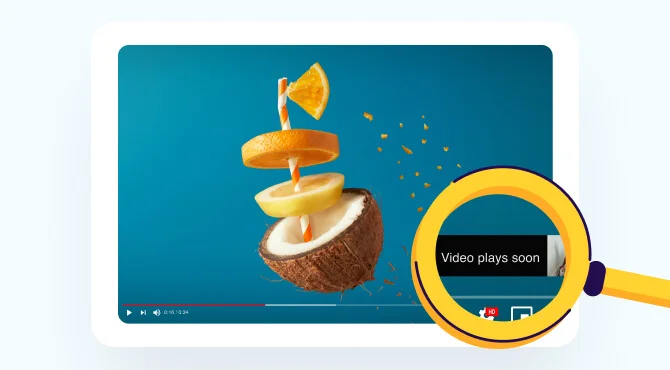
In-stream ads are video advertisements that play directly within video content that viewers have chosen to watch. Instead of appearing separately on a webpage or in a social feed, in-stream video ads become part of the viewing experience by playing before (pre-roll), during (mid-roll), or after (post-roll) a video. Depending on the platform, they may be skippable or non-skippable and can include interactive elements such as clickable calls to action, product cards, or companion banners.
The growing importance of instream advertising reflects broader changes in consumer viewing habits. According to Deloitte's 2026 Digital Media Trends report, 90% of U.S. households subscribe to at least one paid streaming video service, while the average household now maintains approximately four streaming subscriptions. As audiences continue shifting from traditional television to digital video, advertisers are increasingly investing in formats that integrate naturally into premium viewing experiences rather than interrupting unrelated browsing activities.
Today, video stream ads appear across virtually every major digital video ecosystem, including:
- YouTube, where ads can play before, during, or after eligible videos across YouTube and Google Video Partners.
- Meta, which serves instream ads alongside eligible Facebook video content, Reels, and selected publisher videos.
- Amazon, where advertisers can reach audiences across Prime Video, Twitch, Fire TV, and other Streaming TV inventory.
- Connected TV (CTV) and streaming services, where ads are inserted into professionally produced television shows, movies, live sports, and other premium content.
- Publisher websites, where news organizations, entertainment platforms, and media companies monetize editorial videos.
- Mobile applications, where streaming platforms, gaming apps, and video publishers deliver in-stream video ads within their built-in players.
⚡️These environments often overlap with both OTT advertising, which delivers ads through internet-based streaming services, and Connected TV advertising, which focuses specifically on viewers watching through smart TVs and connected devices.
💡What distinguishes instream video advertising from other forms of video advertising is its placement. Because the advertisement is embedded directly into the video playback, viewers encounter it while already engaged with the content they selected. This differs from out-stream ads, which appear within articles or webpages without requiring a video player, and from in-feed video ads that users discover while scrolling through social media or content feeds.
By reaching audiences during active viewing sessions, in-stream video ads provide advertisers with high visibility, premium inventory, advanced targeting capabilities, and measurable performance—making them one of the most widely used formats across today's streaming and digital video ecosystem.
How In-Stream Ads Work
Although in-stream ads appear instantly to viewers, a series of technologies work together behind the scenes to deliver the most relevant advertisement within milliseconds.
The process starts when an advertiser launches an instream advertising campaign by selecting objectives, budgets, audiences, bidding strategies, and creative assets. When a user begins watching a video, the platform evaluates all eligible campaigns, runs an automated auction, and serves the winning in-stream video ad before, during, or after the content.
This workflow enables brands to deliver personalized video stream ads across YouTube, streaming platforms, publisher websites, mobile apps, and Connected TV (CTV) while continuously optimizing campaigns based on audience signals and performance.
⚡️If you'd like to better understand how advertising works on streaming platforms and smart TVs, AI Digital's guide to Connected TV advertising explores the CTV ecosystem, available inventory, and campaign opportunities in more detail:
How Video Ads Are Delivered
Delivering an instream video ad requires several technologies to communicate in real time. Each participant has a specific role in ensuring the right advertisement reaches the right viewer.
The process typically follows these steps:
- The advertiser uploads campaign settings and creative assets to an advertising platform or Demand-Side Platform (DSP).
- The publisher makes its available video inventory accessible through a Supply-Side Platform (SSP).
- An ad exchange matches advertisers with available inventory by running a real-time auction.
- The winning ad is delivered to the video player using VAST (Video Ad Serving Template), the industry standard for serving video ads across websites, apps, streaming services, and CTV devices.
Many enterprise advertisers further optimize this workflow using:
- AI-powered campaign planning to improve media allocation.
- Supply Path Optimization (SPO) to reduce unnecessary intermediaries.
- Open advertising frameworks, such as Elevate, Smart Supply, and the Open Garden Framework, to improve efficiency and campaign performance across multiple channels.
⚡️If you're new to programmatic advertising, AI Digital's guide to Demand-Side Platforms explains how advertisers purchase inventory across digital channels, while its guide to Supply-Side Platforms explores how publishers make inventory available for sale.
⚡️For a technical breakdown of video ad serving, read our guide, VAST Tags: What CTV Advertisers Need to Know.
How Audience Targeting Works
One of the biggest advantages of instream advertising is that advertisers can decide who sees an ad instead of showing the same message to every viewer.
To determine the most relevant audience, advertising platforms evaluate signals such as:
- Demographics, including age, gender, and language.
- Location, from countries and regions to local geographic areas.
- Interests and behaviors, based on previous online activity.
- Contextual signals, such as the video's topic, keywords, and brand suitability.
- First-party data, including customer information collected through websites or CRM systems.
- Device type, including mobile, desktop, tablet, and Connected TV.
💡When someone starts watching a video, these signals are analyzed in real time. Automated bidding then selects the advertiser whose campaign best matches the viewer and campaign objective, helping improve both relevance and efficiency.
⚡️If you'd like to learn more about buying inventory across multiple publishers, AI Digital's guide to programmatic advertising platforms explains how modern media buying works. For a deeper understanding of audience segmentation, contextual advertising, and first-party data strategies, see AI Digital's guide to programmatic targeting.
Types of In-Stream Ads
Not all in-stream ads work the same way. Depending on campaign objectives and the viewing experience, instream video advertising can be classified by:
- Placement within the video (pre-roll, mid-roll, or post-roll).
- Viewer interaction, such as skippable or non-skippable ads.
- Ad format, including linear, non-linear, and companion ads.
Each option offers different advantages. Some formats maximize reach and brand awareness, while others prioritize engagement, video completion, or conversions. Understanding these differences helps advertisers choose the most effective format for their audience, creative, and business goals.
Ads by Placement: Pre-Roll, Mid-Roll, and Post-Roll
The most common way to classify in-stream video ads is by where they appear during the viewing experience.
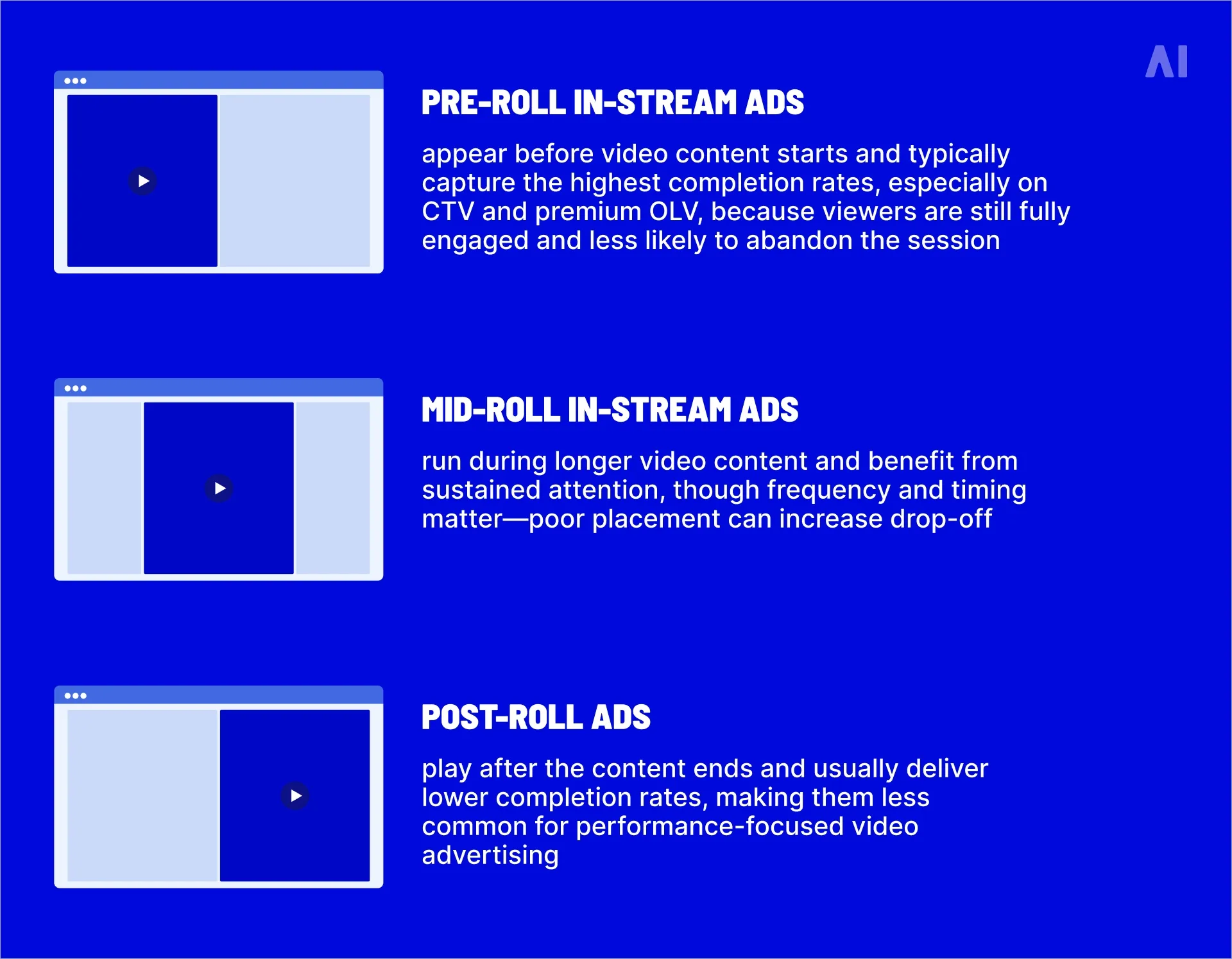
- Pre-roll ads play before the selected video starts. Because viewers haven't reached their content yet, these ads typically deliver the highest reach and are widely used for brand awareness, product launches, and audience acquisition. However, viewers may skip them if the platform allows.
- Mid-roll ads appear during natural breaks in longer videos, such as live streams, TV episodes, podcasts, or long-form YouTube content. Since viewers are already invested in the content, mid-roll placements often achieve higher completion rates and stronger engagement than pre-roll ads, making them well suited for storytelling and consideration campaigns.
- Post-roll ads play after the main video finishes. Although fewer viewers remain until the end, those who do are typically highly engaged, making post-roll placements useful for driving website visits, app downloads, subscriptions, or other conversion-focused actions.
⚡️If you'd like a deeper comparison of these placements—including pricing, performance benchmarks, and creative recommendations—read our guides Pre-Roll vs Mid-Roll vs Post-Roll Ads: A Guide for Marketers and Podcast Advertising Platforms for Modern Media Buying, which explores how placement strategies differ in podcast advertising.
Skippable vs Non-Skippable Ads
Another important distinction is whether viewers can skip the advertisement.
Skippable ads allow viewers to continue to their content after a few seconds (often five seconds on YouTube). Because users have a choice, advertisers must capture attention immediately. These formats generally work best for:
- Brand awareness campaigns.
- Product launches.
- Broad audience reach.
- Longer creative where viewers choose to continue watching.
Non-skippable ads require viewers to watch the entire advertisement before their content resumes. Although they typically command higher CPMs, they often deliver stronger completion rates and guaranteed message exposure.
They are commonly used for:
- Major brand campaigns.
- Premium product launches.
- Short, high-impact creative.
- Campaigns where message completion is critical.
The right choice depends on campaign objectives. Skippable formats maximize efficiency and scale, while non-skippable ads prioritize visibility and message delivery.
Linear, Non-Linear, and Companion Ads
The IAB classifies video ads based on how they appear alongside content.
- Linear ads interrupt the video playback and temporarily replace the content until the advertisement finishes. Most pre-roll, mid-roll, and post-roll campaigns use this format.
- Non-linear ads appear as overlays or expandable units while the video continues playing. Because they don't interrupt viewing, they're generally less intrusive but also less attention-grabbing.
- Companion ads are display banners shown next to or around the video player. They reinforce the video message and often remain visible after the video ends, providing additional opportunities for clicks and conversions.
⚡️These formats are commonly used across desktop, mobile, streaming platforms, and Connected TV, although non-linear and companion formats are less common in CTV environments because of screen size and user experience considerations.
⚡️To learn more about how streaming environments differ from traditional television, AI Digital's guide to CTV vs. Linear TV explains how inventory, targeting, and measurement have evolved.
In-Stream Ads vs Other Video Advertising Formats
In-stream ads are distinguished by their placement within video content that a viewer has intentionally opened. Other formats may appear inside articles, social feeds, apps, or connected-TV programming, creating different levels of attention, control, scale, and cost.
The best choice depends on several factors:
- Viewer intent: Is the audience already watching video or casually browsing?
- Campaign objective: Does the brand need reach, engagement, education, or conversions?
- Creative approach: Is the ad designed to interrupt content or earn attention within a feed?
- Targeting and measurement: Does the campaign require platform data, contextual signals, or cross-channel reporting?
- Budget and inventory: Is the priority efficient scale or premium, high-attention placement?
⚡️Interactive elements can also make video campaigns more action-oriented. To explore formats that encourage viewers to click, shop, choose, or respond directly, read AI Digital’s guide to interactive video ads.
In-Stream vs Out-Stream Ads
The main difference between in-stream and out-stream ads is whether the advertisement is attached to existing video content.
In-stream video ads play before, during, or after a video the user selected. Because the audience is already in a viewing session, these placements usually provide stronger attention and a more natural environment for video storytelling.
Out-stream ads appear independently within non-video content, such as an article or webpage. They often begin playing when the unit enters the visible area of the screen and may pause when the user scrolls away.
Key differences include:
- Placement: In-stream ads require video inventory; out-stream ads can appear across text-based publisher pages.
- Viewer intent: In-stream audiences intended to watch video, while out-stream audiences may only be reading or scrolling.
- Scale: Out-stream gives publishers more opportunities to create video inventory without producing original video content.
- User experience: In-stream interrupts playback; out-stream interrupts browsing.
- Campaign use: In-stream is stronger for storytelling, awareness, and completion-focused campaigns. Out-stream is often useful for broader reach and additional publisher scale.
- Cost: Premium in-stream inventory generally costs more, while out-stream can provide more economical reach, although pricing varies by publisher, audience, and viewability.
💡Choose in-stream advertising when attention and video engagement are the priorities. Use out-stream when the campaign needs scalable distribution beyond established video platforms.
⚡️For a more detailed breakdown of inventory, engagement, and buying considerations, read AI Digital’s guide to in-stream vs out-stream video ads.
In-Stream vs In-Feed Video Ads
In-feed video ads appear as users browse a feed, search page, or content-discovery environment. Google, for example, places in-feed video ads in YouTube search results, the Home feed, subscriptions, and “watch next” recommendations. By comparison, skippable in-stream ads play inside another video before, during, or after the selected content.
This creates different engagement patterns:
- In-stream: The advertiser temporarily takes control of the viewing experience.
- In-feed: The creative must persuade the user to stop scrolling or select the video.
- User intent: In-stream reaches viewers already consuming video; in-feed reaches users discovering what to watch next.
- Creative strategy: In-stream ads need an immediate hook before a skip or completion decision. In-feed ads rely more heavily on thumbnails, headlines, captions, and feed-native visuals.
- Best objectives: In-stream supports reach, awareness, and message delivery. In-feed works well for content discovery, engagement, traffic, and consideration.
💡Brands with strong short-form creative may benefit from in-feed placements, particularly on social platforms. Campaigns that need guaranteed integration into the viewing sequence are generally better suited to instream video advertising.
In-Stream vs Connected TV (CTV) Advertising
.webp)
In-stream advertising describes how an ad appears, while Connected TV advertising describes where it appears. A CTV ad may itself be an in-stream ad when it plays inside a programme, movie, live event, or ad-supported streaming channel.
Traditional online in-stream video ads commonly run across YouTube, publisher websites, and mobile apps. CTV advertising reaches viewers through smart TVs, streaming devices, gaming consoles, and internet-connected television environments.
The distinction matters because CTV typically offers:
- Large-screen, often sound-on viewing
- Premium long-form and professionally produced inventory
- Household-level and first-party audience targeting
- Higher attention but typically higher CPMs
- Fewer click-based interactions
- Measurement focused on reach, completion, brand lift, website activity, and cross-device outcomes
CTV has become a substantial part of ad-supported viewing. Nielsen reported that streaming accounted for 46.6% of ad-supported U.S. television viewing in Q1 2026, while ad-supported content represented nearly 73% of total TV viewing.
💡Choose standard online in-stream placements when the campaign needs flexible formats, clickable actions, and efficient cross-device reach. Choose CTV when the objective is premium brand exposure, incremental television reach, or household-level streaming activation.
⚡️To understand the services and distribution models behind this inventory, read AI Digital’s guide to OTT platforms.
Benefits and Best Use Cases of In-Stream Ads
Despite the rapid growth of new digital advertising formats, in-stream ads remain one of the most effective ways to reach audiences with video. By appearing within content that viewers have intentionally chosen to watch, instream video advertising combines high visibility with sophisticated targeting and measurable performance.
Key advantages of in-stream advertising include:
- High visibility: Ads are integrated directly into the viewing experience, making them difficult to overlook.
- Engaged audiences: Viewers are already consuming video, creating a stronger opportunity to capture attention.
- Advanced targeting: Campaigns can leverage demographics, interests, contextual signals, first-party data, and remarketing audiences.
- Premium inventory: Advertisers can access trusted publishers, streaming platforms, and high-quality video environments.
- Measurable performance: Metrics such as view-through rate, completion rate, CPM, CPV, and conversions make it easier to evaluate campaign effectiveness.
- Scalability: Brands can reach audiences across YouTube, social media, publisher websites, mobile apps, and Connected TV from a single campaign strategy.
💡Modern campaigns are becoming increasingly data-driven. AI-powered audience modeling, predictive optimization, and automated bidding now help advertisers improve targeting accuracy while making media buying more efficient.
⚡️To learn more about these technologies, explore AI Digital's guide to AI-targeted advertising.
Build Brand Awareness
One of the biggest strengths of in-stream video ads is their ability to introduce brands to large audiences in premium viewing environments. Because advertisements appear alongside professionally produced or intentionally selected content, viewers are often more attentive than when casually scrolling through a social feed.
Awareness-focused campaigns are particularly effective for:
- Launching new products or services.
- Entering new markets.
- Promoting seasonal campaigns.
- Building long-term brand recognition.
- Reaching broad audience segments at scale.
💡Equally important is brand safety. Where an advertisement appears can influence how consumers perceive a brand. Running campaigns on trusted publishers and carefully selected video inventory helps protect brand reputation while improving campaign quality.
⚡️If you're planning awareness campaigns, AI Digital's guide to targeting options for brand awareness explains how advertisers build high-reach audiences while maintaining efficiency. For a deeper understanding of safe media placements, read our guide, Brand Safety in Advertising: Why It Matters in Programmatic and Digital Media.
Drive Product Consideration
Not every customer is ready to buy immediately. During the consideration stage, instream advertising helps businesses educate potential customers, demonstrate product value, and answer questions before a purchase decision is made.
Video is particularly effective because it can combine demonstrations, testimonials, storytelling, and product comparisons within a single creative. A software company might showcase platform features, while an automotive brand could highlight safety technology or real-world driving experiences.
These campaigns often perform best when combined with other channels. Someone may first discover a product through an in-stream ad, research it through search engines or reviews, and later return through remarketing before converting. By supporting multiple touchpoints, video helps keep brands visible throughout longer buying journeys.
Support Full-Funnel Marketing Strategies
Rather than operating as a standalone channel, in-stream advertising works best as part of a broader omnichannel strategy. Different video formats can support customers from their first interaction with a brand through to conversion and retention.
For example:
- Awareness: Reach new audiences through YouTube, publisher video, or Connected TV.
- Consideration: Explain products, demonstrate features, or share customer success stories.
- Conversion: Retarget previous visitors with personalized offers or strong calls to action.
- Retention: Re-engage existing customers with updates, cross-selling opportunities, or loyalty campaigns.
💡When integrated with search, display, social media, Connected TV (CTV), email, and remarketing, in-stream video ads reinforce messaging across multiple touchpoints and create a more consistent customer experience.
⚡️Understanding how these channels work together is essential for effective marketing measurement. Our guide, Customer Journey Analytics Explained: Data, Touchpoints, and Cross-Channel Insights, explores how marketers analyze interactions across channels to optimize full-funnel campaign performance.
How to Set Up an In-Stream Advertising Campaign
Launching a successful in-stream advertising campaign involves more than uploading a video and setting a budget. Every decision—from campaign objectives to audience targeting—affects how platforms deliver your ads, optimize performance, and measure results.
Before publishing your campaign, focus on four core setup steps:
- Choose the right campaign objective.
- Select the advertising platform that matches your audience and goals.
- Prepare creative assets that meet platform requirements.
- Configure targeting, placements, bidding, and budgets.
Getting these fundamentals right from the beginning helps reduce wasted spend and creates a stronger foundation for future optimization.
⚡️If you'd like to see how video fits into a broader digital strategy, AI Digital's guide to performance marketing strategy explains how businesses align campaign objectives with measurable business outcomes.
⚡️You can also explore our guide, Programmatic Video Advertising Explained: Smarter Campaigns for the Streaming Era, for a deeper look at launching campaigns across multiple publishers and streaming platforms.
1. Choose the Right Campaign Objective
Your campaign objective tells the advertising platform what success looks like. Rather than simply delivering impressions, platforms optimize delivery based on the outcome you select.
Common objectives include:
- Brand awareness to maximize reach and visibility.
- Video views to increase watch time and completion rates.
- Traffic to drive users to a website or landing page.
- Lead generation to collect form submissions or inquiries.
- Conversions to encourage purchases, registrations, or other valuable actions.
The selected objective also influences:
- Bidding strategy.
- Audience optimization.
- Ad delivery.
- Reporting metrics and KPIs.
For example, a campaign optimized for video views may prioritize viewers likely to watch longer, while a conversion campaign focuses on users with a higher likelihood of taking action.
⚡️To understand which metrics matter for different campaign goals, AI Digital's guide to display advertising KPIs explains the performance indicators marketers should monitor throughout the campaign lifecycle.
2. Select the Best Advertising Platform
Different platforms offer different audiences, placements, and optimization capabilities. The right choice depends on where your customers spend time and what you want the campaign to achieve.
When comparing platforms, consider:
- Audience reach.
- Available ad formats.
- Targeting capabilities.
- Reporting features.
- Budget requirements.
- Campaign objectives.
⚡️If your strategy focuses on YouTube, AI Digital's guide to YouTube ad formats explains the available formats and when to use each one. You can also read our guide, How YouTube TV Advertising Works (and When It Actually Makes Sense) for a closer look at YouTube's television inventory.
3. Prepare Creative Assets
Before launching a campaign, make sure your creative assets meet each platform's technical requirements. Even the strongest campaign strategy can underperform if the creative is rejected or displayed incorrectly.
Prepare the following assets before launch:
- Video files in the required format and resolution.
- Brand logo and visual identity elements.
- Primary messaging and supporting copy.
- Clear call to action (CTA).
- Captions or subtitles for sound-off viewing.
- Destination URLs or landing pages where applicable.
It's also important to verify platform-specific requirements, including:
- Maximum file size.
- Supported aspect ratios.
- Accepted video lengths.
- Thumbnail specifications.
- Safe area guidelines for text and logos.
⚡️For a complete breakdown of technical specifications, read our guide, YouTube Video Ad Specs in 2026: Formats, Sizes, and Creative Requirements.
4. Configure Targeting, Placements, and Budget
The final step is configuring how and where your campaign will run. These settings determine who sees your ads, how often they appear, and how your budget is allocated.
Before launching, review the following:
- Audience targeting: Demographics, interests, first-party data, contextual signals, or remarketing audiences.
- Placements: YouTube, publisher websites, mobile apps, Connected TV, or streaming platforms.
- Bidding strategy: CPM, CPV, CPA, or automated bidding based on campaign objectives.
- Budget: Daily or lifetime budgets aligned with campaign duration.
- Frequency settings: Limit how often individuals see the same advertisement to reduce ad fatigue.
💡After the campaign goes live, monitor performance regularly and adjust targeting, bids, placements, or budgets based on campaign data rather than making large changes all at once.
⚡️If you'd like to understand how advertisers manage ad exposure across campaigns, our guide, Frequency Capping Explained: How Advertisers Control Ad Exposure Across Channels, explores best practices for balancing reach with user experience.
Creative Best Practices for In-Stream Ads
Even the most sophisticated targeting strategy cannot compensate for weak creative. Successful in-stream ads capture attention immediately, communicate a clear message, and motivate viewers to take action—all while adapting to different platforms and viewing environments.
Whether your campaign runs on YouTube, Meta, Amazon, publisher websites, or Connected TV, following proven creative best practices can improve engagement, increase video completion rates, and maximize return on ad spend.
⚡️Because audiences interact with video differently across devices and platforms, marketers should continuously adapt and refine creative instead of relying on a single version for every campaign. To learn how brands create consistent experiences across channels, explore AI Digital's guide to cross-platform advertising.
Hook Viewers in the First Few Seconds
The opening seconds of an in-stream video ad often determine whether viewers continue watching or skip the ad. Since many platforms allow users to skip after only a few seconds, it's essential to communicate value immediately.
Some effective ways to capture attention include:
- Lead with your strongest message instead of saving it for the end.
- Introduce the problem or benefit early to spark curiosity.
- Show the product or brand naturally within the opening scene.
- Use movement, emotion, or an unexpected visual to stop viewers from disengaging.
- Include a clear call to action before viewers have the opportunity to skip.
Rather than treating the opening as an introduction, think of it as your opportunity to convince viewers that the rest of the ad is worth watching.
Optimize for Sound-On and Sound-Off
People consume video differently depending on the platform and device they're using. Someone watching YouTube on a desktop behaves differently from someone scrolling Facebook on mobile or watching premium content on a smart TV.
Instead of using identical creative everywhere, adapt your assets for each environment by considering:
- Platform specifications, including aspect ratio, duration, and file requirements.
- Mobile-first design, with clear visuals that remain effective on smaller screens.
- Sound-on and sound-off viewing, using captions and strong visual storytelling so the message is understood either way.
- Readable text and branding that remain visible across devices.
- Platform-specific creative, adjusting pacing, format, and messaging for YouTube, Meta, Amazon, CTV, and mobile experiences.
⚡️For a deeper understanding of how streaming environments influence creative strategy, read AI Digital's guide to OTT vs. CTV. You can also explore our article, YouTube Ad Formats: Which Ones Actually Drive Results?, for recommendations tailored to YouTube campaigns.
Test Multiple Creative Versions
Creative optimization doesn't stop after launch. Testing multiple versions helps advertisers identify which messages, visuals, and formats resonate most with their audience.
Consider experimenting with:
- Different opening hooks.
- Headlines and value propositions.
- Video lengths.
- Calls to action.
- Visual styles and pacing.
- Product demonstrations versus customer testimonials.
- Platform-specific edits for YouTube, Meta, or Connected TV.
💡Review performance regularly and make decisions based on meaningful metrics such as view-through rate, completion rate, click-through rate, and conversions—not a single KPI in isolation.
⚡️To learn how marketers automate and scale creative testing, read AI Digital's guide to Dynamic Creative Optimization, which explains how AI continuously tests and delivers the highest-performing creative combinations.
Which In-Stream Advertising Metrics Actually Matter?
Launching an in-stream advertising campaign is only the first step. To understand whether it is delivering business value, marketers need to measure the right metrics—not just the ones that look impressive in a dashboard.
The most effective reporting combines delivery, engagement, and business outcomes. A campaign with millions of impressions may have little impact if viewers skip the ad or never convert. Likewise, a campaign with fewer impressions can generate a stronger return if it reaches the right audience and drives meaningful actions.
As campaigns mature, marketers should shift their focus:
- Awareness: Impressions, reach, CPM, viewability.
- Engagement: View-through rate (VTR), watch time, completion rate, CTR.
- Performance: CPA, conversions, ROAS, and revenue.
💡Looking at these metrics together provides a more complete picture of campaign performance than relying on any single KPI.
⚡️If your campaigns include Connected TV, AI Digital's guide to CTV measurement explains how marketers evaluate performance across streaming environments. For a broader measurement strategy, read our guide, Marketing Measurement Framework: Building a Scalable System for Smarter Decisions.
Key Performance Metrics
Different KPIs answer different questions, so the "best" metric depends on your campaign objective.
💡Rather than optimizing for a single KPI, consider how these metrics work together. For example, a high completion rate may indicate engaging creative, but if conversions remain low, the issue may lie with targeting, messaging, or the landing page.
⚡️To better understand pricing models, read AI Digital's guide to CPM vs. CPC vs. CPA and What Is CPM in TV Advertising? You can also explore our guide, Attention Metrics in Advertising: What Marketers Should Actually Measure, for a deeper look at emerging measurement approaches.
⚡️To better understand pricing models, read AI Digital's guide to CPM vs. CPC vs. CPA and What Is CPM in TV Advertising? You can also explore our guide, Attention Metrics in Advertising: What Marketers Should Actually Measure, for a deeper look at emerging measurement approaches.
Common Reporting Mistakes
One of the biggest challenges in instream advertising is interpreting campaign data correctly. Different platforms use different attribution windows, reporting methodologies, and optimization models, making direct comparisons difficult.
Common mistakes include:
- Focusing only on impressions or clicks instead of business outcomes.
- Comparing platform metrics directly, even though each platform measures performance differently.
- Ignoring attribution windows, which can significantly affect reported conversions.
- Optimizing too early, before enough data has been collected.
- Evaluating channels independently instead of measuring their combined contribution across the customer journey.
To make better decisions:
- Review metrics that align with your campaign objective.
- Compare results across multiple KPIs rather than relying on a single number.
- Use consistent attribution models whenever possible.
- Analyze performance across channels instead of in isolation.
⚡️For a deeper understanding of cross-channel reporting, read AI Digital's guide to Cross-Platform Measurement. If you'd like to learn why measurement becomes more difficult in today's privacy-first ecosystem, explore Marketing Effectiveness Measurement Challenges and Alternatives to Walled Gardens, which explain how marketers can build more reliable reporting frameworks across fragmented advertising environments.
Common Challenges and How to Solve Them
While these challenges are common, they can be minimized through continuous testing, better audience strategies, high-quality creative, and reliable measurement. As campaigns become more complex, marketers should also ensure that ads are delivered in suitable environments and that reported impressions are both valid and viewable.
⚡️To learn more, read our guide, What Is Ad Verification and Why It Matters in Programmatic Advertising.
Running In-Stream Ads Across Different Platforms
While the core principles of in-stream advertising remain the same, every platform offers different inventory, audience signals, targeting capabilities, and optimization tools. The right choice depends on your objectives, budget, and the audience you want to reach.
Meta In-Stream Ads
Meta serves in-stream video ads across Facebook's video ecosystem, including eligible videos and Reels. Its greatest strength is audience targeting, using first-party data, custom audiences, lookalike audiences, and AI-powered campaign optimization.
Meta is best suited for:
- Consumer brands and ecommerce.
- Remarketing campaigns.
- Mobile-first advertising.
- Awareness, engagement, and conversion objectives.
YouTube In-Stream Advertising
YouTube is one of the largest platforms for instream advertising, offering skippable and non-skippable ads across videos, Shorts, live streams, and Google Video Partners.
It performs particularly well for:
- Brand awareness.
- Product education and demonstrations.
- Long-form storytelling.
- Reaching audiences actively searching for video content.
Amazon Video Advertising
Amazon combines video stream ads with powerful first-party shopping signals, allowing advertisers to reach consumers across Prime Video, Fire TV, Twitch, and Streaming TV inventory.
Amazon is particularly effective for:
- Retail and ecommerce brands.
- Consumer products.
- Product launches.
- Campaigns targeting high-intent shoppers close to purchase.
Programmatic Video Advertising
Programmatic buying enables advertisers to access premium in-stream video ads across publishers, Connected TV (CTV), OTT services, websites, and mobile apps through a single platform instead of buying inventory individually.
It is the preferred option for brands that need:
- Cross-channel audience reach.
- Premium publisher inventory.
- Centralized campaign management.
- Scalable optimization across multiple channels.
💡Many enterprise advertisers further improve campaign efficiency using Supply Path Optimization (SPO), AI-powered media planning, and open advertising frameworks.
⚡️For example, AI Digital's Smart Supply solution helps advertisers optimize supply paths and improve inventory quality, while Elevate uses AI to streamline campaign planning and activation across channels. Businesses looking to reduce fragmentation and activate audiences more consistently can also explore the Open Garden Framework.
⚡️If you're new to automated media buying, AI Digital's guide to Programmatic Video Advertising explains how advertisers purchase premium inventory across multiple publishers and streaming environments. For a deeper look at the role of artificial intelligence, our guide, AI in Programmatic Advertising: How It Improves Targeting, Bidding, and Optimization, explores how AI is reshaping campaign optimization and decision-making.
Getting the Most from In-Stream Advertising
In-stream advertising continues to be one of the most effective ways to reach audiences in today's video-first digital landscape. However, achieving consistent results requires more than selecting a platform and launching a campaign. Success comes from combining the right audience strategy, ad format, creative, optimization, and measurement throughout the campaign lifecycle.
As you've seen throughout this guide, successful instream advertising campaigns typically follow a few key principles:
- Choose the platform that best aligns with your audience and business goals.
- Match the ad format—such as pre-roll, mid-roll, or non-skippable video—to the campaign objective.
- Build creative that captures attention quickly and delivers a clear message.
- Use audience targeting and first-party data to improve relevance.
- Measure performance using business-focused KPIs instead of vanity metrics.
- Continuously test, learn, and optimize based on campaign data.
The most successful advertisers also recognize that video advertising is never static. Consumer behavior changes, new technologies emerge, and privacy regulations continue to reshape how campaigns are planned, targeted, and measured. Businesses that regularly refresh creative, experiment with new formats, and adapt their strategies are better positioned to maintain long-term performance.
💡Whether you're launching your first in-stream video ads or managing campaigns across multiple platforms, continuous optimization is what turns good campaigns into great ones.
⚡️If you'd like help developing a data-driven in-stream advertising strategy or improving your existing campaigns, get in touch with the team at AI Digital to learn how tailored media planning, AI-powered optimization, and cross-channel advertising solutions can help you achieve your marketing goals.