
In 2026, video advertising is no longer just a question of where brands appear — it is a question of when they appear. U.S. digital video ad spend is projected to surpass $80 billion in 2026, growing 11% year over year and accounting for more than 60% of total TV/video ad spend for the first time, according to IAB. That growth spans YouTube, CTV, OTT, social video, publisher video, and broader programmatic advertising environments, where placement strategy can directly shape attention, completion, recall, and conversion outcomes.
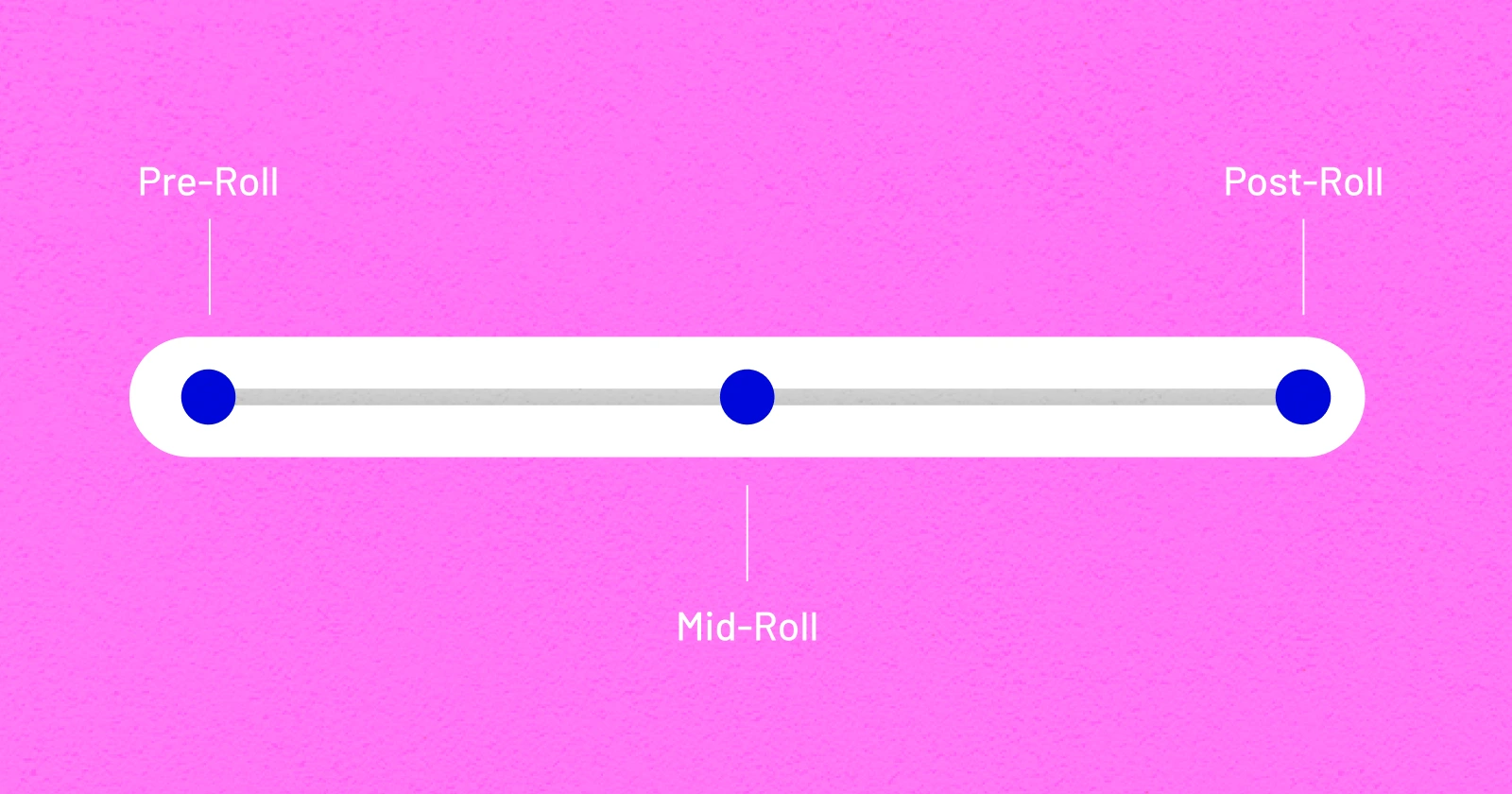
For marketers, this makes the choice between pre-roll, mid-roll, and post-roll ads more strategic than ever. Pre-roll ads help brands capture attention before content begins. Mid-roll ads reach viewers while they are already engaged. Post-roll ads speak to smaller but often more qualified audiences after the viewing experience. Each placement supports different marketing objectives, audience behaviours, buying models, creative decisions, and measurement priorities.
In this guide, AI Digital breaks down pre roll vs mid roll, post-roll performance, costs, buying considerations, creative best practices, and measurement frameworks to help advertisers choose the right in-stream placement for full-funnel video campaigns.
How In-Stream Ad Placement Works
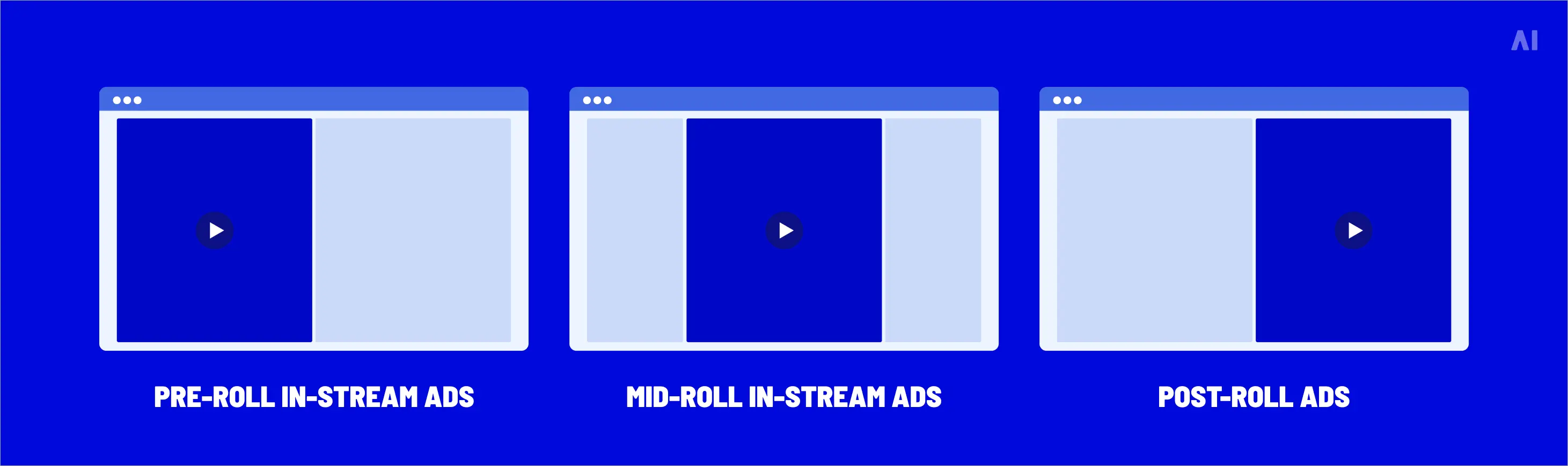
The placement of pre-, mid-, and post-roll ads shapes how viewers experience video advertising. In-stream ads appear inside the video environment, so timing affects whether the viewer sees the message as a quick interruption, a natural pause, or a final call to action. That distinction matters more as digital video becomes a larger part of media planning: according to eMarketer, U.S. adults are expected to spend over 3 hours per day watching digital video in 2026, with connected TV accounting for a growing share of that time.
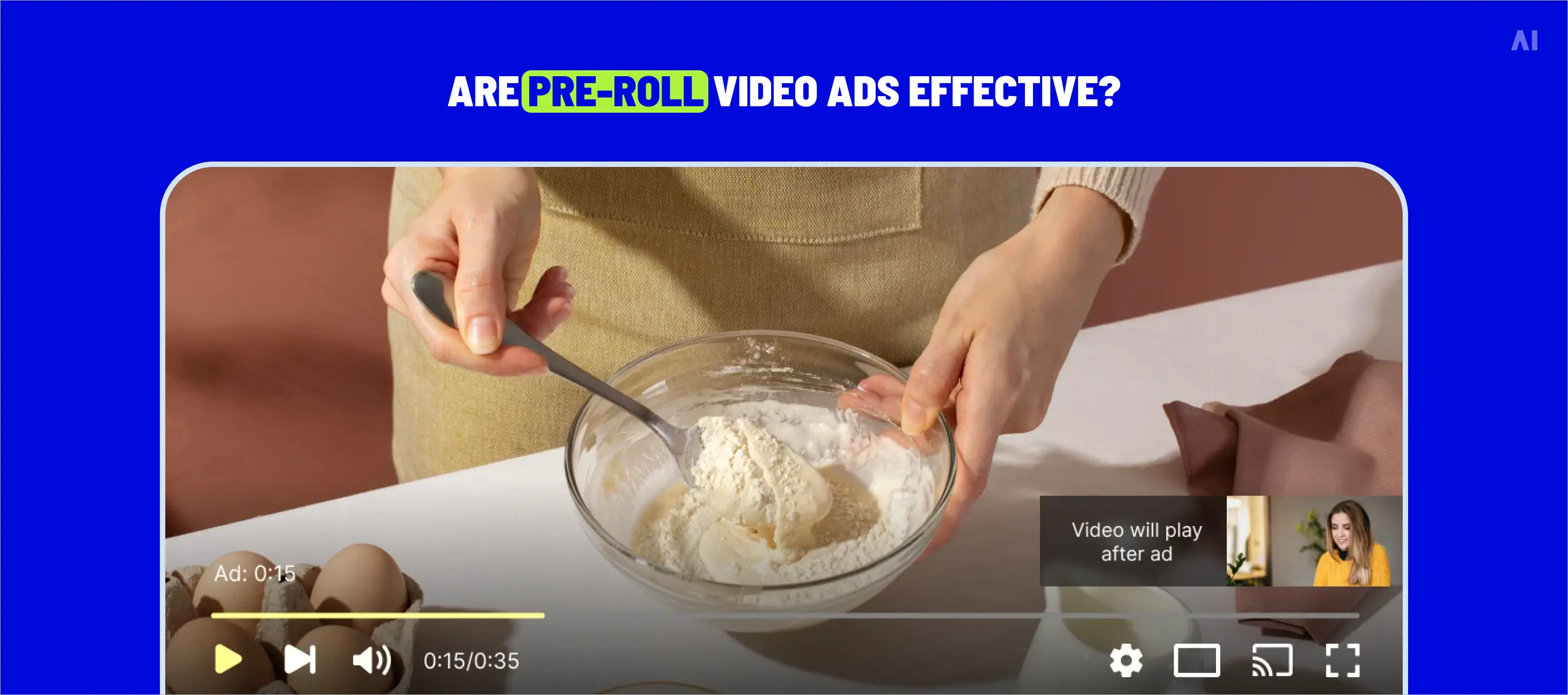
- Pre-roll ads appear before the selected video starts. They usually deliver strong visibility because the viewer is waiting for the content to begin. This makes pre-roll useful for reach, awareness, and fast brand introduction. The trade-off is friction: the audience has not yet received value from the content, so the opening seconds need to work quickly.
⚡️For a deeper foundation, see this guide on what in-stream ads are and how to maximize their impact.
- Mid-roll ads appear during the content, often after the viewer is already engaged. This can make mid-roll more attentive than pre-roll, especially in long-form video, CTV, OTT, and premium publisher environments. The viewer has already committed time, so they may be more willing to continue through the ad. However, poor timing can damage the experience if the ad interrupts an important scene or appears too frequently.
- Post-roll ads appear after the video ends. They usually reach a smaller audience because some viewers leave once the content is finished. But the viewers who remain may be more qualified, which makes post-roll useful for retargeting, product reminders, lead generation, and lower-funnel messaging.
⚡️This is also where in-stream differs from out-stream. In-stream ads depend on the structure of the video experience, while out-stream formats appear independently in feeds, articles, or display placements. For more context, see this comparison of instream vs outstream video ads and this guide to digital display advertising.
💡Technically, placement is determined through a chain of ad-tech systems. The video player identifies available ad slots, such as pre-roll, mid-roll, or post-roll, and sends an ad request. The ad server applies campaign rules, targeting, pacing, frequency caps, and creative eligibility. VAST, or Video Ad Serving Template, helps pass ad metadata from the ad server to the video player, including creative files, tracking events, duration, and playback instructions.
In programmatic buying, the request can then move through a demand-side platform, a supply-side platform, and an auction environment where buyers compete for the impression. The DSP evaluates the opportunity for the advertiser, while the SSP helps the publisher manage inventory quality, yield, and demand access.
⚡️This interaction between DSPs, SSPs, and ad exchanges determines which ad is served, where it appears, and how its performance is measured.
What are Pre-Roll Ads

Pre-roll ads are video ads that appear before the viewer’s selected content begins. In the wider pre roll vs mid roll comparison, pre-roll remains one of the most common in-stream formats because it gives advertisers the first chance to reach viewers before the main video starts.
The strength of pre-roll is timing. The viewer has already chosen to watch something, so the ad appears at a moment of active intent. This makes pre-roll useful for:
- Brand awareness
- Product launches
- Traffic generation
- Campaign introductions
- Broad reach across YouTube, CTV, OTT, social video, and publisher sites
Pre-roll is also valuable as video budgets continue to grow. According to IAB’s 2026 Digital Video Ad Spend & Strategy Report, U.S. digital video ad spend is projected to surpass $80 billion in 2026, growing 11% year over year and representing more than 60% of total TV/video ad spend.
The main drawback is friction. Because pre-roll appears before the content, viewers may see it as a barrier. This is especially true for skippable formats, where the first seconds decide whether the viewer stays or skips. For this reason, pre-roll should not feel like a shortened TV commercial. It needs a fast hook, early branding, and one clear message.
⚡️Pre-roll also works well within programmatic video advertising, where advertisers can use audience data, contextual signals, device type, frequency controls, and bidding strategies to decide where the ad appears.
Best Uses for Pre-Roll
Pre-roll performs best when the goal is reach, awareness, traffic, or message introduction. It is often the strongest placement for launching a brand, introducing a product, or reaching viewers before they engage with competitor content.
- YouTube: Best for tutorials, reviews, entertainment, and creator content. Users often arrive with clear intent, making pre-roll useful for awareness and consideration.
- YouTube TV: Best for TV-style campaigns. YouTube ad formats supports large-screen reach with digital targeting.
- CTV: Best for premium streaming and household viewing. Connected TV advertising gives pre-roll stronger screen presence and brand impact.
- OTT: Best for long-form and ad-supported streaming. In OTT advertising, viewers are already used to video ad breaks.
- Social video: Best for fast mobile awareness. Creative must be visual, immediate, and easy to understand without sound.
- Publisher sites: Best for news, sports, finance, entertainment, and lifestyle content. Context can be strong, but advertisers must monitor viewability and player quality.
Pre-roll is less suited to long explanations or complex product education. It works best when the message can be understood quickly.
Pre-Roll Creative Best Practices
Effective pre-roll creative should assume that attention is limited. The first seconds need to do most of the work.
Strong pre-roll ads usually follow these rules:
- Open quickly with a problem, benefit, product shot, or strong visual.
- Show the brand early through a logo, product, colour cue, or spoken mention.
- Keep one main message instead of trying to explain everything.
- Design for silent viewing with captions and clear visuals.
- Match the format to the goal instead of using one creative everywhere.
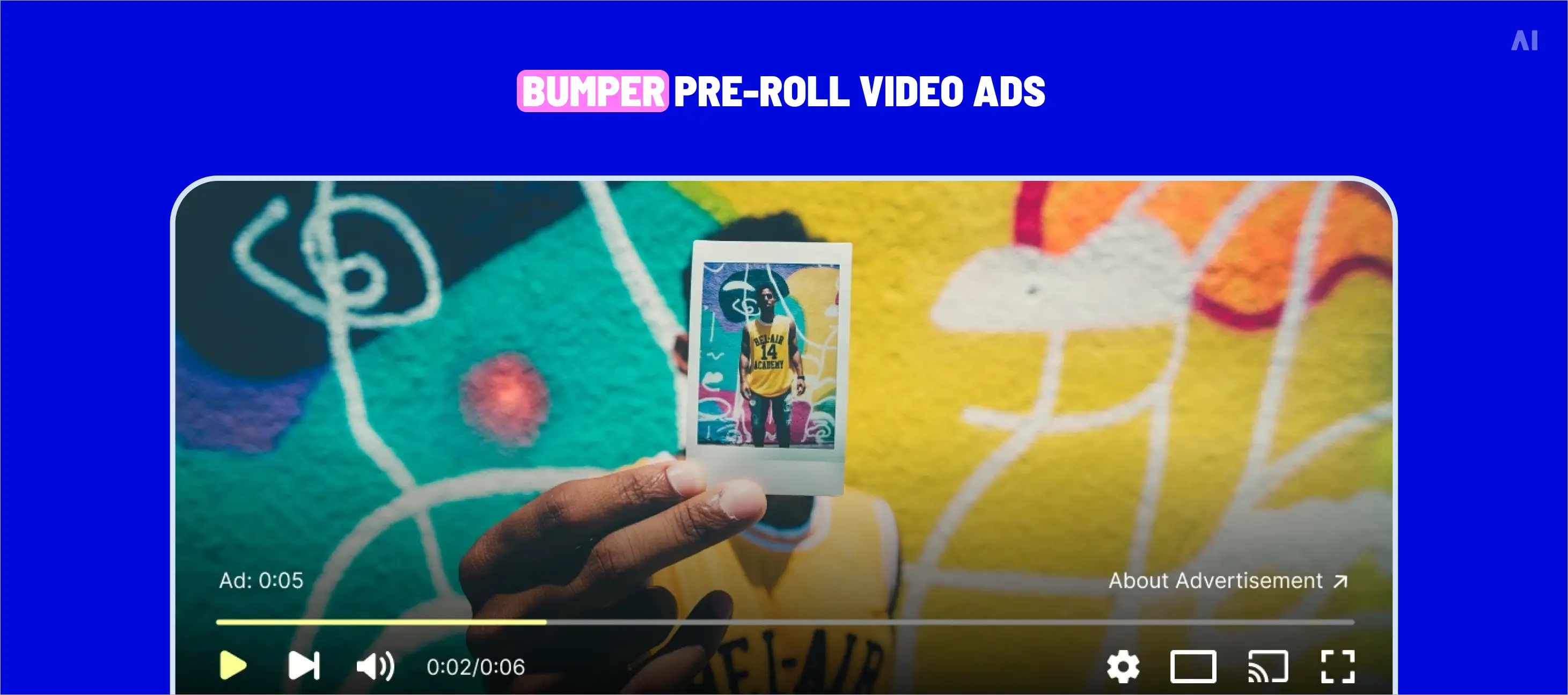
💡Skippable and non-skippable formats need different strategies. Skippable pre-roll should give viewers a reason to continue before the skip option appears. Non-skippable pre-roll gives advertisers more control over completion, but it must respect the viewer’s time.
Pre-Roll Buying Considerations
Pre-roll buying depends on inventory quality, pricing, targeting options, platform controls, and buying method. Advertisers can buy pre-roll through:
- YouTube and Google Ads
- Display & Video 360
- CTV and OTT publisher deals
- Private marketplaces
- Programmatic guaranteed deals
- Open auctions
In open programmatic environments, real-time bidding allows advertisers to compete for pre-roll impressions as they become available. This can create scale, but it also requires stronger controls for brand safety, frequency, viewability, and supply quality.
⚡️Advertisers should also distinguish RTB from broader programmatic buying. RTB is one auction-based method, while programmatic also includes private marketplaces, preferred deals, and guaranteed buying. This difference matters because premium pre-roll inventory is not always available through open auctions. For more context, see this guide to programmatic vs RTB.
When evaluating pre-roll, marketers should look beyond CPM. A cheaper impression may not be more efficient if the placement has weak viewability, low completion, poor audience fit, or limited brand safety controls.
Ultimately, pre-roll works best as a strategic opening touchpoint. It may not always deliver the deepest engagement, but it gives brands scalable visibility before the viewer enters the main content experience.
What are Mid-Roll Ads
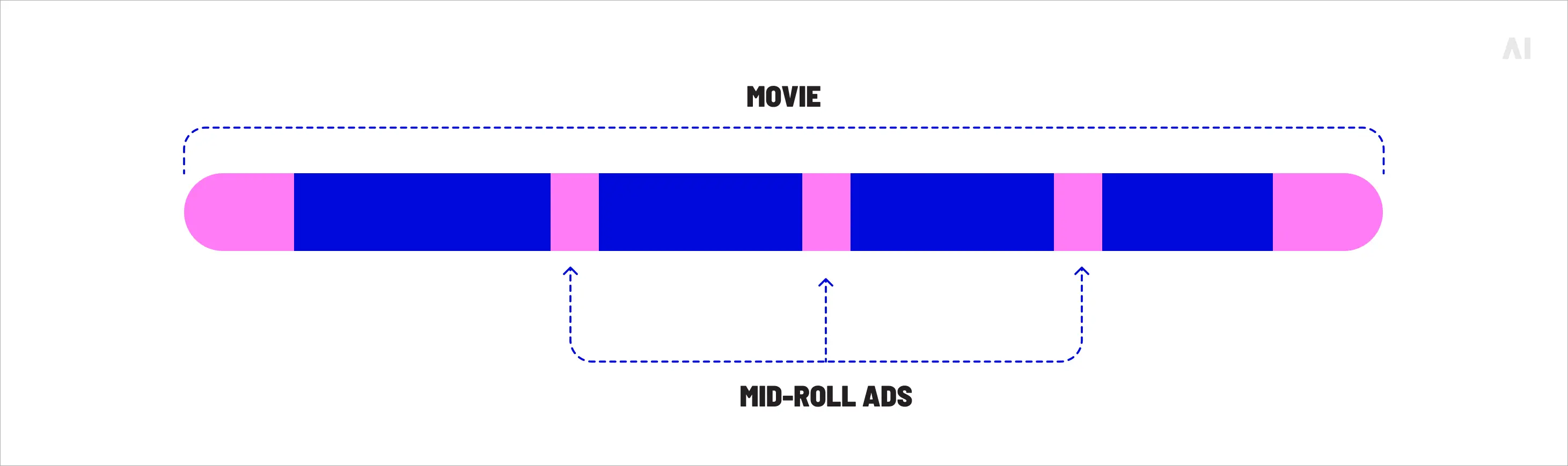
Mid-roll ads are video ads that appear during the main content, usually at a natural break in the viewing experience. In the pre roll vs mid roll comparison, mid-roll often benefits from stronger viewer commitment because the audience has already started watching and is less likely to leave immediately.
This makes mid-roll different from pre-roll. Pre-roll has to win attention before the content begins. Mid-roll reaches viewers after they have already invested time in the video, show, livestream, or streaming session.
💡That is why mid-roll ads deserve a dedicated creative strategy. Reusing the same pre-roll asset can feel abrupt, especially if the message does not match the tone or pacing of the surrounding content.
Mid-roll is becoming more important as streaming takes a larger share of viewing time. Nielsen’s Gauge report found that streaming represented 47.6% of total U.S. TV viewing, while YouTube remained the top media distributor with 13.4% of total TV watch time. This shift makes well-placed mid-roll inventory valuable for advertisers trying to reach engaged viewers inside longer viewing sessions.
Best Uses for Mid-Roll
Mid-roll performs best when the campaign needs attention, message depth, recall, or consideration. It is especially effective in long-form environments where viewers are already engaged with the content.
Mid-roll works well for:
- Product education: explaining features, benefits, or use cases.
- Brand storytelling: adding emotional or narrative depth.
- Consideration campaigns: moving viewers from awareness to evaluation.
- Streaming and CTV campaigns: reaching viewers in lean-back environments.
- Retargeting: reinforcing a message after earlier exposure.
On YouTube, mid-roll is most useful in longer videos, creator-led content, podcasts, tutorials, and livestreams. YouTube allows mid-roll ads on monetized videos that are 8 minutes or longer, and its systems prioritize ad breaks placed at natural pauses or transitions.
⚡️For a broader format comparison, see this future guide to YouTube ad formats.
⚡️On CTV and OTT, mid-roll often feels closer to a traditional TV ad break. Viewers are already used to interruptions inside longer shows, live sports, and ad-supported streaming. This makes mid-roll useful for premium reach, brand recall, and high-attention campaigns. For more context, see this guide to OTT vs CTV.
In general, mid-roll performs strongest when:
- The content is long enough to justify an ad break.
- The viewer has already shown engagement.
- The ad appears at a natural pause.
- The creative matches the surrounding context.
- The campaign goal requires more than a quick brand impression.
Mid-Roll Creative Best Practices
Mid-roll creative should feel connected to the viewing moment. Since the ad interrupts active content, the goal is to maintain engagement instead of resetting attention completely.
Strong mid-roll creative should:
- Match the content pace: avoid a tone that feels too aggressive or disconnected.
- Open smoothly: acknowledge the viewer’s context instead of starting too abruptly.
- Deliver one clear message: focus on one product benefit, offer, or proof point.
- Use stronger storytelling: mid-roll can support more detail than pre-roll.
- Respect the interruption: keep the ad focused and avoid unnecessary length.
⚡️Context matters heavily. A mid-roll ad in a finance explainer should not feel like a TikTok-style product teaser. A mid-roll ad inside entertainment content can be more visual, emotional, or story-led. This is where contextual advertising becomes important: the closer the ad feels to the viewer’s mindset, the less disruptive it becomes.
💡A good mid-roll ad should answer one question quickly: why is this message worth pausing the content for?
Mid-Roll Buying Considerations
Mid-roll buying depends on how each platform controls ad insertion. Some environments use editorial ad breaks, while others rely on algorithmic ad placement.
Editorial ad insertion gives publishers or creators more control over where breaks appear. This can improve the viewer experience because the ad is placed around natural pauses, scene changes, or segment transitions.
Algorithmic ad insertion uses platform systems to decide where ads are most likely to perform. On YouTube, for example, automatic mid-roll placement looks for natural visual or audio breaks and balances viewer experience, creator revenue, and advertiser value.
Advertisers should evaluate mid-roll inventory based on:
- Ad break quality
- Content length and format
- Viewer retention
- Completion potential
- Brand safety controls
- Frequency management
- Platform-level reporting
- Control over placement and exclusions
Mid-roll can deliver strong engagement, but only when the ad break feels intentional. Poorly placed mid-roll ads can interrupt the content, frustrate viewers, and weaken brand perception.
For media buyers, the main question is not only whether mid-roll is available. It is whether the platform can deliver mid-roll inventory in the right content, at the right moment, with enough control to protect the viewer experience.
What are Post-Roll Ads

Post-roll ads are video ads that appear after the main content ends. Compared with pre-roll and mid-roll, post-roll usually reaches a smaller audience because some viewers leave once the video is finished.
However, that smaller audience can be more qualified. If someone stays until the end of a video, stream, podcast, or product demo, they have already shown interest. This makes post roll ads useful for campaigns focused on action, not just exposure.
Post-roll works especially well for:
- Retargeting
- Lead generation
- Product demos
- Offer reminders
- Conversion-focused campaigns
- Next-step calls to action
The format is also becoming more relevant as video and audio content continue to merge. Deloitte predicts that global podcast and vodcast ad revenue will reach about $5 billion in 2026, growing nearly 20% year over year. This matters because post-roll is common in podcast and vodcast environments, where listeners or viewers who stay until the end are often highly engaged.
Best Uses for Post-Roll
Post-roll performs best when the viewer has already shown strong intent. It is not the best placement for broad awareness, but it can work well when the goal is to move engaged users toward a next step.
Post-roll is most effective for:
- Retargeting viewers who already watched earlier ads or visited a product page.
- Product demonstrations where the ad can continue the topic of the content.
- Lead generation with a clear form, offer, demo request, or consultation CTA.
- Conversion campaigns aimed at users who are already familiar with the brand.
- Sequential messaging after pre-roll or mid-roll has introduced the brand.
On YouTube, post-roll can support remarketing, product reminders, and direct-response campaigns. Google’s skippable in-stream guidance notes that these ads can appear before, during, or after videos on YouTube and Google video partners.
On CTV and OTT, post-roll inventory is less common than pre-roll or mid-roll. Viewers often leave once the programme ends, so advertisers should use post-roll carefully. It works best when the ad appears after premium, long-form, or highly relevant content.
⚡️For platform planning, this guide to programmatic advertising platforms explains how advertisers can compare buying options across video environments.
In podcast advertising, post-roll is more familiar. Listeners who reach the end of an episode may be more loyal, which makes the placement useful for host-read CTAs, promo codes, newsletter sign-ups, and product offers.
⚡️For more detail, see our guide to Podcast Advertising Platforms for Modern Media Buying.
Post-Roll Creative Best Practices
Post-roll creative should not behave like an awareness ad. By the time it appears, the viewer has already completed the content journey. The message should help them take the next step.
Strong post-roll creative should:
- Use a clear CTA: tell viewers exactly what to do next.
- Connect to the content: make the ad feel like a natural follow-up.
- Highlight one offer: avoid multiple competing actions.
- Show the product clearly: reinforce what the user will get.
- Keep the message short: do not assume viewers will stay much longer.
Good post-roll CTAs include:
- “Book a demo”
- “Start your free trial”
- “Download the guide”
- “Claim the offer”
- “Compare plans”
- “Subscribe for updates”
Because post-roll reaches users at the end of the viewing experience, urgency matters. The creative should not slowly build toward the message. It should open with the benefit, show the product or offer, and close with one direct action.
Post-Roll Buying Considerations
Post-roll inventory varies by platform. It is not always as widely available as pre-roll or mid-roll, so advertisers need to check how each platform defines and delivers it.
Key differences include:
- YouTube: post-roll may be available through in-stream formats, especially for skippable ads and remarketing campaigns.
- Podcasts: post-roll is often sold as part of host-read or dynamically inserted ad packages.
- CTV and OTT: post-roll is less common and depends on platform rules, content length, and ad break structure.
- Publisher video: availability depends on the video player, completion rates, and publisher monetisation setup.
- Programmatic video: buyers need to confirm whether placement-level reporting separates pre-roll, mid-roll, and post-roll inventory.
Advertisers should pay close attention to completion behaviour. A post-roll impression may be cheaper, but it only has value if the viewer is still present and engaged.
Before buying post-roll, marketers should ask:
- Is the placement clearly identified as post-roll?
- Does reporting separate it from other in-stream ads?
- Is the viewer likely to stay after the content ends?
- Is the creative designed for action rather than awareness?
- Can the campaign use retargeting or sequential messaging?
- Is the CTA easy to complete on the device being used?
Post-roll is not the highest-reach in-stream placement. But when it reaches the right audience, it can be one of the most efficient placements for conversion-focused messaging. It works best as the final step in a broader video advertising journey, after pre-roll and mid-roll have already built awareness and interest.
Which Ad Placement Is Right for You?
The right in-stream placement depends on the campaign goal, not the platform default. Pre-roll, mid-roll, and post-roll ads each serve a different role in the viewing journey.
Marketers should choose placement based on:
- Campaign objective: awareness, consideration, or conversion
- Primary KPI: reach, VCR, brand lift, CTR, leads, or sales
- Audience behaviour: passive viewing, active research, or high-intent engagement
- Platform environment: YouTube, CTV, OTT, social video, or publisher video
- Creative format: short hook, story-led message, or direct CTA
This matters because digital video is now a major media channel. IAB projects U.S. digital video ad spend to surpass $80 billion in 2026, growing 11% year over year and representing more than 60% of total TV/video ad spend. As budgets shift into YouTube, CTV, OTT, and programmatic video, placement strategy becomes a direct performance decision.
Best Placement for Every Funnel Stage
Each placement supports a different stage of the marketing funnel.
A single placement can work, but combined placements often produce stronger results. For example:
- Pre-roll introduces the brand to a broad audience.
- Mid-roll builds understanding with a more detailed message.
- Post-roll encourages the next action after interest has been built.
This approach is especially useful for campaigns with longer customer journeys, such as SaaS, financial services, B2B, education, travel, and high-consideration e-commerce.
Benchmarking Each Placement
Benchmarks should be used carefully. CPMs, completion rates, and viewability vary by platform, device, audience, targeting, inventory quality, and buying method.
Still, the general pattern is clear:
- Pre-roll usually offers the strongest reach and inventory availability.
- Mid-roll often delivers stronger attention and completion because viewers are already engaged.
- Post-roll usually has lower reach but can support stronger conversion intent.
- CTV and OTT often deliver higher completion rates because many placements are non-skippable and viewed on larger screens.
- YouTube and social video offer more scale, but performance depends heavily on creative quality and skip behaviour.
For practical benchmarking, marketers should compare placements using:
- CPM: cost per 1,000 impressions
- VCR: video completion rate
- Viewability: whether the ad had a real chance to be seen
- CTR: useful for clickable environments, but less relevant for CTV
- Brand lift: useful for awareness and recall
- CPA or lead quality: useful for conversion-focused campaigns
- Frequency: important for avoiding overexposure
Best Placements by Industry
Different industries need different placement strategies.
- E-commerce: Use pre-roll for product discovery, mid-roll for product benefits, and post-roll for retargeting or limited-time offers.
- SaaS: Use pre-roll to introduce the problem, mid-roll to explain the solution, and post-roll to drive demo requests or free trials.
- DTC brands: Use pre-roll for fast reach, mid-roll for lifestyle storytelling, and post-roll for promotional CTAs.
- Media and entertainment: Use pre-roll for trailers, mid-roll for longer previews, and post-roll for subscriptions or app downloads.
- Finance and insurance: Use mid-roll for education and trust-building, supported by pre-roll for reach and post-roll for lead capture.
- Travel and hospitality: Use pre-roll for destination awareness, mid-roll for experience-led storytelling, and post-roll for booking reminders.
- B2B: Use pre-roll for category awareness, mid-roll for thought leadership, and post-roll for white paper downloads, webinars, or sales consultations.
How Much Do Pre-, Mid-, and Post-Roll Ads Cost?
The cost of pre-, mid-, and post-roll ads depends on more than placement. CPMs change based on platform, audience, targeting, content quality, device, buying method, and competition.
Still, the cheapest placement is not always the best choice. A low CPM can become expensive if the ad has weak viewability, poor completion, or low audience intent. Marketers should evaluate cost together with attention, completion rate, brand lift, and conversion potential.
⚡️For a broader view of buying models, see this guide to programmatic video advertising.
Average CPMs by Placement
CPM ranges vary by market, platform, and deal type, but these directional benchmarks can help with planning.
These ranges should be treated as planning estimates, not fixed rate cards. Premium CTV, private marketplace deals, niche B2B audiences, and high-demand seasonal periods can push CPMs higher.
What Drives Video Ad Costs?
Several factors influence how much advertisers pay for in-stream video inventory:
- Audience targeting: Narrow or high-value audiences usually cost more.
- Platform: CTV and OTT often carry higher CPMs than standard web video.
- Content quality: Premium shows, live sports, news, and high-attention environments are more expensive.
- Competition: Costs rise when more advertisers bid for the same audience.
- Seasonality: Q4, major sports events, and retail periods often increase CPMs.
- Ad format: Non-skippable, interactive, and high-impact formats usually cost more.
- Buying method: Open auctions may be cheaper, while PMPs and guaranteed deals offer more control.
⚡️Interactive formats can also change the cost equation. They may carry higher CPMs, but they can improve engagement when the campaign needs user action. For more context, see this guide to interactive video ads.
Which Placement Delivers the Best ROI?
The best ROI does not always come from the lowest CPM. It comes from the placement that matches the campaign goal.
- Pre-roll usually offers the best scale for awareness and traffic.
- Mid-roll often delivers stronger attention, recall, and message depth.
- Post-roll can perform well for retargeting, lead generation, and direct-response CTAs.
- CTV and OTT may cost more, but they can deliver stronger completion and brand impact.
A pre-roll campaign may look cheaper on CPM, but mid-roll may produce better recall. Post-roll may have lower reach, but stronger intent among viewers who stay until the end.
The right question is not “Which placement is cheapest?” It is: Which placement delivers the best cost per meaningful outcome?
How to Maximize Video Ad Performance
Choosing between pre-roll, mid-roll, and post-roll ads is only one part of video advertising performance. The bigger question is whether the campaign is buying the right inventory, through the right platforms, with enough visibility to understand what is actually working.
Strong video performance depends on:
- DSP flexibility
- Premium supply access
- Supply path optimisation
- Brand safety controls
- Transparent reporting
- Cross-platform measurement
- AI-powered planning and optimisation
This is where AI Digital’s expertise becomes important. Through its Open Garden Framework, Smart Supply, and Elevate, AI Digital helps advertisers move beyond platform-default buying and build video strategies around business outcomes, not isolated media metrics.
⚡️In a fragmented market, advertisers need more than access to inventory. They need clarity over where ads run, how supply paths are selected, how budgets move across platforms, and how performance is measured. This is especially important as brands balance walled gardens and the open internet, where data, attribution, and reporting are often controlled by separate platforms.
For video campaigns, better performance usually comes from three connected areas: placement targeting, supply quality, and AI-powered optimization. These also support stronger transparency in advertising and better verification across pre-roll, mid-roll, and post-roll environments.
⚡️For more on this, see our guide to ad verification in programmatic advertising.
Placement Targeting in DSPs
Advertisers can target in-stream inventory through major DSPs such as DV360, The Trade Desk, Amazon DSP, and other programmatic platforms. These tools can help buyers reach audiences across YouTube, CTV, OTT, publisher video, and programmatic video supply.
However, not every DSP gives advertisers the same level of access, control, or reporting. Placement quality can change depending on the buying route.
Common buying routes include:
- Open auctions: broad scale, but less control over inventory quality.
- Private marketplaces: curated access to selected publishers or supply packages.
- Programmatic guaranteed deals: reserved inventory with more predictable delivery.
- Direct publisher deals: stronger control, but less flexibility across platforms.
AI Digital’s Open Garden Framework is built for this challenge. Instead of forcing campaigns into one platform or buying logic, it supports DSP-agnostic execution. This gives advertisers more flexibility to choose the right platform, supply path, and optimisation strategy for each campaign goal.
💡For video advertisers, that means pre-roll, mid-roll, and post-roll are not selected only because a platform recommends them. They are selected based on audience fit, placement quality, cost efficiency, and measurable business value.
⚡️For more context, see these guides to programmatic guaranteed, programmatic targeting, and programmatic advertising platforms.
Brand Safety and Supply Quality
Inventory quality matters as much as placement. A mid-roll ad in a low-quality video environment can perform worse than a pre-roll ad in premium content. A cheap CPM can also become expensive if the supply path includes hidden costs, poor traffic quality, or weak brand safety controls.
Advertisers should evaluate video supply based on:
- Content suitability
- Publisher quality
- Viewability
- Completion potential
- Fraud risk
- Placement transparency
- Supply path efficiency
- Brand safety controls
AI Digital’s Smart Supply is designed to improve this part of the buying process. It helps advertisers reduce waste, avoid low-quality inventory, and access curated premium supply without being locked into one DSP or SSP.
This matters because video campaigns often run across many environments at once: YouTube, CTV, OTT, publisher sites, and programmatic video networks. Without supply path optimisation, buyers may pay for duplicated access, unclear fees, or inventory that does not match the campaign objective.
With Smart Supply, AI Digital focuses on:
- Cleaner supply paths
- Premium curated inventory
- Lower exposure to low-quality traffic
- Better pricing visibility
- More efficient media buying
- Stronger alignment between inventory and KPIs
For advertisers, this turns brand safety from a basic exclusion list into a performance lever. Keyword exclusions, suitability controls, verification partners, and curated deal IDs all help protect the brand while improving campaign quality.
⚡️For more detail, see these guides to supply path optimisation, the digital advertising supply chain, and our article on brand safety in advertising.
AI-Powered Planning and Optimisation
Video campaigns generate performance signals across many disconnected systems. YouTube, CTV, OTT, DSPs, publishers, and measurement partners often report performance differently. This makes it hard to compare placements, control frequency, and understand which channels are driving real outcomes.
AI Digital’s Elevate helps solve this by supporting research, planning, optimisation, and reporting across the media mix. Instead of optimizing only for platform-level metrics, Elevate is designed to help teams connect media decisions to business KPIs.
For pre-roll, mid-roll, and post-roll campaigns, AI-powered planning can help advertisers:
- Compare placement performance across platforms
- Shift budget toward higher-value inventory
- Identify inefficient supply paths
- Improve audience and contextual targeting
- Plan creative by funnel stage
- Unify reporting across YouTube, CTV, OTT, and programmatic video
- Measure performance beyond last-click attribution
This is especially valuable when campaigns run across both open web inventory and closed platforms. Data clean rooms can also support privacy-safe analysis when advertisers need to connect platform data, first-party data, and campaign performance. For more context, see this guide to data clean rooms.
The goal is not simply to buy more video impressions. It is to make each placement work harder. AI Digital combines AI-powered media intelligence with human programmatic expertise to help advertisers plan smarter, buy cleaner, optimise faster, and measure video performance with more confidence.
⚡️For more on this topic, see our article on AI in programmatic advertising.
Benefits of a Multi-Placement Strategy
Pre-roll, mid-roll, and post-roll ads work best when they are used as connected touchpoints, not separate formats. Each placement supports a different stage of the viewing journey: pre-roll builds reach, mid-roll strengthens engagement, and post-roll encourages action.
The case for a multi-placement strategy is stronger as audiences move across more video environments:
- 72.4% of U.S. TV viewing was ad-supported in Q1 2025, according to Nielsen. This shows that ad-supported video remains a major viewing environment, not a secondary channel.
- Streaming accounted for 46.6% of ad-supported TV viewing in Q1 2026, Nielsen reported. This makes cross-platform planning across YouTube, CTV, OTT, and publisher video more important.
- Creator ads and brand ads on YouTube increased ad recall by 15% and aided brand awareness by 9% among U.S. adults aged 18–49, according to Kantar. This supports the value of using different video touchpoints together instead of relying on one repeated asset.
A multi-placement strategy helps advertisers:
- Increase reach across YouTube, CTV, OTT, social video, and programmatic inventory.
- Improve recall by repeating the same campaign idea in different moments.
- Reduce wasted frequency by controlling how often viewers see each message.
- Match intent by using awareness, consideration, and conversion messages separately.
- Guide users through the funnel instead of treating every impression the same.
Sequential Storytelling
Sequential storytelling means showing different messages in a planned order. Instead of repeating one generic video ad, advertisers can build a simple journey:
- Pre-roll: introduce the product, brand, or problem.
- Mid-roll: explain the benefit, show proof, or build trust.
- Post-roll: push the next step, such as booking, buying, signing up, or downloading.
This creates a smoother customer experience because every ad has a different role. Google Ads also supports video ad sequencing, with a default frequency cap of one sequence per person in a seven-day period, helping advertisers reinforce the message without overwhelming the viewer.
Creative for Multiple Placements
A multi-placement strategy needs adapted creative. The campaign idea should stay consistent, but the message should change by placement.
Pre-roll should open the story. Mid-roll should build interest. Post-roll should make action easy.
Measuring Pre-, Mid-, and Post-Roll Performance
Measuring pre-, mid-, and post-roll ads only by completion rate can create false conclusions. Each placement has a different job, so performance should be judged by the outcome it is meant to drive.
The key measurement point is simple: do not compare every placement with the same KPI.
Recent data shows why marketers need better measurement models:
- Attention-based campaigns delivered a 33% average lift in brand KPIs and 53% stronger lower-funnel impact, according to Adelaide’s 2026 Outcomes Guide, based on 60 campaigns across 16 industries.
- Average CTV campaign frequency reached 7.09, while average household reach was only 19.64%, according to Innovid’s 2025 CTV Advertising Insights Report. This shows why reach and frequency must be measured together, not separately.
- Interactive CTV ads earned 71 additional seconds of engagement time on average compared with standard pre-roll, according to Innovid. This proves that format and engagement quality can change performance beyond simple completion.
- High-attention ads drove a 130% lift in conversions and reduced CPA by 51%, according to Adlook research cited by eMarketer. This supports measuring attention and outcomes, not only views.
⚡️For more context, see these guides to data fragmentation in advertising, CTV measurement, and this our new article on building a marketing measurement framework.
Why Completion Rates Mislead
Completion rate is useful, but it does not tell the full story.
Raw VCR comparisons often make pre-roll look weaker because skippable ads face early drop-off by design. Mid-roll usually benefits from stronger viewer commitment. Post-roll may have lower reach, but the audience that stays can be more qualified.
A better measurement view compares:
- Pre-roll: reach, frequency, viewability, and brand recall.
- Mid-roll: attention, completion, recall, and engagement quality.
- Post-roll: CTA clicks, assisted conversions, leads, and cost per action.
Brand Lift vs Direct Response
Awareness placements need awareness metrics. Pre-roll and mid-roll should be measured with brand lift, recall surveys, reach, attention, and consideration lift.
Conversion placements need action metrics. Post-roll and retargeted pre-roll should be measured with CTR, CPA, lead quality, assisted conversions, and incrementality.
The mistake is judging upper-funnel placements with last-click logic.
Cross-Platform Measurement Challenges
Cross-platform measurement is difficult because YouTube, CTV, OTT, mobile, desktop, and publisher video all report differently.
CTV has fewer click signals. Mobile has faster skip behaviour. Desktop may show stronger direct-response activity. Last-click attribution also misses the role of earlier pre-roll and mid-roll exposures.
⚡️To compare placements properly, marketers need cross-platform measurement and customer journey analytics models that connect reach, attention, engagement, and conversion across the full journey.
Choosing the Right In-Stream Ad Placement
No single in-stream ad placement is always better. Pre-roll, mid-roll, and post-roll ads each work differently because they reach viewers at different moments in the video experience.
The best choice depends on four factors:
- Campaign goal: Are you trying to build awareness, drive consideration, or generate conversions?
- Audience intent: Is the viewer just starting the content, already engaged, or ready for a next step?
- Budget: Do you need broad reach, premium attention, or lower-cost retargeting?
- Platform: Are you buying across YouTube, CTV, OTT, social video, publisher sites, or programmatic video?
For most campaigns, the strongest strategy is not choosing one placement. It is building the right mix.
- Use pre-roll when the goal is reach, visibility, and fast message introduction.
- Use mid-roll when the goal is attention, storytelling, product education, or recall.
- Use post-roll when the goal is retargeting, lead generation, or conversion-focused action.
The same logic applies to buying models. Direct deals, platform-managed campaigns, and programmatic buying can all support video advertising, but they offer different levels of scale, control, transparency, and optimisation.
⚡️For a deeper comparison, see this guide to programmatic vs non-programmatic advertising.
For marketers, the main question is not “Which placement is best?” It is: Which placement best matches the viewer’s mindset, the campaign KPI, and the business outcome?
⚡️When pre-roll, mid-roll, and post-roll are planned together, they can support the full funnel: introduce the brand, deepen engagement, and encourage action. To build a video strategy that connects placement, supply quality, measurement, and optimisation, get in touch with AI Digital.