Programmatic vs Direct Advertising: Key Differences, Benefits, and Trade-Offs


The most important media-buying question in 2026 is no longer whether to automate. It is where automation creates value—and where negotiated access, guaranteed delivery, and publisher relationships still justify direct control. Global advertising spend is forecast to rise 9.1% to $1.30 trillion in 2026, while U.S. programmatic ad spending is expected to exceed $200 billion. More importantly, most automated ad buys are now projected to be transacted through direct deals, exposing the false simplicity of the programmatic vs direct advertising debate.
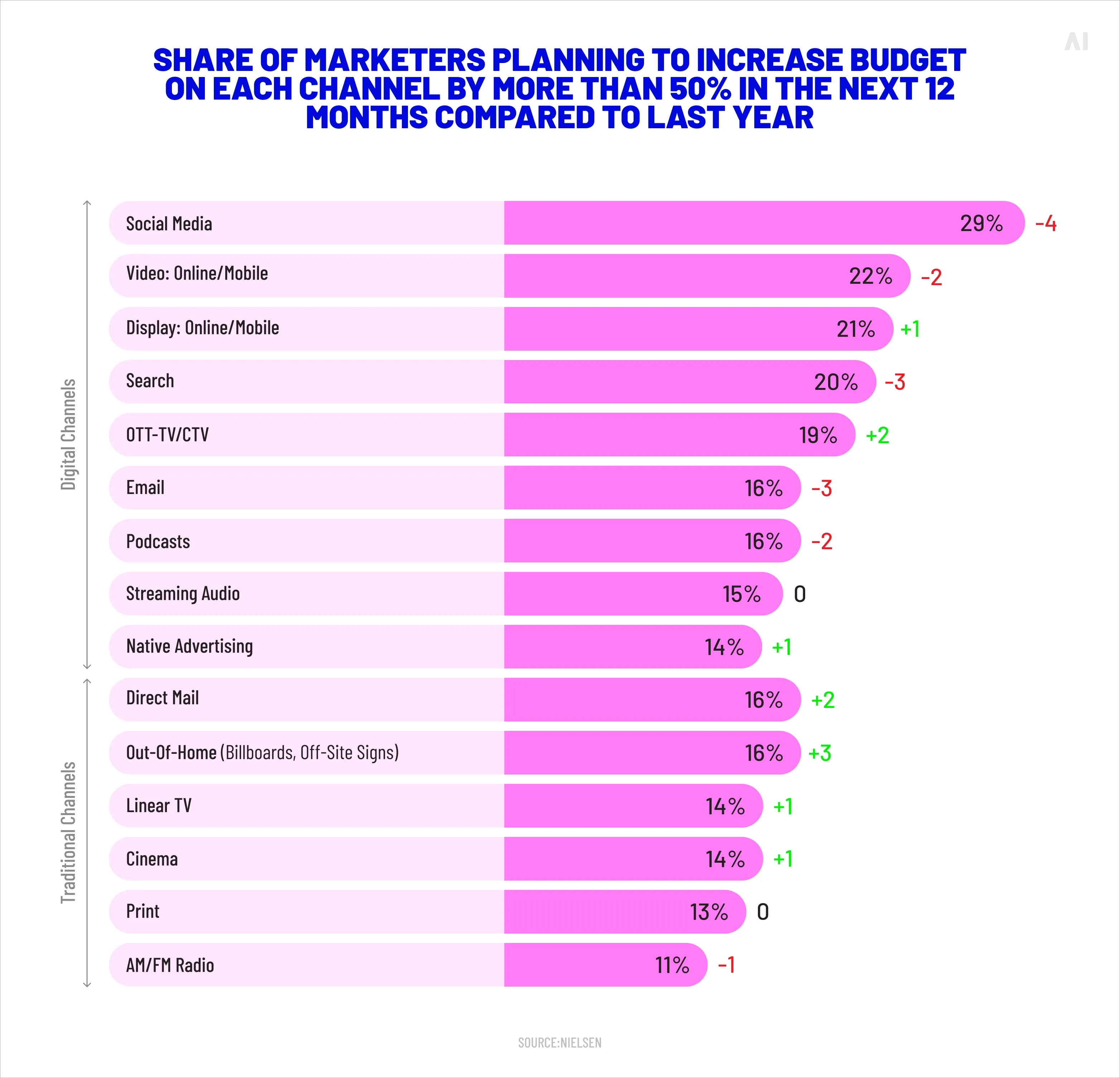
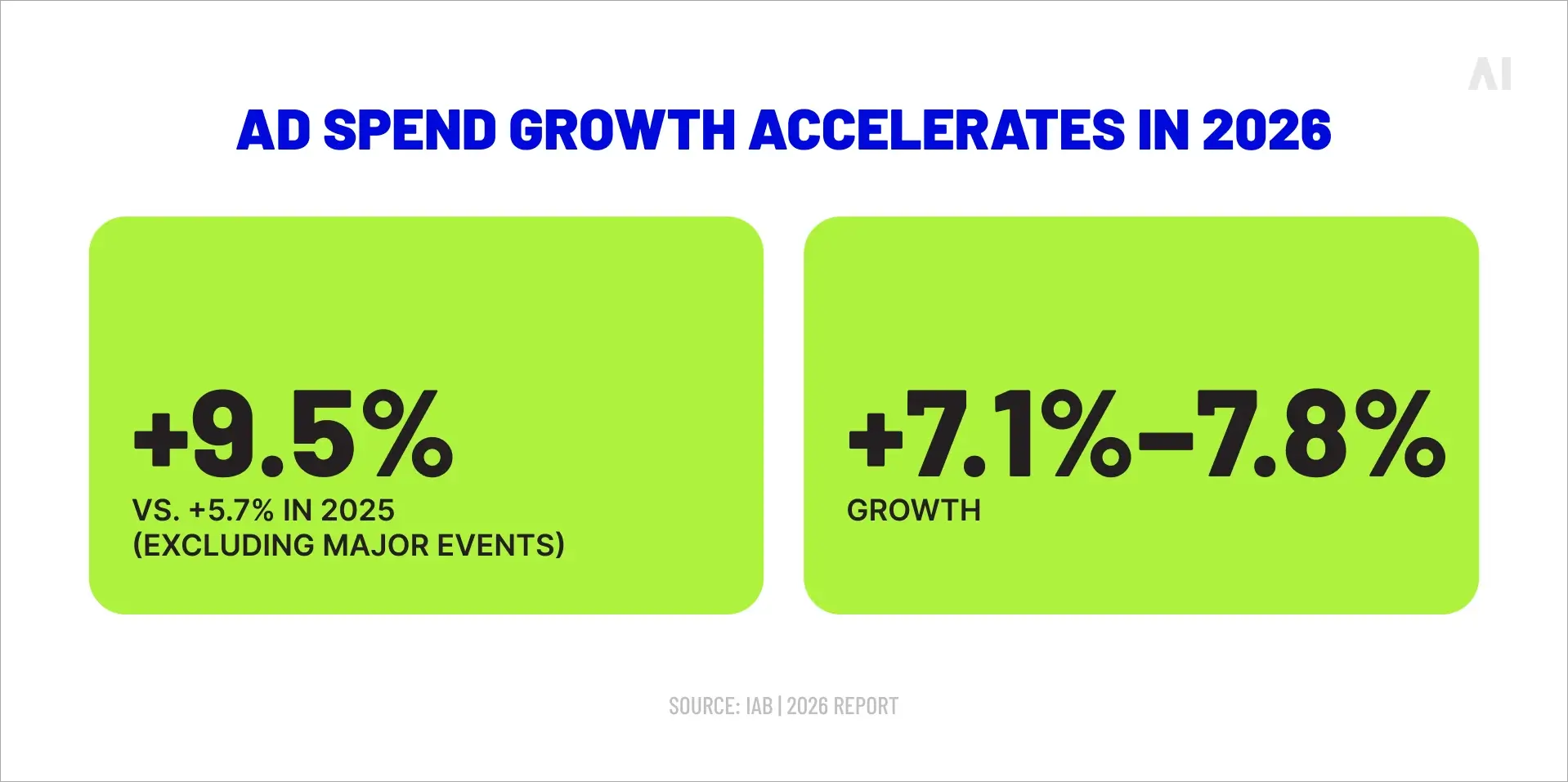
The pressure behind this decision is increasing. IAB expects total U.S. ad spend to grow 9.5% in 2026, with connected TV, commerce media, and social media all expanding at double-digit rates. As budgets spread across more channels, formats, publishers, and technology platforms, marketers must balance scale with inventory quality, audience targeting with brand control, and real-time optimization with transparency over where each media dollar goes.
That is the real distinction between direct and programmatic advertising. Direct buying gives advertisers negotiated terms, reserved inventory, predictable delivery, and closer control over the publishing environment. Programmatic advertising uses data and automation to evaluate impressions, reach defined audiences, adjust bids, and optimize campaigns across a much larger media supply. However, modern transaction types—including private marketplaces, preferred deals, and programmatic direct advertising—increasingly combine elements of both.
For CMOs and media teams, the objective is therefore not to select one universal buying model. It is to determine which transaction structure best supports each campaign’s goals, risk tolerance, inventory requirements, and measurement framework. This guide explains how programmatic advertising vs direct buying works, where each method creates value, what each truly costs, and how to combine them into a more transparent and effective hybrid media strategy.
How Programmatic and Direct Advertising Work
Every digital ad impression must pass through a buying workflow that determines who can purchase it, at what price, under which conditions, and how the campaign will be delivered and measured. In direct advertising, those decisions are established through negotiations between an advertiser and a publisher. In programmatic advertising, software evaluates and transacts inventory using predefined campaign rules, data signals, and automated decisioning.
The distinction is increasingly about transaction structure rather than inventory quality. Emarketer forecasts that programmatic will generate 96% of new global display advertising spend in 2026, yet much of that growth will come through private and direct programmatic deals rather than unrestricted open auctions.
How Direct Advertising Works
Direct advertising begins when an advertiser, agency, or media buyer contacts a publisher to reserve inventory. During the media planning and buying process, both parties negotiate factors such as:
- Ad formats, page positions, and content environments
- Campaign dates, impression volumes, and frequency
- Audience or geographic requirements
- Pricing, cancellation terms, reporting, and make-goods
The agreement is documented in an insertion order (IO), which functions as the campaign’s commercial contract. Direct inventory is commonly priced through a fixed CPM, a flat sponsorship fee, or a time-based placement such as a homepage takeover. Once the agreement is signed, creative assets are trafficked into the publisher’s ad server, where the publisher manages delivery, pacing, and reporting.
Because inventory is reserved in advance, direct buying provides predictable delivery and access to placements that publishers may not release into open auctions. It can also give advertisers access to publisher first-party audiences, custom content integrations, category exclusivity, and closer oversight of the surrounding editorial environment.
💡However, “direct” does not always mean completely manual. A programmatic IO can formalise negotiated inventory, pricing, targeting, and measurement requirements while allowing the deal to be activated through automated buying infrastructure.
How Programmatic Advertising Works
.webp)
Programmatic advertising automates the process through an interconnected technology stack. Advertisers configure budgets, audiences, bid strategies, creative assets, pacing rules, and performance goals in a demand-side platform. Publishers make impressions available through supply-side platforms, while ad exchanges connect eligible buyers and sellers.
In an auction-based transaction, the workflow typically follows five steps:
- A publisher sends information about an available impression through its SSP.
- An exchange forwards the bid request to eligible DSPs.
- Each DSP evaluates the impression and submits a bid or passes.
- The exchange selects the winning eligible bid.
- The publisher serves the winning creative and records the impression.
💡This process is governed by protocols such as IAB Tech Lab’s OpenRTB standard and can occur within milliseconds. A detailed view of DSPs, SSPs, and ad exchanges shows that each technology performs a separate buy-side, sell-side, or marketplace function.
Programmatic buying includes several transaction models:
- Open auction: multiple eligible buyers compete for each impression.
- Private marketplace: selected buyers receive access through a deal ID.
- Preferred deal: a buyer receives priority access at a negotiated price without guaranteed volume.
- Programmatic guaranteed: inventory, price, and volume are negotiated in advance, but execution is automated.
💡Therefore, real-time bidding is one form of programmatic buying—not a synonym for the entire category. Programmatic describes how media is transacted, not whether the inventory is premium, remnant, guaranteed, or available through a direct publisher relationship.
Programmatic vs Direct Advertising: Key Differences
The central difference between programmatic vs direct advertising is how media is purchased and managed. Direct buying relies on negotiated agreements with individual publishers, while programmatic buying uses technology to automate inventory access, audience selection, bidding, delivery, and optimization.
Neither method is inherently superior. The better choice depends on whether the campaign prioritizes guaranteed access and environmental control or audience reach, automation, and flexibility.
In practice, advertisers should evaluate more than the buying label. An open-auction campaign and a programmatic guaranteed deal may both be programmatic, but they offer very different levels of pricing certainty, inventory quality, and control. Similarly, a direct publisher agreement can provide premium access but may offer limited targeting or optimization once the campaign is live.
The most useful decision framework is to match the buying method to the campaign requirement:
- Choose direct advertising when placement certainty, exclusivity, publisher alignment, or guaranteed delivery is essential.
- Choose programmatic advertising when scalable targeting, rapid optimization, cross-channel execution, or flexible budget allocation matters most.
- Use a hybrid model when the campaign requires premium inventory and predictable access alongside automated activation and measurement.
This is why the modern direct vs programmatic advertising decision is less about selecting one system and more about choosing the appropriate transaction model for each objective.
When Direct Advertising Is the Better Choice
Direct advertising delivers the greatest value when placement certainty, inventory quality, and control over the advertising environment matter more than maximum scale. It is particularly effective for major launches, sponsorships, seasonal campaigns, regulated categories, and brand-building initiatives that depend on appearing in a specific publication, programme, podcast, or content environment.
Buying directly also gives advertisers a clearer relationship with the media owner. The parties can agree on inventory, positioning, timing, audience parameters, creative requirements, reporting, and remedies before the campaign begins. However, direct buying should not automatically be treated as risk-free. Advertisers still need to evaluate the publisher, content adjacency, audience suitability, and measurement methodology.
⚡️For a broader framework, read AI Digital’s forthcoming guide to Brand Safety in Advertising: Why It Matters in Programmatic and Digital Media. Teams defining acceptable rather than merely safe environments can also consult Brand Safety vs Brand Suitability in Modern Advertising.
Key Advantages of Direct Advertising
Direct agreements can provide benefits that are difficult to reproduce through unrestricted auction-based buying:
- Guaranteed inventory: Advertisers can reserve impression volumes, campaign dates, and specific placements before launch.
- Premium access: Publishers may reserve homepage takeovers, high-impact formats, newsletters, branded content, and sponsorship packages for direct partners.
- Environmental control: Buyers know which publisher and, in many cases, which section, programme, or content property will carry the advertisement.
- Predictable delivery: Fixed commitments make it easier to coordinate media exposure with launches, events, promotions, and other campaign activity.
- Custom opportunities: Direct relationships can support creative integrations, category exclusivity, co-produced content, and publisher first-party audience packages.
These benefits are especially relevant in channels where context and placement materially influence attention.
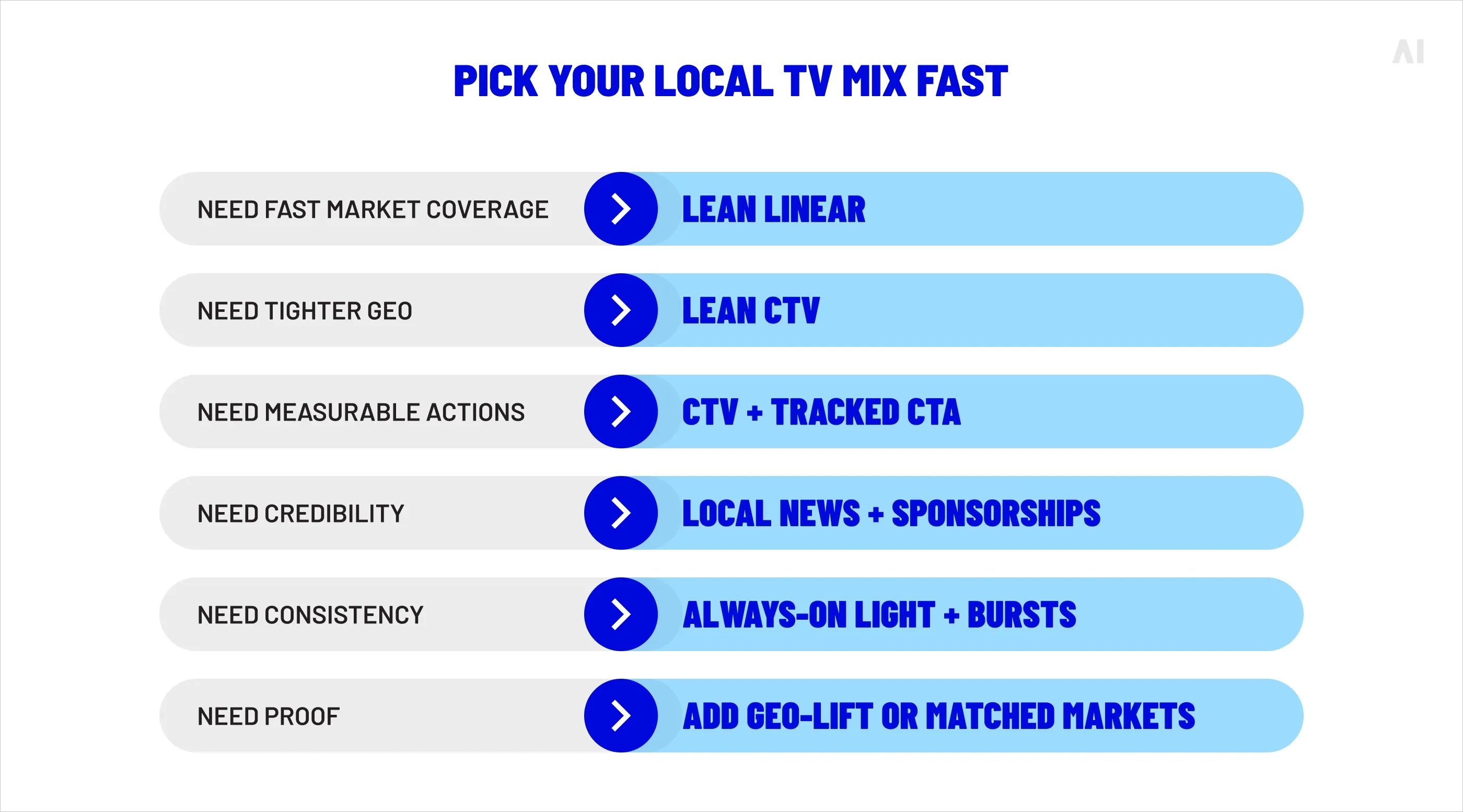
⚡️AI Digital’s analysis, Why Podcast Ads Are Becoming a Premium Media Channel, explores why publisher relationships, host alignment, and content fit can increase the strategic value of podcast inventory. Similar considerations apply to local TV advertising, where geographic relevance and trusted programming environments may justify direct commitments.
Trade-Offs of Direct Advertising
Greater control usually comes with higher operational and financial commitments. Premium direct inventory often carries higher CPMs, minimum-spend requirements, fixed flight dates, and limited cancellation flexibility. Negotiating proposals, insertion orders, creative specifications, trafficking requirements, and make-good terms also requires more coordination than activating media through a single automated platform.
Optimization can be slower once the campaign is live. Shifting spend, changing targeting, or replacing underperforming placements may require publisher approval rather than an immediate platform adjustment. Direct buying also becomes difficult to scale when teams must manage separate contracts, reporting formats, and workflows across many media owners.
Advertisers should therefore use direct buying selectively. It is most defensible when the strategic value of guaranteed access, premium context, or exclusive placement outweighs the additional cost and operational effort.
💡Where placement certainty is unnecessary, contextual advertising can offer a more scalable way to align campaigns with relevant content without negotiating every publisher relationship individually.
When Programmatic Advertising Is the Better Choice
Programmatic advertising is the stronger option when a campaign requires scalable audience access, rapid optimization, and flexible execution across multiple media owners. Instead of reserving placements publisher by publisher, advertisers define audiences, outcomes, budgets, and brand controls centrally, then evaluate available impressions against those rules. This makes programmatic effective for acquisition, retargeting, multi-market launches, and campaigns that must respond quickly to performance data.
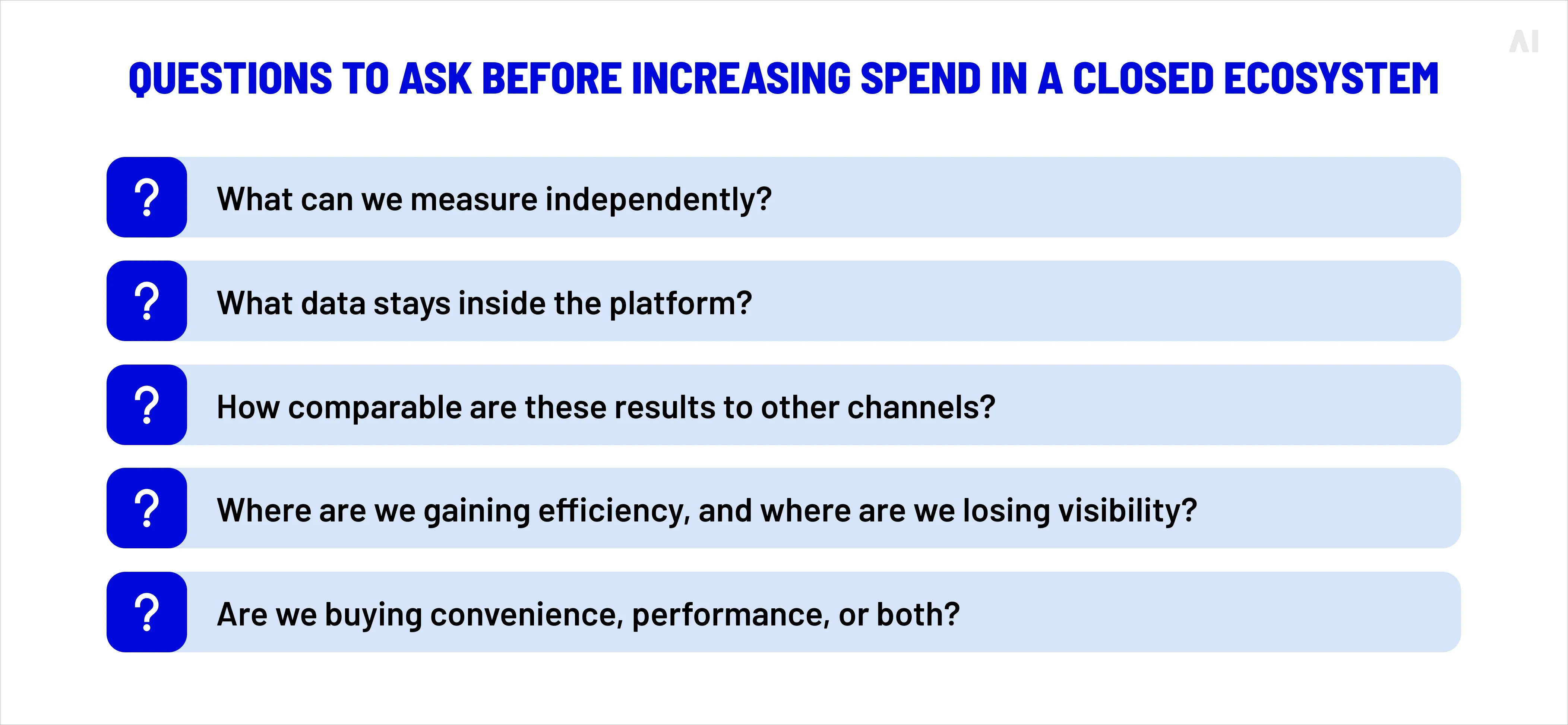
Its value still depends on where the campaign runs. Closed platforms offer proprietary data and automated delivery, but walled gardens limit how far advertisers can inspect, transfer, and compare data outside their ecosystems. Open-internet programmatic provides broader inventory access but requires stronger supply-chain and measurement governance.
Key Advantages of Programmatic Advertising
Programmatic buying shifts media planning from placement-first purchasing towards audience- and outcome-led activation:
- Precision at scale: Programmatic targeting combines first-party audiences with contextual, geographic, device, behavioural, and other permitted signals to determine which impressions merit a bid.
- Automated execution: DSPs apply campaign rules across eligible inventory without requiring separate negotiations for every publisher.
- Continuous optimization: Buyers can adjust bids, pacing, frequency, audiences, supply sources, and creative allocation as performance signals accumulate.
- First-party data activation: A data management platform, customer data platform, or clean-room workflow can make owned audience information actionable under defined governance controls.
- Context without individual identification: Programmatic contextual targeting aligns ads with relevant content using page, video, audio, and semantic signals.
Trade-Offs of Programmatic Buying
Automation does not eliminate complexity; it redistributes it across platforms, data, inventory controls, and optimization decisions. DSP, SSP, exchange, verification, data, and measurement fees can reduce the proportion of spend that reaches media owners. Multiple resellers may obscure the route between buyer and publisher, while weak brand-suitability or fraud controls create avoidable campaign risk.
💡Performance is not automatic either. Algorithms require reliable conversion signals, sufficient data volume, disciplined testing, and human oversight.
⚡️For deeper guidance, read AI Digital’s articles on Real-Time Optimization Across CTV, Programmatic, and Retail Media and AI-Powered Bidding in Modern Programmatic Advertising, which examine how marketers can use automated decisioning without surrendering strategic control.
Omnichannel Scale and Flexibility
%20.webp)
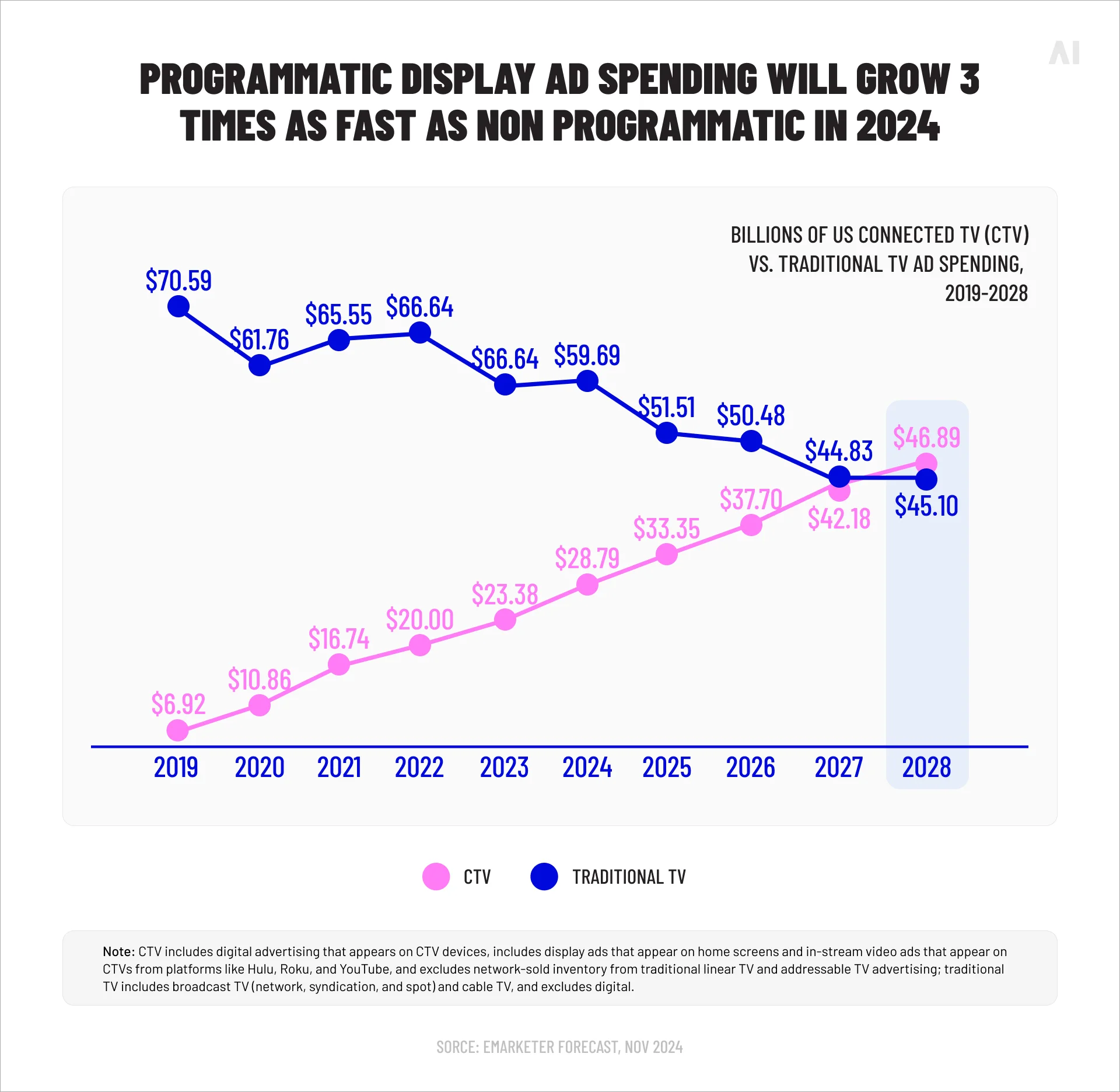
Programmatic infrastructure can extend one buying strategy across display, native, video, CTV, audio, and digital out-of-home inventory. IAB projects U.S. connected TV ad spend to grow 13.8% in 2026, reinforcing the need for cross-format activation and measurement.
Advertisers can use programmatic video advertising for sight, sound, and motion; programmatic audio advertising for streaming and podcast environments; and programmatic DOOH for location- and time-sensitive public screens.
The advantage is not merely wider reach. It is the ability to coordinate budgets, frequency, creative sequencing, and performance optimization across channels while retaining the flexibility to shift investment as audiences, inventory availability, and campaign results change.
Programmatic vs Direct Advertising Costs
A lower CPM does not automatically make a buying method more efficient. The true cost of programmatic vs direct advertising depends on inventory quality, audience precision, technology fees, campaign labor, delivery certainty, and the business results generated after the impression is served.
Direct deals commonly use fixed CPMs, flat sponsorship fees, or minimum spending commitments. Programmatic pricing may be determined through auctions or negotiated through preferred deals, private marketplaces, and guaranteed agreements. Marketers should therefore compare CPM, CPC, and CPA according to the campaign objective rather than treating CPM as a complete measure of value. The same principle applies when evaluating CPM in TV advertising, where audience quality, programme context, reach, and completion can justify a higher impression cost.
CPM Comparison Across Buying Models
Open auctions can provide efficient access to broad inventory, but prices fluctuate according to competition, targeting criteria, seasonality, format, and supply availability. PMPs usually carry higher CPMs because access is restricted and inventory is curated. Programmatic guaranteed deals typically use negotiated fixed pricing in exchange for reserved volume, while traditional direct buys may include premium placements, custom integrations, or exclusivity that cannot be evaluated through CPM alone.
💡Advertisers should compare effective CPM, which reflects the actual cost of delivered impressions, with CPA, conversion volume, incremental reach, and ROAS.
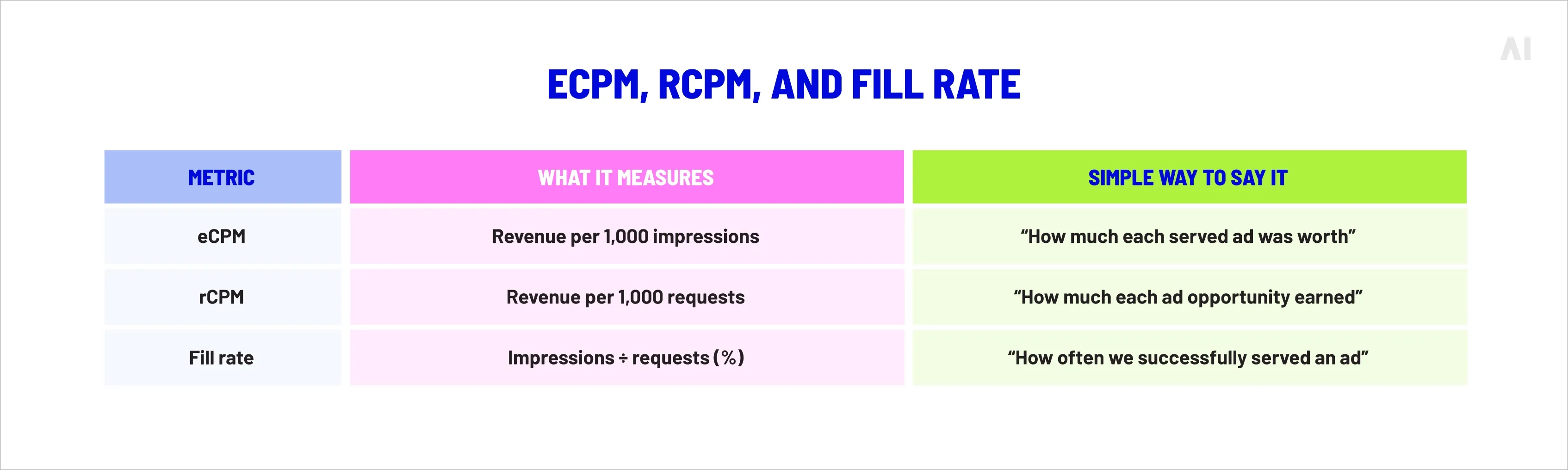
AI Digital’s guide to eCPM, rCPM, and fill rate explains how impression economics differ across buyers and publishers. Lower-priced inventory, including remnant TV advertising, can create value when it reaches the right audience, but low price alone does not establish media quality or business impact.
Hidden Costs Beyond Media Spend
Programmatic campaigns may include DSP, SSP, exchange, audience-data, identity, verification, measurement, and ad-serving fees. The digital advertising supply chain can also contain multiple intermediaries, making fee disclosure and supply-path evaluation essential.
The ANA’s Q3 2025 Programmatic Transparency Benchmark found that 47.1% of participating advertisers’ programmatic spend reached publishers, although this represented an 11-percentage-point improvement from 2023. The finding shows that buying efficiency depends not only on media price but also on how much investment survives the technology and supply-chain cost waterfall.
💡Direct buying creates a different cost structure. Advertisers may face minimum commitments, custom creative requirements, manual negotiations, publisher-specific trafficking, reconciliation, and time spent managing make-goods.
⚡️AI Digital’s new guide, What Is Ad Verification and Why It Matters in Programmatic Advertising, explains how verification costs should be evaluated against the fraud, viewability, and brand-suitability risks they help control.
Total Cost Beyond CPM
The most useful comparison is the fully loaded cost per business outcome. This includes media spend, technology, data, creative, agency or internal labor, optimization, reporting, and the cost of unused or poorly delivered inventory.
A premium direct placement may have a higher CPM but generate stronger attention, qualified reach, or brand impact. A programmatic campaign may add platform fees yet lower acquisition costs through audience selection and continuous optimization. The better investment is the model that produces the required outcome with acceptable transparency, operational effort, and risk—not simply the lowest-priced impression.
Transparency and Measurement
Transparency answers two different questions: where did the budget go, and what did it achieve? Direct advertising generally provides clearer visibility into the publisher, placement, negotiated price, and contracted delivery. Programmatic buying can produce more granular impression-level data, but that information is distributed across DSPs, SSPs, exchanges, verification providers, and publishers.
Neither model automatically creates an accurate source of truth. Publisher reports may use different definitions and delivery schedules, while platform-reported data can reflect platform-specific attribution rules. Closed ecosystems create an additional challenge because advertisers cannot always export user-level data or independently reproduce reported results. Evaluating alternatives to walled gardens can improve interoperability, but only when data governance and measurement standards are established before activation.
Supply Chain Transparency
Transparency varies significantly by programmatic deal type. Open auctions may involve several intermediaries and multiple routes to the same publisher. PMPs restrict access and can reduce supply-path complexity, while programmatic guaranteed deals usually provide the clearest combination of publisher visibility, negotiated terms, and automated execution.
The scale of the ecosystem makes active validation necessary. IAB Tech Lab’s supply-chain datasets cover more than eight million publisher ads.txt records and over 13,000 sellers.json files. Its sellers.json and OpenRTB SupplyChain standards help buyers identify direct sellers, intermediaries, and every entity involved in reselling a bid request.
Advertisers can improve visibility through:
- Supply Path Optimization: SPO prioritizes efficient, authorized routes to inventory and removes duplicative or low-value intermediaries.
- Working-media analysis: Teams measure how much spending reaches publishers and generates usable impressions after technology and transaction costs.
- Log-level data: Impression-level records allow buyers to reconcile bids, fees, sellers, placements, and outcomes.
- Supply-chain audits: Regular reviews verify contracts, reseller relationships, fee disclosures, ads.txt authorization, and data completeness.
- Sustainability controls: A sustainable programmatic supply path can reduce unnecessary auction activity alongside financial waste.
ANA’s Q3 2025 benchmark found that PMPs represented 81.6% of participating advertisers’ programmatic spending, while half of participants had direct supplier contracts. This indicates a broader shift toward curated supply and closer accountability.
Measurement Differences Between Programmatic and Direct
Comparing results is difficult when each buying method uses different reporting standards. A publisher may report delivered impressions, clicks, or completed views weekly, while a DSP reports near-real-time results using its own attribution and conversion methodology.
Common inconsistencies include:
- Viewability and invalid-traffic treatment
- Click-through versus view-through attribution
- Conversion-window length
- Time zones and reporting cadence
- Cross-device identity resolution
- Deduplication across publishers and platforms
💡A strong cross-platform measurement governance framework defines these rules centrally. MRC standards also provide audit criteria and guidance covering impressions, viewability, invalid traffic, attention, digital video, CTV, and cross-media measurement.
Unified Reporting for Better Budget Decisions
Cross-platform measurement should normalize direct and programmatic data into one reporting framework. This requires common campaign taxonomies, metric definitions, attribution windows, currency rules, and quality thresholds.
Unified reporting enables marketers to compare effective reach, frequency, viewability, conversions, CPA, ROAS, and incremental outcomes across buying models. It also exposes duplication and inconsistent platform claims, helping teams shift budgets according to business performance rather than isolated dashboard results.
💡The goal is not merely to collect every available metric. It is to create one governed source of truth that makes direct and programmatic investment genuinely comparable.
Myths About Programmatic and Direct Advertising
Misconceptions about programmatic vs direct advertising can cause marketers to choose a buying method based on outdated assumptions rather than campaign goals. In practice, cost, inventory quality, brand safety, and performance depend on the deal structure, technology, controls, and measurement framework.
- Myth: Programmatic inventory is always low quality.
Reality: Programmatic is a method of buying media, not a category of inventory. Advertisers can access open-auction supply, private marketplaces, preferred deals, and programmatic guaranteed placements. Premium publishers may make the same high-quality inventory available through both direct and automated deals.
- Myth: Direct advertising is always brand-safe.
Reality: Direct buying provides stronger visibility into the publisher and placement, but it does not remove every brand risk. Content may change, unsuitable topics may appear nearby, and user-generated content can create unexpected adjacency. Brand safety and suitability controls remain necessary across both models.
- Myth: Programmatic advertising is always cheaper.
Reality: Open-auction CPMs may appear lower, but DSP fees, data costs, verification services, and inefficient supply paths can increase the total cost. A higher-priced direct placement may generate better attention, stronger context, or more qualified reach.
- Myth: Direct buying always delivers better performance.
Reality: Direct placements can support awareness, credibility, and premium brand exposure, but they may provide limited optimization after launch. Programmatic campaigns can improve results through automated bidding, audience targeting, creative testing, and real-time budget reallocation.
- Myth: Automation removes the need for human expertise.
Reality: Programmatic platforms automate transactions, not strategy. Media teams must still define campaign goals, evaluate inventory, establish brand controls, assess data quality, interpret performance, and intervene when algorithms optimize toward the wrong outcome.
- Myth: Marketers must choose one buying method.
Reality: Many effective campaigns combine direct placements with PMPs, programmatic guaranteed deals, and open-auction buying. This allows advertisers to balance premium access and predictable delivery with targeting, flexibility, and scale.
Neither direct nor programmatic advertising automatically guarantees lower costs, safer placements, or stronger ROI. Those outcomes depend on deal quality, campaign governance, optimization, and measurement discipline.
Direct vs Programmatic by Industry
The right balance between direct and programmatic advertising varies by sector. Industries with long consideration cycles, strict compliance requirements, or a strong dependence on premium environments often retain a larger role for direct buying.
Sectors driven by frequent purchases, dynamic audiences, and measurable conversions typically rely more heavily on programmatic activation. Retail marketers must also account for the growing role of retail media networks, which combine commerce data, high-intent audiences, and advertising inventory across retailer-owned and external channels.
No industry should treat one buying method as universally superior. A luxury brand may use direct deals for a flagship launch while applying curated programmatic buying to extend reach among qualified audiences. A retailer may depend on programmatic optimization for everyday sales but reserve premium direct inventory for major seasonal moments.
The most effective direct vs programmatic advertising mix reflects the industry’s customer journey, regulatory exposure, inventory requirements, data availability, and measurement capabilities. Buying decisions should follow the business objective—not a fixed preference for manual or automated media.
Hybrid Strategy: Combining Programmatic and Direct
The strongest media plans rarely treat programmatic and direct advertising as mutually exclusive choices. Instead, advertisers can assign each buying method to the objectives, audiences, inventory, and measurement requirements it handles best.
Direct deals can secure premium environments and predictable delivery, while programmatic buying adds scalable targeting, flexible budget allocation, and continuous optimization. A hybrid strategy connects these strengths within one media plan rather than forcing every campaign through the same transaction model.
This approach should be supported by clear data standards and decision rules.
⚡️AI Digital’s guide to Creating a Data-Driven Marketing Strategy explains how marketers can use audience, media, and performance data to guide these allocation decisions.
Match Buying Method to Campaign Goals
The buying method should follow the campaign requirement:
- Use direct advertising when the campaign depends on a specific publisher, programme, placement, sponsorship, or launch date.
- Use programmatic guaranteed when inventory and volume must be reserved but the advertiser also wants automated trafficking, targeting, and reporting.
- Use PMPs or preferred deals when buyers need curated publisher access without committing to the rigid structure of a traditional direct agreement.
- Use open-auction programmatic when scalable reach, audience targeting, rapid testing, and performance optimization are the priorities.
For example, a brand may purchase a direct homepage takeover to establish visibility during a launch, then use programmatic video, display, or CTV to extend reach among relevant audience segments. The two investments serve different functions but contribute to the same campaign objective.
Allocate Budget Across the Marketing Funnel
A hybrid approach can also align buying models with different stages of the customer journey.
- Awareness: Direct sponsorships, premium publisher placements, and programmatic guaranteed deals provide broad visibility, predictable reach, and controlled brand environments.
- Consideration: PMPs combine stronger inventory quality with audience targeting, contextual relevance, and frequency management.
- Conversion: Open-auction programmatic supports retargeting, bid optimization, creative testing, and rapid budget reallocation based on performance.
- Retention: First-party data can activate existing customer segments across programmatic channels while direct partnerships support loyalty content and premium brand experiences.
The correct allocation also depends on the balance between brand marketing and performance marketing. Brand activity should not be judged only by last-click conversions, while performance campaigns require tighter control over CPA, ROAS, and incremental revenue.
💡Marketers can use mixed media modeling to assess how direct and programmatic investments contribute to overall outcomes. A marketing intelligence platform can then consolidate those findings with campaign-level data to support faster budget decisions.
Sequential tactics can connect funnel stages. For instance, CTV retargeting can re-engage audiences exposed to premium awareness campaigns with more targeted follow-up messaging.
When a Hybrid Buying Strategy Delivers More Value
A hybrid strategy is especially valuable when advertisers need to balance premium access, targeting precision, operational efficiency, and unified measurement.
Programmatic guaranteed and programmatic direct deals sit between traditional IO-based buying and open auctions. They allow advertisers to negotiate pricing, inventory, and delivery terms with publishers while using programmatic infrastructure for activation and reporting.
This structure is particularly useful in channels such as programmatic TV advertising, where premium content and audience targeting must work together. The same applies to CTV media buying, which may combine direct broadcaster agreements, curated marketplaces, and auction-based reach extension.
⚡️AI Digital’s guide, Programmatic Direct vs Programmatic Guaranteed: What’s the Difference?, examines how these deal types differ in inventory reservation, pricing, buyer commitment, and execution.
The objective is not to divide budgets evenly between direct and programmatic buying. It is to select the transaction model that delivers the required level of control, reach, flexibility, and accountability at each stage of the campaign.
How AI Digital Enables Hybrid Media Buying
A hybrid strategy becomes difficult when direct and programmatic campaigns operate through separate platforms, creative workflows, contracts, and reporting systems. AI Digital addresses that operating problem through a connected model spanning inventory access, supply-path intelligence, creative production, and cross-channel measurement. The aim is not to force enterprise marketers into one buying method, but to preserve flexibility while applying common standards for transparency, optimisation, and business performance.
Premium Programmatic Without Walled Garden Dependency
The Open Garden Framework gives marketers a vendor-neutral structure for connecting data, inventory, technology, and outcomes across the open digital ecosystem. It works across DSPs, SSPs, and data partners, allowing buyers to select the most appropriate technology and supply route instead of relying on the inventory, identity system, and measurement rules of a single platform.
For hybrid buying, this creates a practical middle ground. Advertisers can access curated programmatic inventory across CTV, audio, display, and native while retaining direct-buying advantages such as selected publishers, negotiated Deal IDs, premium environments, and controlled access. AI Digital positions the framework as DSP-agnostic, with Smart Supply operating as its curated PMP and supply-intelligence layer.
The objective is not to eliminate every walled garden from the media plan. It is to prevent one platform from becoming the only source of audience access, optimisation, and performance truth.
⚡️For more context, see AI Digital’s guides to the open internet and walled gardens vs the open internet.
Supply Chain Transparency with Smart Supply
Smart Supply applies supply-path optimisation before and during delivery. Rather than depending only on default DSP supply settings, AI Digital builds KPI-specific Deal IDs, accesses premium SSP supply, filters traffic quality, and adjusts deals in flight according to performance.
It is designed to reduce:
- Duplicated or inefficient routes to publisher inventory
- Hidden mark-ups and unnecessary intermediaries
- Fraudulent, invalid, low-viewability, or unsuitable traffic
- DSP or SSP bias that can distort inventory selection
- Limited visibility into placements, pricing, traffic sources, and performance
⚡️AI Digital states that Smart Supply provides direct SSP access covering 99.9% of top-tier supply sources, DSP-agnostic execution, and impression-level visibility. This gives marketers stronger inputs for optimisation, working-media analysis, fee reconciliation, and supply audits. Our new guide to Vertical Integration in the Advertising Supply Chain examines how ownership structures and commercial incentives can influence these paths.
Creative at Scale Across Both Channels
Hybrid buying increases creative complexity. Direct sponsorships may require bespoke rich media or CTV overlays, while programmatic campaigns need multiple audience, placement, language, and format variations.
AI Creative Studio combines three capability layers:
- Traditional and interactive design: Art direction, static banners, HTML5 units, rich media, motion assets, QR-enabled CTV overlays, and channel-specific adaptations.
- AI-generated production: Cinematic video, AI-generated UGC, motion graphics, voiceovers, audio production, and static-to-video conversion.
- Creative intelligence: Rapid prototyping, synthetic audience feedback, asset tagging, dynamic resizing, bulk versioning, and pre-launch evaluation.
💡Human creative oversight protects brand discipline while AI accelerates adaptation and iteration. One concept can be converted into numerous placement-ready versions without treating every size, channel, or audience as a separate production project. AI Digital also positions its Synthetic Focus Group as a way to evaluate likely consumer responses before creative reaches the market.
This production model supports dynamic creative optimisation, where creative elements can be adapted to audiences and performance signals, as well as more immersive direct or programmatic executions using rich media ads.
Unified Cross-Channel Reporting
Elevate connects audience research, media planning, optimisation, reporting, and AI-assisted analysis within one intelligence platform. AI Digital reports that Elevate draws on more than 8,000 analysed campaigns, 150 billion monthly data points, over 10,000 audience attributes, and integrations with more than 12 DSPs.
For hybrid buying, its value lies in normalisation. Direct publisher reports and programmatic data can be brought into consistent campaign taxonomies, KPI definitions, attribution rules, and business outcomes. Elevate combines advanced reporting with path-to-conversion analysis and marketing mix modelling, helping teams compare channels without relying exclusively on seller-controlled platform reporting.
💡This unified view enables marketers to assess reach, frequency, spend, ROAS, conversions, and marginal performance across buying models, then reallocate budgets using comparable evidence.
⚡️AI Digital’s new guides to Unified Marketing Measurement: Why Attribution Alone No Longer Works and Marketing Measurement vs Attribution vs MMM: What’s the Difference? explain why attribution, incrementality testing, and MMM should operate as complementary methods rather than competing answers.
Together, Open Garden, Smart Supply, AI Creative Studio, and Elevate make hybrid media buying operational: inventory can be accessed without platform lock-in, supply paths can be audited and optimised, creative can scale across placements, and direct and programmatic performance can be evaluated through a shared measurement framework.
Programmatic vs Direct Is Not a Binary Choice
The programmatic vs direct advertising decision should not be framed as a choice between automation and control. Both methods can create value when they are matched to the right campaign requirement.
Three factors should guide the allocation:
- Campaign objective: Direct buying is often better suited to premium awareness, sponsorships, and guaranteed launches, while programmatic supports scalable reach, targeting, retargeting, and continuous optimization.
- Required inventory quality: Direct deals provide certainty around publishers, placements, and delivery. PMPs and programmatic guaranteed agreements can offer similar quality with more automated execution.
- Measurement requirements: Programmatic may provide granular delivery data, while direct campaigns can offer clearer placement visibility. Both require consistent attribution, reporting, and governance to make performance comparable.
The distinction between the two models will continue to narrow. Programmatic direct, preferred deals, PMPs, and programmatic guaranteed transactions already combine negotiated publisher access with automated activation, targeting, and reporting.
For enterprise marketers, the goal is not to move every budget into one buying model. It is to build a portfolio in which each transaction type delivers the appropriate balance of reach, control, efficiency, transparency, and measurable business impact.
⚡️AI Digital helps marketers design and operate this type of hybrid media strategy across inventory, supply, creative, and measurement. Get in touch with AI Digital to identify where direct, programmatic, or combined buying can create the greatest value for your campaigns.